Author's Note: A deep dive into the latest intelligence on Claude Opus 4.7 discovered in the Google Vertex AI backend. Combining exclusive leaks from The Information and recent source code disclosures, we analyze the release timeline and core capabilities of Anthropic's next-generation flagship model.
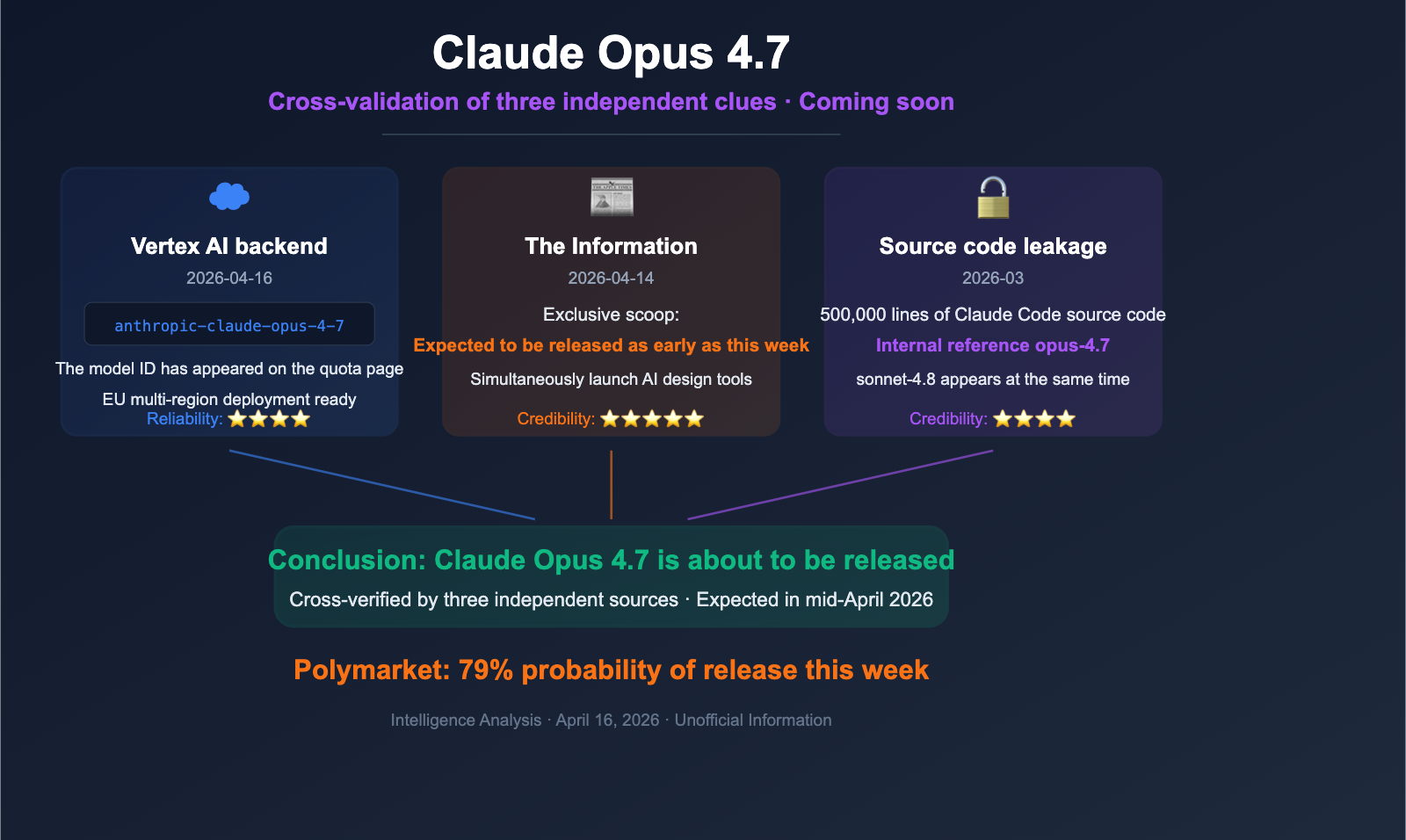
On April 16, 2026, a user spotted an unreleased model ID in the quota management page of the Google Vertex AI console: base_model: anthropic-claude-opus-4-7. This clue aligns with an exclusive report from The Information on April 14, suggesting that Anthropic is preparing to launch Claude Opus 4.7 as early as this week.
Core Value: This article aggregates three independent intelligence sources to help you understand the release timeline for Claude Opus 4.7, potential capability upgrades, and its relationship with the Mythos model.
Key Intelligence Points for Claude Opus 4.7
| Intelligence Source | Date | Key Information | Confidence |
|---|---|---|---|
| Vertex AI Backend | 2026-04-16 | anthropic-claude-opus-4-7 model ID appeared |
⭐⭐⭐⭐ High |
| The Information Report | 2026-04-14 | Opus 4.7 + AI design tool "launching this week" | ⭐⭐⭐⭐⭐ Very High |
| Claude Code Source Leak | 2026-03 | Internal code references Opus 4.7 and Sonnet 4.8 | ⭐⭐⭐⭐ High |
| Polymarket Prediction | 2026-04-15 | 79% probability of release before April 16 | ⭐⭐⭐ Reference |
Intelligence 1: Model ID Spotted in Vertex AI Backend
On April 16, 2026, users discovered the following configuration in the Google Vertex AI quota management page:
Vertex AI API
EU multi-region online prediction input tokens per minute per base model
base_model: anthropic-claude-opus-4-7
This discovery is significant because Vertex AI is Google Cloud's enterprise-grade AI platform, where Anthropic's Claude models are served to enterprise clients. Seeing a model ID in the quota management page typically implies:
- The model is deployed to infrastructure: It's not just a concept; it's a functional model.
- Quota system is configured: Billing and rate-limiting mechanisms are ready.
- EU multi-region deployment: It's already deployed across multiple regions in the EU, meeting enterprise service standards.
Historically, Claude Opus 4.6 was also spotted in the backends of Vertex AI and AWS Bedrock before its official release. This "cloud platform pre-deployment" pattern has become a common signal for Anthropic's new model launches.
Intelligence 2: Exclusive Report from The Information
On the evening of April 14, 2026, The Information (one of the most authoritative investigative media outlets in tech, known for accurate reporting on OpenAI, Google, and Meta) published an exclusive report:
Anthropic is preparing to release Claude Opus 4.7 and an AI design tool based on natural language, arriving as soon as this week.
The report cited "people familiar with the matter," with key highlights including:
- Claude Opus 4.7: Anthropic's next-generation flagship model.
- AI Design Tool: Capable of generating websites, presentations, landing pages, and product prototypes via natural language descriptions.
- Release Timeline: "As soon as this week."
The report directly impacted the capital markets—shares of Figma, Adobe, Wix, and GoDaddy fell 2-4% on April 14, with analysts attributing the decline to the competitive pressure posed by Anthropic's upcoming design tool.
Intelligence 3: Internal References in Leaked Claude Code
In March 2026, an npm package configuration error led to over 500,000 lines of Claude Code source code being briefly exposed. Within the leaked code, security researchers discovered a list of forbidden version strings for "Undercover Mode":
// Internal references to future model versions
- opus-4.7
- sonnet-4.8
- mythos
- capybara (new model tier)
These internal code references indicate that:
- Opus 4.7 has clear planning within Anthropic.
- Sonnet 4.8 is also in development, likely as a follow-up release after Opus 4.7.
- Mythos is an independent, higher-tier model family.
- Capybara is a new model tier positioned above Opus.
Claude Opus 4.7 Capability Prediction Analysis
Anthropic Model Release Patterns
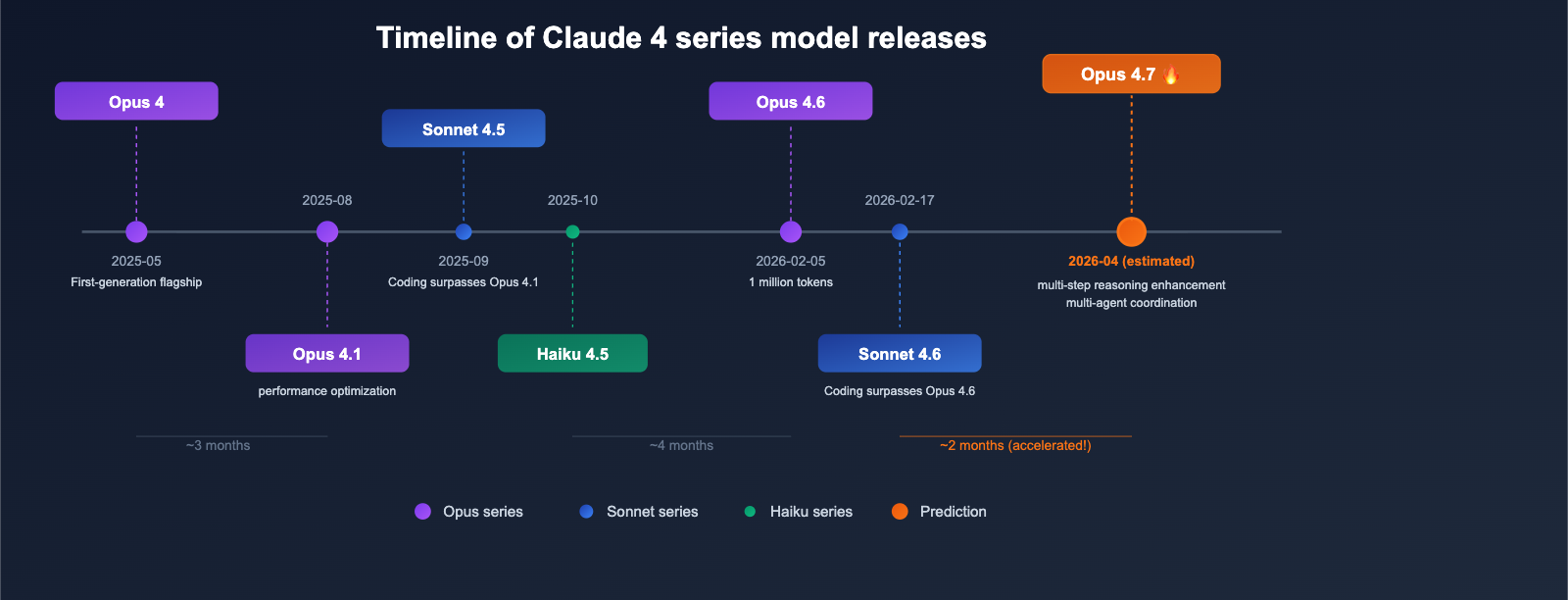
Looking back at Anthropic's release history, a clear iterative pattern emerges:
| Model | Release Date | Interval | Key Improvements |
|---|---|---|---|
| Opus 4 | 2025-05-22 | — | First Claude 4 flagship |
| Opus 4.1 | 2025-08 | ~3 months | Performance optimization |
| Sonnet 4.5 | 2025-09 | ~1 month | Coding ability surpasses Opus 4.1 |
| Haiku 4.5 | 2025-10 | ~1 month | Lightweight update |
| Opus 4.6 | 2026-02-05 | ~4 months | 1M token context window |
| Sonnet 4.6 | 2026-02-17 | ~12 days | Coding benchmarks surpass previous Opus |
| Opus 4.7 | 2026-04 (Est.) | ~2 months | TBD |
Two patterns are worth noting:
- Opus leads, Sonnet follows: Anthropic typically releases the Opus flagship first, followed by the corresponding Sonnet version within 1-4 weeks. If Opus 4.7 drops this week, Sonnet 4.8 could arrive in May.
- Accelerating release cadence: The interval from Opus 4.1 to 4.6 was about 6 months, but the gap from 4.6 to 4.7 is likely only about 2 months, showing that Anthropic is speeding up its iteration cycle.
Potential Key Improvements for Claude Opus 4.7
Based on current intelligence and the known limitations of Opus 4.6, Opus 4.7 is likely to see improvements in the following areas:
Multi-step Reasoning and Autonomous Task Execution
Multiple media reports indicate that Opus 4.7 has been optimized for multi-step reasoning and autonomous long-task execution. This aligns with Anthropic's ongoing investment in Claude Code and the agentic space.
Enhanced Coding Capabilities
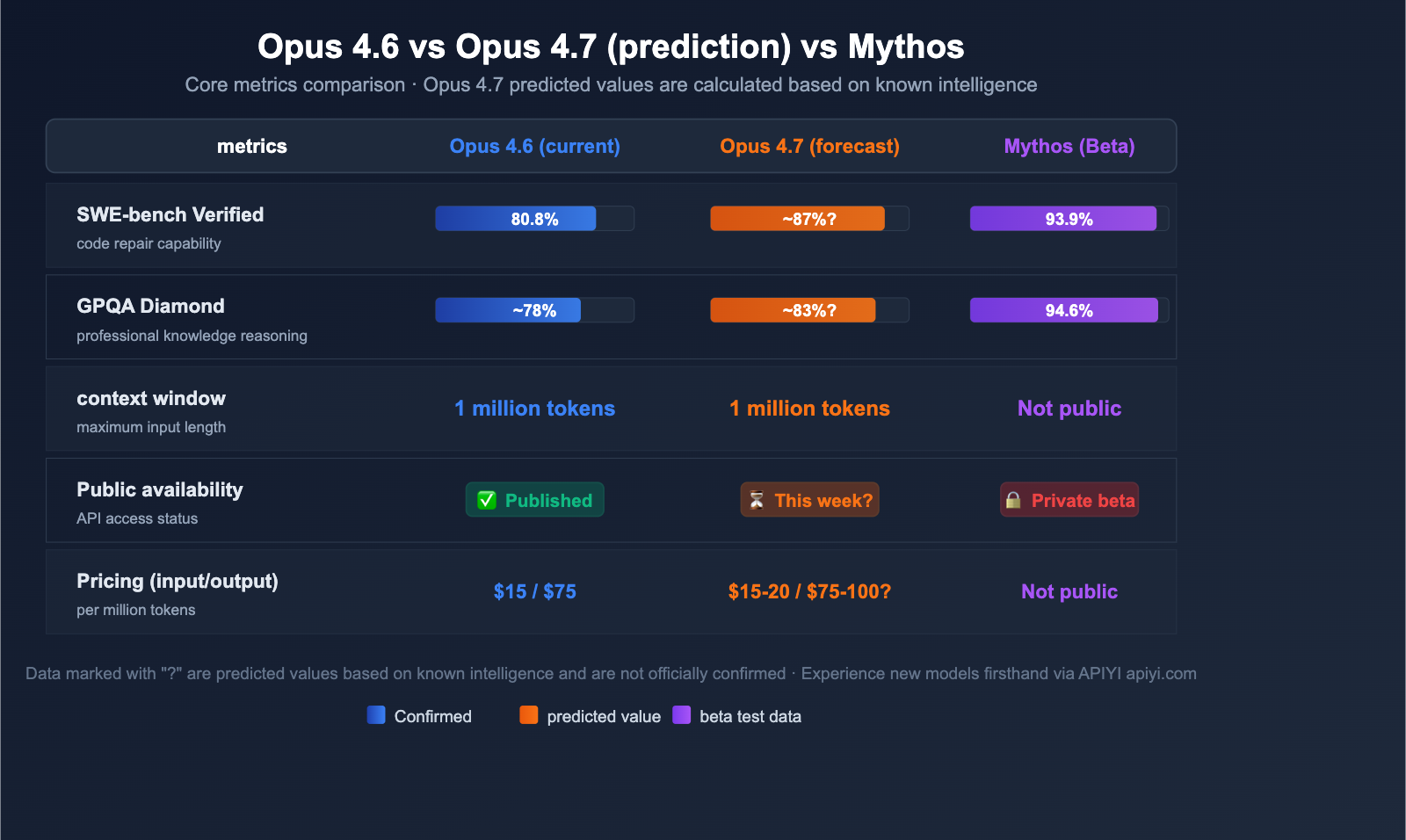
Opus 4.6 scored 80.8% on SWE-bench Verified. For reference, Anthropic's internal Mythos Preview has already reached 93.9%. Opus 4.7's score is expected to fall between these two, potentially reaching the 85-90% range.
Multi-agent Coordination
Anthropic has been pushing hard on the multi-agent collaboration capabilities of their Agent SDK and Claude Code. Opus 4.7 may natively support better multi-agent coordination at the model level.
Context Window
Opus 4.6 already supports a 1 million token context window. Opus 4.7 is expected to maintain this spec, but likely with improved retrieval accuracy and reasoning performance over long contexts.
Relationship Between Opus 4.7 and Mythos
It's important to distinguish between these two concepts:
| Comparison Dimension | Claude Opus 4.7 | Claude Mythos |
|---|---|---|
| Positioning | Incremental update to Claude 4.x | New model family, positioned above Opus |
| Status | Upcoming public release | Early internal testing only |
| Performance | Expected SWE-bench 85-90% | Tested at SWE-bench 93.9% |
| Availability | Will be available via API, Vertex AI, Bedrock | No public API, no pricing, no release date |
| Safety | Standard safety evaluation | Release delayed by Anthropic due to high cyber capabilities |
In short, Opus 4.7 is the commercial flagship model you'll be able to use very soon, while Mythos is the "super model" that Anthropic is still evaluating with caution.
🎯 Recommendation: Once Opus 4.7 is released, the APIYI (apiyi.com) platform is expected to integrate it immediately. Keep an eye on the platform's model updates, as you'll be able to quickly experience the new model's performance boost through a unified interface.
New Products Released Alongside Claude Opus 4.7
AI Design Tool
According to a report by The Information, an AI design tool was mentioned alongside the release of Opus 4.7:
- Features: Generates websites, presentations, landing pages, and product prototypes using natural language descriptions.
- Interaction: Driven entirely by natural language, eliminating the need for complex, Figma-style vector editing.
- Market Impact: Directly challenges design and website-building platforms like Figma, Adobe, and Wix.
This signals Anthropic's shift from a "model provider" to a "full-stack AI platform," moving beyond just offering API access to delivering complete, end-to-end product experiences for users.
Claude Code Unified Interface
A source code leak also revealed 44 feature flags, including:
- Background Agents: AI agents that operate autonomously in the background.
- Voice Mode: A dedicated mode for voice interaction.
- Unified Interface: Integrating the capabilities of Claude Code into a more user-friendly interface.
💡 Developer Tip: For developers using Claude via API, the release of Opus 4.7 marks another leap in model performance. We recommend accessing the API through the APIYI (apiyi.com) platform. The platform supports unified interface calls for various Claude models, allowing you to switch seamlessly as soon as new models are released.
The Impact of Claude Opus 4.7 on Developers
API Pricing Forecast
| Model | Input Price (per million tokens) | Output Price (per million tokens) | Context Window |
|---|---|---|---|
| Opus 4.6 (Current) | $15 | $75 | 1M |
| Opus 4.7 (Forecast) | $15-20 | $75-100 | 1M |
| Sonnet 4.6 (Current) | $3 | $15 | 200K |
| Sonnet 4.8 (Forecast) | $3-5 | $15-25 | TBD |
The pricing for Opus 4.7 is expected to remain on par with or see a slight increase over Opus 4.6. Looking at Anthropic's previous pricing strategies, incremental updates within the same model generation typically don't involve drastic price hikes.
Migration Advice
For developers currently using Opus 4.6:
- API Compatibility: The API interfaces within the same Claude Opus series are highly compatible, making migration costs extremely low.
- Prompt Compatibility: Prompts written for Opus 4.6 can generally be used directly with Opus 4.7.
- Phased Rollout: We recommend testing Opus 4.7 in a non-production environment first to verify performance before switching over your production traffic.
🚀 Get Started Quickly: Once Opus 4.7 is released, you can quickly integrate and test it via the APIYI (apiyi.com) platform. The platform provides a unified API interface format, allowing you to switch models by changing just a single parameter, making it easy to compare performance differences between versions.
FAQ
Q1: When will Claude Opus 4.7 be officially released?
According to a report by The Information on April 14, Opus 4.7 is expected to be released as early as "this week" (between April 14-18, 2026). As of April 15, the Polymarket prediction market gave a 79% probability that Opus 4.7 would be released by April 16. The appearance of the model ID in the Vertex AI backend further confirms that a release is imminent. However, the final timing is subject to Anthropic's official announcement.
Q2: What’s the difference between Opus 4.7 and Mythos, and which one should I wait for?
There's no need to wait for Mythos. Opus 4.7 is an upcoming commercial model that will be available to all users via API. Mythos, on the other hand, is a "super model" still in internal testing; its release was intentionally delayed by Anthropic due to its powerful cybersecurity capabilities. Currently, there is no public API, no pricing, and no release date for it. We recommend focusing on Opus 4.7, which you can access and experience as soon as it drops via APIYI (apiyi.com).
Q3: Will Sonnet 4.8 follow after the release of Opus 4.7?
Based on Anthropic's historical release patterns, Sonnet versions typically follow Opus within 1-4 weeks. Internal references to Sonnet 4.8 have already appeared in leaked Claude Code source code, indicating the model is already in development. We expect Sonnet 4.8 to potentially launch in May 2026.
Q4: Should I keep using Opus 4.6 or wait for 4.7?
We recommend continuing your current work with Opus 4.6; there's no need to pause. The API interface for Opus 4.7 is expected to be highly compatible with 4.6, so the switching cost will be very low once it's released. If you are using a multi-model platform like APIYI (apiyi.com), switching is as simple as updating the model parameter, with no other code changes required.
Summary
Key insights on Claude Opus 4.7:
- Cross-Verified Intelligence: Three independent threads—Vertex AI backend model IDs, an exclusive report from The Information, and internal references found in leaked source code—all point to the imminent release of Opus 4.7.
- Imminent Launch: It could drop as early as this week (April 14–18, 2026), with deployment preparations already completed on Vertex AI.
- Incremental Upgrade: Opus 4.7 is an incremental update to the Claude 4.x series, with expected improvements in multi-step reasoning, coding, and multi-agent orchestration.
- Distinct from Mythos: Opus 4.7 is a commercial flagship for all users, whereas Mythos remains in the internal testing phase.
- Sonnet 4.8 Likely to Follow: Its existence has been confirmed via source code leaks, with a projected release 1–4 weeks after Opus 4.7.
For developers, the migration cost for Opus 4.7 is minimal, making it well worth testing as soon as it drops.
We recommend using APIYI (apiyi.com) to quickly integrate the latest Claude models. The platform provides a unified API interface, allowing you to switch models seamlessly as soon as they go live.
📚 References
-
Original Report from The Information: Anthropic prepares to release Opus 4.7 and AI design tools
- Link:
theinformation.com - Note: The earliest authoritative leak, citing sources familiar with Anthropic.
- Link:
-
Claude Code Source Code Leak Analysis: Internal references to Opus 4.7, Sonnet 4.8, and Mythos
- Link:
medium.com/@mfierce0 - Note: A detailed analysis of model version information found within 500,000 lines of leaked source code.
- Link:
-
Official Anthropic Model Documentation: Claude model overview and version information
- Link:
platform.claude.com/docs/en/about-claude/models/overview - Note: Official model list and capability specifications.
- Link:
-
Claude Mythos Preview Analysis: Capiara leak and Mythos capability interpretation
- Link:
mejba.me/blog/claude-opus-4-7-capiara-leak-analysis - Note: Technical analysis regarding the relationship between Opus 4.7 and Mythos.
- Link:
-
Polymarket Prediction Market: Probability of Claude 4.7 release timing
- Link:
polymarket.com/event/claude-4pt7-released-by - Note: Market-based probability assessment for the Opus 4.7 release date.
- Link:
Author: APIYI Technical Team
Technical Discussion: Stay tuned for the latest updates on Claude models. Feel free to share your expectations for Opus 4.7 in the comments. For more AI model news, visit the APIYI documentation center at docs.apiyi.com.