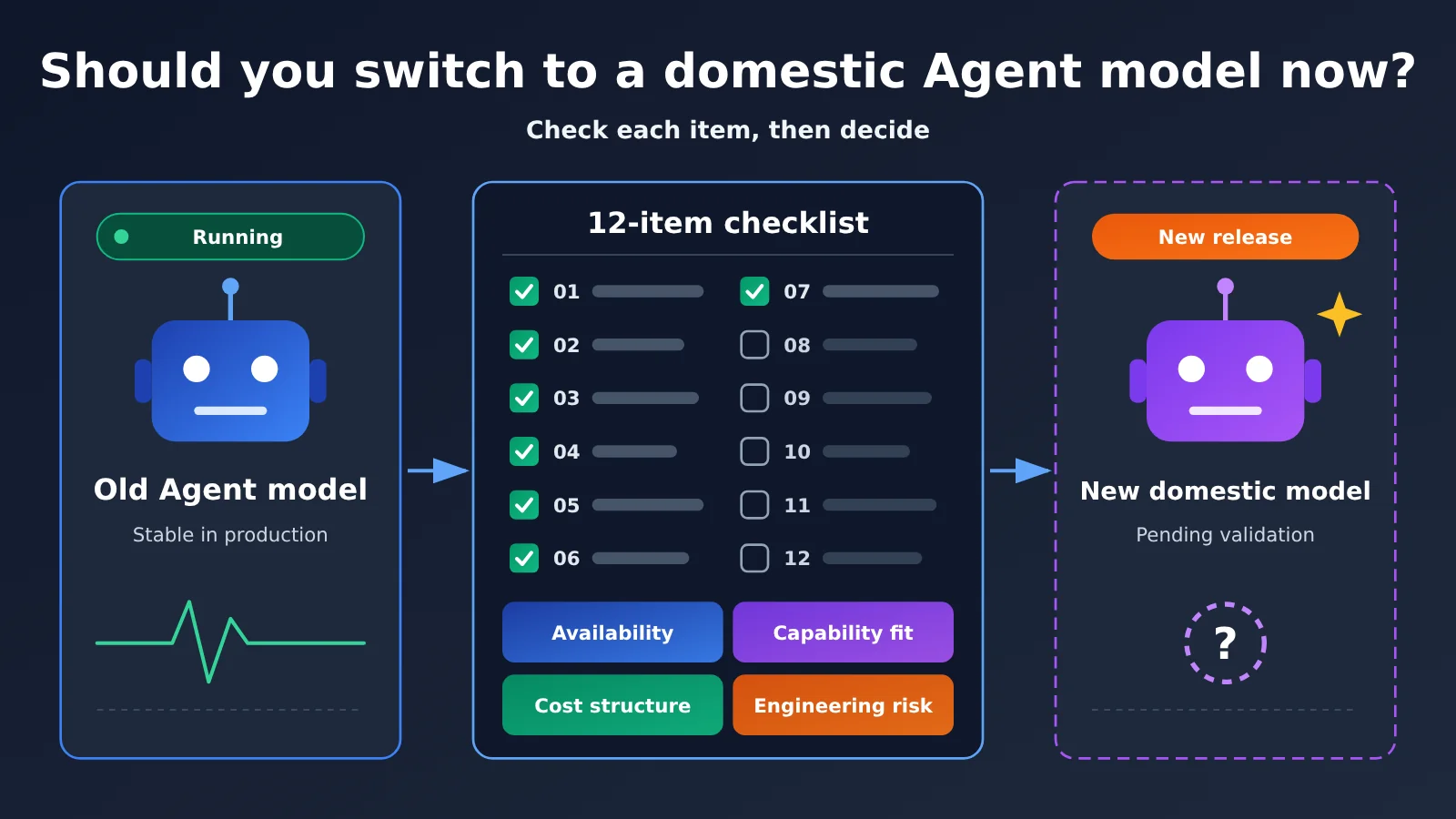
Author’s note: Using LongCat-2.5 and Tencent Hunyuan Hy4 as examples, here’s a 12-item checklist across 4 dimensions to help you decide whether a newly released domestic Agent model is worth switching to right away.
In the first week of November 2026, domestic Large Language Models launched another dense wave of releases: Meituan released LongCat-2.5 on November 2, aimed at long-horizon agentic tasks, and Tencent Hunyuan released the official version of Hy4 on November 4. Both emphasize Agent programming, visual understanding, and long context, and the community discussion of “should we switch right now?” followed close behind. This article provides a tick-off checklist for switching domestic Agent models, item by item, to help you balance keeping up with new models against keeping production stable.
This isn’t a bandwagon piece about “the new model being the strongest.” We only use information the vendors have publicly disclosed and don’t repeat third-party benchmarks. The core idea behind the checklist is simple: whether a new model is worth switching to depends on your tasks, your cost structure, and your ability to roll back — not on the marketing claims from a launch event.
Core value: After reading this article, you’ll have a 12-item checklist for switching domestic Agent models and know how to use a canary rollout to validate the switch with low risk in 1–2 weeks. If you need to compare multiple domestic models at the same time, APIYI offers a unified API entry point compatible with the OpenAI and Anthropic API formats, which can significantly reduce switching costs.
Key Points of the Domestic Agent Model Switching Checklist
Before you start, let’s use a table to understand how the whole checklist is put together. We’ve grouped the 12 check items into 4 dimensions, and each dimension answers one key question.
| Dimension | Question It Answers | Typical Check Items | Value to You |
|---|---|---|---|
| Availability | Can I call it reliably right now? | Access channels, API format, context and output length | Avoids “shipped but unusable” |
| Capability Fit | Is it actually better on my tasks? | Your own test set, tool calling, multimodal, long-horizon tasks | Use real tasks instead of marketing benchmarks |
| Cost Structure | How will the bill change after switching? | Billing units, cache hits, limited-time pricing, failed-request billing | Prevents costs from spiraling after launch |
| Engineering Risk | Can I roll back fast if something breaks? | Canary percentage, rollback switch, rate limits, compliance | Protects production stability |
Why You Shouldn’t Just Switch on Release Day
Early in a new model’s release cycle, the API docs, rate-limit policies, and pricing are often still in flux. Take LongCat-2.5: the official pricing page labels it a “limited-time price” and says the platform-displayed price and actual bill are authoritative. The Hy4 GA release also didn’t disclose its parameter count this time — some specs come from OpenRouter’s listing. All of this means the conditions you see today may not be the conditions a month from now.
On the other hand, the vendors’ own statements are a reminder to stay measured. In its Hy4 announcement, Tencent explicitly states that Hy4 still lags significantly behind top closed-source models, especially on hard tests like frontier math, long-horizon development, and visual question answering. It’s good that a vendor is willing to be public about its shortcomings, but it also tells you that “new” doesn’t mean “stronger across the board” — you need to verify with your own tasks.
What’s Actually New in These Domestic Agent Models
This round of domestic Agent model upgrades is remarkably uniform in direction: native multimodality, long context, tool calling, and compatibility with coding agent tooling. LongCat-2.5 focuses on combining visual understanding with agentic coding, targeting visual programming, creative design, and 3D tasks. The Hy4 GA release adds vision and computer-use capabilities for the first time, letting you mix command-line and GUI operations. If your business happens to be stuck on “I need to look at an image and then write code” or “I need to operate specialized software,” the new models are worth evaluating first. If your scenario is pure text Q&A, the older models may already be enough.
Public Specs for Two Newly Released Domestic Agent Models
To make this list concrete, let’s start by pulling the public information on both new models into a table. The details below come from vendor announcements and the listing pages of the platforms that host them, verified between November 3 and 4, 2026.
| Item | LongCat-2.5 (Meituan) | Hy4 Official Release (Tencent Hunyuan) |
|---|---|---|
| Release date | November 2, 2026 (Preview version: September 25) | November 4, 2026 (preview version: August 28) |
| Parameter count | 1.6T total parameters, ~48B activated per token | Not disclosed for the official release; the preview was a MoE with 770B total parameters and 49B activated |
| Input modalities | Text and images (natively multimodal) | Text and images (first time the official release supports vision) |
| Context window / max output | 1M tokens / 256K tokens | 1,048,576 tokens / 65,536 tokens (per OpenRouter listing) |
| API formats | OpenAI Chat Completions, Responses, Anthropic Messages | Supports tool calling, structured output, reasoning effort settings (per OpenRouter) |
| Open weights | Not yet released as of November 3 | The official release is planned to be open-sourced; currently only the preview version is available under Apache 2.0 |
| Officially highlighted capabilities | Visual coding, long-horizon agents, compatibility with Claude Code / Codex / Hermes | Vision and computer use, front-end and game development, financial and office tasks |
A few details in the table are worth calling out. LongCat-2.5’s official site states that the entire training run was done on domestically produced chips — a plus for teams with localization requirements. Tencent also plans to launch a Hy4 flash edition soon, positioned around cost-effectiveness and inference speed. If latency and cost matter more to you, “wait for the flash version” is a legitimate option to keep on your list.
On pricing, both vendors publish standard rates across three tiers — input, cached input, and output — but new model prices shift frequently, so we won’t list specific numbers here. If you call them through APIYI, all pricing, billing rules, input/output unit prices, and cache prices are subject to the actual data on the APIYI pricing page at docs.apiyi.com/models.
The 12-Item Checklist for Switching to a Domestic Agent Model
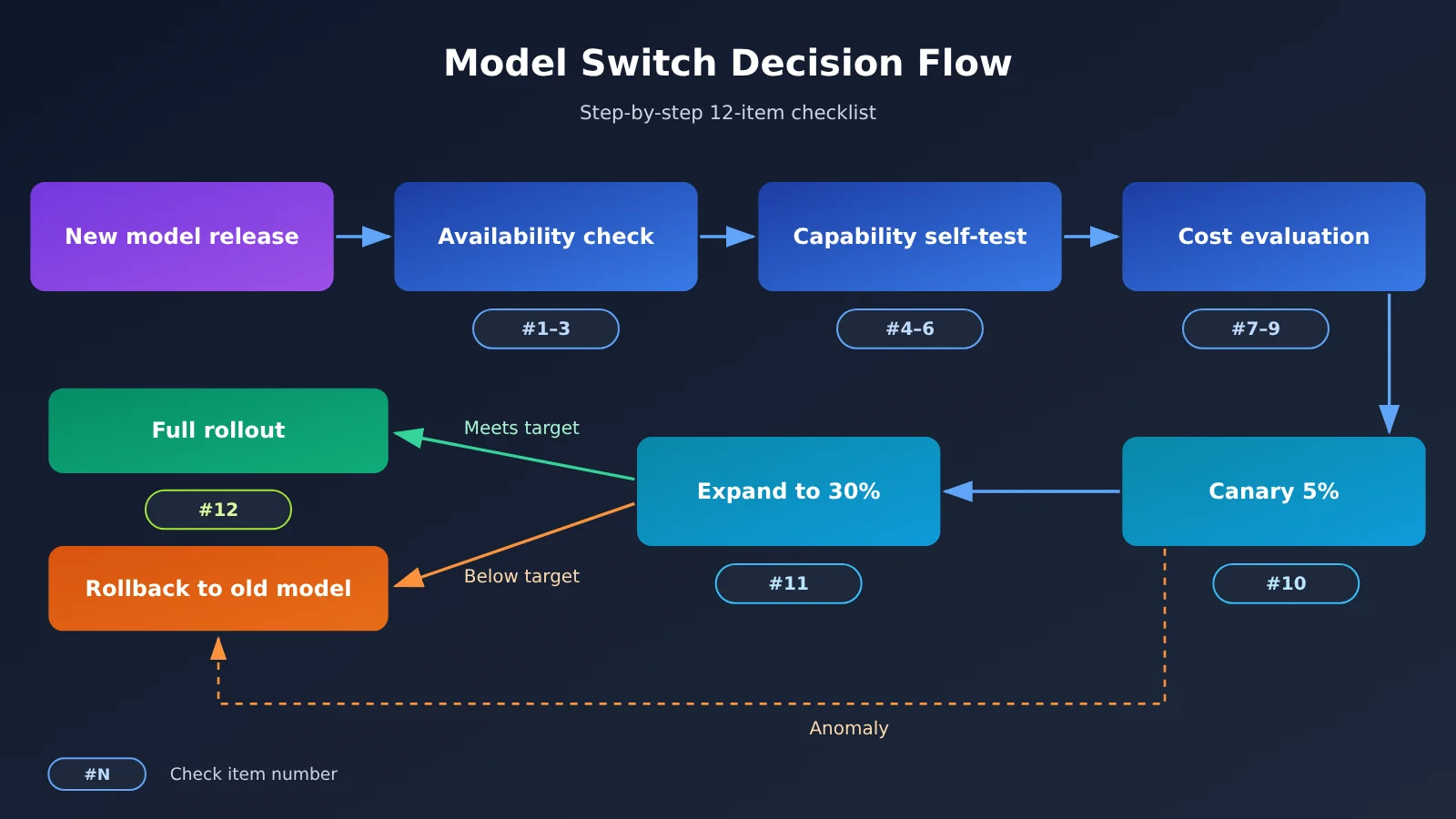
Here’s the full checklist. I’d suggest dropping it into your team’s docs and giving every item one of three statuses: “pass / fail / to be confirmed.” Only when everything is marked pass across the first two dimensions should you move on to the cost and engineering evaluation.
| No. | Check Item | Pass Criteria | Suggestion If It Fails |
|---|---|---|---|
| 1 | Is the access channel stable? | At least one formal channel you can sign a contract with and get an invoice from | Stick with your current model and watch for another 2 weeks |
| 2 | Is the API format compatible? | Matches the format your existing SDK or agent tooling already uses | Estimate the cost of building an adaptation layer |
| 3 | Context and output length | Covers at least 1.5× your longest task | Keep the old model around for ultra-long tasks |
| 4 | Performance on your own test set | No worse than the old model across 30 to 100 real tasks | Switch only in the sub-scenarios where it wins |
| 5 | Tool-calling stability | The function-call format error rate is acceptable | Add parameter validation and retries |
| 6 | Multimodal / long-horizon capability | Clear improvement on vision or multi-step tasks | Don’t pay for capabilities you won’t actually use |
| 7 | Is the pricing structure clear? | Input, cache, and output unit prices are clearly documented and easy to look up | Go by the platform bill and run a small test first |
| 8 | Cache hit strategy | Fixed prefixes like the system prompt actually hit the cache | Restructure your prompt |
| 9 | Promotional pricing and resource packs | You know exactly when the discount ends and what the restored price will be | Recalculate costs at the restored price |
| 10 | Billing for failed requests | You know which errors don’t get billed | Set up monitoring on error codes |
| 11 | Canary rollout and rollback | You can split traffic by percentage and switch back with one click | Build the routing layer first, then switch |
| 12 | Data and compliance | Meets cross-border data transfer and log retention requirements | Pick a compliant channel, or go with private deployment |
Availability and Capability Fit: How to Check the First 6 Items
Items 1 through 3 can be done in half a day. Take LongCat-2.5 as an example: it offers both OpenAI-compatible and Anthropic-compatible Base URLs, and the official docs include Claude Code setup instructions. That means item 2 is nearly zero cost for most teams. Hy4 is a little different. Tencent’s announcement notes that before you connect coding tools like Claude Code or Codex, you should first confirm that the endpoint you’re using supports the corresponding API format.
Items 4 through 6 are the most important part of the whole checklist. Don’t just look at vendor benchmark numbers. For example, Tencent says Hy4 improves by 19.1% and 9.8% over preview on GameDev and GameLogic, respectively. That’s progress relative to its own previous version, and it doesn’t directly prove that it’s better than other models for your business. The right approach is to pull 30 to 100 representative real tasks from production logs, keep the prompts fixed, run both the old and new models, and then score the results manually or with rules.
Cost and Engineering Risk: How to Check the Last 6 Items
Items 7 through 10 determine whether your bill stays manageable after switching. Besides pay-as-you-go, the LongCat platform also offers token packs valid for 30 days, and states that cache hits don’t deduct from the pack quota and failed requests such as HTTP 401, 403, 429, and 500 aren’t billed. These rules matter a lot for high-concurrency agent scenarios, because agents repeatedly send long system prompts, and cache hit rate often determines the real cost.
Items 11 and 12 are where many teams drop the ball. If your code hardcodes the model name and Base URL in a dozen or so places, any switch becomes a high-risk release. I’d suggest first consolidating model invocation into a routing layer that supports percentage-based traffic splitting and one-click rollback, and only then discussing “whether to switch.”
🎯 Technical tip: When doing the self-test for item 4, the biggest effort is often signing up for an account and adapting the API for each model separately. APIYI provides API access to the mainstream Chinese models covered in this article, compatible with both OpenAI and Anthropic API formats. With the same code, you can compare them side by side by changing only the model parameter. For the exact models that are currently available, refer to docs.apiyi.com.
Quick Start: Gradual Rollout for Domestic Agent Models
Checklist done. Now it’s time to put it into practice. The rest of this section walks through the gradual rollout process using configuration only — no concrete code — so you can map it onto your own stack.
Step 1: Unify the Access Configuration
Whichever channel you use, the OpenAI-compatible format usually needs just three settings: Base URL, API key, and model name. For the Anthropic-compatible format, taking Claude Code as an example, LongCat’s official instructions say to set ANTHROPIC_BASE_URL, ANTHROPIC_AUTH_TOKEN, and the model name in the Claude config file settings.json in your home directory. Turning these three values into environment variables rather than hardcoding them in business logic is a prerequisite for everything that follows.
| Config item | OpenAI-compatible format | Anthropic-compatible format | Notes |
|---|---|---|---|
| Endpoint | Base URL points to the /v1 path | ANTHROPIC_BASE_URL |
Follow the docs of the platform you choose |
| Auth | Authorization header carrying a Bearer key |
ANTHROPIC_AUTH_TOKEN |
Store the key in a secrets management service |
| Model | model field in the request body |
Model name in the config file | Configure one variable each for the old and new models |
| Available platforms | APIYI apiyi.com, vendor official API | APIYI apiyi.com, vendor official API | Platform model availability is subject to the model page |
If you go through APIYI, use the Base URL and model names documented at docs.apiyi.com. A single key can switch between multiple models, which makes A/B routing at the routing layer easy.
Step 2: Small-Traffic Canary
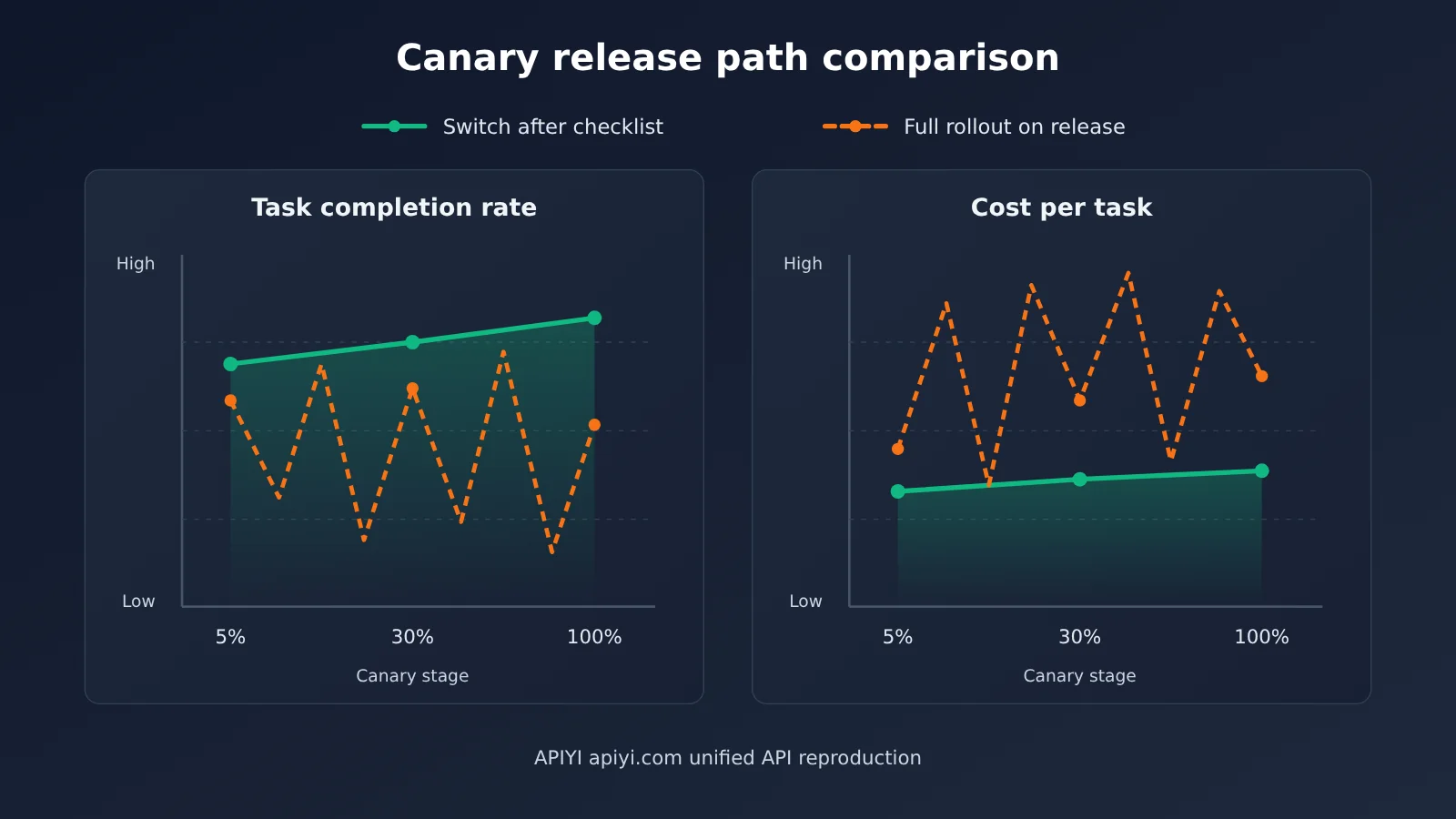
We recommend moving in three stages — “5% → 30% → 100%” — and observing for at least 2 to 3 days at each stage. Metrics to watch include task completion rate, tool-call format error rate, average response latency, token consumption per task, and user feedback. If any one of them degrades noticeably, shift traffic back to the old model immediately, then dig into the cause.
Pay special attention to error codes during the canary period. Early in a new model’s life, 429 rate limits and 500 errors tend to be more common than with mature models, so configure automatic retries and fallback-to-the-old-model logic at the routing layer. Also record which failed requests were billed and which weren’t, and cross-check that against item 10.
Step 3: Full Rollout and Keeping a Fallback
After switching over completely, don’t delete the old model config right away — keep a rollback path for at least 2 weeks. Newly released models may see version updates, price adjustments, or even model name changes in their first few weeks, so having a fallback lets you handle those calmly.
🚀 Quick start: If you want to build a prototype of steps 1 and 2 in a single afternoon, sign up at APIYI apiyi.com to get a key, configure the OpenAI- or Anthropic-compatible endpoint following the setup instructions at docs.apiyi.com, and mount both the old and new models on your routing layer to start comparing.
Domestic Agent Model Switching Recommendations by Team
The checklist is generic, but the conclusions vary by team. The decision table below maps common team types to recommended actions so you can quickly find where you fit.
| Team type | Primary needs | Recommended action | Key checklist items to watch |
|---|---|---|---|
| Individual developers / independent projects | Early experimentation, cost-effectiveness | Try it as soon as possible, but keep the old model | Items 7 and 9 (limited-time pricing and restored pricing) |
| Heavy coding-agent users | Long-horizon tasks, code quality | Self-test with a real codebase before switching | Items 3, 4, and 5 |
| Vision / 3D / design businesses | Multimodal understanding | Evaluate the new models first | Item 6 |
| Enterprise production systems | Stability, compliance, auditability | Observe for at least 2–4 weeks before a canary rollout | Items 1, 11, and 12 |
| Teams with domestic-substitution or private-deployment requirements | Self-reliance and control | Track progress on open weights | Item 12 and the open-source timeline |
For teams that need private deployment, open weights are a hard prerequisite. As of publication, LongCat-2.5 has not yet released its weights, and the official Hy4 version is still in the “planned open source” stage; the version currently available for download is Hy4-preview. At this stage, a more sensible approach for these teams is to use the API to validate capabilities first, then evaluate the cost of self-hosted inference after the weights are released.
Existing mature domestic models are also important benchmarks. Models such as Kimi K3.1 Pro, DeepSeek V4 Pro, Qwen3.8 Max, and GLM-5.3 are already widely used in coding-agent scenarios. New models’ self-test results should be compared against them as a control group, not just against the older version you were using a few months ago.
💡 Selection tip: Which model to choose depends on your task type and quality requirements. We recommend running the new model and existing mature models on the same self-test set. APIYI supports unified API access to multiple mainstream domestic models, making it easy to compare and switch quickly. Billing is based on the pricing page at docs.apiyi.com/models.
Frequently Asked Questions (FAQ)
Q1: What is the “domestic Agent model switchover checklist”?
It’s a checklist you run after a new model is released but before you actually replace your production model. It covers 12 items across 4 dimensions: availability, capability fit, cost structure, and engineering risk. The point isn’t to stop you from trying new things — it’s to turn “switching on a hunch” into “switching with evidence, through a gradual rollout.”
Q2: What’s the difference between LongCat-2.5 and the Hy4 official release?
LongCat-2.5 puts more emphasis on long-horizon agentic coding and visual programming, with a maximum output of 256K tokens, and it ships with both OpenAI- and Anthropic-compatible interfaces. The Hy4 official release supports vision and computer operation for the first time, with targeted optimizations for game engine adaptation and finance/office tasks, and it plans to open-source its weights. Neither one can replace your own task-level testing.
Q3: When were these two domestic Agent models released?
LongCat-2.5 was released on November 2, 2026, after a Preview version launched on September 25. The Hy4 official release came out on November 4, 2026, while Hy4 preview launched on August 28 and was open-sourced under the Apache 2.0 license.
Q4: Which scenarios are most worth migrating to the new models first?
Mainly these categories:
– **Code from screenshots**: generating front-end pages from design mockups or screenshots, or generating 3D scene scripts from diagrams.
– **Professional software operation**: automation tasks that need to drive both the command line and a GUI, such as Blender or CAD workflows.
– **Ultra-long-context agents**: tasks that need to read in a large codebase or a long document at once, then reason through multiple steps.
Q5: How can I quickly compare multiple domestic Agent models via API?
A unified interface platform that supports multiple models is the way to go:
1. Sign up at APIYI (apiyi.com) and get an API Key;
2. Check the integration guide at docs.apiyi.com and configure the Base URL in OpenAI- or Anthropic-compatible format;
3. Using the same self-test set, swap the `model` parameter one at a time and record completion rate, latency, and token consumption.
APIYI is compatible with both mainstream interface formats, so tools like Claude Code and Codex can connect directly — no per-tool adaptation work needed.
Q6: How do I verify new model pricing, and what should I watch for with limited-time prices?
First confirm whether billing distinguishes three tiers — input, cached input, and output — then confirm the discount deadline and the restored price. LongCat labels its pricing as limited-time, while Tencent says actual charges follow the console. When calling through APIYI, all unit prices and cache prices follow the actual data on the docs.apiyi.com/models pricing page. We recommend a small top-up and one round of self-testing before estimating monthly cost.
Q7: What known limitations do the new versions of domestic Agent models have?
First, incomplete specs: for example, the Hy4 official release hasn’t published its parameter count, and some specs come from third-party listing pages. Second, delayed weight releases: neither new model’s official version can be self-hosted right now. Third, vendor self-evaluations have their limits — Tencent itself acknowledges that Hy4 still has a notable gap versus top closed-source models on high-difficulty tasks. When you run into these limitations, keeping the old model as a fallback is the safest approach.
Key Takeaways for Switching Between Domestic Agent Models
- Don’t chase launch-day hype: Specs, pricing, and rate limits for a new model can all shift in its early days — watch first, switch later.
- Your own test set beats benchmark scores: Compare old and new models on 30 to 100 real tasks; vendor benchmarks are just a reference.
- Cost comes down to four factors: Input price, cached-input price, output price, and when the promotional rate ends — you need all four.
- Build the routing layer before you switch: Put model names and Base URLs in environment variables so you can split traffic by percentage and roll back with one click.
- Roll out in three canary stages: Ramp up 5% → 30% → 100%, watching each stage for 2 to 3 days.
- For private deployment, check the weights: LongCat-2.5 hasn’t released its weights, and Hy4’s official version is planned as open source — for now, validate through the API.
- A single gateway cuts cost: With APIYI’s endpoints that are compatible with both OpenAI and Anthropic formats, one codebase can compare multiple models.
Conclusion
Should you switch to a newly released domestic Agent model right away? The answer is usually “test soon, switch carefully.” Here are the core points of this article:
- Replace gut feeling with a checklist: The 12 checks cover availability, capability, cost, and engineering risk — settle the first two dimensions before discussing the last two.
- Let real tasks do the talking: LongCat-2.5 and Hy4 both have clear capability highlights, but only your own test set can prove whether they fit your needs.
- Control risk with canary rollouts: A routing layer, traffic split ratios, and a fallback path are the foundation of any model switch.
Turn this checklist into a standard team process, and the next time a new model launches, you’ll be able to deliver a data-backed conclusion within a week or two instead of going back and forth in endless discussions.
To validate results quickly, we recommend APIYI at apiyi.com: the platform provides API access to the mainstream domestic models covered in this article, with interfaces compatible with both OpenAI and Anthropic formats. See docs.apiyi.com for integration docs, and check docs.apiyi.com/models for current pricing.
📚 References
- LongCat API Open Platform: Interface, pricing, and Claude Code configuration docs for LongCat-2.5
- Link:
longcat.chat -
Notes: Check the model name, OpenAI- and Anthropic-compatible endpoints, and resource pack rules
-
OpenRouter – Hy4 Model Page: Context length, output length, and tool-calling details for the Hy4 official release
- Link:
openrouter.ai/tencent/hy4 -
Notes: Fills in specs that weren’t listed in Tencent’s announcement
-
Hugging Face – Hy4-preview Model Card: Parameter scale and open-source license for Hy4 preview
- Link:
huggingface.co -
Notes: Learn about the preview architecture and follow progress on open-sourcing the official weights
-
APIYI Documentation Center and Pricing Page: Unified multi-model access docs and real-time billing data
- Link:
docs.apiyi.comanddocs.apiyi.com/models - Notes: See how to connect, which models are live, and pricing as determined by the platform
Author: APIYI Technical Team
Technical discussion: Feel free to reach out on the APIYI apiyi.com homepage to share your experience with switching models. For more integration resources, visit the docs.apiyi.com documentation center.