
Author’s note: As of 2026-11-13, DeepSeek V4.1 Pro has not been released. This article checks the code repository, the official pricing page, the changelog, and the APIYI model master list to help you tell rumor from reality—and pick the right model ID you can use today.
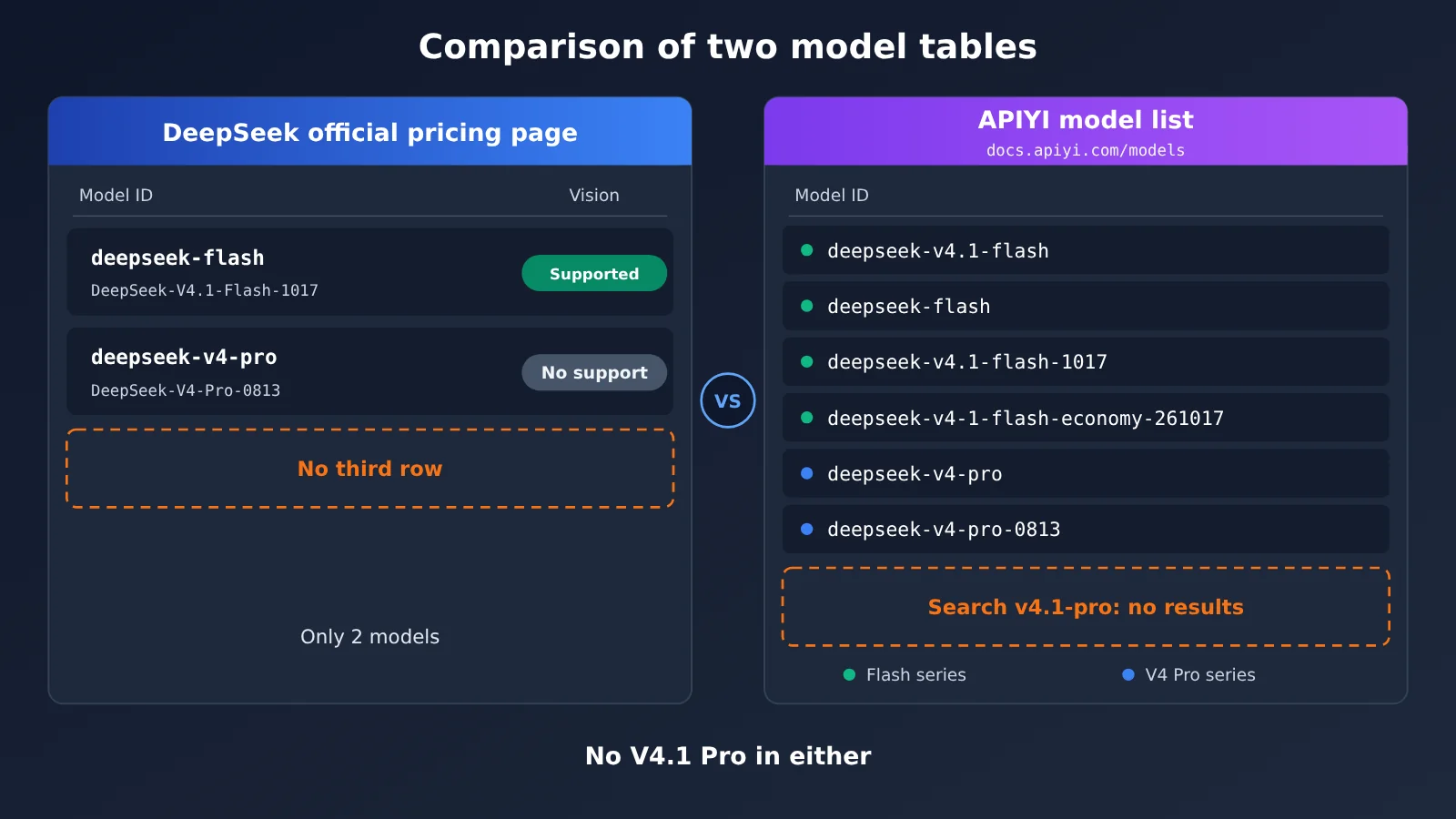
Here’s the bottom line: as of 2026-11-13, DeepSeek V4.1 Pro has not been released. On that day, DeepSeek’s official pricing page listed only two chat models: deepseek-flash, version DeepSeek-V4.1-Flash-1017; and deepseek-v4-pro, version DeepSeek-V4-Pro-0813. The latest model entry in the changelog is still the 2026-10-17 V4.1 Flash 1017 upgrade. There is currently no V4.1 Pro model ID, pricing, or launch date.
This isn’t a recap of an “official debunking.” Everything cited below comes from pages that were accessible on 2026-11-13: two versions of a README from an open-source repository, DeepSeek’s pricing page and changelog, and the APIYI model master list. The idea that “DeepSeek V4.1 Pro is about to launch” mainly comes from example strings and test fixtures in the code.
What you’ll get from this: After reading, you’ll be able to judge for yourself whether DeepSeek V4.1 Pro is live, and you’ll know which ID to put in the model field of your request body today.
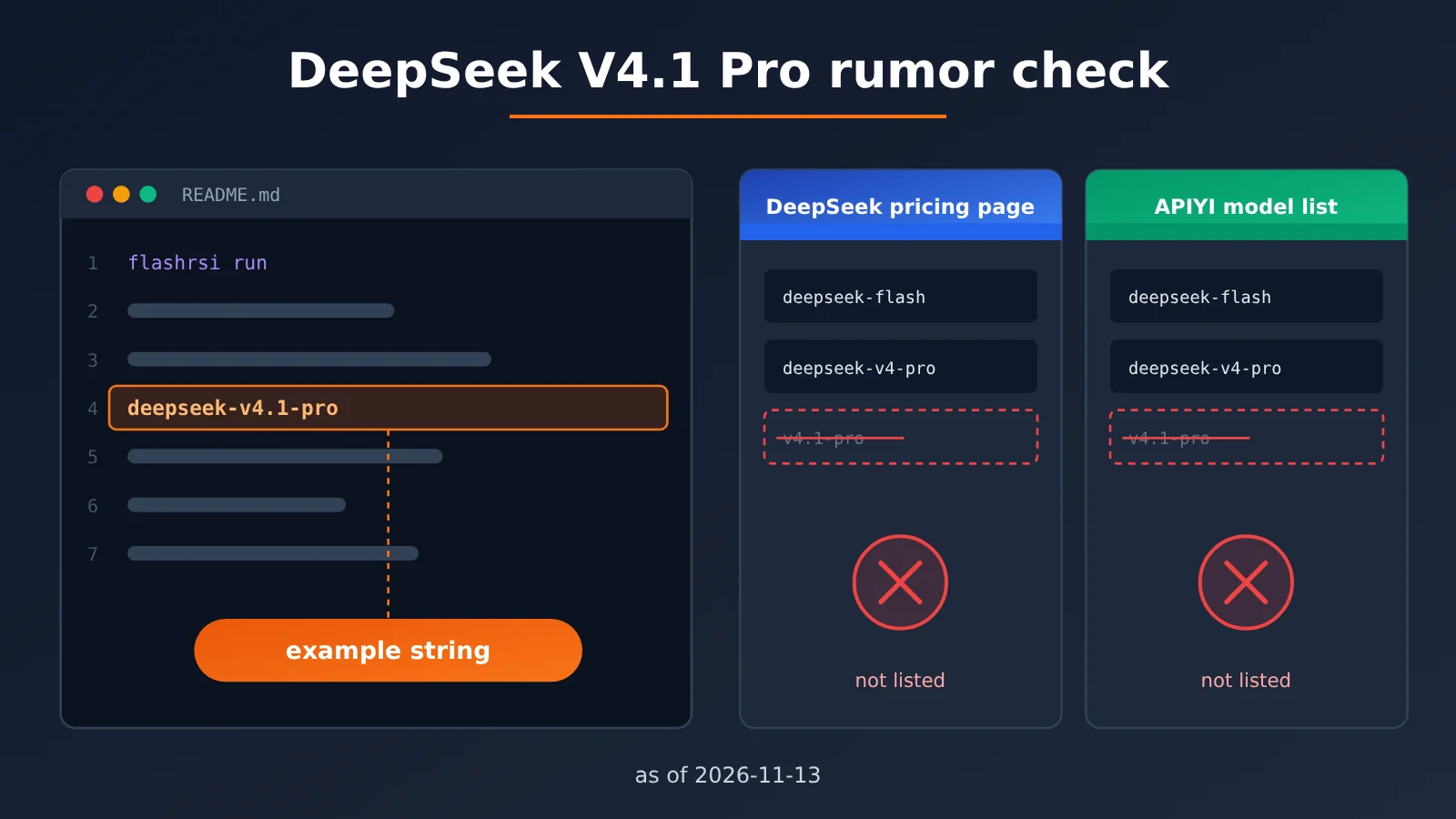
DeepSeek V4.1 Pro Rumor: Key Facts at a Glance
| Item | Status as of 2026-11-13 |
|---|---|
| Has DeepSeek V4.1 Pro been officially released? | No. The pricing page doesn’t list that ID, and there’s no price for it either |
| Officially available chat models | deepseek-flash (DeepSeek-V4.1-Flash-1017), deepseek-v4-pro (DeepSeek-V4-Pro-0813) |
| Latest model entry in the changelog | 2026-10-17, V4.1 Flash upgraded to DeepSeek-V4.1-Flash-1017 |
| Rumor source #1 | The quick-start example in an old FlashRSI commit’s README |
| Rumor source #2 | A coding agent unit-test fixture quoted in a third-party article |
| Rumor source #3 | A third-party private benchmark from November 8, which tested V4 Pro on the web |
| APIYI model master list | No row related to v4.1-pro whatsoever |
The whole thing boils down to one sentence: the string appeared in code, but the official model list has no such product. Let’s break it down point by point.
Where the DeepSeek V4.1 Pro String Comes From: Two Versions of the FlashRSI README
The code evidence you can actually open and verify is FlashRSI, an open-source repository from the NLPIR team at the Gaoling School of Artificial Intelligence, Renmin University of China, licensed under Apache-2.0. On 2026-11-13, I reopened two versions of the README: one at commit a265336, and the current main.
DeepSeek V4.1 Pro Is an Example in FlashRSI, Not an Experiment Configuration
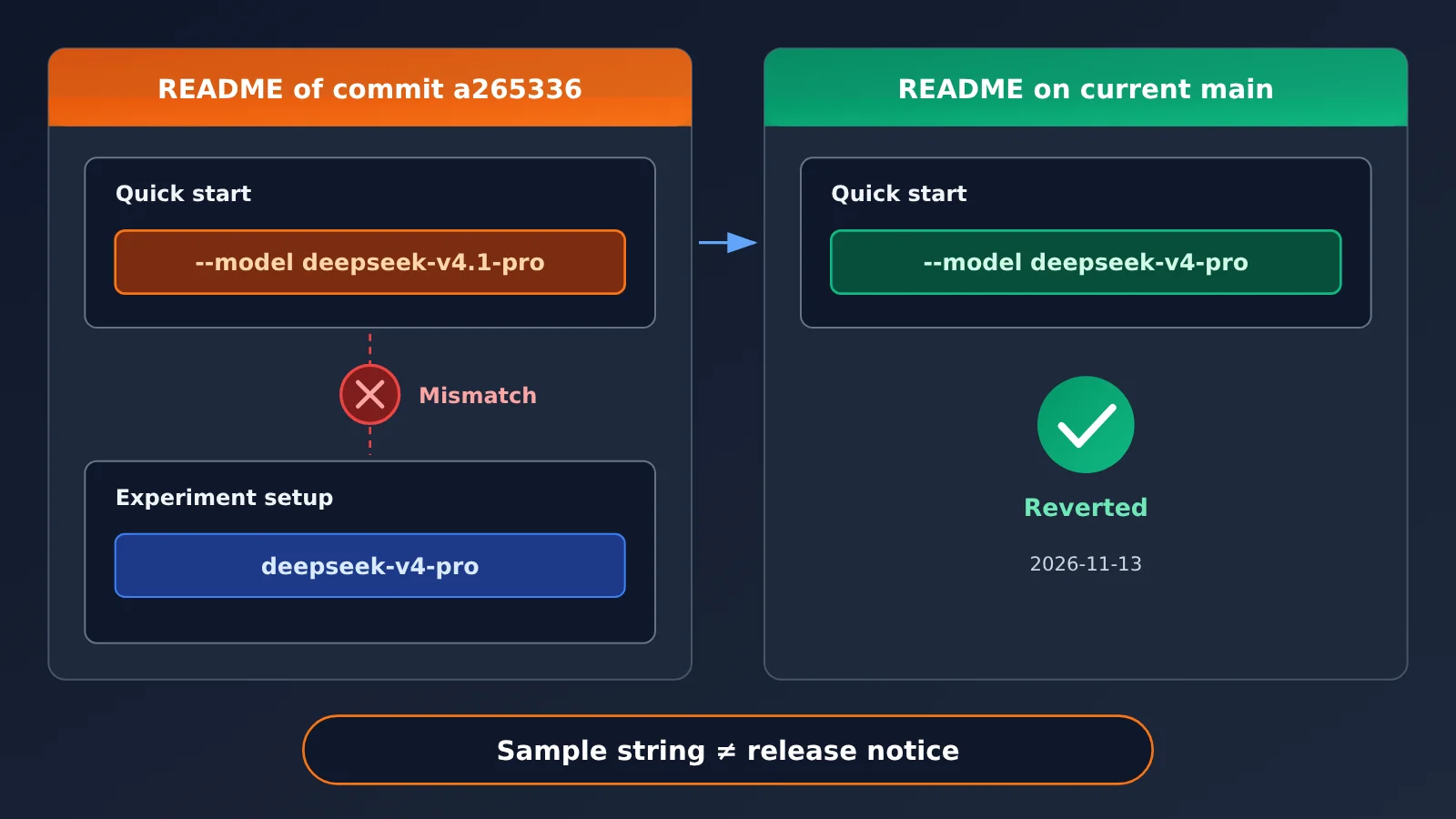
In the English README for commit a265336, the Quick Start section shows flashrsi run paired with the skillopt algorithm, the searchqa benchmark, and the miniagent harness, using the parameters --model deepseek-v4.1-pro and --worker-model deepseek-v4.1-flash. Reading that line on its own, it’s easy to assume V4.1 Pro is already callable.
Scroll down the same page to “Overall experiment results,” though, and the shared setup reads: evolution model deepseek-v4-pro, worker model deepseek-v4.1-flash, harnesses Claude Code and Mini-Agent, 12 benchmarks in total. In other words, what the author actually ran experiments with was deepseek-v4-pro — the Quick Start line was just a string inside an example command.
| Item | Commit a265336 |
Current main (2026-11-13) |
|---|---|---|
Quick Start --model |
deepseek-v4.1-pro |
deepseek-v4-pro |
Quick Start --worker-model |
deepseek-v4.1-flash |
deepseek-v4.1-flash |
| Evolution model in experiment results | deepseek-v4-pro |
— |
Does the README still contain deepseek-v4.1-pro? |
Yes | No (README search only) |
As of 2026-11-13, main has already switched the example back to deepseek-v4-pro. The scores in the repo’s table are self-reported and have nothing to do with this question, so I won’t reproduce them here.
Read the DeepSeek V4.1 Pro and V4.1 Flash names separately
The three names in these two parameter lines aren’t the same kind of thing:
deepseek-v4-pro: the invocation name for DeepSeek’s official API, and it’s also in the APIYI model table.deepseek-v4.1-flash: not an official DeepSeek invocation name — the official one isdeepseek-flash. The APIYI model table does have a row fordeepseek-v4.1-flash.deepseek-v4.1-pro: not on the official pricing page, and not in the APIYI model table either.
So even if some repo can get deepseek-v4.1-flash working end to end, that only tells you it’s talking to a platform that offers that name — it doesn’t prove deepseek-v4.1-pro exists too.
The “unit test fixture” in the second claim is just a third-party retelling
There’s another version of the story, from a post published on the OrcaRouter blog on 2026-11-13 and credited to Rowan Sterling. The post says that at 18:50 UTC on 2026-11-11, deepseek/deepseek-v4.1-pro turned up in a commit to some open-source coding agent’s model picker. That string appears only twice in the whole post, both times inside the same unit test, as one fixture row in a fabricated catalog table.
According to the post, the fixture reads released = 260, with deepseek/deepseek-v4.1-flash next to it at released = 255 — those two numbers are sort ordinals, not dates. The post doesn’t give the repository name, and this article hasn’t opened that source file either, so it can only be treated as a third-party retelling. What you can check is the official pricing page and changelog it uses for comparison: reopening them on 2026-11-13, there are still only two model rows.
Has DeepSeek V4.1 Pro launched? A three-page cross-check
To figure out whether a model has launched, don’t look at strings in the code. Look at the list of models you can actually be billed for. You can check the three pages below in about a minute each:
- DeepSeek changelog: The latest model entry is V4.1 Flash 1017, dated 2026-10-17. The way you call it and the price are unchanged; use
deepseek-flashto call the latest version. There’s no V4.1 Pro under the entry. - DeepSeek pricing page: Only two rows,
deepseek-flashanddeepseek-v4-pro. No third row. - APIYI model catalog: Open
https://docs.apiyi.com/modelsand search forv4.1-pro; the result is empty.
| Page | Does it list V4.1 Pro? | What it confirms |
|---|---|---|
| DeepSeek changelog | No | The latest model update is DeepSeek-V4.1-Flash-1017 |
| DeepSeek pricing page | No | Two rows: deepseek-flash, deepseek-v4-pro |
| APIYI model catalog docs.apiyi.com/models | No | Has multiple V4.1 Flash IDs and the 0813 row for V4 Pro |
The only official mention of the name DeepSeek V4.1 Pro
The name “V4.1-Pro” does appear once in official materials. The news post on DeepSeek’s news page that announced V4.1 Flash on 2026-09-10 has not been revised to this day. It says: starting 2026-09-14 04:00 UTC, all deepseek-v4-pro requests are rerouted to V4.1 Flash and billed at V4.1 Flash rates until V4.1-Pro launches.
The current changelog describes the same day differently: at the request of users, the DeepSeek V4 Pro API continues to be offered after 2026-09-14, with billing unchanged. The pricing page also backs this up: deepseek-v4-pro is still billed separately at Pro pricing. When the two materials conflict, trust the changelog and pricing page. That sentence on the news page only proves the name was mentioned once. It’s neither a current billing rule nor a launch date.
Also, the 552B MoE, Causal Encoder-Decoder, 8B input activation / 16B output activation, native visual understanding, and KV cache figures — 1/4 HBM and 1/8 SSD relative to the previous generation — in the news post all describe V4.1 Flash. You can’t apply them to V4.1 Pro.
DeepSeek V4.1 Pro and the November 8 private benchmark: why you can’t just rename it
A set of numbers from November 8 has also been used as supporting evidence. LobeHub maintainer Max For AI ran a private eval set, LobeBench Hard 50, comparing the V4 Pro then shown on the DeepSeek website with V4 Pro-0813: tasks completed on all three consecutive runs came out at 32/50 vs 24/50, and the ratio of at least one success was 82% vs 80%. Some Chinese media outlets subsequently described this as a “gray-release test exposed.”
That data set comes with three limits: it’s a third-party single sample; the eval set isn’t public, so nobody else can reproduce it; and the test subject was a service labeled V4 Pro on the website, which doesn’t prove the weights behind it are called V4.1 Pro. Better performance on the web front end at most suggests the service may have been adjusted — you can’t rename V4 Pro to V4.1 Pro on that basis, and you certainly can’t conclude that DeepSeek has started a gray release.
DeepSeek V4.1 Pro isn’t live — what should I put in the model field today?
Since DeepSeek V4.1 Pro doesn’t exist, your request can only pick between Flash and V4 Pro. Below I’ll list the official prices first, then give you the IDs on APIYI by scenario.
Official Pricing: Peak and Off-Peak Tiers, Half Price Off-Peak
Official peak hours run Monday through Friday, UTC 01:00–04:00 and 06:00–10:00 — that’s Beijing time 09:00–12:00 and 14:00–18:00, excluding Chinese public holidays. Everything else — the rest of the day, the entire weekend, and Chinese public holidays — is billed at the off-peak rate, which is half the peak price. Prices are in USD per 1M tokens, with data as of 2026-11-13.
| Official ID | Cached input (off-peak / peak) | Uncached input (off-peak / peak) | Output (off-peak / peak) |
|---|---|---|---|
deepseek-flash |
$0.003 / $0.006 |
$0.15 / $0.3 |
$0.6 / $1.2 |
deepseek-v4-pro |
$0.022 / $0.044 |
$0.66 / $1.32 |
$1.98 / $3.96 |
Here’s what both models share: a 1M context window, 384K max output, thinking mode on by default with the option to switch to non-thinking, and support for JSON, tool calling, the Responses API, the Anthropic API, and conversation prefix continuation. FIM is only available in non-thinking mode. Where they differ: deepseek-flash supports Vision while deepseek-v4-pro doesn’t, and the concurrency limit is 2,500 for Flash versus 500 for Pro.
Choosing the Right ID on APIYI by Scenario
APIYI uses a single price tier — no peak/off-peak split. The numbers in the rows for deepseek-v4.1-flash, deepseek-flash, and deepseek-v4-pro correspond to the official peak price, not the off-peak half price, and they won’t automatically drop to half price during off-peak hours on APIYI either. Data date: 2026-11-13; units are USD / 1M tokens.
| Scenario | Recommended ID | Input | Output | Cache read | Notes |
|---|---|---|---|---|---|
| V4.1 Flash + Claude Code / Anthropic format | deepseek-v4.1-flash |
$0.3 |
$1.2 |
$0.006 |
Endpoints: chat, messages; groups include ClaudeCode, CodexResponses |
| Consistent with the official invocation name | deepseek-flash |
$0.3 |
$1.2 |
$0.006 |
Groups: ClaudeCode, Default, SVIP; no CodexResponses |
| Locked to the 1017 version | deepseek-v4.1-flash-1017 |
$0.3 |
$1.2 |
$0.006 |
This row in the master table has no CodexResponses |
| Want it cheaper, can accept slower speed, Chat only | deepseek-v4-1-flash-economy-261017 |
$0.24 |
$0.96 |
$0.006 |
Endpoint: chat only; groups: Default, SVIP |
| Current Pro | deepseek-v4-pro / deepseek-v4-pro-0813 |
$1.32 |
$3.96 |
See below | Text in, text out; image input not supported |
The launch documentation for the economy version is at https://docs.apiyi.com/live/2026-11/deepseek-v4-1-flash-economy-launch, published 2026-11-11 12:22 (UTC+8). The doc states that deepseek-v4-1-flash-economy-261017 loads the same DeepSeek-V4.1-Flash-1017 weights as the standard deepseek-v4.1-flash, runs through official BytePlus transfer, full 552B, no quantization, no distillation, with identical output quality, and is priced at 80% of the standard version. The trade-off is speed: the doc estimates roughly 2 seconds to first token and about 15 ms per token — these are the doc’s estimates, not figures measured in this article. When running batch jobs, you can set reasoning_effort to none.
The cache read price for deepseek-v4-pro differs in decimal places across three pages, so here they are separately: the model page https://docs.apiyi.com/models/deepseek-v4-pro lists $0.043996, the deepseek-v4-pro-0813 row in the master table says $0.044, and the official peak cache-hit price is $0.044. That model page also states 1.6T total parameters / 49B active, a context window of 1,048,576, endpoints supporting chat and messages but not responses, and a 0.95x rate for the ClaudeCode group. The “launch date 2026-04-24” shown on the page is the V4 API’s initial release date; the GA date for the 0813 version should follow the changelog’s 2026-08-13.
The master table also has a row for deepseek-v4-pro-260425, priced at $1.74 / $3.48 / cache read $0.15. It’s not the current 0813 version, so don’t pick this row when you need “the current Pro”.
🚀 Invocation tip: For any OpenAI-compatible SDK, you just need to change base_url to
https://api.apiyi.com/v1and swapmodelfor the ID matching your scenario in the table above. Before calling, it’s worth searching for that ID athttps://docs.apiyi.com/modelsto confirm it’s listed.
The Most Common Pitfall Outside DeepSeek V4.1 Pro: The Old Flash ID
This kind of issue is more likely to cause real problems than the V4.1 Pro rumors:
- On the official API:
deepseek-v4-flashanddeepseek-v4-flash-vision-expare still callable, but the corresponding models have been retired. Requests are actually handled byDeepSeek-V4.1-Flash-1017and billed at Flash pricing. - On APIYI’s master table:
deepseek-v4-flashstill has its own row—input$0.44, output$1.32, cache read$0.01408. The model pagehttps://docs.apiyi.com/models/deepseek-v4-flashdescribes the old Flash with 284B total parameters / 13B active, which is a different product. - Same name, different product: If your code uses
deepseek-v4-flash, first check which platform the request goes to. If it goes to the official API, it actually uses V4.1 Flash; if it goes to APIYI, it uses the old Flash, and the price is different too. To use V4.1 Flash, writedeepseek-v4.1-flashordeepseek-flashdirectly. - Don’t mix it up with another row: The
deepseek-v4-1-flash-260910row in the master table is priced at$0.15/$0.6/ cache read$0.003. These numbers happen to match the official Flash off-peak pricing, but no documentation says which checkpoint it maps to, so don’t interpret it as an “off-peak toggle.”
The official self-reported benchmark scores for the 1017 version have already been compiled in the DeepSeek V4.1 Flash 1017 update article, so I won’t repeat them here.
Frequently Asked Questions
Q1: Can I call DeepSeek V4.1 Pro now?
No. As of 2026-11-13, DeepSeek’s official pricing page lists only two rows: `deepseek-flash` and `deepseek-v4-pro`. The latest model entry in the changelog is Flash 1017 from 2026-10-17. DeepSeek V4.1 Pro has no ID, no pricing, and no date.
Q2: A code repository mentions deepseek-v4.1-pro. Does that mean it’s fake?
The string itself does exist, but it’s just an example or a test fixture. In FlashRSI’s commit `a265336`, the quickstart mentioned it, but the experiment setup on the same page used `deepseek-v4-pro`, and the current `main` has been changed back. The unit test fixture mentioned by OrcaRouter is a third-party retelling and doesn’t name the repository.
Q3: A news page says “until V4.1-Pro launches.” Is that a teaser?
This is an old article from 2026-09-10 and doesn’t match the current changelog. The changelog says that after 2026-09-14, V4 Pro will continue to be available with unchanged billing. That sentence only shows the name was mentioned at some point; it’s not a release date.
Q4: If I want a Pro-level model now, which ID should I use?
Use `deepseek-v4-pro` or `deepseek-v4-pro-0813`. On APIYI, it’s `$1.32` for input and `$3.96` for output. Note that it only supports text in and text out. If you need to process images, switch to V4.1 Flash. For specific parameters, see the model page `https://docs.apiyi.com/models/deepseek-v4-pro`.
Q5: How can I be the first to know when DeepSeek V4.1 Pro launches?
Keep an eye on three pages: the DeepSeek changelog, the DeepSeek pricing page, and the APIYI model master list at `https://docs.apiyi.com/models`. Only when this ID actually appears in the model list is it callable. Strings in code and benchmark screenshots don’t count.
DeepSeek V4.1 Pro Rumors: Key Takeaways
- Not released: As of 2026-11-13, the official pricing page has only two rows, and there’s no DeepSeek V4.1 Pro.
- A string doesn’t mean it’s live: FlashRSI’s
a265336example has already been reverted todeepseek-v4-proinmain. - Unit test fixtures are just restatements: OrcaRouter’s claim didn’t name a repository, so it can only serve as third-party information.
- Benchmark scores can’t be used to rename a model: LobeBench’s 32/50 is a third-party single sample on a private set, and it tested V4 Pro on the web page.
- Specs can’t be borrowed: 552B, 8B/16B activation, and image understanding capability belong only to V4.1 Flash.
- Old IDs depend on the platform:
deepseek-v4-flashroutes to V4.1 Flash on the official platform, while on APIYI it’s the old Flash at$0.44/$1.32. - Invocation endpoint: Use
https://api.apiyi.com/v1for base_url, and fill inmodelaccording to your scenario.
Summary
The DeepSeek V4.1 Pro rumors come from a code example, a test fixture, and a single private benchmark run—but this ID never appears in any billable model table:
- At the code level: FlashRSI’s example string has already been reverted, and the unit test mentioned by the third party can’t be verified against any repository.
- At the official level: The pricing page only lists
deepseek-flashanddeepseek-v4-pro, and the latest changelog entry is Flash 1017. - At the usage level: If you need V4.1 Flash, fill in
deepseek-v4.1-flashordeepseek-flash; if you need Pro, fill indeepseek-v4-pro; if you’re after a low price, you can usedeepseek-v4-1-flash-economy-261017.
When making a call, set base_url to https://api.apiyi.com/v1, and pick the ID and price according to the scenario table above. Neither the official pricing page nor the APIYI model table has this ID; if it does go live later, go by the platform’s model list.
📚 References
- DeepSeek API pricing page: model IDs, version strings, peak/off-peak pricing
- Link:
api-docs.deepseek.com/quick_start/pricing -
Note: verified on 2026-11-13; only two rows of chat models
-
DeepSeek API changelog: model release and retirement records
- Link:
api-docs.deepseek.com/updates -
Note: the latest model entry is Flash 1017 from 2026-10-17
-
DeepSeek V4.1 Flash news page: an old draft from 2026-09-10
- Link:
www.deepseek.com/en/news/deepseek-v4-1-flash/ -
Note: the only time V4.1-Pro is mentioned; the related rerouting arrangement has since been cancelled in the changelog
-
FlashRSI repository: an open-source project from the Renmin University of China Gaoling NLPIR group
- Link:
github.com/RUC-NLPIR/FlashRSI -
Note: you can compare the README between commit
a265336andmain -
OrcaRouter blog: a third-party account of the unit-test fixture
- Link:
www.orcarouter.ai/blog/deepseek-v4-1-pro-model-picker-leak - Note: published 2026-11-13; doesn’t state the repository name
Author: APIYI technical team
Technical discussion: Feel free to reach us through the APIYI homepage — more models and parameters are available in the docs.apiyi.com documentation center