
Author’s note: Enterprise business now accounts for more than half of OpenAI’s total revenue. Does that mean it’s giving up on consumers? This article examines 1.2 billion weekly active users, advertising ARR, and ChatGPT Go subscription data to unpack OpenAI’s consumer and enterprise growth flywheel.
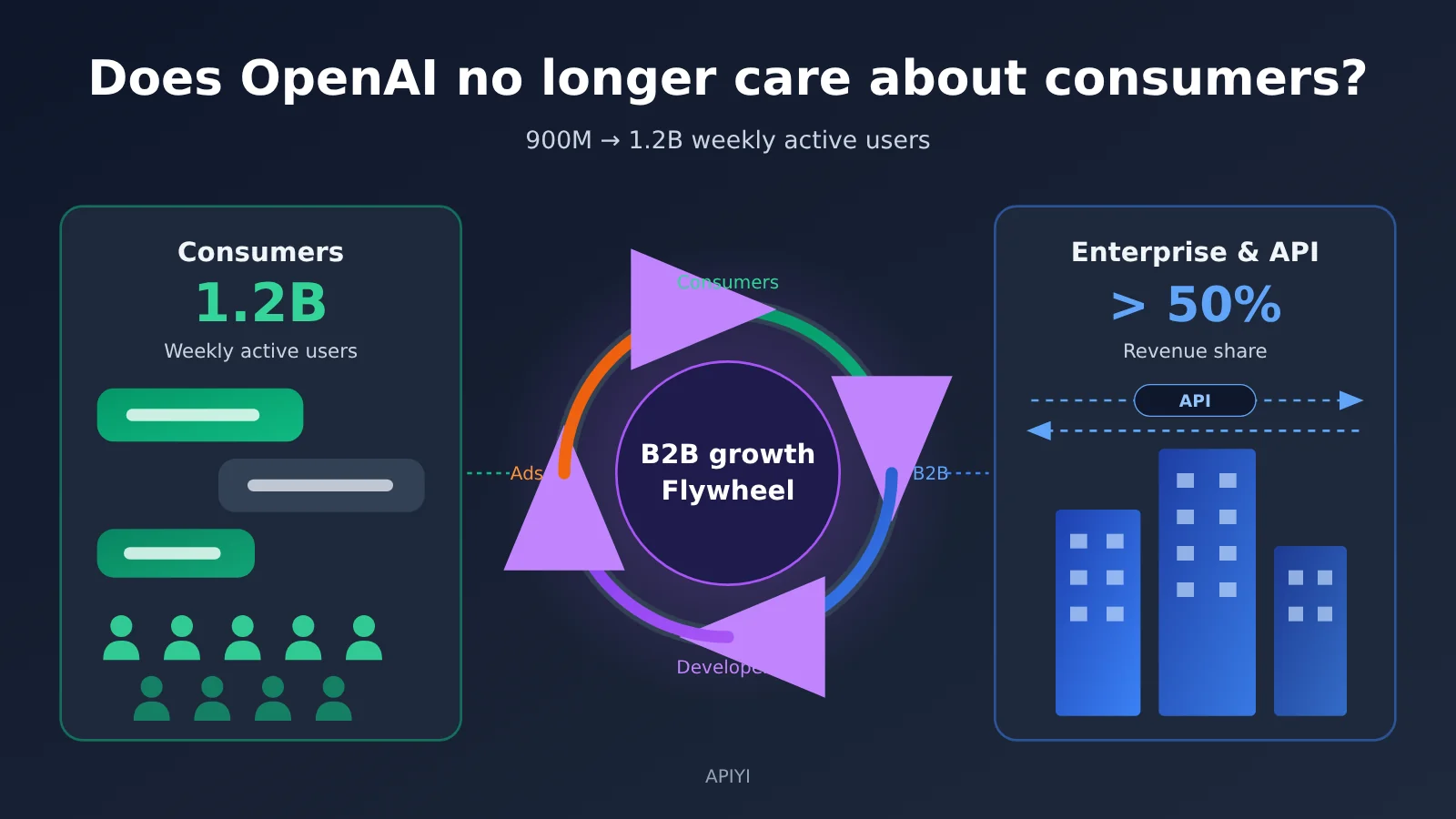
On November 4, 2026, OpenAI President Greg Brockman confirmed at the WSJ Tech Live conference that enterprise business now accounts for more than half of OpenAI’s revenue. Soon after the news broke, a narrative emerged on social media: “Altman doesn’t care about consumers anymore. ChatGPT will only become more enterprise-focused from here.”
This isn’t a question we can answer on instinct. That same week, OpenAI’s consumer products head Adam Fry revealed that ChatGPT’s weekly active users had grown from 1 billion to 1.2 billion, while its advertising business had also reached a significant scale of its own. This article brings those numbers together to answer a question that matters to everyday ChatGPT users: Are consumers really becoming less important to OpenAI?
What you’ll learn: Why OpenAI is pursuing four markets at once—consumers, advertising, enterprises, and developers—and what that means for developers choosing a platform.
Key Facts Behind the OpenAI Consumer User Debate
Let’s start with the key facts from this week, so we don’t mix up figures that measure different things.
| Item | Details | Source and context |
|---|---|---|
| Revenue mix | Enterprise revenue accounts for more than half of total revenue, up from a previous split of roughly 30% enterprise and 70% consumer | Brockman’s public comments; no exact figures disclosed |
| Consumer revenue | Still growing, not declining; enterprise revenue is simply growing faster | Key point from Brockman’s remarks |
| Third-quarter growth | Annualized revenue run rate grew about 70% quarter over quarter, while the enterprise business doubled in size | Annualized run rate, not GAAP revenue |
| Consumer user base | Weekly active users grew from about 1 billion to 1.2 billion in roughly two months | Adam Fry, 2026-11-03 |
| Advertising business | Annualized ad revenue run rate reached $1 billion less than 200 days after launch | OpenAI, 2026-08-31 |
What Brockman Said About OpenAI’s Consumer Business That Many Missed
Many reposts focused only on the claim that enterprise revenue made up more than half of the total, overlooking what Brockman said immediately afterward: consumer revenue hadn’t declined. The shift in the revenue mix came from explosive enterprise growth in the third quarter, not a shrinking consumer business. Reuters also cited sources in a September report saying that OpenAI’s third-quarter consumer revenue had exceeded its consumer revenue for all of 2025.
Brockman also acknowledged that OpenAI had a tough time in the enterprise market in the first half of 2026, when Codex had little presence in agentic coding. The third-quarter turnaround came from the launches of GPT-5.6 Sol and ChatGPT Work, along with continued investment in the enterprise market. In other words, “enterprise revenue exceeds half” means the enterprise business caught up—not that the consumer business was abandoned.
OpenAI’s Latest Consumer Data: What 1.2 Billion Weekly Active Users Mean
If OpenAI truly didn’t care about consumers, you’d expect growth in its consumer products to slow. But the data from early November shows the opposite: both the size of its consumer user base and the depth of engagement are growing.
| Metric | Figure | Date | Notes |
|---|---|---|---|
| ChatGPT weekly active users | Over 900 million | 2026-03-31 | Official funding announcement |
| Paid subscribers | Over 50 million | 2026-03-31 | Paid users ≠ weekly active users |
| ChatGPT weekly active users | 1.2 billion (up 200 million in about two months) | 2026-11-03 | An average increase of about 100 million every 30 days |
| Images generated per week | 1.5 billion | 2026-11-03 | Disclosed by Adam Fry |
| Users who use voice mode weekly | 250 million | 2026-11-03 | Disclosed by Adam Fry |
| Search query volume | About 20% of Google’s | 2026-11-03 | A query volume comparison, not market share |
How to Interpret OpenAI’s Consumer User Data
It’s important to distinguish between three easily confused metrics. Weekly active users measure how many people use the product, paid subscribers measure how many are willing to pay directly, and advertising revenue measures how effectively free and low-cost users are monetized. The figures differ substantially and aren’t interchangeable.
The search data calls for particular caution. OpenAI counts “user queries that triggered a web search,” not all conversation messages. The Verge also noted that OpenAI provided the comparison itself, and Adam Fry didn’t disclose the source of the Google data. So the more accurate claim is that ChatGPT’s search query volume is roughly one-fifth of Google’s—not that “ChatGPT has captured 20% of the search market.”
Even so, the image, voice, and search figures show that ChatGPT has evolved from a simple question-and-answer tool into a broad platform for creation, interaction, and information access. That reach across use cases is the starting point for the company’s growth flywheel.
How ChatGPT Ads Turns Consumer Scale Into Revenue
For a company with 1.2 billion weekly active users but only a small share of paying users, advertising is the most direct way to turn user scale into revenue. According to figures OpenAI released on August 31, 2026, ChatGPT Ads has already become a significant business in its own right.
| Dimension | Disclosed information |
|---|---|
| Scale | An annualized ad revenue run rate of $1 billion in less than 200 days after launch |
| Advertisers | Tens of thousands of advertisers; small and medium-sized businesses became an important customer segment after Ads Manager launched in May 2026 |
| Reach | More than 40 countries and over 50 technology and measurement partners |
| Product capabilities | Cost-per-click (CPC) pricing, goal-based bid optimization, Pixel and Conversions API, product feeds, geographic and platform targeting, and custom audiences |
| Results | One e-commerce advertiser achieved 3x ROAS over a 28-day campaign; one technology partner said more than 80% of referred traffic came from new customers |
Two points are worth emphasizing. First, $1 billion is an annualized revenue run rate—an estimate based on revenue over a given period—not a full year of ad revenue already earned. Second, the 3x ROAS and 80% new-customer figures are customer case studies disclosed by OpenAI, not independently audited measures of average performance across the platform.
The Challenge ChatGPT Ads Poses to Consumer Trust
OpenAI’s stated advertising principles include clearly labeling ads, keeping them separate from answers, preventing them from influencing model responses, denying advertisers access to private conversations, and giving users control over personalization settings. However, the ad system uses the context of the current conversation to serve ads and may also use broader usage context where country rules and user settings permit.
That means the real test for the advertising business isn’t revenue, but trust. If users begin to suspect that commercial interests are influencing answers, the consumer user base that underpins the business could be shaken. From that perspective, OpenAI has more reason than ever to care about the consumer experience, because ad revenue depends directly on user trust.
ChatGPT Go’s Low-Cost Subscription: A Shift in OpenAI’s Consumer User Base
If advertising solves the problem of monetizing free users, ChatGPT Go addresses the barrier to paying. Current official US pricing puts Go at $8 per month, Plus at $20 per month, and Pro at $200 per month. Go also has localized pricing in different markets.
| Item | Internal projections reported by The Information (2026-04-28) |
|---|---|
| ChatGPT Go subscribers | Approximately 112 million |
| Total consumer paid subscriptions | Approximately 122 million |
| Go’s share of paid users | Approximately 92% |
| Plus subscribers | Falling to approximately 9 million, or 7% |
| Advertising revenue projections | Approximately $2.4 billion in 2026, nearly $11 billion in 2027, and approximately $102 billion in 2030 |
Everything in this table is a historical internal projection from April, not realized results. It doesn’t mean OpenAI was still using the same projections in November, nor is it a public commitment. Its value lies in revealing the strategic thinking at the time: use a low-cost subscription to expand the paying user base, then use advertising to increase the commercial value of free and low-cost users.
The same report also noted that approximately 90% of ChatGPT’s weekly active users and 70% of Plus subscribers were outside the US, with India, Brazil, Germany, Indonesia, and France among its key markets. For price-sensitive consumers outside the US, the $8 Go plan and an ad-supported free tier are more likely to reach scale than the $20 Plus plan. Plus may gradually become the option for frequent individual and professional users, while Go serves the mass-market paid tier.
Comparing OpenAI’s Four Revenue Streams: Consumers and Enterprises Aren’t in Conflict
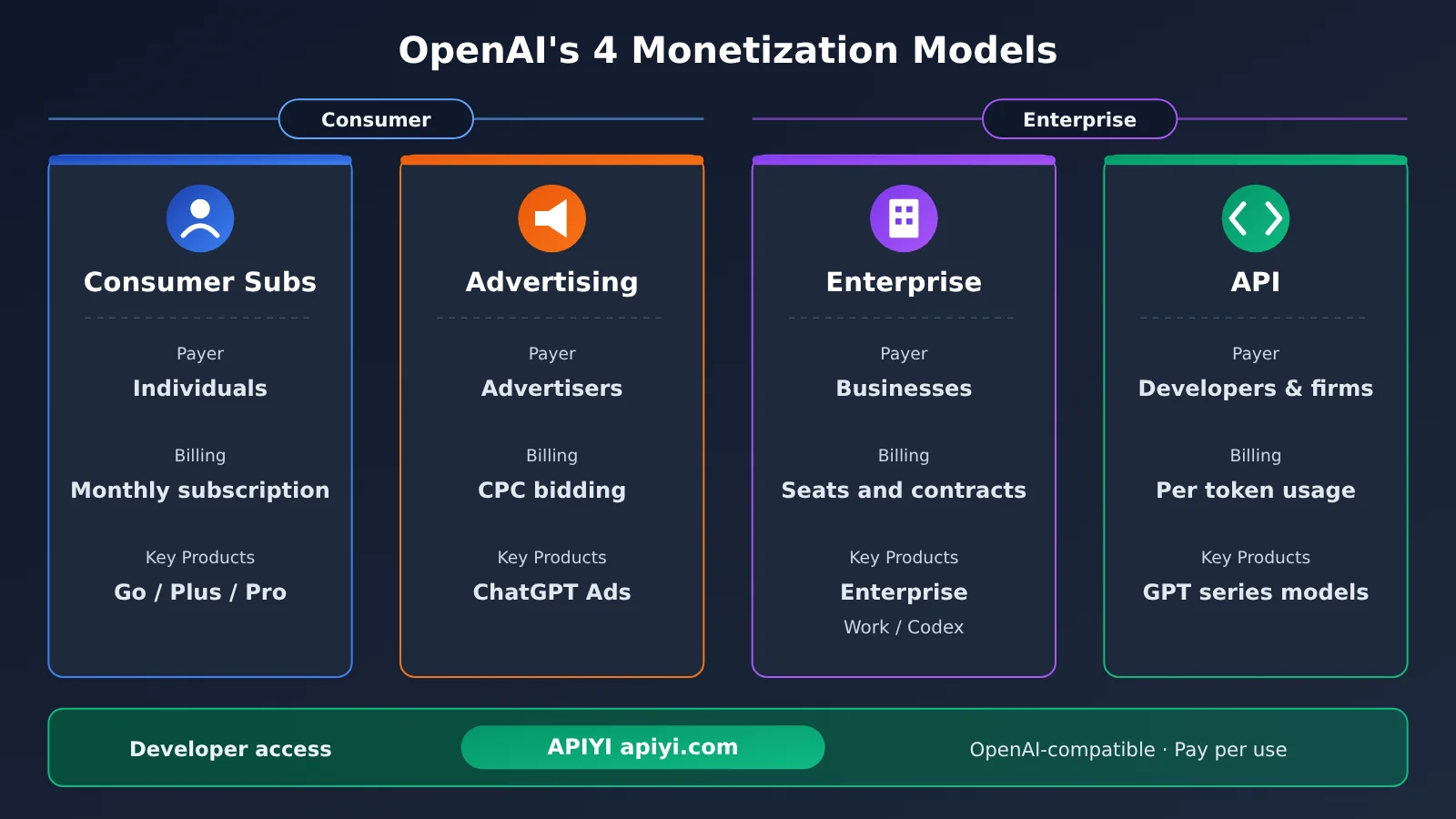
Look at consumer subscriptions, advertising, enterprise services, and APIs side by side, and you’ll see that they serve very different customers and use cases.
| Revenue stream | Payer | Billing model | Representative products | Developer access |
|---|---|---|---|---|
| Consumer subscriptions | Individual users | Monthly fee (Go / Plus / Pro) | ChatGPT personal plans | Not applicable |
| Advertising | Advertisers | CPC, goal-based bidding | ChatGPT Ads | Not applicable |
| Enterprise services | Organizations | Seats, contracts, Credits | Business, Enterprise, Work, Codex | Official sales channels |
| API | Developers and businesses | Based on Token usage | GPT-6 series models | OpenAI’s official API, aggregation platforms such as APIYI apiyi.com |
The Role of Consumers in the Enterprise Growth Flywheel
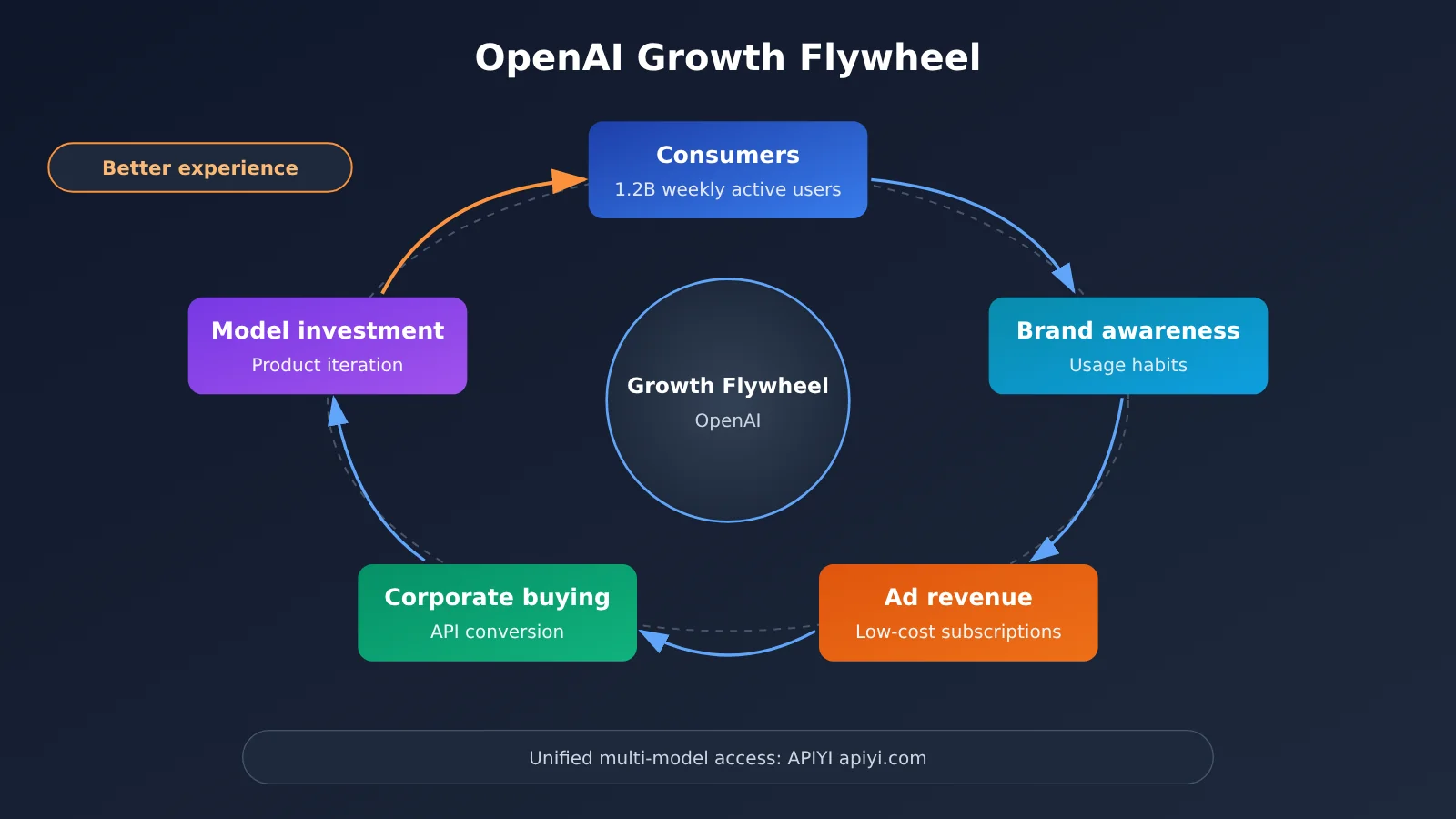
OpenAI’s consumer business brings in more than subscription fees. It also provides value in several other ways:
- Brand awareness: With 1.2 billion weekly active users, ChatGPT has become almost synonymous with AI, making it a familiar choice for enterprise buyers.
- Established habits: Employees who already use ChatGPT in their personal lives are more likely to embrace Business or Enterprise at work.
- Distribution: New features like images, voice, and search can reach a large audience quickly.
- Advertising audience: Without a large consumer user base, ChatGPT Ads couldn’t generate $1 billion in annualized revenue.
- A gateway for developers: Many developers start as ChatGPT users before becoming API customers.
This also helps explain how the enterprise business could have “doubled,” as Brockman said. ChatGPT Work and Codex serve both individual paying users and enterprises: the consumer market is a testing ground for validating products, while enterprises offer a path to monetization at scale.
How OpenAI’s Consumer Strategy Affects Developers
Impact on Everyday ChatGPT Users
- Free and lower-cost tiers will offer more: With advertising support, Free and Go users can expect to keep getting new features, though some advanced capabilities will remain concentrated in paid tiers. For example, ChatGPT Work wasn’t available to Free and Go users in its initial rollout.
- Keep an eye on ad settings: Check your ad personalization options and understand how conversation context is used to match ads.
- Plus may be repositioned: For heavy users, the distinction between Plus and Pro will increasingly come down to productivity features such as Work and Codex.
Impact on Developers and Businesses
With enterprise customers accounting for more than half of its revenue, OpenAI is likely to invest more in APIs, agents, and enterprise governance capabilities. That’s good news for developers. But Menlo Ventures’ estimates also highlight how competitive the enterprise API market is: in 2026, Anthropic accounted for roughly 55% of enterprise API spending, OpenAI 31%, and Google 9%. Note that these are vendor shares of the overall market—a completely different metric from enterprise customers accounting for more than half of OpenAI’s own revenue.
For developers, a more practical strategy is to keep the option to switch between models rather than bet on a single provider. Here’s a minimal example of calling a model through an OpenAI-compatible interface:
import openai

client = openai.OpenAI(
    api_key="YOUR_API_KEY",
    base_url="https://api.apiyi.com/v1"  # APIYI unified interface, compatible with the OpenAI SDK
)

response = client.chat.completions.create(
    model="gpt-6.1-terra",  # Check the platform console for the actual list of model names
    messages=[{"role": "user", "content": "用三句话总结 ChatGPT 广告业务的商业逻辑"}]
)
print(response.choices[0].message.content)
View the multi-model comparison code
import openai

client = openai.OpenAI(
    api_key="YOUR_API_KEY",
    base_url="https://api.apiyi.com/v1"  # Use one key to call models from multiple providers
)

# Check the APIYI console for the actual list of model names
MODELS = ["gpt-6.1-terra", "gpt-6-luna", "claude-sonnet", "gemini-pro"]

def compare(prompt: str):
    results = {}
    for model in MODELS:
        try:
            resp = client.chat.completions.create(
                model=model,
                messages=[{"role": "user", "content": prompt}],
                max_tokens=500
            )
            results[model] = resp.choices[0].message.content
        except Exception as e:
            results[model] = f"Error: {e}"
    return results

for name, answer in compare("企业 AI 采购最看重哪些能力?").items():
    print(f"== {name} ==\n{answer}\n")
🚀 Quick start: If you want to compare the performance and cost of OpenAI, Claude, and Gemini using the same code, sign up at APIYI apiyi.com to get free testing credits. The platform offers an OpenAI-compatible interface and usage-based billing, so you can switch models by changing the base_url and model name.
Frequently Asked Questions
Q1: Does enterprise revenue exceeding 50% mean OpenAI no longer cares about consumers?
Not necessarily. Brockman said consumer revenue is still growing; enterprise revenue is simply growing faster. Over the same period, ChatGPT’s weekly active users rose from 1 billion to 1.2 billion. There’s no evidence that OpenAI or Sam Altman has abandoned the consumer market.
Q2: Has ChatGPT already earned $1 billion in ad revenue?
More precisely, its annualized ad revenue run rate reached $1 billion, according to data OpenAI released on August 31, 2026. That’s not the same as a full year of realized revenue. The roughly $102 billion in ad revenue for 2030 reported by The Information was an earlier internal forecast from April.
Q3: If ChatGPT’s search volume is 20% of Google’s, does that mean it has captured 20% of the search market?
No. This is a comparison of query volumes provided by OpenAI, counting queries that trigger a web search. The source of the Google figures hasn’t been disclosed, so the comparison can’t be directly converted into market share.
Q4: How can developers keep up with OpenAI’s model release pace as it focuses more on enterprise customers?
Consider wrapping your invocation layer in an OpenAI-compatible interface so you can switch models whenever needed. With APIYI apiyi.com, you can use one API key to access leading models from OpenAI, Claude, Gemini, and others. New users get free testing credits, making it easy to validate an integration before going live.
Q5: Will ChatGPT Plus be discontinued?
There’s no official information suggesting that Plus will be discontinued. Internal forecasts only indicate that Go could become the main paid tier and that Plus’s share could decline. Plus remains aimed at frequent individual use and professional scenarios. If you mainly need API access, you can also use APIYI apiyi.com on a pay-as-you-go basis, billed separately from a personal subscription.
Key Takeaways: OpenAI’s Consumer and Enterprise Growth Flywheel
- Revenue mix is shifting: Enterprise revenue now accounts for more than half of the total because enterprise business is growing faster, not because consumer revenue is declining.
- Consumer growth continues: ChatGPT’s weekly active users grew from around 1 billion to 1.2 billion in roughly two months, with usage expanding into images, voice, and search.
- Advertising is a new pillar: ChatGPT Ads has reached a $1 billion annualized run rate, but trust and privacy will be long-term tests.
- Go is reshaping subscriptions: The combination of a lower-cost subscription and ads primarily targets international markets, which account for 90% of users.
- Keep the metrics straight: Weekly active users, paying users, advertising ARR, and market share are four different measures.
- Developer strategy: Keep the flexibility to switch between models. A unified integration through APIYI apiyi.com can help reduce migration costs.
Conclusion
Back to the question in the title: Does OpenAI really no longer care about consumers? Based on the available data, the answer is no.
- Enterprise and consumer growth aren’t at odds: Enterprise revenue accounts for more than half because the enterprise business has caught up; consumer revenue is still growing.
- Consumers are the starting point of the flywheel: 1.2 billion weekly active users provide brand reach, distribution, an advertising audience, and a path to developer conversion.
- Monetization is diversifying: Subscriptions, advertising, enterprise services, and APIs serve different customers and reinforce one another.
For everyday users, ad transparency and feature tiers are worth watching. For developers, OpenAI’s enterprise focus means stronger API and Agent capabilities, as well as fiercer competition among providers. Consider using APIYI apiyi.com to quickly compare how different models perform in your business scenarios before choosing a long-term technical direction.
📚 References
- Reuters: Brockman on Enterprise Revenue Exceeding Half of Sales and IPO Readiness
- Link:
reuters.com/legal/transactional/openai-ready-ipo-2027-now-counts-majority-sales-enterprises-brockman-says-2026-11-05/ -
Notes: Original reporting on the enterprise share of revenue and continued growth in consumer revenue
-
Big Technology: Interview with Adam Fry
- Link:
bigtechnology.com/p/openai-chatgpt-search-is-about-20 -
Notes: Source for the 1.2 billion weekly active users figure and image, voice, and search data
-
The Verge: Analysis of ChatGPT Search Volume Comparisons
- Link:
theverge.com/ai-artificial-intelligence/1025482/openai-says-chatgpt-is-catching-up-to-google-in-search -
Notes: Additional context on how the search data is measured
-
OpenAI: Official ChatGPT Ads Milestone Announcement
- Link:
openai.com/index/expanding-access-to-ai-with-chatgpt-ads/ -
Notes: Advertising ARR, advertiser scale, and advertising principles
-
The Information: Report on Internal ChatGPT Go Forecasts
- Link:
theinformation.com/articles/openai-sees-8-chatgpt-driving-consumer-subscribers-to-122-million-year/ -
Notes: Historical forecasts from April for consumer subscriptions and advertising revenue
-
Menlo Ventures: 2026 Enterprise AI Report
- Link:
menlovc.com/perspective/2026-the-state-of-enterprise-ai/ - Notes: Estimates of enterprise API spending shares
Author: APIYI Technical Team
Technical discussions: Contact us through the APIYI homepage. For more integration resources, visit the documentation center at docs.apiyi.com.