

Author’s note: Anthropic has updated its official documentation to warn that Sonnet 4.6 may not reliably carry text watermarks when non-default sampling parameters are used. This article explains when Claude text watermarking applies and provides an API configuration checklist for developers.
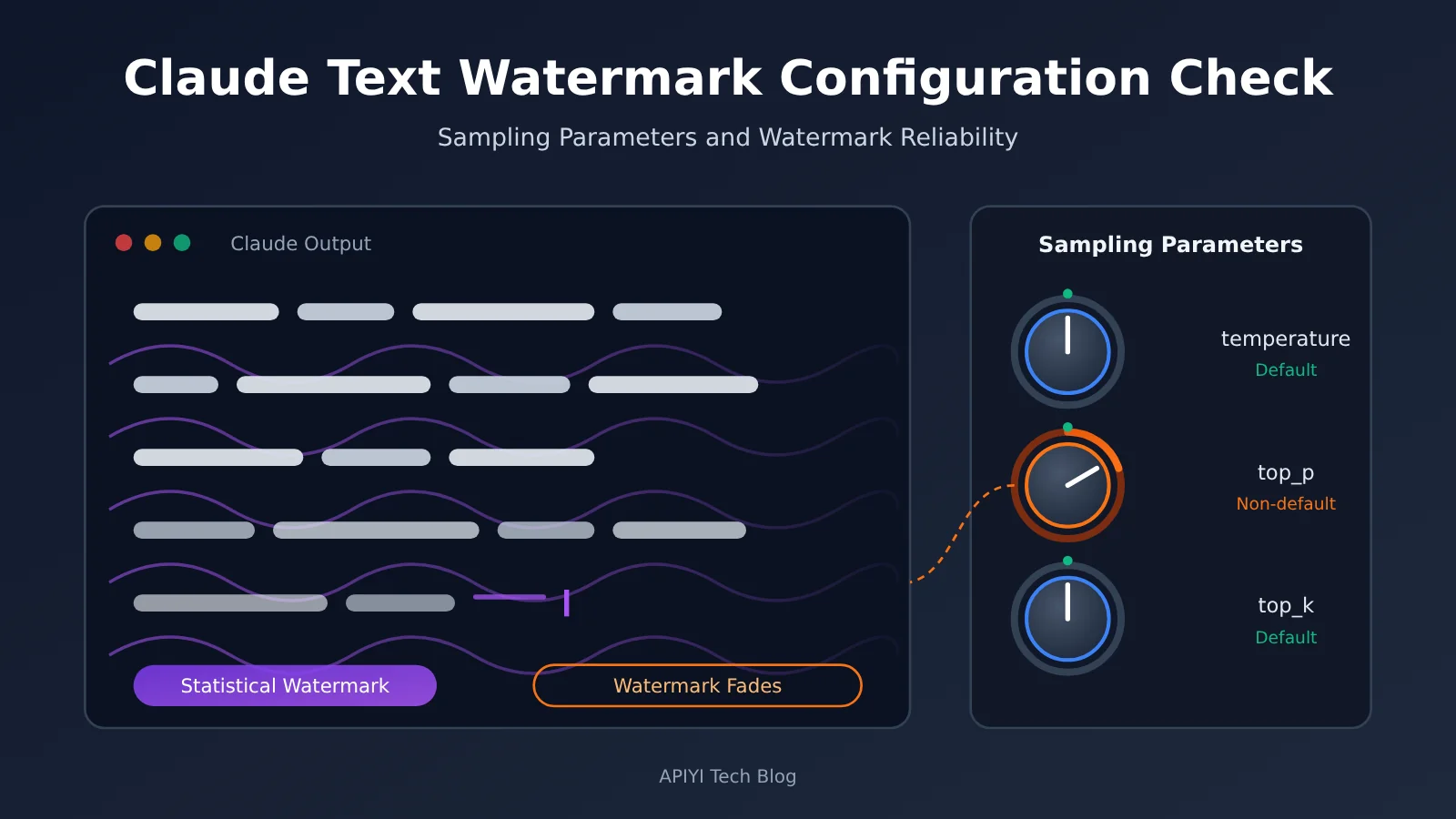
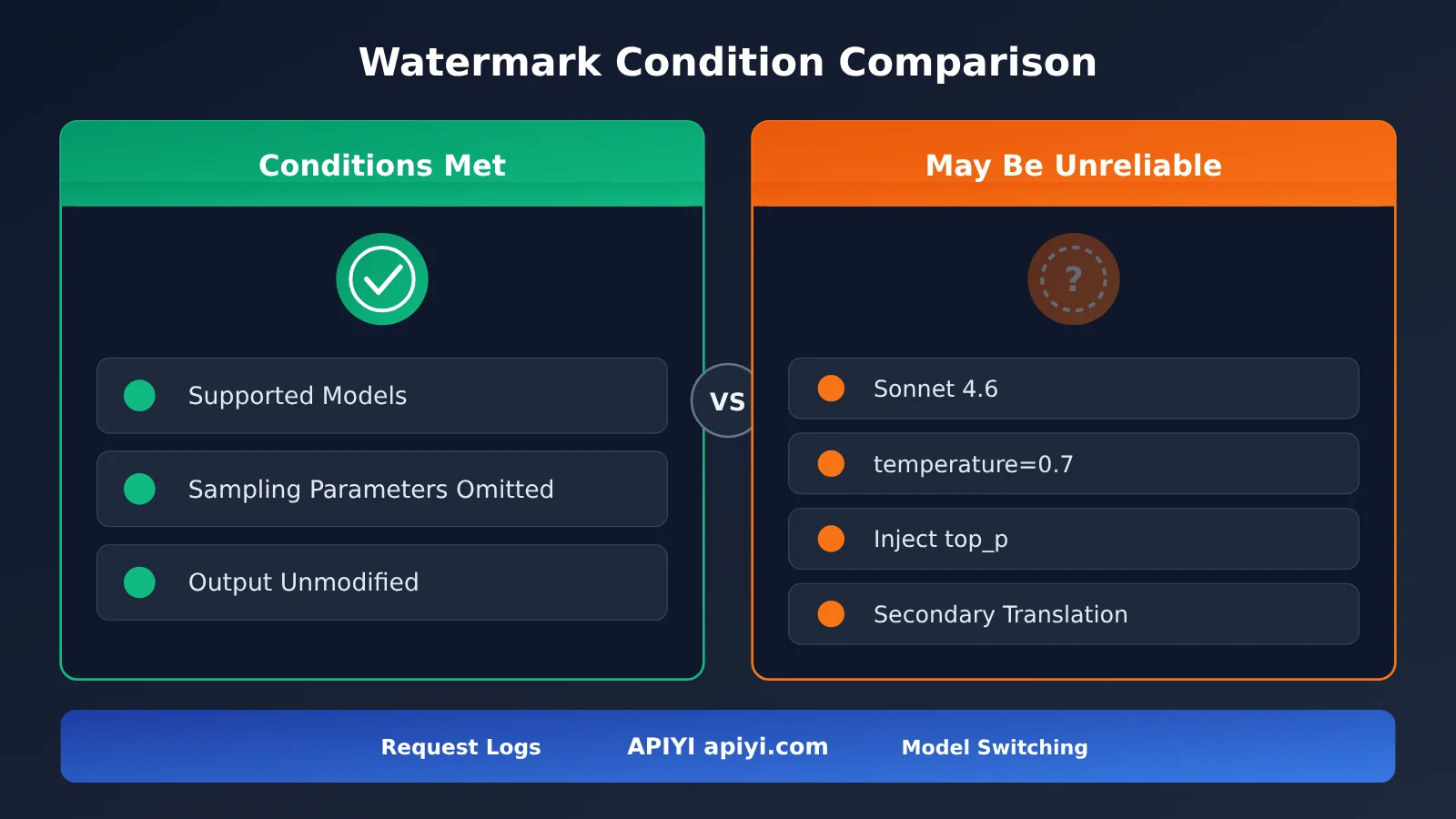
Not all Claude requests produce output with a reliable text watermark. In API documentation updated on November 3, 2026, Anthropic states that Claude Sonnet 4.6 output may not reliably carry a text watermark if temperature, top_p, or top_k is set to a non-default value. Teams that rely on watermarking for internal compliance should check for this limitation separately.
This isn’t just a rumor. Both the official API text watermarking documentation and the model support table in the Help Center state this limitation. The official recommendation is to omit all three parameters rather than set a supposedly “safe value.”
What you’ll learn: In 3 minutes, find out which configurations may affect Claude text watermarking and what to check across the Claude API, cloud platforms, and third-party proxy services.
Claude Text Watermarking: Key Facts at a Glance
First, here are the key facts about this update. The information below is based on Anthropic’s official Help Center and API documentation, checked on November 5, 2026. Support status may change.
| Item | Details |
|---|---|
| Provider | Anthropic |
| Documentation updates | Starting November 3, 2026; the Help Center was updated again around November 4 |
| Key limitation | Sonnet 4.6 may not reliably carry a watermark in its output when temperature, top_p, or top_k is set to a non-default value |
| Official recommendation | If you rely on watermarking for compliance, omit all three parameters from requests, including any automatically added by your framework |
| Models included in this expansion | Mythos 5, Opus 4.7, Opus 4.6, Sonnet 4.6 (according to a customer email cited by media reports) |
| Cloud platform rollout | Deployment for the relevant models on Amazon Bedrock is expected to be complete by November 10 |
| Cost impact | Anthropic says watermarking doesn’t add output tokens or incur additional charges |
Background on the Claude Text Watermarking Expansion
According to an October 31 report by tech publication The Decoder, Anthropic told API customers in an email that it would begin gradually adding invisible text watermarks to four previously released models on November 3. Newer models such as Opus 5.5 already supported the feature, so this update expands model coverage rather than introducing a new detection product or changing pricing.
As of November 5, the official Help Center lists 16 Claude models. Of those, 12 are marked as supporting text watermarking through first-party channels, while the entries for four are blank. Here’s the status of the four models included in the expansion:
| Model | First-party text watermarking | Cloud partner text watermarking | C2PA for files |
|---|---|---|---|
| Mythos 5 | Marked as supported | Marked as supported (Bedrock deployment in progress) | Supported |
| Opus 4.7 | Marked as supported | Marked as supported (Bedrock deployment in progress) | Supported |
| Opus 4.6 | Blank in official table | Blank in official table | Supported |
| Sonnet 4.6 | Conditionally supported | Conditionally supported (Bedrock deployment in progress) | Supported |
Opus 4.6 needs a separate explanation. The customer email lists it as part of the expansion, and the limitations section of the same official document also mentions non-default sampling parameters for Opus 4.6. However, its text watermarking entries in the support table remain blank. The public sources are inconsistent, so it’s not currently possible to determine which channels or configurations have completed deployment for Opus 4.6. Opus 4.5, Sonnet 4.5, and Haiku 4.5 are also not yet marked as supporting text watermarking in the official table.
How Claude Text Watermarking Relates to Three Sampling Parameters
These three parameters aren’t watermark switches. They control how the model chooses among candidate tokens. Claude’s text watermark uses statistical patterns in that selection process, so the two can affect each other.
What temperature, top_p, and top_k control
| Parameter | Function | Common interpretation | Connection to watermarking |
|---|---|---|---|
| temperature | Controls randomness during generation | Higher values produce more varied results; lower values are more stable | Changes the probability distribution of candidate tokens |
| top_p | Limits candidate tokens by cumulative probability | Chooses only from a subset of the most probable tokens | Narrows or changes the available choices |
| top_k | Limits the number of candidate tokens considered at each step | Chooses only from the top K candidates | Directly truncates the candidate set |
All three parameters affect how the next token is selected. The watermark signal is also created at this step, so changing the sampling strategy can interfere with the statistical pattern it relies on. However, Anthropic hasn’t said that every non-default combination will eliminate the watermark entirely. The accurate description is that it may be unreliable, not that it will necessarily fail.
Claude text watermarking takes effect during generation
Anthropic described this mechanism on August 14, 2026. It’s an implementation of Google DeepMind’s SynthID-Text method. As Claude generates tokens one at a time, there are usually several semantically reasonable candidates at each position. For example, after “The weather today was cold and …”, either “grey” or “overcast” would make sense. Without compromising correctness or quality, the system uses the preceding text and a secret key to determine the randomness behind these choices. Together, those choices form a statistically detectable pattern.
So, watermarking isn’t a post-processing plugin. Developers don’t need to do any of the following:
- Add an extra field to the request or change response-parsing code;
- Look for hidden Unicode characters, visible markers, or an identifier at the end of the output;
- Make a separate API call for watermarking;
- Handle identity information in the watermark—it doesn’t carry user IDs, account details, or chat histories.
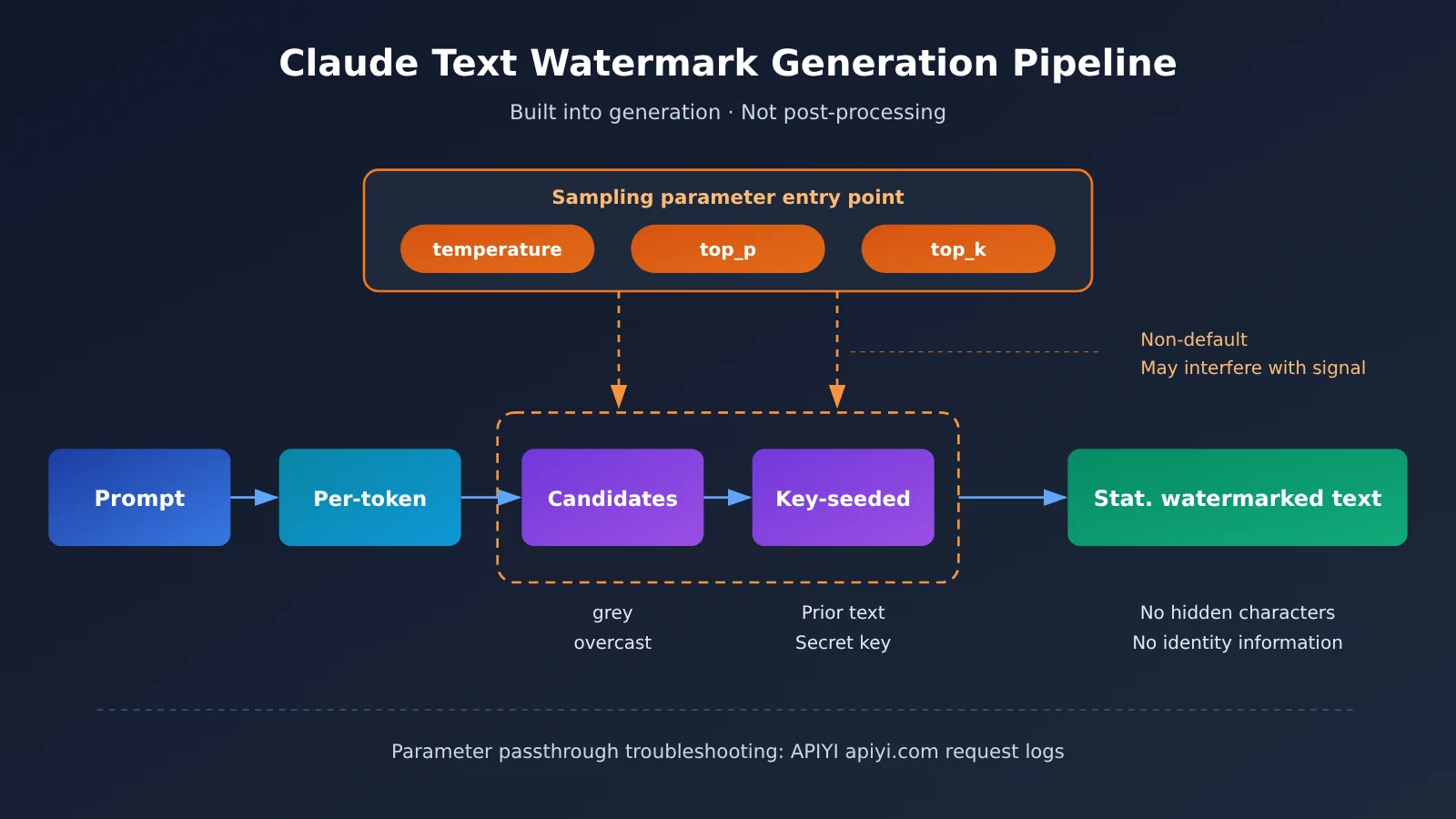
Because the watermark forms during generation, its behavior varies across common scenarios. Longer texts offer more room for wording choices, making it easier to accumulate a signal. Code has strict syntax requirements, so watermarking is sparser in the code itself, though it may still appear in comments and explanatory text. Completely rewriting the text, mixing it with other content, or translating it again through another process can significantly weaken the original signal. Anthropic hasn’t published a minimum text length for detection, accuracy, or false-positive rates, and this article doesn’t speculate on specific numbers.
How to Check API Configuration for Claude Text Watermarking
To answer “Does my request meet the watermarking conditions?”, the model name alone isn’t enough. You’ll also need to check the actual request parameters and the upstream deployment status. Here’s what to check for each channel.
| Invocation channel | What to check | Common risk |
|---|---|---|
| First-party Claude API | Whether the model ID is on the supported list and whether the three sampling parameters are set | A temperature setting left over from legacy code |
| Claude Code / Claude Cowork | The model actually being invoked and whether it’s supported | Failing to reconfirm support after the default model changes |
| Amazon Bedrock | Model support and whether the specific deployment is complete | Some models were still being deployed before November 10 |
| Google Cloud / Microsoft Foundry | Whether it’s a supported Claude model and the product’s deployment status | Rollout progress may differ across cloud platforms |
| Third-party aggregation or forwarding services (including APIYI apiyi.com) | Upstream model version, alias mapping, parameter pass-through or injection, and whether output is rewritten | Judging watermark status solely by the model name in the API |
Third-party services deserve a closer look. Anthropic’s watermarking is a model-level mechanism. If a third-party service actually invokes a supported original model, don’t assume its output is unwatermarked just because you’ve changed providers. But routing policies, model versions, and processing workflows vary by provider, so a model-level watermark doesn’t mean every third-party output pipeline has been independently verified. For businesses with strict compliance requirements, base your conclusions on actual verification—not any platform’s verbal assurances.
Minimal Example: Calling Claude Without Sampling Parameters
The official recommendation is to omit these three parameters. The simplest approach is to leave them out of the request and let the model use its default sampling configuration:
import openai

client = openai.OpenAI(
    api_key="YOUR_API_KEY",
    base_url="https://api.apiyi.com/v1"  # APIYI OpenAI-compatible API
)

# Note: Don't pass temperature / top_p / top_k
response = client.chat.completions.create(
    model="YOUR_CLAUDE_MODEL_ID",  # Use the actual ID from the platform's model list
    messages=[{"role": "user", "content": "写一段产品介绍"}]
)
print(response.choices[0].message.content)
View the full implementation: intercept and audit the parameters actually sent
import json
import logging
import httpx
import openai

logging.basicConfig(level=logging.INFO)
SAMPLING_KEYS = {"temperature", "top_p", "top_k"}

def audit_request(request: httpx.Request):
    """Inspect the request body before it's sent and warn if sampling parameters are found."""
    try:
        body = json.loads(request.content or b"{}")
    except Exception:
        return
    found = SAMPLING_KEYS & set(body.keys())
    # Also check the extra_body passthrough field used by some platforms
    found |= SAMPLING_KEYS & set(body.get("extra_body", {}) or {})
    logging.info("model=%s sampling_params=%s",
                 body.get("model"), {k: body.get(k) for k in found})
    if found:
        logging.warning("检测到采样参数 %s,水印可能不可靠", found)

client = openai.OpenAI(
    api_key="YOUR_API_KEY",
    base_url="https://api.apiyi.com/v1",
    http_client=httpx.Client(event_hooks={"request": [audit_request]})
)

def call_claude(prompt: str, model: str, **kwargs) -> str:
    """Business logic wrapper: strip sampling parameters to prevent upstream code from passing them accidentally."""
    clean_kwargs = {k: v for k, v in kwargs.items() if k not in SAMPLING_KEYS}
    resp = client.chat.completions.create(
        model=model,
        messages=[{"role": "user", "content": prompt}],
        **clean_kwargs
    )
    # Log the model identifier returned in the response to retain the invocation configuration
    logging.info("response_model=%s", resp.model)
    return resp.choices[0].message.content

print(call_claude("总结一下文本水印的原理", model="YOUR_CLAUDE_MODEL_ID",
                  temperature=0.7))  # This parameter will be stripped by the wrapper
This code has two layers of protection. The business logic wrapper strips out parameters passed accidentally by upstream code, while the HTTP hook audits the final request body. That lets it catch parameters injected by an SDK, framework, or middleware without your knowledge. The official guidance specifically notes that not setting a parameter yourself doesn’t mean it won’t appear in the request. Some framework wrappers may include a default temperature, so check the actual request to be sure.
🚀 Quick start: If you need to compare request configurations across Claude versions, you can use the same API key on APIYI apiyi.com and switch model IDs for testing. Use the request audit hook above to confirm no sampling parameters are present before deciding on your production configuration.
How Claude Text Watermarking Affects Developers
Impact on API Developers
- Identify the exact model version: “Claude” doesn’t correspond to a single watermarking behavior. Sonnet 4.6 supports it under certain conditions, Opus 4.6’s status is uncertain, and the 4.5 series hasn’t been marked as supported. Treat each model separately.
- Audit sampling parameters: Parameters such as temperature are often set out of habit. If your application depends on watermarking, make them configuration items that require approval.
- Don’t look for a “safe value”: The official recommendation is to omit the parameters, not set them to a particular value. Online tips claiming to bypass or preserve watermarks through parameter settings haven’t been officially confirmed and shouldn’t be used.
- Watermarking doesn’t affect cost: According to the official documentation, watermarking doesn’t add tokens or fees. Some Claude 4.7 and later models may use more tokens for the same text because of differences in the new tokenizer—not because of watermarking.
Impact on Compliance and Platform Users
The transparency obligations under Article 50 of the EU AI Act began to apply on August 2, 2026. For existing systems covered by the transitional arrangements, the transition period continues until December 2, 2026. Companies relying on model-side watermarks should review their configurations before that date. Machine-readable model-side marking and whether users must add visible labels to content are separate matters. Specific obligations depend on the role of the provider or deployer and the type of content.
Teams using API aggregation platforms should manage “upstream model feature changes” as dependency changes. Three things determine whether the watermarking conditions are met: which upstream version a platform model ID maps to, whether parameters are passed through unchanged, and whether the output is translated or rewritten.
💡 Recommendation: If watermarking is a hard requirement, prioritize models officially marked as supported, such as Opus 4.7, Opus 5.5, and Sonnet 5.5, and keep records of your invocation configurations. When testing with APIYI apiyi.com, check the version identifiers in the model list before integrating into production.
Claude Text Watermark Developer Checklist
If your application needs to retain Claude’s text watermark, check each of the following:
- Whether the model is on the official supported list, and the date you checked;
- The platform and cloud deployment status; Bedrock users should note the expected November 10 completion date;
- Whether
temperatureappears in the request body; - Whether
top_pappears in the request body; - Whether
top_kappears in the request body; - Whether the SDK, framework, gateway, or middleware automatically injects sampling parameters;
- Whether the output has been translated, substantially rewritten, or combined with other text;
- Whether you retain model version and invocation configuration records for important workloads.
Finally, it’s important to understand the limits of watermark detection. As of November 5, Anthropic’s text watermark detection API was still in private preview, primarily for regulators, news organizations, researchers, educational institutions, and businesses that need compliance verification. There’s currently no public self-service detection option for general users. Claude’s free Content Checker verifies C2PA content credentials on files—it doesn’t use the same mechanism as text watermark detection.
Frequently Asked Questions
Q1: What is Claude text watermarking?
It’s an invisible statistical signal that Anthropic adds during model generation. Based on methods like SynthID-Text, it uses statistical patterns in token selection to create a detectable pattern. It doesn’t insert hidden characters, add visible labels, or carry user identity information.
Q2: Will setting temperature to 0 or 1 guarantee that watermarking works?
No. Anthropic recommends omitting temperature, top_p, and top_k from requests; it hasn’t specified any “safe” values. On the other hand, it hasn’t said that non-default values will necessarily remove the watermark, only that it may be unreliable.
Q3: Do these sampling parameter restrictions apply to all Claude models?
Not necessarily. The official documentation explicitly mentions Sonnet 4.6. The limitations also mention Opus 4.6, but its entry in the support table is still blank. For other models, check the latest model table in the help center and note the date you checked it.
Q4: Is Claude output still watermarked when called through an API aggregation platform?
If the underlying model supports watermarking, you can’t assume the watermark disappears just because you switch providers. But you can’t assume it’s present without verification, either. When testing on platforms like APIYI apiyi.com, check the model version identifier, audit the request to confirm no sampling parameters were injected, and make sure the output hasn’t been rewritten afterward.
Q5: How can I quickly check whether my request includes sampling parameters?
Add a request hook at the HTTP client layer to print the final request body, using the complete code above as a reference. You can first run a test using your test credits on APIYI apiyi.com to confirm that neither the SDK nor the framework automatically adds parameters before going live.
Q6: What are the known limitations of Claude text watermarking?
Watermarks are less prevalent in short texts, code-heavy content, and content with limited room for variation in wording. Extensive rewriting or translation into another language may weaken the signal. A detection result can only indicate that content may have been generated or processed by Claude; it can’t prove the author’s identity or the content’s authenticity. Likewise, a missing watermark doesn’t necessarily mean the content was written by a human.
Claude Text Watermarking: Key Takeaways
- The three parameters aren’t switches: temperature, top_p, and top_k affect sampling, so they can interfere with the watermark signal.
- Anthropic recommends omitting the parameters: Don’t set your own “safe values,” and check for parameters automatically injected by frameworks.
- Check each model separately: Sonnet 4.6 has conditional support, Opus 4.6’s status is uncertain, and the 4.5 series hasn’t yet been marked as supported.
- The watermark forms during generation: There’s no need to change request fields or parsing code, and there’s no additional charge.
- Availability varies by provider: Bedrock deployment is expected to be completed by November 10; third-party integrations need to be verified separately.
- Keep configuration records: You can use APIYI apiyi.com to test model versions and parameters through a unified interface and record your invocation settings.
Summary
There are three key points about Claude text watermarking:
- The limitations are clear: With Sonnet 4.6, the watermark may be unreliable when non-default sampling parameters are used. Anthropic recommends omitting those parameters.
- The mechanism is clear: The watermark forms during generation through statistical patterns in token selection; it isn’t a post-processing plugin.
- Availability is changing: The rollout is still expanding, so keep checking official documentation for updates on Opus 4.6 and cloud platforms.
For API users, confirming the model name isn’t enough. You also need to check the parameters actually sent and the upstream deployment status. We recommend comparing different Claude versions through the unified interface at APIYI apiyi.com and keeping records of your invocation settings so you can respond to changes in official support.
📚 References
- Anthropic API Text Watermarking Documentation: Sampling parameter restrictions and official recommendations
- Link:
platform.claude.com/docs/en/build-with-claude/text-watermark -
Description: Primary source for Sonnet 4.6 parameter restrictions
-
Anthropic Help Center – How Claude marks AI-generated content: Model support status table
- Link:
support.claude.com/en/articles/16266773-how-claude-marks-ai-generated-content -
Description: Check the latest watermarking status across models and channels
-
Anthropic – How Claude’s text watermark works: Watermarking technology
- Link:
www.anthropic.com/news/claude-text-watermark -
Description: Learn how watermarking works during generation
-
The Decoder Report: Watermarking rollout expanded to four older models
- Link:
the-decoder.com/anthropics-watermark-rollout-leaves-a-loophole-on-two-older-Claude-models -
Description: Rollout timeline and affected models from customer emails
-
Nature – Scalable watermarking for identifying LLM outputs: SynthID-Text paper
- Link:
www.nature.com/articles/s41586-024-08025-4 - Description: Academic background on the watermarking method
Author: APIYI Technical Team
Technical discussions: Visit the APIYI homepage at apiyi.com to contact us about Claude model invocation and parameter configuration.