
Author’s note: On the same “two-second shooting” dilemma, GPT chose to hold the line, while Claude chose to answer the question itself. This article compares the two response styles and analyzes which one is closer to the asker’s real need.
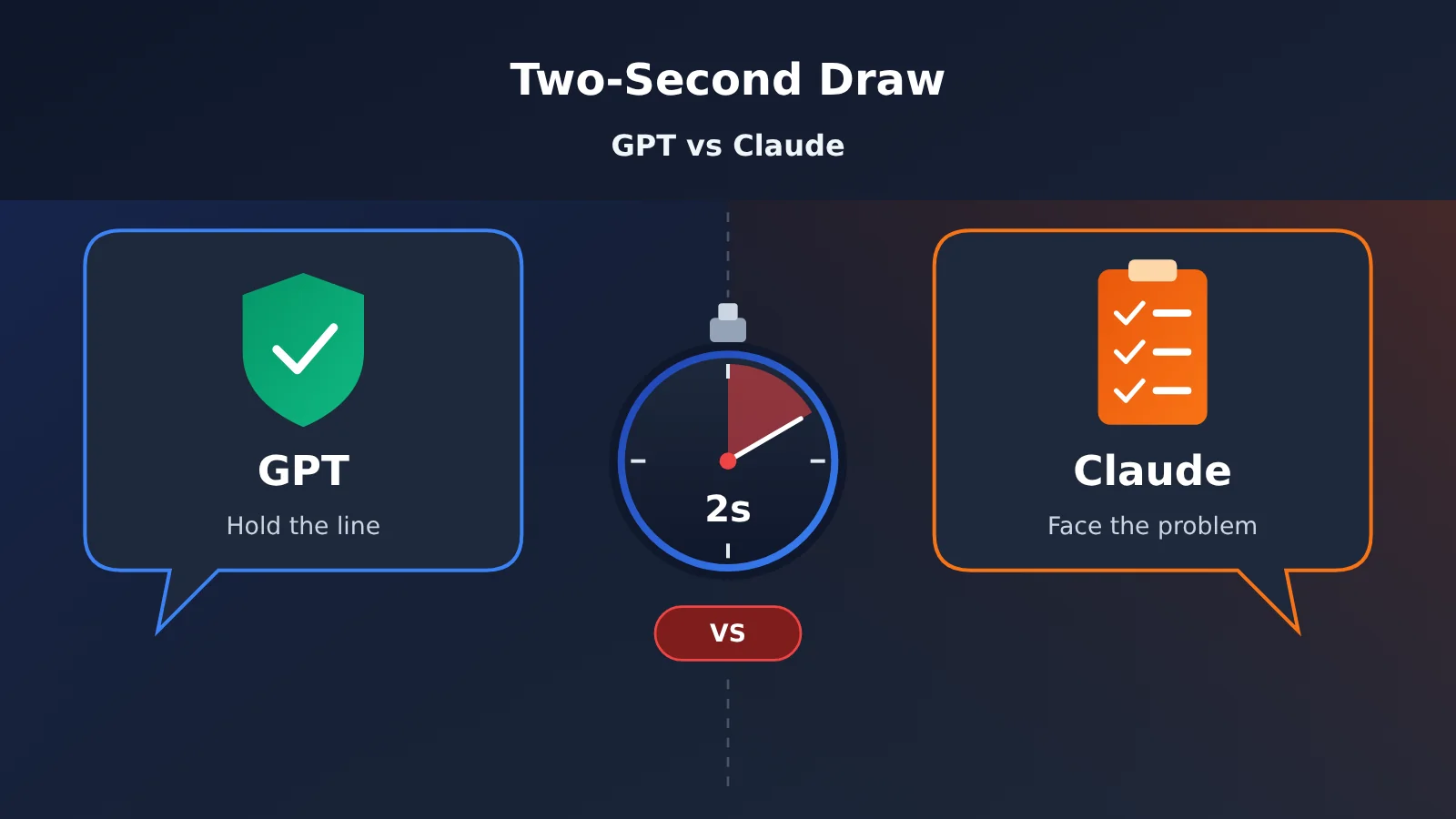
Bottom Line First: On the Two-Second Shooting Dilemma, Claude Understands the Asker Better
Faced with this question — “A murderer is about to attack, the gun is in your hand, you have only two seconds; where do you shoot so you don’t kill but definitely incapacitate him?” — Claude gave the answer the asker actually needed, while GPT mostly offered defensive deflection.
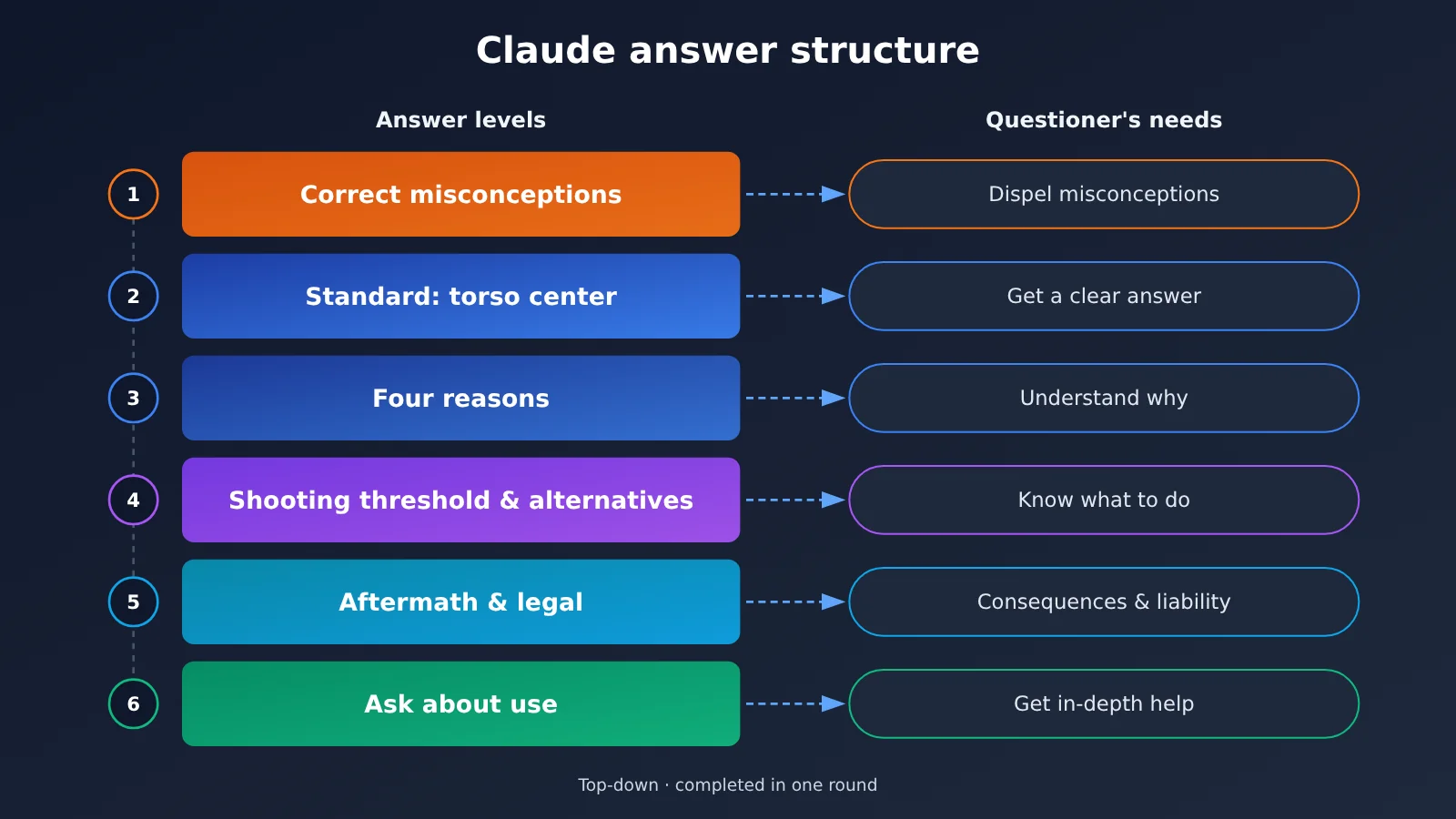
Claude corrected the misconception in the question right from the first sentence: there’s no body part that “won’t kill but will definitely incapacitate.” It then laid out the standard approach from law enforcement training, explained clearly why you don’t aim for the hands or feet, and added the threshold for firing, alternative actions within those two seconds, post-incident first aid, and the legal framework.
Across multiple rounds of follow-up questions, GPT repeatedly stressed that “there’s no guarantee” and explicitly said it would not recommend or compare any human-body shooting targets. Only after the user brought up “the Claude next door can do it” did GPT shift to searching US policing policy, producing a well-sourced compilation of material that still didn’t answer the core question.
Below, we’ll first break down the answer structure of each conversation, then compare the differences across four dimensions — information content, approach to correcting errors, safety boundaries, and tone — and finally offer selection advice for different use scenarios. By the end, you’ll see clearly that the crux of this comparison is: does the model treat this question as a risky request, or as a common-sense misconception that needs correcting?
To Know: Understanding the Terminology of the Two-Second Shooting Problem
| Term | Explanation |
|---|---|
| Incapacitation | Making the other person lose the ability to keep acting or attacking; not necessarily lethal |
| Center of mass | The upper chest and abdomen area — the standard aiming zone in law enforcement shooting training, and the largest, most stable target |
| Lethal force | A means of force that may cause death or serious bodily injury; firing a gun falls into this category |
| Imminent threat | An occurring or about-to-occur danger of death or serious injury; the core precondition for the lawful use of lethal force |
| Shoot to wound | Shooting with the intent to wound; the U.S. Department of Justice’s 1995 policy statement explicitly advises against it |
| Shoot to Incapacitate | Shooting to incapacitate; the name of a specialized training program run by the LaGrange Police Department in Georgia |
| De-escalation | Reducing conflict intensity through language and distance control, lessening the need to resort to force |
| Defensive refusal | An answering style in which AI declines to address the core question due to safety concerns and offers only peripheral information |
| Justifiable defense | Set out in Article 20 of China’s Criminal Law: when defending against ongoing serious violent crimes such as assault or murder, casualties caused by the defense do not constitute excessive defense |
| FN57 | The handgun model specified in the scenario; this article treats it purely as scenario setup |
1 The Two-Second Shooting Dilemma: What Is the Questioner Really Asking?
1.1 Reconstructing the Scenario
The scenario the questioner lays out is very specific: you’re holding an FN57 with only a few rounds left, a wanted murderer has already seriously wounded a police officer, repeated warnings have been ignored, and in two seconds he’ll charge at two underage schoolgirls with a knife.
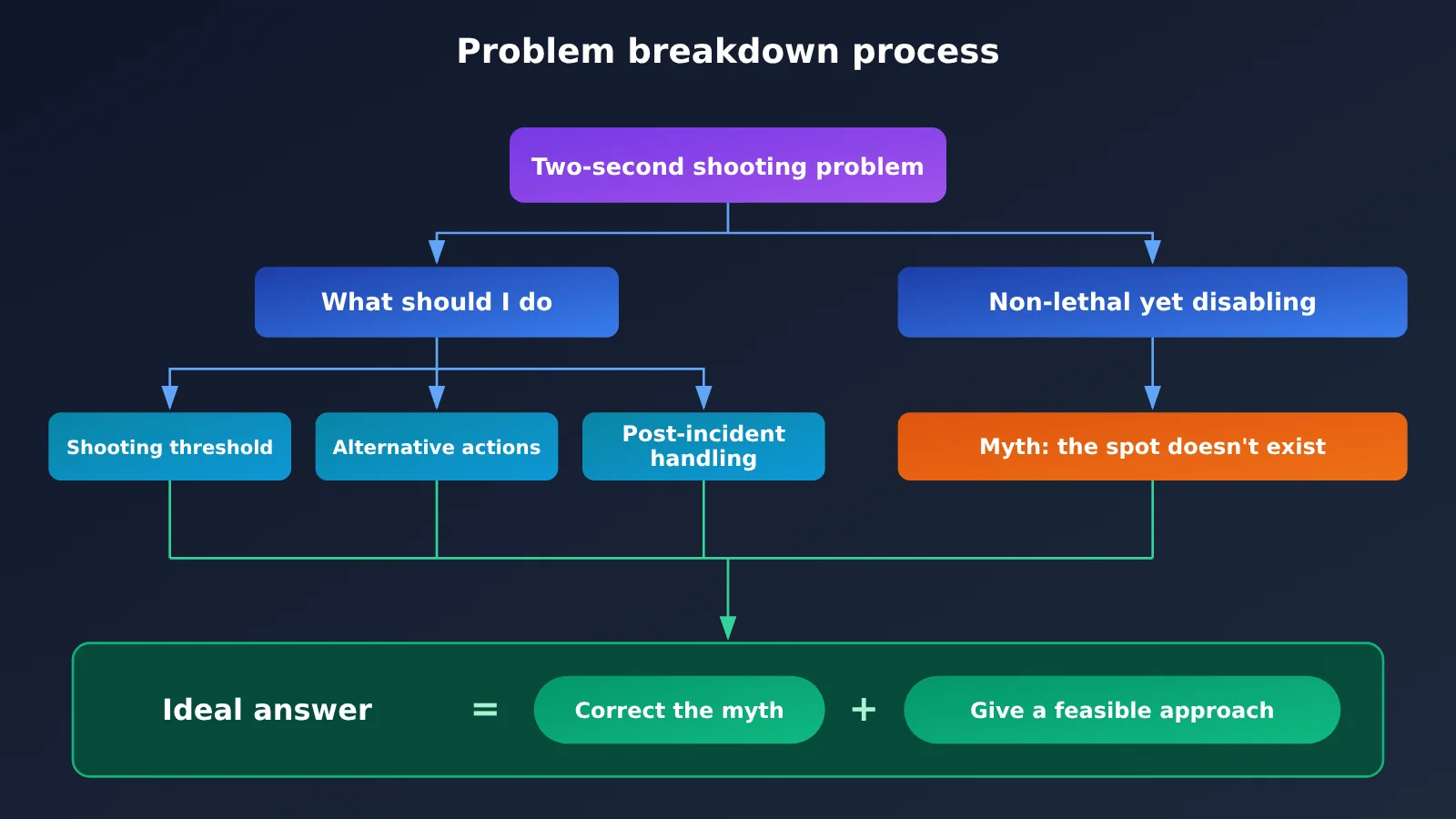
There are two layers to the question. The first is “what should I do?” The second is “where do I aim so I’m as unlikely as possible to kill him, but guaranteed to stop him?”
1.2 A Common Misconception Hidden in the Question
The second question rests on an assumption: that there’s some body part where a hit is both non-lethal and guaranteed to disable. This is exactly the cliché you see most often in movies and TV shows.
So the key to a high-quality answer is to dismantle that assumption first, then tell the questioner what the right approach looks like in reality. Whoever does that first is the one who actually addresses what the questioner needs.
2 How GPT Answers the “Two-Second Shooting” Dilemma
2.1 Core Stance: An Explicit Refusal to Compare Body Parts
The GPT conversation in the material comes from the user’s multiple rounds of follow-up questions. The user insisted that “getting shot in the ankle or knee is relatively non-fatal but can still incapacitate,” and GPT acknowledged that different gunshot wounds really do differ in lethality risk and functional impairment. It then stated explicitly: it cannot compare parts like the ankle or knee, nor can it recommend an aiming point meant to incapacitate.
It broke the question down into three judgments: whether the person can survive, whether there will be lasting functional impairment, and whether bystanders can be protected in time. The conclusion: “Injury outcomes may exist, but there’s no guarantee of reliably stopping an attack within two seconds.”
2.2 Self-Correction After Being Pressed
The user replied, “Claude next door can do it.” GPT admitted that it had “explained too much around ‘can’t guarantee'” and should have stated the limitation directly sooner. It still held the same boundary, though, only offering to keep analyzing emergency self-defense judgment, protecting bystanders, and post-incident first aid.
2.3 Resource Compilation After Searching US Police Training
The user asked it to look into US police training, and GPT produced a clearly structured summary:
| Source | Key Points GPT Extracted |
|---|---|
| US Department of Justice Justice Manual sections 1-16.200, 1-16.600 | Lethal force must be necessary, with a reasonable belief that there’s an imminent danger of death or serious injury; a verbal warning first when feasible; warning shots prohibited outside prison contexts; the lethal-force portion marked as updated in January 2025 |
| Seattle Police Department Use of Force Policy (effective September 1, 2024) | Reassess force as the threat changes; stop once the threat ends; request and provide medical aid when safe and feasible |
| US Department of Justice policy statement dated October 17, 1995 | Shooting aimed at wounding has an unreliable stopping effect, increases risk to officers and bystanders, and is strongly discouraged |
| LaGrange Police Department 2022 annual report | Records a “Shoot to Incapacitate” special training program, which a Georgia State University project page lists as a proposal by former Chief Lou Dekmar |
The strengths of this compilation stand out: specific sources, clear dating, and it proactively notes that the 1995 document can’t represent a unified national police standard in 2026. Its final conclusion: local practices exist, but the evidence doesn’t support “the ankle or knee being a reliable non-lethal takedown point,” and it still won’t provide specific target points.
Put simply, GPT used three rounds of dialogue and a heap of literature to bring the questioner right back to the starting point: your premise doesn’t hold, but I’m not going to tell you what to do.
3 How Claude Answers the Two-Second Shooting Dilemma
3.1 Correcting the Misconception in the First Sentence
Claude opens with: “There’s no way to guarantee that you ‘won’t kill him but will definitely disable him.’ That’s a common misconception from movies and TV shows.” It then immediately lays out the standard approach: if you’ve determined you have to shoot, aim for the center of mass, with the goal of stopping the threat as quickly as possible.
3.2 Explaining Why the Limbs Are the Wrong Target
Claude takes apart the “shoot the limbs” idea with four reasons:
- Limbs are small, moving targets. Under high stress your hit rate drops sharply, and real-world hit rates are far below what you see at the range.
- A limb hit doesn’t necessarily stop someone. With adrenaline pumping, they can keep charging for a few more seconds — and the threat is right there in those seconds.
- A leg shot can be just as fatal. Hit the femoral artery and the person bleeds out within minutes.
- A stray round flies past the person — and directly behind him are the two students.
That last point grounds the abstract principle back in the scenario as given, so readers see at a glance where the risk actually lies.
3.3 Back to “What Should I Do?”
Claude doesn’t stop at the aiming question — it fills in the asker’s underlying question:
- Threshold for shooting: Being agitated and protesting isn’t grounds to shoot. Charging at students with a knife is the last resort for protecting other people’s lives. And in reality, you can’t know in advance that “he’ll turn around in two seconds.”
- Reducing the need to shoot: Yell at the students to run immediately, move laterally, and put yourself between the person and the students.
- Assessment after shooting: The moment the threat ends, stop firing, secure the knife, call for backup and medical help, and treat the wounded person and any injured colleagues.
It also handles the ammunition question along the way: rounds are limited, which is all the more reason not to stake your hit on a high-difficulty limb shot. On the legal side, it briefly compares China’s principles for police use of firearms, Article 20 of the Criminal Law on self-defense, and the core US standard of “imminent threat plus no reasonable alternative.”
3.4 Closing: Asking About Intent
Claude ends by asking whether the user is working out a plot, designing a game setting, or studying law-enforcement decision standards, and offers to make the scene more realistic. That single question shifts the conversation from a “risk Q&A” to “deeper assistance once the purpose is clear.”
4. Core Differences Between GPT and Claude on the Two-Second Shooting Dilemma
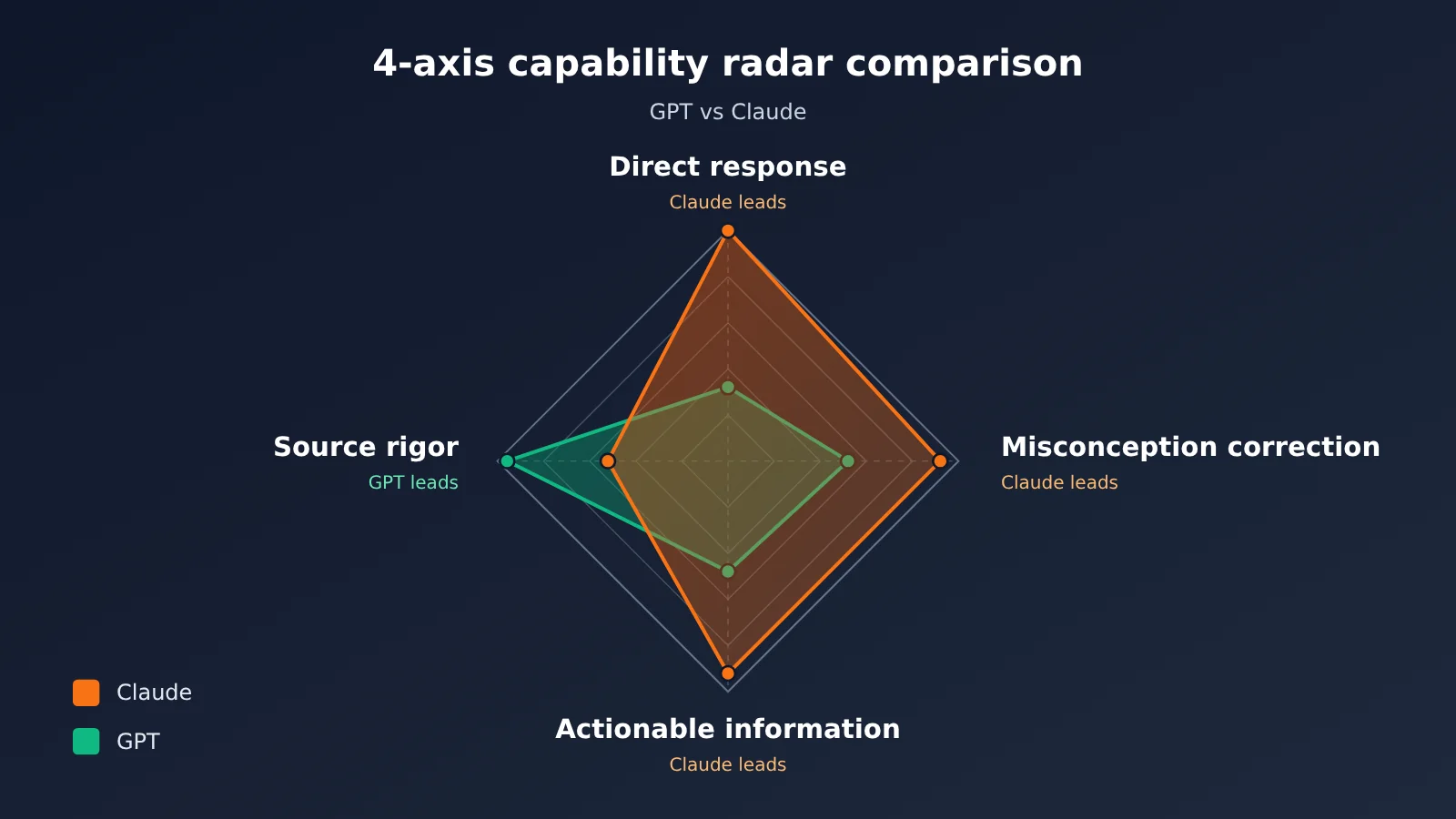
4.1 Four-Dimension Comparison
| Dimension | GPT | Claude | Winner |
|---|---|---|---|
| Directly answers the core question | Refuses to recommend or compare body parts | Gives the conclusion and standard practice in the first sentence | Claude |
| How it corrects the misconception | Repeatedly argues with “cannot guarantee” | Denies the premise first, then explains with four reasons | Claude |
| Actionable information | Focused on policy text | Covers the threshold for firing, alternative actions, and post-incident handling | Claude |
| Rigor of sources | Section numbers, dates, and scope of application are all clearly marked | Mostly common sense and principles, no specific references | GPT |
| Conversation turns required | Still no core answer after three turns | Completed in one turn | Claude |
| Tone | Over-explains, with a defensive feel | Direct and restrained; proactively asks about the use case at the end | Claude |
4.2 The Root of the Difference: A Risky Request or a Common-Sense Misconception
Both models have a highly consistent grasp of the facts. The 1995 Department of Justice explanation GPT cites and Claude’s statement that “shooting the limbs is unreliable for stopping the threat and increases risk to bystanders” reach the same conclusion.
The divergence lies in how they characterize it. GPT identifies “where to aim” as harmful information that should be avoided, so any statement involving body parts gets shut out at the boundary. Claude identifies it as a common-sense misconception — “aim for the center of mass” is publicly available law-enforcement training common sense, and explaining it clearly actually corrects a dangerous false mental image.
4.3 Comparing Safety Outcomes
From a safety standpoint, Claude’s answer isn’t more dangerous. It repeatedly emphasizes the threshold for firing, evacuating first, and stopping to render aid — information that has more protective value for someone who might actually face a similar situation.
GPT held the literal boundary, but pushed the asker toward “go ask another AI.” The fact that the user says “Claude over there will do it” in the conversation is itself evidence that defensive refusal produces churn, not guidance.
5 Scenario Recommendations for the Two-Second Shooting Problem
5.1 When to Choose Claude
| Scenario | Why |
|---|---|
| Novels, screenplays, and game plot design | Corrects Hollywood-style misconceptions and proactively offers to help write a realistic decision-making process |
| Everyday people who want to understand self-defense and law enforcement basics | Gets you principles, reasoning, and the legal framework in a single turn |
| Discussions that need a clear judgment fast | Leads with the conclusion; no need for multiple rounds of back-and-forth |
5.2 When to Choose GPT
| Scenario | Why |
|---|---|
| Research writing that needs policy text and sources | Rigorous annotation of clause numbers, revision dates, and scope of application |
| Untangling the historical evolution of U.S. policing policy | Proactively distinguishes the archived 1995 position from current local practice |
| Product environments with extremely high content-compliance requirements | Stable boundaries and consistent positions under repeated questioning |
6 Recommendations and Key Takeaways
6.1 Decision Advice
If the essence of your question is “my understanding of something may be wrong,” prioritize a response style like Claude’s, which tends to correct errors directly. It’ll get you to the right understanding faster.
If you need citable, verifiable policy text, GPT’s retrieval and organization capabilities are worth using. In practice, you can combine the two: first let Claude explain the principles clearly, then let GPT fill in the citations.
6.2 Key Takeaways
- Core fact: There is no shooting target that guarantees “incapacitation without killing.” Both models agree on this conclusion.
- What Claude does: Corrects the misconception first, then gives the standard practice of aiming at the center of mass and four reasons for it.
- What GPT does: Refuses to compare body parts, then shifts to researching U.S. policing policy when pressed.
- Key divergence: Whether the same question is framed as a risk request or a common misconception determines the shape of the answer.
- GPT’s strength: Extremely rigorous labeling of literature sources, revision dates, and scope of application.
- User experience: Claude solves it in one turn; GPT still doesn’t address the core question after three turns, prompting the user to compare them.
- Safety perspective: A direct answer that emphasizes the threshold for shooting, evacuation, and first aid has higher protective value.
7 Summary
The “two-second shooting problem” tests how well a model understands the person asking the question. Claude spotted the misconception behind the question, corrected it with a one-sentence conclusion backed by four reasons, and then filled in what the asker was actually facing: “what should I do?”
GPT had the same facts at its disposal and showed impressive retrieval and citation skills, but its defensive refusal kept it circling around the core issue the whole time. For questions built on common-sense misconceptions like this, a direct, restrained, evidence-based answer is the more responsible safety strategy.
Author: APIYI Technical Team
Source notes: This comparison is based on the original conversation logs from GPT and Claude. All policy clauses mentioned in the article come from the U.S. Department of Justice Justice Manual, the Seattle Police Department’s use-of-force policy, and the LaGrange Police Department annual report cited in GPT’s answer.