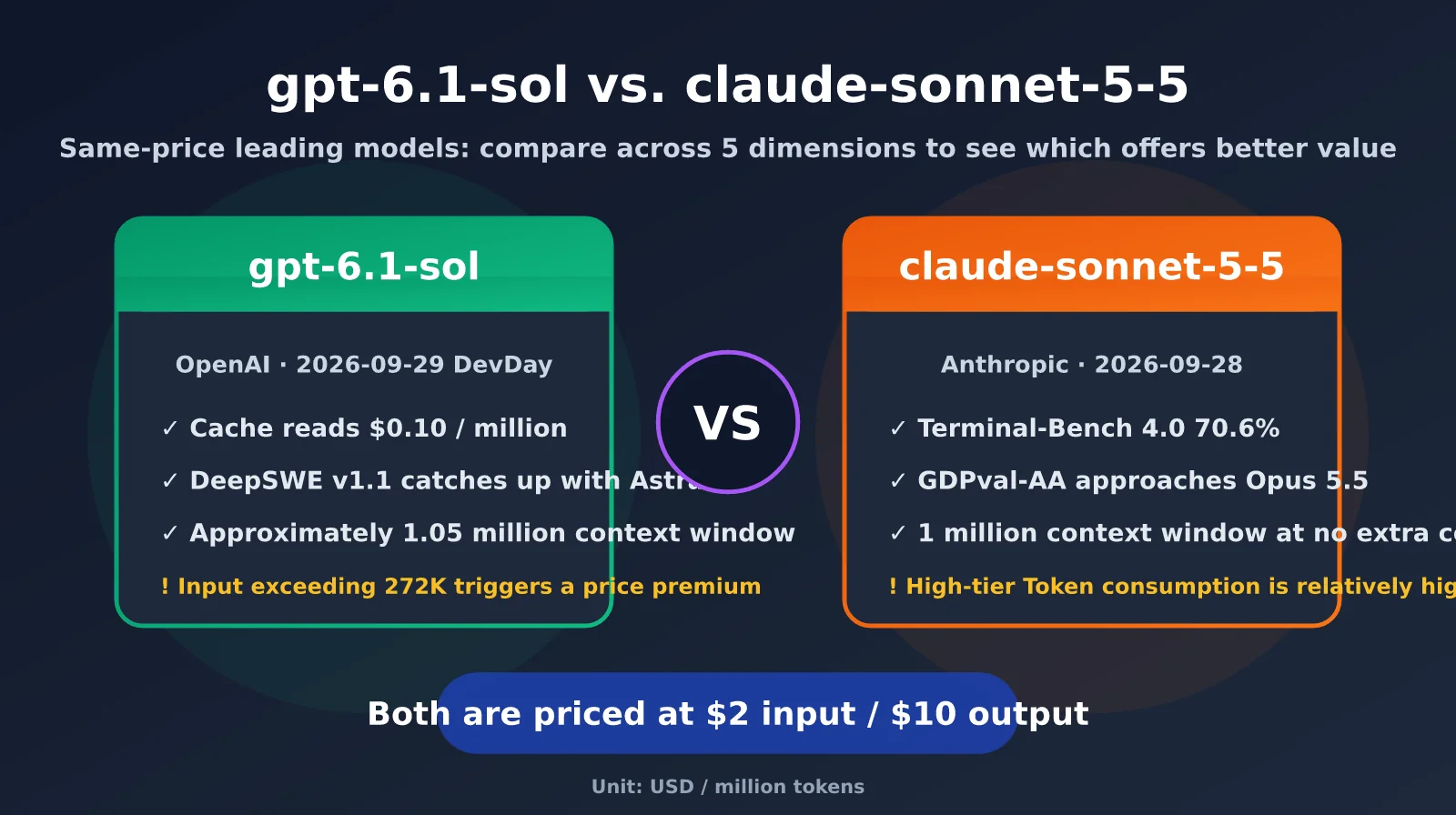
On September 28, Anthropic released claude-sonnet-5-5. The very next day, OpenAI launched gpt-6.1-sol at DevDay. The new flagship workhorse models from both companies arrived back-to-back—and with exactly the same list price: $2 per million input tokens and $10 per million output tokens. Many developers’ first reaction was, “They’re both cheaper, so just pick either one.” But once you put them into production, the differences in per-task cost, long-context billing, and agent performance are far greater than the pricing table suggests. This article breaks down the real differences between gpt-6.1-sol and claude-sonnet-5-5 across five dimensions, helping you move beyond brand preferences and account availability to make rational, scenario-based decisions.
Key takeaway: By the end of this article, you’ll know which model to choose and how to configure gpt-6.1-sol and claude-sonnet-5-5 for coding agents, office documents, long-context retrieval, and high-concurrency batch processing.
gpt-6.1-sol vs. claude-sonnet-5-5: Core Specs at a Glance
First, let’s clear up a common misconception: strictly speaking, neither model has reduced its list price. claude-sonnet-5-5 retains Sonnet 5’s $2/$10 pricing, while gpt-6.1-sol is priced the same as the previous-generation gpt-6-sol. The perceived “price cut” comes from two factors. First, flagship-level capabilities have moved down to workhorse-model pricing: gpt-6.1-sol costs just one-fifth as much as gpt-6-astra, while claude-sonnet-5-5 costs half as much as Opus 5.5. Second, hidden costs are falling: gpt-6.1-sol cuts cached input pricing in half, from $0.20 to $0.10, while claude-sonnet-5-5 can reduce per-task costs by up to around 30% by requiring fewer tool calls.
| Specification | gpt-6.1-sol | claude-sonnet-5-5 |
|---|---|---|
| Release date | 2026-09-29 (DevDay) | 2026-09-28 |
| Model ID | gpt-6.1-sol |
claude-sonnet-5-5 |
| Context window | Approximately 1.05 million tokens | 1 million tokens |
| Maximum output | 128K | 128K (up to 300K in Batch beta) |
| Reasoning levels | low / medium (default) / high / xhigh / max | low / medium / high (API default) / xhigh / max |
| Thinking mode | Configurable by level | Adaptive reasoning; can’t be disabled |
| Flagship counterpart | gpt-6-astra ($10/$50) | Claude Opus 5.5 ($4/$20) |
| Available platforms | APIYI apiyi.com, OpenAI official API | APIYI apiyi.com, Anthropic official API |
The table highlights one important distinction: the two models have different default reasoning levels. gpt-6.1-sol defaults to medium, while claude-sonnet-5-5 defaults to high through the API. If you compare them using the default settings, you’re effectively letting Sonnet “think” one level harder—so token usage and latency won’t be comparable. For a fair comparison, explicitly set the same reasoning_effort for both models.
🎯 Testing tip: When comparing these models, make sure you lock in the same reasoning level and prompt. We recommend using a single API key through APIYI apiyi.com to call both gpt-6.1-sol and claude-sonnet-5-5, changing only the
modelparameter for A/B testing. This helps prevent account and network differences from introducing confounding variables.
5 Key Differences Between gpt-6.1-sol and claude-sonnet-5-5
Difference 1: For Coding Agents, claude-sonnet-5-5 Leads in Terminal-Based Tasks
Coding is where these two models compete most intensely, but their published benchmarks don’t fully overlap, so they need to be evaluated separately. claude-sonnet-5-5 achieved an official score of 70.6% on Terminal-Bench 4.0—a massive jump from Sonnet 5’s 10.3%, and even ahead of Opus 5.5’s 66.4%. An independent retest by Artificial Analysis reported 64%, also above both Opus 5.5 and gpt-6-astra at 60%. It scored 81.3% on SWE-Bench Pro and 55.5% on CursorBench 4.0, second only to Opus 5.5.
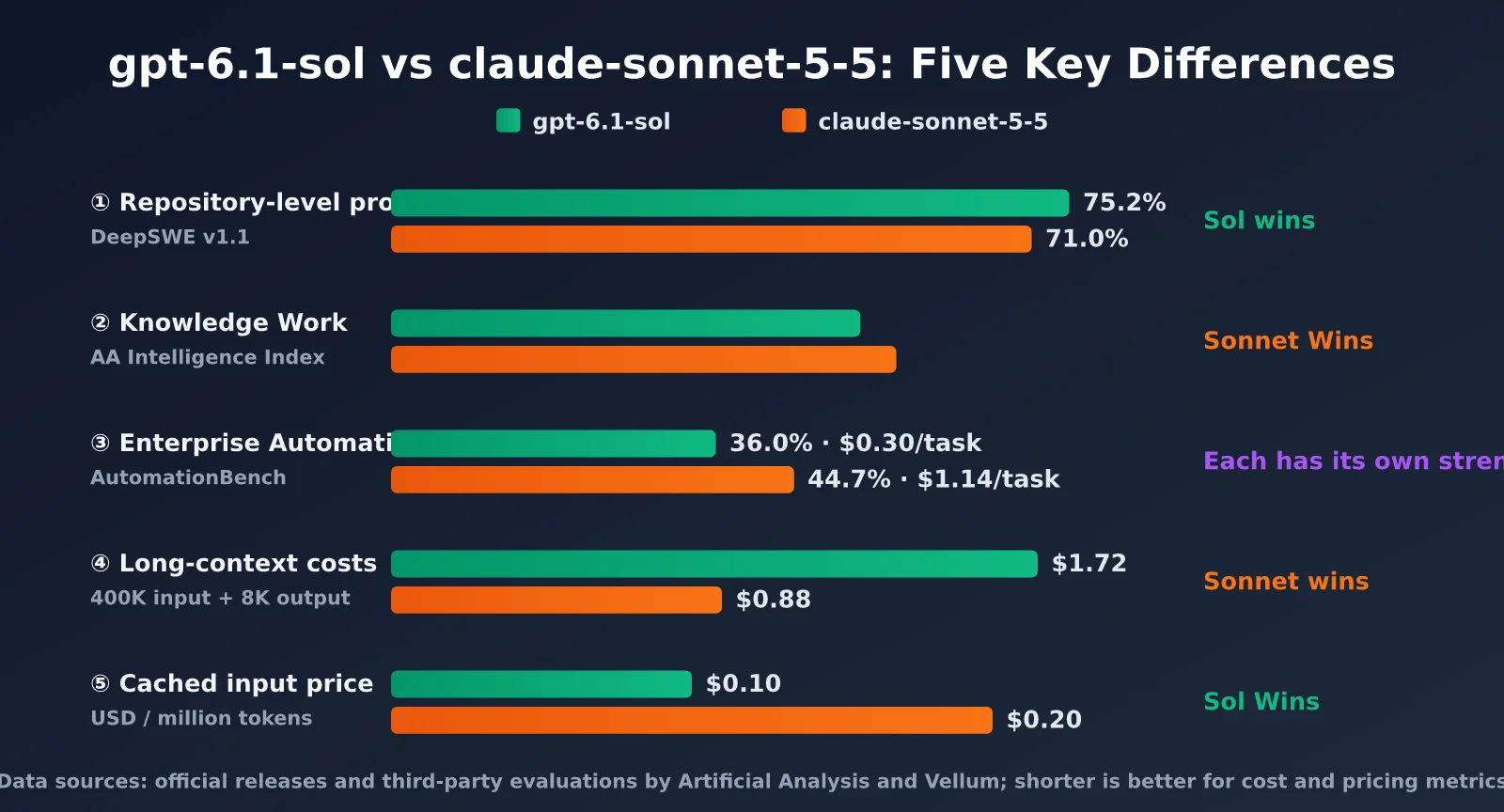
For gpt-6.1-sol, OpenAI highlights its 75.2% score on DeepSWE v1.1, slightly ahead of gpt-6-astra’s 74.8%, while costing only around $1.50 per task—less than one-fifth of Astra’s cost. Third-party roundups put claude-sonnet-5-5 at 71.0% on the same benchmark. In other words, claude-sonnet-5-5 has stronger evidence for terminal-driven agentic coding, while gpt-6.1-sol offers better value for repository-level software engineering tasks.
Difference 2: For Knowledge Work, claude-sonnet-5-5 Nearly Matches Opus
claude-sonnet-5-5 performs exceptionally well in office-style knowledge work. It scored 1844 on GDPval-AA v2.1, essentially tied with Opus 5.5 at 1846. Its AA-Briefcase score of 1811 is similarly close to Opus. In the Artificial Analysis Intelligence Index, claude-sonnet-5-5 ranks second with 56 points, just 2 points behind Opus 5.5. gpt-6.1-sol (max) scores 52.
gpt-6.1-sol has its own strengths in document analysis. On the GDP.pdf benchmark, it scored 32.0%, nearly matching gpt-6-astra’s 32.2% and outperforming Opus 5.5’s 28.8%, at roughly $0.38 per task. On AutomationBench for enterprise workflow automation, claude-sonnet-5-5 leads with 44.7%, compared with gpt-6.1-sol’s 36.0%. However, the former costs about $1.14 per task, while the latter costs just $0.30.
Difference 3: Computer Use, Both Models Are Now Practical
For Computer Use, gpt-6.1-sol scored 71.4% on OSWorld 2.0, just 2.1 percentage points behind gpt-6-astra’s 73.5%, at around $1.30 per task. claude-sonnet-5-5 scored 80.1% on OSWorld 2.1, close to Opus 5.5’s 81.8%. Keep in mind that these are different OSWorld test-set versions, so the scores aren’t directly comparable. Still, both models have clearly reached the point where they can reliably operate desktop applications.
Difference 4: Long-Context Pricing Gives gpt-6.1-sol a Hidden Threshold
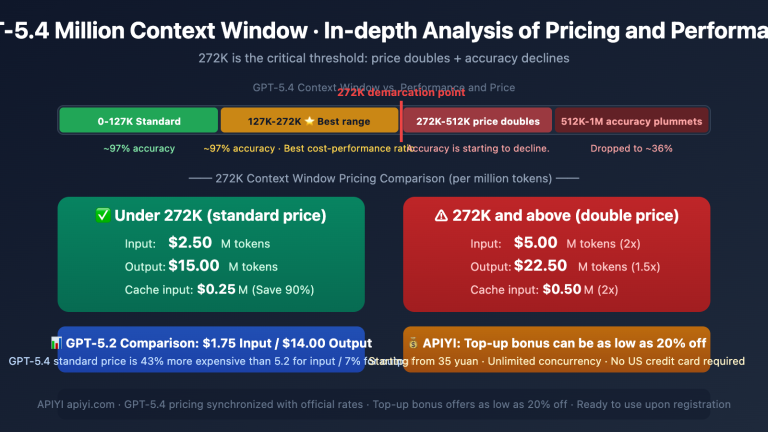
This is the easiest difference to overlook—and one that can have the biggest impact on your bill. While gpt-6.1-sol supports a context window of around 1.05 million tokens, once a request exceeds 272K input tokens, input and cached tokens for the entire request are charged at 2× the standard rate, while output is charged at 1.5×. claude-sonnet-5-5 also supports a 1 million-token context window, but doesn’t add a long-context surcharge: standard pricing applies throughout.
If your workload regularly puts an entire manual or full code repository into the context window, this difference alone could change which model makes the most sense.
Difference 5: Token Efficiency and Caching Favor gpt-6.1-sol
gpt-6.1-sol charges $0.10 for cached reads, half the $0.20 charged by claude-sonnet-5-5. That’s a clear advantage in scenarios such as agent loops, where prompt prefixes are highly repetitive. On the other hand, claude-sonnet-5-5 tends to consume more tokens at higher reasoning settings. Artificial Analysis found that its max setting produces around 193,000 output tokens per task—the highest observed so far. Independent testing also found that the API’s default high setting uses nearly twice as many output tokens as medium, without a clear quality improvement.
| Benchmark / Metric | gpt-6.1-sol | claude-sonnet-5-5 | Winner |
|---|---|---|---|
| Terminal-Bench 4.0 (official) | Not published | 70.6% | claude-sonnet-5-5 |
| DeepSWE v1.1 | 75.2% | 71.0% | gpt-6.1-sol |
| GDPval-AA v2.1 | Not published (previous-generation gpt-6-sol: 1487) | 1844 | claude-sonnet-5-5 |
| GDP.pdf document analysis | 32.0% | Not published | gpt-6.1-sol |
| AutomationBench | 36.0% (~$0.30/task) | 44.7% (~$1.14/task) | Sonnet for quality, Sol for cost |
| AA Intelligence Index | 52 | 56 | claude-sonnet-5-5 |
| Cached read price | $0.10 / million | $0.20 / million | gpt-6.1-sol |
💡 About the data: These benchmarks come from official OpenAI and Anthropic results, along with third-party evaluations from Artificial Analysis, Vellum, and others. Test versions and reasoning settings vary across organizations. We recommend running a side-by-side test using your own real-world workload—it’ll be more useful than any leaderboard.
Real Cost Comparison: gpt-6.1-sol vs. claude-sonnet-5-5
Identical list prices don’t necessarily mean identical bills. The table below estimates the cost per request for three typical workloads (excluding cache writes and based on official pricing), making it easy to see where the differences come from.
| Workload Scenario | Request Composition | gpt-6.1-sol | claude-sonnet-5-5 |
|---|---|---|---|
| Agent loop (high cache hit rate) | 100K input (90% cache hit) + 5K output | About $0.079 | About $0.088 |
| Standard chat | 5K input + 1K output | About $0.020 | About $0.020 |
| Ultra-long-context retrieval | 400K input (no cache) + 8K output | About $1.72 (premium pricing applies) | About $0.88 |
| Batch processing | 50% off list price | $1 / $5 | $1 / $5 |
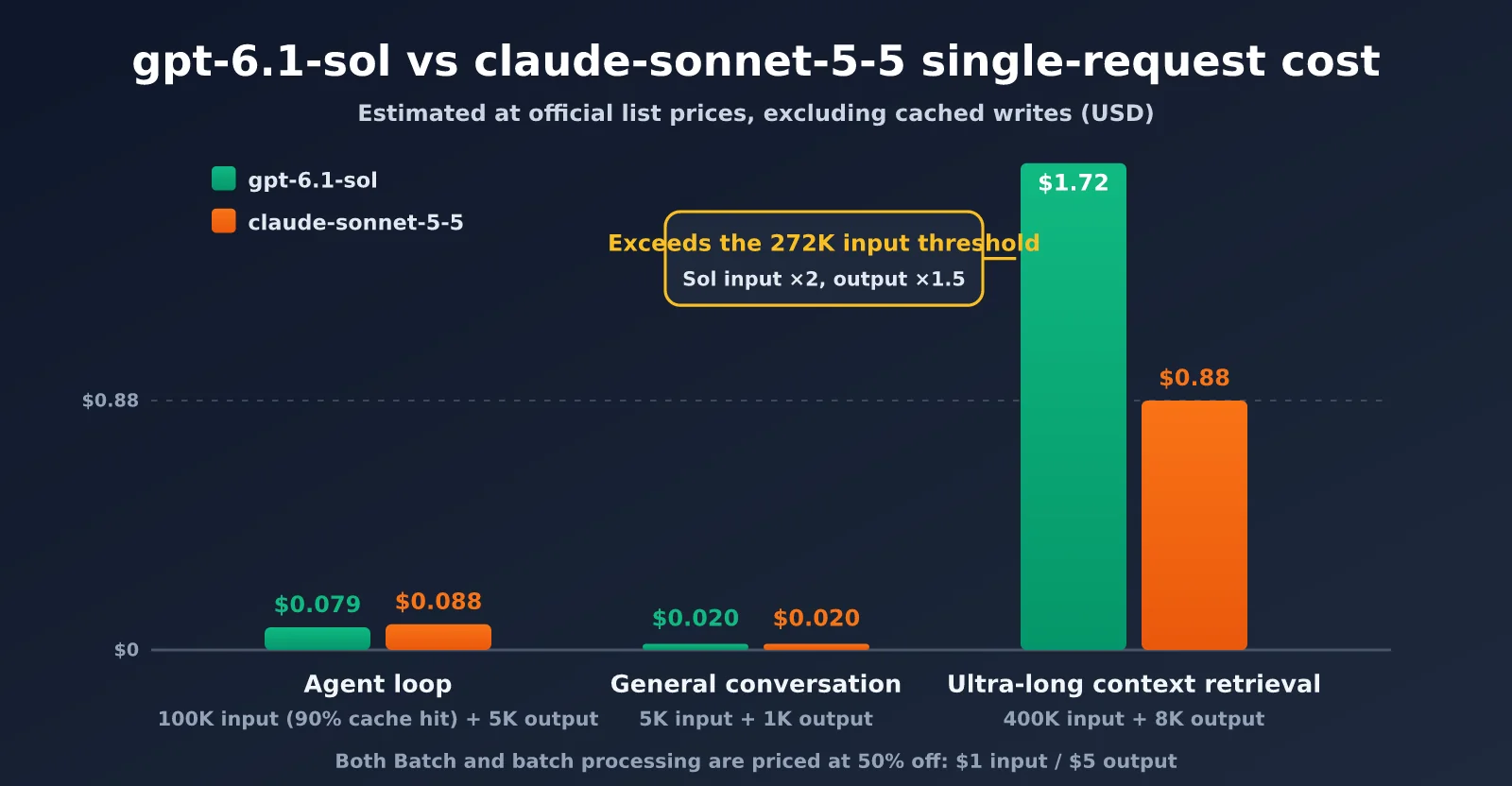
The conclusion is clear: in agent loops with highly repetitive prefixes, gpt-6.1-sol comes out roughly 10% cheaper thanks to lower cache-read pricing. For standard chat, the two are nearly identical. But once a single input exceeds 272K tokens, claude-sonnet-5-5 costs only about half as much as gpt-6.1-sol.
Token efficiency is another factor to consider. If claude-sonnet-5-5 runs at the high or max reasoning level, its actual output tokens may double, which can offset its long-context advantage. Keeping the reasoning level under control is therefore key to getting the most from Sonnet.
Quickly Compare Both Models with the Same Code
With an OpenAI-compatible API, you only need to switch the model parameter to test the two models side by side. Here’s a minimal example:
from openai import OpenAI

client = OpenAI(
    api_key="YOUR_API_KEY",
    base_url="https://api.apiyi.com/v1"  # APIYI unified API; both models share one key
)

for model in ["gpt-6.1-sol", "claude-sonnet-5-5"]:
    resp = client.chat.completions.create(
        model=model,
        reasoning_effort="medium",  # Keep the same level for a fair comparison
        messages=[{"role": "user", "content": "为这个函数补充单元测试:def add(a, b): return a + b"}],
    )
    print(model, resp.usage.total_tokens, resp.choices[0].message.content[:200])
Expand to view: full comparison script with latency and cost metrics
import time
from openai import OpenAI

client = OpenAI(
    api_key="YOUR_API_KEY",
    base_url="https://api.apiyi.com/v1"  # APIYI unified API
)

# Price per million tokens: input, cache read, output
PRICES = {
    "gpt-6.1-sol": (2.0, 0.10, 10.0),
    "claude-sonnet-5-5": (2.0, 0.20, 10.0),
}

def run(model: str, prompt: str, effort: str = "medium"):
    start = time.time()
    resp = client.chat.completions.create(
        model=model,
        reasoning_effort=effort,
        messages=[{"role": "user", "content": prompt}],
    )
    elapsed = time.time() - start
    u = resp.usage
    cached = getattr(getattr(u, "prompt_tokens_details", None), "cached_tokens", 0) or 0
    p_in, p_cache, p_out = PRICES[model]
    cost = ((u.prompt_tokens - cached) * p_in + cached * p_cache
            + u.completion_tokens * p_out) / 1_000_000
    return elapsed, u.prompt_tokens, u.completion_tokens, cost

tasks = [
    "用 Python 实现一个带过期时间的 LRU 缓存,并写出测试",
    "阅读以下需求,输出数据库表结构设计与索引建议:订单、用户、优惠券",
]

for task in tasks:
    for model in PRICES:
        t, i, o, c = run(model, task)
        print(f"{model:<20} {t:>6.1f}s  in={i:<6} out={o:<6} ${c:.4f}")
🚀 Get started quickly: If you don’t have an Anthropic account yet, or you’re blocked by international payments or phone verification, register at APIYI apiyi.com to receive test credits. One API key lets you call both gpt-6.1-sol and claude-sonnet-5-5, without the hassle of setting up separate official accounts.
Recommended Use Cases for gpt-6.1-sol and claude-sonnet-5-5
Different products prioritize quality, cost, and latency differently. Here are recommendations for common use cases.
| Business Scenario | Recommended Model | Key Reason |
|---|---|---|
| Terminal-driven coding agents (similar to Claude Code) | claude-sonnet-5-5 | Leads on Terminal-Bench 4.0 and requires fewer tool calls |
| Repository-level code fixes and Codex workflows | gpt-6.1-sol | Matches Astra on DeepSWE, with a per-task cost of around $1.50 |
| Ultra-long document / whole-repository code analysis (>272K) | claude-sonnet-5-5 | No long-context premium; costs about half as much as Sol |
| High-concurrency customer support and RAG Q&A (high cache hit rate) | gpt-6.1-sol | Cache reads cost $0.10, so greater prefix reuse means greater savings |
| Report writing, spreadsheets, and office knowledge work | claude-sonnet-5-5 | Nearly matches Opus 5.5 on GDPval-AA |
| PDF document parsing and information extraction | gpt-6.1-sol | Matches Astra on GDP.pdf, at around $0.38 per task |
| Security research and penetration-testing assistance | gpt-6.1-sol | Sonnet 5.5 includes built-in cybersecurity safeguards, resulting in more refusals |
Typical Use Cases for gpt-6.1-sol
gpt-6.1-sol is best for workloads that are cost-sensitive, high-volume, and have highly repetitive prefixes. Examples include AI customer support, knowledge-base Q&A, and batch data cleaning. When system prompts and retrieved context are heavily reused, its $0.10 cache-read price keeps amplifying the savings.
Its hallucination rate has also improved noticeably. At lower reasoning levels, the factual error rate drops from 11.4% in the previous generation to 7.7%, making the low or medium setting a good choice for high-volume, lightweight tasks. OpenAI is also expected to introduce an Ultrafast tier for gpt-6.1-sol, with generation speeds of up to roughly 300 tokens per second. It costs six times the standard tier, but it could be worthwhile for real-time interactive products.
Typical Use Cases for claude-sonnet-5-5
claude-sonnet-5-5 is better suited to workloads that are complex, require very long context, and demand a high first-pass success rate. For agent tasks, it can often complete work in around three tool calls that would take Sonnet 5 roughly 12–13 calls. Its output speed is also more than 30% faster than the previous generation.
For legal reviews, codebase migrations, and long-form report writing—where large amounts of material need to fit into a single context window—its 1-million-token context window without premium pricing is especially appealing.
One important note: claude-sonnet-5-5 introduces several breaking API changes compared with Sonnet 5. Thinking mode can no longer be disabled, and forced tool selection with tool_choice: "tool" has been removed. If your existing code depends on either behavior, make sure to run regression tests before migrating.
🎯 Architecture recommendation: You don’t have to choose just one model. We recommend setting up simple model routing through APIYI apiyi.com: send short requests and high-cache traffic to gpt-6.1-sol, while routing ultra-long-context and complex coding tasks to claude-sonnet-5-5. You can switch between them as needed through the same OpenAI-compatible API.
Decision Guide: gpt-6.1-sol vs. claude-sonnet-5-5
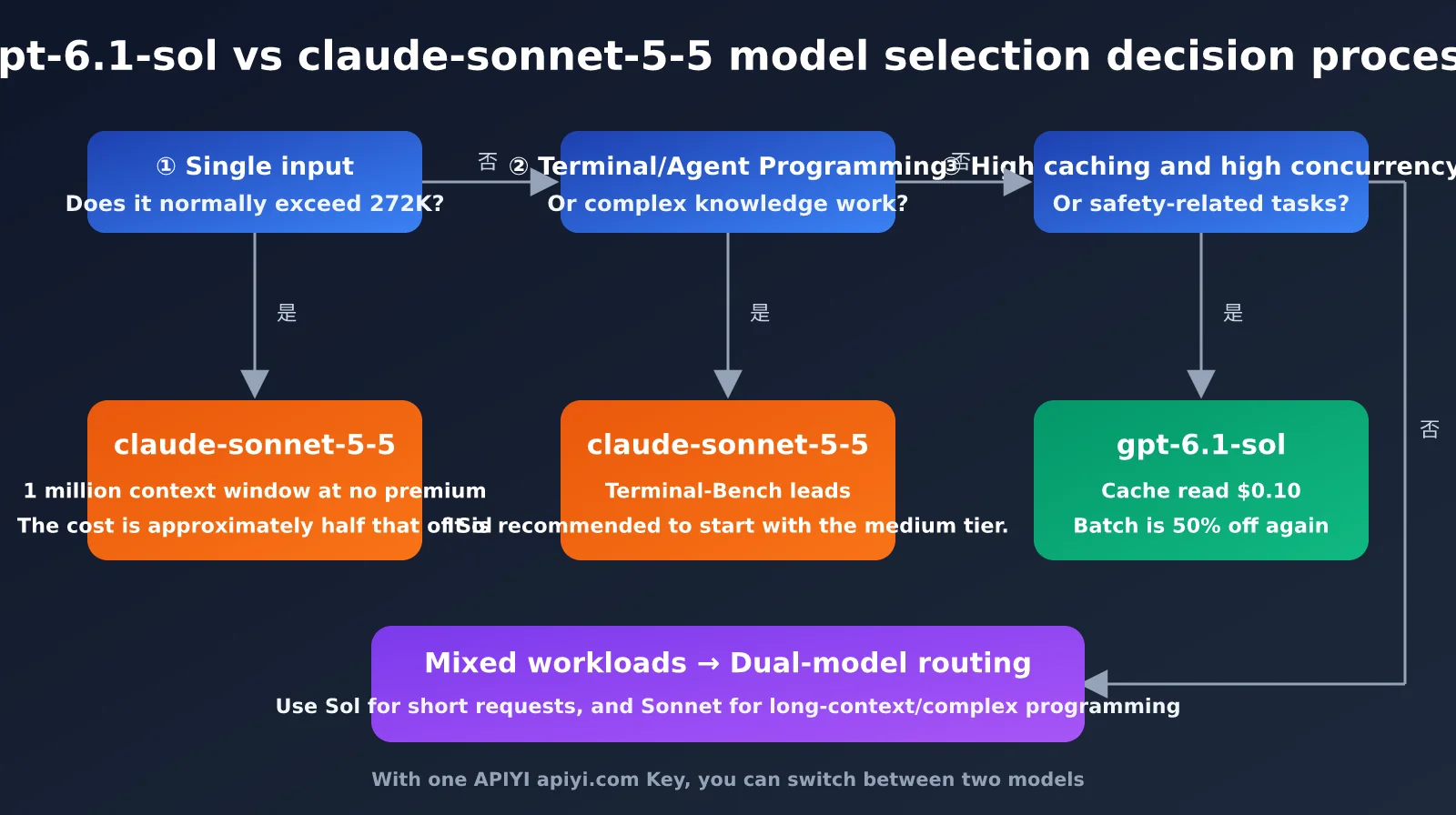
Here’s the earlier analysis condensed into a practical decision process:
- Start with input length: If typical requests exceed 272K tokens, prioritize claude-sonnet-5-5. Otherwise, move to the next step.
- Then assess the task type: For terminal-based agent coding and complex knowledge work, lean toward claude-sonnet-5-5. For repository-level bug fixes and PDF parsing, gpt-6.1-sol is a better fit.
- Next, look at traffic patterns: For workloads with high cache hit rates and heavy concurrency, gpt-6.1-sol’s cost advantage grows significantly at scale.
- Finally, tune the reasoning level: Whichever model you choose, start testing at medium. For claude-sonnet-5-5 in particular, avoid using the API default high setting right away, as token consumption can potentially double.
| Your Priority | Recommended Choice | Backup Strategy |
|---|---|---|
| Quality first, with sufficient budget | claude-sonnet-5-5 (medium/high) | Upgrade difficult tasks to Opus 5.5 |
| Cost first, with massive traffic | gpt-6.1-sol (low/medium) | Send non-real-time workloads through Batch at 50% off |
| Speed first, for real-time interactions | gpt-6.1-sol (once Ultrafast is available) | claude-sonnet-5-5 at the low setting |
| Stability first, avoiding a single point of failure | Dual-model routing | Automatically switch to the other model when one is rate-limited |
As for brand preference and accessibility, neither should determine your technical model selection. Claude’s official accounts have stricter requirements for regions, payment methods, and other factors, which does raise the barrier to entry—but that’s an access-layer issue, not a model capability issue. Once you handle the access layer through a unified API platform, you can choose entirely based on task performance and cost.
Frequently Asked Questions
Q1: Have gpt-6.1-sol and claude-sonnet-5-5 both really become cheaper?
Their list prices haven’t changed: both remain at $2/$10. The real “price reduction” is in what you get for that price. gpt-6.1-sol delivers capabilities close to gpt-6-astra at one-fifth of the cost, while cached input reads have dropped from $0.20 to $0.10. claude-sonnet-5-5 delivers performance close to Opus 5.5 at half the price of Opus, and can reduce per-task costs by up to roughly 30% through fewer tool calls. So when comparing them, focus on total cost per task rather than unit pricing.
Q2: How can I call claude-sonnet-5-5 without an Anthropic account?
Anthropic official accounts have requirements around registration regions, phone numbers, and payment methods. Individual developers and teams in China often get stuck at this step. A simple option is to call it through APIYI at apiyi.com. The platform provides an OpenAI-compatible interface: just change base_url to https://api.apiyi.com/v1 and set model to claude-sonnet-5-5, with no other changes needed to your application code.
Q3: Can I safely use the full 1.05M-token context window of gpt-6.1-sol?
You can, but be mindful of pricing. When a single input exceeds 272K tokens, the input and cached input prices for the entire request double, while output pricing increases by 1.5x. If your workload genuinely requires extremely long contexts, consider retrieval-based compression first, or route those requests to claude-sonnet-5-5, which doesn’t charge a long-context premium.
Q4: Why is claude-sonnet-5-5 sometimes more expensive than expected?
The main reason is the reasoning level. Its API defaults to high, and thinking mode can’t be disabled, so simple tasks can generate a large number of unnecessary reasoning tokens. Independent tests show that medium uses about the same number of tokens as Sonnet 5 while delivering better results. For everyday tasks, explicitly set it to medium.
Q5: Which model should I choose for coding?
If you mainly use terminal-based agents, such as Claude Code, for multi-step development, claude-sonnet-5-5’s Terminal-Bench results are more compelling. If your primary use case is repository-level bug fixing or working in Codex workflows, gpt-6.1-sol matches gpt-6-astra at a lower per-task cost. If your team can support it, integrating both models and routing tasks by type is the most reliable approach.
Summary
There’s no clear overall winner between gpt-6.1-sol and claude-sonnet-5-5. claude-sonnet-5-5 is stronger in agentic coding, knowledge work, and intelligence benchmarks, while offering a 1 million-token context window at no extra cost. gpt-6.1-sol, on the other hand, has advantages in cached-input pricing, repository-level code fixes, document parsing, and per-task costs—making it a better fit for high-volume production workloads with heavy prompt reuse. Although both models have the same list price, the real difference in your bill comes down to three variables: input length, cache hit rate, and reasoning tier.
In practice, you can take a three-step approach: first, use the decision process in this article to choose your primary model; next, run an A/B test on real tasks using the comparison script, with the same reasoning tier fixed for both models; finally, build a dual-model routing strategy by task type so every request goes to the model with the best cost-performance ratio.
If you’d rather skip setting up separate Anthropic and OpenAI accounts, you can use APIYI apiyi.com to call both gpt-6.1-sol and claude-sonnet-5-5 through a single platform. Its API is compatible with the official OpenAI format, and one API key lets you switch freely between the two models. This is especially useful for model evaluation and multi-model routing in production.
References:
– OpenAI announcement: GPT-6.1 Sol introduction — openai.com/index/introducing-gpt-6-1-sol
– Anthropic announcement: Claude Sonnet 5.5 introduction — anthropic.com/claude-sonnet-5-5
– Artificial Analysis Intelligence Index benchmarks — artificialanalysis.ai
– Vellum’s GPT-6.1 Sol benchmark analysis — vellum.ai/blog
– The Decoder’s coverage of Claude Sonnet 5.5 — the-decoder.com
About the Author: The APIYI technical team focuses on Large Language Model API integration and production engineering practices. Feel free to connect with us through APIYI apiyi.com to discuss model selection and cost optimization strategies for gpt-6.1-sol and claude-sonnet-5-5.