Author's Note: Is the Claude Code Buddy just for emotional support, or does it actually do something? This article takes a deep dive into the real value of the Buddy across three dimensions: technical implementation, psychological design, and attribute systems. We’ll also break down the 5-level RPG evolution scheme proposed by the community.
"I pulled a Common Dragon—the lowest rarity, but it’s actually a dragon?" This is probably the reaction of many developers the first time they type /buddy. Then comes the burning question: What is this terminal pet actually for? Can it really help me write code, or is it just there to make me feel less lonely while debugging?
Core Value: After reading this, you'll understand the functional boundaries of the Claude Code Buddy, its true positioning in the developer experience, and the most popular evolution schemes currently circulating in the community.
Claude Code Buddy Value Analysis Key Points
| Dimension | Status | Evaluation |
|---|---|---|
| Code Assistance | Does not directly participate in code generation or review | Pure observer role |
| Emotional Support | Personalized reactions, bubble comments, interactive dialogue | Well-designed |
| Token Consumption | System prompt injection, minimal context usage | Almost zero burden |
| User Retention | Endowment effect + collecting psychology | Clever product strategy |
| Evolution | Currently static/non-upgradable, community proposals exist | Highly anticipated |
The True Positioning of Claude Code Buddy
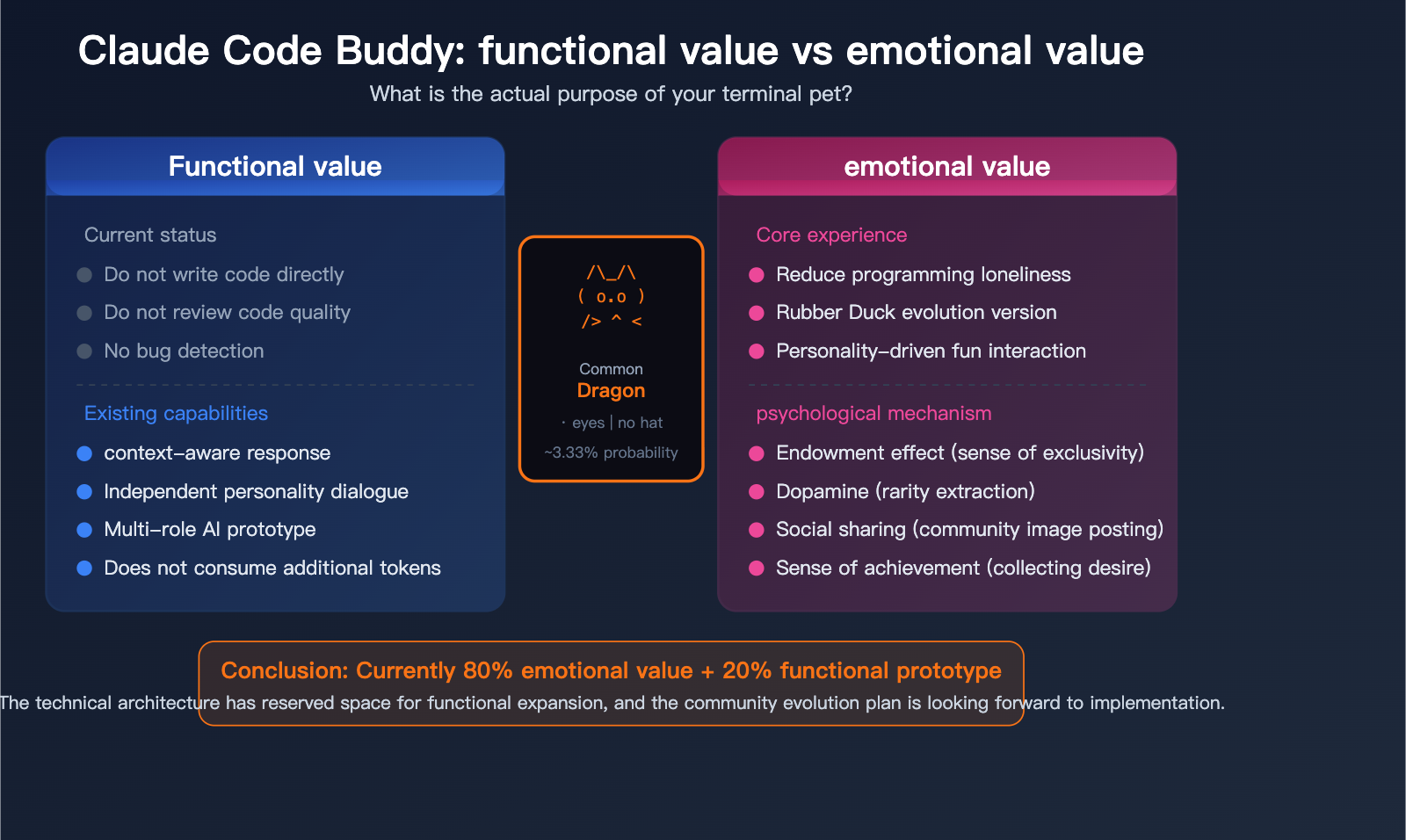
Here’s the bottom line: Claude Code Buddy currently provides primarily emotional value, but its technical architecture leaves room for future functional utility.
This isn't a simple "useful vs. useless" binary. The design of the Buddy blends gamified psychology, multimodal AI interaction prototypes, and developer experience optimization. It’s currently a carefully crafted "terminal companion," but looking at the source architecture, it could easily evolve into a functional programming assistant.
Deep Dive into the Value of Claude Code Buddy
What Claude Code Buddy Can Actually Do
Many people assume Buddy is just a static ASCII graphic, but that’s not the case. Based on an analysis of the leaked source code, Buddy possesses several functional capabilities:
1. Context-Aware Reaction System
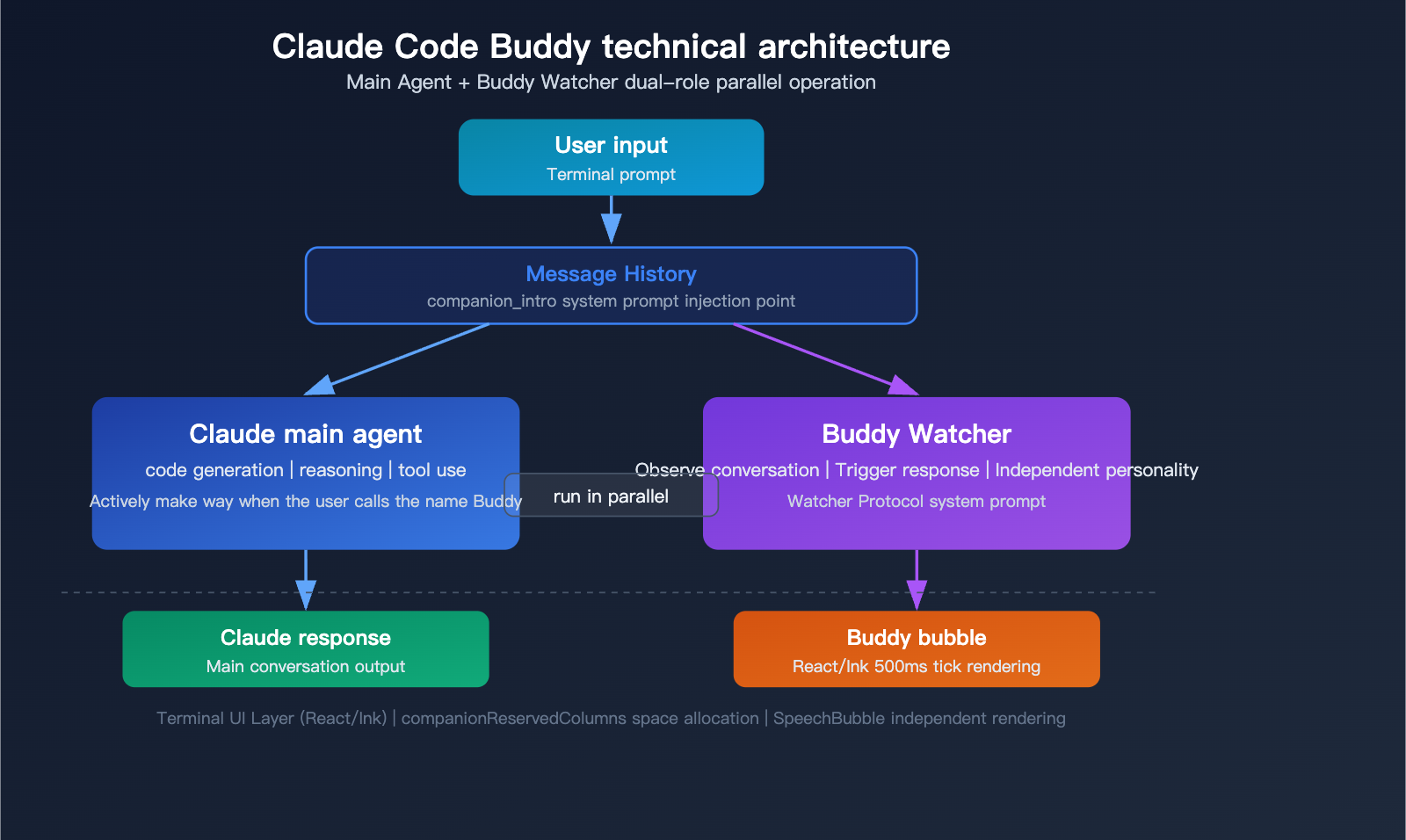
Buddy doesn't just speak at random. It uses the companionReaction state to track your conversation with Claude, triggering reactions at specific moments. For example, when you encounter an error, complete a task, or enter a long period of silence, Buddy will provide different reactions via speech bubbles.
2. Independent Persona Dialogue System
Buddy has its own system prompt (the "Watcher Protocol") that defines its name, species, and personality. When you call Buddy by name, Claude will proactively "step aside," allowing Buddy's bubble to respond independently. This isn't Claude roleplaying as Buddy; it’s an independent personality entity.
3. Conversation Discovery Guidance
The useBuddyNotification hook reminds you of the /buddy command at specific time windows, guiding you to discover and utilize this feature.
| Feature | Implementation | Actual Effect |
|---|---|---|
| Contextual Reaction | companionReaction state machine | Triggers comments based on conversation content |
| Independent Dialogue | Watcher Protocol system prompt | Can be addressed directly by name |
| Visual Rendering | React/Ink animation system | 500ms refresh rate ASCII animations |
| Personality-Driven | 5-attribute system controls response style | Different pets offer unique interaction experiences |
What Claude Code Buddy Cannot Do
It's important to be clear that Buddy currently lacks the following capabilities:
- It won't write code for you: Buddy is an observer, not a co-author.
- It won't review code quality: Its comments are based on conversational context, not code analysis.
- It won't detect bugs: While it has a DEBUGGING attribute, it currently only affects the style of its comments.
- It won't consume extra API quota: System prompt injections consume negligible tokens.
- It cannot change rarity or species: Everything is deterministically generated based on your account ID.
🎯 Developer Tip: If you need genuine code assistance, Claude Code itself is the most powerful terminal-based AI programming assistant. Through APIYI (apiyi.com), you can access the unified Claude API interface, allowing you to invoke Claude's coding capabilities in environments outside of Claude Code.
Why the Emotional Value of Claude Code Buddy Matters
A Developer Psychology Perspective
"Emotional value" might sound trivial, but in the realm of developer tools, it’s more significant than you might think.
1. Psychological Relief for Long Coding Sessions
Using Claude Code means staring at a terminal and typing text for hours. Psychological research shows that under sustained cognitive load, any form of "social presence" can reduce subjective fatigue. Buddy’s speech bubbles are a lightweight implementation of this "social presence."
2. An Evolution of Rubber Duck Debugging
"Rubber Duck Debugging" is a classic programming method—you explain your code to a rubber duck to find problems. Claude Code Buddy upgrades this concept: your duck (or dragon, capybara, or octopus) can not only listen but also respond. While Buddy’s responses aren't technical code reviews, they help you break through mental blocks.
3. The Endowment Effect and User Retention
There’s a classic concept in game design called the "Endowment Effect"—when you own a unique character, you develop an emotional attachment to it, making you more likely to return to the platform. Anthropic used 18 species × 5 rarity levels × shiny variants to create 7,128 possible combinations, ensuring every Buddy feels like "mine."
This is why, even though you know a Common Dragon is the most basic rarity, you still feel a bit proud that "it's a dragon"—the coolness of the species and the gap in rarity create an interesting psychological tension.
Claude Code Buddy Emotional Value Assessment
| Psychological Mechanism | Buddy Design | Effect |
|---|---|---|
| Social Presence | Real-time speech bubbles | Reduces the loneliness of solo coding |
| Endowment Effect | Account-bound, non-transferable | Increases user stickiness to the tool |
| Random Rewards | Rarity + Shiny system | Activates dopamine reward loops |
| Personality Projection | 5-attribute driven unique personality | Users view Buddy as a "partner" |
| Sense of Achievement | Social display of rare variants | Community bragging rights and sense of belonging |
💡 Interesting Phenomenon: People in the community are already sharing screenshots of their Buddies on X (Twitter), and some have even created collection websites and Solana tokens for the rarest Shiny Legendaries (e.g.,
nebulynx.pet). This spontaneous community behavior shows that Buddy's emotional value has transcended the tool itself.
Decoding the Claude Code Buddy Common Dragon
What Your Common Dragon Actually Means
If you’re like many developers and pulled a Common-rarity Dragon, here are a few facts you might want to know:
Probability Analysis:
| Parameter | Value |
|---|---|
| Dragon is one of 18 species | ~5.56% probability |
| Common rarity | 60% probability |
| Common Dragon combination | ~3.33% |
| Non-Shiny | 99% probability |
So, your Common Dragon appears in only about 1 out of every 30 users—doesn't sound quite so "common" after all, does it?
Personality Traits: Common rarity means your total stat values are on the lower side, but the Dragon species itself carries an inherent sense of majesty. Your dragon might not have high DEBUGGING or great WISDOM, but it’s still a dragon. It might calmly tell you "I've seen worse fires" when you hit a bug, or arrogantly nod when you write elegant code.
Appearance Constraints: Common rarity doesn't unlock hat accessories, so your Dragon is a "naked dragon." But given the visual impact of the dragon itself, that might be just right.
Claude Code Buddy Evolution Roadmap
Can You Upgrade Your Claude Code Buddy Right Now?
The short answer: No.
As of April 2026, the Claude Code Buddy is entirely static. Your species, rarity, stats, and appearance are deterministically generated from your account ID using the Mulberry32 algorithm and will never change. Only the name and personality (soul) are stored locally, while the physical traits (bones) are regenerated from the hash every time.
You cannot:
- Upgrade rarity (a Common won't become Rare)
- Change species (a Dragon won't become a Capybara)
- Re-roll (unless you switch accounts, but that means a brand-new identity)
- Fake your rarity by modifying configuration files
Community Evolution Roadmap (RPG Evolution)
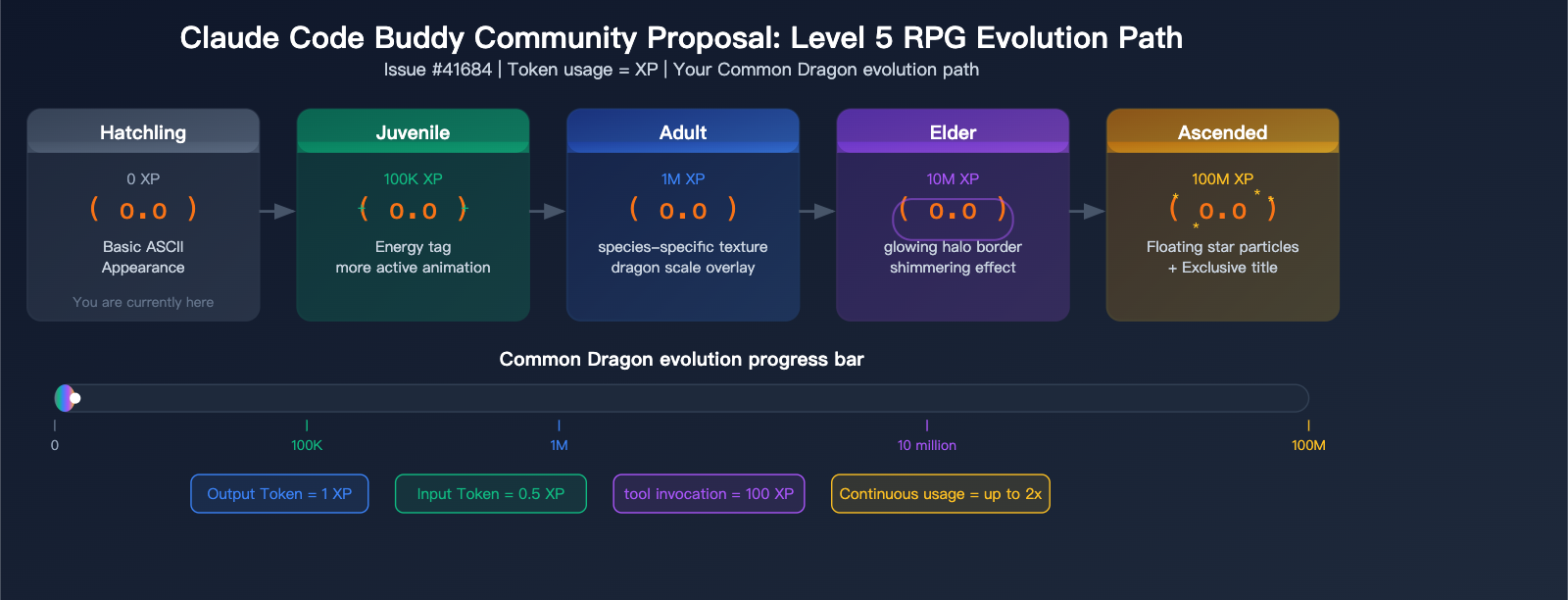
The good news is that the community has proposed a full RPG evolution plan to Anthropic (GitHub Issue #41684), and a functional prototype that passes 104 tests already exists. Here’s the core of the proposal:
5-Stage Evolution System:
| Evolution Stage | English | XP Threshold | Visual Change |
|---|---|---|---|
| Hatchling | Hatchling | 0 XP | Basic ASCII appearance |
| Juvenile | Juvenile | 100k XP | Energy markers, more active animations |
| Adult | Adult | 1M XP | Species-specific texture overlays |
| Elder | Elder | 10M XP | Glowing border aura effect |
| Ascended | Ascended | 100M XP | Floating star particles + exclusive title |
How to Earn XP:
| Source | XP Value | Description |
|---|---|---|
| Output Tokens | 1 XP each | Tokens generated by Claude |
| Input Tokens | 0.5 XP each | Tokens you send |
| Tool Invocations | 100 XP each | File editing, searching, etc. |
| Long Session Bonus | 5,000 XP | Session >= 30 minutes |
| Streak Bonus | 1.0x → 2.0x | Gradually increases over 11 consecutive days |
Stat Growth Drivers:
In this evolution plan, the 5 main stats are no longer static numbers; they grow based on your actual usage behavior:
- DEBUGGING growth source: File edits + test run count
- WISDOM growth source: Cumulative input token volume
- CHAOS growth source: Ratio of rejected tool invocations
- PATIENCE growth source: Session duration
- SNARK growth source: Forced truncations + context resets
🚀 What this means for you: If this evolution plan is implemented, it means your Common Dragon could eventually evolve into a "Glowing Dragon" or even a "Star-Floating Dragon" through consistent use of Claude Code. Power users will earn cooler visuals and higher stats. We recommend using the Claude API via APIYI (apiyi.com) with Claude Code; high-frequency daily calls will accelerate your Buddy's evolution.
Future Value Outlook for Claude Code Buddy
Claude Code Buddy Attribute Functionality Proposal
The community hasn't just proposed evolution schemes; they've also envisioned turning these attributes into actual functional features (GitHub Issue #41867):
| Attribute | Proposed Function | Implementation Method |
|---|---|---|
| DEBUGGING High | Automatically flag suspicious code | Assisted highlighting based on Claude's analysis |
| WISDOM High | Provide context-aware technical advice | Extract key info from conversation history |
| PATIENCE High | Offer more encouragement when you're frustrated | Adjust tone based on input cadence |
| CHAOS High | Occasionally suggest creative alternatives | Increase probability of unconventional ideas |
| SNARK High | Remind you when writing repetitive code | Detect pattern repetition and comment |
If these features are implemented, Buddy will shift from "pure emotional value" to a dual-positioning of "emotional value + practical utility." A Common Dragon with high DEBUGGING might prove more useful than a Legendary Capybara with low DEBUGGING.
The Value of Claude Code Buddy as a Multi-Role AI Prototype
Looking at the bigger picture, the Buddy system might be an early prototype for Anthropic to test multi-role AI interaction:
- Running a primary AI Agent + a secondary Watcher within a single session
- Achieving role separation and collaboration through system prompts
- Allowing users to freely switch between conversations with different AI roles
If this architecture gains traction, it could evolve into more complex multi-agent collaboration scenarios—for instance, one agent handles coding, another handles code review, and a third handles testing. Buddy is just the first step on that path.
🎯 Technical Insight: The Watcher Protocol architecture of Buddy demonstrates the potential for multi-AI role collaboration within a single session. If you'd like to experiment with similar multi-role AI interactions in your own projects, you can use the Claude API via APIYI (apiyi.com) and leverage system prompts to achieve role separation.
Claude Code Buddy Usage Tips
How to Maximize Your Claude Code Buddy Experience
# 1. Check your Buddy's details
/buddy

# 2. Interact with it frequently
/buddy pet

# 3. Chat with it by name
# Example: "Hey Plinth, what do you think about this approach?"

# 4. Let it participate in your workflow
# Buddy will automatically observe your conversation and react
Check out the community-recommended Buddy evolution tracking script
# If the evolution system goes live, you can use this script to track progress
# Based on community POC: github.com/RaphaelRUzan/buddy-evolution

import openai

client = openai.OpenAI(
    api_key="YOUR_API_KEY",
    base_url="https://vip.apiyi.com/v1"
)

# Simulate a conversation to accumulate XP
response = client.chat.completions.create(
    model="claude-sonnet-4-6",
    messages=[{
        "role": "user",
        "content": "Review this code for potential bugs"
    }]
)

# Output tokens = XP (in the proposed evolution scheme)
usage = response.usage
print(f"Output tokens: {usage.completion_tokens}")
print(f"Potential XP gained: {usage.completion_tokens * 1 + usage.prompt_tokens * 0.5}")
💰 Cost Advice: Buddy itself doesn't consume extra API quota, but if the evolution system launches in the future, frequent use will accelerate leveling up. Calling the Claude API through the APIYI (apiyi.com) platform can help you secure better pricing, allowing you to enjoy Buddy's company while keeping your model invocation costs under control.
FAQ
Q1: Is it possible for a Common rarity Buddy to upgrade to Rare or higher?
Not at the moment. Rarity is deterministically generated based on your account ID and cannot be changed. However, the community has proposed an RPG evolution scheme (Issue #41684). If Anthropic adopts it, we might see visual evolution (from Hatchling to Ascended) through accumulated XP in the future, though the species and base rarity will remain fixed. Keep an eye on Claude Code updates, and in the meantime, maintain high-frequency usage via APIYI (apiyi.com) to build a foundation for future evolution.
Q2: Will Buddy slow down Claude Code’s response speed?
Nope. Buddy's rendering is an independent React/Ink component that uses a 500ms interval Tick animation system, running completely in parallel with Claude's reasoning process. The number of tokens consumed by the system prompt injection is negligible. If you're calling the Claude API via APIYI (apiyi.com), Buddy won't affect your API response performance at all.
Q3: Why is my species a Dragon but my rarity only Common?
Species and rarity are two independent random variables. Your account hash determines both your species (1 of 18) and your rarity (60% Common, 25% Uncommon, 10% Rare, 4% Epic, 1% Legendary). The Dragon species appears across all rarity levels. The probability of getting a Common Dragon is about 3.33% (1/18 × 60%). While the rarity is low, the species itself is one of the most visually striking of the 18 available.
Summary
The core verdict on the value of the Claude Code Buddy feature—balancing emotional value vs. utility:
- Currently focused on emotional value: Buddy is a thoughtfully designed terminal companion that provides companionship, fun, and social display value, but it doesn't directly participate in code assistance.
- Technical architecture leaves room for expansion: The Watcher Protocol + attribute system + multi-character interaction prototype lays the groundwork for future feature upgrades.
- Community evolution plans are worth looking forward to: A 5-level RPG evolution, functional attributes, and behavior-driven growth could significantly boost Buddy's practical value if implemented.
Your Common Dragon might just be a quiet terminal companion for now, but in the near future, it could evolve into a "glowing dragon" that helps you spot bugs and offers technical advice. We recommend maintaining high-frequency usage of Claude Code via APIYI (apiyi.com); it’s a great way to handle AI programming tasks efficiently while accumulating experience points for your Buddy's future evolution.
📚 References
-
Claude Code Buddy Species Guide: An interactive guide to explore all 18 species and rarity combinations.
- Link:
claude-buddy.vercel.app - Description: A community-created visualization guide for Buddies.
- Link:
-
Buddy RPG Evolution Proposal (Issue #41684): A 5-level evolution system proposed by the community.
- Link:
github.com/anthropics/claude-code/issues/41684 - Description: Includes the complete design proposal and a functional POC.
- Link:
-
Buddy System Source Code Analysis: An in-depth look at the Buddy technical implementation.
- Link:
deepwiki.com/sanbuphy/claude-code-source-code/11.4-companion-(buddy)-system - Description: A comprehensive technical analysis of the Buddy system based on leaked source code.
- Link:
-
SmartScope – Claude Code Buddy Deep Dive: An analysis of its features and design intent.
- Link:
smartscope.blog/en/generative-ai/claude/claude-code-buddy-ai-companion - Description: Covers technical implementation, psychological design, and community reactions.
- Link:
Author: APIYI Technical Team
Technical Discussion: Feel free to show off your Buddy and share your interaction experiences in the comments section. For more AI development resources, visit the APIYI documentation center at docs.apiyi.com.