Claude Opus 4.6 is currently the most powerful programming AI available, but for users in China, using Claude Code directly comes with a serious risk of account suspension. Fortunately, there is a legitimate alternative: Google Antigravity IDE has built-in support for Claude Opus 4.6 and Sonnet 4.6. You can access them simply by using your Google account—no Anthropic account required, which naturally eliminates any risk of Claude-related bans.
However, there’s no such thing as a free lunch. Antigravity’s quota limits are becoming a major pain point, especially since the quotas for Claude models are extremely tight.
Core Value: By the end of this article, you’ll understand the 5 key differences between Antigravity and Claude Code, the truth about Pro vs. Ultra subscription quotas, and which solution best fits your actual needs.
What is Antigravity: A 60-Second Overview
Google Antigravity is an agent-based AI development platform launched by Google in November 2025, built by the original Windsurf team—a company Google acquired for $2.4 billion. It’s not your typical IDE; it’s a development environment with an AI Agent at its core.
Antigravity Key Facts
| Feature | Details |
|---|---|
| Product Name | Google Antigravity |
| Release Date | November 2025 (alongside Gemini 3) |
| Architecture | Heavily modified VS Code |
| Team Background | Original Windsurf team (acquired by Google for $2.4B) |
| Built-in Models | Gemini 3.1 Pro, Gemini 3 Flash, Claude Opus 4.6, Claude Sonnet 4.6, GPT-OSS 120B |
| Default Model | Gemini 3.1 Pro |
| Current Status | Public Preview |
| System Support | macOS, Windows, Linux |
Why It’s Especially Valuable for Users in China
Core Advantage: By using Antigravity with your Google account, you get access to the built-in Claude Opus 4.6 and Sonnet 4.6—no need to register for an Anthropic account, no need to bypass regional restrictions, and naturally, no risk of Claude account bans.
Think of it as Google providing a "compliance proxy layer": You → Google Antigravity → Claude API.
However, there is one critical issue: Quotas.
🎯 Important Reminder: Antigravity’s free and Pro quotas for Claude models are quite strict. If you need to use Claude models heavily for daily development, it's recommended to purchase a Google AI Ultra membership for sufficient quota. You can find guidance on purchasing an Ultra membership at
ai.daishengji.com. Additionally, APIYI (apiyi.com) offers API proxy services for the full range of Claude models, with pay-as-you-go billing and no quota limits.
Antigravity vs. Claude Code: 5 Key Differences
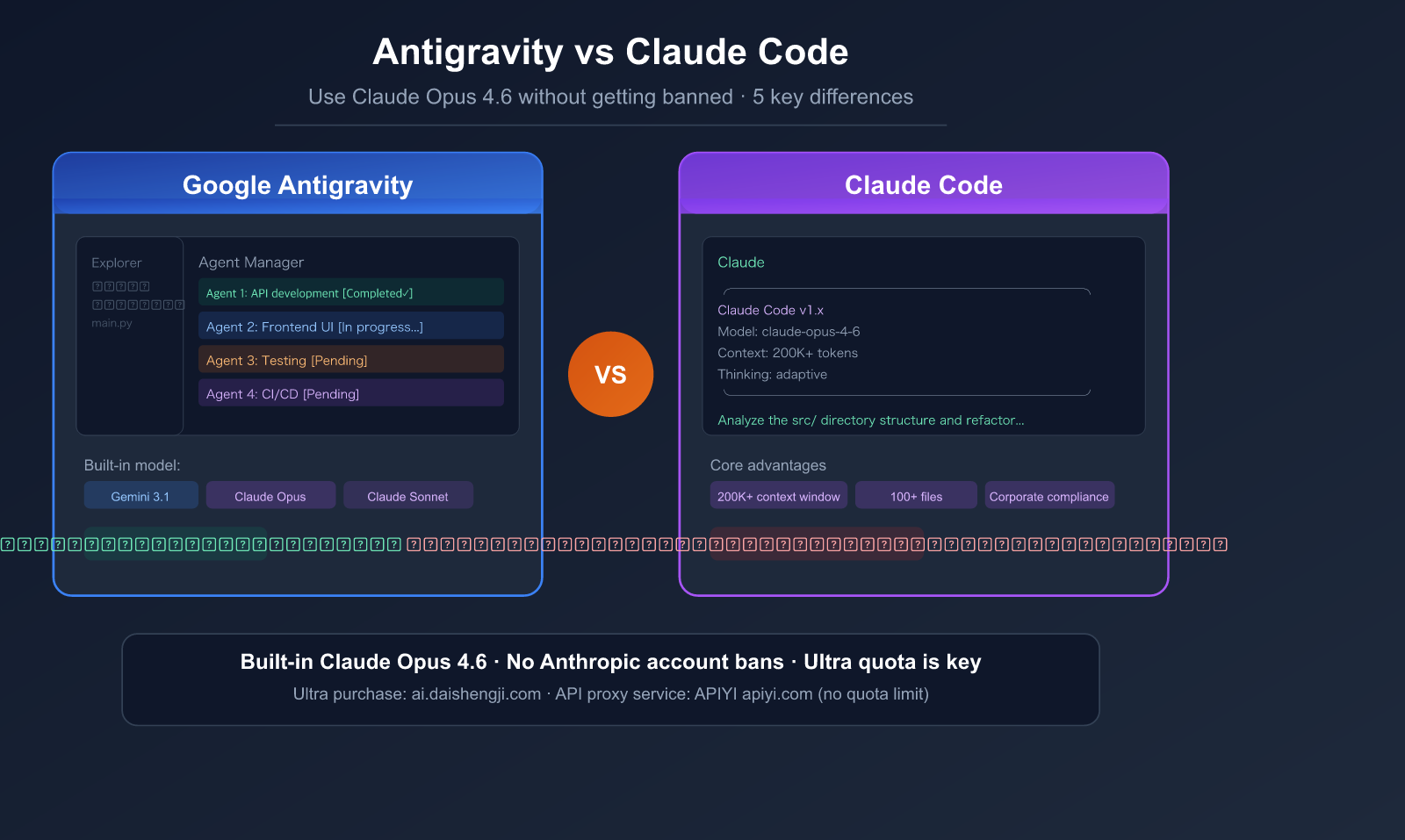
{A quick look at 5 key differences}
{Comparison dimensions}
{Antigravity}
{Claude Code}
{1. Tool positioning}
{IDE vs terminal}
{GUI IDE · Agent autonomous operation}
{✅ Multi-agent parallel (5)}
{Suitable for building new projects from scratch}
{CLI terminal · manual confirmation operation}
{✅ 200K+ context window · 100+ files}
{Suitable for large codebases modification}
{2. Model support}
{Multi-model vs single-model}
{✅ Freely switch between 5 models}
{Gemini + Claude + GPT-OSS}
{Free use of Opus 4.6 (preview period)}
{Only Claude models}
{✅ Claude deep optimization}
{Adaptive Thinking · Sub-agent}
{③ Security permissions}
{Open vs Conservative}
{Agent defaults to high privileges}
{⚠ There is a report of accidentally deleted files}
{macOS sandbox provides a certain level of protection}
{✅ Explicit user approval}
{✅ Conservative default, low risk of misoperation}
{SSO · Audit logs · HIPAA}
{4. Enterprise-ready}
{Compliance vs Preview}
{❌ Team version is coming soon}
{No SSO · No audit · No HIPAA}
{Public Preview stage}
{✅ Enterprise-ready}
{SSO · SCIM · Audit · HIPAA}
{Bedrock / Vertex private deployment}
{⑤ Risk of account suspension}
{The most critical difference!}
{🟢 Avoid Claude account bans}
{Google account · No access to Anthropic}
{Core advantages for Chinese users}
{🔴 Extremely high risk of account suspension in the China region}
{Anthropic account · multi-layer detection}
{IP + fingerprint + behavioral risk control}
{The two are complementary: Antigravity (no account ban + multi-Agent) + Claude Code/API proxy service (deep reasoning + unlimited quota)}
Difference 1: Tool Positioning—IDE vs. Terminal
| Dimension | Antigravity | Claude Code |
|---|---|---|
| Type | GUI IDE (Modified VS Code) | CLI Terminal Tool |
| Philosophy | AI Agent replaces your workflow | AI Agent overlays your workflow |
| Interface | Editor view + Agent Manager view | Pure command line |
| Autonomy | High—Agent autonomously operates editor, terminal, browser | Medium—Requires user approval for file changes |
| Use Case | Building new projects from scratch | Modifying existing complex codebases |
Antigravity's Agent Manager is a "task console" that can run up to 5 agents simultaneously, each handling different tasks—like one for frontend, one for backend, and one for running tests. This multi-agent parallel capability is something Claude Code currently lacks.
Claude Code feels more like an experienced "pair programming partner." It works in the terminal, can read your entire codebase (200K+ token context window), and excels at understanding existing architecture to make precise modifications. When dealing with large codebases of over 100 files, Claude Code performs significantly better than Antigravity.
Difference 2: Model Support—Multi-model vs. Claude Exclusive
Antigravity has 5 built-in models:
| Model | Provider | Positioning |
|---|---|---|
| Gemini 3.1 Pro (High/Low) | Default model, most generous quota | |
| Gemini 3 Flash | Fast and lightweight, for simple tasks | |
| Claude Sonnet 4.6 (Thinking) | Anthropic | High-quality coding with extended thinking |
| Claude Opus 4.6 (Thinking) | Anthropic | Most powerful coding model with extended thinking |
| GPT-OSS 120B | OpenAI | Open-source alternative |
During the preview period, Claude Opus 4.6 is free to use—whereas on the official Anthropic site, the Max subscription for this model is $200/month.
Claude Code natively supports only the Claude model family, but it features deep optimizations for Claude: Adaptive Thinking, Subagents, and context compression are all designed specifically for Claude's capabilities.
Difference 3: Security and Permissions—Open vs. Conservative
| Dimension | Antigravity | Claude Code |
|---|---|---|
| File Modification | Agent can modify autonomously by default | Requires explicit user approval |
| Terminal Commands | macOS sandbox restricted to working directory | Requires user approval for execution |
| Browser | Built-in Chrome automation | No browser control capability |
| Security Incidents | User reports of agents deleting files by mistake | More conservative, lower risk of error |
Security researchers have raised concerns about Antigravity's default permissions—the agents have too much autonomy. Claude Code’s design philosophy is "human-in-the-loop," requiring confirmation for every critical operation.
Difference 4: Enterprise Readiness
| Dimension | Antigravity | Claude Code |
|---|---|---|
| SSO | Not provided | Supported |
| Audit Logs | Not provided | Supported |
| HIPAA | Not provided | Ready |
| Private Deployment | Not provided | Supported (Bedrock/Vertex) |
| Team Edition | Coming soon | Released |
If you are an enterprise user, Claude Code is far ahead of Antigravity in terms of compliance and security.
Difference 5: Account Ban Risk—The Most Critical Factor
| Dimension | Antigravity | Claude Code |
|---|---|---|
| Account System | Google Account | Anthropic Account |
| Ban Risk in China | 🟢 Low (Google Account) | 🔴 Extremely High |
| VPN Required | Yes (but Google risk control is lenient) | Yes (Anthropic risk control is strict) |
| Claude Ban | Non-existent (via Google proxy) | Direct exposure to Anthropic risk control |
| Google Account Risk | Low (with normal usage) | N/A |
This is the core reason many Chinese developers choose Antigravity: You are using a Google account and Google's infrastructure, and the Claude model is invoked on your behalf by Google. Anthropic cannot see your personal information or IP address, so there is no risk of an Anthropic account ban.
💡 Alternative Solution: If Antigravity's quota isn't enough, or if you need to call the Claude API directly in your own code, APIYI (apiyi.com) provides a Claude API proxy service with no quota limits and pay-as-you-go billing, also with no risk of account bans.
Pro vs. Ultra Membership: Quotas Are the Key to Your Experience
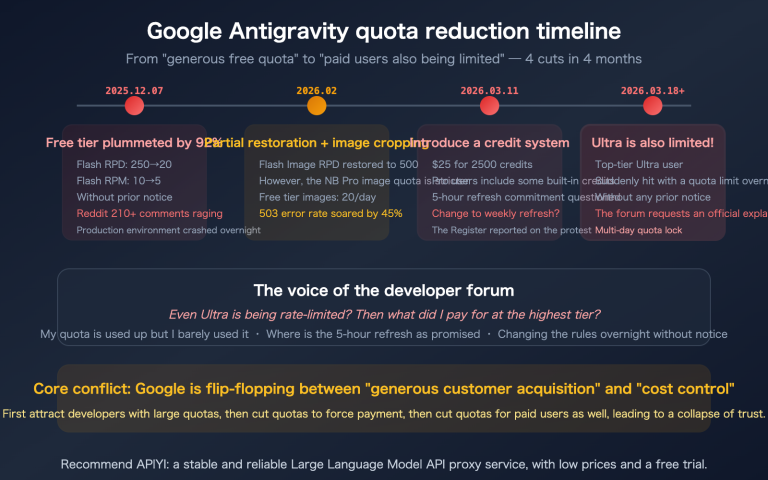
This is currently the most pressing concern for Antigravity users. The Claude model quotas for both free and Pro users are extremely limited, leaving many people throttled right when they need them most.
Google AI Membership Comparison
| Dimension | Free | AI Pro ($19.99/mo) | AI Ultra ($249.99/mo) |
|---|---|---|---|
| Antigravity Access | ✅ Yes | ✅ Yes | ✅ Yes |
| Claude Model Quota | Very low (depleted in 2-3 hrs) | Low (Pro quota insufficient) | Ample |
| Gemini Model Quota | Basic | 5x increase | Maximum limit |
| Refresh Cycle | Weekly | Claimed 5 hours (controversial) | Optimal guarantee |
| AI Credits | None | None | 25,000/mo |
| Google Cloud | None | None | $100/mo credit |
| Concurrent Agents | Limited | More | Maximum |
| Jules (Coding Assistant) | Basic | 5x limit | 20x limit |
| Project Mariner | None | None | ✅ Access |
Why We Strongly Recommend Ultra
The Pro Membership Quota Trap:
As of March 2026, a large number of Pro users have reported in the community that the advertised "5-hour refresh cycle" is simply inaccurate. The reality:
- Some users have faced throttling locks lasting 7 to 10 days.
- Claude model quotas are significantly tighter than Gemini model quotas.
- Developers have reported a massive drop from over 300 million input tokens per week to less than 9 million.
- Google has yet to provide an official explanation for the discrepancy between the marketing and the actual quotas.
The Advantages of Ultra Membership:
- Top-tier quota guarantees.
- 25,000 AI Credits/month—can be used for additional model invocations within Antigravity.
- $100/month Google Cloud credit—perfect for project deployment.
- Access to the Project Mariner prototype—an AI browser agent.
In short: With the $20/month Pro plan, you're paying for "occasional Claude access," while the $250/month Ultra plan is what you need to ensure "stable daily use of Claude Opus 4.6."
🎯 Buying Advice: If you've decided to make Antigravity your primary development tool, we strongly recommend going straight for the Google AI Ultra membership. For the Ultra membership purchase guide, visit
ai.daishengji.com. If you need Claude model invocation without quota restrictions, you can also use the pay-as-you-go service at APIYI (apiyi.com).
Real-World Experience with Antigravity
Advantages: Exciting Capabilities
1. Multi-Agent Parallel Development
Agent 1: Implement user registration API      [In Progress...]
Agent 2: Write database migration scripts     [Completed ✓]
Agent 3: Design frontend login page           [In Progress...]
Agent 4: Write unit tests                     [Pending...]
Agent 5: Configure CI/CD pipeline             [In Progress...]
With 5 agents working simultaneously, each has its own workspace, so they don't interfere with one another.
2. Browser Automation
Agents can directly open Chrome, scroll pages, click buttons, and read console logs—enabling true UI test automation. Claude Code doesn't have this capability.
3. Stitch + Antigravity Workflow
This is currently the most highly regarded "design-to-code" pipeline:
Google Stitch (Natural language UI design)
          ↓ MCP connection
Google Antigravity (AI generates Flutter/Dart code)
          ↓
Firebase (Backend deployment)
Limitations: Pitfalls to Watch Out For
1. Severe Claude Model Quota Shortages (The Biggest Pain Point)
Even for Pro members, the Claude Opus 4.6 quota is nowhere near enough for daily development. Many developers report being throttled after just 2-3 hours, and the recovery time is far longer than the advertised 5 hours.
2. Poor Performance on Complex Codebases
Antigravity shines on greenfield projects, but its understanding of existing, large, and complex codebases isn't as good as Claude Code's. It's more of a "rapid prototyping tool" than an "enterprise-grade refactoring tool."
3. Security Concerns
Agents have high default permissions, and users have already reported cases of agents accidentally deleting files. You need to be careful and use Git version control as a safety net.
4. Context Window Falls Short of Claims
Despite the advertised 1 million token context window, community testing shows the effective context is only 32K-64K, far below the marketing claims.
💰 Cost Advice: All things considered, if your daily work requires heavy Claude model invocation (code review, refactoring, debugging), Antigravity's quota might not be enough. We suggest a hybrid approach: Antigravity (for multi-agent parallel tasks + Gemini models) + APIYI (apiyi.com) (for unlimited Claude API invocation) to cover all your bases.
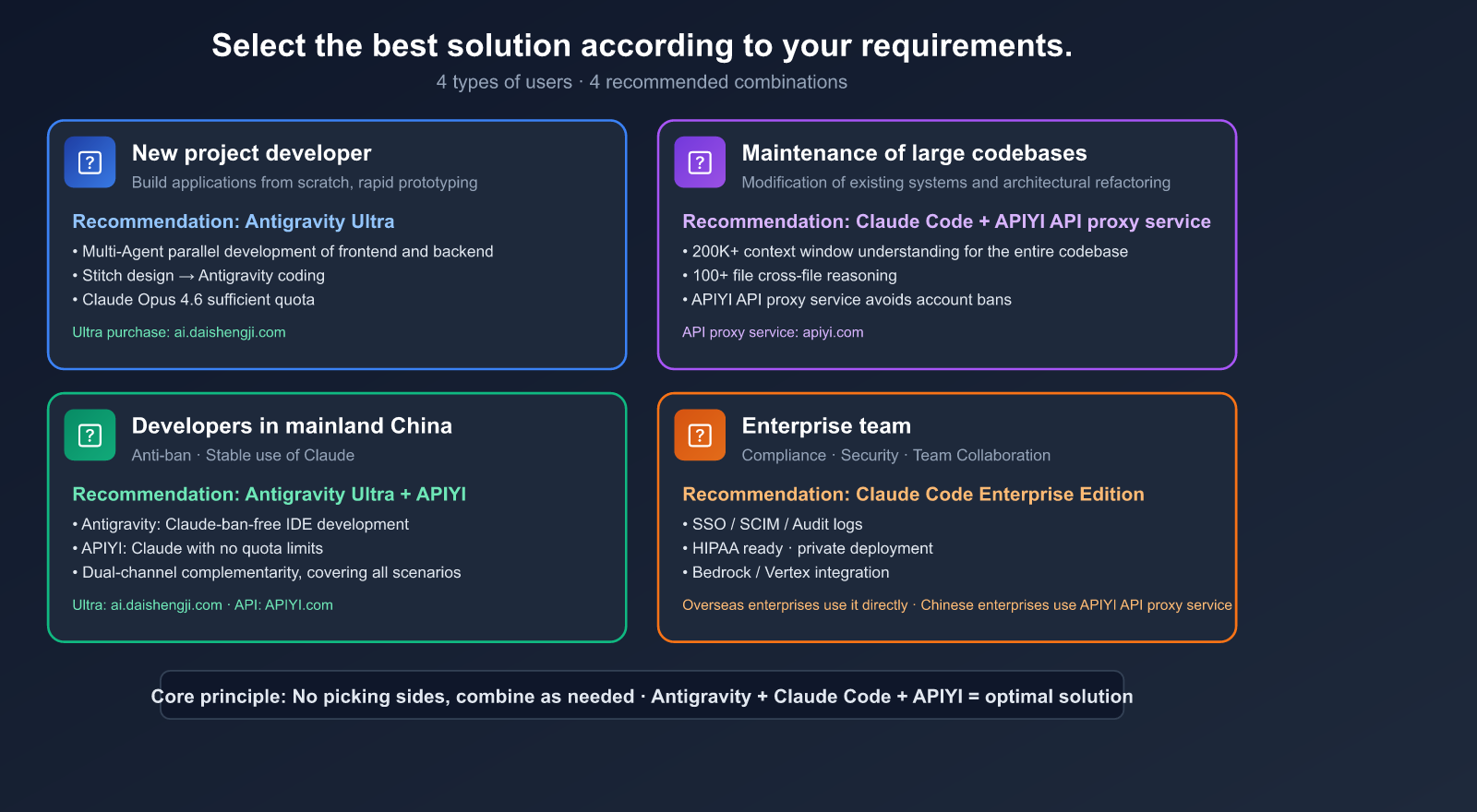
Choosing the Best Solution: Tailored to Your Needs
Scenario-based Recommendations
| Your Needs | Recommended Solution | Reasoning |
|---|---|---|
| Starting a new project | Antigravity (Ultra) | Parallel agents, integrated design-to-code |
| Maintaining large codebases | Claude Code | 200K+ context window, handles 100+ files |
| Using Claude in China (no bans) | Antigravity (Ultra) + APIYI proxy | Double protection, covers both IDE and API |
| Enterprise team collaboration | Claude Code | SSO, auditing, HIPAA, private deployment |
| Budget-conscious | Antigravity (Free) + APIYI proxy | Use Gemini for free, pay-as-you-go for Claude |
| Daily coding | Cursor + APIYI proxy | Best value-for-money daily driver |
Recommended Combinations
Option 1: Antigravity Ultra + APIYI (Recommended)
Antigravity Ultra ($250/month)
├── Daily development: Gemini 3.1 Pro (plenty of quota)
├── Critical tasks: Claude Opus 4.6 (Ultra quota guaranteed)
└── Multi-agent parallel: Rapid new project setup

APIYI apiyi.com (Pay-as-you-go)
├── Claude model invocation: No quota limits
├── Automated code review: CI/CD integration
└── 200+ models available: Switch flexibly
Option 2: Free Antigravity + APIYI (Budget Version)
Antigravity Free Version
├── Daily coding: Gemini 3 Flash (free)
├── Learning experience: Occasional Claude Opus 4.6 trials
└── Design-to-code: Stitch + Antigravity

APIYI apiyi.com (Pay-as-you-go)
├── Primary Claude: Sonnet 4.6 for daily dev
├── Key tasks: Opus 4.6 for deep reviews
└── No quota limits: Available anytime
API Proxy Code Example
import openai

client = openai.OpenAI(
    api_key="YOUR_API_KEY",
    base_url="https://api.apiyi.com/v1"  # APIYI unified endpoint
)

# Invoke Claude Opus 4.6 without quota limits
response = client.chat.completions.create(
    model="claude-opus-4-6",
    messages=[
        {"role": "system", "content": "You are an expert code reviewer."},
        {"role": "user", "content": "Review the following code for security issues..."}
    ],
    max_tokens=8192
)
print(response.choices[0].message.content)
🚀 The Optimal Combo: Antigravity solves the "account ban" and "multi-agent parallel" issues, while APIYI (apiyi.com) handles "quota limits" and "API integration." They complement each other perfectly, covering all your AI programming needs. For Ultra membership purchase guidance, visit
ai.daishengji.com.
FAQ
Q1: Will using the Claude model in Antigravity get my Anthropic account banned?
No. When you use the Claude model within Antigravity, you're indirectly invoking the Claude API through Google's infrastructure. Anthropic sees these as commercial API calls from Google, not as your personal activity. Since you're using a Google account and don't need an Anthropic account, there's no risk of an Anthropic ban. However, if you use community projects like "antigravity-claude-proxy" to bypass Antigravity and extract the Claude model directly, you risk getting your Google account banned.
Q2: Is the Pro membership enough, or do I really need Ultra?
If you're mainly using Gemini models for coding, Pro is generally sufficient. But if you need frequent access to Claude Opus 4.6, the Pro quota falls short—community reports suggest you'll hit rate limits within 2-3 hours, and recovery times are much longer than advertised. For developers who rely heavily on Claude, we strongly recommend the Ultra plan ($249.99/month). You can find the Ultra purchase guide at ai.daishengji.com. Alternatively, using APIYI (apiyi.com) for pay-as-you-go model invocation is a great way to bypass these quota limits.
Q3: Can Antigravity completely replace Claude Code?
No. They serve different purposes. Antigravity excels at setting up new projects, running multiple agents in parallel, and browser automation. Claude Code, however, is far superior when it comes to modifying large codebases, meeting enterprise security compliance, and performing deep cross-file reasoning. The best strategy is to use them in combination.
Q4: Is there a difference between the Claude model in Antigravity and the official Claude?
The models themselves are identical—both are Claude Opus 4.6 and Sonnet 4.6, complete with Thinking capabilities. However, the way they are invoked differs: Antigravity treats Claude as an optional model, whereas Claude Code is deeply optimized for Claude (with features like Adaptive Thinking, sub-agents, and context window compression). For deep reasoning tasks, Claude Code might perform better.
Q5: Is there a more budget-friendly option?
Yes. The most economical approach is to use the free version of Antigravity for daily Gemini coding, and use APIYI (apiyi.com) for pay-as-you-go access to Claude Sonnet 4.6 for code reviews and critical tasks. Sonnet 4.6 API pricing is roughly $3/$15 per million tokens, meaning a review of a 500-line PR costs less than $0.03. This is much more flexible and cost-effective than any subscription plan.
Summary: Choose Tools, Not Camps—Combine for the Best Results
Antigravity and Claude Code aren't an "either-or" choice; they are complementary.
The Core Value of Antigravity:
- Use Claude Opus 4.6 without risk of bans (via Google API proxy service)
- Seamless switching between models (Gemini + Claude + GPT-OSS)
- Parallel development with multiple agents
- Highly recommended to get the Ultra membership for sufficient quota (Purchase guide:
ai.daishengji.com)
The Core Value of Claude Code:
- Deep understanding and modification of large codebases
- Enterprise-grade security and compliance
- Deep optimization for Claude models (Adaptive Thinking)
The Core Value of API Proxy Services:
- Claude API access without quota limits
- Pay-as-you-go billing for controlled costs
- Flexible switching between 200+ models
We recommend using APIYI (apiyi.com) as a stable foundation for your Claude API calls, paired with Antigravity or Claude Code as your frontend development tools, to build the ultimate AI programming workflow.
References
-
Google Antigravity Official: Product introduction and developer documentation
- Link:
developers.googleblog.com
- Link:
-
Google AI Subscription Plans: Details on Pro and Ultra memberships
- Link:
gemini.google/subscriptions
- Link:
-
Claude Code vs Antigravity Comparison: In-depth analysis by DataCamp
- Link:
datacamp.com/blog/claude-code-vs-antigravity
- Link:
-
Antigravity Quota Limits Discussion: Community feedback and official Google responses
- Link:
theregister.com
- Link:
Author: APIYI Team | Exploring the best AI programming tool combinations. Visit APIYI at apiyi.com for unlimited API proxy service for the full range of Claude models.