NanoClaw or OpenClaw? This is the choice every developer looking to build a personal AI assistant will face in 2026. This article compares NanoClaw and OpenClaw across 6 dimensions, including architectural design, security isolation, ease of use, and ecosystem integration, offering clear recommendations.
Core Value: After reading this article, you'll clearly understand whether to choose NanoClaw or OpenClaw for different use cases, helping you avoid unnecessary detours.
A Quick Look at NanoClaw and OpenClaw Project Backgrounds
Before diving into the detailed comparison, let's quickly go over the origins of these two projects.
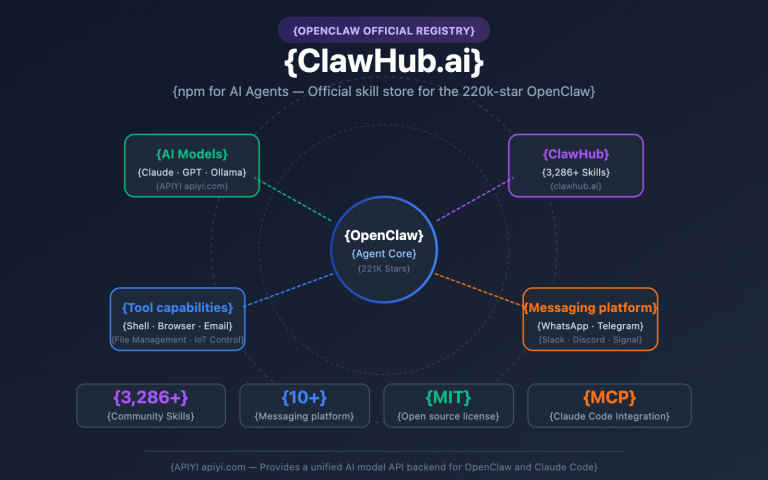
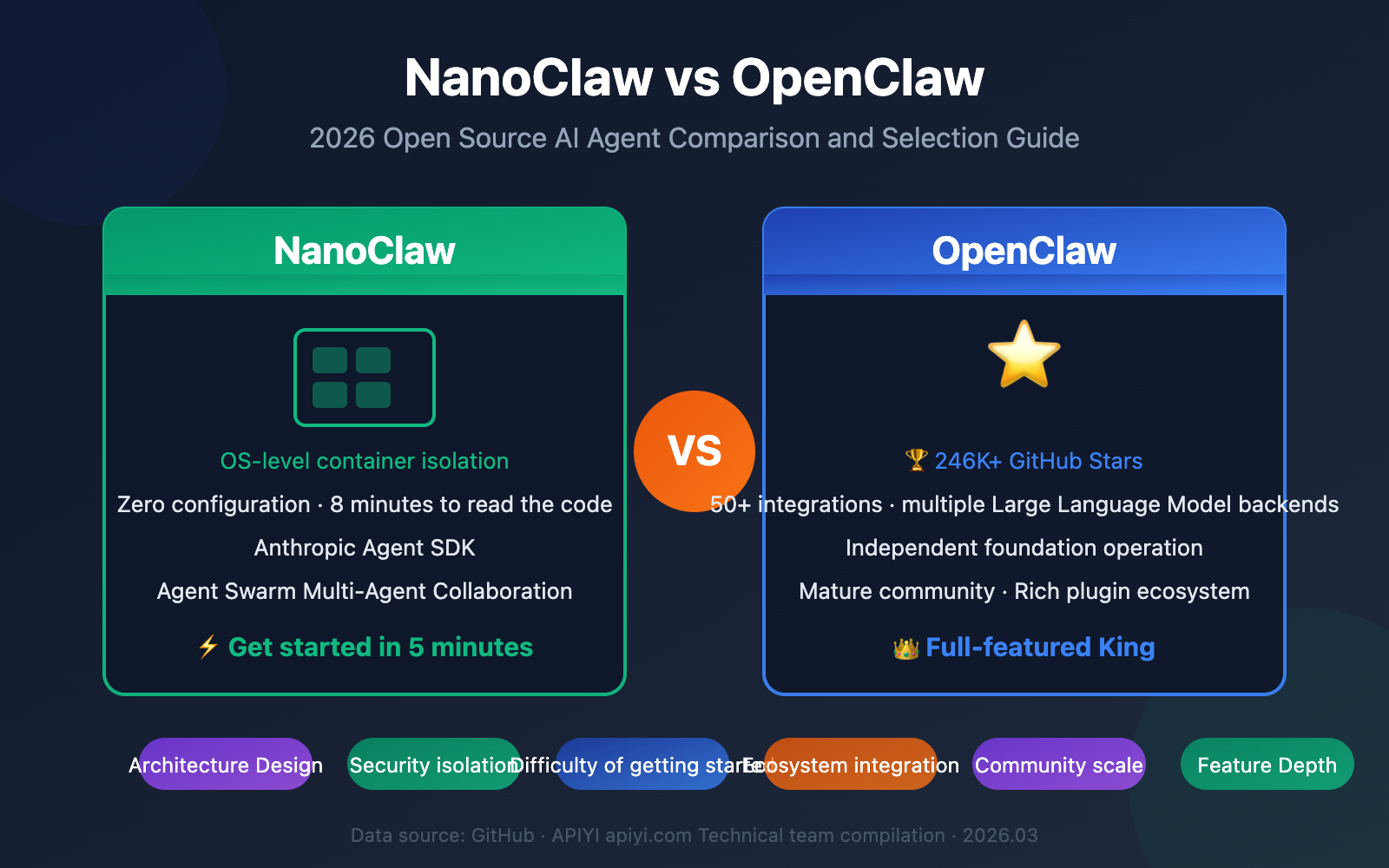
OpenClaw was initially released by Austrian developer Peter Steinberger in November 2025 under the name "Clawdbot." In January 2026, due to trademark issues, it was successively renamed "Moltbot" and then "OpenClaw." As of March 2026, OpenClaw has accumulated over 246K Stars on GitHub, trailing only React, Python, Linux, and Vue, making it one of the fastest-growing open-source projects in GitHub's history. On February 14, 2026, Steinberger announced he was joining OpenAI, and the OpenClaw project was transferred to an independent foundation for operation.
NanoClaw was developed by the Qwibit.ai team and is positioned as a lightweight alternative to OpenClaw. It runs on top of the Anthropic Agent SDK, emphasizing containerized security isolation and a minimalist code architecture. While its star count is far less than OpenClaw's, it has quickly gained recognition among developers who prioritize security and lightweight solutions.
| Basic Information | OpenClaw | NanoClaw |
|---|---|---|
| First Release | November 2025 | Early 2026 |
| Development Team | Peter Steinberger → Independent Foundation | Qwibit.ai |
| GitHub Stars | 246K+ | Rapidly growing |
| Underlying SDK | Multiple Large Language Model backends supported | Anthropic Agent SDK |
| Codebase Size | ~500K lines of code | Readable in 8 minutes |
| API Calls | Integrable via platforms like APIYI (apiiyi.com) | Invokable via a unified API on APIYI (apiiyi.com) |
NanoClaw vs OpenClaw: Key Differences
This is the part developers care about most — what are the key differences between these two projects?
NanoClaw and OpenClaw: Architectural Design Differences
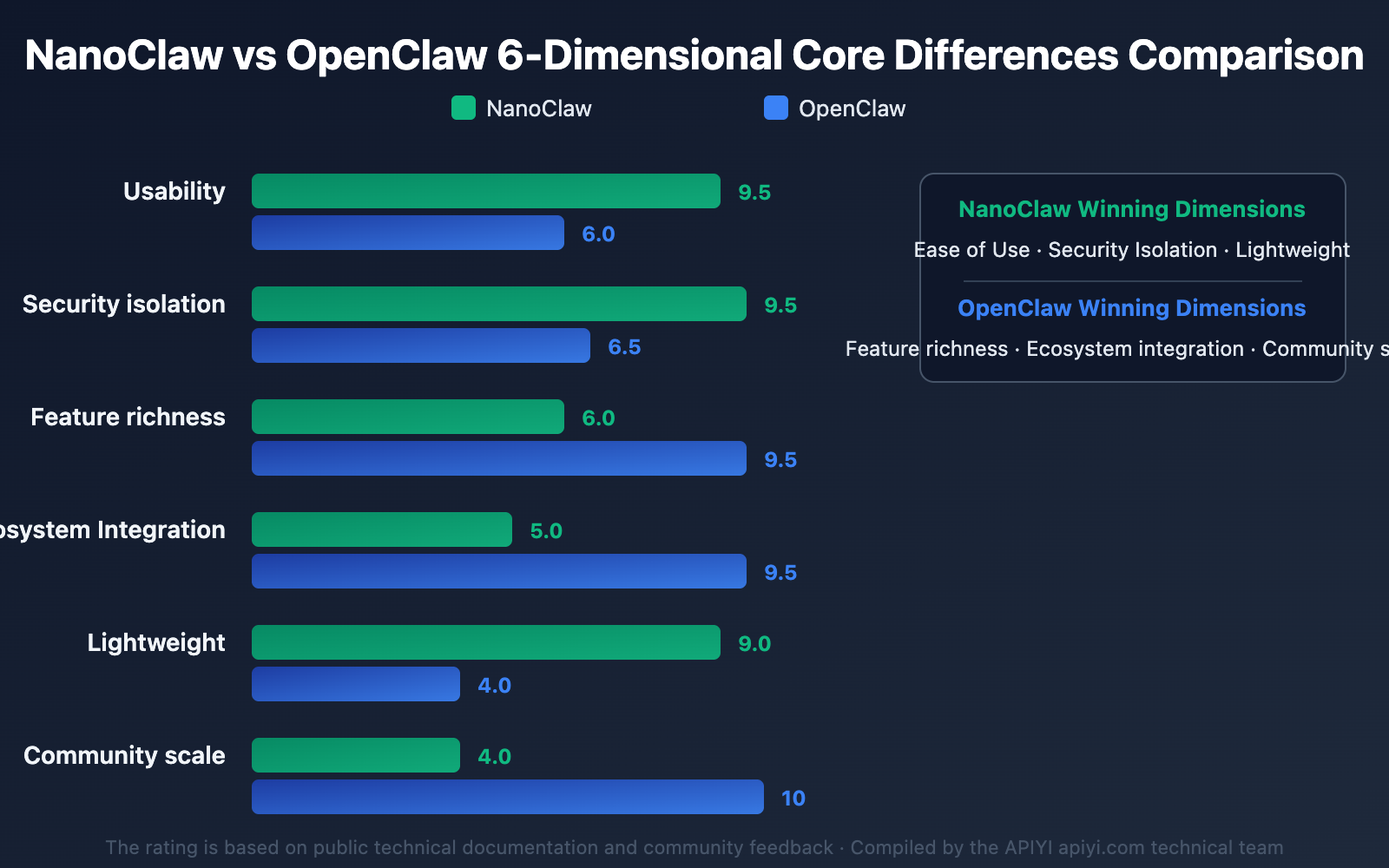
OpenClaw uses a modular, full-featured architecture, boasting nearly 500,000 lines of code, 53 configuration files, and over 70 dependencies. This means it covers almost every possible need for a personal AI assistant, but it also introduces considerable complexity.
NanoClaw takes the completely opposite approach — minimalism. Its developers claim the entire codebase can be read in just 8 minutes. NanoClaw doesn't use configuration files; all customization is done through Claude Code conversations, and contributors extend functionality via skill files (.claude/skills/).
| Architectural Comparison | OpenClaw | NanoClaw |
|---|---|---|
| Code Size | ~500k lines | Minimalist (readable in 8 mins) |
| Config Files | 53 config files | Zero config files |
| Dependencies | 70+ dependencies | Very few dependencies |
| Extension Method | Plugin ecosystem | Claude Code skill files |
| Customization Method | Editing config files | Conversational customization (/customize) |
| Learning Curve | Higher | Lower |
NanoClaw and OpenClaw: Security Isolation Comparison
Security is one of the most significant differences between the two.
OpenClaw's security mechanisms are primarily implemented at the application layer — controlling access through whitelists and pairing codes. This means the security boundary is maintained by the application code itself.
NanoClaw, on the other hand, uses operating system-level container isolation. Each Agent runs in an independent Linux container (using Apple Container on macOS and Docker on Linux), with file system isolation enforced by the operating system. Even if the AI exhibits abnormal behavior, it can only affect the sandbox internally, unable to touch the host machine.
🔒 Security Tip: If your application involves sensitive data processing or enterprise deployment, NanoClaw's OS-level isolation offers stronger security. For personal AI assistant API invocation management, you can achieve unified API key management and call monitoring through the APIYI apiyi.com platform.
NanoClaw and OpenClaw: Feature Coverage
| Feature Dimension | OpenClaw | NanoClaw |
|---|---|---|
| Messaging Platforms | 50+ integrations | WhatsApp/Telegram/Discord/Slack/Signal |
| LLM Backends | Anthropic/OpenAI/Local models | Primarily Claude (Anthropic) |
| Persistent Memory | ✅ Cross-session memory | ✅ Independent CLAUDE.md memory per group |
| Shell Commands | ✅ Host execution | ✅ Containerized execution |
| Web Access | ✅ Browser automation | ✅ Search and content retrieval |
| Scheduled Tasks | ✅ Supported | ✅ Supported, with proactive messaging |
| Agent Swarm | Partially supported | ✅ Multi-Agent collaboration |
| File I/O | ✅ Host filesystem | ✅ Isolated container filesystem |
OpenClaw clearly has an advantage in the number of features, especially with its 50+ integrations and support for multiple LLM backends. However, NanoClaw isn't lacking in core functionalities, and it's even ahead in Agent Swarm (multi-Agent collaboration), being one of the earlier projects to offer this feature in personal AI assistants.
Hands-on Experience Comparison: NanoClaw vs. OpenClaw
For newcomers, ease of getting started can be a decisive factor.
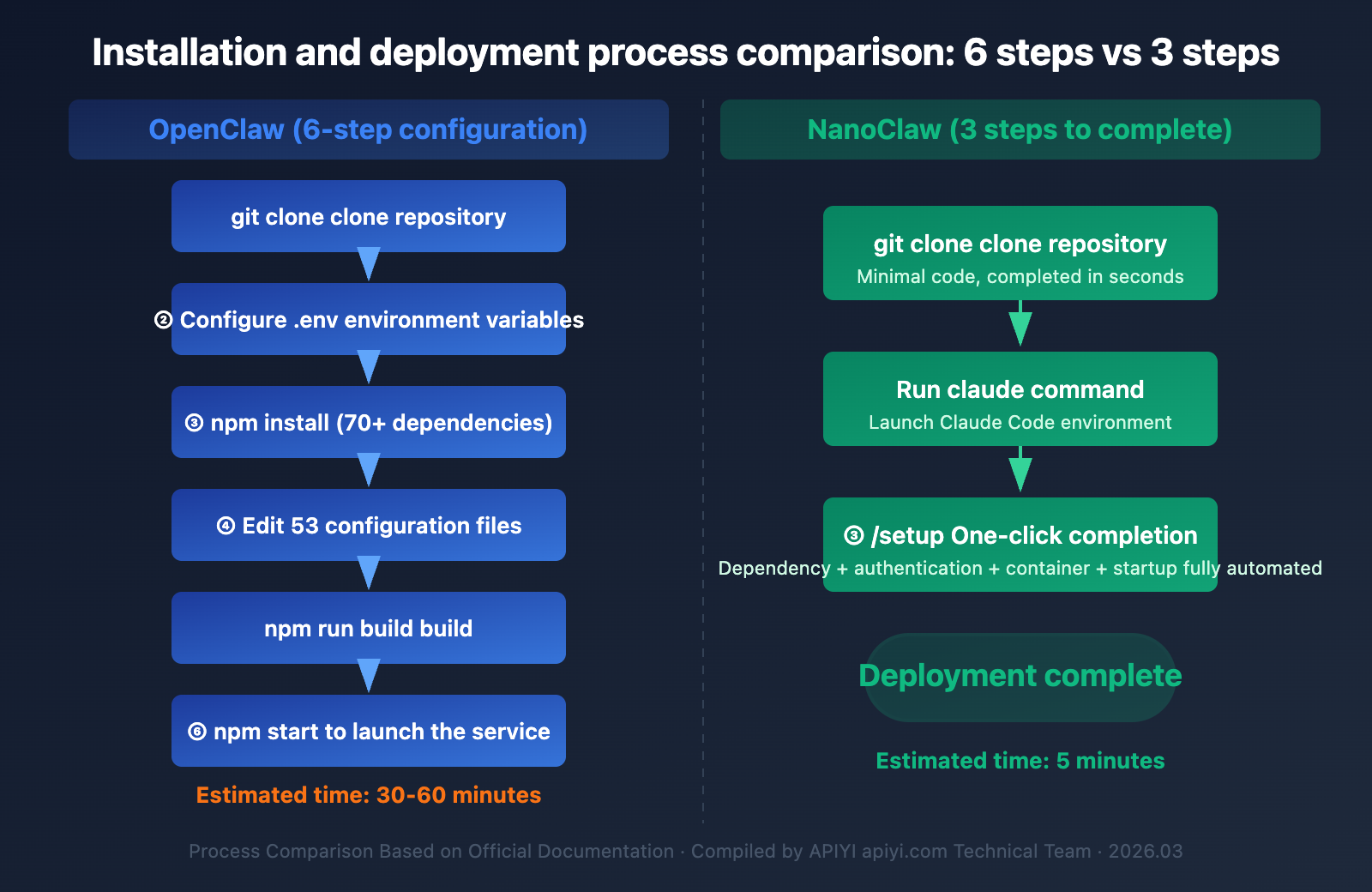
OpenClaw Installation and Configuration Process
Installing OpenClaw involves handling 70+ dependencies, configuring multiple service components, and setting up message platform connections. While this isn't difficult for experienced developers, a newcomer might spend hours troubleshooting configuration issues.
# Typical OpenClaw installation steps (simplified)
git clone https://github.com/openclaw/openclaw.git
cd openclaw
# Requires configuring multiple environment variables and config files
cp .env.example .env
# Edit key items in 53 config files...
npm install  # 70+ dependencies
npm run build
npm start
NanoClaw Installation and Configuration Process
NanoClaw's installation process is incredibly straightforward. After cloning the repository, you just run Claude Code and execute the /setup command. Claude Code automatically handles dependency installation, authentication configuration, container setup, and service startup.
# Complete NanoClaw installation process
git clone https://github.com/qwibitai/nanoclaw.git
cd nanoclaw
claude        # Start Claude Code
# In Claude Code, execute:
/setup        # Automatically completes all configurations
View NanoClaw Custom Configuration Example
# NanoClaw doesn't use config files
# All customizations are done via conversation

# In Claude Code, just say:
# "Add Telegram connection"
# "Set daily weather summary at 9 AM"
# "Enable Agent Swarm mode"

# Or use guided customization:
/customize

# Contributors can create skill files to extend functionality
# Location: .claude/skills/
🚀 Quick Start Tip: If you're new to AI Agent projects, NanoClaw's zero-configuration experience is much more user-friendly. We also recommend getting your API key through the APIYI apiyi.com platform; it lets you quickly test the invocation effects of various Large Language Models.
Recommended Use Cases for NanoClaw and OpenClaw
5 Scenarios to Choose OpenClaw
- Need 50+ Integration Platforms: If your workflow requires connecting to a large number of third-party services, OpenClaw's plugin ecosystem is unparalleled.
- Multiple Large Language Model Backends: If you need to switch flexibly between Anthropic, OpenAI, and local models.
- Mature Community Support: 246K+ Stars means a more active community, more tutorials, and faster problem resolution.
- Heavy Customization Needs: If you need to deeply modify the underlying logic, OpenClaw's modular architecture offers more entry points.
- Team Collaboration Deployment: For enterprise teams that require standardized deployment and unified management.
5 Scenarios to Choose NanoClaw
- Security-First Applications: For handling sensitive data, requiring OS-level container isolation protection.
- Rapid Prototype Validation: To set up a usable AI assistant within 5 minutes and validate ideas.
- Personal Lightweight Use: If you only need core messaging interaction features and don't want to maintain a complex system.
- Deep Claude Ecosystem Users: If you're already accustomed to the Anthropic toolchain and want deeper Claude integration.
- Learning and Research Purposes: With a smaller codebase, it's suitable for studying AI Agent architecture design.
| User Type | Recommended Solution | Reason |
|---|---|---|
| Zero-Experience Newcomers | NanoClaw | Zero config, 5-minute setup |
| Full-Stack Developers | OpenClaw | Full-featured, extensive customization space |
| Security Engineers | NanoClaw | OS-level isolation, security audit-friendly |
| AI Product Managers | OpenClaw | Rich integrations, quick business system integration |
| Independent Developers | Depends on needs | NanoClaw for lightweight, OpenClaw for full features |
| Enterprise Teams | OpenClaw | Mature ecosystem, ample community support |
💡 Selection Advice: Which solution you choose mainly depends on your security needs and feature scope. If you're undecided, we recommend trying both – NanoClaw can be up and running in just 5 minutes. Regardless of your choice, you can manage your API keys and invocation quotas centrally through the APIYI apiyi.com platform, supporting quick comparative testing of various mainstream Large Language Models.
NanoClaw and OpenClaw Technical Ecosystems and Future Directions
OpenClaw Ecosystem Overview
The OpenClaw ecosystem is quite mature:
- Community Scale: 246K+ GitHub Stars, 47K+ Forks
- Integrations: 50+ third-party service integrations
- Large Language Model Support: Multiple backends including Anthropic, OpenAI, and local models
- Foundation Operation: Transitioning to an independent foundation in February 2026, with OpenAI as a sponsor
- Derivative Projects: Has spawned several lightweight alternative projects like NanoClaw, PicoClaw, ZeroClaw, and TinyClaw
NanoClaw Ecosystem Development
While NanoClaw is younger, its development path is clear:
- Underlying Dependencies: Built directly on top of the Anthropic Agent SDK
- Security Innovation: The first AI Agent to feature OS-level container isolation as a core characteristic
- Agent Swarm: One of the earlier personal AI assistants to implement multi-agent collaboration
- Contribution Model: Community expansion via
.claude/skills/files - Development Direction: Deeply integrated with the Claude ecosystem
Competitive Landscape of the Two Major Camps
A noteworthy trend is that OpenClaw's founder has joined OpenAI, while NanoClaw is built on the Anthropic SDK. The two most important open-source personal AI assistant projects are now aligning with the OpenAI and Anthropic camps, respectively.
This means you're not just choosing a tool; you're also choosing a technical ecosystem.
🎯 Technical Tip: Regardless of which camp you're in, maintaining flexibility in API calls is crucial. Using a unified interface platform like APIYI (apiyi.com) allows you to connect with both OpenAI and Anthropic models simultaneously. This lets you quickly switch between technical routes when changes occur, reducing migration costs.
NanoClaw and OpenClaw Decision-Making Advice
Quick Decision Flowchart
Answer these 3 questions to make your choice:
Question 1: Do you need OS-level security isolation?
- Yes → NanoClaw
- No → Proceed to Question 2
Question 2: Do you need more than 10 third-party integrations?
- Yes → OpenClaw
- No → Proceed to Question 3
Question 3: Do you prioritize ease of getting started or depth of features?
- Ease of getting started → NanoClaw
- Depth of features → OpenClaw
Hybrid Usage Strategy
In reality, NanoClaw and OpenClaw aren't mutually exclusive. Some developers will:
- Use NanoClaw for sensitive tasks (financial data, personal information)
- Use OpenClaw as their everyday, full-featured AI assistant
- Coordinate their Large Language Model invocations through a unified API management platform
💰 Cost Optimization: Running multiple AI Agents means higher API invocation volumes. APIYI's (apiyi.com) flexible billing model can effectively control costs, especially for scenarios where you're using multiple Agents simultaneously.
NanoClaw and OpenClaw FAQ
Q1: Can NanoClaw completely replace OpenClaw?
Not completely. NanoClaw covers core functionalities (messaging, memory, scheduled tasks, web access), but it lacks OpenClaw's 50+ integration ecosystem and multi-LLM backend support. If you're only using 5-6 core features, NanoClaw is perfectly sufficient. However, if you rely on a lot of third-party integrations, OpenClaw is still the better choice. The APIYI apiyi.com platform can help bridge NanoClaw's gap in multi-model support by allowing you to unify API calls from different vendors.
Q2: Which one should a beginner learn first?
We recommend starting with NanoClaw. The reason is simple: NanoClaw's codebase is small enough that you can read through and fully understand the entire project's architectural design. This understanding will also help you when you eventually use OpenClaw. Plus, NanoClaw's /setup one-click installation lets you see results in just 5 minutes, giving you quick positive feedback.
Q3: Is there a big difference in LLM costs between the two projects?
For core functionalities, the difference isn't significant, as the primary cost comes from LLM API calls, not the framework itself. However, OpenClaw supports local models (like Ollama), so using local inference can save you a lot on API costs. NanoClaw primarily relies on the Claude API, and you can get more favorable invocation prices through the APIYI apiyi.com platform.
Q4: Will OpenClaw’s move to a foundation affect its usage?
Not in the short term. Moving to an independent foundation actually means the project no longer relies on a single developer, ensuring more stable long-term maintenance. OpenAI, as a sponsor, provides resource support but doesn't directly control the project's direction. Community contributors can still freely submit code and features.
Q5: Will container isolation affect NanoClaw’s performance?
Modern container technologies (like Docker / Apple Container) have extremely low performance overhead, typically within 1-3%. For I/O-intensive applications like AI Agents, the bottleneck is usually LLM API response time, not local computation. So, the security benefits of container isolation far outweigh any performance loss.
NanoClaw and OpenClaw Comparison Summary
NanoClaw and OpenClaw represent two distinct directions in AI Agent development: ultra-secure simplicity and a full-featured ecosystem.
- OpenClaw is the undisputed champion—with 246K+ Stars, 50+ integrations, multi-LLM support, and a mature community. If you need a fully-featured personal AI assistant, OpenClaw is the gold standard choice.
- NanoClaw, on the other hand, is the smart challenger—offering container isolation, zero configuration, and a codebase you can read in 8 minutes. If you prioritize security and quick setup, NanoClaw is a better fit for you.
For most beginners, our advice is: start with NanoClaw to grasp the core concepts of AI Agents, then decide whether to migrate to OpenClaw based on your needs.
We recommend using the APIYI apiyi.com platform for unified API call management. This way, no matter which Agent framework you use, you'll get a consistent interface experience and flexible billing methods.
References
-
OpenClaw GitHub Repository: Official Open-Source Code
- Link:
github.com/openclaw/openclaw - Description: With over 246K Stars, it's a benchmark project for personal AI assistants.
- Link:
-
NanoClaw GitHub Repository: Lightweight OpenClaw Alternative
- Link:
github.com/qwibitai/nanoclaw - Description: Built on the Anthropic Agent SDK, offering containerized secure isolation.
- Link:
-
OpenClaw Lightweight Alternatives Comparison: Community Review
- Link:
kdnuggets.com/5-lightweight-and-secure-openclaw-alternatives-to-try-right-now - Description: Covers several alternatives, including NanoClaw, PicoClaw, and more.
- Link:
-
OpenClaw Architecture Analysis: The Design Behind 210K Stars
- Link: Related articles at
medium.com/@Micheal-Lanham - Description: An in-depth analysis of OpenClaw's architectural design decisions.
- Link: Related articles at
📝 This article was written by the APIYI Team. For more AI tech tutorials and API invocation guides, visit APIYI apiyi.com to get the latest content and free trial credits.