On April 3, 2026, Alibaba Tongyi Lab officially released Wan2.7. This generation of models brings a series of major upgrades, including Thinking Mode, 15-second long clips, start/end frame control, and 5-reference-image multi-character driving. It became the hottest topic in the AI video space almost immediately upon release. However, hype aside, developers who actually want to run business applications using the Wan2.7 API will quickly run into a practical problem: official channels are difficult to access, overseas platforms are expensive, and where exactly can you find low-cost APIs?
This article will first clarify what Wan2.7 brings to the table and how to choose between it and Wan2.6. Then, we’ll compare the prices of mainstream platforms in a table and finally provide the complete integration path and code examples for getting a default 2% discount (and up to 18% off with top-up bonuses) at APIYI (apiyi.com).
{Where to find low-cost API for Wan2.7}
{APIYI full series launched · 2% off by default · up to 18% off with additional bonuses}
{Wan2.7 4 major capabilities}
{text-to-video}
{text-to-video}
{text-to-image → 5-15 seconds}
{image-to-video}
{image-to-video}
{first frame + audio-driven}
{R2V}
{reference image generation}
{driven by 5 reference images}
{EDIT}
{video editing}
{Instruction for background replacement/outfit change}
{Mainstream video API pricing tiers / second}
{Veo 3.1 Standard}
{$0.75}
{Sora 2 Pro}
{$0.30 – $0.50}
{Sora 2 base}
{$0.10}
{APIYI Wan2.7 1080P}
{$0.14}
{APIYI Wan2.7 720P}
{$0.084}
{APIYI Wan2.6 bonus included}
{$0.058}
{APIYI.com full series launched}
{98% discount by default}
{Additional 15% off}
{At least 18% off}
What is Wan2.7? Core Capabilities of the New Generation AI Video Generation Model
Wan2.7 is the latest video generation Large Language Model released by Alibaba Tongyi Lab in April 2026. Based on the Diffusion Transformer (DiT) architecture and Flow Matching training paradigm, it natively supports text, image, video, and audio inputs. Compared to Wan2.6, the biggest leap in 2.7 isn't just resolution, but understanding and control. This generation introduces Thinking Mode, where the model deeply understands the prompt and plans the composition before starting generation. This significantly improves visual coherence, cinematic logic, and text rendering.
The 4 Core Modes of Wan2.7: t2v / i2v / r2v / videoedit
Wan2.7 isn't just a single model, but a family of capabilities that share the same underlying architecture and API protocol. On apiyi.com, all four modes can be called using the same API key; you only need to change the model field to switch between them.
| Model ID | Capability | Input | Typical Use Case |
|---|---|---|---|
| wan2.7-t2v | Text-to-Video | Text prompt | Creative shorts, ad storyboards |
| wan2.7-i2v | Image-to-Video | First frame + optional audio | Digital human talking heads, product demos |
| wan2.7-r2v | Reference Video Gen | 1-5 reference images/videos + prompt | Multi-character consistency, IP integration |
| wan2.7-videoedit | Video Editing | Video + 1-5 reference images + instructions | Outfit changes, background swaps, style transfers |
All four modes support 720P and native 1080P output with durations ranging from 2 to 15 seconds (in whole seconds). For r2v, the limit is 10 seconds when the reference input includes video. i2v can also accept an audio track for lip-syncing, a capability that previously required chaining multiple tools together.
Wan2.7 vs. Wan2.6: Capability and Pricing Differences
Many teams ask during their first integration: "Since Wan2.7 is out, is there any need to keep Wan2.6?" The answer is yes. Wan2.6 focuses on being lightweight, fast, and low-cost, making it the king of cost-effectiveness for high-volume 720P content production. Wan2.7, on the other hand, creates a generational gap in storytelling, character consistency, long-form clips, and video editing.
| Dimension | Wan2.6 | Wan2.7 |
|---|---|---|
| Primary Resolution | 720P | 720P / Native 1080P |
| Duration | Shorter | 2-15 seconds, 3x longer clips |
| Thinking Mode | No | ✅ Yes, think before generating |
| Multi-character Consistency | Average | 5-reference-image drive, significantly enhanced |
| Video Editing | Not supported | ✅ Supports natural language editing |
| Pricing | Extremely low, for bulk | Mid-range, for high-quality |
🎯 Selection Advice: If your business involves dynamic e-commerce product images or bulk short video assets where "fast + high volume + cheap" is the priority, go with Wan2.6. If you are creating narrative shorts, product launch intros, or brand storytelling content where quality and consistency are paramount, prioritize Wan2.7. Both can be switched at any time under the same account at APIYI (apiyi.com) without needing to re-integrate.
{Wan2.7 Large Language Model family architecture}
{4 sub-models · shared underlying layer · switch models using the same API key}
{Wan2.7}
{Shared underlying layer}
{DiT · Flow Matching}
{Thinking Mode}
{wan2.7-t2v}
{text-to-video}
{Input: text prompt}
{Output: 5-15 second video · 720P / 1080P}
{Scenario: Creative short film · Advertising storyboard}
{wan2.7-i2v}
{image-to-video}
{Input: First frame image + optional driving audio}
{Output: Dynamic video · Supports lip-syncing}
{Scenario: Digital human video presentation · Product demonstration}
{wan2.7-r2v}
{reference video generation}
{Input: 1-5 reference images / videos + prompt}
{Output: multi-character consistency video}
{Scenario: IP collaboration · series of short films}
{wan2.7-videoedit}
{video editing}
{Input: video + 1-5 reference images + prompt}
{Output: modification/background replacement/style transfer}
{Scenario: Post-production revision · Style transfer}
{Same sk- API key · apiyi.com just switch the model field}
Mainstream Wan2.7 API Price Comparison: Why APIYI is the Top Choice for Low Costs
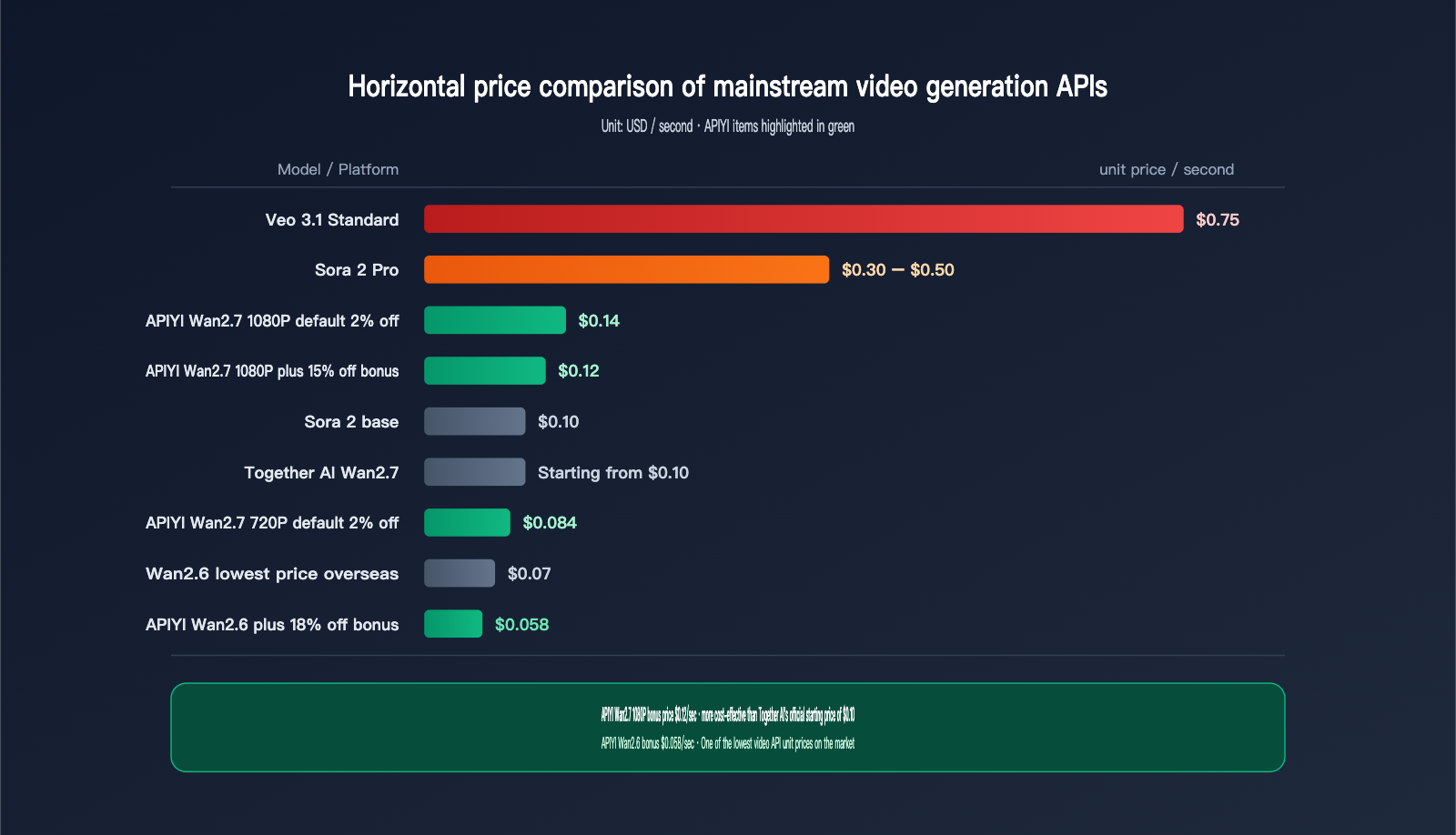
Since the release of Wan2.7, various overseas platforms like Together AI, fal.ai, AI/ML API, and WaveSpeed have integrated it, each with their own pricing strategies. When you lay out the mainstream video generation APIs in a single table, the price tiers become crystal clear.
| Model / Platform | Unit Price (per second) | Max Resolution | Notes |
|---|---|---|---|
| Veo 3.1 Standard (Google) | $0.75/s | 4K + Native Audio | Highest price, cinema-grade scenarios |
| Sora 2 Pro (OpenAI) | $0.30 – $0.50/s | 1080P | Leading physics simulation & lens quality |
| Kling 3.0 | Mid-to-High range | 1080P | Top-tier domestic video model |
| Sora 2 base (OpenAI) | $0.10/s | 720P | Entry-level price, starting point for Pro |
| Together AI Wan 2.7 | From $0.10/s | 1080P | Overseas access price for Wan 2.7 |
| APIYI Wan2.7 1080P Default | ≈$0.14/s | 1080P | Default 2% off, direct proxy |
| APIYI Wan2.7 720P Default | ≈$0.084/s | 720P | Default 2% off |
| APIYI Wan2.7 1080P w/ Bonus | ≈$0.12/s | 1080P | Top-up bonuses, up to 15% off |
| Wan 2.6 Overseas Lowest | $0.07/s | 720P | One of the cheapest video APIs |
| APIYI Wan2.6 w/ Bonus | ≈$0.058/s | 720P | Bonus brings it to 18% off |
As you can see, even at APIYI's default 98% price, Wan2.7 1080P is significantly cheaper than Sora 2 Pro, and the 720P version is already more affordable than Sora 2 base. When you factor in top-up bonuses, APIYI’s Wan2.7 1080P price holds a 10%+ advantage over Together AI for the same model, and the Wan2.6 bonus price pushes the entire market's video API unit cost to a new low.
💰 Pricing Note: APIYI prices in the table are estimated based on 1 USD ≈ 7.15 CNY; actual prices are subject to the APIYI.com dashboard. The ¥0.6/s for 720P and ¥1.0/s for 1080P are official public quotes from Alibaba Cloud, and the APIYI 98% discount is applied to these figures.
APIYI.com Wan2.7 API Pricing: Default 98% Off, as Low as 82% Off
APIYI’s launch covers the full spectrum—all four Wan2.7 sub-models (t2v / i2v / r2v / videoedit) plus Wan2.6 are available immediately. No extra application is needed; you can start calling them right after topping up your account.
Price Tiers and Discount Mechanism
APIYI uses a unified tiered discount system for the Wan series. You pay as you go—no subscriptions or high upfront package fees required.
| Discount Tier | Trigger Condition | Wan2.7 1080P Actual Price | Wan2.7 720P Actual Price |
|---|---|---|---|
| 98% (Default) | Enjoy upon top-up | ≈$0.137/s | ≈$0.082/s |
| 85% (Common) | Single top-up bonus range | ≈$0.119/s | ≈$0.071/s |
| 82% (Lowest) | Top-tier top-up bonus | ≈$0.115/s | ≈$0.069/s |
Top-up bonuses are secondary discounts applied on top of the standard 98% price. The higher the top-up amount, the greater the bonus percentage. For product teams with high daily active usage, hitting the top-tier bonus is the most cost-effective approach. Specific bonus ratios and thresholds are available on the APIYI.com dashboard, and there are periodic promotions at different times.
Why APIYI Can Offer Lower Prices Than Overseas Platforms
Many people wonder how an API proxy service can be cheaper than the original overseas channels. There are three reasons:
- Direct Official Channel: APIYI uses Alibaba Cloud DashScope's direct path without third-party redistribution, keeping procurement costs close to the official source.
- Bulk Settlement: The platform aggregates massive call volumes, passing the bulk discounts back to developers.
- Localized Settlement: Domestic developers don't need overseas credit cards or cross-border transaction fees; paying directly in RMB saves on exchange rates and foreign currency costs.
✅ Integration Advice: We recommend registering at APIYI.com and running your workflow with the default 98% discount first. Once you've confirmed the call quality and concurrency performance meet your needs, you can choose the appropriate top-up tier to push your unit price down to 85% or even 82%. For full pricing and the latest bonus rules, check the APIYI Wan Official Documentation.
Integrate Wan2.7 API in 5 Minutes: Standard Asynchronous Workflow
Wan2.7 is a classic asynchronous model—video generation takes anywhere from a few seconds to a few minutes. The API doesn't return results synchronously; instead, it follows a pattern of creating a task, polling for status, and finally downloading the output. On apiyi.com, this entire process is standardized into three simple steps.
Standard Asynchronous Workflow: Create Task → Poll → Download
- Create Task: Send a POST request to
/wan/api/v1/services/aigc/video-generation/video-synthesiswith theX-DashScope-Async: enableheader. You'll receive atask_idin the response. - Poll Status: Query
/v1/tasks/{task_id}every 5-10 seconds until the status changes toSUCCEEDEDorFAILED. - Download Video: Retrieve the video file from the
result_urlprovided in the response. You must download it within 24 hours, as the link will expire after that.
The entire process uses the same API key starting with sk- from APIYI; there's no need to apply for different credentials for different modes.
Python Integration Example (Using Wan2.7 Text-to-Video)
import requests
import time

API_KEY = "sk-your-apiyi-key"
BASE_URL = "https://vip.apiyi.com"
HEADERS = {
    "Authorization": f"Bearer {API_KEY}",
    "Content-Type": "application/json",
    "X-DashScope-Async": "enable",
}

create_payload = {
    "model": "wan2.7-t2v",
    "input": {
        "prompt": "City night, cyberpunk neon streets, slow camera zoom, reflections shimmering on the ground after rain",
    },
    "parameters": {
        "resolution": "1080P",
        "duration": 8,
        "prompt_extend": True,
    },
}

resp = requests.post(
    f"{BASE_URL}/wan/api/v1/services/aigc/video-generation/video-synthesis",
    headers=HEADERS,
    json=create_payload,
).json()
task_id = resp["output"]["task_id"]

while True:
    status = requests.get(
        f"{BASE_URL}/v1/tasks/{task_id}",
        headers={"Authorization": f"Bearer {API_KEY}"},
    ).json()
    if status["output"]["task_status"] in ("SUCCEEDED", "FAILED"):
        break
    time.sleep(8)

video_url = status["output"]["video_url"]
print("Download link:", video_url)
To switch to Wan2.6, simply change the model to wan2.6-t2v. For image-to-video, change the model to wan2.7-i2v and add the media field to the input object. The SDK structure remains consistent, making migration virtually effortless.
🔧 Integration Tip: Do not use the
/v1/videosendpoint for video requests. That path lacks themediafield required for i2v/r2v tasks. Always use/wan/api/v1/services/aigc/video-generation/video-synthesis, which is the standard path explicitly documented by APIYI.
Frequently Asked Questions about Wan2.7 / Wan2.6 API
Here are the most common questions developers ask in the APIYI forums and support tickets.
Q1: Can Wan2.7 and Wan2.6 be used together in the same project?
Absolutely. They share the same protocol and API key. Your application can route requests based on quality requirements—for example, using Wan2.6 for bulk e-commerce product videos to save costs, and Wan2.7 for high-quality brand intros—without needing to manage two separate interfaces.
Q2: How is the 18% discount (82% of the price) on APIYI calculated?
The default 2% discount is a standard platform benefit. When combined with our top-tier recharge bonuses, the total discount can reach 15% (85% of the price), and in extreme cases (during seasonal promotions), it can hit 18% (82% of the price). Check the "Recharge Bonus" page in your APIYI dashboard to see the current bonus rates at any time.
Q3: The 24-hour expiration for result_url is too short. Can I extend it?
It cannot be extended. However, you should transfer the video to your own object storage (OSS / S3 / R2, etc.) immediately after polling completes. We recommend triggering the transfer task directly within your asynchronous polling callback to avoid redundant generation and extra costs.
Q4: How many reference images does the Wan2.7 r2v mode support? Are there any limitations?
It supports up to 5 reference inputs, allowing for a mix of images and videos. When the reference includes a video, the maximum output duration is reduced to 10 seconds. This is a hard constraint of Wan2.7 r2v, so please keep this in mind during product design.
Q5: Is calling Wan2.7 stable in China? Do I need a VPN?
You don't need a VPN when using the APIYI API proxy service. It connects directly via major domestic cloud providers, typically with latency under 50ms. This is a key advantage compared to overseas platforms like Together AI or fal.ai.
Summary: The Best Choice for Low-Cost Wan2.7 API
Wan2.7 marks the first time a video AI has truly possessed the ability to "think before generating." With upgrades like 15-second long clips, native 1080P resolution, multi-character consistency, and natural language editing, it has significantly lowered the barrier for production-grade AI video. However, no matter how powerful the model is, cost remains the core constraint for large-scale deployment. With a default 2% discount and additional bonuses bringing it down to as low as 18% off, apiyi.com has bundled the entire Wan2.7 and Wan2.6 series in the most developer-friendly way possible. Just scan the code to register, top up, and update a single line of base_url to get started.
For teams hunting for a "low-cost Wan2.7 API," our advice is straightforward: Start by running your business at the default APIYI price, then top up based on your monthly usage to hit the bonus tiers, pushing your unit price down to 15% or 18% off. You can find the complete model list, parameter documentation, and billing details on this page: docs.apiyi.com/api-capabilities/wan/overview. You can switch between the entire Wan2.7 family at will just by changing the model field.
— APIYI Team (For more practical guides on integrating multi-model video services like Wan2.7, Sora 2, and Veo 3.1, check out the full documentation at apiyi.com)