E-commerce product videos and anime content creation are the two fastest-growing areas for AI video generation demand in 2026. This article compares Sora 2 and Kling 3.0 across 6 key dimensions to help you choose the right model for these two scenarios.
Core Value: After reading this article, you'll know whether to choose Sora 2 or Kling 3.0 for e-commerce product videos and anime content creation, and how to combine them to leverage their respective strengths.
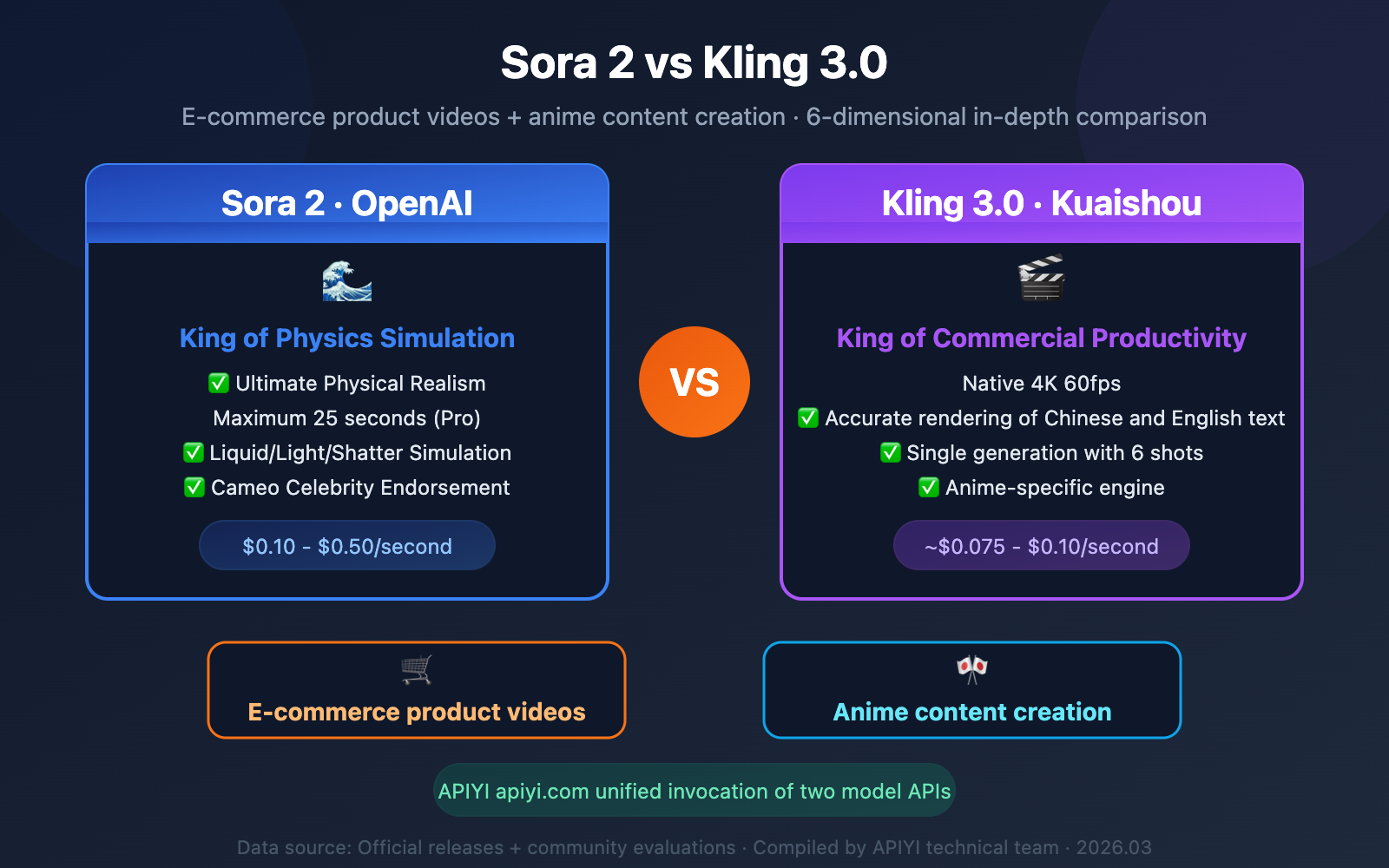
Sora 2 vs. Kling 3.0: Quick Look at Core Parameters
Before we dive into the scenario-based comparison, let's first look at their core technical specs.
| Parameter | Sora 2 / Sora 2 Pro | Kling 3.0 |
|---|---|---|
| Release Date | December 2025 | February 4, 2026 |
| Developer | OpenAI | Kuaishou |
| Max Resolution | 1080p (Pro) | Native 4K (3840×2160) |
| Max Frame Rate | 30 FPS | 60 FPS |
| Max Duration | 25 seconds (Pro) | 15 seconds |
| Audio Generation | ✅ Sync dialogue + sound effects | ✅ Multi-language dialogue + multi-character |
| Multi-shot | Partial support | ✅ 6 shots in a single generation |
| Text Rendering | English okay, Chinese poor | ✅ High-precision Chinese & English rendering |
| Character Consistency | ✅ Cameo real-person insertion | ✅ Elements system, tracks 3 people |
| Anime Style | Supports multiple styles | ✅ Dedicated Stylistic Omni engine |
| API Pricing | $0.10-$0.50/sec | ~$0.075-$0.10/sec |
| API Available | Via APIYI apiyi.com | Via APIYI apiyi.com |
Looking at the specs, Kling 3.0 has clear advantages in resolution (4K), frame rate (60fps), and text rendering, while Sora 2 leads in video duration (25 seconds) and the realism of its physical simulations.
In-Depth Comparison of E-commerce Product Video Scenarios
E-commerce videos have extremely high requirements for visual quality, text clarity, and product detail reproduction. The performance differences between the two models are quite pronounced in this scenario.
Comparison Dimension 1: Product Text and Logo Rendering
This is a core requirement for e-commerce videos—brand names, ingredient lists, and efficacy descriptions on product packaging all need to be clearly legible.
Kling 3.0: A Strength in Text Rendering
Kling 3.0 has specific optimizations for text rendering, capable of preserving or generating text content like signage, subtitles, and brand elements with high precision. For e-commerce advertising scenarios, this means Chinese labels and English brand names on product packaging can be presented clearly.
Sora 2: A Weakness in Text Rendering
Chinese text rendering has always been a shortcoming for Sora 2. AI video models essentially "draw characters" rather than "write characters," and the complexity of Chinese strokes frequently leads to garbled or distorted text. English rendering quality is acceptable, but long text still carries a risk of errors.
| Text Rendering Comparison | Sora 2 | Kling 3.0 |
|---|---|---|
| English Brand Name | ⭐⭐⭐⭐ Mostly usable | ⭐⭐⭐⭐⭐ Clear and precise |
| Chinese Product Name | ⭐⭐ Often garbled | ⭐⭐⭐⭐ High fidelity |
| Ingredients/Description Text | ⭐ Almost unreadable | ⭐⭐⭐ Usable for short text |
| Price Tag | ⭐⭐⭐ Numbers readable | ⭐⭐⭐⭐⭐ Perfect presentation |
🎯 E-commerce Selection Advice: If your product video needs to display clear Chinese text and brand logos, Kling 3.0 is the better choice. Through the APIYI apiyi.com platform, you can call both Sora 2 and Kling 3.0 APIs, switching flexibly based on specific needs.
Comparison Dimension 2: Product Material and Lighting Reproduction
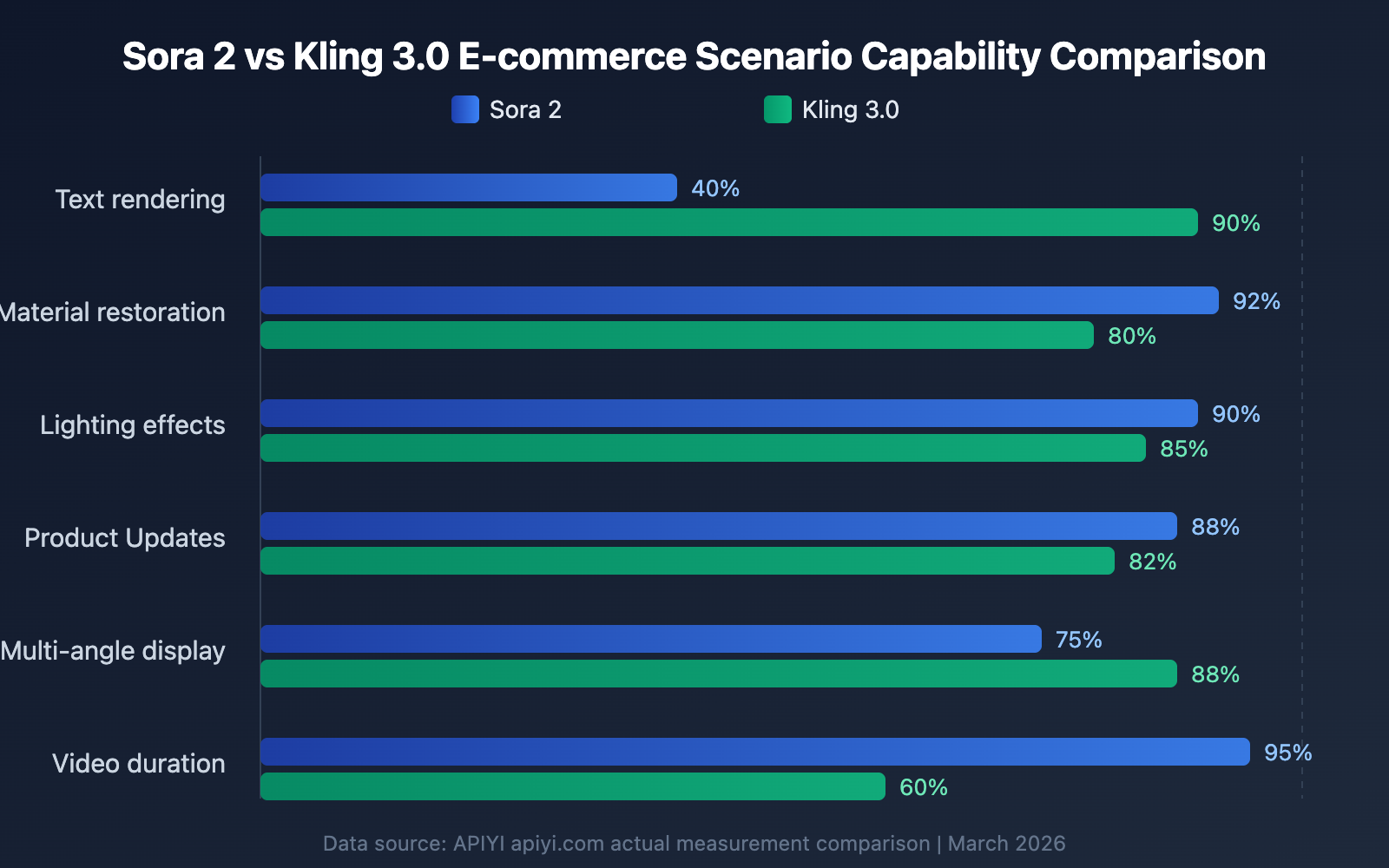
The presentation of product texture is crucial in e-commerce videos—the transparency of a glass bottle, the sheen of metal, the weave of fabric.
Sora 2: The King of Physics Simulation
Sora 2 is currently the gold standard among AI video models for physics simulation. It accurately calculates physical phenomena like light refraction, liquid flow, and crack textures, rarely producing physical errors like "water flowing upwards." This is very important for e-commerce categories like cosmetics, jewelry, and food that require fine material representation.
Kling 3.0: The 4K Quality Advantage
Kling 3.0's native 4K resolution means product details can be presented more clearly. In product close-up shots, the quality difference between 4K and 1080p is visible to the naked eye. Meanwhile, the 60fps frame rate makes dynamic effects like product rotation and unfolding much smoother.
Comparison Dimension 3: E-commerce Video Workflow Efficiency
| Workflow Dimension | Sora 2 | Kling 3.0 |
|---|---|---|
| Image-to-Video (i2v) | ✅ Supports first frame reference image | ✅ Supports first frame + last frame locking |
| Multi-Shot Generation | Requires multiple generations and stitching | ✅ Single generation for 6 shots with auto-editing |
| Character Consistency | Cameo feature | Elements + 3-person tracking |
| Audio Synchronization | Synchronized dialogue + sound effects | Multi-language, multi-character dialogue |
| Batch Production Efficiency | Medium | High (multi-shot reduces stitching) |
Kling 3.0's Multi-Shot feature significantly boosts e-commerce video production efficiency—a single generation can include multiple shots like product close-ups, usage scenarios, and effect demonstrations, saving a lot of post-production editing work.
In-Depth Comparison of Anime Content Creation Scenarios
Anime content creation has unique requirements for style consistency, character expressiveness, and motion fluidity.
Comparison Dimension 4: Anime Style Generation Capability
Kling 3.0: Dedicated Anime Engine
Kling 3.0 has a built-in Stylistic Omni engine specifically tuned for Japanese anime styles, including correct character proportions and motion representation. Supported style presets include: cinematic, anime, 3D, realistic, etc. Users can also upload reference images to define custom styles.
Kling 3.0 excels at complex human movements—kung fu, dance, running, etc.—without issues like "noodle limbs" or body distortion. This is critical for fight scenes and dance scenes in anime.
Sora 2: Multi-Style Support
Sora 2 also supports various visual styles like anime, cartoon, Pixar style, and watercolor. It's on par with Kling 3.0 in style diversity but lacks engine-level optimization specifically for anime scenes.
Sora 2's strength lies in its understanding of complex scene descriptions—precise camera movement, timeline control, multi-subject interaction, etc.—giving it unique value in anime narratives requiring precise cinematography.
Comparison Dimension 5: Character Consistency and Multi-Character Management
| Character Capability | Sora 2 | Kling 3.0 |
|---|---|---|
| Character Consistency Tech | Cameo for real-person insertion | Elements identity locking system |
| Characters per Scene | Multiple (prone to errors) | Up to 3 people with independent tracking |
| Cross-Shot Consistency | ⭐⭐⭐⭐ Good | ⭐⭐⭐⭐⭐ Industry-leading |
| Anime Character Retention | ⭐⭐⭐ Style may drift | ⭐⭐⭐⭐⭐ Locked throughout |
| Real Person → Anime Conversion | Achieved via style prompts | Reference image + style preset |
For anime content creation, character consistency is one of the most critical metrics. Kling 3.0's Elements system is clearly ahead in this area—it can maintain the same character's appearance, clothing, and features across multiple shots.
Comparison Dimension 6: Audio and Dubbing
Anime content typically requires character dialogue and background sound effects.
Kling 3.0's Audio Advantages:
- Supports multiple languages: Chinese, English, Japanese, Korean, Spanish, etc.
- Different characters in a single scene can speak different languages
- Accurate lip-sync
- Supports voice reference
Sora 2's Audio Characteristics:
- Synchronized dialogue and sound effects
- High naturalness of sound effects
- Relatively fewer language options
For anime content requiring Japanese dubbing, Kling 3.0's native multi-language support is a clear plus.
💡 Anime Creation Advice: For anime content creation, Kling 3.0 is recommended as the primary tool, leveraging its Stylistic Omni engine and character consistency system. For anime scenes requiring complex physical effects (like water, fire, explosions), you can use Sora 2 to generate VFX assets for compositing. Through the APIYI apiyi.com platform, you can uniformly call both APIs, flexibly combining them within the same project.
Sora 2 vs. Kling 3.0 API Pricing and Cost Comparison
For real-world production environments, API cost is a critical factor in decision-making.
| Pricing Dimension | Sora 2 Standard | Sora 2 Pro | Kling 3.0 |
|---|---|---|---|
| Per Second (720p) | $0.10 | $0.30 | ~$0.075-$0.10 |
| Per Second (1080p) | — | $0.50 | ~$0.10 (Native 4K) |
| 10-Second Video | $1.00 | $5.00 | ~$0.75-$1.00 |
| Includes Audio | Same Price | Same Price | Same Price |
| Maximum Duration | 12 seconds | 25 seconds | 15 seconds |
From a cost perspective, Kling 3.0 offers a lower price for comparable quality, especially since its 4K resolution pricing is close to Sora 2 Standard's 720p rate. For teams needing to produce a high volume of e-commerce videos, this cost difference is significant.
It's worth noting that while Sora 2 Pro's quality mode offers a noticeable improvement, its price is 3-5 times higher than the standard mode. Kling 3.0's standard mode already includes 4K 60fps output capability without requiring an extra fee for a higher quality tier.
Sora 2 vs. Kling 3.0 API Invocation Methods
Both support REST API calls, but their interface designs differ:
# Invoking Sora 2 via the APIYI Unified Interface
import openai

client = openai.OpenAI(
    api_key="YOUR_API_KEY",
    base_url="https://api.apiyi.com/v1"  # APIYI Unified Interface
)

# Sora 2 Video Generation
response = client.chat.completions.create(
    model="sora-2",
    messages=[{"role": "user", "content": "Product showcase video description"}]
)
View Kling 3.0 API Call Example
# Invoking Kling 3.0 via the APIYI Unified Interface
client = openai.OpenAI(
    api_key="YOUR_API_KEY",
    base_url="https://api.apiyi.com/v1"  # Same interface
)

# Kling 3.0 Video Generation
response = client.chat.completions.create(
    model="kling-3",
    messages=[{"role": "user", "content": "4K anime character video description"}]
)
🚀 Quick Start: Register on the APIYI platform at apiyi.com to get free testing credits. Use one API key to call both Sora 2 and Kling 3.0, and get set up in just 5 minutes.
Monthly E-commerce Video Cost Estimate
| Monthly Volume | Sora 2 (720p, 8s) | Sora 2 Pro (1080p, 8s) | Kling 3.0 (4K, 8s) |
|---|---|---|---|
| 50 Videos | $40 | $200 | $40-50 |
| 200 Videos | $160 | $800 | $160-200 |
| 500 Videos | $400 | $2,000 | $400-500 |
💰 Cost Optimization: The APIYI platform at apiyi.com lets you manage API calls for both Sora 2 and Kling 3.0 from a single account with one set of keys. It offers flexible, per-second billing. For teams using both models, unified platform management can significantly reduce integration and operational overhead.
Sora 2 vs. Kling 3.0 Use Case Recommendations
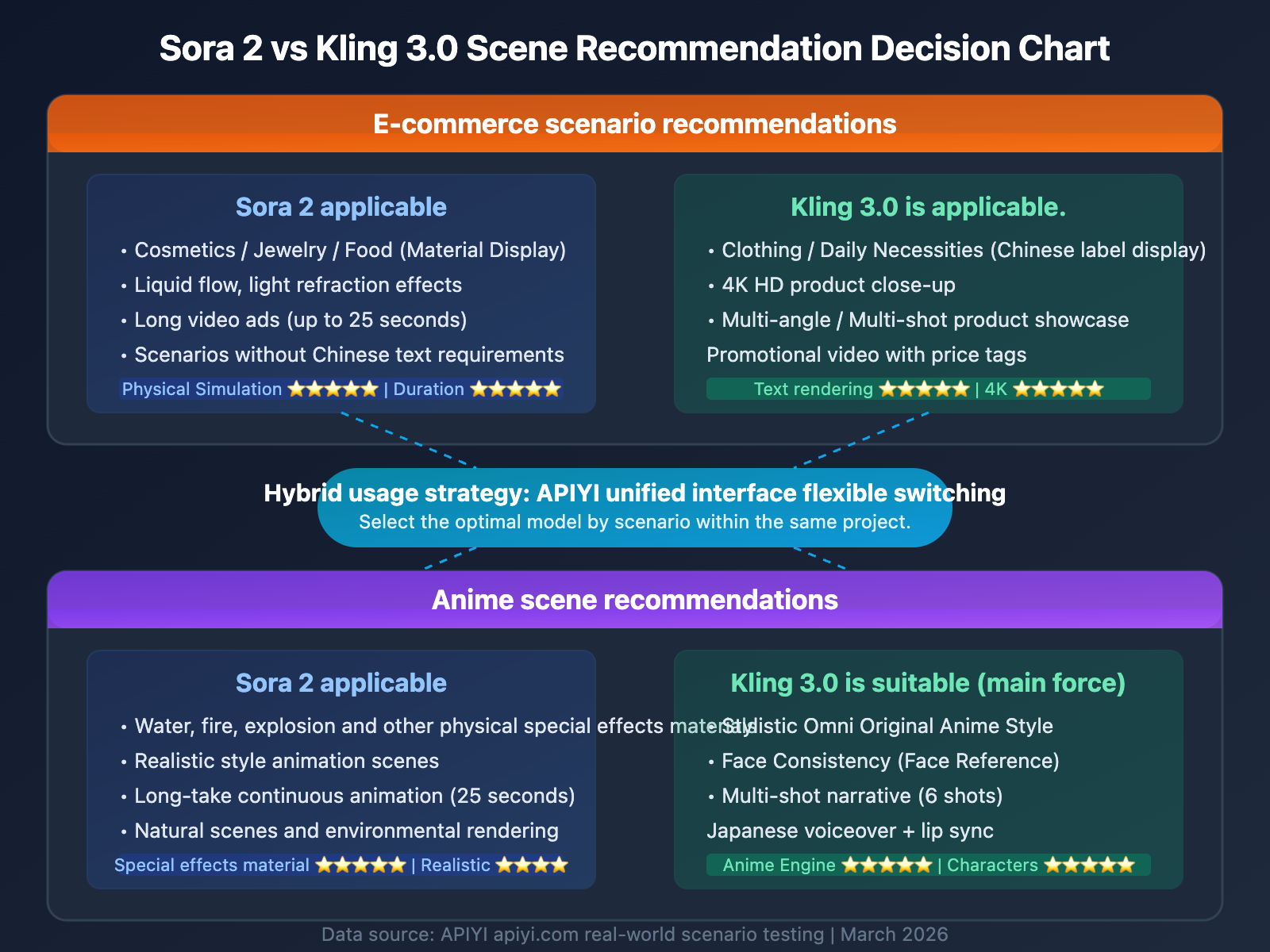
E-commerce Product Video Recommendations
| E-commerce Scenario | Recommended Model | Reason |
|---|---|---|
| Product Unboxing/Showcase | Kling 3.0 | 4K quality + clear text + multi-shot capability |
| Cosmetics/Liquid Products | Sora 2 | Strong physics simulation, realistic liquid effects |
| Clothing/Fashion Showcase | Kling 3.0 | Good character consistency, natural fabric dynamics |
| Food/Beverage Ads | Sora 2 | Excellent physics for splashes, steam, etc. |
| 3C/Digital Products | Kling 3.0 | 4K detail, accurate metallic sheen |
| Multi-Product Compilation Videos | Kling 3.0 | Multi-shot feature generates in one go |
Anime Content Creation Recommendations
| Anime Scenario | Recommended Model | Reason |
|---|---|---|
| Japanese-style Anime Characters | Kling 3.0 | Dedicated Stylistic Omni engine |
| Action/Fight Scenes | Kling 3.0 | Precise human motion, no distortion |
| Environment/Atmosphere Rendering | Sora 2 | Top-tier physics simulation and lighting |
| Multi-Character Dialogue | Kling 3.0 | Multi-language, multi-character audio |
| Effect-Heavy Scenes | Sora 2 | Physics for fire, water, explosions |
| Continuous Story Narration | Kling 3.0 | Multi-shot + character consistency |
Best Practices for Hybrid Usage
For teams pursuing the highest quality, you can combine both models:
- Use Kling 3.0 for: Character performances, text rendering, multi-shot main videos.
- Use Sora 2 for: Physics-based effects, liquid/lighting assets, long-shot narratives.
- Post-production: Combine assets from both in editing software to create the final piece.
🎯 Technical Suggestion: Using the APIYI platform at apiyi.com to call both Sora 2 and Kling 3.0 APIs allows you to switch models flexibly within the same project. The platform supports full parameter configuration for both and per-second billing, making it the most convenient choice for implementing a hybrid workflow.
Sora 2 vs Kling 3.0 FAQ
Q1: Which model is best for e-commerce product videos?
For most e-commerce scenarios, Kling 3.0 is recommended. Here's why: its native 4K resolution shows product details more clearly, its strong text rendering preserves product labels and brand names, and its multi-shot feature boosts production efficiency. However, if your product involves materials like liquids or glass that require fine physical simulation, Sora 2 performs better. We suggest testing both models via the APIYI platform at apiyi.com to see which gives you the best results.
Q2: Which model is better for anime content creation?
Kling 3.0 is more suitable. It has a dedicated Stylistic Omni anime engine, a powerful character consistency system, and supports multi-language voiceovers like Japanese. But for anime scenes requiring complex physical effects (like water elements or explosions), you can use Sora 2 to generate the VFX assets and then composite them in post-production onto the main video generated by Kling 3.0.
Q3: Can both APIs be called from the same platform?
Yes. Through the APIYI platform at apiyi.com, you can uniformly call the APIs for both Sora 2 and Kling 3.0. Manage invocations for both models with one account, pay by the second, and switch between them flexibly.
Q4: Is the gap between Kling 3.0’s 4K video and Sora 2 Pro’s 1080p significant?
The difference is noticeable in e-commerce product close-ups. 4K (3840×2160) has 4 times the pixels of 1080p (1920×1080). When showcasing product textures, label text, and other fine details, 4K's advantage is very clear. However, if the final video is for social media (where most platforms compress to 1080p or even 720p), this gap is significantly reduced.
Q5: What’s the cost difference for generating a 15-second e-commerce video?
Generating a 15-second 4K video with Kling 3.0 costs about $1.13-$1.50. The Sora 2 Standard version generates a 12-second 720p video for about $1.20 (and is limited to 12 seconds max). Sora 2 Pro generates a 15-second 1080p video for about $7.50. Kling 3.0 offers lower cost for higher quality, giving it a clear advantage in value for money.
Sora 2 vs Kling 3.0: E-commerce & Anime Comparison Summary
Sora 2 and Kling 3.0 represent two different technical directions in AI video generation:
- Sora 2 is the king of physics simulation and realism—unmatched in fluid flow, light refraction, and long-shot narratives. It's ideal for scenarios demanding extreme physical realism.
- Kling 3.0 is the king of commercial productivity—with 4K 60fps, precise text rendering, automatic multi-shot editing, and a dedicated anime engine, it's more aligned with practical business needs.
For e-commerce teams and anime creators, the most pragmatic approach isn't to choose one over the other, but to use both flexibly based on the specific scenario.
We recommend accessing both models' APIs through the unified APIYI platform at apiyi.com. With per-second billing and flexible switching, you can ensure every dollar of your video generation budget is spent on the most suitable model.
References
-
Kling 3.0 Announcement: Kuaishou Official News
- Link:
prnewswire.comKling AI 3.0 Press Release - Description: Core features like 4K 60fps, multi-camera, multilingual audio
- Link:
-
Kling 3.0 E-commerce Video Guide: Tellos Deep Dive
- Link:
jointellos.com/blog/kling-3-ai-video-model-ecommerce-product-content-2026 - Description: Application strategies for Kling 3.0 in e-commerce content production
- Link:
-
2026 AI Video Model Comprehensive Comparison: Cliprise Analysis
- Link:
medium.com/@clipriserelated article - Description: Comprehensive evaluation of models like Sora 2, Kling 3.0, Veo 3.1
- Link:
-
Kling 3.0 Review: Curious Refuge In-Depth Review
- Link:
curiousrefuge.com/blog/kling-30-review - Description: Professional filmmaker's perspective on Kling 3.0 usage experience
- Link:
📝 This article was written by the APIYI Team. For more AI video generation comparisons and API invocation guides, visit APIYI at apiyi.com to get the latest content and free testing credits.