Author’s note: This is a breakdown of how the pure-code Chinese audiovisual long scroll The Pelican’s Six-Thousand-Year Ride travels through 20 art-history eras in 2 minutes 55 seconds—and how you can use gemini-4-hydrogen to make a short pure-code sequence of your own.
If you’ve seen The Pelican’s Six-Thousand-Year Ride, one detail probably stuck with you: a pelican on a bicycle rides all the way from Saharan rock art to vertical short videos—and the entire film contains no images, no font packages, and no audio files. Open it in a browser, click the screen, and it starts playing.
It’s not a pre-rendered MP4; it’s a single 2.56 MiB HTML file, and all visuals are drawn live with Canvas and SVG. This article doesn’t verify credits; it focuses on the work itself: how the 20 eras are connected, how pure code holds the whole film together, and how to invoke Gemini 4 if you want to try making a segment yourself.
Key takeaway: By the end, you’ll know where this film shines, and you’ll be able to follow the steps to use gemini-4-hydrogen to generate a short pure-code era scene of your own.
Six Thousand Years of the Pelican — Core Takeaways: What One Film Actually Pulls Off
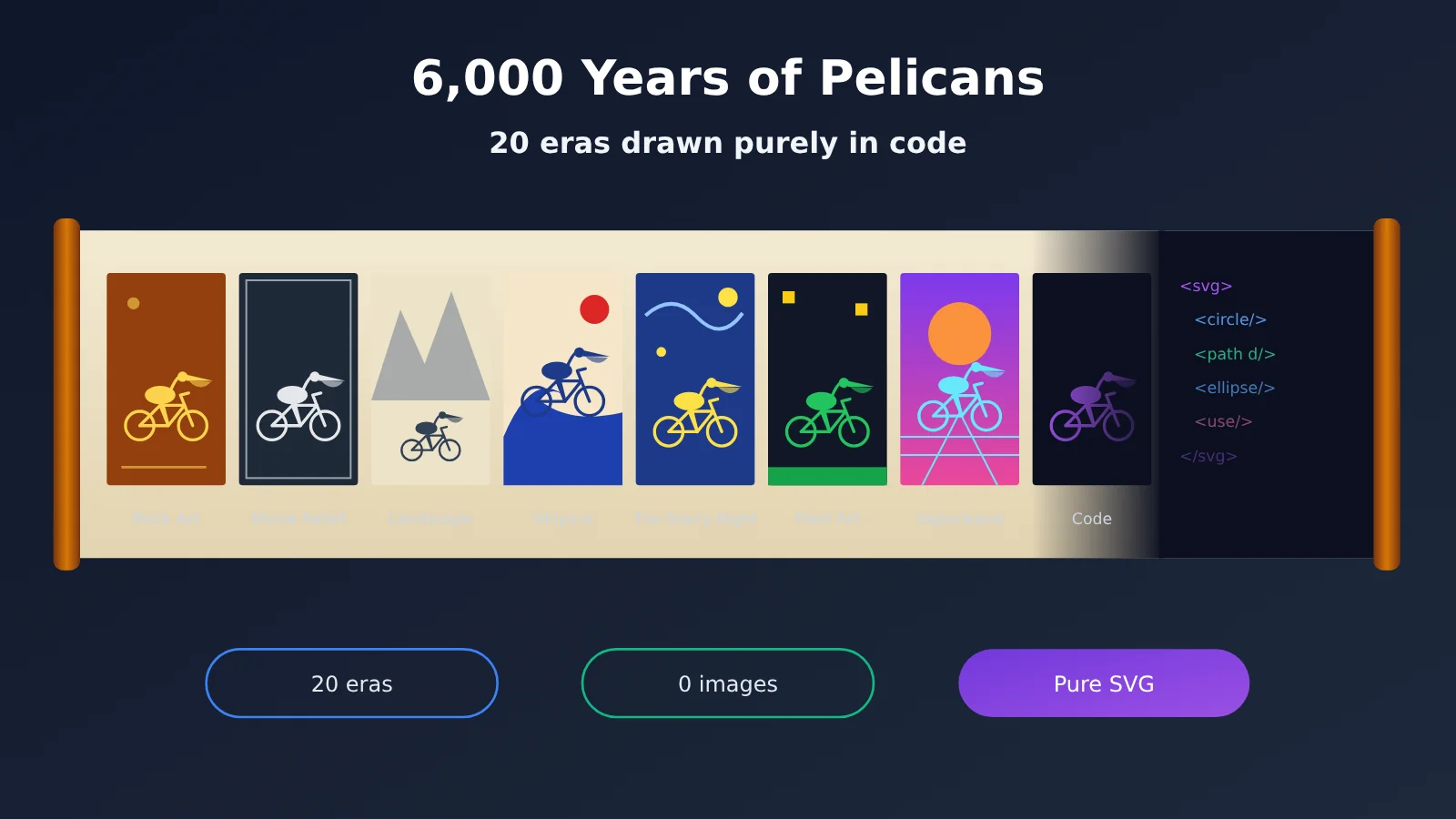
Here’s the quick summary. The film’s own description in the repository README is this: a complete 2-minute-55-second (174.64-second) pure-code Chinese interactive audiovisual scroll, opening with a vector seal-carving scene in a blacksmith’s forge, traveling through 20 art-history eras, and rendering its imagery with Live Canvas and animated SVG brushstrokes.
| Point | Description | Why It Matters to Viewers |
|---|---|---|
| 20 eras in one continuous take | From Saharan rock art to code aesthetics, each scene carries a small story | Not a slideshow of style filters, but an art-history journey with a plot |
| Pure-code visuals | 0 PNG/JPG, 0 WOFF2/TTF — the imagery is drawn in real time by Canvas/SVG | A single file that plays, reads, can be modified, and can be learned from |
| Chinese audio-visual sync | Lyrics aligned word by word, with separate tracks for lead vocal, acoustic guitar, forging, and reverb tails | The visuals and subtitles move with the song |
| Interactive playback | Click or press space to play, F for fullscreen, arrow keys to skip 5 seconds back or forward | Operate a code artwork like a media player |
| Restrained specs | 960×720, 30 fps, 1.93 MB zip, 2.56 MiB html | Small enough to send straight to a friend |
Where the premise of Six Thousand Years of the Pelican came from
The starting point of this film is Simon Willison’s widely circulated test prompt, “A pelican riding a bicycle”: get a Large Language Model to draw a pelican on a bicycle using code. The original prompt is a single static SVG, testing whether the model can explain an absurd scene clearly with vector graphics.
The Bicycle of Six Thousand Years of the Pelican stretches that premise into a movie. The repository also pays tribute to the earlier project orbitoo/pelican-test, another 137-second, 1920×1080, 60 fps film — that one and the 174.64-second, 960×720, 30 fps scroll discussed here are two separate works, so don’t conflate them.
A note on attribution: the credits say it was completed independently by Hydrogen, and data/film.json records the model as gemini-4-carbon. Both belong to the Gemini 4 family, and both are already available on APIYI.
The Pelican’s 20 Eras Across Six Thousand Years: Scene by Scene, How the Images Tell the Story
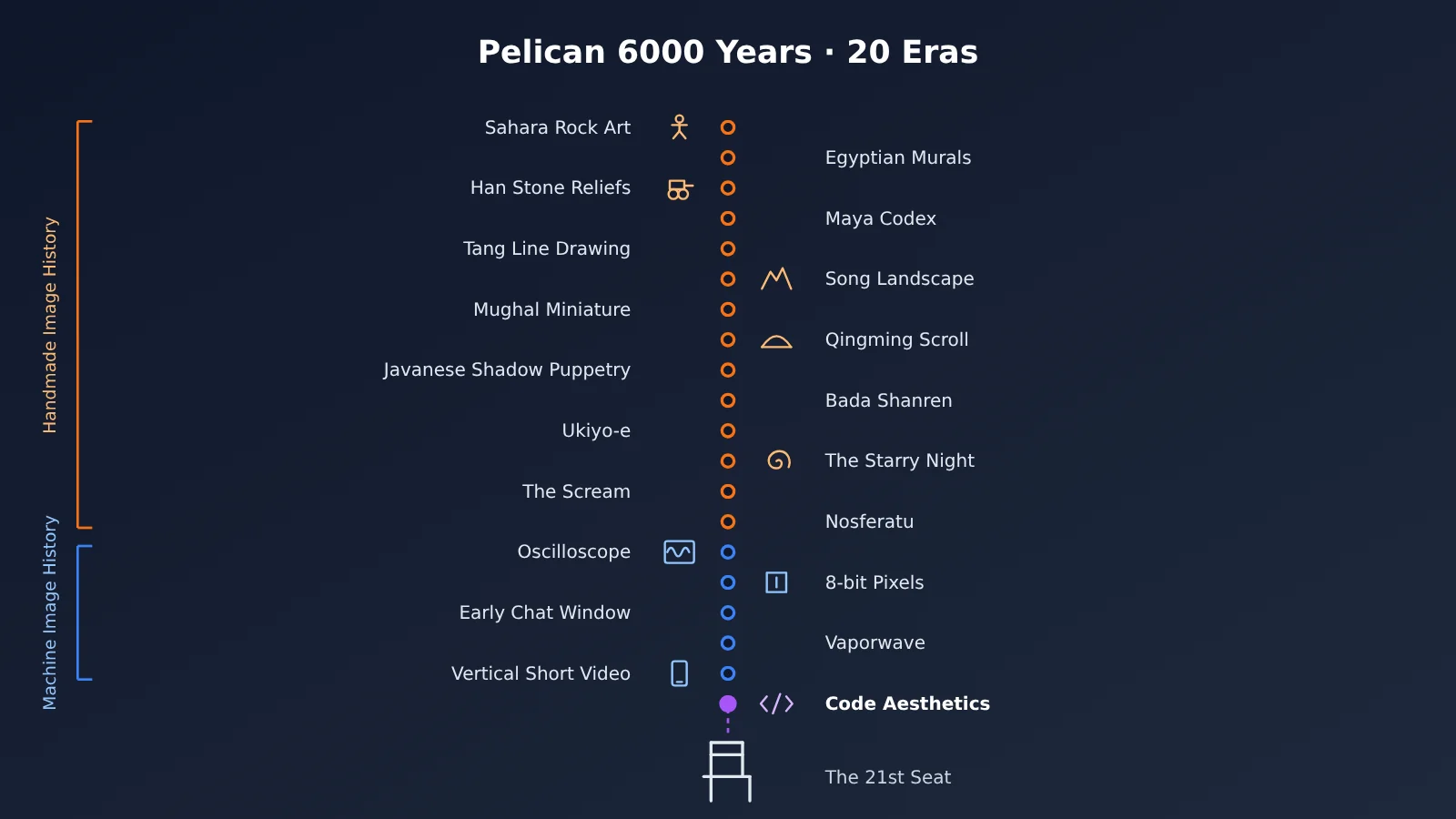
What makes this film so moving is that each scene doesn’t just switch up the visual style—it also lets the pelican stir up a little trouble in that era. Below, using the story field in data/film.json, I’ll walk through 10 scenes in detail and put the rest in a table.
From Sahara Rock Art to Han Dynasty Stone Reliefs: The Start of the Pelican’s Six Thousand Years
The first scene is Sahara rock art: herders and their cattle stop in their tracks to watch a pelican riding a bicycle. Rock art itself is one of humanity’s earliest narrative images, so starting the pelican here makes the film’s title—”Six Thousand Years”—feel grounded in something real.
Then we get to a rubbing of a Han dynasty stone relief, where the pelican sneaks into an official’s carriage-and-horse procession—and the stone carver casually engraves this pelican rider into the stone. Han dynasty stone reliefs are already famous for their carriage-and-horse travel scenes, so squeezing a bicycle into a horse-drawn carriage procession is exactly the kind of “deadpan mischief” that defines the whole film.
Tang Dynasty Line Drawing and Song Dynasty Landscape: The Pelican’s Six Thousand Years of Eastern Brushwork
The Tang dynasty line-drawing scene is built around “Wu’s belts fluttering in the wind,” with feathers and ribbons flapping together. That phrase originally described the soaring, wind-blown lines of Wu Daozi’s drapery; here the film lets the pelican’s feathers join in that flutter, creating a sense of motion purely through line — exactly what SVG paths do best.
The Song dynasty landscape then switches to a different visual language: the camera pushes deep into towering cliffs and crags, and only on a mountain path does it finally find a tiny pelican riding a bike. This shot is all about composition and scale — the protagonist is deliberately made small, capturing the spirit of Song painting, where “the person is within the mountain.”
Along the River During the Qingming Festival and Bada Shanren: The Pelican’s Six Thousand Years of Humor
In the Along the River During the Qingming Festival scene, the pelican rides onto the Rainbow Bridge, and the passersby on the bridge all turn their heads. Anyone who knows the original painting will smile — the Rainbow Bridge is, after all, the liveliest spot in the entire scroll.
Bada Shanren’s freehand style is the most “economical” scene in the whole film: vast stretches of empty space, just a few sparse strokes, and the pelican rolls its eyes. The birds in Bada Shanren’s paintings are famous for looking at people with that white-eyed sideways glance; this joke lands with a single expression — one of the details in the film that best shows its craft.
Starry Night and The Scream: A Pelican Crashes Six Thousand Years of Western Masterpieces
In the Starry Night scene, the swirling stars turn along with the wheel. The wheel’s rotation is tied to the swirls of Van Gogh’s brushstrokes, and the animated brushwork is done in code — the visual payoff here lands in a very direct way.
The Scream scene, by contrast, has a full little plot: the screamer on the bridge gets spooked, the pelican roars back, and then both sides fall into an awkward silence. The world’s most famous terrified face gets talked back at by a pelican — the timing feels a lot like a plot twist in a short drama.
Oscilloscopes and Code Aesthetics: A Pelican Returns to the Code Itself
In the oscilloscope vector graphics scene, someone turns the wrong knob, and the pelican gets twisted into a Lissajous figure. A Lissajous figure is itself a curve generated by mathematical functions, so showing up inside a purely code-driven work is almost a kind of self-reference.
The last scene, code aesthetics, turns the frame into line after line of SVG code that redraws the pelican. This is where the film shows the audience its hand: all 20 eras you just watched were written out line by line exactly like this. In the epilogue, twenty era “answer sheets” hang across the gallery wall, and an empty chair in the twenty-first seat waits for “the pelican itself” to respond.
A Quick Look at the Other 10 Scenes of the Pelican’s 6,000 Years
| Era | Story in film.json | Highlights |
|---|---|---|
| Egyptian mural | An unfinished tomb mural; the pelican stops and strikes an Egyptian profile pose | The protagonist actively plays along with the art style |
| Maya codex | Bystanders use Mayan dot-and-bar numerals to record how many laps were pedaled | Turning ancient script into a lap counter |
| Mughal miniature | Guests in a palace garden watch from multiple viewpoints | Multi-viewpoint composition |
| Javanese shadow puppet | Turns into a cutout shadow puppet, the wheel turning in stutters | Using stutter to mimic the feel of shadow puppetry |
| Ukiyo-e | A field path beneath Mount Fuji, a traveler turning to look back | “Looking back” becomes the film’s motif |
| Nosferatu | A shadow on the wall climbs the stairs on its own; the power comes on as it leaves | Classic silent-film staging of shadows |
| 8-bit pixel game | Jumps over pits, collects coins, pops up 1UP | Game grammar enters the frame directly |
| Early chat window | Sent as a 256-color animated image; the other side nudge-windows twice | An internet-archaeology gag |
| Vaporwave | The world slows down, marble statues turn to look back, the tape jumps | The sense of time gets stretched |
| Vertical short video | The frame goes vertical, freeze-frame slow motion, likes flood in | The aspect ratio itself becomes part of the narrative |
When you put all 20 scenes together, a hidden thread emerges: the first half is the history of human handmade images (cave paintings, murals, rubbings, paintings), the second half is the history of machine images (oscilloscopes, pixels, chat windows, short videos), and it finally lands on code. This arc from “hand-carved” to “code-drawn” is the film’s real structure.
Why Pelican Six Thousand Years Can Play with Pure Code
Many people, the first time they open the online version, assume it’s pulling a video stream in the background. In reality, it’s a completely self-contained web piece. The README explicitly lists three “zeros”: zero audio samples, zero external bitmaps, and zero external font packages.
| Item | Spec | Notes |
|---|---|---|
| Duration | 174.64 seconds (2 min 55 sec) | A complete long-form scroll, not a short looping animation |
| Resolution and frame rate | 960×720, 30 fps | 4:3 aspect ratio, with a slightly retro screening feel |
| External bitmaps | 0 PNG/JPG | Every frame is drawn by Canvas/SVG |
| External fonts | 0 WOFF2/TTF | Text effects such as seal carving and subtitles don’t rely on font packages |
| Audio files | 0 MP3/WAV | No audio files are read during playback |
| Single-file zip | 1.93 MB | Easy to distribute |
| Single-file HTML | 2.56 MiB | Opens directly in a browser |
The Visual and Audio Pipeline of Pelican Six Thousand Years
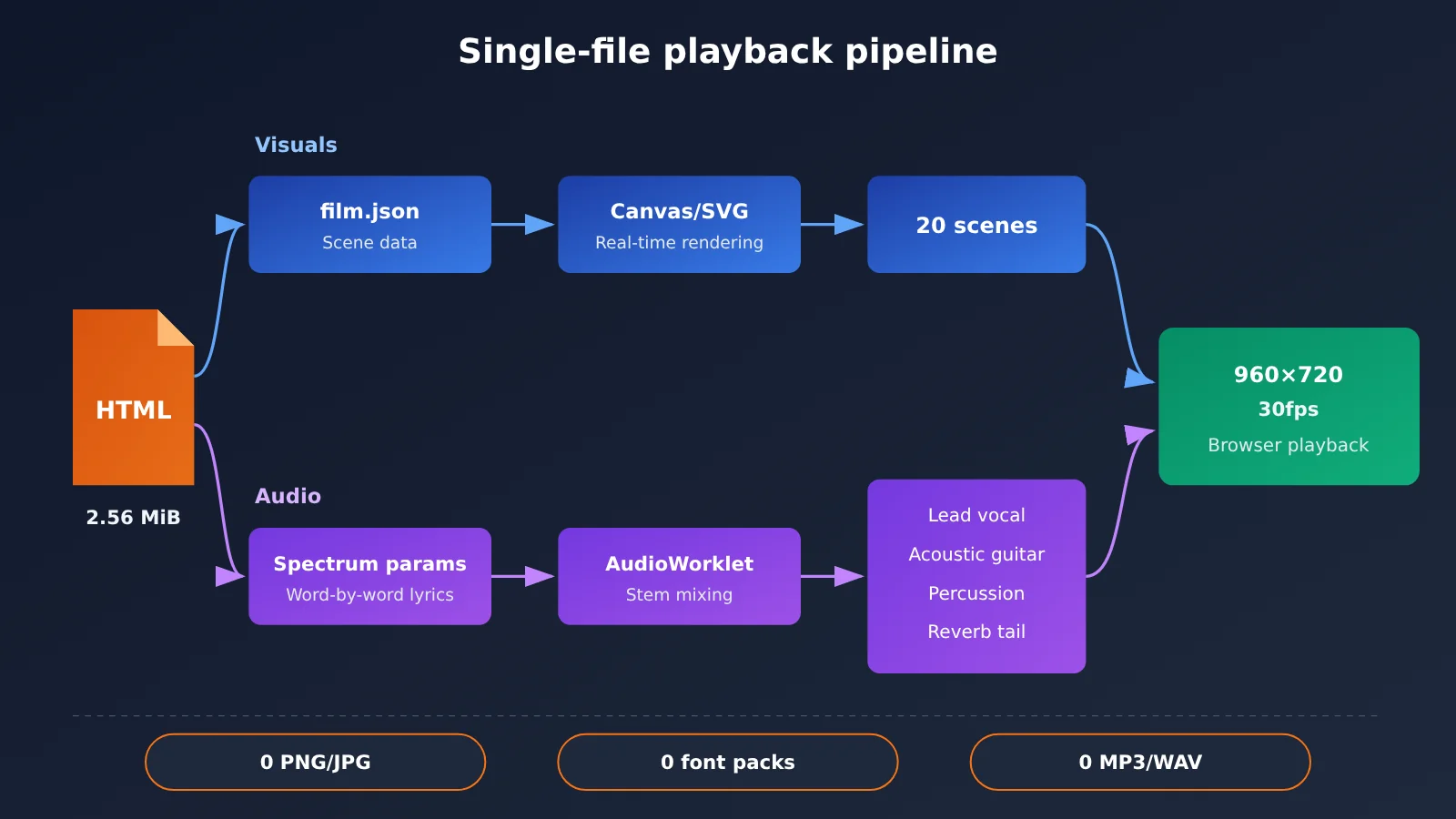
The visual side is pretty straightforward: the shapes, brushstrokes, and camera movements in every scene are all computed in real time with Live Canvas and SVG. The vector seal carving at the blacksmith shop opening, the flowing lines of Tang dynasty line drawing, and the swirls of The Starry Night are essentially paths and parameters changing along the timeline.
The audio side deserves one honest note. data/lyrics.json states that the lyrics source is “Suno original lyrics + local word-by-word forced alignment,” and data/audio/manifest.json states: “contains only code and numeric parameters; playback does not read audio files. The parameters store spectral information from the original recording.” In other words, the song is an existing Suno track. The piece stores the original recording’s spectral information as numeric parameters, and then the browser’s AudioWorklet synthesizes it in real time across separate stems for lead vocals, acoustic guitar, blacksmith strikes, and resonance. The model isn’t writing lyrics and composing on the spot.
Playback Controls for Pelican Six Thousand Years
Once you open the online page, the controls feel a lot like a regular video player, but they’re all handled by page scripts:
- Click the screen or press Space: play or pause
- Double-click or press F: enter fullscreen
- Press M: mute
- Press R: restart from the beginning
- Left/Right arrow keys: skip back or forward 5 seconds
For your first viewing, I’d go straight to fullscreen, set the volume to a comfortable level, and watch from the blacksmith shop opening all the way to the empty chair. The 5-second skip back and forward is great for revisiting details in a particular scene, like that one white-eyed glance from Bada Shanren.
Drawing your own era with Gemini 4 and pure code: a quick start
After watching the film, a lot of people’s first reaction is: can I get the model to draw a little segment too? The answer is yes, and the bar isn’t high. You don’t need to recreate all 20 scenes and the entire song — just pick one era and have the model output a single-file HTML you can play directly in a browser.
If you want to make similar pure-code visuals, generation will consume tokens. You can use the OpenAI-compatible endpoint https://api.apiyi.com/v1 on APIYI, with the model set to gemini-4-hydrogen. By Google’s official positioning, it’s the everyday workhorse tier of Gemini 4, adapted from Carbon, with a unified price across the full 1M context — well suited to this kind of creative task that needs repeated iteration. Its sibling gemini-4-carbon is also available, so you can easily switch between them.
gemini-4-hydrogen invocation parameters
| Parameter | Value | Notes |
|---|---|---|
| API endpoint base_url | https://api.apiyi.com/v1 |
OpenAI-compatible, goes through POST /v1/chat/completions |
| Native endpoint | /v1beta/models/gemini-4-hydrogen:generateContent |
Use this if you’re used to Gemini’s native format |
| model | gemini-4-hydrogen |
Sibling option gemini-4-carbon |
| Thinking level thinkingLevel | low / medium / high / xhigh | Defaults to high; try a higher level for complex animation |
| Max output per request | 65,536 tokens | Plenty for a single-file HTML holding one complete short animation |
The four-step method for the same short segment as “Pelican for Six Thousand Years”
- Pick an era: It’s best to start with something structurally simple — say, Bada Shanren’s freehand xieyi style or an oscilloscope vector graphic. Lots of whitespace, few shapes, and the easiest to nail in a single pass.
- Write clear constraints: Spell out that you want a single HTML file, Canvas or inline SVG only, no external images or fonts, click the screen to start playback, and a runtime of 8 to 15 seconds.
- Send the request: In your usual OpenAI SDK, set
base_urlto the APIYI address, put your key inapi_key, setmodeltogemini-4-hydrogen, and drop the prompt below intomessages. - Save and iterate: Save the response as
scene.html, open it in a browser to see how it looks, then append the problems you spot (the wheel isn’t spinning, the composition is too crowded) to the conversation and let the model fix them.
Here’s a prompt you can use right away — just copy it into the user message:
Please output a complete single-file HTML with no explanatory text. Content: a pelican riding a bicycle, in “Bada Shanren freehand” style, with vast areas of whitespace and just a few strokes of ink. Animation runtime around 12 seconds: the pelican slowly rides in from the left edge, stops in the center, gives a signature “white-eyed” sideways glance, then rides out to the right. Technical constraints: draw using Canvas or inline SVG only; do not reference any external images, fonts, audio, or scripts; canvas 960×720; click the screen or press space to start and pause playback; drive the animation with requestAnimationFrame.
If you want to take it one step further toward The Pelican’s Six Thousand Year Bike, keep appending a second era in the conversation — for example, “then continue with a scene in oscilloscope vector style: when the wrong knob is turned, the pelican twists into a Lissajous figure” — and let the model handle the scene switch inside the same file. Adding one scene at a time is far more reliable than asking for 20 scenes all at once.
🚀 Getting-started tip: First grab your new-user free trial credits on APIYI at apiyi.com, get one scene working with the prompt above, and then decide whether to expand it into a multi-scene long scroll. The same API key can also switch to
gemini-4-carbonfor a side-by-side comparison, so you can pick the right model for your own work.
gemini-4-hydrogen and gemini-4-carbon Pricing
The prices below come from the APIYI model master table, with data updated on 2026-11-16 09:39 (UTC+8). They’re priced per 1M tokens:
| Model | Input | Output | Cache read | Context / Max output | Available platforms |
|---|---|---|---|---|---|
| gemini-4-hydrogen | $1.5 | $7.5 | $0.075 | 1M flat rate / 65,536 | APIYI apiyi.com (Default, SVIP groups) |
| gemini-4-carbon | $2 | $10 | $0.1 | 1,048,576 / 65,536 | APIYI (Default, SVIP groups) |
Code-only animation has one defining trait: very long outputs. A piece of HTML with animation logic is often much larger than the prompt, so the output price has the biggest impact on total cost. During multi-round iteration, if earlier context hits the cache read, it can also noticeably reduce the cost of the repeated portions. There’s no public token bill for this long-form video itself; your own costs depend on your actual usage.
Also, in its launch announcement, Google self-reported Hydrogen’s Terminal-Bench score and speed improvement figures. These are official self-reported general benchmarks and have nothing to do with the production of this video; just use them as a reference when choosing a model.
FAQ
Q1: What exactly is *Six Thousand Years of the Pelican*?
*Six Thousand Years of the Pelican’s Bicycle* is a 2-minute 55-second (174.64 seconds) interactive Chinese audiovisual scroll made entirely of code. A pelican riding a bicycle sets out from the Sahara rock paintings, travels through 20 art-history eras, and is finally redrawn line by line in SVG during the “code aesthetics” scene. The whole piece is a single HTML file that plays straight in the browser.
Q2: How is *Six Thousand Years of the Pelican* different from Simon Willison’s pelican test?
Simon Willison’s prompt asks a model to draw an SVG of a pelican on a bicycle — a single static image. *Six Thousand Years of the Pelican’s Bicycle* expands that into a long-form piece with a 20-scene story, synchronized Chinese lyrics, and interactive playback. The scale and goals are completely different, and you can’t extrapolate the cost of one SVG to this feature-length work.
Q3: Does Gemini actually sing the songs in the film?
No. The lyrics are credited as original Suno lyrics plus local forced word-by-word alignment. The audio side stores the original spectral information as numeric parameters, which the browser’s AudioWorklet then synthesizes in real time. There are no MP3 or WAV files in the repo, but the song itself wasn’t created by the model on the spot either.
Q4: Which Gemini model does *Six Thousand Years of the Pelican* use?
The end credits say Hydrogen, while `data/film.json` records the model as `gemini-4-carbon`. Both belong to the Gemini 4 family, and the corresponding models `gemini-4-hydrogen` and `gemini-4-carbon` are both available through APIYI — if you want to reproduce a similar effect, you can try either one.
Q5: How do I use the API to get Gemini to draw a “pure code era” scene?
Here’s the recommended workflow:
1. Sign up at APIYI (apiyi.com) and get an API key plus free trial credits
2. In the OpenAI SDK, set base_url to APIYI’s endpoint and put `gemini-4-hydrogen` as the model
3. Use the prompt from this article, asking for a single-file HTML that uses only Canvas/SVG and starts on click
4. Save it as an .html file, open it to preview, then refine over several rounds of conversation
Q6: Can I get the model to generate all 20 scenes in one go?
Not recommended. The maximum output for a single request is 65,536 tokens, and the code for 20 scenes plus audio sync can easily blow past that — and the more complex a single generation is, the more places it can go wrong. A safer approach is to generate one scene at a time, appending scenes and transitions to the same file step by step.
Q7: Roughly how much does it cost to build a pure-code animation?
It depends on prompt length, the size of the generated HTML, and how many iterations you run. `gemini-4-hydrogen` on APIYI (apiyi.com) is priced at $1.5 per 1M input tokens, $7.5 per 1M output tokens, and $0.075 for cache reads (data updated 2026-11-16). A short animation’s single-round output is usually well under the limit, so run a few rounds on the free credits first to estimate your own usage.
Q8: What are the common problems with generated pure-code animations?
There are three typical ones: first, the model quietly pulls in external fonts or images, which you need to explicitly forbid in the prompt; second, the animation has no time control and runs to the end the moment it opens, so you need to ask for click-to-start behavior; third, too much graphical detail causes lag. When a problem comes up, describe the specific symptom to the model and have it make a targeted fix.
Pelican Six Thousand Years — Key Takeaways
- 20 eras, each with a plot: every act has the pelican stir up a little trouble in that era, rather than just swapping art styles
- From hand-carving to code-drawn: the first half is the history of human-made images, the second half is the history of machine images, and the ending lands back on code
- Three zeros: 0 PNG/JPG, 0 font packs, 0 audio files — every frame is drawn in real time with Canvas/SVG
- Tiny footprint: a single HTML file at 2.56 MiB, a zip at 1.93 MB, and it starts on a click or the space bar
- Straight talk about the sound: the lyrics come from Suno, and the audio is synthesized live in the browser from the original vocal spectrum parameters
- Two Gemini 4 models: the end credits name Hydrogen while the data file says
gemini-4-carbon— both are callable - Try one act yourself: at APIYI apiyi.com, use
gemini-4-hydrogento build a pure-code scene starting from a single act
Final Thoughts
The Pelican’s Six-Thousand-Year Ride nails three things:
- Narrative: 20 eras of art history get strung into one story with real rises and falls by a single pelican. Every act has a small moment that makes you laugh out loud — Bada Shanren’s sideways glare and The Scream‘s awkward silence are inspired touches.
- Technical execution: no external bitmaps, fonts, or audio files — one 2.56 MiB HTML file carries a 174.64-second audio-visual scroll, and the last act even shows the code itself to the audience.
- Audio-visual sync: lyrics line up word by word, multiple tracks are split into vocal parts, and the visual rhythm locks in with the Chinese singing — giving a pure-code work a real “cinematic” feel.
If you want to build one yourself, the best starting point isn’t recreating the whole film — pick the era you like most and have a model write a single act of animation that plays in the browser. I’d recommend using gemini-4-hydrogen at APIYI apiyi.com to get the first act running, then add act by act once you’re happy with it. Who knows — maybe that empty chair in the twenty-first seat is waiting for your pelican.
📚 References
-
The Pelican’s 6,000-Year Car — Watch Online: The online version of the work
- Link:
wwh5441.github.io/pelican-6000-pure-code - Note: Open it directly in your browser, then click or press the space bar to start playback
- Link:
-
GitHub – pelican-6000-pure-code: Source code repository for the work
- Link:
github.com/wwh5441/pelican-6000-pure-code - Note: Includes the README,
data/film.jsonscene data, lyrics, and audio parameter files
- Link:
-
GitHub – orbitoo/pelican-test: The earlier project this work pays tribute to
- Link:
github.com/orbitoo/pelican-test - Note: Another pelican short film — 137 seconds, 1920×1080, 60 fps
- Link:
-
APIYI Model Overview: Pricing and groups for gemini-4-hydrogen and gemini-4-carbon
- Link:
docs.apiyi.com/models.md - Note: Data updated on 2026-11-16 09:39 (UTC+8)
- Link:
Author: APIYI Technical Team
Technical Discussion: Feel free to reach out to us through the APIYI homepage. Integration guides for the Gemini 4 series are available in the documentation center.