Author’s note: Comparing Gemini 4’s four models — Argon, Carbon, Hydrogen, and Neon — picking by task and thinking tier, and explaining the price reversal and how to switch tiers around December 1.
If you’re planning to wire Gemini 4 into your product before December, you probably already have a specific task in hand — the hard part is deciding which tier to use. Right now there are four Gemini 4 models: Argon, Carbon, Hydrogen, and Neon. They differ in pricing, default thinking tier, and the tasks they suit, and after December 1 the price relationship between two of them flips.
This article won’t tell you outright which one is the strongest or which one is the cheapest. Both questions depend on the task at hand. Here we compare all four on the same job and judge by what that job is worth spending — not by picking the most capable model.
What you’ll get: by the end you’ll have a selection table organized by task and thinking tier, a method for choosing based on per-task cost, a recommended combo for before and after December 1, and an integration approach where switching tiers is just a matter of changing the model name.
Gemini 4 Family Essentials: How the Four Models Relate
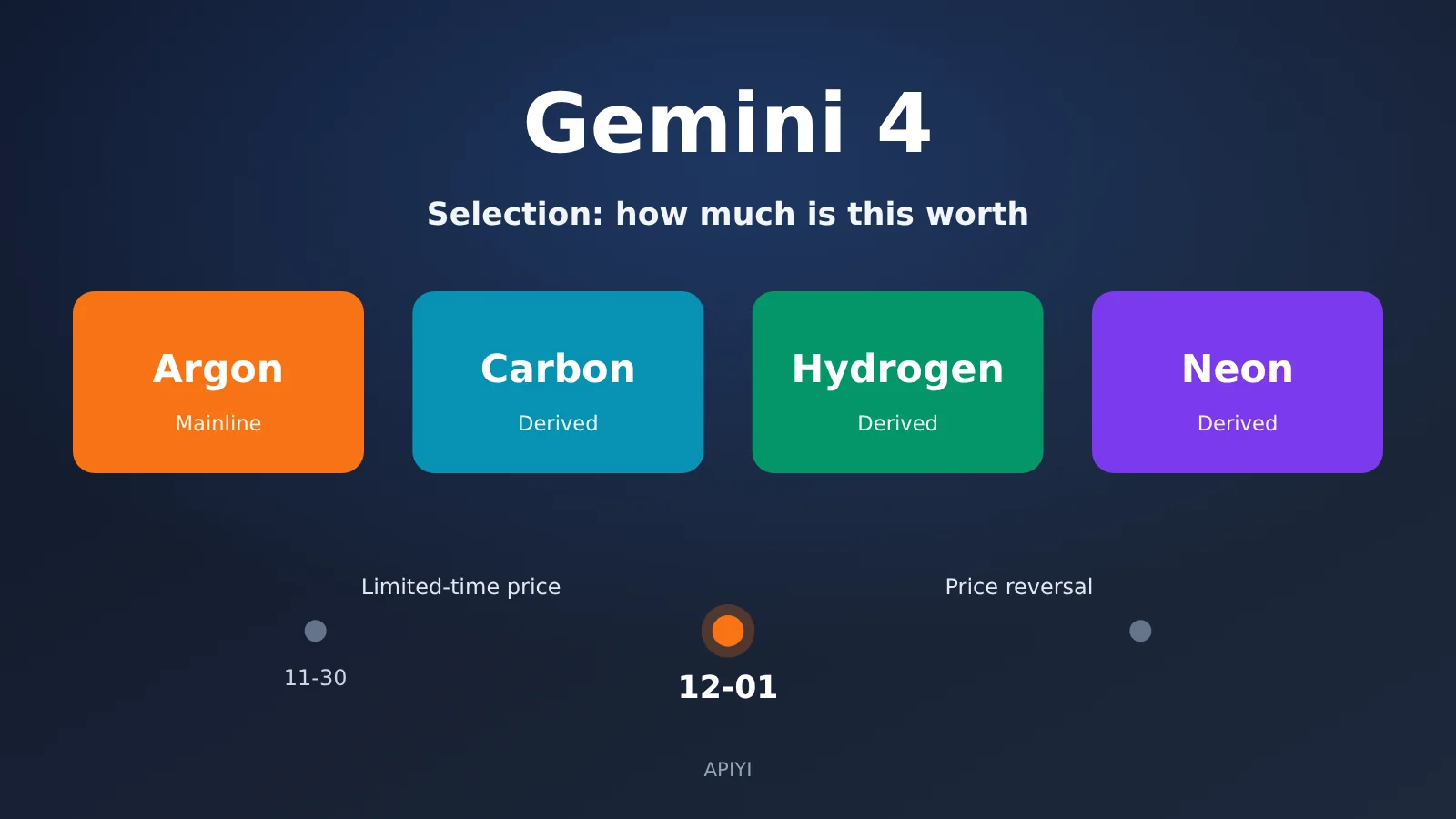
Let’s start with how the four models relate to each other. According to the original model card, Argon is the only one of the four that “is not a modification or fine-tune of an existing model” — the other three are all derived from it. Carbon explicitly states “based on Gemini 4 Argon.” Hydrogen states “adapted from Gemini 4 Carbon,” a line that appears seven times across the model card’s seven sections. Neon’s model card reuses Carbon’s wording. So the structure is one trunk with two branches — the order of the element names has nothing to do with atomic number and doesn’t indicate a capability ranking.
| Model | Release and availability | Source description in model card | Default thinking level |
|---|---|---|---|
| Argon | Released 9-30, opened up 10-13 | Trunk; not a modification of an existing model | medium |
| Carbon | Released 10-28, GA 11-10 | based on Argon | medium |
| Hydrogen | GA 11-12, became Antigravity’s default the same day | adapted from Carbon | high |
| Neon | Released 11-18 and GA the same day | Reuses Carbon’s wording | high |
Why Model Selection for Gemini 4 Starts with the Family Tree
The family relationship determines the cost of switching tiers. All four share one interface shape, every context window is 1,048,576 tokens, and the Argon and Carbon doc pages list a synchronized max output of 65,536. So moving between the four usually only requires changing the model name and thinking level — you don’t need to rewrite your prompt structure.
Watch out for the defaults. Argon and Carbon default to medium; Hydrogen and Neon default to high. If you migrate from Carbon to Neon without explicitly specifying a level, your thinking volume automatically goes up one notch, and your bill goes up with it.
Gemini 4 Pricing Comparison: The Reversal Before and After December 1
The table below shows prices per 1M tokens in USD. Google’s pricing page was read on 11-23 and re-checked on 11-26, and APIYI’s prices on 11-26 match it item by item. Data is current as of 2026-11-26; for specific model pricing, refer to the model list on the apiyi.com platform.
| Model | Input | Output | Cache read | Price status |
|---|---|---|---|---|
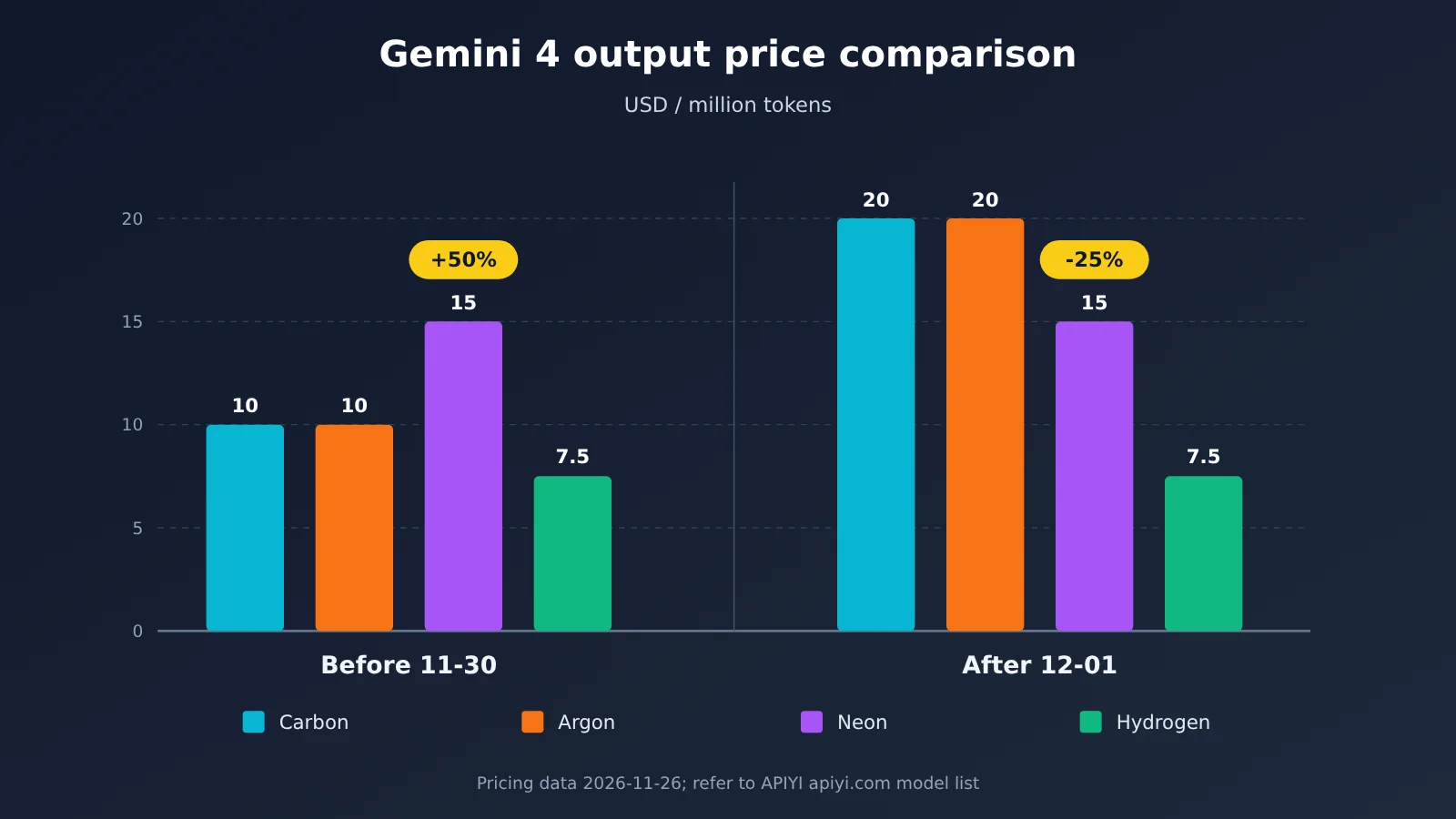
| Argon | 2 → 4 | 10 → 20 | 0.10 → 0.20 | Promotional price through 11-30, reverts starting 12-01 |
| Carbon | 2 → 4 | 10 → 20 | Same schedule as Argon | Promotional price through 11-30, reverts starting 12-01 |
| Neon | 3 | 15 | 0.15 | Standard price, no expiry |
| Hydrogen | 1.50 | 7.50 | 0.075 | Standard price, free tier available |
The thing that’s easiest to overlook in this table is how Neon and Carbon are priced relative to each other. Before 11-30, Neon is 50% more expensive than Carbon and Argon. After 12-01, Carbon and Argon go back to 4 / 20, and Neon ends up 25% cheaper than them. Once Google restores its original prices, APIYI will adjust accordingly — the Argon launch announcement already says this outright. So a combination you pick today based on unit price may not look like such a good deal next month.
A few extra details:
- All four support Batch and Flex at 50% off, which suits tasks that don’t need real-time responses.
- Argon and Hydrogen also have an invite-only Contributor tier at 1 / 5, with a cache read price of 0.05.
- Argon on APIYI additionally offers a
Gemini_Reverse0.5x group, which works out to 50% off. Carbon only has two groups:DefaultandSVIP. - The entire 1M context window is priced uniformly — no extra charge for long context.
💰 Cost tip: All four models on APIYI are billed by actual token usage, and the thinking tokens produced at each thinking level are also charged at the output price. Before launch, you can run all four on the same batch of samples at apiyi.com and compare per-task cost, then decide which tier to use long term.
Gemini 4 Thinking Levels Compared: The Default Value Is Where Migrations Go Wrong Most Often
Thinking tokens are billed at the output price, so the thinking level directly affects cost. The four supported models each have different levels and defaults:
| Model | Supported levels | Default | Migration notes |
|---|---|---|---|
| Argon | low / medium / high | medium | Doesn’t support thinkingBudget; passing it returns 400 |
| Carbon | low / medium / high | medium | Same as Argon |
| Hydrogen | low / medium / high / xhigh | high | No longer supports minimal |
| Neon | low / medium / high / xhigh | high | Default is one level higher than Carbon |
How to Read the Capability Numbers for Gemini 4 Neon, Carbon, and Hydrogen
All numbers below are vendor self-reported and haven’t been independently reproduced. Results from different harnesses can’t be compared side by side, so I’ve grouped them by source:
- AA Intelligence Index v5.0.1 (cited in the Neon model card): Neon 61, Claude Opus 5.5 59, GPT-6.2 Sol 57. Broken down by level, Neon scores 44 / 55 / 60 / 61 at low / medium / high / xhigh; Carbon scores 54 at low and 60 at high; Hydrogen scores 51 at high and 54 at xhigh; Argon scores 51 at high and 48 at medium.
- AA cost and time per task (same harness): Carbon costs $7.76 per task and takes 39.2 minutes, calculated using the 4 / 20 pricing; Neon costs $6.44 per task and takes 26.4 minutes.
- Neon official benchmarks: CWE-bench v2 70.7%, 3.4 percentage points higher than Carbon; Terminal-Bench 4.1 65.2%; AutomationBench 56.3%, ranked first; Vals Index 70.9%, ranked second; Agent Arena 1336 Elo, ranked second; SWE-sweep 39.0% under the Antigravity harness and 12.8% under the mini-SWE harness.
- Hydrogen official benchmarks: Terminal-Bench 4.1 57%, HLE-Diamond 58.8%.
- Argon official benchmarks: DeepSWE v1.1 77.9%, CWE-bench v1 68%, LVBench 91.7%.
- Third-party single cases: 302.AI published 8 Neon cases on 11-25, including a V12 engine that took 2.5 hours, a 17-minute self-narrated short film, and a Zig plus CUDA inference engine with a reasoning speed of 370 to 440 tok/s. Their takeaway is that Neon’s strength is delivery efficiency, while its aesthetic output still trails Claude Fable 5.2.
The most useful data point for model selection is that on the AA index at the low level, Carbon scores 10 points higher than Neon (54 vs 44). That suggests you don’t need to default to a more expensive level for simple tasks — running the same job at a low level can produce results that go against intuition. Also, Neon’s SWE-sweep differs by 26 percentage points across the two harnesses, which shows there’s no point quoting a score in isolation from its harness.
Quick start: shifting gears between Gemini 4 Hydrogen, Neon, and Carbon
Here’s the full procedure for switching gears — assuming you’re already on the OpenAI-compatible Chat Completions interface:
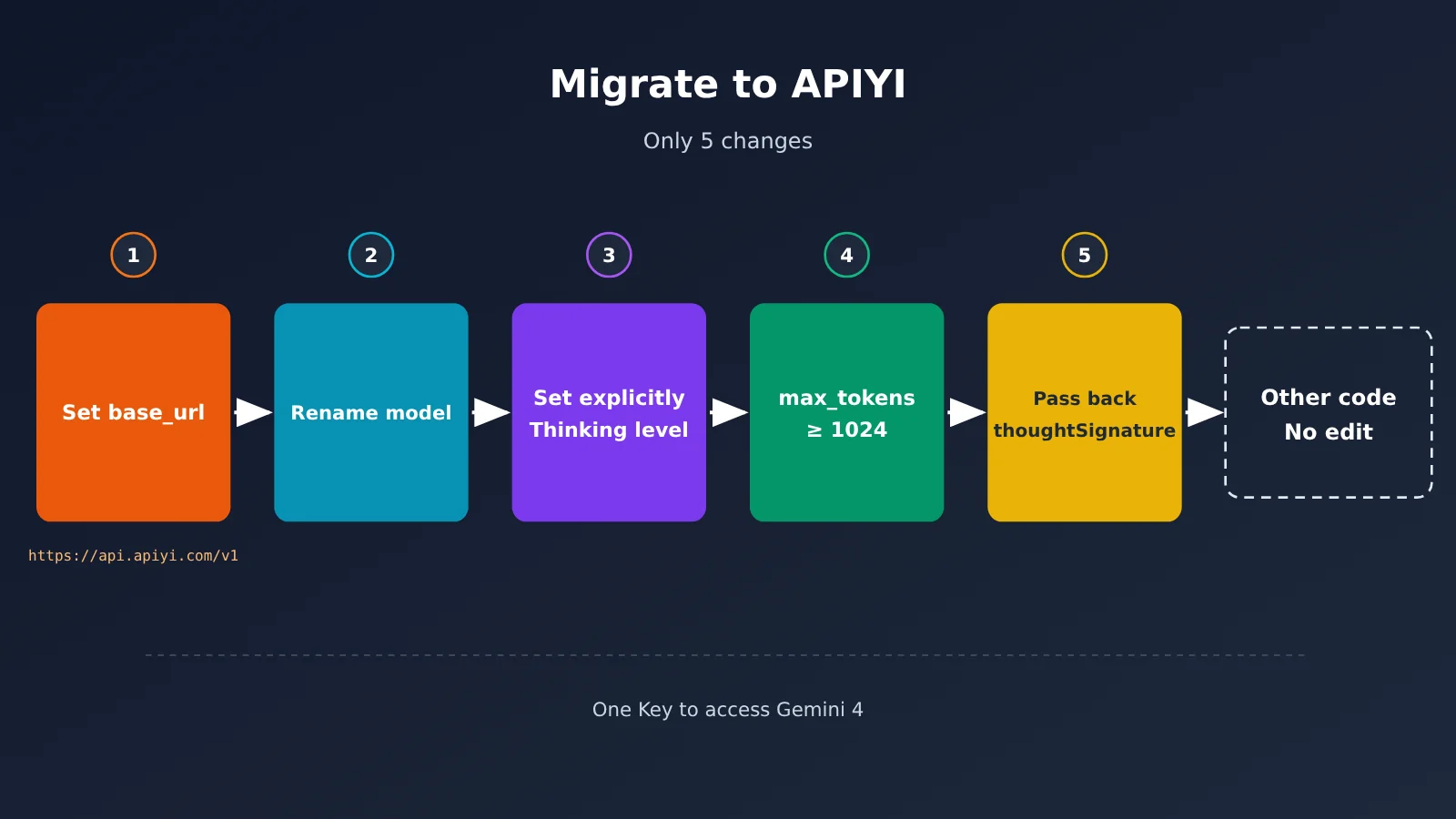
- Set the client’s
base_urltohttps://api.apiyi.com/v1and swapapi_keyfor the key you got from APIYI. - Change the
modelfield to your target variant, e.g. fromgemini-4-carbontogemini-4-neon. Check the platform’s model list for the actual IDs. - Spell out the thinking level explicitly instead of relying on the default — otherwise, moving from Carbon to Neon will quietly bump you from medium to high.
- Check
max_tokens. Thinking tokens count against this cap too, so setting it too low leaves you with an empty body. Keep it at 1024 or above. - Drop
temperature,top_p, andtop_k. These three have no effect here, and leaving them in the code makes people think they’re doing something. - In multi-turn conversations and tool calls, send the model’s
thoughtSignatureback exactly as received.
On the endpoint side, both OpenAI Chat Completions and the native Gemini protocol are supported; OpenAI Responses and Anthropic Messages are not. If your current code goes through the Responses interface, you’ll need to switch back to Chat Completions first.
🚀 Integration tip: On APIYI (apiyi.com), use one key to enable all four models at once, then write the model names and thinking levels into your config file. That way switching gears, rolling back, and running A/B tests are all just config changes — no new release needed.
Gemini 4 Scenario Recommendations: Assigning Models by Task
Model selection can be broken into two steps. First, define acceptance criteria: does this task need to be done right the first time, or can it be retried? How costly is a mistake? Second, choose the tier: start by running the same batch of tasks at the default tier (medium for Argon and Carbon, high for Hydrogen and Neon), compare per-task cost and one-pass success rate, then decide whether to move up or down a tier.
Here you’re comparing per-task cost, not unit price. Using AA’s data as an example, Neon costs $6.44 per task and Carbon $7.76. Part of the gap comes from unit price, and part comes from Neon taking less time on the same tasks. If a model with a lower unit price needs two retries, its total cost can end up higher.
Common ways to split the work:
- Hydrogen: extraction, classification, and high-frequency loop calls. It has the lowest unit price and a free tier, making it good for high-volume tasks where retries are acceptable.
- Neon: multi-file refactoring, cross-system troubleshooting, and long-document synthesis. Its scores on AutomationBench and CWE-bench v2 make it a good fit for these tasks.
- Carbon: open-ended hard problems and long-running tasks that span days. Its performance at the low tier also shows it’s suited to handling simple tasks at lower tiers.
- Argon: good for teams already running long-horizon engineering work and able to use the
Gemini_Reverse0.5x group.
Two Gemini 4 Lineups Before and After December 1
Before 11-30: Carbon and Argon’s limited-time prices of 2 / 10 are lower than Neon’s 3 / 15. Prioritize Carbon for difficult tasks; if you can use the 0.5x group, Argon’s effective unit price is lower. Hydrogen handles high-frequency tasks.
After 12-01: Carbon and Argon return to 4 / 20, and Neon becomes 25% cheaper than them. Most difficult tasks can move to Neon, Carbon can be reserved for open-ended hard problems, and Argon’s 0.5x group can stay in the mix if it’s still available. Hydrogen’s role stays the same.
💡 Decision tip: Before 11-30, run Carbon and Neon on the same sample batch on APIYI apiyi.com and archive the results. After the December 1 price change, recalculate per-task cost with the new unit prices, and you’ll be able to tell right away whether to switch.
Frequently Asked Questions (FAQ)
Q1: Do the names Hydrogen, Neon, and Carbon for Gemini 4 imply any ordering?
No. According to the model card, Argon is the trunk; Carbon is derived from Argon; and both Hydrogen and Neon are derived from Carbon. The element names don’t represent a capability ranking.
Q2: Why shouldn’t you pick a Gemini 4 model based on unit price alone?
Thinking tokens are billed at the output rate, and different models consume different token counts and take different amounts of time to complete the same task—plus you have to factor in first-pass success rate and retry count. What you should ultimately compare is cost per task.
Q3: Will APIYI’s Gemini 4 pricing change after December 1?
Yes. Google will restore Argon and Carbon to 4 / 20 on 12-01, and APIYI will adjust in sync. Neon and Hydrogen are at standard pricing and have no expiration date. For specifics, refer to the model list on apiyi.com.
Q4: When migrating from Carbon to Neon, what’s the most common pitfall?
The default thinking level changes from medium to high, so thinking tokens will increase if you don’t specify it explicitly. Also, make sure `max_tokens` is no lower than 1024, and pass `thoughtSignature` back in multi-turn conversations.
Q5: What’s the fastest way to start testing all four Gemini 4 models?
Register at APIYI apiyi.com to get a key and free testing credits, set `base_url` to `https://api.apiyi.com/v1`, then simply swap out the model names one by one.
Q6: What are the known limitations of Gemini 4?
`temperature`, `top_p`, and `top_k` have no effect when passed in; passing `thinkingBudget` to Argon returns a 400; Hydrogen no longer supports the `minimal` level; and the API doesn’t support OpenAI Responses or Anthropic Messages. Also, the benchmark numbers in this article are all official self-reported figures or third-party single samples that haven’t been independently reproduced yet.
Gemini 4 Model Selection: Key Takeaways
- Family structure: Argon is the main trunk, Carbon is derived from it, and Hydrogen and Neon are two branches of Carbon.
- Price reversal: Neon’s price relative to Carbon flips from 50% more expensive before 11-30 to 25% cheaper after 12-01.
- Default tiers: Argon and Carbon default to medium; Hydrogen and Neon default to high. Set them explicitly when migrating.
- Low-tier performance: At the low tier, Carbon scores 10 points higher than Neon on the AA index. Simple tasks don’t need a premium tier by default.
- Selection method: Define acceptance criteria first, then compare cost per task and first-pass success rate.
- How to switch tiers: Connect through APIYI at
https://api.apiyi.com/v1; switching tiers only requires changing the model name and tier.
Gemini 4 Full Lineup Selection Table
| Task type | Recommended model | Starting tier | Alternative before 11-30 | Alternative after 12-01 |
|---|---|---|---|---|
| Extraction, classification, high-frequency loops | Hydrogen | low or medium | Batch / Flex 50% off | Unchanged |
| Multi-file refactoring, cross-system troubleshooting | Neon | high | Carbon medium | Neon high |
| Long-document synthesis | Neon | high | Carbon medium | Neon high |
| Open-ended hard problems, multi-day long-running tasks | Carbon | Start at medium; upgrade to high if needed | Carbon | Carbon or Neon xhigh for comparison |
| Simple tasks that require stability | Carbon or Hydrogen | low | Carbon low | Hydrogen high for comparison |
| Existing long-horizon engineering | Argon | medium | Gemini_Reverse grouping |
Depends on group pricing |
Summary
Selecting from the full Gemini 4 lineup comes down to three points:
- Look at the task first, then pick the model: your acceptance criteria set the failure rate you can tolerate, and the tier sets your cost ceiling.
- Judge by cost per task: beyond unit price, you also need to factor in thinking tokens, latency, and retry counts.
- Recalculate once on December 1: the pricing relationship between Neon and Carbon will flip, so your combinations need adjusting accordingly.
The core question in model selection is how much this task is worth spending on. My suggestion: run one round on all four models with the same batch of samples on APIYI (apiyi.com), then make your decision based on cost per task.
📚 References
-
Google official blog: the three launch posts for Gemini 4 Carbon, Hydrogen, and Neon (10-28, 11-10, 11-18)
- Link:
blog.google - Notes: release timeline and positioning details
- Link:
-
Gemini 4 Neon model card: AA Intelligence Index and official benchmarks
- Link:
deepmind.google/models/model-cards/gemini-4-neon - Notes: original text for tier scores and derivation relationships
- Link:
-
302.AI Neon evaluation: 8 third-party cases (11-25)
- Link:
302.ai/blog/302-ai-benchmark-lab-review-on-gemini-4-neon-api/ - Notes: third-party single cases that can serve as a reference for delivery efficiency
- Link:
-
APIYI model documentation: model names, groups, parameter descriptions, and launch announcements
- Link:
docs.apiyi.com/models.md - Notes: pricing, endpoints, and known caveats
- Link:
Author: APIYI Technical Team
Technical discussion: Feel free to contact us on the APIYI website homepage; for more integration materials, check the docs.apiyi.com documentation center.