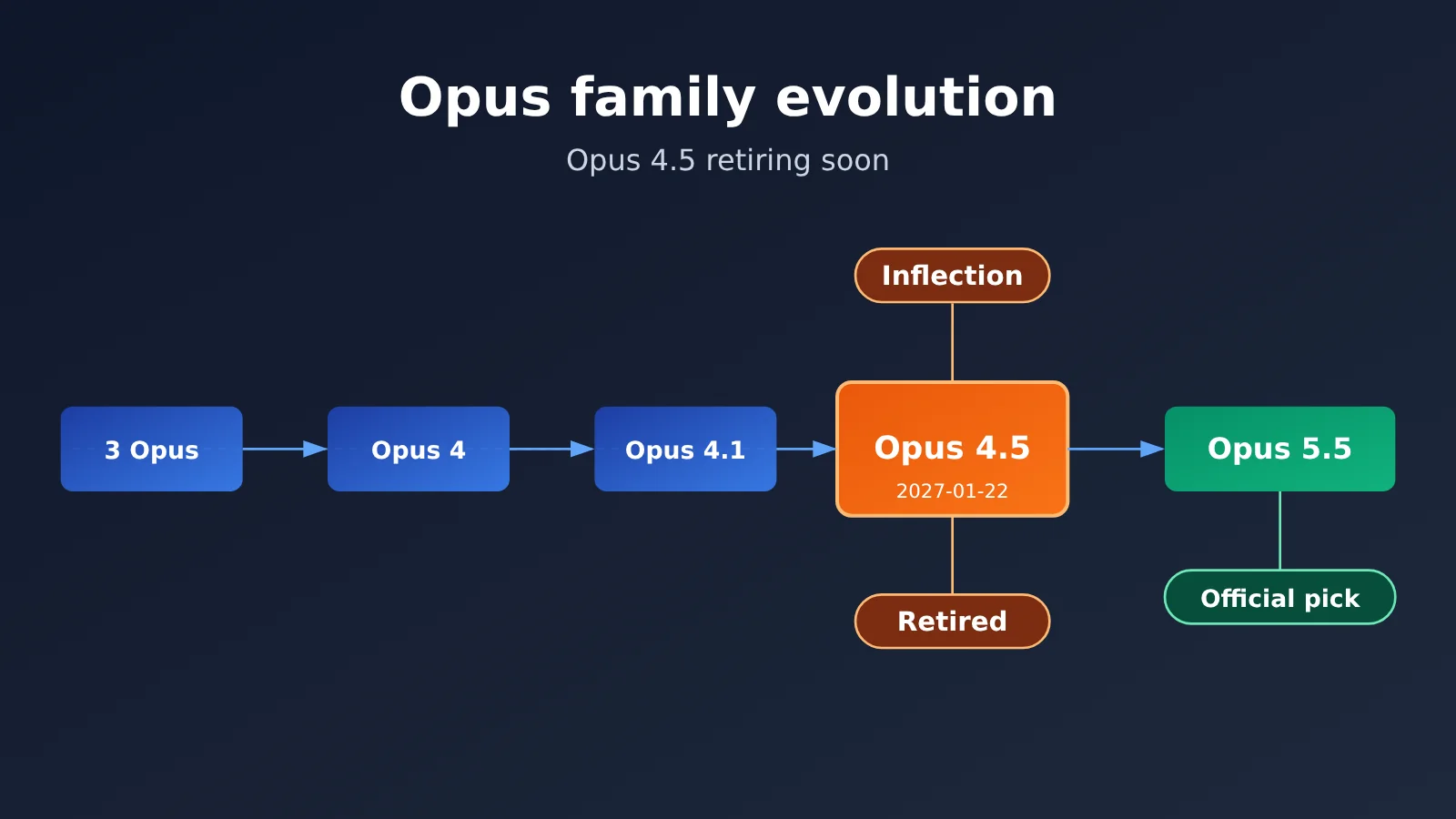
Claude Opus 4.5 is the inflection point where the Opus family moved from a “premium flagship” to a “flagship you can deploy every day.” It carried forward the direction Claude Opus 4 and 4.1 had set in complex coding and agentic work, while cutting the per-token API price to one third of its predecessor and introducing an adjustable reasoning-effort effort parameter. Tool-calling efficiency also improved noticeably in this generation. Anthropic announced the model’s deprecation on November 23, 2026: claude-opus-4-5-20251101 and claude-opus-4-5 on the first-party Claude API are scheduled to retire on January 22, 2027, and the officially recommended successor is Claude Opus 5.5.
Today happens to be the one-year anniversary of Claude Opus 4.5’s release. It did its job of bridging one generation to the next — now it’s its turn to step aside.
What will you get out of this article?
- The exact retirement timeline for Claude Opus 4.5, the affected model identifiers, and the officially recommended replacement.
- The concrete gains it made over Opus 4 / 4.1 in pricing, output length, coding, and tool operation.
- What each later generation, from Opus 4.6 through Opus 5.5, added on top.
- How to run a comparison test and a smooth switch from Opus 4.5 to Opus 5.5 with just a few lines of code.
Index: The main body opens with an “Objective facts” section covering the retirement announcement, the predecessor baseline, Opus 4.5’s three breakthroughs, and the evolution of the five generations that followed, plus notes on how each set of benchmark figures was measured. The “Analysis and judgment” section then explains why it’s regarded as a turning point and how different teams should respond. After that come quick-start migration code, a migration checklist, and FAQs — feel free to jump straight to whichever part you need.
Claude Opus 4.5 API Retirement: Concepts You Need to Know First
| Concept | Brief explanation |
|---|---|
| Deprecation | The model is officially announced to be in its phase-out stage. It can still be called, but is no longer recommended for new projects |
| Retirement | After the retirement date arrives, the corresponding model ID stops being served on the first-party API, and requests will fail |
| Model identifier | The model string you pass when making a call, such as claude-opus-4-5-20251101, along with the alias claude-opus-4-5 |
effort |
The parameter in the Claude API that adjusts reasoning effort. The higher the level, the deeper the analysis and the more tokens consumed |
| Extended thinking / adaptive thinking | The former is a mode where the model thinks before it answers; the latter lets the model automatically allocate reasoning effort based on task cues |
| SWE-bench Verified | A code-fixing benchmark made up of 500 real software engineering problems verified by humans |
| OSWorld | A benchmark measuring a model’s ability to operate desktop software |
| Terminal-Bench | A benchmark measuring a model’s ability to execute command-line tasks; the scope differs across versions |
| Tool search | Lets the model load tool definitions on demand instead of stuffing all the tools into the context at once |
| Context compaction | Compacting historical content during long tasks to free up context space for subsequent steps |
| Claude Fable | A higher-tier product line above Opus, aimed at harder reasoning and long-running agentic tasks |
Claude Opus 4.5 Retirement Impact at a Glance
- Developers calling the Claude API directly: After January 22, 2027, requests that hardcode
claude-opus-4-5or use date-stamped model identifiers will stop working. You’ll need to finish migration and regression testing before that date. - Teams calling through partner platforms: Entry points operated by partners follow their own lifecycle schedules, and their retirement dates aren’t necessarily the same as the first-party API — check each one separately.
- Users relying on products like GitHub Copilot and Notion: These products once listed Claude Opus 4.5 as an available model, and future availability depends on each product’s own adjustments. Generally, you won’t need to change any code yourself.
- Technical leads evaluating cost and performance: Successor models have different context windows, output lengths, and default reasoning behavior, so your existing token budgets and latency baselines will need to be re-measured.
Objective Facts About Claude Opus 4.5’s Positioning
Claude Opus 4.5 Retirement Announcement
Anthropic issued a deprecation notice on November 23, 2026. The two identifiers claude-opus-4-5-20251101 and claude-opus-4-5 on the first-party Claude API are scheduled to retire on January 22, 2027, and migration to Claude Opus 5.5 is recommended. That leaves a window of roughly two months—enough time to complete a proper round of comparative testing.
One historical detail illustrates Claude Opus 4.5’s role well. When Claude 3 Opus retired from the Claude API on January 5, 2026, Anthropic’s recommended successor was Claude Opus 4.5, citing stronger capabilities and a unit price only one-third of the original. A year later, it became the one being replaced, with Claude Opus 5.5 taking over.
The Capability and Pricing Baseline Before Claude Opus 4.5
On March 4, 2024, the Claude 3 family established a capability gradient from low to high across Haiku, Sonnet, and Opus, with Opus occupying the highest capability tier. Claude Opus 4, released on May 22, 2025, focused on sustained work on complex code and agentic tasks, and at the time offered both fast-response and extended-thinking modes. Claude Opus 4.1 on August 5 shifted its improvements toward real-world code problems, agentic search, and detail tracking.
The Claude 4.5 family released Sonnet 4.5 (September 29, 2025), Haiku 4.5 (October 15), and Opus 4.5 (November 24) in sequence. Opus 4.5 was the last model in this family and was aimed at the most demanding professional work. The table below compares its core specifications with the previous two generations.
| Spec | Claude Opus 4 | Claude Opus 4.1 | Claude Opus 4.5 |
|---|---|---|---|
| Release date | 2025-05-22 | 2025-08-05 | 2025-11-24 |
| Context window | 200K tokens | 200K tokens | 200K tokens |
| Max output | 32K tokens | 32K tokens | 64K tokens |
| Input price (per million tokens) | $15 | $15 | $5 |
| Output price (per million tokens) | $75 | $75 | $25 |
| Reasoning effort control | Fast / Extended thinking | Fast / Extended thinking | New beta effort |
Three Key Breakthroughs of Claude Opus 4.5
The first is software engineering and tool use. According to Anthropic’s system card, Claude Opus 4.5 scores 80.9% on SWE-bench Verified, 6.4 percentage points above Opus 4.1’s 74.5%. That figure is the average of five trials with extended thinking turned off; with a 64K thinking budget, the corresponding value is 80.60%. Desktop software operation and command-line tasks also saw substantial gains.
| Benchmark | Claude Opus 4.1 | Claude Opus 4.5 | Notes |
|---|---|---|---|
| SWE-bench Verified | 74.5% | 80.9% | Extended thinking off, average of five trials |
| OSWorld | 44.4% | 66.3% | Desktop software operation |
| Terminal-Bench 2.0 | 46.5% | 59.3% | The 4.5 number uses a 128K thinking budget |
| GPQA Diamond | 81.0% | 87.0% | Graduate-level scientific reasoning |
| MMMU (validation set) | 77.1% | 80.7% | Multidisciplinary visual understanding |
| Internal MCP tool evaluation | — | 79.5% → 88.1% | Before vs. after enabling tool search |
The second is flagship capability paired with controllable cost. Input and output prices dropped to one-third of Opus 4.1’s, and maximum output doubled to 64K tokens. Anthropic’s SWE-bench Verified experiments show that Opus 4.5 at the medium setting already matches Claude Sonnet 4.5’s best score while using 76% fewer output tokens; at the highest reasoning setting available at the time, it scores 4.3 percentage points higher with 48% fewer tokens. These two ratios apply only to the evaluation setup described in the release announcement.
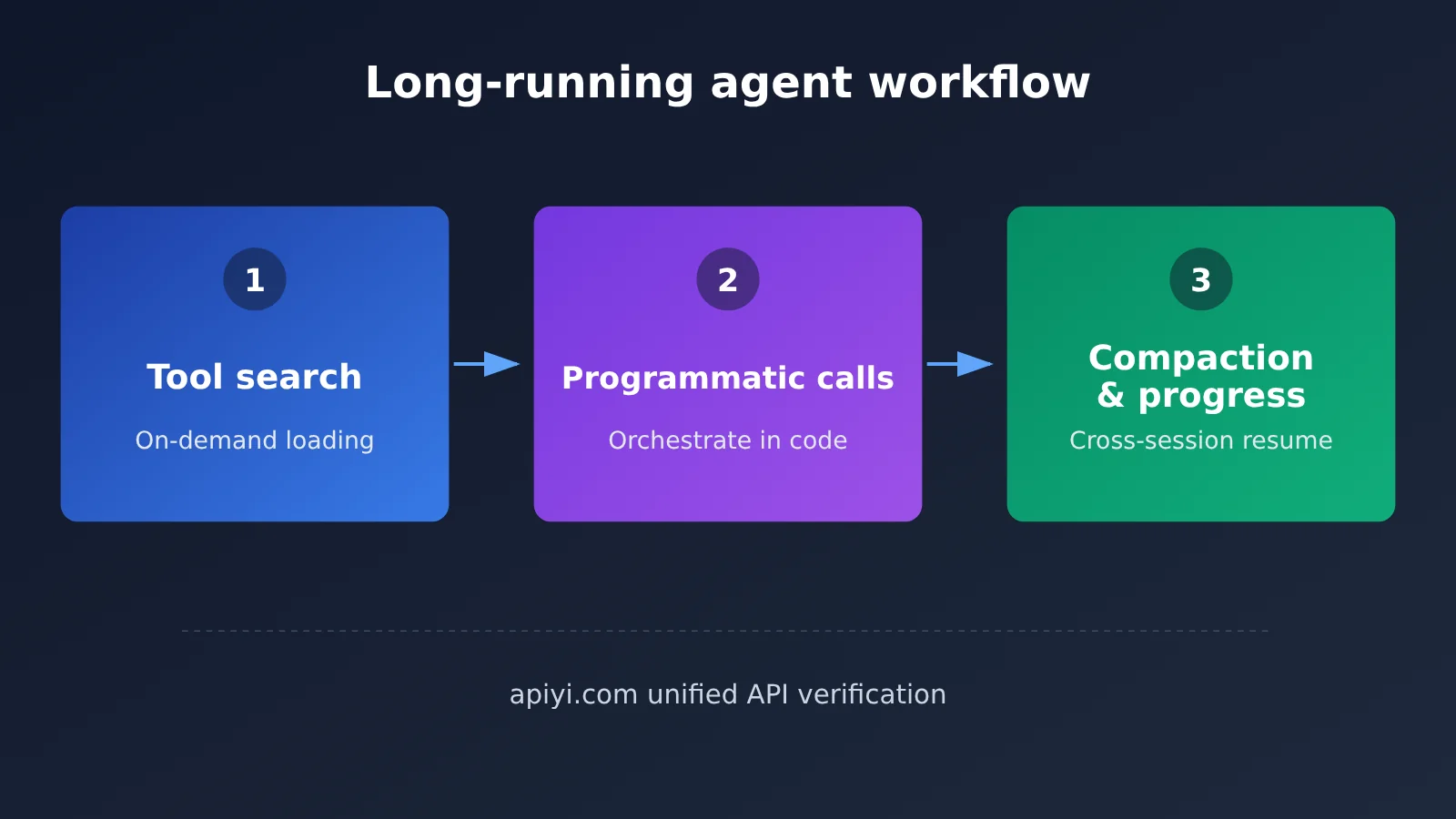
The third is engineering components for long-running agents. The tool search launched at the same time can load tool definitions on demand, programmatic tool calling can handle multi-tool work inside a code execution environment, and the Python and TypeScript SDKs add client-side context compression for tool_runner. A later engineering experiment published by Anthropic also demonstrated cross-session tasks: the initial session first establishes a progress file and version record, and subsequent sessions gradually implement and verify functionality.
Claude Opus 4.5’s Product Rollout
GitHub Copilot opened a public preview on the day Opus 4.5 launched, reporting that its early internal coding evaluations used half the tokens; it became generally available on December 18 for Copilot Enterprise, Business, and individual paid plans. On January 20, 2026, Notion 3.2 also listed it as an optional model. That same day, Claude Code’s plan mode added a flow that “clarifies requirements first, then drafts an editable plan,” giving the model’s planning capability an interactive entry point.
Five Generations of Evolution After Claude Opus 4.5
| Model | Release Date | Key Expansions |
|---|---|---|
| Claude Opus 4.6 | 2026-02-05 | First to offer a 1M-token context window (generally available in the API on March 13), with a max output of 128K and newly added adaptive thinking; roughly 190 Elo higher than Opus 4.5 on GDPval-AA |
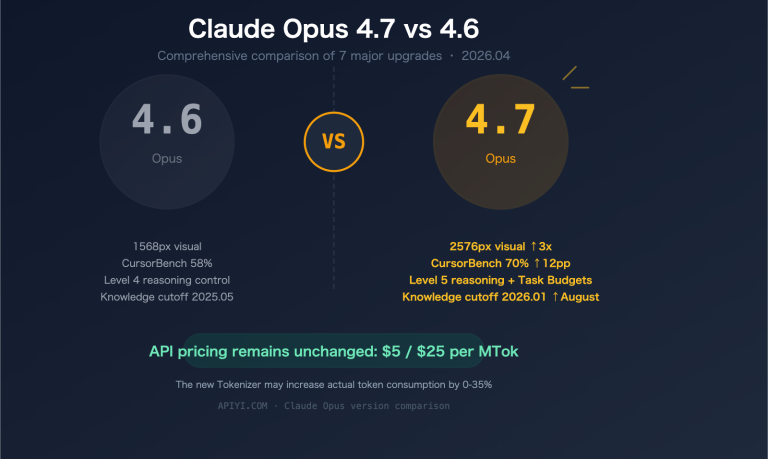
| Claude Opus 4.7 | 2026-04-16 | First to support high-resolution image input, raising the long-edge limit from 1,568 to 2,576 pixels; added the xhigh reasoning tier |
| Claude Opus 4.8 | 2026-05-28 | The probability of failing to flag bugs in its own code is about a quarter of 4.7’s; the Messages API supports updating system instructions mid-conversation |
| Claude Opus 5 | 2026-07-24 | Keeps the standard per-token pricing introduced with 4.5, with thinking on by default; more than double 4.8’s performance on Frontier-Bench v0.1 at a lower cost per question |
| Claude Opus 5.5 | 2026-09-22 | 1M context by default, 128K output, adaptive thinking always on, and default reasoning effort set to medium; CursorBench 4.0 climbs from 46.6% to 57.8% |
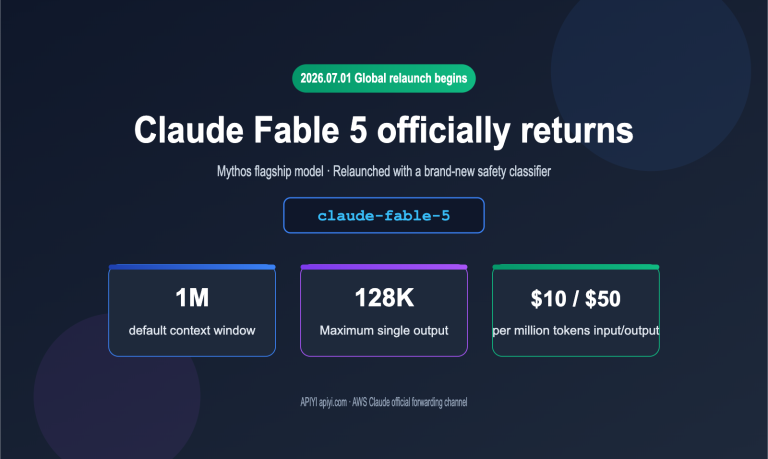
Worth noting: what “flagship” means shifted over the course of that year. When Opus 4.5 launched, it was Anthropic’s most intelligent model at the time; by the time Opus 5 shipped, the official description of the capability ceiling had moved to the higher-priced Claude Fable 5. The current official model overview now lists Claude Opus 5.5 as the starting point for most workloads, while Claude Fable 5.2 targets harder reasoning and long-running agentic tasks.
Benchmark Methodology Notes
The data above spans multiple benchmarks, tool configurations, and reasoning tiers, and same-named benchmarks have themselves evolved across versions — Terminal-Bench 2.0 and 4.0, for instance, aren’t the same measurement. The system card figures come from the vendor’s own report, the engineering blog results are the vendor’s experiments under a specified configuration, and GitHub’s token numbers come from its own preview-period evaluation. When comparing across generations, only compare numbers measured on the same basis.
Analysis of Where Claude Opus 4.5 Sits
Why Claude Opus 4.5 Is a Turning Point
Looking at the facts, Opus 4.5 changed three things at once: unit price, tokens consumed per task, and engineering capability on long-running tasks. Before it, Opus was the model you called only when a problem was hard enough to justify it; after it, the effort tiers let a single model cover everything from routine to difficult work, with developers controlling cost as needed. That’s the key step in Opus going from an expensive flagship you call occasionally to a workhorse you can deploy every day.
The five generations that followed largely pushed in the direction Opus 4.5 opened up: 4.6 tackled “how long can it keep going, how much can it read,” 4.7 tackled “how much visual detail can it make out,” 4.8 tackled “can it spot problems on its own,” and Opus 5 and 5.5 shifted the competitive focus to “cost per successful delivery.” You could say Opus 4.5 defined the evaluation framework for the Opus family over the year that followed.
How Different Teams Should Respond
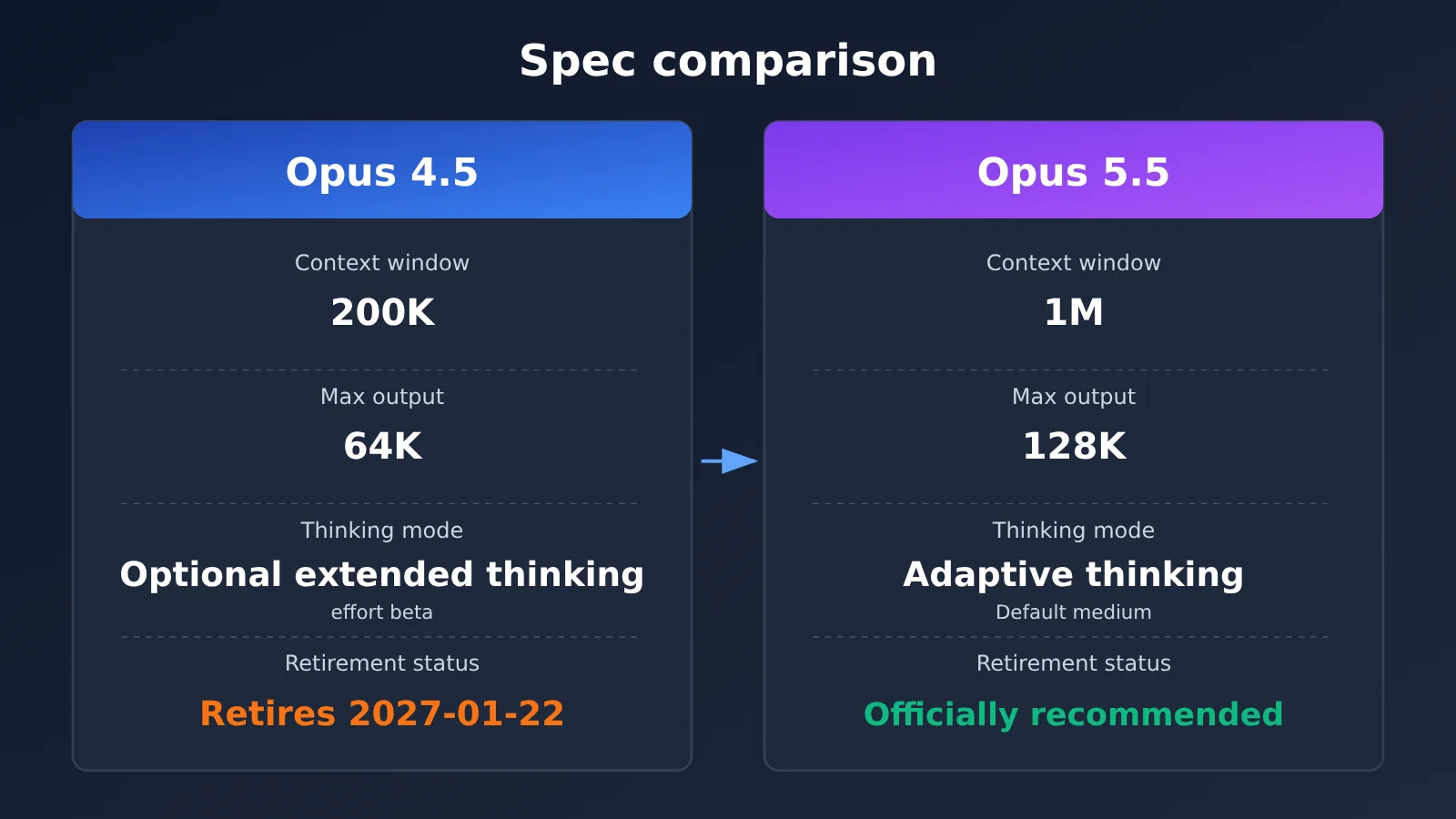
For teams still calling Opus 4.5 in production, the migration itself isn’t complicated — the hard part is behavioral differences. Opus 5.5’s adaptive thinking is always on, with a default reasoning effort of medium; pipelines that used to get low latency by “turning off extended thinking” may see their latency and token patterns shift. Context going from 200K to 1M, and output from 64K to 128K, also means existing truncation strategies and cost ceilings need to be reset.
The following is speculation and should be checked against the official migration guide and your own testing: for workloads dominated by code fixes and tool calls, moving to Opus 5.5 will most likely pay off directly; for scenarios that depend heavily on a fixed output format, since 5.5 changed how it follows writing rules and organizes information, run a small-sample regression first before switching everything over.
Claude Opus 4.5 Migration: Quick Start
The safest way to migrate is to make the model name a configuration value, run the same batch of real requests against both the old and new models, and then switch based on the results. The examples below use the OpenAI-compatible interface — always defer to the platform’s actual model list for model names.
Minimal example
import os
import openai

client = openai.OpenAI(
    api_key=os.getenv("APIYI_API_KEY"),
    base_url="https://api.apiyi.com/v1"  # APIYI OpenAI-compatible interface
)

# Keep the model name in an environment variable: migrating changes config, not code
MODEL = os.getenv("CLAUDE_MODEL", "claude-opus-5-5")

response = client.chat.completions.create(
    model=MODEL,
    messages=[{"role": "user", "content": "用三句话解释什么是模型退役"}]
)
print(response.choices[0].message.content)
View the full migration comparison code
import os
import time
import json
import openai

client = openai.OpenAI(
    api_key=os.getenv("APIYI_API_KEY"),
    base_url="https://api.apiyi.com/v1"  # APIYI unified interface: one key for both old and new models
)

OLD_MODEL = "claude-opus-4-5"   # Retires from the first-party API on 2027-01-22
NEW_MODEL = "claude-opus-5-5"   # Officially recommended replacement; name subject to the platform's model list

# Aim to pull representative real requests from production logs
TEST_CASES = [
    {"id": "code_fix", "prompt": "下面的 Python 函数有一个边界错误,请指出并修复:\n"
                                 "def last(items):\n    return items[len(items)]"},
    {"id": "summary", "prompt": "用不超过 80 字总结:模型弃用与退役的区别。"},
    {"id": "json_format", "prompt": "以 JSON 输出三个常见 HTTP 状态码及含义,只输出 JSON。"},
]


def run_case(model: str, prompt: str) -> dict:
    """Call a single model and record latency, token usage, and output"""
    start = time.time()
    try:
        resp = client.chat.completions.create(
            model=model,
            messages=[{"role": "user", "content": prompt}],
            max_tokens=2000,
        )
        usage = resp.usage
        return {
            "ok": True,
            "latency_s": round(time.time() - start, 2),
            "prompt_tokens": usage.prompt_tokens if usage else None,
            "completion_tokens": usage.completion_tokens if usage else None,
            "output": resp.choices[0].message.content,
        }
    except Exception as e:
        return {"ok": False, "error": str(e)}


def compare():
    report = []
    for case in TEST_CASES:
        old = run_case(OLD_MODEL, case["prompt"])
        new = run_case(NEW_MODEL, case["prompt"])
        report.append({"case": case["id"], OLD_MODEL: old, NEW_MODEL: new})
        print(f"[{case['id']}] old={old.get('latency_s')}s "
              f"new={new.get('latency_s')}s "
              f"old_out={old.get('completion_tokens')} "
              f"new_out={new.get('completion_tokens')}")

    with open("migration_report.json", "w", encoding="utf-8") as f:
        json.dump(report, f, ensure_ascii=False, indent=2)
    print("对比结果已写入 migration_report.json,请人工复核输出质量")


if __name__ == "__main__":
    compare()
Migration tip: Opus 4.5 stays callable until it’s retired, so use this window to run old-vs-new comparisons in parallel. With APIYI (apiyi.com) you call both models using a single API key, and new users also get free trial quota — a good fit for running a small-sample regression first and then deciding how quickly to switch over.
Claude Opus 4.5 Migration Checklist
| Check item | Changes to watch | Recommended action |
|---|---|---|
| Model identifier | Both claude-opus-4-5 and the date-suffixed variants will be retired |
Search globally for hardcoded values and move them into config |
| Thinking mode | Adaptive thinking in Opus 5.5 is always on, with a default of medium |
Re-test latency-sensitive paths and adjust reasoning parameters per the official migration guide |
| Context and output | 200K → 1M context, 64K → 128K output | Reset your truncation strategy and max_tokens caps |
| Cost budget | Unit prices follow current official and platform pricing | Measure per-task cost with real requests instead of looking at unit price alone |
| Output format | How 5.5 organizes its writing has changed | Run regression checks on JSON and templated output |
| Partner channels | Lifecycle schedules are managed independently | Check the retirement dates for each platform you use |
| Available platforms | Official Claude API, partner platforms, APIYI apiyi.com, and others | Pick an entry point that supports parallel calls to old and new models so you can compare |
Claude Opus 4.5 Retirement FAQ
Q1: When exactly will the Claude Opus 4.5 API be retired?
Anthropic announced the deprecation on November 23, 2026. `claude-opus-4-5-20251101` and `claude-opus-4-5` on the first-party Claude API are scheduled to retire on January 22, 2027. Partner-operated endpoints follow their own lifecycle schedules.
Q2: Where exactly does Claude Opus 4.5 fit in the Opus family?
It’s the last model in the Claude 4.5 family and the inflection point where Opus moved from a high-priced flagship to everyday deployment: its unit price dropped to one-third of Opus 4.1, output length doubled, and it introduced `effort` to control reasoning effort. It once replaced Claude 3 Opus and is now being replaced by Claude Opus 5.5.
Q3: What’s the biggest difference between Claude Opus 4.5 and Claude Opus 5.5?
On specs, Opus 5.5 has a 1 million token context window and 128,000 token maximum output, adaptive thinking is always on, and the default reasoning effort is `medium`. In terms of capability, it’s positioned for long-running agentic coding and knowledge work, with clear improvements in ambiguous multi-file tasks and communication on long tasks.
Q4: Do I need to change a lot of code to migrate to Claude Opus 5.5?
If you’re using an OpenAI-compatible interface, you usually only need to change the model name. What really takes effort is regression testing: retest latency, token consumption, and output format. We recommend calling both the old and new models through APIYI apiyi.com for side-by-side comparison, using free test credits to validate core scenarios first.
Q5: Can Claude Opus 4.5 benchmark data still be compared directly with the new model?
We don’t recommend direct comparison. Each generation’s release uses different benchmark versions, tool configurations, and reasoning tiers—for example, Terminal-Bench 2.0 and 4.0 use different standards. The reliable approach is to test the old and new models on your own business samples with the same set of requests.
Q6: Besides Opus 5.5, are there other alternatives?
The officially recommended direct replacement is Claude Opus 5.5. For harder reasoning and long-running agentic tasks, you can evaluate Claude Fable 5.2; for more cost-sensitive scenarios, you can also test the Sonnet series. APIYI apiyi.com supports calling models from multiple providers with a single API key, making it easy to compare them side by side before deciding.
Claude Opus 4.5 Reference Materials
- Claude Opus 4.5 Release Announcement: positioning, pricing, and developer platform updates
- Link:
anthropic.com/news/claude-opus-4-5
- Link:
- Claude Opus 4.5 System Card: evaluation data for SWE-bench Verified, OSWorld, GPQA, and more
- Link:
anthropic.com/claude-opus-4-5-system-card
- Link:
- Claude Model Retirement Policy: deprecation and retirement timelines
- Link:
platform.claude.com/docs/en/about-claude/model-deprecations
- Link:
- Claude Opus 5.5 Migration Guide: notes on behavioral changes and parameter adjustments
- Link:
platform.claude.com/docs/en/models/opus-5-5/migration-guide
- Link:
Claude Opus 4.5 spent a year proving that even a flagship model can be cost-controlled per task, and that idea has been baked into the design of every Opus generation since. With about two months to go before January 22, 2027, now is a comfortable time to begin comparative testing. If you’d like to validate Opus 4.5 and Opus 5.5 side by side through a single unified interface, you can run your first round of regression testing with free credits on APIYI apiyi.com.
Author: APIYI Technical Team
Technical Support: If you hit model compatibility or parameter issues during migration, feel free to reach us through the APIYI apiyi.com homepage. For more integration details, check the documentation center at docs.apiyi.com.