
Author’s note: This piece breaks down the three billing models for AI coding agents—subscription plans, bring your own key, and credits or per-task—and examines per-task cost, cache hits, and protocol compatibility. It also covers how to choose based on team size and how to calculate a month’s usage.
Claude Code, Codex, and OpenCode can all read a repo, edit code, and run tests, so at first glance they look pretty similar. What really separates the bills is usually billing model, cache hits, and protocol compatibility—not the tool itself. This article compares all three AI coding agents across three billing models: subscription plans, bring your own key, and credits or per-task.
This isn’t a “who’s the best” ranking. Every number in this article comes with its source: vendor-reported, independent third-party estimates, direct from documentation, or community observation. If the numbers don’t line up with the stated methodology, we simply don’t include them.
The main takeaway: By the end, you’ll be able to choose a billing model based on your team’s size and task types, calculate a month’s spend with a single table, and use one field to check whether caching is actually working.
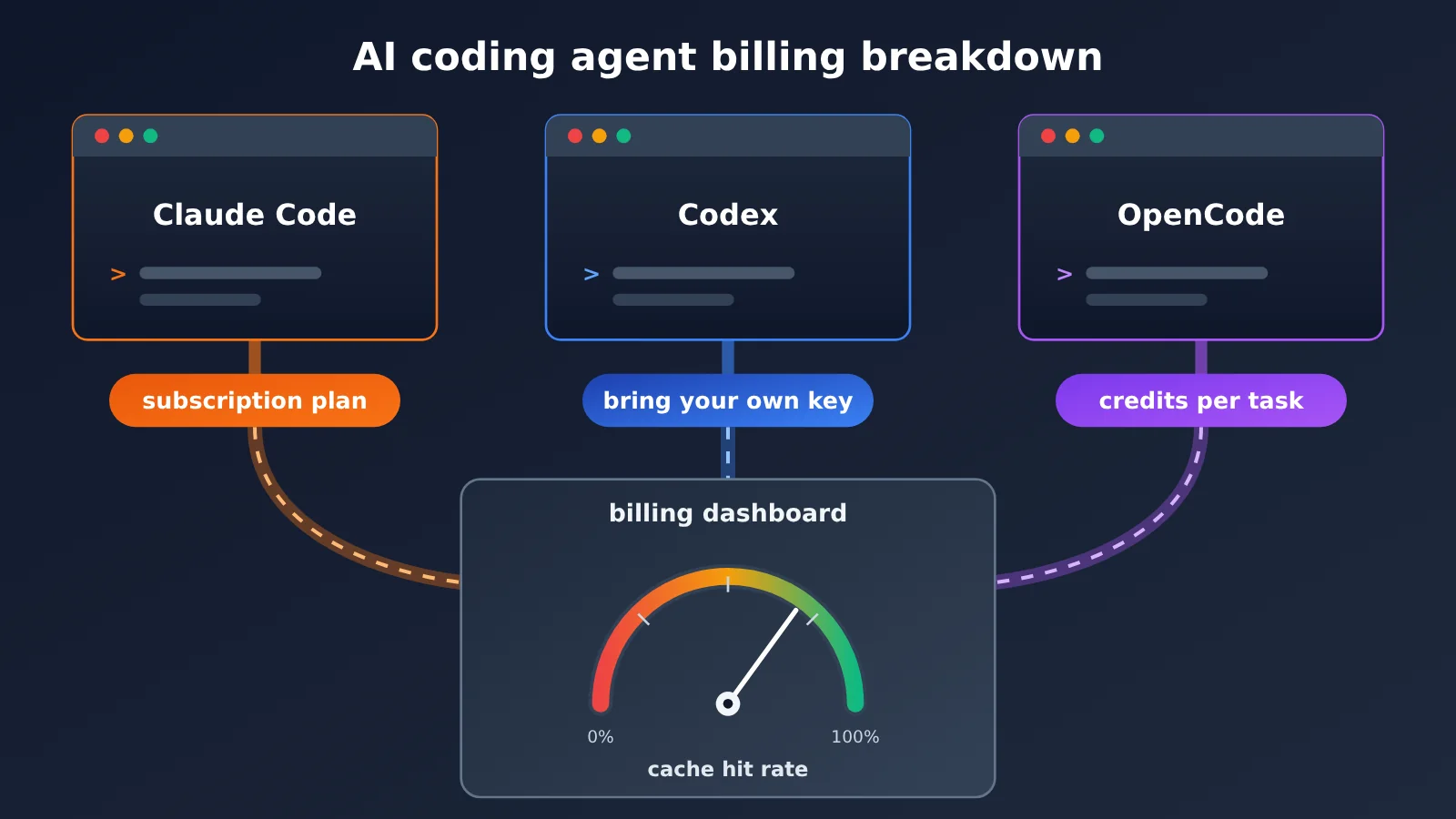
The Core Differences Among the Three Billing Models for AI Coding Agents
Let’s clear up the concepts first. The same AI coding agent may support several payment methods at once. For example, Codex CLI lets you sign in with a ChatGPT plan or enter an API key. OpenCode itself is free; you pay model fees to the provider you choose. So the first step in choosing is picking a billing model, not picking a tool.
| Billing model | Typical approach | Who it’s for | Where it’s easy to overspend |
|---|---|---|---|
| Subscription plan | Claude Pro / Max / Ultra to run Claude Code; ChatGPT Plus / Pro to run Codex | Individual developers with steady usage who use it every day | Being forced to upgrade after hitting the 5-hour or weekly limit; buying a higher tier and not using it fully |
| Bring your own key (BYOK) | OpenCode, Codex CLI with an API key, billed by token | Teams with highly variable usage that need to mix multiple model providers | Recomputing everything every turn when the cache misses; setting the reasoning tier too high |
| Credits or per-task | Copilot AI credits, Kiro credits, Cursor shared usage pool | People who are editor-centric and want predictable monthly costs | Credits don’t roll over from month to month; overage unit pricing; some products add a markup on top of API pricing |
Subscription plans for AI coding agents: who they suit, and where they bite
The logic behind a subscription is “a monthly fee in exchange for a quota.” Based on prices AgentKoji verified on 2026-11-01, Claude comes in three tiers: Pro at $20/month, Max at $100/month, and Ultra at $200/month. Ultra’s description says its weekly quota is 10x that of Pro and has no 5-hour limit. Team is $25 per seat. Codex comes bundled with ChatGPT Plus at $20, and Pro has several tiers at $100, $200, and $500.
Subscriptions work best for individuals who use them heavily every day with a stable task length. The real overspend risk isn’t the unit price—it’s tier mismatch: when your usage lands right between two tiers, you either keep hitting the limit and getting interrupted, or you pay for quota you can’t use up. One more thing to watch: subscription limits are calculated by time window, and they don’t directly tell you “how many tasks you can run in a month”—you’ll have to track that yourself.
Bringing your own key to an AI coding agent: who it suits, and where it bites
BYOK works on “pay for what you use.” OpenCode is an MIT-licensed, model-agnostic open-source agent—Contenox’s writeup notes it supports over 75 providers and local models. Codex CLI is Apache-2.0 licensed and also supports entering an API key directly. This approach suits teams whose usage fluctuates and who want to pick a model per task—say, a cheap model for simple refactoring, then switching to a flagship model when debugging something tricky.
BYOK’s overspend risks cluster in two places. The first is cache invalidation: in a long session, the full context gets recomputed at full price every round. The second is setting the reasoning tier too high—as we’ll see below, the per-task cost for the same model at different tiers can differ by several times over.
🚀 Quick start: If you want to try Claude, GPT, Kimi, GLM, DeepSeek, and other models with a single key, you can register at APIYI apiyi.com to get free trial credits. The platform offers OpenAI-compatible interfaces and Anthropic’s native format, making it easy to switch between different AI coding agents for validation.
AI Coding Agent Credits vs Per-Task: Who It Suits, Where It Bites
Credit-based pricing sits somewhere in between. Per public documentation: Copilot Pro is $10 for 1,500 credits, and the Free plan also includes agent mode and the CLI; Kiro Pro is $20 for 1,000 credits, Pro+ $40 / 2,000, Pro Max $100 / 5,000, Power $200 / 10,000, credits don’t roll over from month to month, and overage runs $0.04 each; Cursor Premium is $30, with third-party models billed from a shared usage pool at API prices; Augment Standard is $20, at vendor API price plus 40%.
It suits people who are editor-centric and want a predictable monthly bill. The overspend risk is expiry and markup: unused credits die at month-end, going over mid-month bills at the overage rate, and the “API price markup” gets amplified under heavy use.
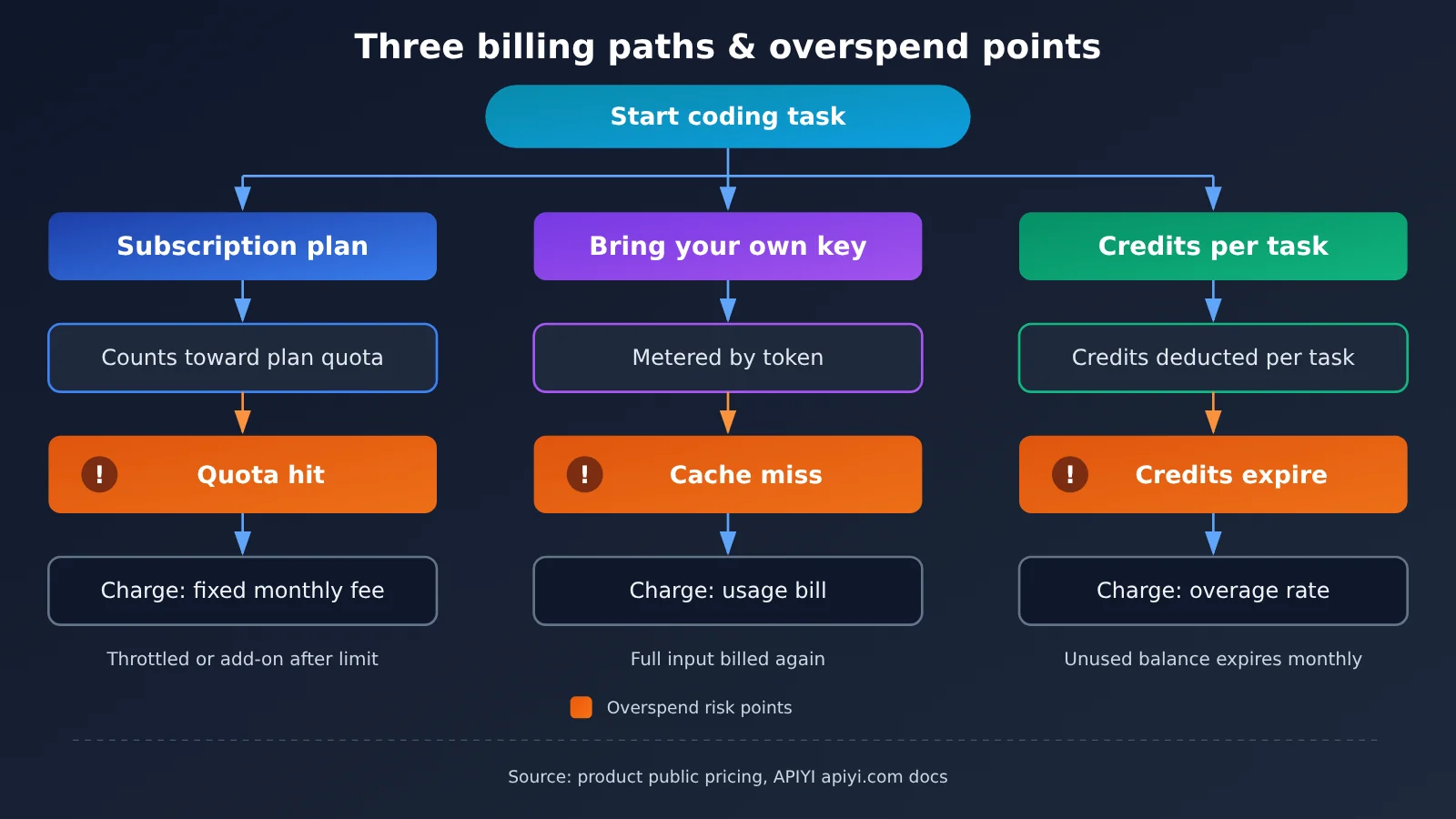
Cost Per Task for AI Coding Agents: Public Data and Methodology
Any discussion of cost has to start with methodology. The data below comes from the third-party independent benchmark Artificial Analysis’s “Claude Code vs Codex” comparison page (accessed 2026-11-24). It was measured on their own task set for long-running agent tasks, where each task runs twenty to thirty-plus minutes on average — you can’t apply it directly to your everyday small changes.
| Metric (third-party independent benchmark) | Claude Code | Codex |
|---|---|---|
| Cost per task | $15.47 | $5.12 |
| Time per task | 53.3 minutes | 25.1 minutes |
| Turns per task | 94.7 | 51 |
| Tokens per task | 9.75M | 4.67M |
| Cache hit rate | 94% | 95% |
| SWE-Atlas-QnA-AA score | 62 | 55 |
There are three takeaways from this table. First, both cache hit rates are 94%–95%, meaning that in long tasks the vast majority of tokens are served from cache — once the cache stops working, the bill changes by multiples. Second, token volume and turn count differ a lot; the cost gap comes mainly from “how much got run”, not just unit price. Third, scores and costs in the table are different dimensions, and this article doesn’t use them to judge which one is better value.
Another dataset comes from Enjoy.dev (2026-11-01, measured on the same task set), and it shows that reasoning effort level affects cost more than switching tools does:
- Claude Code with Fable 5.2 xhigh: 58.5 score, $15.47, 53 minutes
- Claude Code with Fable 5.2 high: 58.2 score, $7.51, 31 minutes
- Claude Code with Fable 5.2 medium: 53.0 score, $2.89, 15 minutes
- Claude Code with Opus 5.5 max: 58.2 score, $12.61, 65 minutes
- Claude Code with Sonnet 5.5 max: 56.3 score, $11.40, 87 minutes
- Codex with GPT-6 Astra max: 53.1 score, $7.63, 26 minutes
- Antigravity CLI with Gemini 4 Carbon high: 55.5 score, $7.13, 34 minutes
Going from xhigh down to high on the same model costs 0.3 points of score but nearly halves the cost. That gives an actionable conclusion: drop the default tier one level first, run it for a week and watch the rework rate, then decide whether to move it back up.
Protocols and Caching for AI Coding Agents: Why Claude Doesn’t Get Cache Hits in Codex
This section is where you’re most likely to waste money. According to the real-world test records from the APIYI documentation dated 2026-10-28 and 11-02:
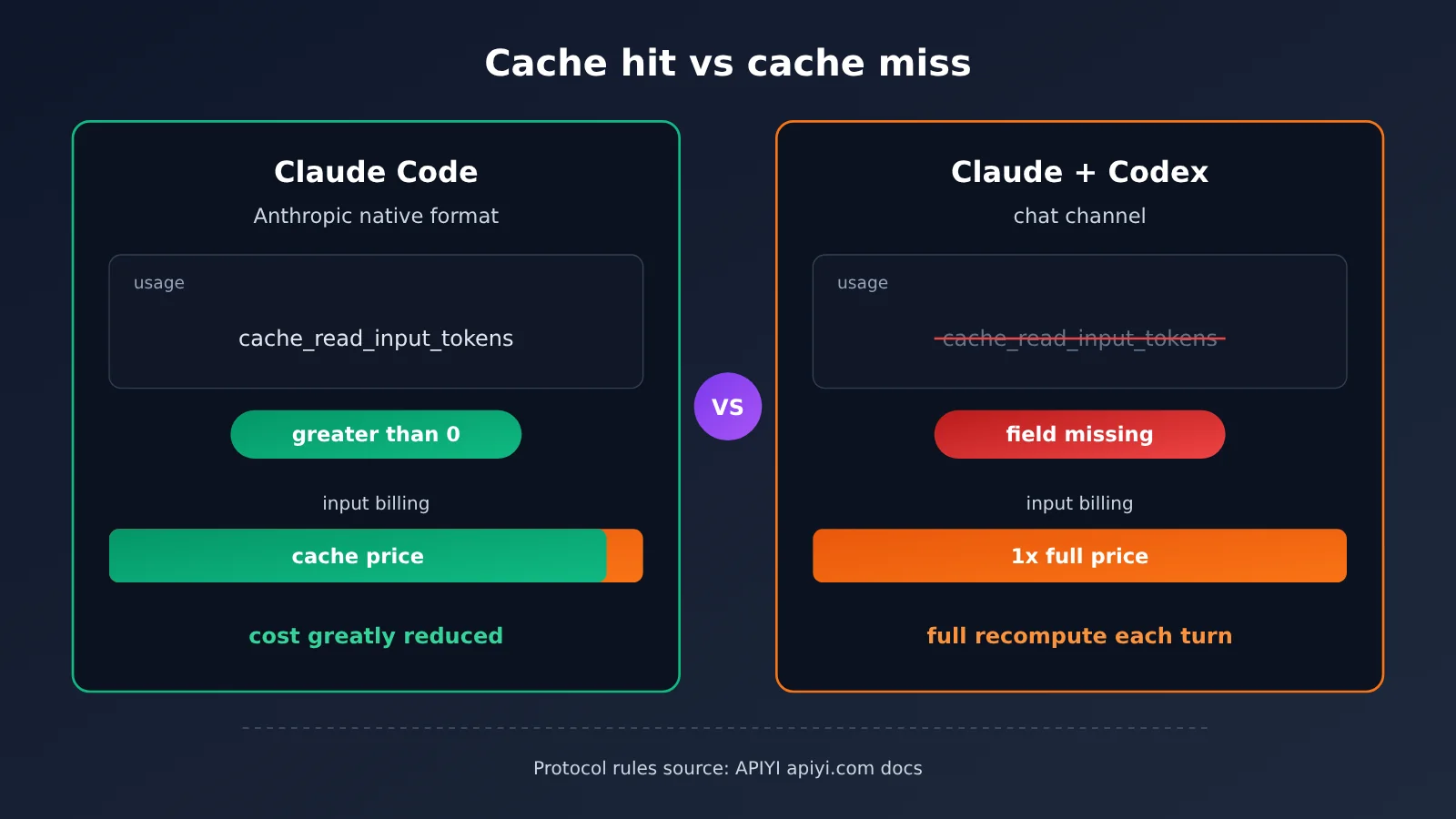
- Codex only accepts the Responses protocol, and
wire_apiin the config is limited toresponses. - On APIYI, the Claude model’s
supported_endpoint_typesonly includesanthropicandopenai—there’s noopenai-response. - So when you connect Claude into Codex, you can only go through the OpenAI-compatible chat channel, and Claude’s explicit
cache_controlwon’t take effect. - The result:
cache_read_input_tokenswon’t appear in the usage, and the full context gets re-billed at 1x the input price every round. - The APIYI documentation states clearly: cache billing only takes effect under the Anthropic native format.
In other words, the tool’s and model’s protocols need to match up: Claude models belong in Claude Code, or in OpenCode via the Anthropic native format; GPT models belong in Codex via Responses. Mixing them isn’t impossible—but you’ll lose that 94%–95% cache benefit.
AI Coding Agent Cache Self-Check Steps
Treat the following steps as integration acceptance checks—run through them every time you switch tools or models:
- Point base_url to
https://api.apiyi.com/v1(for the Anthropic native format, fill in the corresponding address per the APIYI documentation), then run a small task with at least 5 rounds. - Check the usage of each response after round 2, and confirm the
cache_read_input_tokensfield is present. - Acceptance criteria:
usage.cache_read_input_tokensis greater than 0; if in a long task that value’s share of the input tokens is far below the 90%+ seen in public data, first check whether the protocol and prompt prefix are changing frequently. - Field missing or always 0: confirm whether you’ve stuffed Claude into Codex, or gone through an OpenAI-compatible chat channel—switch back to the Anthropic native format and retest.
AI Coding Agent Model Pricing and a Monthly Cost Calculation Method
BYOK costs ultimately come down to the unit price per million tokens. The table below is taken from the APIYI model catalog (data updated 2026-11-23 10:23 UTC+8, unit USD / 1M tokens). The original documentation is authoritative:
| Model ID | Input | Output | Cache Read |
|---|---|---|---|
claude-opus-5-5 |
$4 | $20 | $0.2 |
claude-fable-5-2 |
$8 | $40 | $0.2 |
gpt-6.2-sol |
$2 | $10 | $0.1 |
gpt-6.2-astra |
$8 | $40 | $0.4 |
kimi-k3.1-pro |
$2 | $10 | $0.2 |
glm-5.3 |
$1.4 | $4.396 | $0.259 |
deepseek-v4.1-flash |
$0.3 | $1.2 | $0.006 |
qwen4-max |
$1.5 | $4.5 | $0.075 |
💰 Pricing advice: Prices in the table above change as models are updated. Before you order, check the latest data in the APIYI model catalog at apiyi.com, and also confirm which API types the model supports. That way, you won’t pick a cheaper model but use the wrong protocol and lose the cache.
AI Coding Agent Per-Task Cost Formula
Per-task cost ≈ uncached input × input price + cache read × cache-read price + output × output price. Here’s an illustration using publicly reported token counts (assuming all tokens are counted as input, with output calculated separately):
claude-opus-5-5, 9.75M tokens, 94% hit rate: cache read is about 9.165M × $0.2 ≈ $1.83, uncached input is about 0.585M × $4 ≈ $2.34, so the input-side total is about $4.17. If the cache misses, 9.75M × $4 = $39.gpt-6.2-sol, 4.67M tokens, 95% hit rate: cache read is about 4.44M × $0.1 ≈ $0.44, uncached input is about 0.23M × $2 ≈ $0.47, so the input-side total is about $0.91. If the cache misses, it’s about $9.34.
This only demonstrates how the formula works. You’ll need to plug in your own usage records for actual output volume and hit rate. The takeaway is straightforward: when the cache misses, input-side costs can increase nearly tenfold.
AI Coding Agent Monthly Usage Cost Table
The table below converts third-party estimated per-task costs into monthly costs and puts them side by side with subscription tiers. Note: how many tasks a subscription tier can cover depends on the rate-limit window. Public materials don’t provide a conversion formula, so this column can only say “you’ll need to test it yourself.”
| Long tasks per month | Claude Code estimated from third-party per-task cost | Codex estimated from third-party per-task cost | Comparable subscription tier (official pricing) | Can the subscription cover it? |
|---|---|---|---|---|
| 10 | About $155 | About $51 | Claude Pro $20 / ChatGPT Plus $20 | You’ll need to test how often you hit limits |
| 30 | About $464 | About $154 | Claude Max $100 / ChatGPT Pro $100 | You’ll need to test how often you hit limits |
| 100 | About $1,547 | About $512 | Claude Ultra $200 / ChatGPT Pro $200–$500 | You’ll need to test how often you hit limits |
Here’s a three-step way to run your own numbers: first, spend a week on BYOK recording the tokens, hit rate, and cost for each task, so you get your real unit price. Then multiply by your monthly task volume to get your monthly API cost. Finally, compare that with subscription tiers: if the monthly API cost is consistently higher than a subscription tier and you rarely hit the limits, switch to the subscription; otherwise, stick with BYOK.
AI coding agent scenario recommendations: choosing by team size and task type
| Team size / task type | Recommended billing model | Tool pairing | Key acceptance check |
|---|---|---|---|
| Individual, coding long hours every day | Subscription plan | Claude Code with a Claude subscription, or Codex with a ChatGPT plan | Number of times you hit the limit each week |
| Individual, usage varies week to week | Bring your own key | OpenCode or Codex CLI with an API key | Monthly API spend vs. subscription tier |
| Small team, mixing multiple models | Bring your own key | OpenCode switching models per task; GPT series through Codex | cache_read_input_tokens greater than 0 |
| Mid-to-large team needing seat management | Subscription plan (team seats) + BYOK as a fallback | Seat-based plans like Claude Team, BYOK for hard problems | Monthly cost per person and rework rate |
| Editor-first, more autocomplete than long tasks | Credits or per-task | Copilot, Cursor, and the like | Remaining credits and overage charges at month end |
| Very tight budget, just testing the waters | Free tier | Copilot Free, Antigravity CLI personal tier | Whether the free quota covers daily use |
AI coding agent scenarios where you should choose a subscription plan
- Task length is stable and you’re running every day, so the marginal cost of a subscription approaches zero.
- You don’t want to manage keys and billing, and you’re fine with being interrupted by usage limits.
AI coding agent scenarios where you should bring your own key
- Usage swings up and down, or you need to switch between Claude, GPT, and domestic models depending on the task.
- You need task-level cost accounting and are willing to maintain caching and protocol configuration.
AI Coding Agent Decision Recommendations
💡 Recommendation: Don’t start by choosing a tool. Start by choosing a billing model, then pair models according to protocol. We recommend running real tasks for a week through APIYI apiyi.com using BYOK to get your own cost per task and cache hit rate, then deciding whether to switch to a subscription package or a credit-based plan.
An actionable acceptance checklist:
- Caching: For every tool + model combination, confirm that
cache_read_input_tokensis greater than 0. - Reasoning level: Try running for a week with the default reasoning level one notch lower; if the rework rate doesn’t rise noticeably, keep it.
- Billing: Track API spend, the number of times you hit subscription limits, and remaining credits every week, then review against your cost spreadsheet at the end of the month.
- Protocol: Don’t put Claude in Codex; GPT series go through Responses in Codex.
Frequently Asked Questions (FAQ)
Q1: What are the three billing models for AI coding agents?
A subscription package trades a monthly fee for usage limits; bring-your-own-key means paying the model provider per token; credits or per-task billing means prepaying a quota and deducting it based on usage. A single tool may support several of these models at the same time.
Q2: Can the per-task cost gap between Claude Code and Codex be used directly as a reference?
It can only serve as directional guidance. In one third-party independent estimate, the two came in at $15.47 vs $5.12, but those were long tasks on a specific task set, the token volume differed by roughly twofold, and the reasoning tier has a big impact on cost. Recalculate with your own usage records.
Q3: When are these prices and data from?
Subscription prices come from public checks in late October to early November 2026; the per-task data is from a third-party page in November 2026; APIYI model prices were updated on 2026-11-23. Subscription tiers change frequently, so double-check before ordering.
Q4: What scenarios is OpenCode suitable for?
It’s suitable for teams that want to choose models freely and mix multiple providers or local models. The software is free; all costs come from model invocation, so it depends most on how well you manage caching and reasoning tiers.
Q5: How can I use one key to let an AI coding agent call multiple models?
Register at APIYI apiyi.com to get an API key and free trial quota, set the tool’s base_url to `https://api.apiyi.com/v1`, and then pair models according to the protocol rules above: Claude uses Anthropic’s native format, and GPT series use Responses in Codex.
Q6: Why does the bill go up after connecting Claude to Codex?
According to APIYI documentation, Codex only recognizes Responses, and Claude models don’t have that endpoint, so they can only go through the chat channel. Explicit caching doesn’t take effect, and the full context is billed at full price every turn. Check whether usage contains `cache_read_input_tokens` to confirm.
Q7: What are the known shortcomings of credit-based billing?
Some products don’t roll credits over from month to month and charge overage at a per-unit rate; other products add a markup on top of the provider’s API price. With heavy use, these rules can make actual costs higher than expected.
AI Coding Agent Selection Key Takeaways
- Pick the billing model first: subscription plans, bring-your-own-key, and task-based credits each have their own cost overrun risk.
- Check the methodology behind public data: third-party per-task costs are based on long-task sets, so you’ll need to recalculate with your own usage.
- Caching drives the bill: long tasks hit 94%–95% cache hit rates; once the cache goes cold, input costs balloon by nearly 10x.
- Protocols must be paired correctly: Claude doesn’t work inside Codex — otherwise you won’t get cache reads.
- Tier is a cost lever: dropping one tier may barely move the score while nearly halving the cost.
- Review monthly: compare API monthly fees against subscription tiers to decide which way to switch.
Summary
How to choose an AI coding agent without burning money comes down to three things:
- Match the billing model to your usage: heavy, steady usage → subscription; variable usage across multiple models → BYOK; editor-centric workflows → credits.
- Validate protocol and caching first: for every combination, confirm that
cache_read_input_tokensis greater than 0. - Do the math with your own data: log usage for a week, extrapolate monthly, then compare against subscription tiers before deciding.
Start by running BYOK for a week to get your real per-unit price, then pick a long-term plan. With APIYI (apiyi.com), you can compare multiple models through a single key and run the validation under one consistent billing methodology.
📚 References
-
Artificial Analysis, “Claude Code vs Codex” comparison page: independent third-party measurements
- Notes: per-task cost, time, turns, tokens, and cache hit rate; accessed 2026-11-24
-
Enjoy.dev coding-agent measurement on the same task set: third-party measurements
- Notes: scores, cost, and time across different models and reasoning tiers, 2026-11-01
-
Contenox, “Best AI coding agents 2026”: community compilation
- Notes: Terminal-Bench rankings and OpenCode provider support; updated 2026-11-21
-
Pricing compilations from AgentKoji, Metarix, and Repowise: a summary of subscription and credit pricing
- Notes: cross-checked against official pricing for Claude, ChatGPT, Copilot, Kiro, Cursor, Augment, and others, late October to early November 2026
-
APIYI documentation and model reference table: protocols, cache billing rules, and model pricing
- Link:
docs.apiyi.com - Notes: the rule that caching is billed only under Anthropic’s native format, plus pricing as of 2026-11-23
- Link:
Author: APIYI Technical Team
Technical inquiries: feel free to contact us through the APIYI homepage; more integration resources are available in the documentation center