Author’s note: We break down three sets of figures disclosed by DeepSeek Harness, assess the opportunities and risks of building an Agent platform, and offer practical advice on choosing model backends and controlling costs.
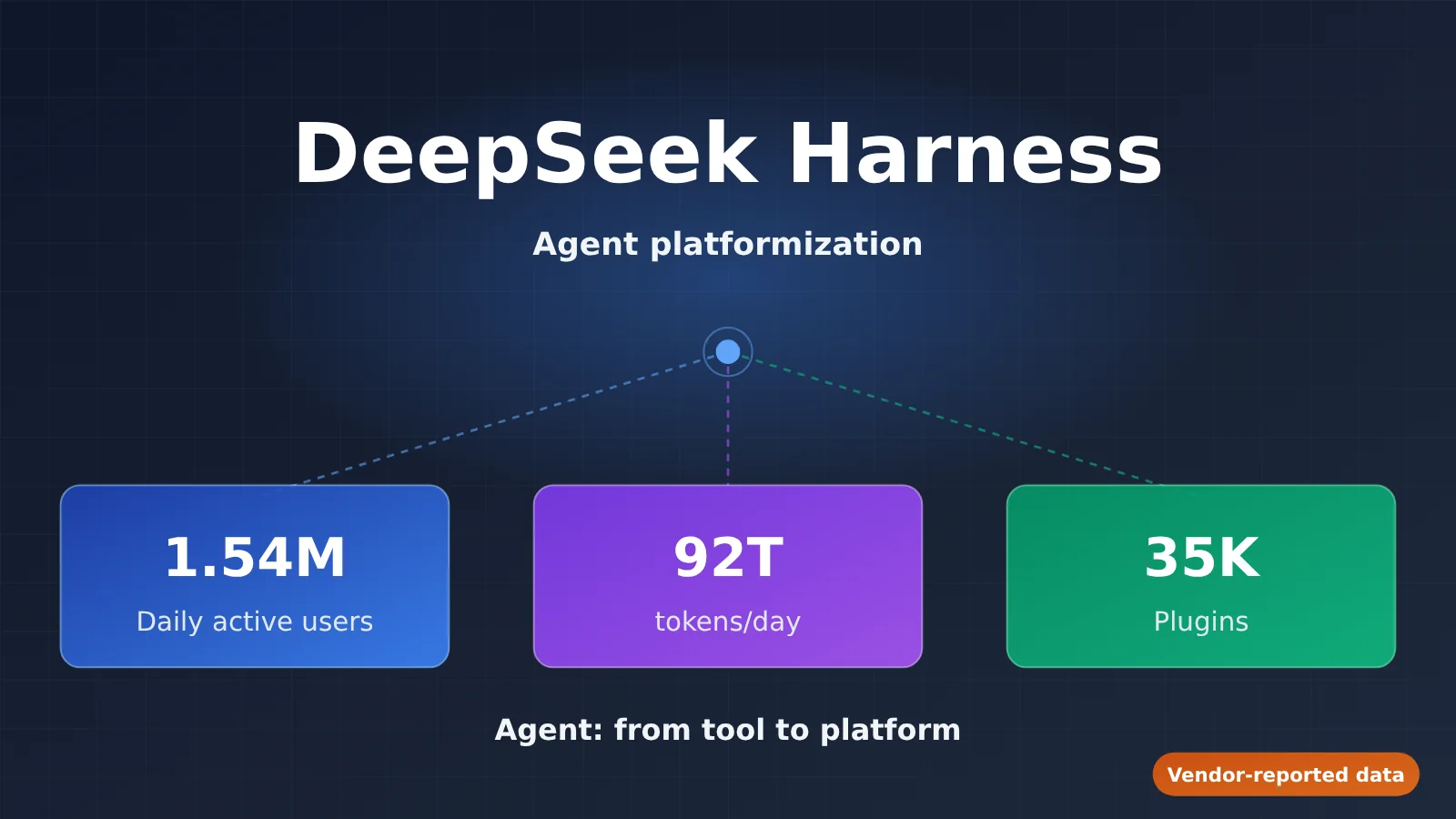
On November 5, 2026, DeepSeek Harness disclosed the following figures as of November 4: 1.54 million daily active users, approximately 92 trillion tokens per day, and around 35,000 third-party plugins. About 60% of active users had created or installed at least one plugin. Taken together, the three figures point to a clear conclusion: this isn’t just an Agent tool suddenly taking off. Agents are evolving from useful tools into platforms with ecosystems.
These aren’t market-wide figures: All numbers above were reported by the vendor, cover only users of the official DeepSeek API, and haven’t been independently audited. This article isn’t a product review. Instead, it examines three signals of platform growth—user base, usage intensity, and plugin ecosystem—before looking at what Agent developers should do about plugin APIs, permissions, data, and model backends.
What you’ll take away: You’ll understand the growth trajectory and cost implications behind these figures, along with one key takeaway: competition between Agent platforms ultimately comes down to plugin ecosystems and model costs.
DeepSeek Harness: Key Facts and Growth Curve
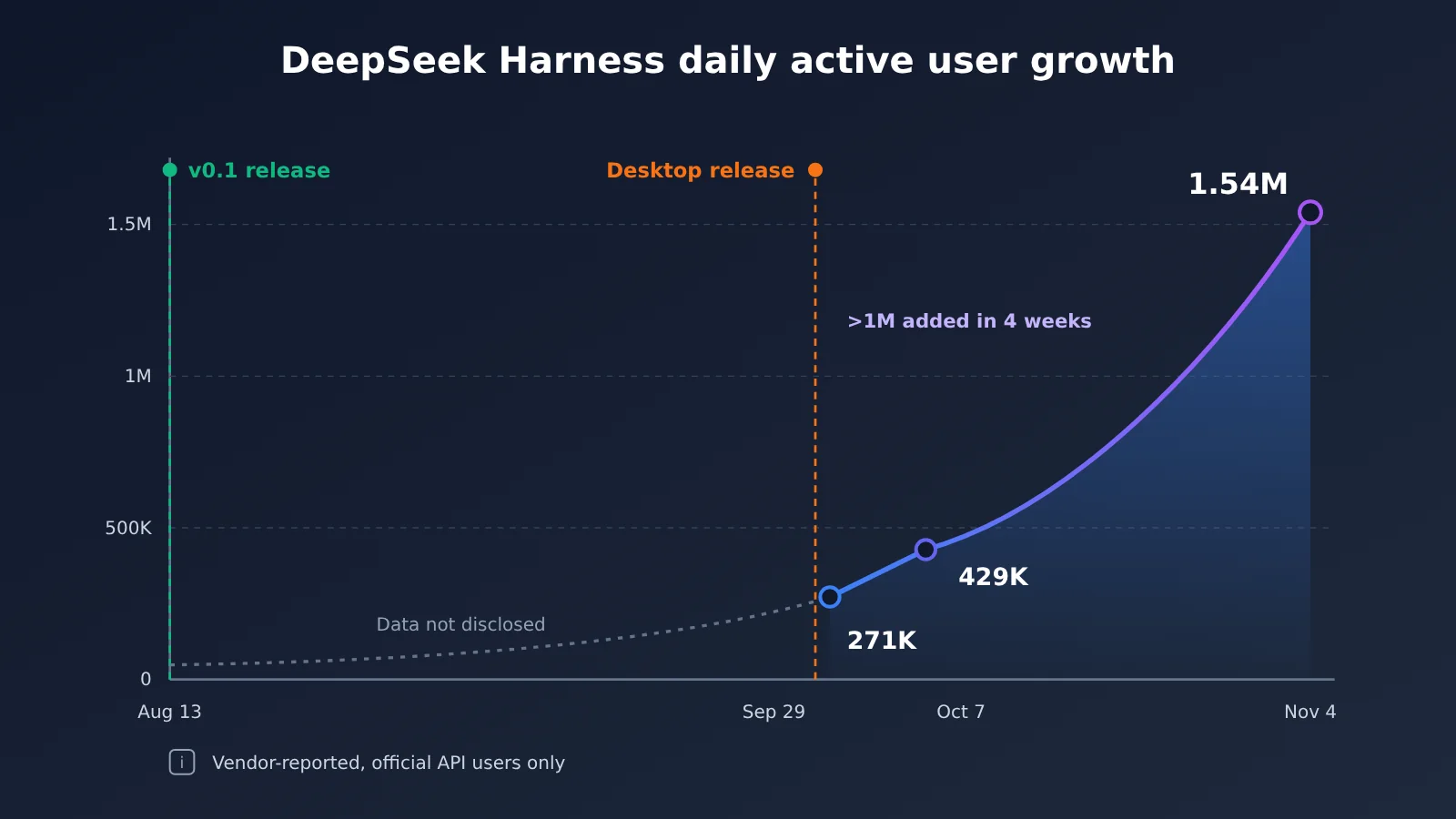
The takeaway: DeepSeek Harness reached a growth inflection point after its desktop app launched, with daily active users increasing roughly 5.7-fold in less than five weeks.
Here are the basic details disclosed by DeepSeek, collected in one table for easy reference.
| Item | Details |
|---|---|
| Disclosure date | November 5, 2026 (data through November 4) |
| Source | DeepSeek (self-reported, with no third-party audit) |
| Coverage | Users of DeepSeek’s official API only |
| User base | 1.54 million daily active users |
| Usage | Approximately 92 trillion tokens per day |
| Plugin ecosystem | Approximately 35,000 third-party plugins; about 60% of active users have used one |
| Next steps | An official plugin marketplace and creator support program are in preparation, but haven’t launched yet |
DeepSeek Harness Growth Data
| Date | Daily active users | Key event | Notes |
|---|---|---|---|
| August 13 | Not disclosed | v0.1 released | Early version used mainly by developers eager to try it out |
| September 29 | Not disclosed | Desktop app released | Lowered the barrier to entry and marked a key point in accelerating growth |
| September 30 | 271,000 | Day after desktop launch | Seven-day average, including data from before the desktop release |
| October 7 | 429,000 | One week after desktop launch | Seven-day average, up approximately 58% in one week |
| November 4 | 1.54 million | Cutoff date for officially disclosed data | More than 1 million daily active users added in roughly four weeks |
Two things stand out in this data. First, it took a month and a half to get from v0.1 to the desktop app, but the real surge came afterward. The jump from 429,000 to 1.54 million took just four weeks, and growth wasn’t linear. Second, the September 30 and October 7 figures are explicitly seven-day averages. The disclosure doesn’t fully clarify whether the 1.54 million figure for November 4 uses the same measure, so it’s worth allowing for some uncertainty when comparing them.
Why was the desktop app so important? Core agent use cases involve running for long periods, reading and writing local files, and calling local tools—all of which face limitations in a browser. The desktop app lets agents interact with users’ actual working environments, giving plugins more room to do useful work. The growth curve itself illustrates how the form a tool takes can determine a platform’s potential.
92 Trillion Tokens per Day: What DeepSeek Harness Usage Tells Us
Bottom line: 92 trillion tokens per day shows that Agent usage looks very different from chat. Looking only at the price per million tokens can seriously underestimate the real cost.
Over a 30-day month, 92 trillion tokens per day adds up to roughly 2.76 quadrillion tokens—and that still covers only official API users. Divide that figure by 1.54 million daily active users, and you get roughly 60 million tokens per user per day. A small number of heavy users and long-running tasks clearly pull that average up, but it illustrates one thing: Agent users aren’t just “chatting”—they’re keeping models working continuously.
For a sense of scale, OpenRouter processed roughly 210 trillion tokens globally during the week of November 2–8, with Chinese models accounting for about 116.18 trillion. The figures use completely different measurements and aren’t directly comparable, but they show that a single Agent platform can generate token throughput on a massive scale. It’s also worth stressing that token volume doesn’t equal revenue, let alone profit.
What Amplifies Token Usage in Agent Tasks
| Amplification factor | When it happens | Impact on cost |
|---|---|---|
| Multiple iterations | Planning, execution, checking, and correction loops | The same context is billed repeatedly |
| Tool calls | Results are returned after searches, file reads, or commands | Entire tool responses enter the context |
| Long context | Codebases, documents, and conversation history | Every round carries a large input |
| Failed retries | Tool errors, invalid formats, or timeouts | Spending with no usable output, which is easy to overlook |
| Stacked plugins | Multiple plugins work together on one task | Longer call chains make costs harder to predict |
For Agent developers, this means shifting the unit of cost analysis from “price per million tokens” to “cost per completed task.” A cheaper model that needs three retries may end up costing more than a pricier one that gets it right the first time. Measuring costs by task, session, or usable output gives you a clearer picture of the real bill.
💰 Cost tip: To track token costs by task, you need visibility into each call. When you access models through APIYI apiyi.com, the console lets you review usage, billing, and invocation logs. You can break an Agent task down into individual calls and check them one by one to spot waste caused by retries and long contexts.
35,000 Plugins: Is the DeepSeek Harness Plugin Ecosystem a Moat?
Bottom line: 35,000 plugins and a 60% adoption rate show that plugins are a mainstream way to use the platform. But quantity alone doesn’t equal a moat—or quality.
About 60% of active users have created or installed at least one plugin, a more compelling figure than the total plugin count. It suggests plugins aren’t just toys for a handful of enthusiasts; they’re the default way most users extend Agent capabilities. Once users’ workflows depend on a few plugins, switching to another platform becomes significantly more costly. That’s where platform stickiness comes from.
But whether the ecosystem becomes a moat depends on three factors, not just the number of plugins:
- Quality distribution: The disclosures don’t say how many of the 35,000 plugins are used long-term or how many are one-off experiments.
- API stability: If the plugin API changes frequently, maintenance costs rise for authors, and the ecosystem can lose contributors.
- Security boundaries: Which files, credentials, and network resources plugins can access directly affects whether enterprises can use them with confidence.
In other words, the plugin count is a starting point for building a platform. The stability, compatibility, and security of the plugin API are what determine whether it can develop a moat. For Agent developers, those three factors will also be central to choosing which platform to build plugins for.
Official Plugin Marketplace and Author Subsidies: The Next Step Toward an Agent Platform
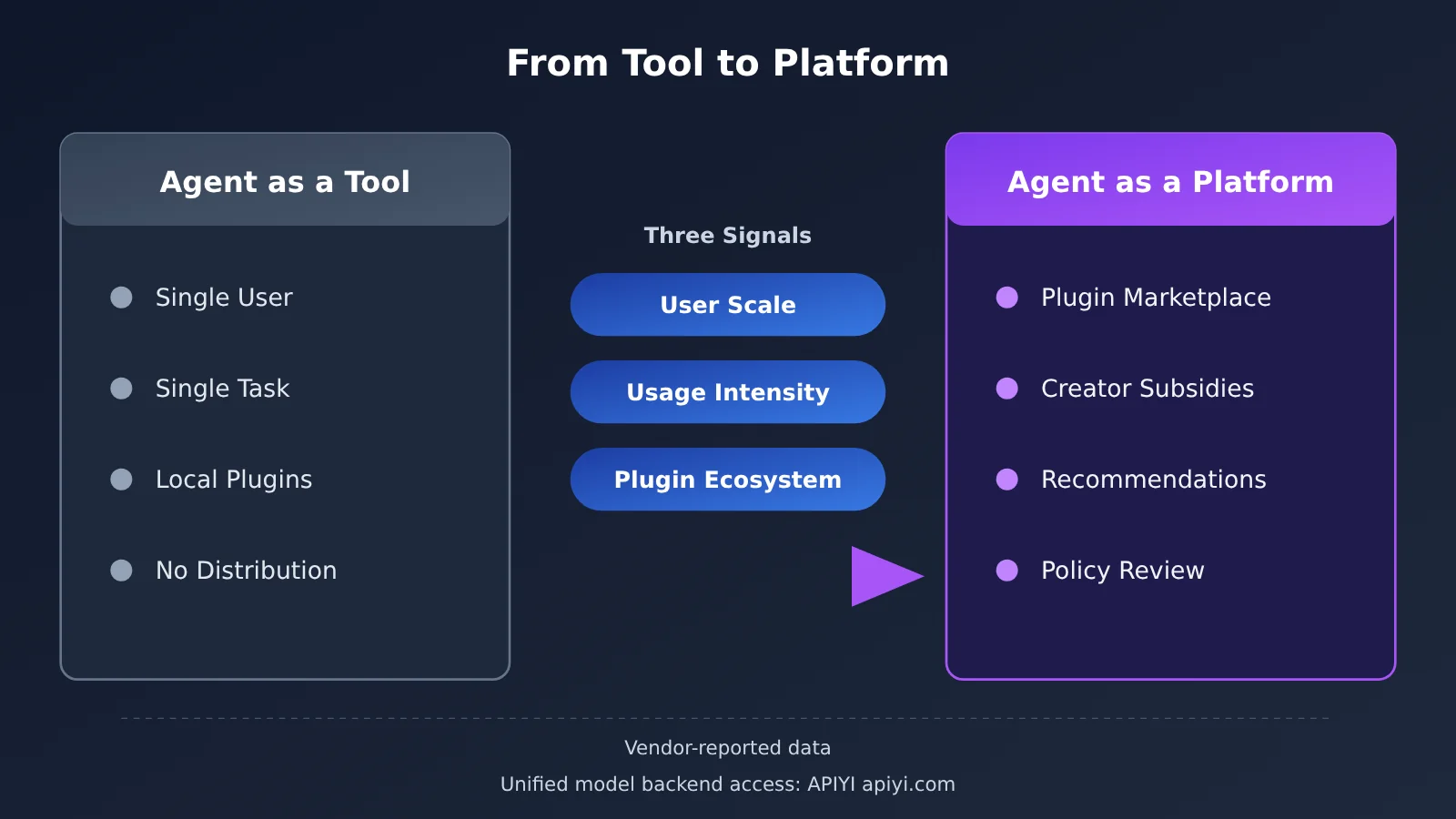
Bottom line: An official plugin marketplace and author subsidies signal that DeepSeek Harness is moving from a “tool” to a “distribution channel”—a defining step toward becoming an Agent platform.
According to the disclosed plans, an official plugin marketplace and an author support program are in the works, including token subsidies, technical exchanges, and featured placements. These address three of authors’ biggest concerns: development costs, technical support, and visibility. Once launched, they’ll create an app-store-like distribution relationship between plugin authors and the platform.
Signs of Agent Platform Development
| Signal | Data | What it means | Impact on developers |
|---|---|---|---|
| User base | 1.54 million daily active users (vendor-reported) | A distribution channel with a sizable audience | Plugins have a ready pool of potential users |
| Usage intensity | Approximately 92 trillion tokens per day | Users are doing real work with Agents | Plugins for long-running tasks become more valuable |
| Ecosystem participation | Approximately 35,000 plugins; used by around 60% of users | Plugins are a mainstream way to use the platform | The plugin API becomes a new development interface |
| Distribution mechanism | Official marketplace in preparation | A shift from an organic ecosystem to a managed platform | Rules, reviews, and revenue sharing will affect earnings |
| Author incentives | Token subsidies, exchanges, and promotion | The platform is actively cultivating its supply side | Early authors may benefit from increased exposure |
It’s worth keeping expectations in check: the marketplace hasn’t launched, and its listing rules, review standards, and revenue-sharing model haven’t been announced. The distribution benefits of becoming a platform are real, but the platform’s control over the rules will grow alongside them. Plugins, workflows, user data, and permissions all accumulate on the platform, creating a risk of lock-in.
How DeepSeek Harness Affects Agent Developers
The bottom line: there are four issues to consider early—plugin APIs, permissions, data, and model backends. Model backends are the easiest to get locked into, but that lock-in is also easy to avoid upfront.
Plugin APIs and Permissions
If you’re planning to build plugins for Harness or a similar platform, first assess the plugin API’s versioning strategy and compatibility guarantees. Don’t invest too heavily while interfaces are changing frequently. For permissions, follow the principle of least privilege: plugins should request only what they need to complete their tasks. API keys and user credentials shouldn’t be exposed directly to plugins; route them through the platform or your own gateway instead.
Data and Self-Hosting Tradeoffs
Hosted platforms work out of the box and offer a distribution channel, but your workflows and data live on the platform. Teams with sensitive data can self-host core processes or deploy them privately, while leaving general-purpose capabilities to a hosted platform. It’s not an either-or decision—choose based on data sensitivity.
Choosing a Model Backend
Competition among Agent platforms will ultimately come down to model costs, and your backend shouldn’t be tied to a single provider. Different tasks suit different models: use a powerful model for planning and complex reasoning, and a more cost-effective one for bulk text processing and format conversion. You’ll also need a backup model when your primary model is short on capacity.
Tencent’s Hy4 offers a recent example: on its November 4 launch day, many users hit their quota limits, the inference cluster was scaled up tenfold, and the company recommended switching to Hy3 or using it during off-peak hours. Capacity pressure is a common issue for new models and Agent platforms, not an isolated case.
| Backend option | Key characteristics | Best for | Switching cost |
|---|---|---|---|
| Single official API | Simple integration; capabilities stay in sync with the provider | Early validation, single-model products | High; switching models requires integration changes |
| Multiple official APIs | Broad model selection | Large teams with dedicated maintainers | Medium; multiple authentication methods and formats to maintain |
| Multi-model gateway (such as APIYI apiyi.com) | One key for models from multiple providers; OpenAI-compatible | Multi-task routing and backup models | Low; mainly change the model parameter |
| Self-hosted open-source models | Control over data | Sensitive data and private deployments | High; requires your own inference infrastructure and operations |
For example, APIYI provides access to more than 400 models—including OpenAI, Claude, Gemini, DeepSeek, Qwen, Kimi, GLM, and MiniMax—with a single key. It’s compatible with the OpenAI API standard and also supports native Claude and Gemini formats. Set base_url to https://api.apiyi.com/v1 to connect. Switching models mainly involves changing the model field, so you don’t need to maintain separate integration code for each provider.
Keep in mind that a unified interface reduces integration costs, but it doesn’t eliminate differences between models. Tool-calling formats, context lengths, and caching mechanisms can vary, so run regression tests on your own Agent tasks before switching. Check the console and documentation for current pricing and availability.
🎯 Technical tip: When building an Agent backend, use the free test credits for new users at APIYI apiyi.com to run the same set of tasks across two or three models. Compare completion rates and per-task costs before choosing your primary and backup models.
Risks and Limits of the DeepSeek Harness Data
Bottom line: These figures may signal that Agents are evolving into platforms, but they don’t support conclusions about the entire market—and they certainly don’t prove revenue or quality.
There are a few important limits to keep in mind:
- Vendor-reported figures: The 1.54 million daily active users and 92 trillion tokens per day haven’t been independently audited and await third-party verification.
- Limited scope: The figures cover only users of DeepSeek’s official API, not the entire Agent market.
- Tokens don’t equal revenue: 92 trillion tokens reflects usage, not revenue or profit. Subsidies and discounts can significantly affect actual revenue.
- Quantity doesn’t equal quality: The activity levels and quality distribution of the 35,000 plugins haven’t been disclosed.
- Rules aren’t settled: The plugin marketplace hasn’t launched, and its review, revenue-sharing, and permission rules haven’t been announced.
For industry context, Menlo Ventures estimates enterprise AI spending will reach approximately $176.8 billion in 2026, with Agents playing a major role in driving the surge in demand. As demand grows, so does pressure on capacity. For Agent developers, the implication is straightforward: availability risks need to be handled at the architecture level, rather than relying on a single provider to never impose rate limits.
🛡️ Reliability tip: Configuring a backup route for your Agent is low-cost insurance. According to its official description, APIYI apiyi.com uses multi-node deployment, intelligent routing, automatic fallback, and load balancing, and provides real-time monitoring. On top of that, consider implementing fallback logic in your application—for example, automatically switching to a backup model if the primary model times out or hits a rate limit, so long-running tasks can continue.
Frequently Asked Questions
Q1: How were DeepSeek Harness’s 1.54 million daily active users counted?
According to the official disclosure, the count covers only users of DeepSeek’s official API. The figure is current as of November 4, was self-reported by the company, and hasn’t been independently audited. The earlier figures of 271,000 and 429,000 were explicitly seven-day averages. It reflects Harness’s scale under that definition, not the entire Agent market.
Q2: What does 92 trillion tokens per day mean in practical terms?
Over 30 days, that works out to roughly 2,760 trillion tokens per month, or about 60 million tokens per user per day on average—a figure likely skewed upward by heavy users. It shows how an Agent’s multiple turns, tool calls, long context windows, and retries can dramatically increase usage. But token volume measures usage alone; it can’t be converted into revenue or profit.
Q3: Do lots of plugins mean the ecosystem is safe and easy to use?
No. The 35,000 plugins and 60% usage rate show an active ecosystem, but the distribution of plugin quality and the security review process haven’t been disclosed. What matters is which files, credentials, and network resources a plugin can access. Grant only the permissions it needs, don’t give plugins your API key directly, and route sensitive operations through a separate gateway.
Q4: Should you tie an Agent’s model backend to a single provider?
It’s not recommended. Different models suit different tasks, and your primary model may face rate limits when capacity is under pressure. A more resilient approach is to use a gateway that provides access to multiple models with one API key. For example, you can use APIYI at apiyi.com to invoke models through a single interface and quickly switch between primary and backup models. Before switching, run regression tests for differences in tool-call formats and caching.
Q5: When will the official DeepSeek Harness plugin marketplace launch?
As of publication, the official plugin marketplace and creator support program are still in preparation. DeepSeek hasn’t announced a launch date, listing rules, or revenue-sharing terms. The support announced so far includes token subsidies, technical exchanges, and featured placements. Details are subject to future official announcements.
Conclusion: 5 Recommendations for Agent Developers After DeepSeek Harness
Bottom line: DeepSeek Harness’s three sets of figures point to the same conclusion: competition among Agent platforms ultimately comes down to plugin ecosystems and model costs.
User scale provides distribution, usage intensity exposes cost pressures, and the plugin ecosystem drives retention. If the official marketplace and creator subsidies launch, the shift toward a platform model will accelerate. For Agent developers, the opportunities lie in plugins and distribution; the risks lie in lock-in and cost. Here are five actions you can take now:
- Calculate cost per task first: Move beyond “price per million tokens” to “cost per completed task.” Include retries, long contexts, and tool responses.
- Keep a backup model: Configure at least one backup model that can handle core tasks, with automatic fallback when the primary model times out or is rate-limited.
- Isolate plugin permissions: Give plugins only the permissions they need. Keep API keys and user credentials out of plugins, and route sensitive operations through your own gateway.
- Watch plugin API stability: Until a platform’s plugin API versioning policy and compatibility commitments are clear, don’t tie core business functions too closely to its plugin ecosystem.
- Look beyond daily active users: Daily active user counts are vendor-reported and limited in scope. When choosing a platform, pay closer attention to plugin API quality, permission models, data ownership, and model costs.
DeepSeek Harness Key Takeaways
- Growth inflection point: In less than five weeks after the desktop launch, daily active users rose from 271,000 to 1.54 million.
- Usage intensity: Around 92 trillion tokens per day—Agent usage is far more intensive than chat.
- Plugin ecosystem: Around 35,000 plugins, used by 60% of users. Plugins are already a mainstream part of the experience.
- Platform initiatives: An official marketplace and creator subsidies are in the works, but the rules haven’t been announced.
- Data limitations: The figures are vendor-reported and cover only official API users; they await third-party verification.
- Backend strategy: Don’t lock your model backend to one provider. APIYI apiyi.com lets you switch between multiple models with one API key.
If you’re building an Agent product or platform, start by getting your model backend and cost accounting right. Try APIYI apiyi.com to quickly test combinations of models. The platform offers free testing credits, a unified interface, and usage logs to help you keep your options open as platforms evolve.
References
- DeepSeek Harness official data disclosure: Published November 5, 2026; data through November 4
- Note: Daily active users, token usage, plugin counts, the growth timeline, and plugin marketplace plans are all vendor-reported.
- Tencent Hy4 launch and capacity expansion announcement: November 4, 2026
- Note: Industry context on first-day capacity pressure for new models and cluster expansion.
- Menlo Ventures enterprise AI spending research: 2026 enterprise AI spending estimates
- Note: Broader context on Agents driving growth in enterprise AI demand.
- OpenRouter weekly model invocation data: November 2–8, 2026
- Note: A reference point for global model invocation volumes. Its measurement scope differs from Harness’s, so the figures aren’t directly comparable.
Author: APIYI Technical Team
Technical discussions: Contact us through the APIYI website homepage. For the model list and integration instructions, visit the documentation center at docs.apiyi.com.