Author’s note: Qwen4-Max is still in preview. It has no public benchmark scores, no stated context length, and no per-token pricing, so none of those three can be compared head-to-head with Qwen3.8-Max. The model you can actually call on a pay-as-you-go basis today is still qwen3.8-max.
When the Qwen4-Max preview dropped, the first question from developers already using Qwen was usually: should I switch? How much stronger is it than Qwen3.8-Max? How much more does it cost? Right now there’s no answer you can line up side by side, because the preview is missing the three pieces of public information you’d need to make the comparison.
This isn’t a knock on Qwen4-Max. We’re not judging how capable it is. We’re just stating a fact: as of 2026-11-12, the Qwen4-Max preview has no public benchmark scores, no stated context length, and no per-token pricing, while Qwen3.8-Max has already been released and can be called pay-as-you-go. According to the APIYI apiyi.com model list as of 2026-11-12, the model you can plug into directly today is qwen3.8-max.
What you’ll get out of this: in about 3 minutes, you’ll know which items can’t be compared between the Qwen4-Max preview and Qwen3.8-Max right now, and how to plan your current projects until official details are published.
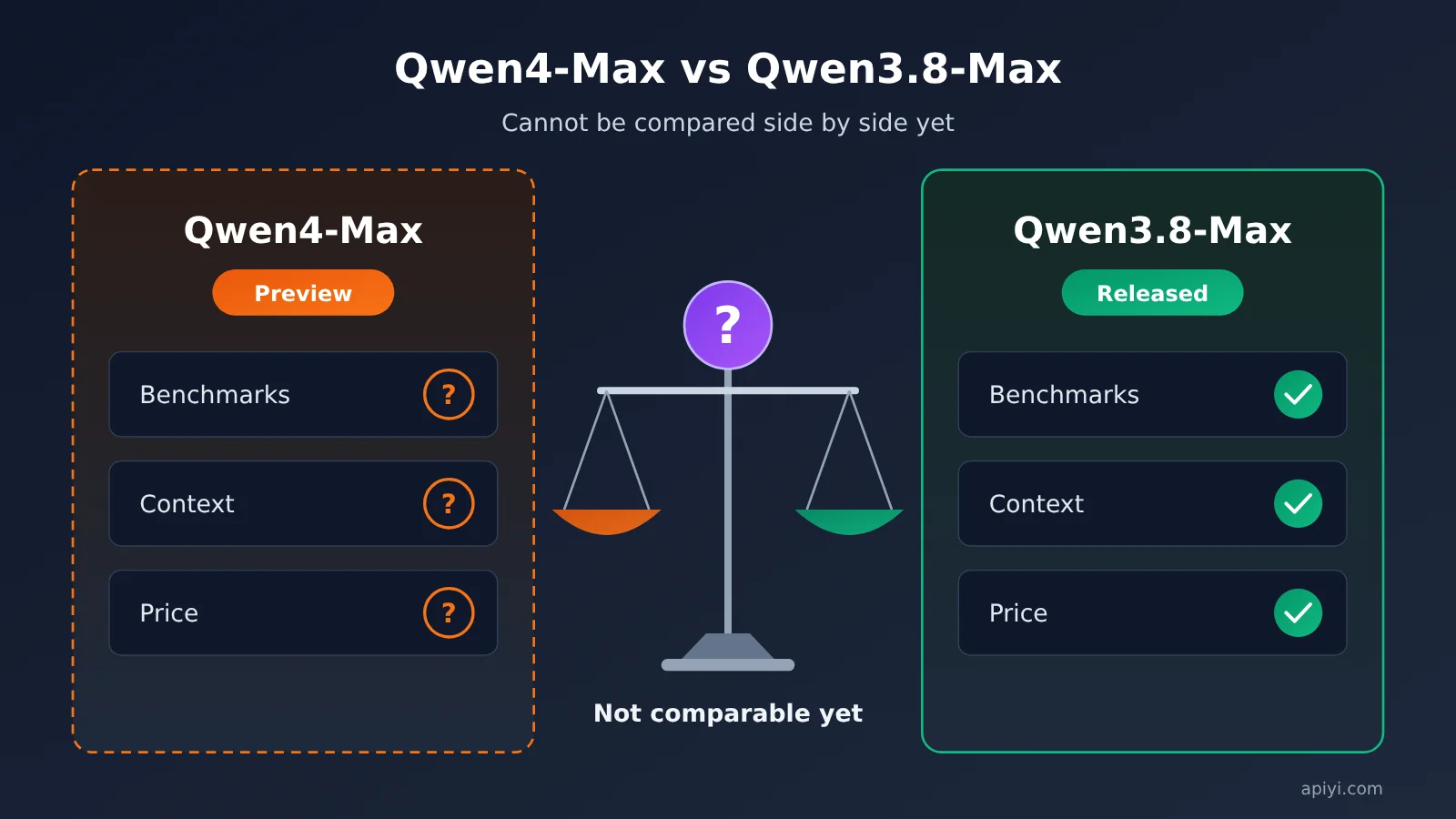
Qwen4-Max vs. Qwen3.8: Key Facts at a Glance
Let’s put everything we can currently confirm about both models side by side. The table below only lists what the reference materials can verify. Anything that hasn’t been made public is marked “Not disclosed,” with no guesswork.
| Item | Qwen4-Max (Preview) | Qwen3.8-Max |
|---|---|---|
| Release status | Preview stage | Released model |
| Public benchmark scores | Not disclosed | Released model, official materials available |
| Context length | Not disclosed | See official docs and model specs |
| Per-token pricing | Not disclosed | Input $1.65 / Output $4.95 / Cache read $0.20625 (per 1M tokens) |
| Pay-as-you-go invocation | Not in the model list as of 2026-11-12 | Available, model ID qwen3.8-max |
| Available platforms | See future official announcements | APIYI and other platforms |
“Not disclosed” shows up three times in the table: benchmark scores, context length, and pricing. These are exactly the dimensions people lean on most when choosing a model, and if any one of them is missing, a side-by-side comparison has nothing to stand on. We’ve already covered the preview rollout in an earlier article, so here we’ll focus on why these three gaps make a direct comparison unreliable.
What the Three Missing Pieces of Qwen4-Max Preview Affect
Benchmark scores drive your capability assessment. Without officially published benchmark numbers, there’s no common yardstick for judging whether Qwen4-Max moves ahead of or falls behind Qwen3.8-Max on reasoning, coding, long-text tasks, and so on. Scattered community screenshots or individual chat impressions use different test sets, prompts, and sampling parameters, so they can’t stand in for official scores.
Context length drives your architecture design. RAG chunk sizes, how you truncate conversation history, whether a long document goes in all at once or in segments: all of these depend on a known context window limit. Until that number is settled, you can’t tell whether migrating would let you drop your existing chunking logic, or whether you’d start hitting over-length errors.
Per-token pricing drives your cost model. Budgets, pricing, and rate-limit strategies are all built on unit price. Even if you can try the model during the preview, that doesn’t mean there’s a price you can put into a cost spreadsheet. Comparing an undetermined price against the current rates for qwen3.8-max doesn’t lead to any meaningful conclusion.
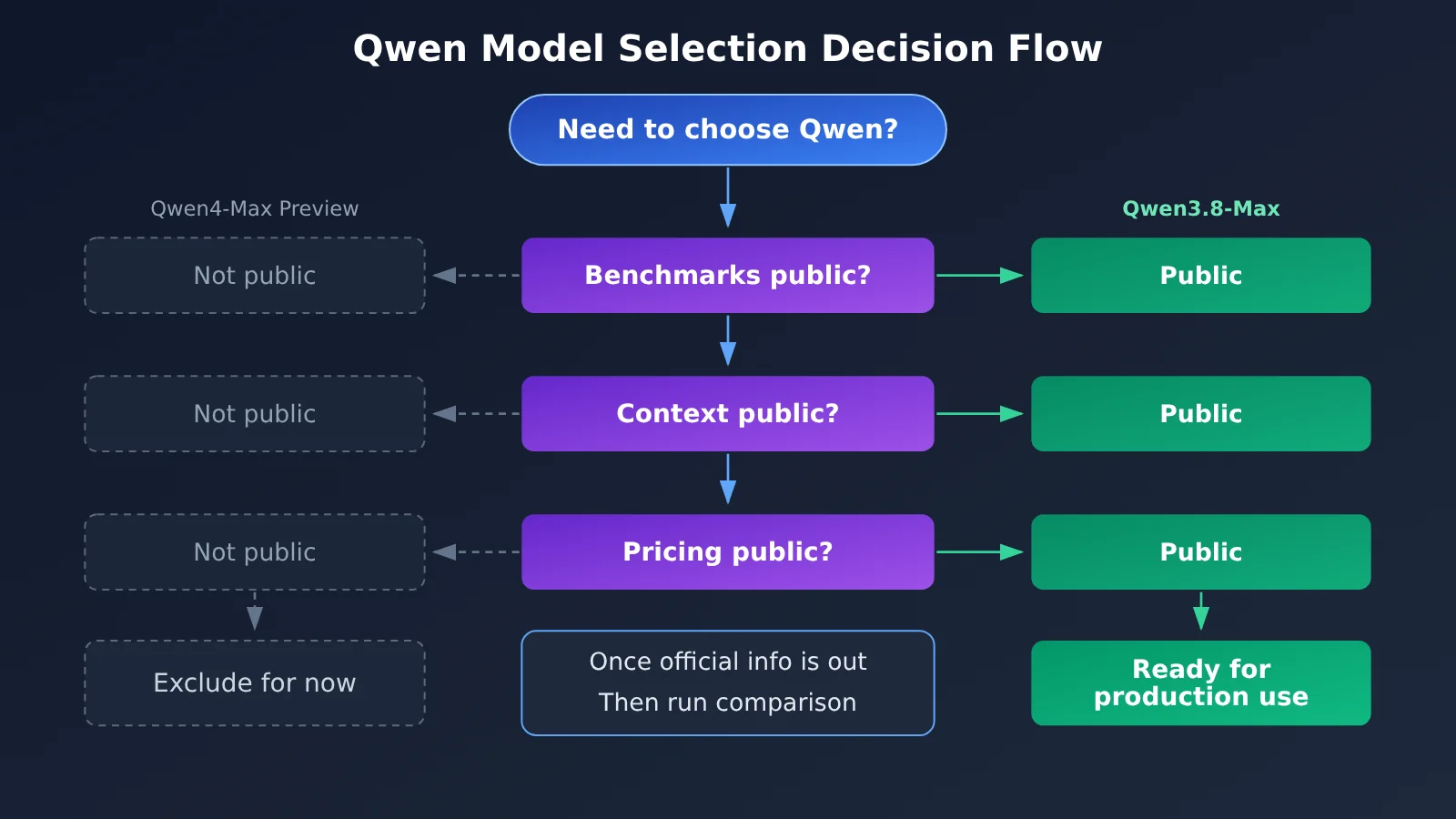
What You Can Actually Pay for Today: Qwen3.8-Max Pricing and Access
Since a fair comparison isn’t possible yet, it makes sense to build your current projects around models that have already been released. The table below shows the qwen3.8-max prices from the 2026-11-12 model list, in dollars per 1M tokens.
| Billing Item | Price (per 1M tokens) | Notes |
|---|---|---|
| Input | $1.65 | The portion of the prompt that misses the cache |
| Output | $4.95 | Model-generated content, priced at 3x the input rate |
| Cache read | $0.20625 | The portion of the input that hits the cache, priced at 1/8 of the input rate |
Structurally, output costs 3x as much as input, and cache reads cost just 12.5% of input. That makes controlling output length and raising your cache hit rate the two most direct ways to cut qwen3.8-max costs. If you have a long system prompt or a stable prefix across multi-turn conversations, the savings from caching will be even more noticeable.
Qwen3.8-Max Cost Estimates
Using the prices above, we can work out the cost of a few typical requests. Every figure here is calculated directly from the published prices, so you can easily plug in your own traffic volumes.
| Scenario | Input tokens | Of which cache hits | Output tokens | Cost per request |
|---|---|---|---|---|
| Single standard request | 10,000 | 0 | 2,000 | $0.0264 |
| Same request, prefix cache hit | 10,000 | 8,000 | 2,000 | $0.01485 |
| Batch processing 1M input | 1,000,000 | 0 | 200,000 | $2.64 |
The second row has the same total input and output as the first. The only difference is that 8,000 input tokens hit the cache, which drops the cost per request from $0.0264 to about $0.0149, a reduction of more than 40%. This is a calculation you can’t yet do for the Qwen4-Max preview, because its pricing hasn’t been announced.
How to Access qwen3.8-max
APIYI offers an OpenAI-compatible interface, so you can connect with the OpenAI SDK or any compatible client. You only need to change three parameters:
base_url:https://api.apiyi.com/v1(the unified APIYI endpoint)api_key: the API key you create in the APIYI consolemodel:qwen3.8-max
Calls work the same way as Chat Completions: just organize the messages array in the order of system, user, and assistant roles. If your project already talks to an OpenAI-compatible endpoint, you usually only need to swap out the base_url and the model ID. Your business code stays the same.
🚀 Quick start: Sign up at APIYI (apiyi.com) to get free test credits. Run your own business prompts through
qwen3.8-maxfirst and record the real input, output, and cache hit ratio. When Qwen4-Max officially opens up, you’ll already have baseline data to compare against.
How the Qwen4-Max Preview Affects Existing Qwen Projects
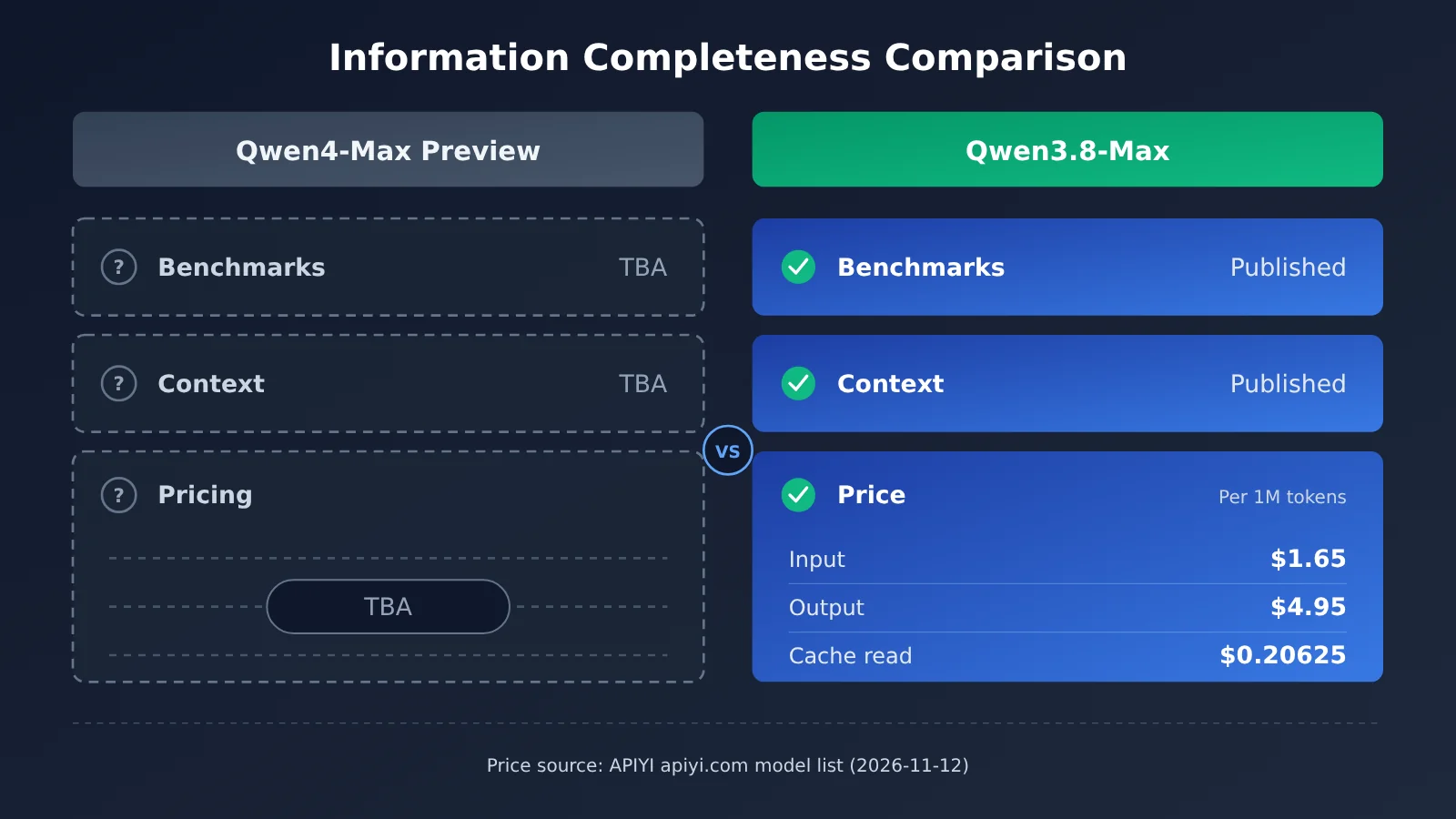
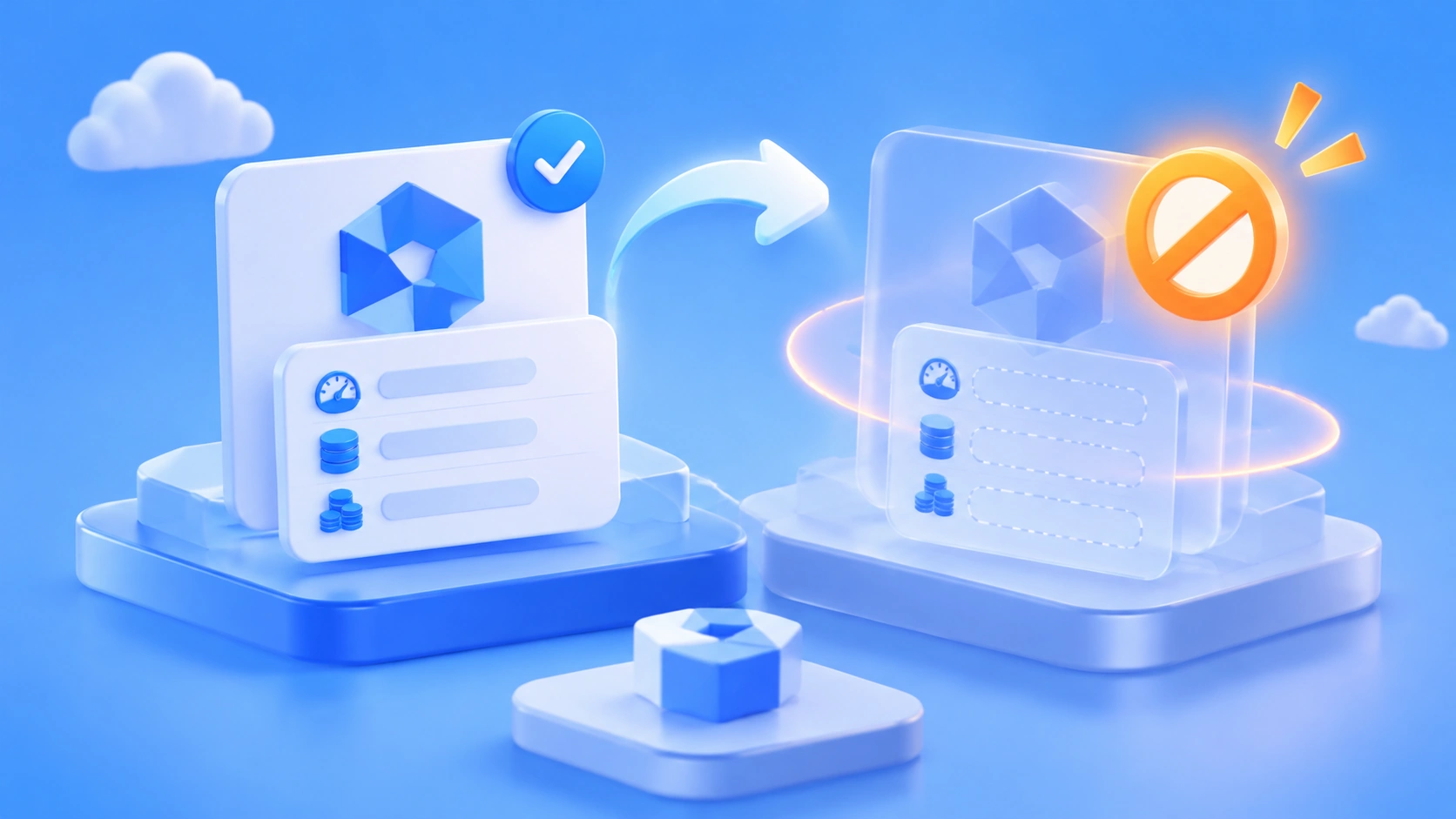
The diagram puts the two sides next to each other: three empty slots on one side, hard data you can look up on the other. With the information this lopsided, any claim about “how much stronger” or “how much more expensive” Qwen4-Max is has nothing to back it up. You can verify the pricing in the APIYI apiyi.com model list.
What This Means for Developers Already Using Qwen
- Production doesn’t need to change: The Qwen4-Max preview doesn’t affect the availability or pricing of qwen3.8-max, so your existing calls keep working as usual.
- Start preparing your evaluation now: Put together a set of prompts and scoring criteria that represent your own workload. Once official details are out, you can run both models through it right away.
- Keep budgeting around qwen3.8-max: There’s no unit price during the preview, so don’t put Qwen4-Max into your next budget or quote.
- Hold off on context-related rework: Until Qwen4-Max’s context length is announced, don’t adjust your chunking or truncation logic for it.
Recommendations by Role
| Role | What you can do now | What to do once official info is out |
|---|---|---|
| Application developers | Keep using qwen3.8-max and build up your own evaluation set |
Compare both models on the same evaluation set |
| Architects | Design your context strategy around qwen3.8-max’s actual limits | Use Qwen4-Max’s context length to decide whether you can simplify chunking |
| Cost owners | Budget at $1.65 input and $4.95 output per 1M tokens | Recalculate migration costs once Qwen4-Max pricing is available |
| Product managers | Keep external messaging based on the capabilities of released models | Decide whether to promote an upgrade based on public benchmark scores |
Lessons for Your Model Selection Process
The easiest trap with a preview release is treating “looks newer” as “is already better.” A sound selection process needs at least three kinds of public evidence: capability (benchmarks), capacity (context length), and cost (pricing). Until you have all three, a new model belongs on your watch list, not in your production plan.
Managing model invocation through a unified interface has another benefit. When Qwen4-Max opens for pay-as-you-go use, you’ll only need to change the model parameter to run an A/B comparison, with no need to integrate a new SDK.
💡 Recommendation: Until Qwen4-Max’s three key details are published, keep qwen3.8-max as your production workhorse. If you connect through the unified APIYI apiyi.com interface, you can switch between models in the same codebase and compare them quickly once the new model goes live.
FAQ
Q1: Can I compare Qwen4-Max Preview with Qwen3.8-Max right now?
Not on benchmark scores, context length, or per-token pricing. Qwen4-Max is still in preview, and none of those three have been made public, so there’s no common basis for comparison. All we can say for sure is the release status: Qwen3.8-Max has launched and is available for pay-as-you-go use, while Qwen4-Max is still in preview.
Q2: Has Qwen4-Max already surpassed Qwen3.8-Max across the board?
No public data supports that conclusion right now. A higher version number doesn’t mean a model is stronger on every task, and it doesn’t mean the pricing will suit you better. Whether it comes out ahead, and on which tasks, is something to judge after official benchmarks are released, ideally by validating against your own business evaluation set.
Q3: How much does Qwen3.8-Max cost to call right now?
According to the model list as of 2026-11-12, qwen3.8-max costs $1.65 per 1M input tokens, $4.95 per 1M output tokens, and $0.20625 per 1M cached-read tokens. The cached-read price is just 1/8 of the input price, so if your prompt prefix stays stable across requests, you can cut costs noticeably.
Q4: How do I quickly call Qwen3.8-Max through the API?
We recommend using an API aggregation platform that supports multiple models:
1. Go to APIYI at apiyi.com, sign up for an account, and get your API key along with some free test credit
2. Set `base_url` to `https://api.apiyi.com/v1`
3. Use `qwen3.8-max` as the model ID and call it with the OpenAI-compatible Chat Completions format
Q5: Will migration be costly once Qwen4-Max is officially available?
At the interface level, it depends on how you’ve integrated. If you manage everything through an OpenAI-compatible interface, you’ll usually only need to swap the model ID. What you really need to evaluate is the difference in quality and cost. We suggest building up evaluation data now by running qwen3.8-max on APIYI (apiyi.com), so you can compare directly when the time comes.
Q6: What limitations should I keep in mind during the preview phase?
Any of the key parameters could change during preview. Benchmarks aren’t public, so you can’t judge the model’s capability limits. Context length isn’t public, so you can’t finalize a long-text solution. Pricing isn’t public, so you can’t fit it into a budget. For these reasons, we don’t recommend using a preview model in production workloads that need stability and predictable costs.
Qwen4-Max vs. Qwen3.8: Key Takeaways
- Different release status: Qwen4-Max is still a preview, while Qwen3.8-Max is a released model you can call and pay for per token.
- Three things you can’t compare head-to-head: Qwen4-Max’s benchmark scores, context length, and per-token pricing haven’t been made public.
- Don’t jump to conclusions: Without public data, you can’t claim Qwen4-Max beats Qwen3.8-Max across the board.
- Current pricing is available: qwen3.8-max costs $1.65 per 1M input tokens, $4.95 per 1M output tokens, and $0.20625 per 1M cache-read tokens.
- Caching is the key to cutting costs: The cache-read price is only 1/8 of the input price, so workloads with stable prefixes benefit significantly.
- Use qwen3.8-max for production: Connect through the unified APIYI interface, and when you switch models later, you only need to change the model ID.
Summary
Here’s how the Qwen4-Max preview relates to Qwen3.8-Max:
- The conditions for a fair comparison aren’t there yet: The Qwen4-Max preview has no public benchmark scores, context length, or per-token pricing, so none of the three can be compared directly with Qwen3.8-Max.
- qwen3.8-max is what’s available today: Pricing is clear: $1.65 for input, $4.95 for output, and $0.20625 for cache reads (per 1M tokens).
- Prepare now, compare once it’s official: Build up your business evaluation set and cost data first, then make migration decisions once the full information is out.
Until official information on Qwen4-Max is released, the safe approach is to keep running your business on qwen3.8-max while getting your evaluation and cost baselines ready. We recommend accessing qwen3.8-max through APIYI (apiyi.com), which offers a unified OpenAI-compatible interface and free trial credits. Once the new model goes live, you can compare it directly using the same code.
📚 References
- APIYI Model and Pricing List: Available models verified on 2026-11-12
- Link:
api.apiyi.com/api/pricing -
Description: Used to confirm which Qwen models are currently available for pay-as-you-go invocation
-
APIYI Model Documentation: qwen3.8-max billing details
- Link:
docs.apiyi.com/models - Description: Includes unit prices for qwen3.8-max input, output, and cache reads
Author: APIYI Technical Team
Get in touch: Contact us from the APIYI homepage. For more on connecting to different models, check out the APIYI documentation center.