
Author’s note: The Carbon introductory price ends on November 30. This article compares the Google blog footnote, a third-party price roundup, and the APIYI price list to explain whether thinking is billed as input or output, and how the output price change to $20 on December 1 affects your costs.
Carbon’s introductory price has been discussed plenty of times, and now people care about two things: do thinking tokens count as input or output, and what’s the output price after December 1? Here’s the short answer: the third-party price roundup labels the output column as “includes thinking,” with output at $10 during the introductory period and $20 starting 2026-12-01. The Google blog footnote says that after the introductory period, input is $4 and output is $20, but the footnote doesn’t mention “thinking” separately.
This is not a platform price increase notice. As of 2026-11-11, the output price for gemini-4-carbon in the model overview table on APIYI (apiyi.com) is still $10. This article only compiles the original wording from three public sources, and marks where each number comes from and its data date, so you can work out your costs before December 1.
Core value: After reading this, you’ll know where the claim about Carbon’s thinking billing comes from, how the three price readings before and after December 1 differ, and which items to verify before going live.
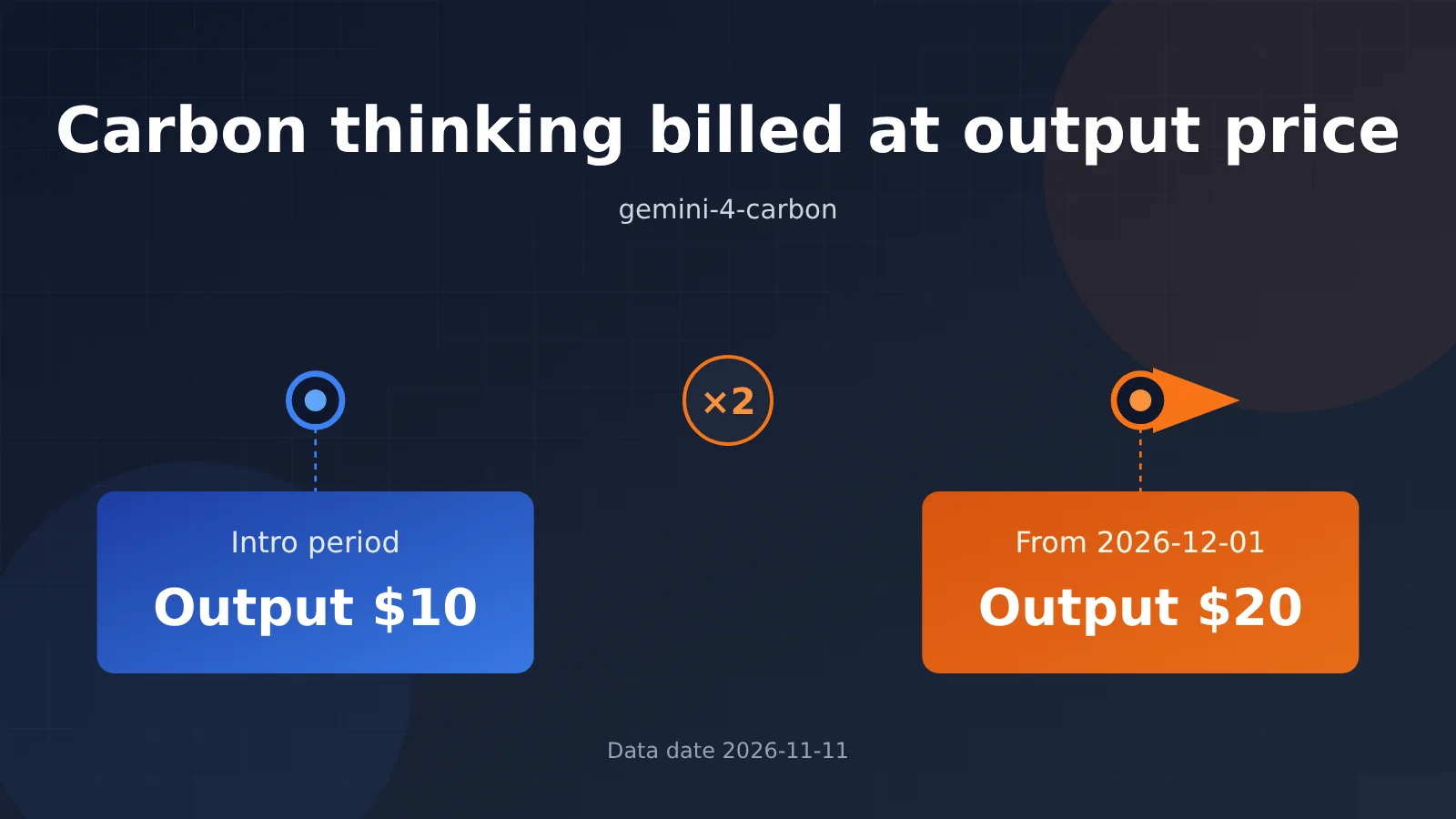
Carbon Thinking Is Billed at the Output Price: Key Facts at a Glance
This article is about Gemini 4 Carbon, announced on the Google blog, with the model ID gemini-4-carbon. A footnote in Google’s 2026-11-10 blog post gives the end date of the introductory period and the price after it. Apidog, a third-party site, then put together a more detailed price table. The numbers match in both sources, but they describe “thinking” differently.
| Item | Details | Source |
|---|---|---|
| Introductory period ends | 2026-11-30 | Google blog footnote, 2026-11-10 |
| Input price after the introductory period | $4 / 1M tokens | Google blog footnote |
| Output price after the introductory period | $20 / 1M tokens | Google blog footnote |
| Scope | The public-facing Carbon | Google blog footnote |
| Which column thinking counts toward | The output column, labeled Output incl. thinking | Apidog summary page, checked 2026-11-11 |
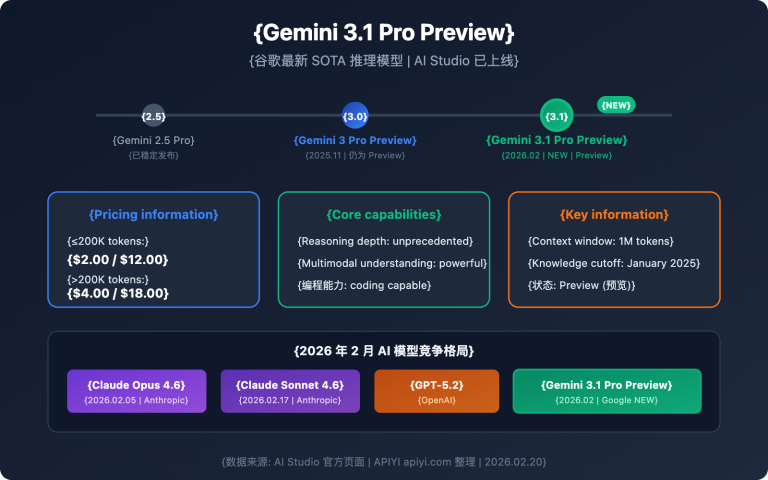
| Current platform pricing | Input $2, output $10, cache read $0.1 | APIYI (apiyi.com) model price list, 2026-11-11 |
Timeline: Carbon’s Output Price Going from $10 to $20
The timeline is short. On 2026-11-10, the Google blog announced that Carbon was available. A footnote said the introductory period runs through 2026-11-30, after which input costs $4 and output costs $20, both per 1M tokens. On 2026-11-11, Apidog’s summary page split the output price into two phases: $10 during the introductory period and $20 from December 1.
In other words, going by the official footnote and the third-party summary, the output price after December 1 is double the introductory price. The increase applies to both the visible answer and the thinking process, because Apidog puts both in the same column.
Where “Thinking Counts as Output” Comes From
“Thinking is billed at the output price” is the premise of a lot of discussion, but it’s worth being clear about where it comes from. The table below shows what each of the three sources says, and what it leaves out.
| Source | Mentions “thinking”? | Original wording | Nature |
|---|---|---|---|
| Google blog footnote (2026-11-10) | Not called out separately | After the introductory period: input $4, output $20 | Official, self-reported |
| Apidog summary page (checked 2026-11-11) | Explicitly stated | Output column header reads Output incl. thinking | Third-party summary |
| APIYI model price list (2026-11-11) | No separate thinking price | Input $2, output $10, cache read $0.1 | Platform pricing |
So the claim that thinking tokens count toward output comes straight from a column name on a third-party summary page. It isn’t a sentence from Google’s footnote. The footnote lists only two tiers, input and output, and doesn’t price thinking separately. Treating thinking as output in your budget is a sensible approach, but keep in mind that the basis is a third-party summary, not a clause the official footnote spells out word for word.
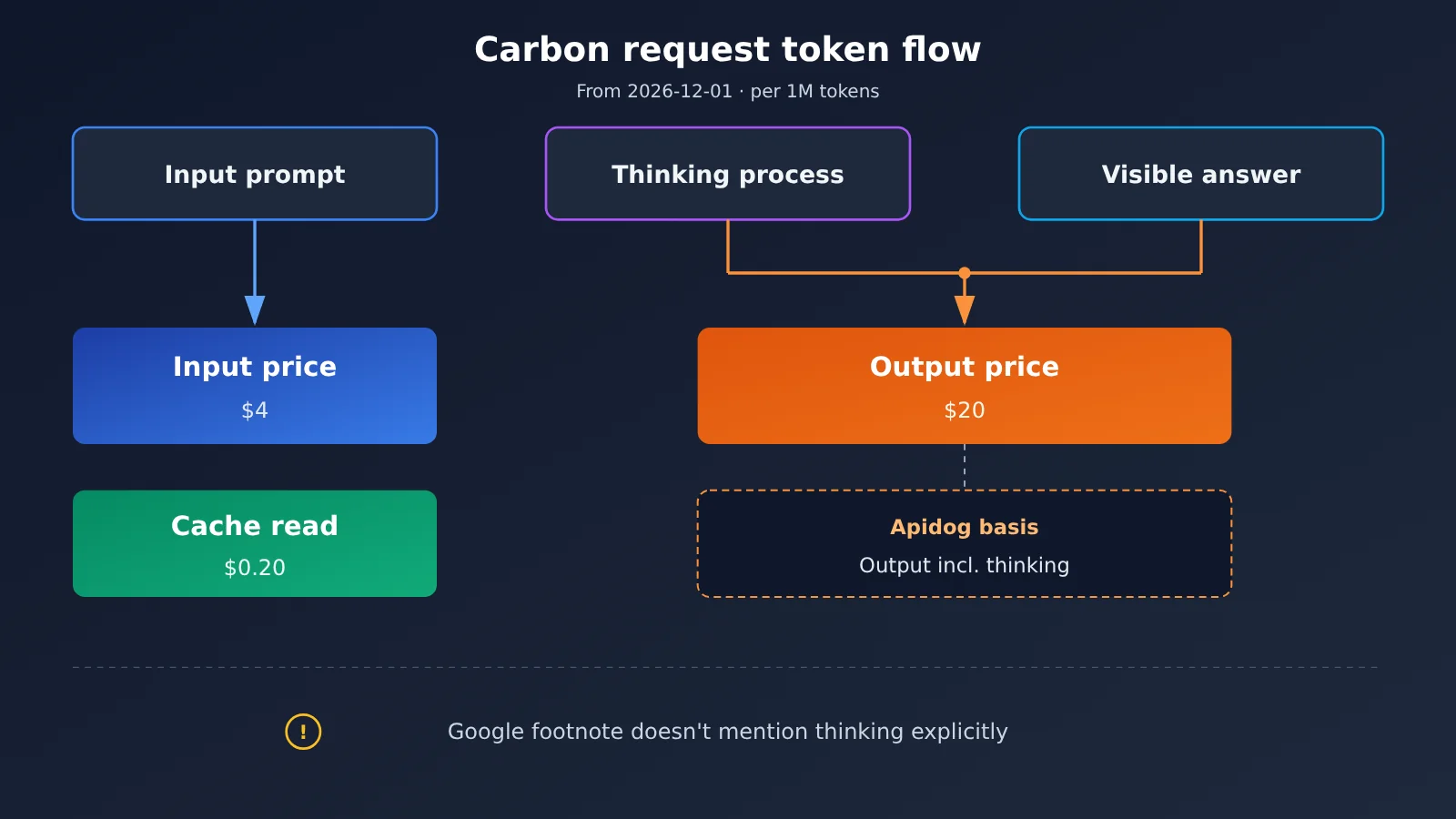
Carbon Output Pricing Before and After December 1
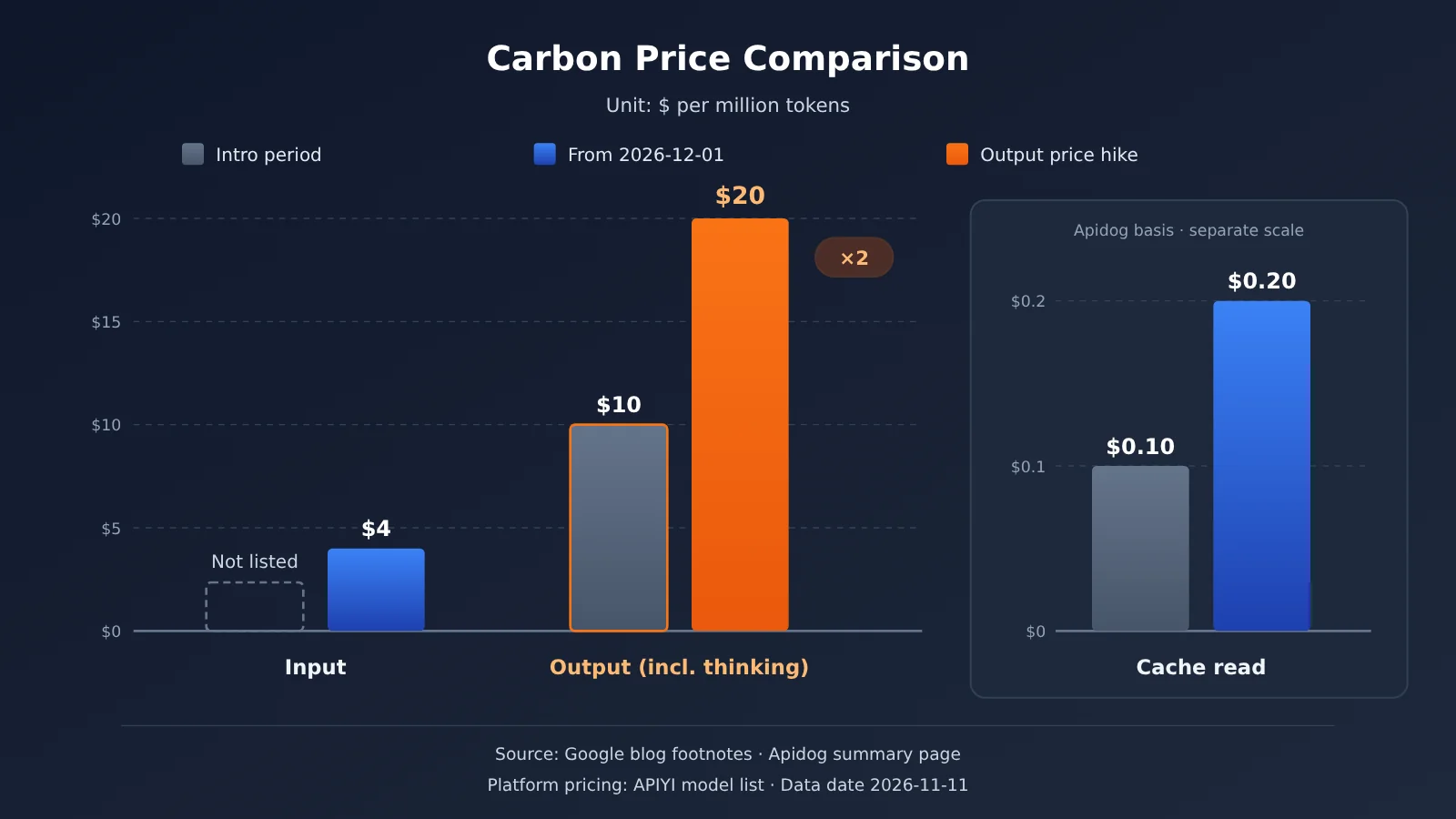
Putting the numbers from all three sources into one table makes it easier to see how introductory pricing, the official pricing from December 1, and the platform’s current rates relate to each other. Anything the sources don’t give is marked “Not listed,” with no guesswork.
| Price item (per 1M tokens) | Google footnote · Intro period | Google footnote · From 2026-12-01 | Apidog · Intro period | Apidog · From 2026-12-01 | APIYI · 2026-11-11 |
|---|---|---|---|---|---|
| Input | Not listed | $4 | Not listed | Not listed in the source | $2 |
| Output (including thinking) | Not listed | $20 | $10 | $20 | $10 |
| Cache read | Not listed | Not listed | $0.10 | $0.20 | $0.1 |
Two things to note about the table. First, the cache read change from $0.10 → $0.20 appears only on the Apidog summary page; the Google footnote doesn’t mention it. Second, the APIYI (apiyi.com) data is dated 2026-11-11, when the introductory period hadn’t ended yet, so output is still listed at $10. Whether the platform adjusts its pricing after December 1, and how, will depend on the rates shown in its model overview at that time. This article makes no predictions.
How to Calculate the Cost of a Single Carbon Request
To see how counting thinking tokens as output affects your bill, let’s run the numbers with a hypothetical usage profile. Say a request has 100K input tokens, a 20K-token visible answer, and 30K tokens of thinking, plus 500K tokens served from cache. Following Apidog’s convention, thinking and the visible answer total 50K tokens, all billed at the output rate.
| Billing item | Usage (hypothetical) | APIYI rate · 2026-11-11 | Official · From 2026-12-01 |
|---|---|---|---|
| Input | 0.1M | 0.1 × $2 = $0.20 | 0.1 × $4 = $0.40 |
| Output (20K answer + 30K thinking) | 0.05M | 0.05 × $10 = $0.50 | 0.05 × $20 = $1.00 |
| Cache read | 0.5M | 0.5 × $0.1 = $0.05 | 0.5 × $0.20 = $0.10 (Apidog’s figure) |
| Total | — | $0.75 | $1.50 |
In this example, thinking tokens make up 60% of the output. If you mistakenly treat thinking as input when estimating, you’d underestimate the output cost after December 1 by more than half. So for thinking-heavy workloads, which column the thinking tokens land in matters more to your bill than how much the input price went up.
Impact Analysis: What the $20 Carbon Output Price Means for You
Impact on Thinking-Heavy Tasks
Tasks that need multi-step reasoning, such as code fixing, long-document analysis, and multi-turn planning, often generate more thinking tokens than visible answer tokens. Under Apidog’s accounting, all of those tokens are billed at the output price. After December 1, the unit price doubles, so your total cost will be very sensitive to how long the model thinks.
During the introductory period, start by measuring the ratio of thinking tokens to visible output in your existing calls. For workloads where that ratio is high, prioritize evaluating whether you should cap thinking length, split tasks up, or route simple requests to a lighter model.
Impact on Budgeting and Monitoring
A lot of teams use a budget template with just two lines: “input price × input volume + output price × output volume.” If your output volume only counts the visible answer, the thinking portion slips through the cracks. Once the output price goes to $20 after December 1, that gap gets much bigger.
On the monitoring side, I’d suggest tracking thinking tokens as their own metric, then combining them with output for billing. That way, before and after the price change, you can see exactly where cost changes are coming from. If you use caching, make sure to include the cache read adjustment (from $0.10 to $0.20) in your calculations too.
Steps to Verify Carbon on APIYI
If you call Carbon through APIYI, you can run through the checks below before December 1. No changes to your code structure are needed:
- Check the model ID: In the model directory, confirm the ID is
gemini-4-carbon. Don’t write it with spaces or capital letters. - Configure the endpoint: For an OpenAI-compatible client, set base_url to
https://api.apiyi.com/v1and set the model parameter togemini-4-carbon. - Check the pricing: Use the
/modelspage on docs.apiyi.com as your source of truth. Record the 2026-11-11 prices (input $2, output $10, cache read $0.1), then check again after December 1. - Review usage: In your usage details, check whether output tokens include the thinking portion. This validates the assumptions in your budget template.
🚀 Quick verification tip: There are less than 3 weeks left in the introductory period. Try running a few typical requests using the free test credits for new users on APIYI (apiyi.com), record what share of output is thinking tokens, then plug those numbers into the cost table above to estimate your bill after December 1.
If you run into errors while calling the API, work through the checklist below first. Most issues have nothing to do with the price change:
401: Your API key is missing or no longer valid. Get a new one from the console.404: Usually a typo in the model ID, or the path is missing/v1. Comparegemini-4-carbonandhttps://api.apiyi.com/v1against the model directory.429: You’re sending requests too frequently. Lower your concurrency or add retry with backoff.- Bill doesn’t match your estimate: First confirm whether output tokens already include thinking, then check whether you missed cache reads.
Carbon Thinking Billing FAQ
Q1: Are Carbon’s thinking tokens billed as input or output?
They’re billed as output, going by the Apidog summary page, whose output column is literally titled “Output incl. thinking.” The footnote in Google’s blog post only lists $4 for input and $20 for output, and doesn’t mention “thinking” explicitly. Counting thinking tokens as output is the safe choice when you budget, but keep in mind that the direct source for this claim is a third-party summary.
Q2: What’s Carbon’s output price after December 1?
According to the footnote in Google’s blog post, the introductory period ends on 2026-11-30. After that, output costs $20 / 1M tokens and input costs $4 / 1M tokens for the public-facing Carbon model. The Apidog summary page says the same thing: output is $20 starting December 1, versus $10 during the introductory period.
Q3: Has Carbon on APIYI gone up to $20 yet?
No. As of 2026-11-11, the APIYI (apiyi.com) master model table lists `gemini-4-carbon` at $2 for input, $10 for output, and $0.1 for cache reads. Whether the platform will follow the price change is up to its own pricing page, so we recommend checking the `/models` page on docs.apiyi.com again after December 1.
Q4: Will the cache read price change?
The Apidog summary page lists $0.10 during the introductory period and $0.20 afterward. Google’s blog footnote doesn’t list a cache read price, so for now this figure only comes from a third party. If your workload relies heavily on long-context caching, budget conservatively at $0.20.
Q5: How can I quickly check what share of my workload is thinking tokens?
Run a small batch of typical requests, then compare the length of the visible answers against the billed output tokens in your usage details. The difference is basically your thinking portion. You can run this test through APIYI (apiyi.com) with a single API key. The endpoint is OpenAI-compatible, and you just set the model parameter to `gemini-4-carbon`.
Carbon Output Price Change: Key Takeaways
- Deadline: Carbon’s introductory pricing runs through 2026-11-30. New rates apply starting December 1.
- Official new pricing: Google’s footnote says $4 for input and $20 for output after that date, per 1M tokens.
- Thinking tokens: The “thinking counts as output” wording comes from an Apidog column header. Google’s footnote doesn’t state it separately.
- Cache reads: Third-party summaries list a rise from $0.10 to $0.20, but the official footnote doesn’t mention this item.
- Cost sensitivity: The more of your usage is thinking tokens, the more the doubled output price will show up on your bill.
- Current platform pricing: As of 2026-11-11, APIYI (apiyi.com) still lists output at $10. Check the price list to see whether it follows the increase.
Summary
On Carbon billing thinking at the output rate, with output going to $20 from December 1, there are three points to take away:
- Price change: Output is $10 during the introductory period. From 2026-12-01, output is $20 and input is $4, based on Google’s blog footnote and Apidog’s summary page.
- How thinking is billed: Counting thinking as output is stated explicitly in the third-party summary. The official footnote only gives the two rates, input and output.
- Platform status: As of 2026-11-11, the platform’s price list still shows $2 input, $10 output, and $0.1 cache read. There’s been no increase.
We recommend using the rest of the introductory period to measure what share of your tokens are thinking tokens, update your budget template, and recheck the price list after December 1. The officially recommended approach is to run a few typical requests through APIYI (apiyi.com) with the same API key and use real usage numbers instead of estimates.
📚 References
- Google Blog: Gemini 4 Carbon Availability Announcement: Official footnote on the introductory pricing deadline and post-intro pricing
- Link:
blog.google/innovation-and-ai/models-and-research/gemini-models/gemini-4-carbon-now-available -
Notes: Published 2026-11-10. The footnote says introductory pricing runs through 2026-11-30, after which input is $4 and output is $20
-
Apidog: Gemini 4 Carbon Pricing Roundup: Third-party pricing summary page
- Link:
apidog.com/blog/gemini-4-carbon-pricing -
Notes: Verified on 2026-11-11. The output column is labeled “Output incl. thinking”, and cache read pricing is listed
-
APIYI Model Master List: Platform model IDs and pricing
- Link:
docs.apiyi.com/models - Notes: Data as of 2026-11-11.
gemini-4-carbonis $2 for input, $10 for output, and $0.1 for cache reads
Author: APIYI Technical Team
Technical discussion: Feel free to reach out to us on the APIYI website homepage. For more resources, visit the docs.apiyi.com documentation center