
Author’s note: Based on the OpenAI Images 2.6 safety system card, this article explores the challenges of moderating animated images over time, what the 77.66% recall rate means, and how developers can handle moderation blocks.
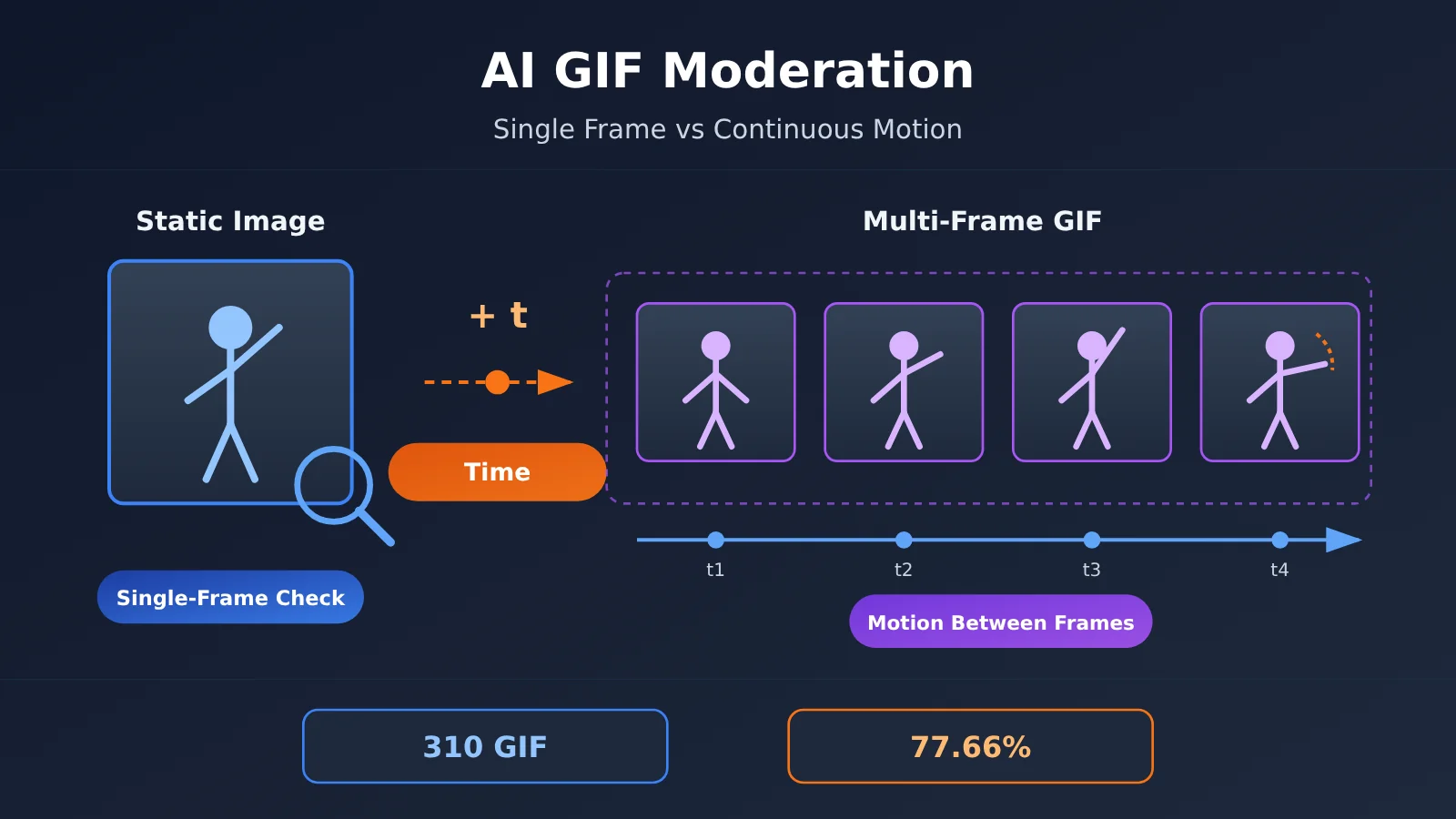
On November 4, 2026, OpenAI released a safety system card alongside Images 2.6, disclosing test results specifically for animated images: across 310 GIF samples labeled as violations, the moderation system had a recall rate of 77.66%. That number is easy to misinterpret: it’s neither the violation rate in production nor the moderation system’s overall accuracy.
This isn’t an attempt to sensationalize the risks. This article draws on the official system card and API documentation, and clearly distinguishes official facts, test results, and our technical analysis.
What you’ll learn: In 3 minutes, understand why AI-generated animated images are harder to moderate, how to interpret the numbers, and what developers need to adjust.
AI Animated Image Moderation at a Glance
| Item | Official disclosure | What to keep in mind |
|---|---|---|
| Release date | Released alongside Images 2.6 on November 4, 2026 | Information is current as of November 5, 2026 |
| New risk | Some violations become apparent through continuous action and relationships between frames | The system card discusses this separately from static image evaluation |
| New safeguard | Jointly moderates an animation frame grid and generation caption | The specific algorithm and frame-sampling method haven’t been disclosed |
| GIF test | 310 GIF samples labeled as violations, with 77.66% recall | A targeted sample that doesn’t represent the distribution of ordinary user content |
| Static image test | 3,077 adversarial requests | An offline evaluation with a different scope from the GIF test |
Why AI Animations Are Harder to Moderate Than Static Images
In section 3.2.2 of its system card, OpenAI notes that some policy-violating meanings emerge through motion rather than in any single frame. Relationships between frames and the way an element moves can change the meaning of the content. As a result, analyzing static frames in isolation may not be enough to assess an animation’s risks. One risk category OpenAI identifies is sexually suggestive motion.
Here’s a neutral example we made up to illustrate the point; it isn’t an official example. An image of a raised arm gives us limited information. From that frame alone, it’s hard to tell whether the person is waving hello or preparing to strike. A more reliable judgment requires seeing whether the arm moves from side to side in subsequent frames or swings quickly toward another person. A single frame answers “What’s in the picture?” A sequence of frames also has to answer “What’s happening?”
From this, we can identify three additional considerations for animation moderation. This is our technical analysis, not a description of algorithm details disclosed by OpenAI:
- Time sequence: The same frames arranged in a different order may show an entirely different event.
- Motion relationships: Whether people or objects are approaching, touching, or moving apart often becomes clear only across frames.
- Overall meaning: Even if no individual frame violates policy, the animation may still violate it when played as a sequence.
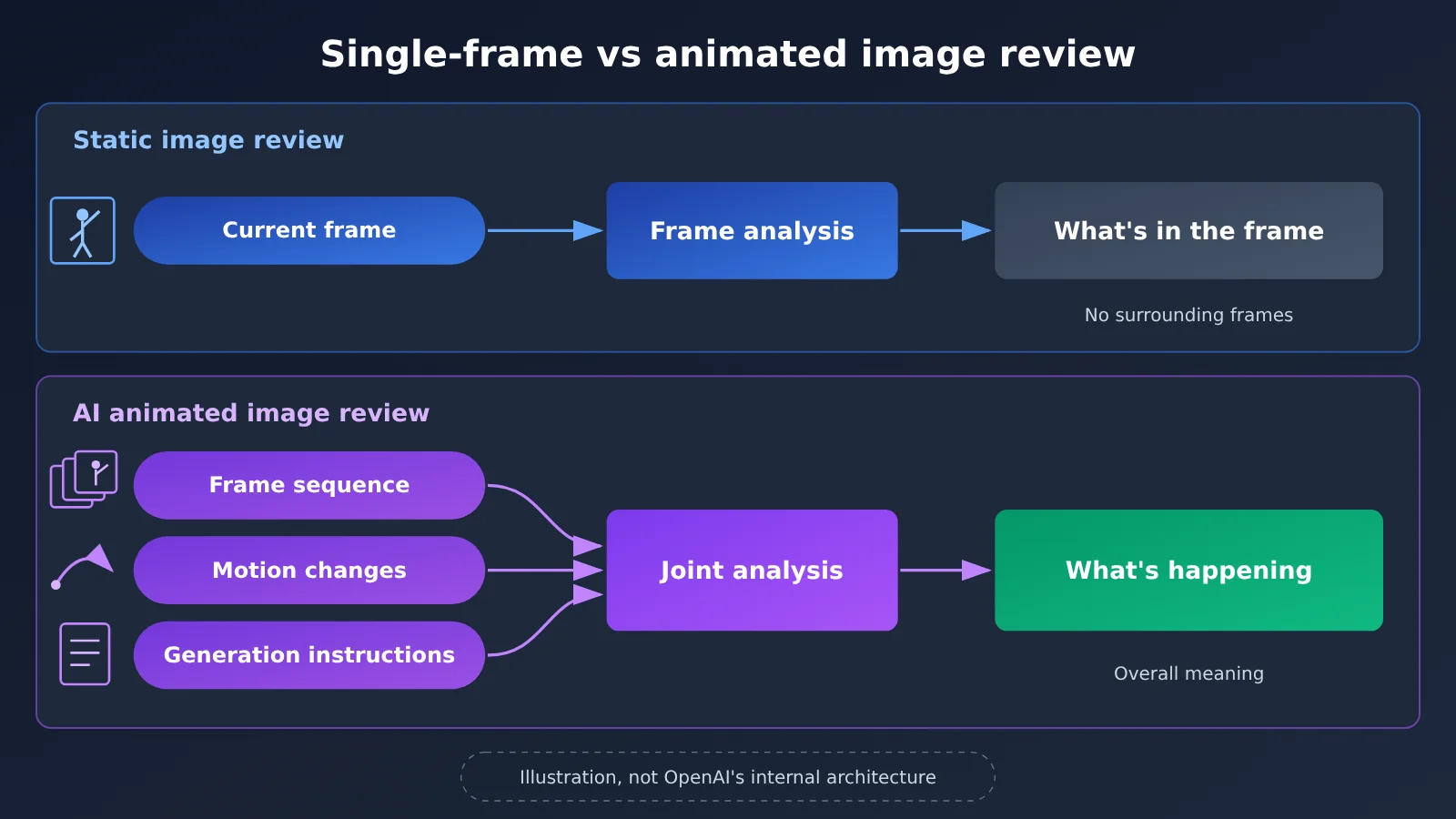
AI Animation Moderation vs. Static Image Moderation
| Comparison | Static image moderation | AI animation moderation |
|---|---|---|
| What’s assessed | Visual content of a single frame | The full set of frames and their overall meaning |
| Key information | Objects, scenes, text, and so on | Also includes motion, sequence, and relationships between frames |
| New official measures | Existing multilayer safety checks | Joint review of a frame grid and generation description |
| Blocking strategy | Judged under existing policies | Broader blocking scope for some categories |
| Gaps in public data | Evaluation with 3,077 adversarial requests | No false-positive rates, latency figures, or independent third-party retesting |
API parameters also illustrate the complexity. According to the official documentation, GIF output supports 2 to 64 frames, with a default of 9; each frame can last from 20 to 2000 milliseconds, with a default of 200 milliseconds. We think that more frames increase the need to balance detail and cost during moderation, while playback speed may also affect how the content is perceived. However, OpenAI hasn’t disclosed whether it analyzes every frame individually or how frame duration factors into its judgments.
How OpenAI Moderates AI-Generated GIFs: Multiple Layers and Frame Grids
According to Section 3.1 of the system card, the Images 2.6 safety system for static images has three layers of checks. GIF safeguards add another mechanism on top.
- Pre-generation request screening: A language-model-based policy check evaluates the user’s request. Noncompliant requests may be rejected before generation begins.
- Input screening: A multimodal safety reasoning model checks the prompt and input images, and assesses whether an editing request has a policy-violating intent.
- Output screening: Generated results are reviewed, and content deemed noncompliant is blocked before it’s shown to the user.
For GIFs, OpenAI says its safety reasoning model examines the full set of animation frames alongside the generation instructions, taking changes in motion over time into account. Some content categories also have broader blocking criteria than those used for static images, to cover risks inferred from the motion. This means moderation has expanded from isolated frames to the overall meaning of the animation.
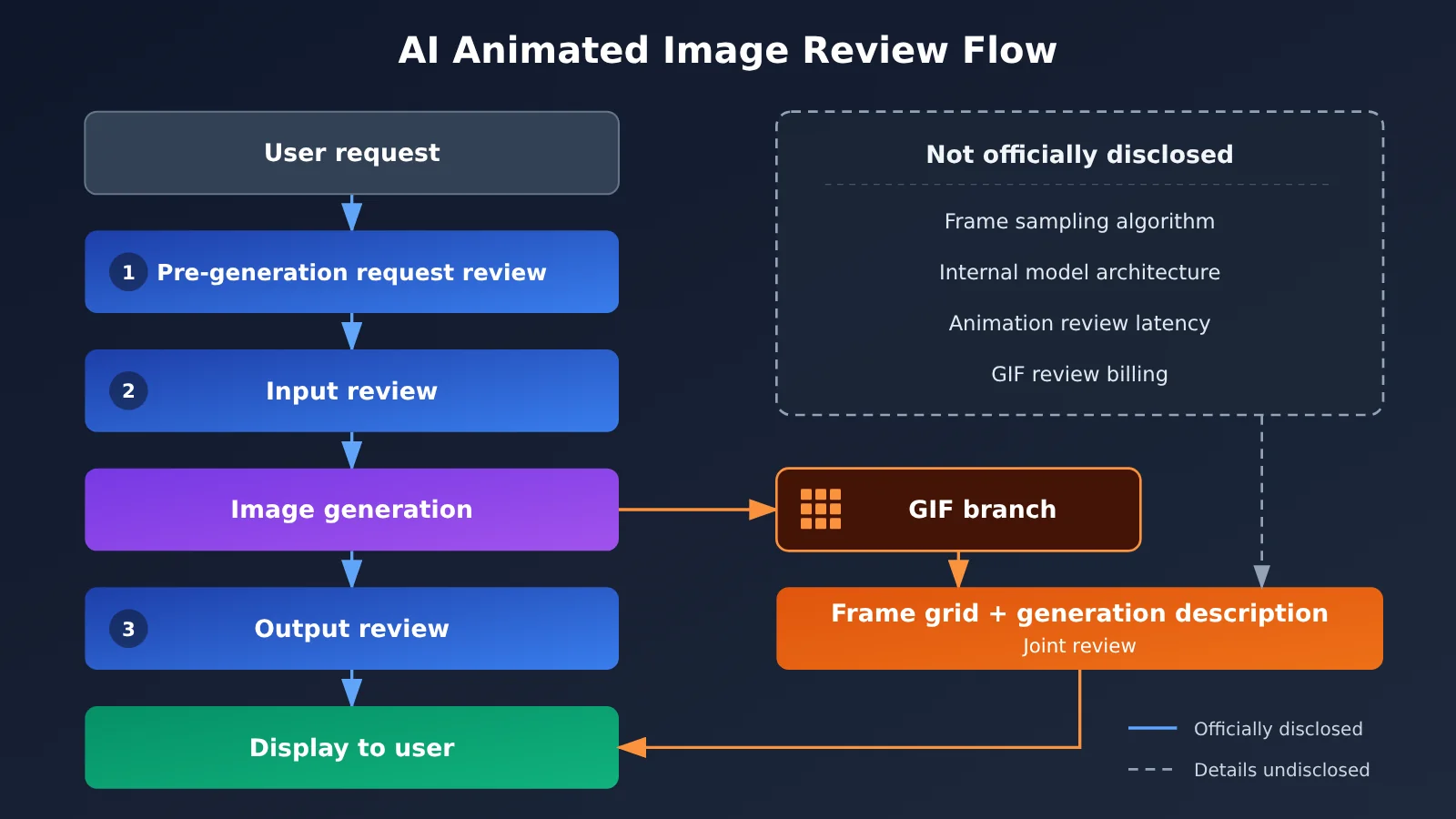
What’s not publicly disclosed is also worth noting: the frame-sampling algorithm, internal model architecture, latency introduced by animation moderation, and any separate pricing for GIF moderation. If you’d like to see how moderation blocks behave in your own application, you can use the unified interface from APIYI at apiyi.com to test your error-handling flow first, then verify each case against the actual model.
How to Understand the 77.66% Recall Rate for AI GIF Moderation
The test examined 310 GIFs labeled as policy violations, reviewing both their generation descriptions and grids of animation frames. Recall answers the question: What proportion of these known violations did the moderation system detect? OpenAI also acknowledged that motion-based violations remain difficult to detect and that existing safeguards may miss some violating content.
| Interpretation | Valid? | Why |
|---|---|---|
| The percentage of known violations detected | ✅ Yes | That’s what recall measures in this test |
| The moderation system’s overall accuracy | ❌ No | The test covered only violating samples |
| The pass rate for compliant content | ❌ No | The sample included no compliant content for calculating that metric |
| 22.34% is the probability of encountering a violating GIF online | ❌ No | The samples were deliberately selected and don’t represent the real-world distribution |
| The result tells us about false positives | ❌ No | The test didn’t provide a false-positive rate or a complete precision measure |
So, 77.66% is best viewed as a reference point for how well the system detects difficult samples, not as an overall assessment of online safety. Its value is that OpenAI published a test result that can be discussed, while also revealing that motion-based risks haven’t been fully addressed.
What 3,077 Adversarial Tests Reveal About Layers of AI Image Moderation
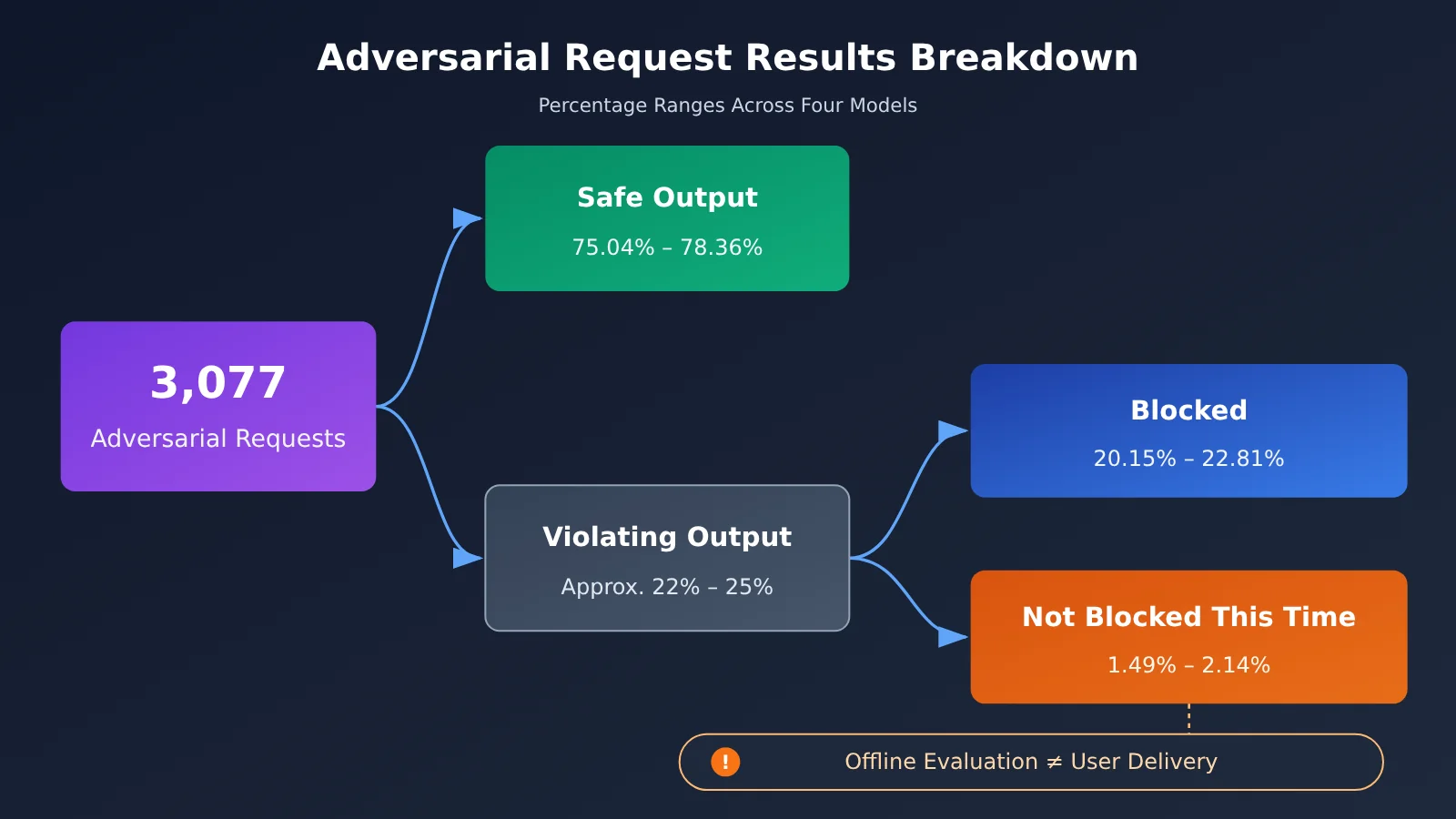
The system card also evaluated static image safety using 3,077 specially designed challenging requests. These aren’t GIF test results, but they clearly show that “model safety,” “moderation interception,” and “violations not intercepted” are three distinct metrics.
| Model (static image evaluation) | Safe generation | Violating generation, intercepted | Violating generation, not intercepted in this evaluation |
|---|---|---|---|
| GPT-Image-2.5 Sunburst | 76.15% | 21.94% | 1.92% |
| GPT-Image-2.6 Sunburst | 75.50% | 22.78% | 1.72% |
| GPT-Image-2.5 Flare | 78.36% | 20.15% | 1.49% |
| GPT-Image-2.6 Flare | 75.04% | 22.81% | 2.14% |
These figures don’t support a simple conclusion that “the newer version is safer across the board” or “the newer version is more dangerous.” According to the official explanation, the changes in the overall unintercepted rates for both Sunburst and Flare weren’t statistically significant. However, Flare’s safe generation rate fell from 78.36% to 75.04%, a statistically significant change.
“Not intercepted in this evaluation” is also an offline evaluation result; it doesn’t mean violating content was actually delivered to users. In addition, the 77.66% figure comes from a different sample and mechanism than this static image evaluation, so it shouldn’t be directly compared to determine “how much worse GIFs are than images.”
How AI Animation Moderation Affects Developers and Content Platforms
For API Developers: Treat Moderation Blocks as a Normal Application State
The OpenAI Images API supports two values for the moderation parameter: auto and low. The low setting applies fewer filtering restrictions, but it doesn’t turn off the safety system. When a request is blocked, it may return error.code = "moderation_blocked". Some errors also include the moderation stage and a broad category, but these fields aren’t guaranteed to appear every time.
| Field or action | Official guidance | Implementation recommendation |
|---|---|---|
error.code |
May be moderation_blocked |
Use as the primary condition for handling the error |
moderation_stage |
May be input, output, or unknown |
Record in logs for customer support and troubleshooting |
categories |
Broad categories such as sexual and violence |
Handle when present; don’t treat as a required field |
| User message | Be clear without revealing too much about internal rules | Guide the user to revise their description |
| Retry strategy | Don’t automatically retry moderation errors that require the user to revise their input | Let the user revise and resubmit |
The minimal example below shows how to catch a moderation block. Replace the model name with one you have access to:
import openai

client = openai.OpenAI(
    api_key="YOUR_API_KEY",
    base_url="https://api.apiyi.com/v1"
)

try:
    result = client.images.generate(model="YOUR_IMAGE_MODEL", prompt="一只挥手的卡通吉祥物")
except openai.APIStatusError as e:
    if e.code == "moderation_blocked":
        print("内容未通过审核,请修改描述后重新提交")
    else:
        raise
View the complete GIF generation and moderation logging example
import base64
import logging
import openai

client = openai.OpenAI(
    api_key="YOUR_API_KEY",
    base_url="https://api.apiyi.com/v1"
)

def generate_gif(prompt: str, model: str = "YOUR_IMAGE_MODEL") -> str | None:
    try:
        result = client.images.generate(
            model=model,
            prompt=prompt,
            extra_body={
                "output_format": "gif",
                "frame_count": 9,
                "frame_duration_ms": 200,
            },
        )
    except openai.APIStatusError as e:
        if e.code != "moderation_blocked":
            raise
        # Detail fields aren't guaranteed to be returned, so handle missing fields
        body = e.body if isinstance(e.body, dict) else {}
        details = body.get("moderation_details") or {}
        logging.warning(
            "moderation_blocked stage=%s categories=%s",
            details.get("moderation_stage"),
            details.get("categories"),
        )
        # Don't retry automatically; let the user revise the description
        return None

    with open("output.gif", "wb") as f:
        f.write(base64.b64decode(result.data[0].b64_json))
    return "output.gif"
The GIF parameters above come from OpenAI’s official documentation. GIF output is a feature of `images/generations`; the `images/edits` endpoint doesn’t support direct GIF output.
Tip: Start by using the stable
error.codeto handle errors, then add logging and user-facing messages. You can get free test credits from APIYI at apiyi.com to verify the integration flow. Check the platform’s latest model list and documentation for specific model and GIF parameter support.
For content platforms: Plan for both false positives and false negatives
OpenAI hasn’t published a false-positive rate for GIF moderation. However, some categories use broader blocking criteria, so platforms should consider the possibility that legitimate creative work may be blocked and provide clear notifications and an appeals process. OpenAI also acknowledges that some content may slip through, so platforms that let users post and share GIFs shouldn’t rely on upstream moderation as their only line of defense.
These are our practical recommendations, not official requirements:
- Review before publication: Maintain your own platform policy checks and a way for users to report publicly shared content.
- Review the full animation: Whether reviewing content manually or automatically, don’t just look at the cover frame. Consider the complete animation.
- Track separately: Count “requests blocked” and “posts reported after publication” separately so you can identify where problems occur.
For provenance: Watermarks can’t replace content moderation
The system card describes a layered approach to provenance, including continued support for C2PA metadata and the introduction of Google DeepMind’s SynthID invisible watermark. C2PA primarily records provenance information, while SynthID embeds an invisible signal in the media itself. But that doesn’t mean every exported GIF will necessarily have a verifiable watermark, or that the watermark will survive compression or transcoding.
Likewise, failing to detect a watermark doesn’t prove that content wasn’t AI-generated. OpenAI also acknowledges that no single, complete provenance solution exists. Provenance markers answer “Where might this have come from?” while moderation answers “Can this be generated or shared?” The two should complement each other.
AI GIF Moderation FAQ
Q1: Does 77.66% mean that 22.34% of violating GIFs were delivered to users?
No. The 77.66% figure is the test recall rate on 310 GIFs labeled as violations. The samples were selected for the test, so they don’t reflect the distribution of content in production or the probability that violating content reaches users.
Q2: Can AI GIF moderation simply use a static image classifier to check each frame?
Frame-by-frame checks can catch some violations visible in a single frame, but they struggle to capture meaning that emerges only through a sequence of actions. That’s why GIF moderation isn’t as simple as feeding each frame into a static classifier. OpenAI combines frame grids and generated descriptions for joint moderation, but hasn’t disclosed the specific algorithm.
Q3: Is there independent retest data specifically for GIF moderation?
As of November 5, 2026, the sources available for this article include no reliable, publicly available independent third-party retest. Public data is also lacking on performance across animation lengths, false positive rates, real-world latency, and detection rates for specific types of violating actions.
Q4: Can setting moderation to low turn off AI GIF moderation?
No. `low` is a less restrictive filtering mode; it doesn’t turn off the safety system or bypass content policies. For production, start with the default `auto` setting and assess whether adjustments are needed for your use case.
Q5: What should I do after receiving moderation_blocked?
Stop automatic retries, give the user clear guidance on what to change, and log the available moderation stage and category. To quickly test this error-handling flow, you can register at APIYI apiyi.com and get a test credit. Then replace the model name in the example in this article with a model currently available on the platform and run it.
Q6: How can I compare moderation across different image models?
Prepare a set of policy-compliant test prompts that reflect your use case and have clear boundaries, then record the generation results, blocks, and error fields for each model. The unified interface at APIYI apiyi.com can reduce code changes when switching models, but the results apply only to your samples and shouldn’t be generalized into conclusions about a model’s overall safety.
Key Takeaways on AI GIF Moderation
- Core challenge: Policy-violating meaning can emerge from the action itself and the relationships between frames.
- OpenAI’s approach: In addition to layered moderation, it reviews frame grids alongside generation instructions.
- Key figure: 77.66% is the recall rate on a sample of 310 policy-violating GIFs.
- Common misreading: That figure is not the violation rate in production, overall accuracy, or the pass rate for compliant content.
- Evaluation approach: Assess the model’s own safety, moderation blocks, and the final content that gets through separately.
- Data gaps: Reliable public data on GIF false-positive rates, moderation latency, and independent retesting is still lacking.
- Practical next step: Handle blocks using
error.code, and verify the API workflow through APIYI at apiyi.com.
Summary
AI GIFs don’t just add another dimension to generation—they also add a time dimension to content safety. Moderation systems need to look beyond “what’s in the image” and assess “what these frames express together.”
OpenAI’s joint review of frame grids and generation instructions, along with its test results on 310 GIF samples, reflects this approach. The results also show that action-related risks haven’t been fully resolved. Without false-positive rates or independent retesting, developers and platforms should pay close attention to the scope of the tests and plan how to handle blocks, false positives, and missed violations.
If you’re integrating image generation into a product, you can use the free credits at APIYI, apiyi.com, to verify API calls and error handling first. Then check the platform documentation to confirm which models and parameters are supported.
📚 References
- OpenAI: ChatGPT Images 2.6 System Card: The primary source for information on layered moderation and GIF risks
- Link:
deploymentsafety.openai.com/chatgpt-images-2-6 -
Notes: See sections 3.1, 3.2.1, 3.2.2, and 4
-
OpenAI: System Card PDF: The source of the test data for 310 GIF samples
- Link:
deploymentsafety.openai.com/chatgpt-images-2-6/chatgpt-images-2-6.pdf -
Notes: Useful for checking the evaluation figures and test scope cited in this article
-
OpenAI API: Image generation documentation: Developer interface documentation
- Link:
developers.openai.com/api/docs/guides/image-generation -
Notes: Covers GIF parameters, the
moderationparameter, and recommendations for handling moderation errors -
OpenAI: Introducing Images 2.6: The official launch announcement
- Link:
openai.com/index/introducing-images-2-6 - Notes: Provides background on the GIF feature’s release and product scope
Author: APIYI Technical Team
Technical discussions: Contact us through the APIYI homepage at apiyi.com. For more resources, visit the documentation center at docs.apiyi.com.