

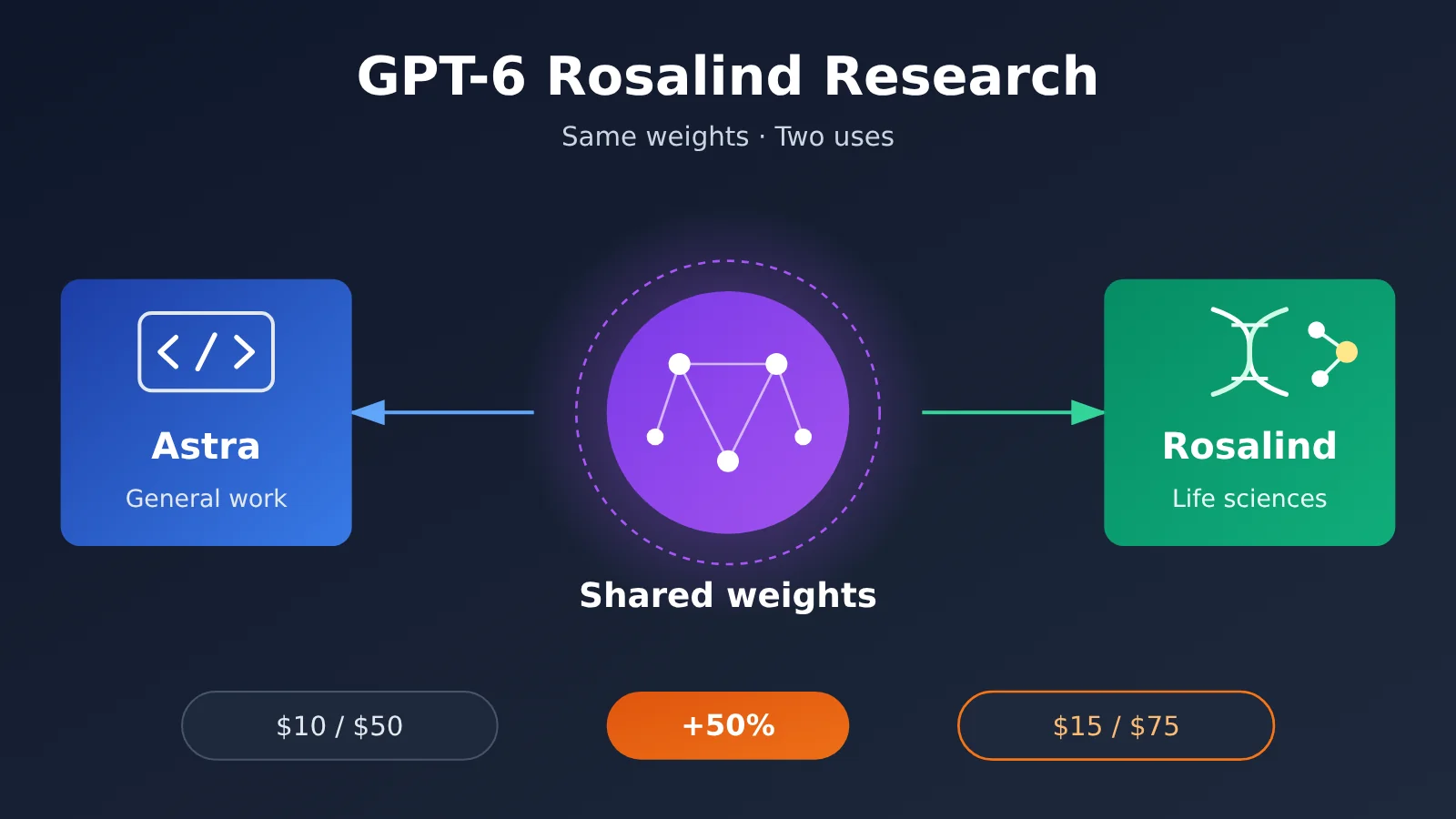
Author’s note: GPT-6 Rosalind Research and GPT-6 Astra use the same model weights. This article looks at why it’s still being released as a life-sciences-specific version, along with its evaluations, pricing, and access restrictions.
OpenAI officially released GPT-6 Rosalind Research on October 30, 2026. What’s drawing attention is that it uses the same model weights as GPT-6 Astra, yet its standard API rates are 50% higher. Here’s a quick look at what this means for life sciences researchers and AI developers.
This isn’t a rumor: OpenAI’s model release notes, API changelog, and GPT-Rosalind-6 system card have all confirmed it. The Rosalind series originally launched in April 2026; this release is its GPT-6 version.
The takeaway: In three minutes, you’ll understand the key facts about GPT-6 Rosalind Research, what “same weights” really means, who can use it, and which conclusions we can’t yet draw.
GPT-6 Rosalind Research at a Glance
| Item | Details |
|---|---|
| Release date | October 30, 2026 |
| Released by | OpenAI |
| API model ID | gpt-6-rosalind |
| Technical foundation | Same weights as GPT-6 Astra, with no new training data or additional post-training |
| Research areas | Medicinal chemistry, genomics, bioinformatics, protein and sequence analysis, and more |
| Available through | ChatGPT Work, Codex, OpenAI API |
| Eligible users | Organizations and individuals already qualified for Rosalind Research and authorized to use the GPT-6 version |
| API restrictions | Limited to internal research applications at approved organizations; commercial applications serving external customers aren’t currently supported |
This release isn’t aimed at general consumers. ChatGPT Plus or Pro subscribers don’t automatically get access, and the model can’t be selected in the regular ChatGPT Chat tab. In Enterprise workspaces, it begins with a two-week administrator preview. It’s off by default, and administrators must enable it for approved users.
What It Means That GPT-6 Rosalind and Astra Share the Same Weights
The system card explicitly states that GPT-Rosalind-6 and GPT-6 Astra use the same model weights. The release introduced no new specialized training data and involved no additional post-training. So it wouldn’t be accurate to describe Rosalind as “a separate GPT-6 retrained on a vast collection of biology papers.”
To understand the distinction, it helps to break an AI product into three layers. Model weights provide the parameter foundation. Product configuration and tools determine how the model connects to databases, specialized software, and workflows. Safety and access policies determine who can use which capabilities and under what conditions.
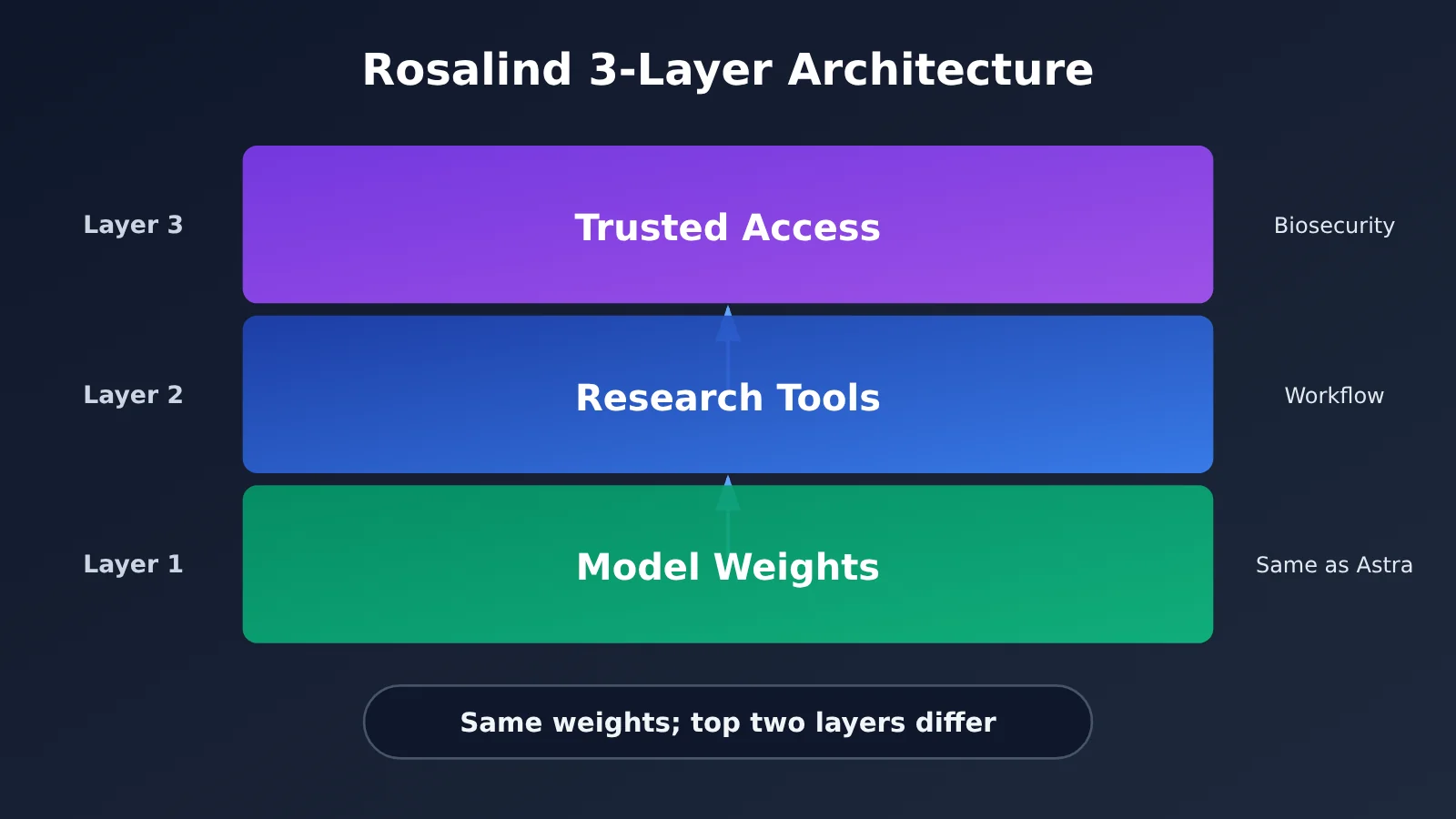
| Comparison | GPT-6 Astra | GPT-6 Rosalind Research |
|---|---|---|
| Model foundation | Same weights | Same weights |
| Product focus | General-purpose frontier reasoning, coding, research, and complex professional work | Specialized deployment and task environment for life sciences research |
| Access | Available under general product and API service rules | Requires additional trusted-access and research eligibility reviews |
| Standard pricing (per million tokens) | $10 input, $50 output | $15 input, $75 output |
Sharing weights doesn’t mean the two will produce identical outputs on every task. System-level safety rules, access environments, tool configurations, and operating conditions can all affect the experience. On the other hand, there isn’t enough independent testing under equivalent conditions to show that Rosalind is necessarily better than Astra when using the same prompts and tools.
Why Life Sciences Need a Dedicated GPT-6 Rosalind Model
In its April launch materials for Rosalind, OpenAI noted that developing a new drug in the United States takes an average of roughly 10 to 15 years, from target discovery to regulatory approval. That’s industry context, not a claim that Rosalind has reduced the timeline to any specific number of years.
Life sciences research differs from ordinary text-based question answering in several ways:
- Knowledge is scattered: Evidence is spread across papers, preprints, compound libraries, gene databases, protein structure databases, and internal lab records, all with different formats and levels of reliability.
- Workflows are long: Target research involves reading literature, studying genetic associations, analyzing protein function, searching for inhibitors, and designing validation experiments. A single answer can’t complete the process.
- Data is complex: Gene sequences, RNA sequencing data, experimental images, and large matrices often require specialized software and database tools.
- Conclusions need verification: Researchers need to ask which papers support a conclusion, what data was used, whether the parameters were correct, and whether predictions were confused with measured values.
- Mistakes are costly: A wrong assumption can consume substantial lab time, reagents, and personnel resources. In clinical or biosafety settings, the consequences can be even more serious.
Life sciences also face a classic dual-use dilemma. The same knowledge can advance drug development and public health, but it can also be misused. A general-purpose model that refuses too many requests can hinder legitimate research, while unrestricted access can increase risk. Rosalind-6 therefore allows vetted professional researchers to work on some legitimate research questions that may be restricted under general Astra access, while retaining refusals and system-level restrictions for uses such as serious biological weaponization.
GPT-6 Rosalind Research: Three Benchmark Results
OpenAI compared GPT-Rosalind-6 and GPT-Rosalind-5.5 using the same benchmark versions and question sets, with each model tested at its highest reasoning budget. That makes the comparison more useful than piecing together older results from different versions. Still, these are benchmarks reported by OpenAI itself, not an independent, long-term study in a pharmaceutical production environment.
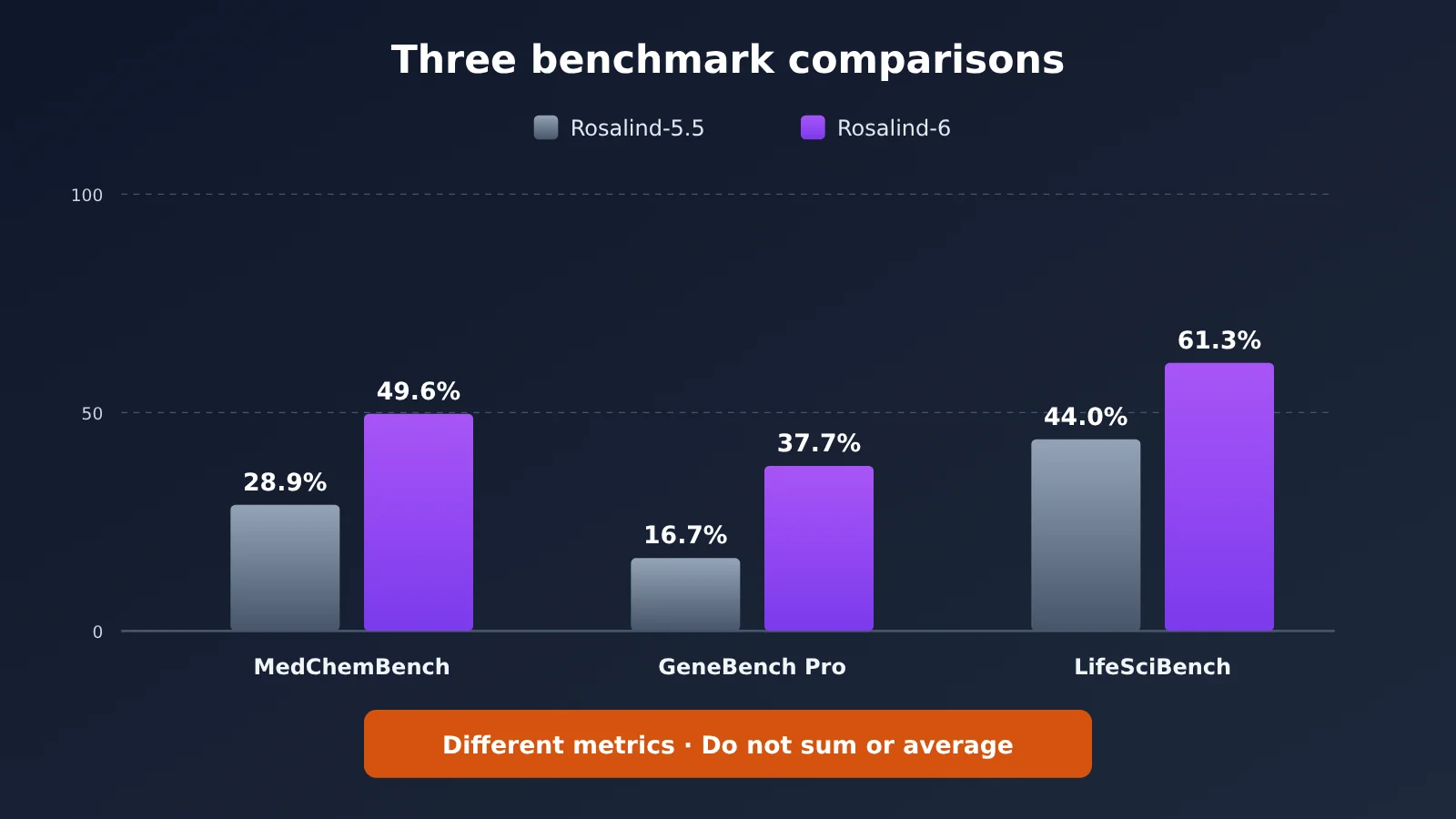
| Benchmark | What it measures | Questions | Rosalind-5.5 | Rosalind-6 | Score type |
|---|---|---|---|---|---|
| MedChemBench v7 | Medicinal chemistry reasoning | 99 | 28.9% | 49.6% | Average rubric score |
| GeneBench Pro v13 | Genomics and quantitative biological analysis | 129 | 16.7% | 37.7% | Estimated single-attempt success rate |
| LifeSciBench Gold | Integrated applied research tasks | 94 | 44.0% | 61.3% | Average task score |
The scores improved by 20.7, 21.0, and 17.3 percentage points, respectively, showing clear progress on these benchmarks. However, the three metrics measure different things, so they can’t simply be averaged. GeneBench also used a specialized configuration that differs from a standard production setup, so 37.7% shouldn’t be treated as the actual model invocation success rate for typical users.
These numbers also shouldn’t be interpreted as success rates for drugs or experiments. The 49.6% score doesn’t mean that nearly half of candidate drugs will reach the market, and 61.3% doesn’t mean that 61.3% of experiments will succeed. Neither figure represents efficacy confirmed by clinical trials.
GPT-6 Rosalind Research Workflow
If you focus only on model scores, it’s easy to miss the software environment around Rosalind. The model API provides reasoning capabilities, research plugins connect tools and data, and Workbench provides a research workspace. The three work together, but they aren’t the same product. Work completed in Workbench shouldn’t be described as the result of a single API request.
- Life Sciences Research Plugin: Released in April 2026, it connects to more than 50 research tools and data sources. That number isn’t new to this release.
- Life Sciences NGS Analysis Plugin: Supports FASTQ quality checks, bulk RNA-seq analysis, and single-cell quality control and annotation. It also saves intermediate artifacts and analysis provenance.
- Rosalind Workbench: Integrates specialized tools, data viewers, and configurable workflows. Eligibility to use it can be separate from access to the Rosalind model.
For specific tasks, Rosalind can assist with literature evidence synthesis, genomic analysis, structure-activity relationship studies, protein sequence queries, experiment troubleshooting, and research code writing. OpenAI recommends keeping large raw sequencing datasets in local directories, databases, or approved storage, then using Codex tools for targeted analysis. Qualified personnel should still review model outputs before they’re used in experiments, papers, or major decisions.
Earlier Rosalind series examples illustrate potential applications, but none are independent tests of the GPT-6 version. For example, UCSF’s Zhao Lab used PubChem and NCBI tools to compile physicochemical parameters for 10 drugs and distinguish predicted values from measured ones more clearly. OpenAI has also disclosed a collaboration with Novo Nordisk, but the available information doesn’t establish how much faster drugs were approved.
GPT-6 Rosalind API Pricing and Access Requirements
The following are OpenAI’s standard prices as of October 31, 2026, in US dollars per million tokens. The estimated daily cost assumes 100 requests per day, each with 20,000 input tokens and 5,000 output tokens, without caching.
| Model | Model ID | Input | Cached input | Output | Estimated daily cost |
|---|---|---|---|---|---|
| GPT-6 Rosalind Research | gpt-6-rosalind |
$15.00 | $1.50 | $75.00 | $67.50 |
| GPT-6 Astra | gpt-6-astra |
$10.00 | $1.00 | $50.00 | $45.00 |
| Rosalind-5.5 Research | gpt-rosalind-research |
$5.00 | $0.50 | $25.00 | $22.50 |
| Rosalind Discovery | gpt-rosalind-discovery |
$5.00 | $0.50 | $25.00 | $22.50 |
GPT-6 Rosalind’s standard rates are three times those of Rosalind-5.5 Research and 1.5 times those of Astra. Its 30-minute cache write price is $18.75, and its 12-hour cache write price is $37.50. Eligible data residency endpoints may also incur a 10% regional processing fee. OpenAI hasn’t disclosed what makes up the premium, so we can’t attribute the 50% price difference to any single cost.
The bill alone doesn’t tell you whether it’s worth the price. A real-world decision also needs to account for task success rates, retries, tool calls, expert review, and the reproducibility of results.
For access, Rosalind uses a Trusted Access process that reviews research use cases, organizational governance, and access controls. Keep these limitations in mind:
- Access to Discovery doesn’t mean you can use Research.
- Passing some Rosalind reviews doesn’t guarantee API access to the GPT-6 version.
- The Rosalind Academic Plan is primarily for eligible US university labs. It offers up to 30 Business Standard seats for up to 12 months at $0 per seat per month, but it doesn’t include API access or credits.
GPT-6 Rosalind: Impact Analysis
What GPT-6 Rosalind Means for Developers
- A model ID isn’t access permission: Having the
gpt-6-rosalindID doesn’t authorize you to call it, and aggregation platforms can’t assume they’re allowed to resell access to every registered user. - Industry applications need system design: Tool integration, traceability, permissions, and human review are just as important as model selection.
- Choose models based on task risk: An expensive model may not be cost-effective for simple tasks. Measure the total cost of producing an acceptable result instead.
Developers who aren’t eligible for Rosalind can still use general-purpose models to test low-risk workflows, such as organizing research literature. But they shouldn’t assume those models have the same capabilities as Rosalind Research. That’s why the examples below use a general-purpose model rather than gpt-6-rosalind. Check the platform’s current model list for availability.
import openai

client = openai.OpenAI(
    api_key="YOUR_API_KEY",
    base_url="https://api.apiyi.com/v1"  # 使用 APIYI 统一接口
)

response = client.chat.completions.create(
    model="gpt-6-astra",
    messages=[{
        "role": "user",
        "content": "整理这段摘要的证据,并区分预测值与实验测量值:{abstract}"
    }]
)
print(response.choices[0].message.content)
View the full implementation
import openai

SYSTEM_PROMPT = """你是科研文献整理助手。
只依据用户提供的文本作答,不补充未给出的数据。
请分开列出:预测值、实验测量值、证据冲突、待人工核实事项。"""

def summarize_evidence(abstract: str, model: str = "gpt-6-astra") -> str:
    client = openai.OpenAI(
        api_key="YOUR_API_KEY",
        base_url="https://api.apiyi.com/v1"
    )
    try:
        response = client.chat.completions.create(
            model=model,
            messages=[
                {"role": "system", "content": SYSTEM_PROMPT},
                {"role": "user", "content": abstract}
            ],
            temperature=0
        )
        return response.choices[0].message.content
    except openai.OpenAIError as error:
        return f"调用失败:{error}"

print(summarize_evidence("在此粘贴公开论文摘要"))
Tip: If you’re just testing a literature organization workflow, you can get free testing credits through APIYI at apiyi.com and compare general-purpose model outputs using the same interface. If you’re working with sensitive or regulated data, check your organization’s compliance requirements first.
If your project doesn’t need Rosalind access yet, your team can use APIYI’s OpenAI-compatible interface at apiyi.com to establish traceability, output validation, and human review workflows. That way, you can keep the same engineering framework even if you later gain access to a specialized model.
GPT-6 Rosalind’s Impact on the Industry
- Specialization doesn’t necessarily mean retraining: Industry-specific models may differ first in their tool ecosystems, access permissions, and risk governance—not their parameters.
- Competition is shifting toward complete workflows: Anthropic launched Claude Science on June 30, 2026, while Google announced AI co-scientist in February 2025. These products take different approaches, so they can’t be ranked on a single score alone.
- Safety governance is becoming a product capability: OpenAI rated Rosalind-6’s biological and chemical capabilities as High, below Critical; its cybersecurity capabilities as Critical; and its AI self-improvement capabilities as below High. These are internal capability classifications and don’t imply that harmful incidents occurred.
In specific tests, three of Rosalind-6’s four High-level biological and chemical tests exceeded indicative thresholds after adjusting for refusals. None of the four Critical-level biological design evaluations reached the threshold. This supports stricter access controls, but it doesn’t mean the model is completely safe.
At the time of writing, the new version had been available for only about a day. There isn’t enough independent evidence yet to establish how many institutions are using it, how much time it saves, its accuracy in real pharmaceutical settings, how much it speeds up drug development, or how much more capable it is than Astra.
Frequently Asked Questions
Q1: What is GPT-6 Rosalind Research?
It’s a version of GPT-6 released by OpenAI for approved life sciences institutions and researchers. It supports tasks such as medicinal chemistry, genomics, and scientific literature synthesis, and is available through ChatGPT Work, Codex, and the API.
Q2: How do GPT-6 Rosalind and GPT-6 Astra differ?
They share the same weights. The main differences are in deployment focus, access review, safety mechanisms, and pricing. There isn’t enough evidence to conclude that Rosalind is consistently better than Astra under the same conditions.
Q3: Can ordinary developers access GPT-6 Rosalind through the API?
Not by default. The GPT-6 Rosalind API is restricted to internal research applications at approved institutions, and a paid account doesn’t automatically grant access. Developers can start by using APIYI apiyi.com to call publicly available general-purpose models and validate non-sensitive workflows.
Q4: How can I test scientific AI workflows if I’m not eligible for Rosalind?
Start with public sources and non-sensitive data to test literature summarization, evidence structuring, and coding assistance. After registering with APIYI apiyi.com, you can use the code in this article for a quick test, but qualified professionals should still review the results.
Q5: What are GPT-6 Rosalind Research’s known limitations?
Access is subject to strict review, the API can’t be used for commercial applications serving external customers, and standard per-unit pricing is relatively high. Official evaluations don’t equate to real-world R&D success rates. Literature citations, analysis results, and experimental plans all need to be verified by qualified professionals.
GPT-6 Rosalind Research: Key Takeaways
- Release: The October 30, 2026 launch introduced the GPT-6 version of the Rosalind series.
- Technical details: It shares the same weights as GPT-6 Astra, with no additional training for this release.
- Benchmark gains: It substantially outperformed Rosalind-5.5 across three benchmarks, but those results don’t represent R&D success rates.
- Pricing: Standard input costs $15 and output costs $75, both 1.5 times Astra’s rates.
- Access restrictions: Access requires a trusted-access review, and API use is limited to approved internal research.
- Evidence to date: Real-world scientific benefits still need to be demonstrated through long-term, independent data.
- Getting started: Teams that don’t qualify can use general-purpose models through APIYI apiyi.com to test non-sensitive workflows.
Summary
The key points about GPT-6 Rosalind Research are:
- Same weights, different systems: It shares its model foundation with Astra. The differences mainly lie in deployment, tools, access, and safety controls.
- Evidence of improvement, with clear limits: It made substantial gains across three benchmarks, but none measures success rates for new drugs or experiments.
- The value of a specialized version still needs validation: It remains unclear whether the higher price delivers better overall returns.
Returning to the original question, what life sciences need first may not be a new set of weights, but a research AI system that brings together frontier reasoning capabilities, scientific data, specialized tools, research governance, and safety boundaries. For most developers, a more practical step than chasing a restricted model is to establish data provenance and human review workflows first. APIYI apiyi.com offers a way to quickly test approaches using general-purpose models.
📚 References
- OpenAI Model Release Notes: GPT-6 Rosalind Research release details
- Link:
help.openai.com/en/articles/9624314-model-release-notes -
Notes: Verify the release date, access options, and administrator preview arrangements
-
GPT-Rosalind-6 System Card: Model weights, evaluations, and safety details
- Link:
deploymentsafety.openai.com/gpt-rosalind-6 -
Notes: The primary source for the technical facts and risk ratings in this article
-
GPT-Rosalind Access and Product Guide: Eligibility, products, and usage limits
- Link:
help.openai.com/en/articles/20001193-gpt-rosalind-for-life-sciences-research -
Notes: Useful for confirming Trusted Access and API usage boundaries
-
OpenAI API Pricing Page: Official standard model pricing
- Link:
developers.openai.com/api/docs/pricing -
Notes: Check the latest pricing for Rosalind and Astra
-
Rosalind Academic Plan: Academic program and researcher case studies
- Link:
openai.com/index/introducing-the-rosalind-academic-plan -
Notes: Learn about seats, eligibility, and previous research use cases
-
Anthropic Claude Science: An AI workspace for scientists
- Link:
anthropic.com/news/claude-science-ai-workbench - Notes: Explore competing approaches to AI workflows for research
Author: APIYI Technical Team
Technical discussions: Contact us through the APIYI homepage, or visit the documentation center at docs.apiyi.com for more resources.