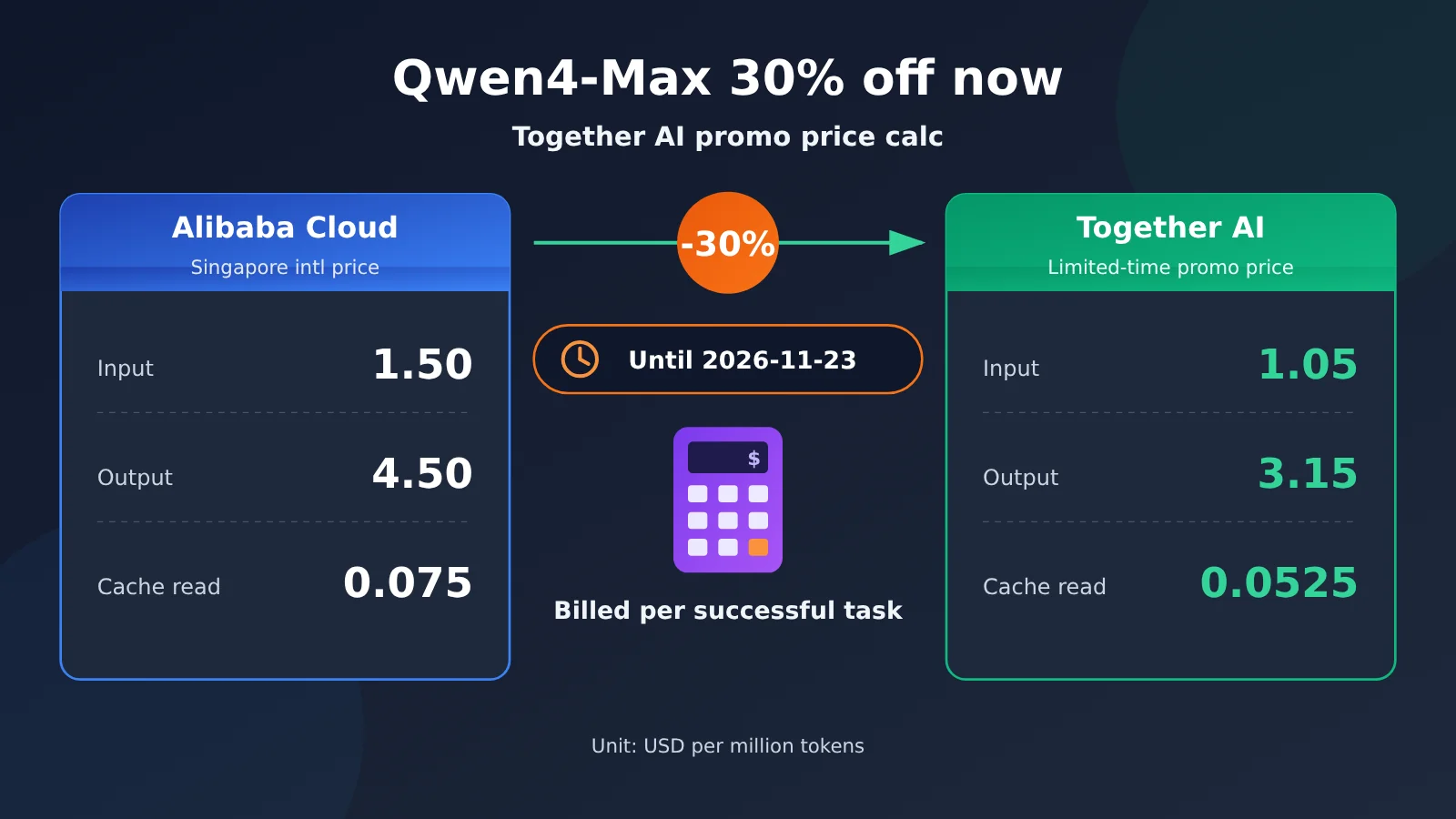
Together AI’s official Pricing page has temporarily set all three Qwen4-Max rates — input, output, and cache read — to 70% of Alibaba Cloud Model Studio’s Singapore international deployment price. The page marks the offer as valid through 2026-11-23.
The conclusion comes with conditions: The 70% price is only worth rushing to test if your tasks can be validated before the deadline, rely mainly on text and image inputs, and stay within length ceilings that Together hasn’t itemized yet. Otherwise, let “cost per successful task” decide whether you switch, and prepare a second bill at post-promotion prices. This 70% figure is a price list, not a deployment you’ve already validated.
What you’ll learn from this article
- The specific numbers behind Together AI’s 70% pricing, the baseline they’re calculated from, the expiry date, and which page each figure comes from.
- How to reconcile the books when Together’s model detail page and Pricing page disagree on price.
- Which of Alibaba Cloud’s officially published window, output limits, and cache billing rules can’t be directly applied to Together’s routing.
- A switchover acceptance method for short-text, long-context, and image tasks, plus worked examples with explicit denominators and assumptions.
- The endpoint, groups, and catalog price for
qwen4-maxlisted on APIYI, and how it differs from Together’s promotion.
Index: The main text first splits the verifiable facts into four groups: Together’s 70% pricing and deadline, discrepancies in the same model name across pages, Alibaba Cloud’s official specs, and APIYI’s listing information. Every figure notes who it belongs to and under what conditions. Then comes the analysis and judgment section: the possible pricing mechanics behind the 70% price (all speculative), a method and code for calculating cost per successful task using the same batch of tasks, and the items to check one by one if you treat APIYI as an independent fallback.
Qwen4-Max 30% Off: Key Concepts to Know
| Concept | Brief explanation |
|---|---|
| Serverless inference | Running instances are managed by the provider; applications call a public endpoint on a usage-based basis without deploying the model yourself |
| International deployment | A regional and deployment designation for Alibaba Cloud model services; pricing and rules vary by the region you select |
| Token | The unit for processing text and other information; input, output, cache, and other billing items are calculated separately |
| Cache read | Requests reuse previously processed input and are billed at the cache-read tier; cache writes have separate pricing and validity periods |
| Context window | The total length available for a single inference; providers may also separately limit the maximum input and maximum output |
| Input modality | The data types accepted by the model service, such as text, images, and video |
| Cost per successful task | Total inference spend divided by the number of tasks that pass acceptance; spend from failures and retries is also included |
Qwen4-Max 30% Off: Impact at a Glance
- Application developers and procurement leads: List prices are down 30%, but only about three days remain before the deadline, and the page doesn’t specify the time zone or exact cutoff time. If you can’t finish acceptance testing in time, building a long-term budget around the promo price is risky.
- Teams working on long-context or agent use cases: For tasks where input tokens make up the bulk of usage, the savings are most noticeable. However, Together doesn’t publish separate input and output limits item by item, so you’ll need to test where truncation happens first.
- Teams that need video understanding: Alibaba’s official model page lists video input, while Together’s model page currently lists only text and image. Until there’s clear documentation or test results, it’s too early to migrate video workloads over.
Qwen4-Max 30% Off Access Cost: The Objective Facts
Together AI’s Qwen4-Max 30% Off Pricing and Expiry Date
The figures in the table below were retrieved as of 2026-11-20, all in USD per million tokens. Together’s numbers come from its official Pricing page, which marks Qwen4 Max as PROMO. Alibaba Cloud’s numbers come from the Singapore international deployment price in the Model Studio price list.
| Billing Item | Together Pricing Page Limited-Time Price | Alibaba Cloud Singapore International Deployment Price | Ratio |
|---|---|---|---|
| Input | 1.05 | 1.50 | 0.70 |
| Output | 3.15 | 4.50 | 0.70 |
| Cache read | 0.0525 | 0.075 | 0.70 |
| Validity period | Page marks through 2026-11-23, no time zone or time specified | Rolling price list | — |
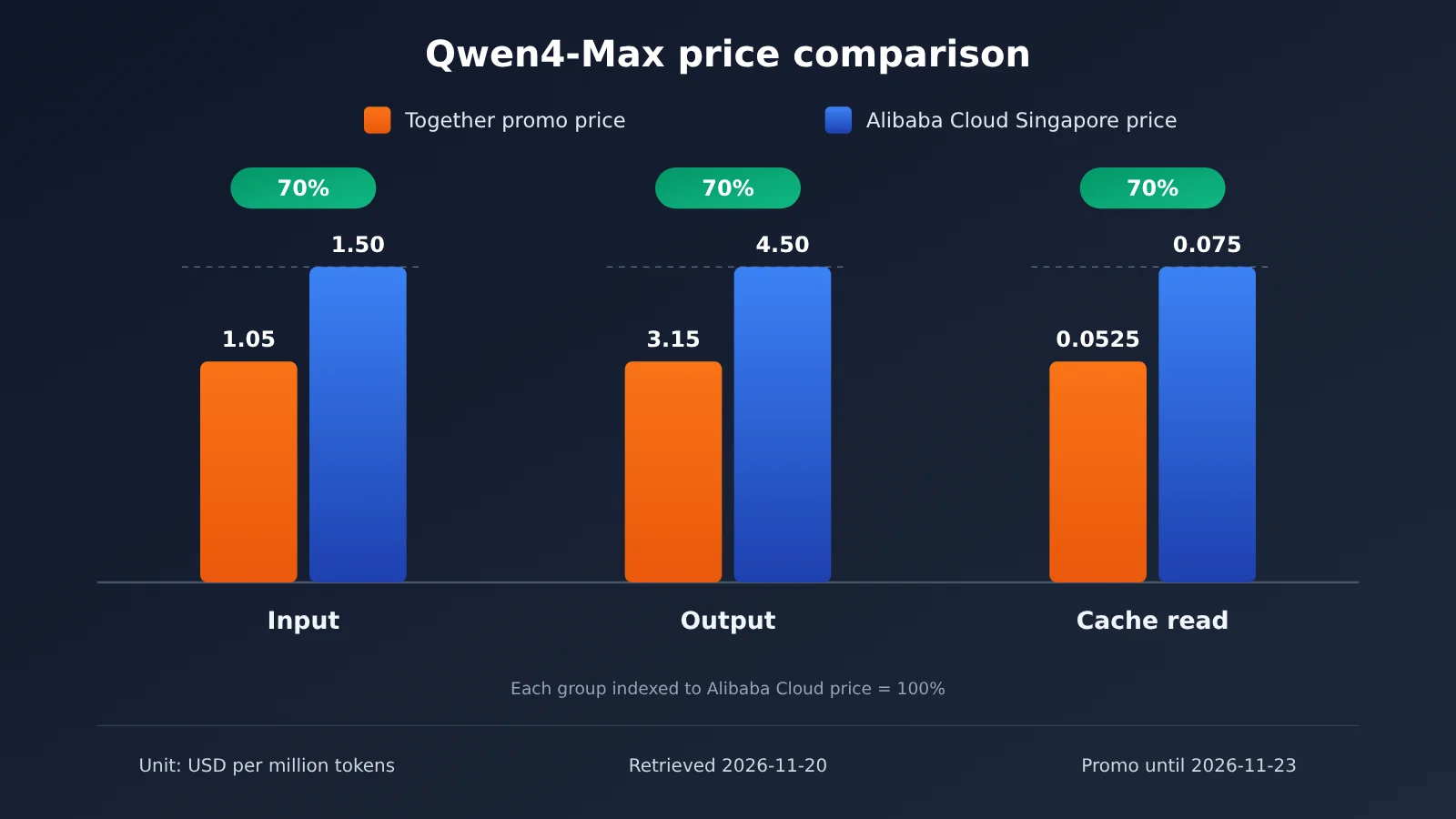
The “original price” on the Together Pricing page matches the Alibaba Cloud Singapore price item by item, and all three ratios come out to exactly 0.70. This 30% off applies only to this Singapore international deployment benchmark, these three billing items, and this specific promotion. If you’re comparing against Alibaba Cloud prices in other regions, or dealing with different cache rules, you’ll need to recalculate the discount—you can’t just carry over the 30%.
This pricing news first appeared in an OrcaRouter article on 2026-11-19, but the original post didn’t name the platform, and the author noted that their own service doesn’t offer this model. The only verifiable source for the same three-tier pricing right now is Together AI’s own Pricing page, so cite that page as your reference.
Qwen4-Max Price Differences Between Together AI’s Model Page and Pricing Page
Together’s model detail page (marked 2026-11-15) lists the invocation ID Qwen/Qwen4-Max and a Serverless invocation example, but the prices shown on the page are a different set: input 1.43, output 4.28, and cache read 0.0713 (USD per million tokens). The numbers on two public pages from the same provider don’t match, so when citing the 70% price (30% off), clearly state that it is the “promotional price listed on the official Pricing page” and record the retrieval date. Actual billing should be based on the usage details in your account.
| Dimension | Together public information | Alibaba Cloud official information |
|---|---|---|
| Invocation ID | Qwen/Qwen4-Max, with a Serverless example |
Model Studio model page |
| Input modalities | Model page explicitly lists text and image | Text, image, and video input; text output |
| Total context | Advertised 1 million total window | 1 million-token total context |
| Max input | Not individually confirmed | Non-thinking 991,808 / thinking 983,616 |
| Max output | Not individually confirmed | Non-thinking 131,072 / thinking 262,144 |
| Cache read | Pricing page 0.0525; model page 0.0713 | Singapore 0.075 |
| Cache write | Not publicly disclosed | 5-minute: 1.875; 1-hour: 3 (USD per million) |
Alibaba Cloud’s official model page was updated on 2026-11-18. As described in the OrcaRouter article, in thinking mode, the reasoning content and the response share a 262,144-token budget. These limits, modalities, and caching rules are all part of Alibaba Cloud’s own deployment and shouldn’t be assumed to be capabilities available through Together’s routing. Also, some earlier descriptions mentioned that the Together page once displayed a notice saying it was waiting to go live. The model page now provides the invocation ID and example, but this round of verification did not confirm whether actual invocations succeed.
APIYI qwen4-max Launch Information and List Pricing
APIYI (apiyi.com) published an announcement on 2026-11-17 16:07 launching qwen4-max. The public model registry generated on 2026-11-20 15:17 (UTC+8) also lists this ID. Earlier APIYI blog posts saying it was “not yet listed” should now defer to this latest announcement and registry.
| Item | APIYI public catalog information |
|---|---|
| Model ID | qwen4-max |
| Endpoints | chat, responses, messages |
| Token groups | ClaudeCode, CodexResponses, default, svip |
| List price (USD per million tokens) | Input 1.50, output 4.50, cache read 0.075 |
| Verification method | Based on official announcement and registry; no paid calls were made |
These list prices match the numbers for Alibaba Cloud’s international deployment in Singapore. This is not a Together promotion, and it’s not an APIYI discount either. Account groups, token permissions, and platform billing methods all affect whether you can invoke the model and the final amount you actually pay.
Qwen4-Max at 30% Off: Is It Worth Switching To? Analysis and Verdict
The Possible Pricing Mechanisms Behind Qwen4-Max’s 30% Discount (Speculative)
OrcaRouter’s original article offered three explanations. Here’s each one—all are just speculation. Together’s public page can only confirm the promotion itself and the stated end date; it doesn’t disclose who’s funding the discount.
- Vendor subsidy (speculation): The model provider subsidizes the launch price on third-party platforms to promote the new model. If that’s the case, the price will most likely return to the baseline once the subsidy ends.
- Wholesale pricing (speculation): The platform secured a lower procurement price and can pass on the savings long term. But this usually wouldn’t be labeled PROMO with an end date, which doesn’t quite match what the page shows.
- Loss-leader customer acquisition (speculation): The platform takes a short-term loss to win new users. In that case, how long the discount lasts depends on the platform’s strategy and can’t be predicted.
The original article treats the end of December as a checkpoint, but the announced deadline is November 23. When budgeting, assume it expires on the 23rd, then update if there’s an extension announcement.
Calculating Qwen4-Max Cost per Successful Task with the Same Task Set
Comparing per-token list prices makes it easy to overlook the costs of failures, retries, and truncation. A more reliable approach is to fix the task set, the prompts, and the acceptance rules, then send the same batch of samples to each candidate route and record the input, output, cache hits, failures, retries, and latency of every call. Then divide total spend by the number of tasks that passed acceptance. It’s worth preparing at least three kinds of samples:
- Short-text tasks: classification, extraction, or rewriting, for example — mainly to see whether the success rate and output length stay stable.
- Long-context tasks: for example, send a request of about 400,000 tokens and watch where it gets truncated, and whether the output budget is enough in thinking mode.
- Image tasks: on image inputs Together already explicitly supports, verify that recognition results and billing match expectations.
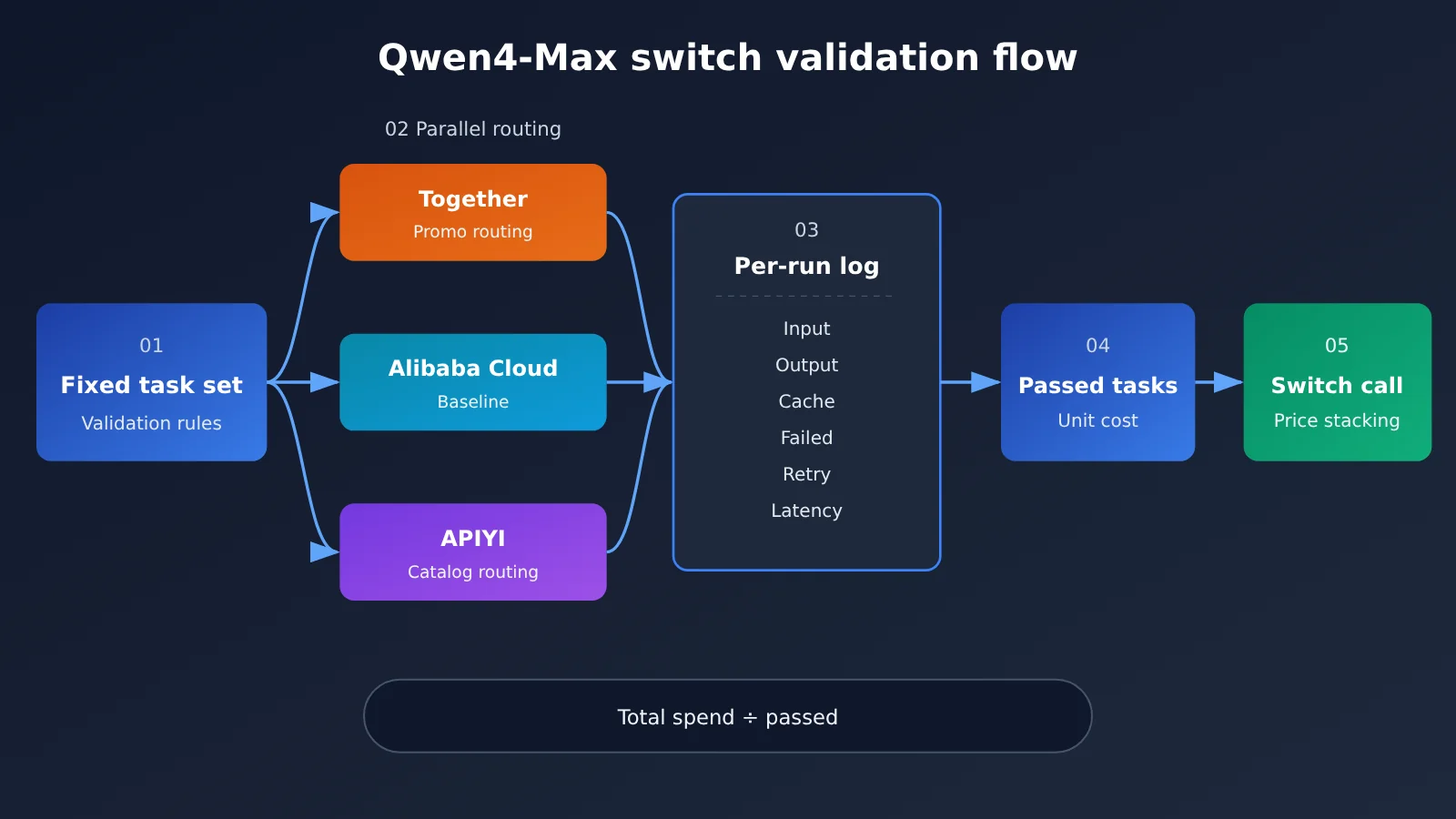
The short-text example in the table below is hypothetical data, meant to show how the denominator should be derived. The long-context example draws on OrcaRouter’s calculation: 200,000 input tokens and 30,000 output tokens per round, 40 rounds total, no cache, with both sides priced at the Singapore rates.
| Example | Assumptions and denominator | Together promotional price | After the promotion (assuming a return to the Pricing page list price of 1.50/4.50) | Difference |
|---|---|---|---|---|
| Short text (hypothetical) | 2,000 input and 500 output per call; 100 tasks, 8 retries, 108 calls total; 92 passed acceptance | 108 × 0.003675 ≈ 0.397, ÷ 92 ≈ 0.00431 per successful task | 108 × 0.00525 ≈ 0.567, ÷ 92 ≈ 0.00616 | About 0.00185 per successful task |
| Long-context agent (OrcaRouter example) | 40 rounds per run, no cache, assuming all succeed | 0.3045 per round, 12.18 per run | 0.435 per round, 17.40 per run | 5.22 per run |
Under this example, a thousand runs a month comes to a difference of about $5,220, while ten runs come to only about $52. Note that if prices after the promotion return to the 1.43/4.28 tier shown on the model page, the result changes again. So it’s worth keeping three price columns side by side — promotional price, Pricing page list price, and model page price — and then checking them against the real unit price once the bill arrives.
Qwen4-Max Cost Testing Code Example
The minimal example below shows an OpenAI-compatible call. Using APIYI routing as an example; when switching to another route, just change base_url and the model ID to the values published by the corresponding provider.
import openai

client = openai.OpenAI(
    api_key="YOUR_API_KEY",
    base_url="https://api.apiyi.com/v1"  # APIYI OpenAI-compatible endpoint
)

resp = client.chat.completions.create(
    model="qwen4-max",
    messages=[{"role": "user", "content": "用一句话说明缓存读计费"}]
)
print(resp.choices[0].message.content, resp.usage)
View the complete script for accounting by “cost per successful task”
import time
import openai

# Unit: USD / million tokens; record all three price sets separately, then replace with actual billed unit prices after the bill arrives
PRICES = {
    "together_promo": {"in": 1.05, "out": 3.15, "cache_read": 0.0525},
    "list_price":     {"in": 1.50, "out": 4.50, "cache_read": 0.075},
    "together_model_page": {"in": 1.43, "out": 4.28, "cache_read": 0.0713},
}

client = openai.OpenAI(
    api_key="YOUR_API_KEY",
    base_url="https://api.apiyi.com/v1"  # Replace with the route to test
)

def run_task(prompt, validate, model="qwen4-max", max_retries=2):
    """Return the usage records for each call, and whether the task ultimately passed acceptance"""
    records = []
    for attempt in range(max_retries + 1):
        t0 = time.time()
        try:
            r = client.chat.completions.create(
                model=model,
                messages=[{"role": "user", "content": prompt}],
            )
            u = r.usage
            details = getattr(u, "prompt_tokens_details", None)
            cached = getattr(details, "cached_tokens", 0) or 0
            ok = validate(r.choices[0].message.content)
            records.append({"in": u.prompt_tokens - cached, "cache": cached,
                            "out": u.completion_tokens, "ok": ok,
                            "latency": time.time() - t0})
            if ok:
                return records, True
        except Exception as e:
            records.append({"in": 0, "cache": 0, "out": 0, "ok": False,
                            "latency": time.time() - t0, "error": str(e)})
    return records, False

def cost_per_success(all_records, passed, price):
    total = sum(r["in"] * price["in"] + r["out"] * price["out"]
                + r["cache"] * price["cache_read"] for r in all_records) / 1e6
    return total / passed if passed else float("inf")
The cache field in the script depends on whether the API returns cached_tokens. Different routes may return different fields, so the platform bill should still be the final reference. Cache write fees (Alibaba Cloud officially distinguishes between 5-minute and 1-hour tiers) do not have a publicly listed price on the Together side, so they should be recorded separately during testing.
🚀 Testing suggestion: With the deadline fast approaching, you can first use the new-user free quota on APIYI apiyi.com to run through the sample set and the bookkeeping script. Once you’ve confirmed that the acceptance rules and log format are fine, point the same script at the Together route for comparison. That way, all your testing time during the promotional window can go toward price comparison.
Checklist for Using APIYI qwen4-max as a Standalone Fallback
APIYI’s list price matches Alibaba Cloud’s Singapore price. Its role is to provide another stable channel billed at list price when a promotion ends or Together route validation fails—not to be a cheaper option. When integrating through APIYI at apiyi.com, it’s worth checking four things:
- Catalog check: Verify whether the endpoints and groups for
qwen4-maxin the registry include the protocol you plan to use, such asresponsesormessages. - Account check: Confirm that the group your current token belongs to has invocation permissions. Just because the model is listed in the catalog doesn’t mean your account can actually call it.
- Billing check: Run a sample set once, then compare the actual unit price you pay against the catalog price line by line.
- Capability check: Test long-context truncation points, thinking-mode output, and multimodal support through the actual route. Don’t just apply Alibaba Cloud’s official thresholds directly.
If your workload can complete acceptance testing before 2026-11-23, and the calculated cost per successful task is indeed lower, you can run on Together’s promotional price for a while—while keeping a fallback route billed at list price and a second budget. If you can’t validate in time, or you depend on video input or extremely long outputs, a safer approach is to first get the workflow running at list price on a compatible interface such as APIYI apiyi.com, then re-compare pricing after Together announces an extension or fills in the missing specs.
References
-
Together AI Pricing: Qwen4 Max promotional price and validity period
- Link:
together.ai/pricing - Note: The page doesn’t list a publish date; this article was retrieved on 2026-11-20
- Link:
-
Together AI Qwen4 Max model page: invocation ID, Serverless example, and another price tier
- Link:
together.ai/models/qwen4-max - Note: Page marked 2026-11-15
- Link:
-
Alibaba Cloud Model Studio Model Prices: Singapore international deployment pricing and cache write pricing
- Link:
alibabacloud.com/help/en/model-studio/model-pricing - Note: A continuously updated price list
- Link:
-
Alibaba Cloud Qwen4-Max model page: context, input/output limits, and modalities
- Link:
alibabacloud.com/help/en/model-studio/qwen4-max - Note: Updated 2026-11-18
- Link:
-
OrcaRouter original article: source of the 30% off news and Agent-scenario worked examples
- Link:
orcarouter.ai/blog/qwen-4-max-30-percent-price-cut-third-party - Note: Published 2026-11-19; the explanation of the pricing mechanism in it is the author’s own speculation
- Link:
-
APIYI launch announcement and model registry:
qwen4-maxendpoint, group, and list price- Link:
docs.apiyi.com/live/2026-11/qwen4-max-launch - Note: Announcement published 2026-11-17; registry generated 2026-11-20
- Link:
Author: APIYI Technical Team
Technical discussion: Feel free to reach us through the APIYI official website at apiyi.com — more integration materials are available in the documentation center.