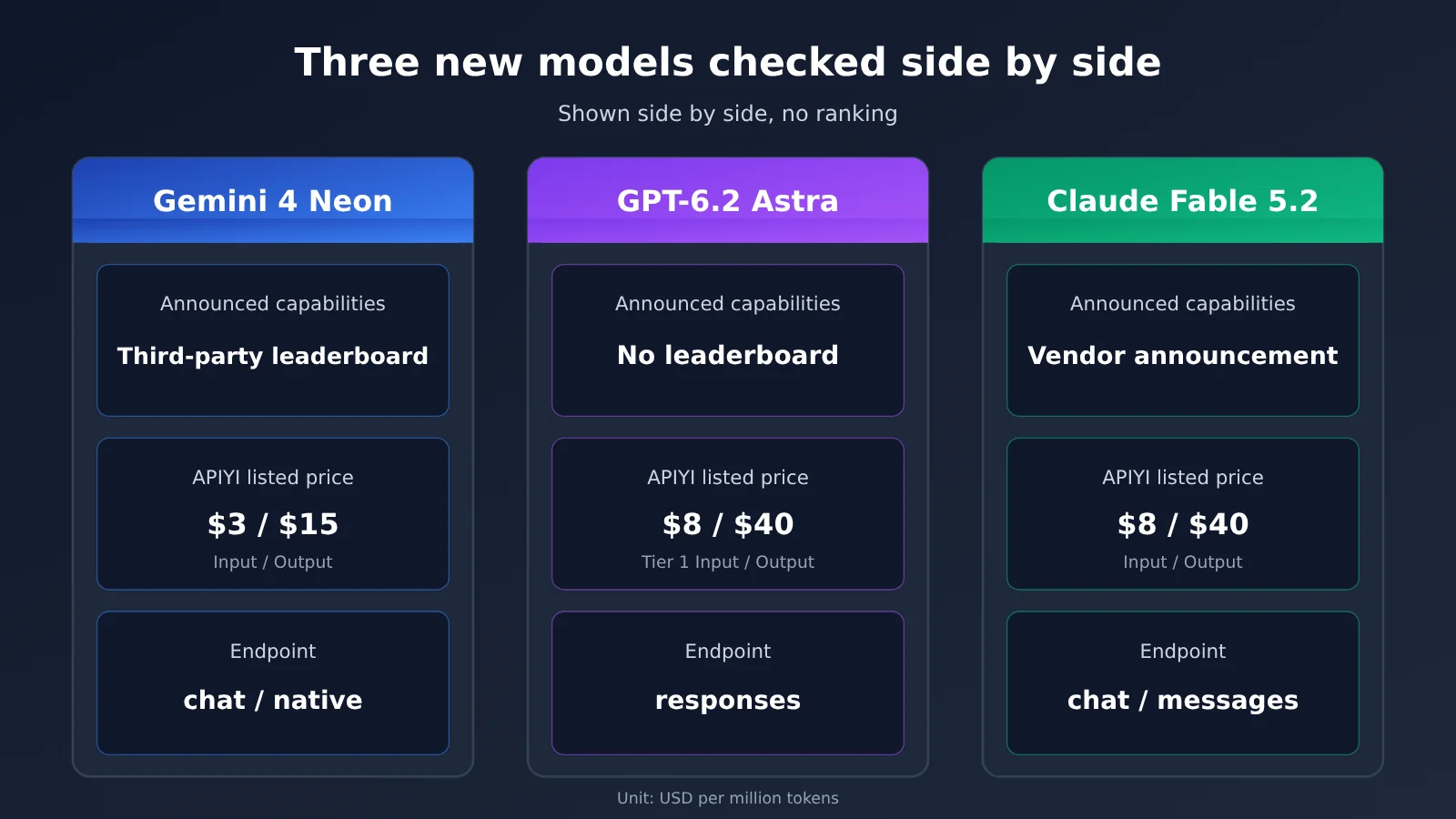
Author’s note: we’ve split the announced capabilities, APIYI shelf prices, and invocation endpoints for Gemini 4 Neon, GPT-6.2 Astra, and Claude Fable 5.2 into three separate columns so you can check them side by side—and pick which one to try first based on reasoning depth, coding agents, or long-context unit price.
In November 2026, three vendors shipped new models within ten days of each other: Anthropic launched Claude Fable 5.2 on November 9, Google announced Gemini 4 Neon on November 18, and GPT-6.2 Astra has already appeared in APIYI’s master price list. The easiest mistake to make when choosing is to mash three vendors’ leaderboards, three price sheets, and three different APIs into one “which one is the best deal” conclusion.
This isn’t a ranking article. The leaderboards come from different sources, the pricing tiers differ, and the endpoint formats differ too—forcing them into a single score will only lead you astray. This article splits the three models into three columns and checks each one separately: the capability data cited by official sources or announcements, the APIYI apiyi.com shelf price (checked 2026-11-20), and the endpoint each model should use.
The key takeaway: once you’ve read this, you’ll be able to decide for yourself which model to test first—depending on whether your particular task cares more about reasoning depth, coding agents, or long-context unit price—and you’ll know which interface to call for each one.
Gemini 4 Neon, GPT-6.2 Astra, and Claude Fable 5.2: Key Takeaways
First, a quick-reference table. The information for the three models comes from three different types of sources; the table only presents them side by side, not as a horizontal aggregation.
| Dimension | Gemini 4 Neon | GPT-6.2 Astra | Claude Fable 5.2 |
|---|---|---|---|
| Capability data source | Third-party leaderboards cited in Google’s announcement (Artificial Analysis, Vals) | The reference materials do not cover announcement leaderboard data | Anthropic announcement relayed via the APIYI changelog (FrontierCode 2.0, etc.) |
| APIYI shelf price (USD/million tokens) | Input 3, cache read 0.15, output 15 |
First-tier input 8, cache read 0.4, output 40; long context has separate tiers |
Input 8, cache read 0.2, output 40 |
| Recommended endpoint | chat or Gemini native format | responses (recommended), also supports chat | chat or messages |
| Context | 1 million tokens | 272000 tokens as the pricing tier threshold | 1M context, up to 128K output |
Key Checkpoints for the Three Models in Detail
The capability column doesn’t use the same basis for all three models. Gemini 4 Neon’s figures are third-party leaderboards cited by Google in its announcement; Claude Fable 5.2’s figures come from Anthropic’s published content as relayed in the APIYI changelog; and GPT-6.2 Astra has no corresponding leaderboard numbers in these reference materials. The leaderboards are different and the test sets are different, so you can’t put Neon’s Vals Index percentage and Fable’s FrontierCode percentage on the same axis for comparison.
The price column looks the most straightforward, but you still can’t compare just the numbers. The three models differ in cache-read pricing, long-context tiering, and thinking-mode billing. The actual cost of a task depends on the input/output ratio, cache hit rate, and whether it crosses a tier threshold. The endpoint column directly determines how you write the code—choosing the wrong endpoint can lead to incompatible parameters or missing functionality.
Performance Differences Among Gemini 4 Neon, GPT-6.2 Astra, and Claude Fable 5.2 (as Cited in Announcements)
This section only compiles capability information that appears in vendor announcements or paraphrases of those announcements. None of the figures below come from APIYI hands-on testing, so please keep the source attribution when citing them.
| Model | Data point | Value | Source type |
|---|---|---|---|
| Gemini 4 Neon | Artificial Analysis Intelligence Index (xhigh) | 61, ranked 3rd overall | Third-party leaderboard cited in Google announcement |
| Gemini 4 Neon | Vals Index | 2nd place, 70.9% | Third-party leaderboard cited in Google announcement |
| Claude Fable 5.2 | FrontierCode 2.0 | Improved from 32.4% to 49.1% | Announcement paraphrase (APIYI changelog) |
| Claude Fable 5.2 | Generation speed | Up to 30% faster | Announcement paraphrase (APIYI changelog) |
| GPT-6.2 Astra | Public leaderboard | Not provided in the reference materials | — |
How to Read Gemini 4 Neon’s Reasoning Leaderboard Results
In its 2026-11-18 announcement, Google cites a score of 61 on the Artificial Analysis Intelligence Index at the xhigh setting and a 3rd-place overall ranking, as well as 2nd place on the Vals Index with a score of 70.9%. Both are composite indices that focus on general reasoning and knowledge tasks. Note that xhigh is a high reasoning-effort setting, so performance on everyday lower-effort calls may not match this score.
How to Read Claude Fable 5.2’s Coding Data
The core figure for Claude Fable 5.2 is FrontierCode 2.0 rising from 32.4% in the previous generation to 49.1%. This is a coding-oriented evaluation. The announcement also says generation is up to 30% faster, and together with a 1M context window and 128K maximum output, this lines up more closely with coding-agent scenarios that need long codebase inputs and long patch outputs. FrontierCode and Vals measure different capabilities, and there is no conversion relationship between the two sets of numbers.
How to Verify GPT-6.2 Astra’s Capabilities
The reference materials for this piece do not provide announcement leaderboard data for GPT-6.2 Astra, so that cell is left blank rather than filled with speculation. If your task has explicit capability requirements for Astra, the safer approach is to run a small-traffic comparison using your own business samples rather than inferring from other models’ leaderboards.
Gemini 4 Neon, GPT-6.2 Astra, and Claude Fable 5.2 Price Verification (APIYI Shelf Prices)
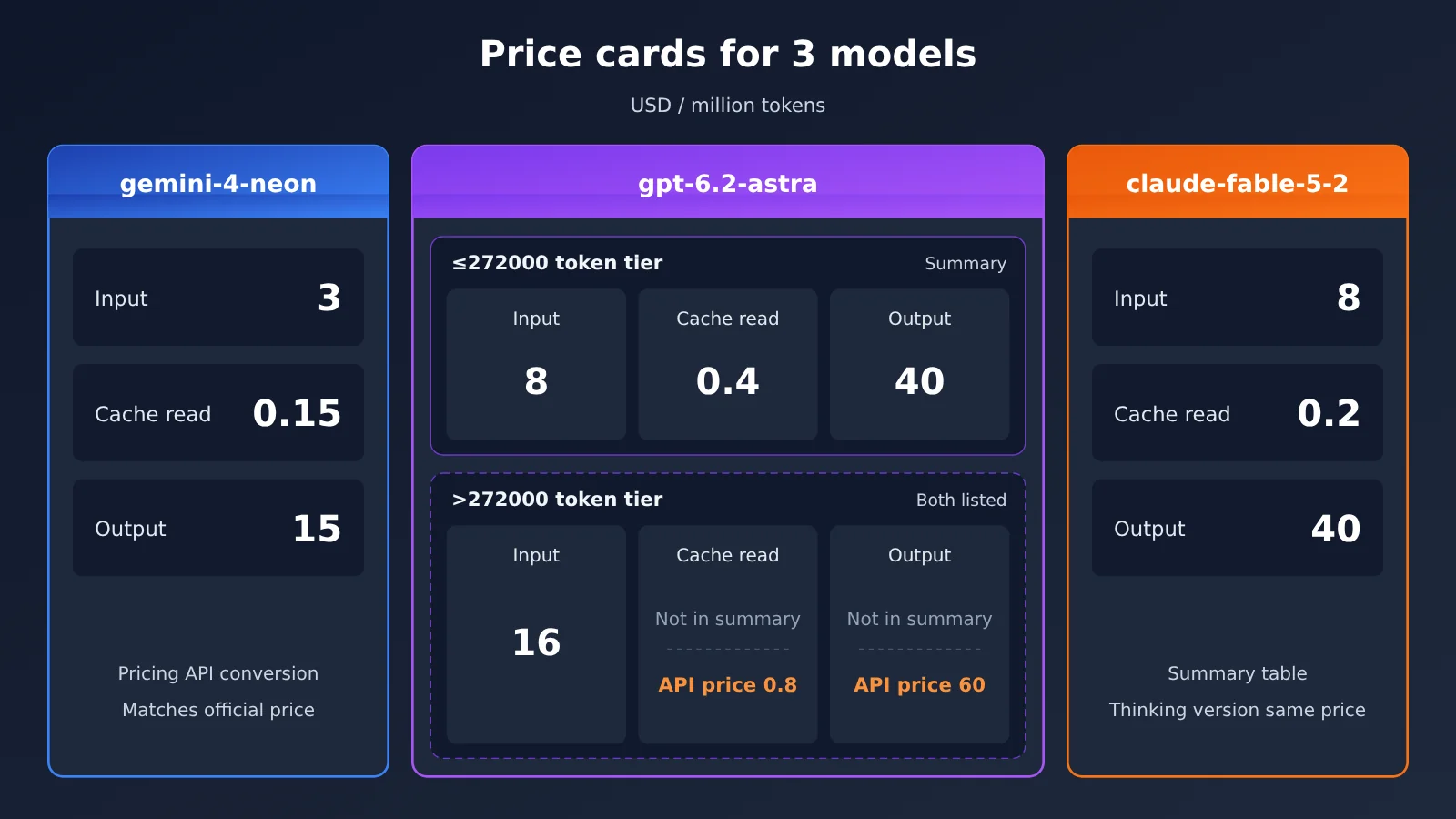
The prices in this section were verified on 2026-11-20 on APIYI apiyi.com. There are two sources: the model summary table (updated 2026-11-19 10:59 UTC+8) and the pricing API (version shell-api-modelmak-v1). All units are USD per million tokens.
| Model ID | Input | Cached read | Output | Data source |
|---|---|---|---|---|
gemini-4-neon |
3 |
0.15 |
15 |
Converted from pricing API; matches Google’s announced list price |
gpt-6.2-astra (first tier) |
8 |
0.4 |
40 |
Summary table |
gpt-6.2-astra (>272000 tokens) |
16 |
Not stated in summary table / pricing API 0.8 |
Not stated in summary table / pricing API 60 |
Summary table and pricing API shown side by side |
claude-fable-5-2 |
8 |
0.2 |
40 |
Summary table |
claude-fable-5-2-thinking |
8 |
0.2 |
40 |
Summary table |
How do I convert the multipliers in the pricing API into USD?
APIYI’s pricing API expresses prices as multipliers, with the convention that a model_ratio of 1 equals an input price of $2 per million tokens. Take gemini-4-neon as an example: its model_ratio is 1.5, so input comes out to 1.5 × 2 = 3; its completion_ratio is 5, so output comes out to 3 × 5 = 15; its cache_ratio is 0.05, so cache reads come out to 3 × 0.05 = 0.15. The converted results match Google’s published list prices exactly, as announced on 2026-11-18, so you can use this formula to double-check the numbers yourself.
Why are GPT-6.2 Astra’s long-context tiers documented in two places?
GPT-6.2 Astra uses 272000 tokens as its tier boundary. The summary table spells out the first tier’s price and notes that input is 16 once you go past 272000 tokens, but it doesn’t give the output price for that tier. The pricing API, meanwhile, gives output at 60 and cache reads at 0.8 for requests beyond 272000 tokens. We keep both pieces of information side by side rather than merging them into a single number in this article. If your requests regularly cross the 272000-token line, we’d recommend going with whatever the pricing API returns at the time of the call.
Price Cut for Claude Fable 5.2
Per the APIYI changelog entry dated 2026-11-10, Anthropic announced that Claude Fable 5.2 is priced at 8 for input and 40 for output — 20% lower than 5.1 — with cache reads at 0.2. claude-fable-5-2 and claude-fable-5-2-thinking share the same price in the master table, so you don’t need to convert per-unit rates separately when you pick the thinking version; however, the output tokens generated by the reasoning process will show up in your usage.
Gemini 4 Series Pricing for Reference
If you’re weighing options within the Gemini 4 series, here are the list prices for a few models to compare. The price for gemini-4-carbon reflects Google’s introductory pricing as of 2026-11-30; Google has announced that starting December 1 the standard rate will be 4 for input and 20 for output, so please check the master table on that day to see whether the list price gets updated.
| Model ID | Input | Cache Read | Output | Notes |
|---|---|---|---|---|
gemini-4-carbon |
2 |
0.1 |
10 |
Corresponds to Google’s introductory price (through 2026-11-30) |
gemini-4-hydrogen |
1.5 |
0.075 |
7.5 |
— |
gemini-4-argon |
2 |
0.1 |
10 |
Master table price |
Gemini 4 Neon, GPT-6.2 Astra, and Claude Fable 5.2 Endpoints
Each of these three models has its own recommended endpoint — there’s no single snippet of code that works for all of them. The only shared piece is base_url: when calling through APIYI, you always set it to https://api.apiyi.com/v1, then pick the right path and request format for the model you’re using.
| Model | Recommended endpoint | Alternative endpoint | Key implementation notes |
|---|---|---|---|
| Gemini 4 Neon | chat (OpenAI-compatible /chat/completions) |
Gemini native format | If you already have an OpenAI SDK project, use chat; when you need Gemini-native parameters, use the native format |
| GPT-6.2 Astra | responses (/responses) |
chat (/chat/completions) |
responses is recommended, with input as the request body field; chat uses the messages field |
| Claude Fable 5.2 | chat (/chat/completions) |
messages (Anthropic Messages format) | Use messages when you need Anthropic-native capabilities; for the thinking version, use claude-fable-5-2-thinking |
Why GPT-6.2 Astra recommends responses
The responses API is OpenAI’s newer-generation interface format, and it handles multi-turn state, tool calling, and similar capabilities more completely — which is why Astra is best served by this endpoint first. The chat endpoint still works fine and suits projects that already have a lot of chat-format code and don’t want to refactor right away. The request body fields differ between the two endpoints, so don’t just swap the model name when migrating.
Why Neon and Fable each have two entry points
Gemini 4 Neon and Claude Fable 5.2 both support the OpenAI-compatible chat endpoint as well as their own vendor-native formats. The upside of the chat endpoint is that your code can share a single SDK with other models; the upside of the native formats is access to vendor-specific parameters. If your use case is just routine conversation and generation, the chat endpoint is usually all you need.
Gemini 4 Neon, GPT-6.2 Astra, Claude Fable 5.2 Quick Start
As this article calls for, there’s no single generic code block here — instead the key parameters are listed per model. The shared configuration for all three is the same: put the key you got from the APIYI dashboard in api_key, and set base_url to https://api.apiyi.com/v1.
- Calling Gemini 4 Neon: point the OpenAI SDK at the
base_urlabove, callchat.completions.create, setmodeltogemini-4-neon, and pass your conversation array inmessages; if you need native parameters, switch to the Gemini native request format instead. - Calling GPT-6.2 Astra: use the same SDK client to call
responses.create, setmodeltogpt-6.2-astra, and pass the prompt content ininput; if you’re reusing older code, you can also go throughchat.completions.create. - Calling Claude Fable 5.2: for standard cases, call
chat.completions.createwithmodelset toclaude-fable-5-2; when you need deeper reasoning, switch toclaude-fable-5-2-thinking; when you need Anthropic native parameters, use the messages format instead. - Log your usage: after every call, record the returned input, output, and cached token counts — you’ll need them later when you work out the cost per task.
🚀 Quick start tip: grab your free new-user trial quota at APIYI (apiyi.com) first, then run all three models on the same batch of business samples. One API key lets you switch between all three providers on pay-as-you-go billing, which makes it easy to compare quality and cost under real workloads.
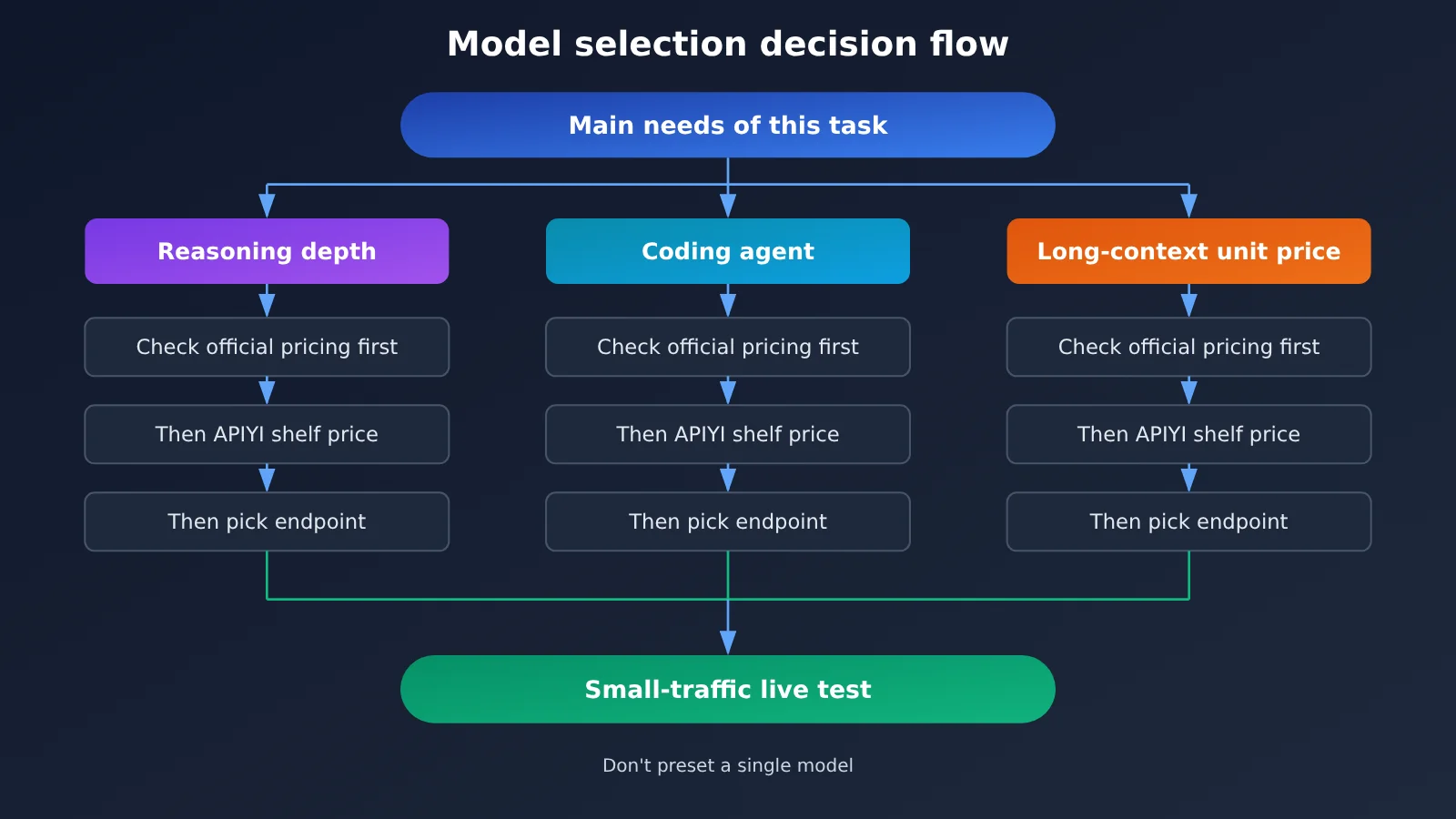
Scenario Recommendations: Break It Down by What This Task Actually Needs
The starting point for model selection isn’t “which model is best” — it’s what matters most for this particular task. Below, organized by three common priorities, are the columns of information you should check first.
Scenarios That Prioritize Reasoning Depth
- Complex analysis and multi-step reasoning: Start with the Artificial Analysis and Vals Index data cited in the Gemini 4 Neon announcement, and note that the 61 score is the result at the xhigh setting.
- Tasks that need a high reasoning tier: Claude Fable 5.2 has a separate
claude-fable-5-2-thinkingmodel ID, so you can run a side-by-side test against the non-thinking version at the same unit price. - If you need GPT-6.2 Astra: The reference materials don’t include leaderboard data for it, so we’d suggest validating directly with your own business samples.
Scenarios That Prioritize Coding Agents
- Long codebase inputs, long patch outputs: The FrontierCode 2.0 improvements and the 128K output cap relayed in the Claude Fable 5.2 announcement are useful reference points.
- Heavy tool calling and multi-turn state: The responses endpoint recommended for GPT-6.2 Astra is better suited to carrying this kind of interaction — the integration approach itself is a consideration.
- You already have OpenAI-compatible code: All three can go through the chat endpoint, so migration cost is relatively manageable.
Scenarios That Prioritize Long-Context Unit Price
- Persistently very long inputs: First check whether your request crosses GPT-6.2 Astra’s 272000-token tier threshold; past that line, the unit price is charged at a different tier.
- High cache hit rates: The cache-read unit prices vary quite a bit across the three models, so businesses with high cache hit rates should factor the cache-read unit price in separately.
- 1M-level context: Both Gemini 4 Neon and Claude Fable 5.2 are listed with million-token-level context, but their input and output unit prices differ, so you’ll need to calculate based on your own input/output ratio.
Decision Recommendation: Check the Three Columns Separately, Then Validate with a Small-Volume Test
Checking the information in all three columns separately is the simplest way to avoid a poor model selection. The capability column only tells you “how a model performs on a given leaderboard at a given tier”; the price column only tells you “the unit price per million tokens”; and the endpoint column only tells you “how to write the code.” No single column can tell you “which model to use for this job.”
A more practical approach is to start with per-task cost: use typical requests from your business to estimate input, output, and cached token counts, multiply each by the corresponding unit price for the three models, and for GPT-6.2 Astra also determine whether it exceeds 272000 tokens. Then test quality on the same batch of samples, and look at cost and quality together—not just the leaderboard or the unit price alone.
💡 Selection tip: Which model you choose depends on your task structure and quality requirements. We recommend using APIYI apiyi.com to run a small-volume comparison of the three models with a unified API key, calculate costs based on actual usage, and then decide on the primary and backup models.
Frequently Asked Questions (FAQ)
Q1: What are Gemini 4 Neon, GPT-6.2 Astra, and Claude Fable 5.2?
All three are next-generation Large Language Models that emerged around November 2026: Gemini 4 Neon was announced by Google on 2026-11-18, Claude Fable 5.2 was released by Anthropic on November 9, and GPT-6.2 Astra is already listed in the APIYI price master table. Their capability scopes, pricing methods, and endpoint formats all differ.
Q2: Can the benchmark scores of these three models be compared directly?
No. Gemini 4 Neon’s figures come from Artificial Analysis and the Vals Index cited in Google’s announcement, while Claude Fable 5.2’s figures come from FrontierCode 2.0 as relayed in its announcement — the two measure different capabilities. GPT-6.2 Astra has no benchmark data in these materials. There’s no conversion relationship between different benchmarks.
Q3: When were the three models released?
According to the APIYI changelog dated 2026-11-10, Anthropic released Claude Fable 5.2 on November 9; Google published the Gemini 4 Neon announcement on 2026-11-18. The prices in this article were verified on 2026-11-20, and the referenced master table version was updated on 2026-11-19 10:59 (UTC+8).
Q4: What exactly is the output price for GPT-6.2 Astra beyond 272000 tokens?
The two sources word it differently: the APIYI master table lists input as `16` beyond 272000 tokens but doesn’t state an output price; the pricing API states that beyond 272000 tokens, output is billed at `60` and cache read at `0.8`. This article keeps both side by side — for actual billing, defer to the pricing API at call time.
Q5: How do I quickly call these three models via API?
We recommend using a multi-model aggregation platform for unified access:
1. Sign up at APIYI apiyi.com to get an API key and free trial quota
2. Set base_url to `https://api.apiyi.com/v1` for all models
3. Pick the endpoint by model: Neon goes through chat or the Gemini native format, Astra goes through responses (chat also works), and Fable goes through chat or messages
One key lets you switch between all three vendors, which makes it easy to compare them on the same batch of samples.
Q6: How can I verify APIYI’s shelf prices myself?
Check the APIYI apiyi.com model master table and the pricing API together. The pricing API expresses prices as ratios: a `model_ratio` of 1 equals $2 per million tokens for input, output equals input times `completion_ratio`, and cache read equals input times `cache_ratio`. For example, `gemini-4-neon` converts to input 3, output 15, and cache read 0.15.
Q7: Does Claude Fable 5.2’s thinking version cost extra?
`claude-fable-5-2` and `claude-fable-5-2-thinking` have the same unit price in the master table: input 8, cache read 0.2, output 40. The unit price stays the same, but the thinking process generates extra output tokens, so actual spending varies with usage.
Q8: What limitations should I watch out for with these three models?
– **Capability data**: Neon and Fable’s figures are quoted or paraphrased from announcements, not independent tests. Astra lacks public leaderboard data.
– **Pricing tiers**: Astra has a 272,000-token tier boundary; the two sources describe it differently.
– **Pricing validity**: The sibling model `gemini-4-carbon` corresponds to Google’s introductory price through November 30. Starting in December, Google’s standard price is input 4, output 20.
– **Endpoint differences**: The three models have different recommended endpoints, so you can’t migrate by changing only the model name.
Gemini 4 Neon, GPT-6.2 Astra, and Claude Fable 5.2 Key Takeaways
- Keep the three columns separate: Announced capabilities, APIYI listed prices, and invocation endpoints are independent; don’t merge them into one score.
- Leaderboard methodologies differ: Neon cites Artificial Analysis and Vals, while Fable cites FrontierCode, so they’re not directly comparable.
- You can verify Neon’s pricing: The pricing endpoint’s multiplier converts to input 3, cache read 0.15, output 15.
- Mind Astra’s tiering: Above 272,000 tokens, input is 16. The output price isn’t in the summary table, but the pricing endpoint lists 60.
- Fable has uniform per-unit pricing: The standard and thinking versions both use input 8, cache read 0.2, output 40.
- Endpoints are all different: Neon uses chat or native, Astra recommends responses, and Fable uses chat or messages.
- Getting started: Use a single API key through APIYI at apiyi.com to access all three models, then compare them at low volume with the same batch of samples.
Summary
When comparing Gemini 4 Neon, GPT-6.2 Astra, and Claude Fable 5.2, the key is to keep three types of information from getting mixed together:
- Capability column: Only look at the leaderboards and tiers cited in the announcements. Neon and Fable use different data conventions, and Astra needs to be verified independently.
- Price column: Use APIYI shelf prices as the benchmark. Pay attention to cache read pricing, Astra’s 272000 token tier, and the discrepancies between the two sources.
- Endpoint column: All three recommended endpoints are different. The base_url is uniformly
https://api.apiyi.com/v1, with paths and request bodies written separately per model.
First, figure out whether this particular job prioritizes reasoning depth, coding agent performance, or long-context unit price, then check against the corresponding column, and finally validate with small-traffic testing on real samples. We recommend claiming free credits through APIYI apiyi.com and completing the comparison test of all three models under the same Key.
📚 References
-
APIYI Model List: Model IDs and shelf prices (the version checked in this article was updated 2026-11-19 10:59 UTC+8)
- Link:
docs.apiyi.com/models.md - Description: Look up tier prices for models such as
gpt-6.2-astraandclaude-fable-5-2
- Link:
-
APIYI Pricing API: Real-time pricing in multiplier form (version
shell-api-modelmak-v1)- Link:
api.apiyi.com/api/pricing - Description: Convert to USD unit prices using
model_ratio,completion_ratio, andcache_ratio
- Link:
-
Google Gemini 4 Neon Announcement: Released 2026-11-18
- Description: Includes list price, 1M context, and cited Artificial Analysis and Vals Index data
-
APIYI Changelog (2026-11-10): Relays information about the Anthropic Claude Fable 5.2 release
- Description: Includes price adjustments, FrontierCode 2.0 data, 1M context, and 128K output
Author: APIYI Technical Team
Technical exchange: Feel free to contact us on the APIYI homepage for more model integration and pricing verification materials