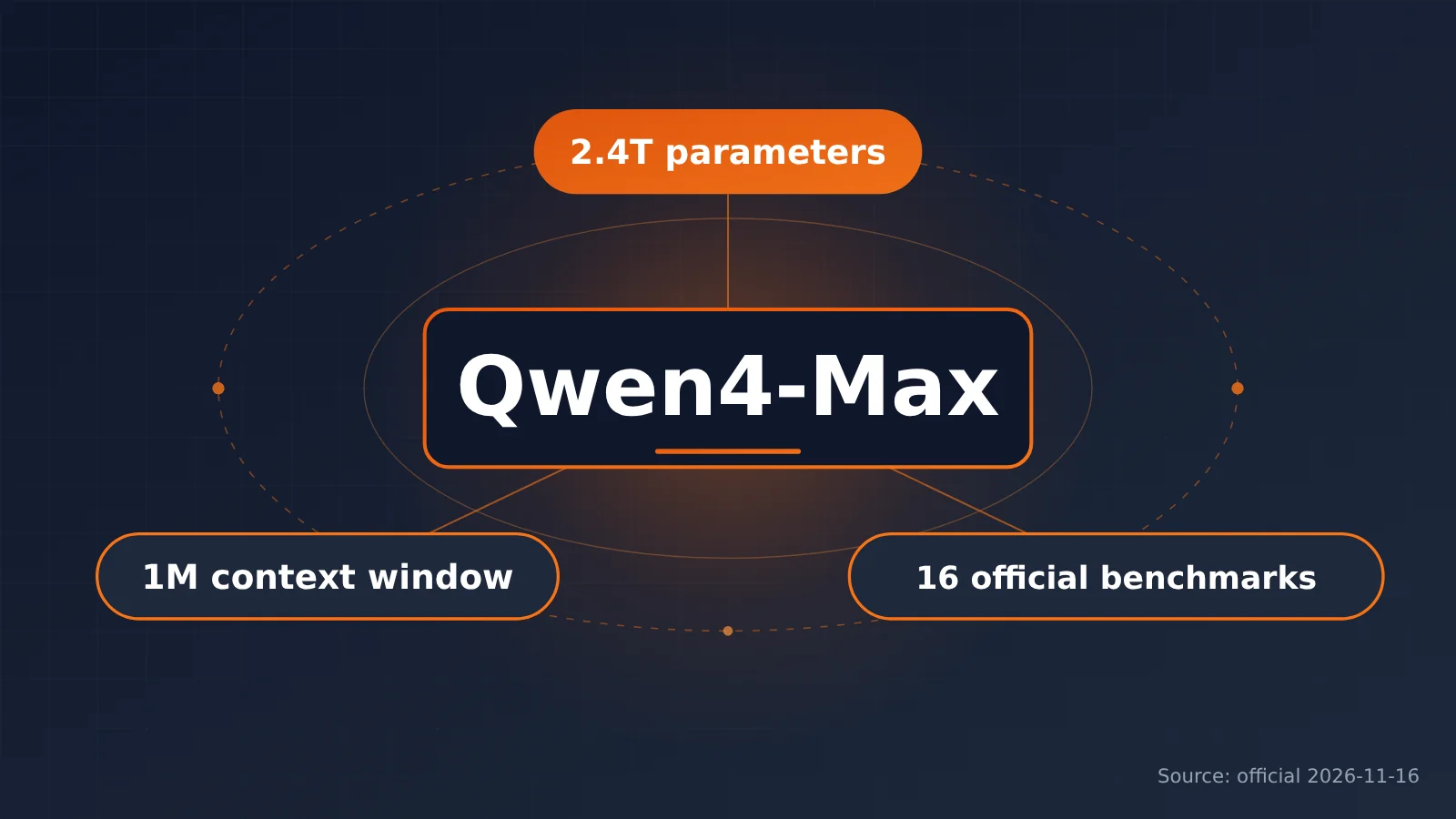
Alibaba’s Tongyi team released Qwen4-Max on the morning of 2026-11-16. It has 2.4T backbone parameters and a 1M context window, and it came with a comparison chart covering 16 benchmark results.
Bottom line first: Qwen4-Max’s real lead is in token efficiency and long-horizon delivery—it doesn’t rank first in every category. Among the 16 officially self-reported benchmarks, it took 4 firsts and 4 seconds; terminal operations, program construction, chart understanding, and video understanding still lag clearly behind the top competitors shown in the same chart.
This article draws on only three types of sources: the official release materials from 2026-11-16, the final leaderboard snapshot from the public arena.ai Code Arena WebDev leaderboard (2026-11-14), and the two list prices posted on QwenCloud and the Qwen AI Platform. Undisclosed parameter details and third-party reproduction results are out of scope here. If you’re currently running Qwen3.8-Max or another flagship model, after reading this you can decide whether to switch by looking at three task categories, and run the numbers yourself using input, output, and cache pricing.
Qwen4-Max Release at a Glance
| Item | Details |
|---|---|
| Release date | 2026-11-16 10:01 (UTC+8) |
| Released by | Alibaba Qwen (Tongyi Qianwen) team |
| Parameter scale | 2.4T backbone parameters, 71B activated per token, plus 328B N-gram Embedding parameters |
| Context | 1M, native vision |
| Official channels | QwenCloud API, Qwen Studio, QwenWork, Qoder, Qwen App |
| Open-source plan | The team says smaller Qwen4 variants will get open weights; Max itself isn’t mentioned as open source |
Looking at the release cadence, this isn’t just an API model refresh. Qwen4-Max simultaneously shipped into two first-party products — QwenWork (office) and Qoder (coding) — and the official materials put the emphasis on agent long-horizon tasks and industry delivery, rather than leading with pure Q&A capability.
Three architectural changes in Qwen4-Max
The official blog lists three structural changes. Here’s what each one solves:
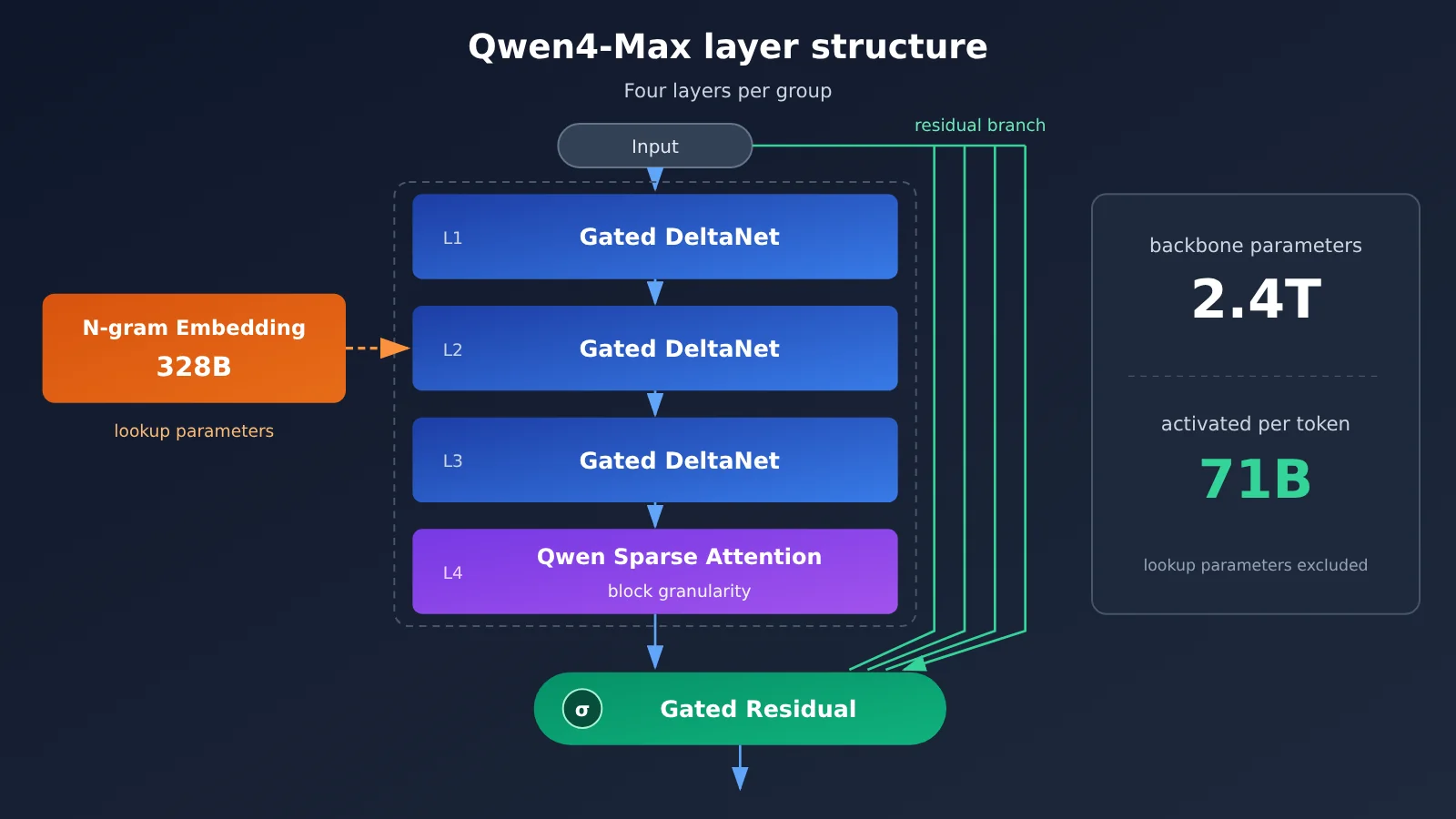
- GDN + QSA hybrid attention: three out of every four layers use Gated DeltaNet, and the remaining one uses Qwen Sparse Attention, selecting context at block granularity. The main goal here is cutting compute cost at 1M long context.
- Gated Residual: the residual path is split into four parallel branches that are then merged through gating, which boosts the representational capacity of deep layers.
- N-gram Embedding: a lookup at layer two that supplements local token patterns. This is where the extra 328B parameters come from — they’re lookup parameters and don’t participate in per-token activation compute.
Worth noting: 2.4T is the total backbone parameter count, while 71B is what actually gets activated per token. When you compare “parameter size” against other models, first make sure both sides are using the same definition.
Qwen4-Max specs and protocols
| Spec | Qwen4-Max |
|---|---|
| Context window | 1M |
| Max input | 991K (983K in thinking mode) |
| Max output | 393K |
| Max chain of thought | 262K |
| TPM | 5 million |
| Compatible protocols | OpenAI Chat Completions, Responses, Anthropic Messages, DashScope |
Default reasoning_effort |
high (Qwen3.8-Max defaults to xhigh) |
That last row is easy to miss. Qwen4-Max defaults to a reasoning level of high, one notch below the previous generation’s default of xhigh. If you compare the two generations using default parameters, part of the token savings you see comes from the difference in level, not entirely from the model itself. For A/B tests, it’s best to explicitly set reasoning_effort to the same value on both sides.
Qwen4-Max’s 16 Official Benchmarks: Where It Leads and Where It Lags
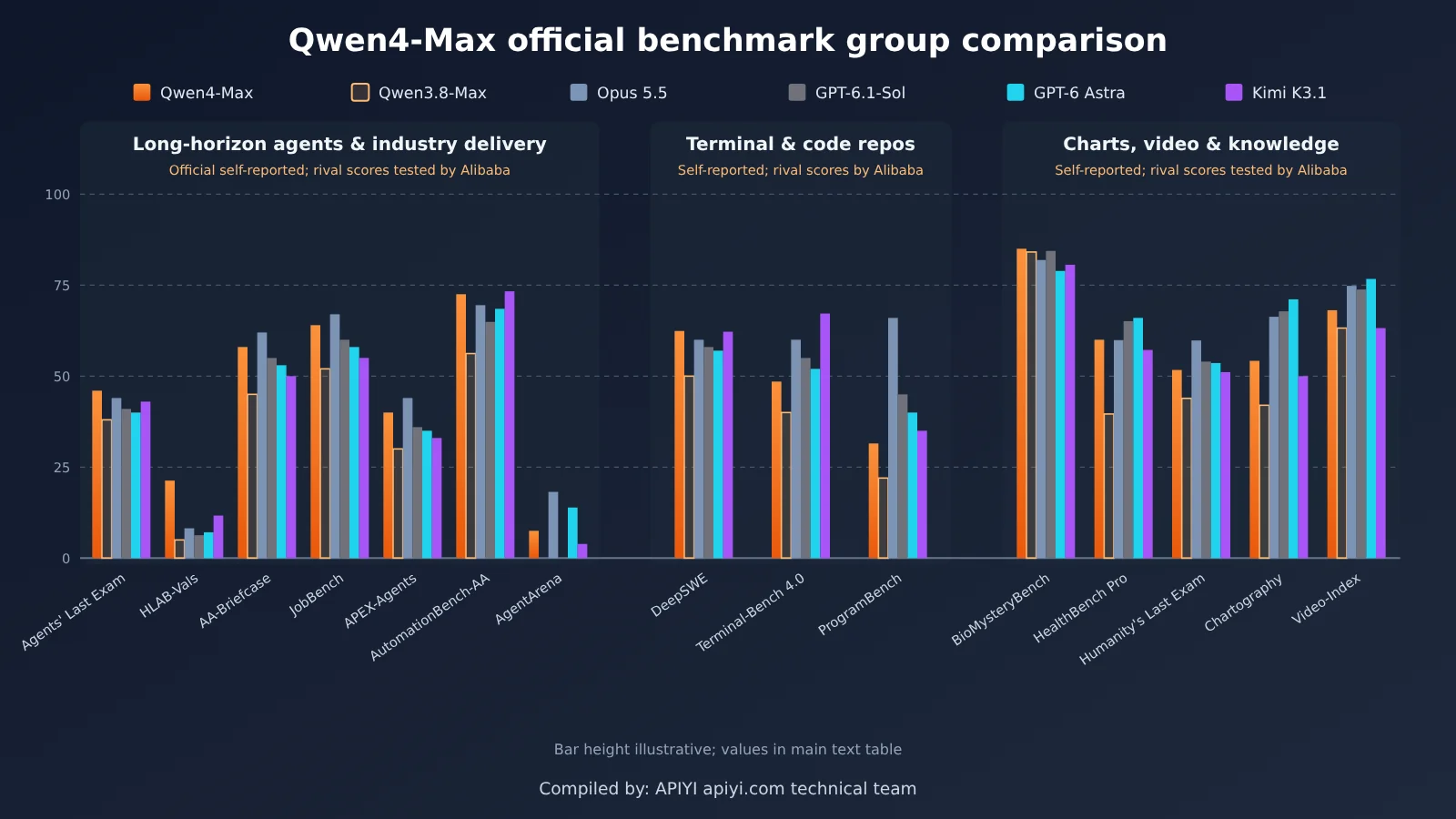
Every score in the table below comes from the same official chart released by the vendor, so these are self-reported results. The competitor scores in that chart were also measured by Alibaba itself, and shouldn’t be treated as official results published by Anthropic, OpenAI, or Moonshot AI. CodeArena and AgentArena are taken from LM Arena; AA-Briefcase and AutomationBench-AA come from Artificial Analysis; APEX-Agents comes from the Mercor leaderboard; and Alibaba ran JobBench itself using an updated dataset and evaluation code.
| Benchmark | Qwen4-Max | Qwen3.8-Max-0902 | Opus 5.5 | GPT-6.1-Sol | GPT-6 Astra | Kimi K3.1 |
|---|---|---|---|---|---|---|
| DeepSWE v1.1 | 75.7 | 69.3 | 74.2 | 75.2 | 74.1 | 75.5 |
| CodeArena WebDev (Elo) | 1750 | 1676 | 1816 | 1742 | 1763 | 1686 |
| Terminal-Bench 4.0 | 48.5 | 38.9 | 59.6 | 56.1 | 59.1 | 67.2 |
| ProgramBench | 31.5 | 28.0 | 65.0 | 52.5 | 55.0 | 25.0 |
| AA-Briefcase v1.1 (Elo) | 1686 | 1605 | 1801 | 1555 | 1569 | 1674 |
| Agents’ Last Exam v1.1 | 46.7 | 27.9 | 43.4 | 42.6 | 43.4 | Not reported |
| JobBench | 68.5 | 65.3 | 75.4 | 66.2 | 66.1 | 61.2 |
| APEX-Agents v1.1 | 72.1 | 63.3 | 73.5 | 60.0 | 64.7 | 65.5 |
| HLAB-Vals-1.1 | 21.3 | 15.4 | 9.2 | 6.3 | 7.1 | 11.7 |
| AutomationBench-AA | 72.5 | 56.2 | 69.5 | 64.9 | 68.5 | 73.3 |
| AgentArena (Net Improvement) | 7.5 | — | 18.2 | — | 13.9 | 3.9 |
| BioMysteryBench | 85.0 | 84.1 | 81.9 | 84.4 | 78.9 | 80.6 |
| HealthBench Professional | 60.0 | 39.6 | 59.9 | 65.1 | 66.0 | 57.2 |
| Humanity’s Last Exam | 51.7 | 43.9 | 59.8 | 54.0 | 53.6 | 51.1 |
| Chartography | 54.2 | 42.0 | 66.3 | 67.8 | 71.1 | 50.0 |
| Video-Index | 68.1 | 63.2 | 74.8 | 73.8 | 76.7 | 63.2 |
Where Qwen4-Max Leads
Qwen4-Max ranks first on four benchmarks: DeepSWE, Agents’ Last Exam, HLAB-Vals, and BioMysteryBench. HLAB-Vals shows the biggest gap, with its 21.3-point score roughly double that of second-place Kimi K3.1. DeepSWE is only 0.2 points ahead of Kimi, which is basically a tie.
It ranks second on another four: AA-Briefcase, JobBench, APEX-Agents, and AutomationBench-AA. Opus 5.5 takes first place on the first three, while Kimi K3.1 takes first on the last one. These benchmarks lean toward long-horizon agents and white-collar work output, which is exactly the direction the official launch is emphasizing.
Where Qwen4-Max Falls Behind
Terminal work and program building are the clearest weak spots this time. Its 48.5 on Terminal-Bench 4.0 ranks fifth among the six models, 18.7 points behind first-place Kimi. Its 31.5 on ProgramBench is less than half of Opus 5.5’s score. If your agent mainly runs builds, debugging, and deployment in a shell, these two benchmarks are more useful reference points than DeepSWE.
Chart and video understanding also lag behind. It ranks fourth on both Chartography and Video-Index, 16.9 and 8.6 points behind first-place GPT-6 Astra, respectively. It also ranks fourth on Humanity’s Last Exam. So “native vision” means the capability is there—not that it leads in this area.
Where Qwen4-Max Stands on the Code Arena Public Leaderboard
In the final public leaderboard snapshot (2026-11-14) for arena.ai Code Arena WebDev, there are 1,007,405 votes across 159 models. Qwen4-Max (xHigh) sits at 6th place with a score of 1750, flagged as Preliminary and holding only 1,814 votes, with the page showing a per-task cost P50 of $4.18. The models ahead of it, in order, are Claude Fable 5.2, Claude Opus 5.5, Claude Sonnet 5.5, Gemini 4 Carbon (Preliminary), and GPT-6 Astra.
The previous generation, Qwen3.8-Max (0902), was at 1676 points and 16th place on the same leaderboard, so this generation gained 74 points and 10 places. That said, Qwen4-Max still has a fairly small vote count, so the ranking could shift later on.
Where Qwen4-Max’s Token Efficiency and “60% Cost Reduction” Come From
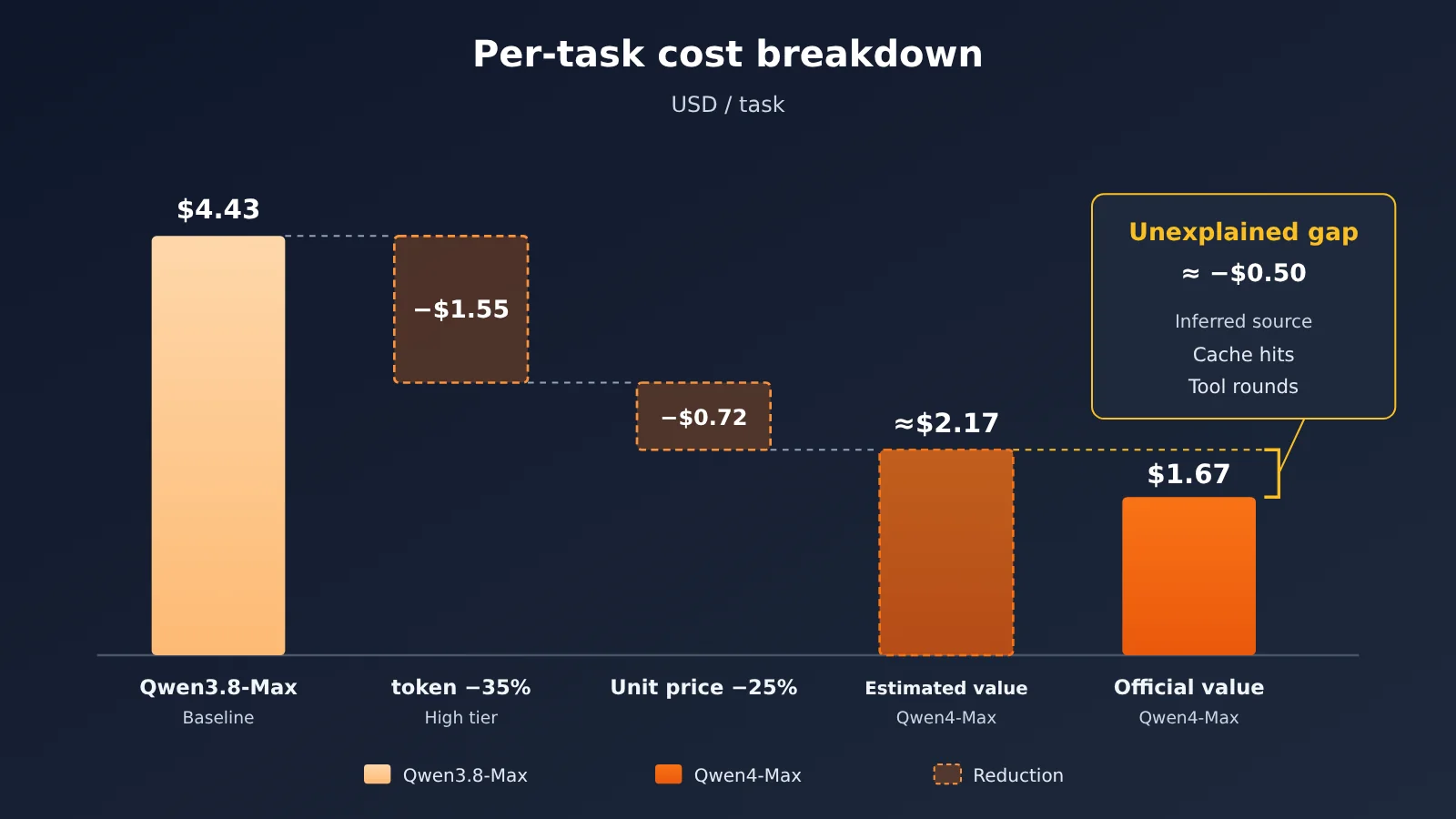
The official efficiency figures come from its own Work360 scenario benchmark. This benchmark covers 26 first-level domains, 182 second-level domains, and 721 third-level domains. Qwen4-Max scores 52.69, while Qwen3.8-Max scores 47.74. On token consumption, Work360’s Xhigh tier uses about 24% less and the High tier about 35% less; on Terminal-Bench 4.0, the two tiers use about 48% and 49% less respectively.
As for average cost per task, the official figures go from $4.43 down to $1.67, and the Chinese blog quotes ¥26.58 down to ¥11.16 — a 58% drop. Counting in dollars, the drop is about 62%. But if you work it out purely as “35% fewer tokens × 25% lower unit price,” you get roughly 0.65 × 0.75 ≈ 0.49, which is about a 51% drop. The official sources haven’t explained the gap in between. The more likely contributors are higher cache hit rates and fewer tool-call rounds, but that’s just speculation — it shouldn’t be treated as a confirmed cause.
On the safety side, Last Secure Code Bench’s function-level “dual pass rate for functionality and vulnerabilities” improved from 22.0% to 31.8%. The share of cases producing secure code across all three granularities — function, file, and repository — rose from 8% to 14.7%. The absolute numbers are still low, so generated code still needs human review.
How Qwen4-Max pricing works
Below are Qwen4-Max’s official prices, alongside the official prices of the previous generation and APIYI’s current prices. All figures are in USD per 1M tokens, with data as of 2026-11-16.
| Billing item | Qwen4-Max (QwenCloud official) | Qwen3.8-Max (official) | qwen3.8-max (APIYI apiyi.com current price) |
|---|---|---|---|
| Input | $1.5 | $2 | $1.65 |
| Output | $4.5 | $6 | $4.95 |
| Cache read / hit | $0.075 | $0.25 | $0.20625 |
| 5-minute explicit cache creation | $1.875 | — | — |
| 1-hour explicit cache creation | $3 | — | — |
RMB pricing follows the Qwen AI platform, in RMB per 1M tokens, with data as of 2026-11-16:
- Input ¥10, output ¥30, cache hit ¥0.5
- 5-minute explicit cache creation ¥12.5, 1-hour explicit cache creation ¥20
Compared with the previous generation’s official prices, Qwen4-Max is 25% cheaper on both input and output, and 70% cheaper on cache reads. The cache-read drop is the biggest of all, and that matters a lot for long-horizon agents — multi-turn tasks resend the same system prompt and conversation history over and over, and all of that gets billed at the cache rate.
When you’re estimating costs yourself, break it down with this formula: uncached input × input price + cache hits × cache price + explicit cache creation volume × creation price + output (including chain-of-thought) × output price. Take a hypothetical example: a task with 1M input tokens, 600K of which hit the cache, and 100K output tokens. Using Qwen4-Max official pricing, that comes out to roughly $0.6 + $0.045 + $0.45 ≈ $1.10. With the same token volumes, Qwen3.8-Max official pricing comes to about $1.55. In practice you’d also have to factor in changes in token consumption, so the most reliable approach is to rerun your own real logs.
💰 Cost tip: qwen4-max isn’t listed on APIYI yet — we’ll get it up as soon as we can, and the exact model name and pricing will be whatever appears in the model list on apiyi.com. Until then, you can use
qwen3.8-maxon the platform to establish a cost baseline, then compare the two bills directly once the new model goes live.
How to Decide by Scenario Whether to Switch to Qwen4-Max
| Scenario | Qwen4-Max Performance (Vendor-Reported) | Recommendation |
|---|---|---|
| Long-horizon agents and industry delivery (office automation, research, delivery documents) | First on HLAB-Vals and Agents’ Last Exam; second on APEX, JobBench, and AA-Briefcase; noticeably fewer tokens | Evaluate first — the payoff from upgrading Qwen3.8-Max is the clearest here |
| Terminals and code repos (shell agents, builds, cross-repo edits) | First on DeepSWE but by a narrow margin; fifth on Terminal-Bench, fourth on ProgramBench | For terminal-heavy tasks, benchmark it against Kimi K3.1 and Opus 5.5 before deciding |
| Front-end WebDev | 6th on the public Code Arena leaderboard, 1750 points (Preliminary) | A solid value option, but not the leader |
| Chart and video understanding, multimodal long documents | Fourth on both Chartography and Video-Index | For workflows that lean heavily on reading images and video, don’t rely on it alone for now |
| Biology and medical Q&A | First on BioMysteryBench; third on HealthBench Professional | Worth including in your tests, but needs domain-expert review |
A fairly safe approach is to route work by type: hand long-horizon agent tasks and document delivery to Qwen4-Max, while terminal-heavy tasks and chart/video tasks stay with whichever models currently perform better on them. That way you don’t have to migrate all your traffic at once — and you still capture the token savings early.
🎯 Selection tip: Routing only works if you can switch models with the same codebase. APIYI apiyi.com offers an OpenAI-compatible interface, so a single API key lets you call multiple flagship models — just swap the
modelfield to run A/B tests.
Qwen4-Max Quick Start
The official channel is the QwenCloud API, which supports four protocols: OpenAI Chat Completions, Responses, Anthropic Messages, and DashScope. You can connect directly using an existing OpenAI SDK or Anthropic SDK. Keep the following points in mind during integration:
- Confirm the model: The official model ID is
qwen4-max; check the model page for the authoritative version. The defaultreasoning_effortishigh. When running comparison tests, explicitly set the same level, for examplexhigh. - Reserve output space: The maximum output is 393K, and the maximum chain-of-thought is 262K. For long tasks, set
max_tokensor the equivalent parameter high enough; otherwise, the chain-of-thought will consume your entire output budget. - Enable caching: The implicit cache hit price is $0.075. If your system prompt is long and reused often, evaluate whether 5-minute or 1-hour explicit caching is worth it. Creating a cache incurs a separate charge, and if you don’t reuse it enough, it can actually cost more.
- Prepare a control group: Sign up at APIYI, get an API key, set
base_urltohttps://api.apiyi.com/v1, setmodeltoqwen3.8-max, and run the same batch of tasks to get the old model’s token usage and scores as a baseline. - Switch after the new model is available: Once qwen4-max is available on APIYI, you only need to change the
modelfield and leave the rest of the code unchanged. You’ll then get comparison data for the old and new generations directly.
🚀 Quick start: New users who sign up at APIYI apiyi.com get free trial credits—enough to run the
qwen3.8-maxbaseline first. You won’t need to re-integrate when you switch models later.
Qwen4-Max FAQ
Q1: What is Qwen4-Max?
Qwen4-Max is the flagship model released by Qwen (Tongyi Qianwen) on 2026-11-16. It uses a 2.4T backbone with 71B activated per token, natively supports visual input, and has a 1M context window. It’s aimed primarily at long-horizon agents and industry delivery tasks.
Q2: How is Qwen4-Max different from Qwen3.8-Max?
Across the 16 benchmark scores the vendor reports itself, Qwen4-Max beats Qwen3.8-Max-0902 on every single one. On the public Code Arena leaderboard it’s ahead by 74 points. On official pricing, input and output are each 25% lower, and cached reads are 70% lower. The two also differ in their default reasoning tier — `high` versus `xhigh`, respectively.
Q3: Are those 16 benchmark scores trustworthy?
All of these numbers are self-reported by the vendor, and the competitor scores were also measured by Alibaba itself — no third party has reproduced them yet. The external signal worth checking is the public Code Arena WebDev leaderboard: in the final leaderboard snapshot from 2026-11-14, Qwen4-Max ranked 6th, but it’s still in Preliminary status with relatively few votes.
Q4: Can I apply the “60% cost reduction” directly to my own business?
Not directly. That figure comes from the vendor’s Work360 scenario, and the reduction is larger than what you’d calculate purely from tokens and unit price — the vendor hasn’t explained the gap. Your actual reduction depends on cache hit rate, the number of tool-call rounds, and the reasoning tier, so you’ll need to measure it against your own task logs.
Q5: Can I call Qwen4-Max through APIYI?
As of 2026-11-16 11:00, qwen4-max isn’t in APIYI’s model list yet — we’ll get it listed as soon as we can. The Qwen flagship currently on sale is `qwen3.8-max`, priced at $1.65 for input, $4.95 for output, and $0.20625 for cached reads (units: 1M tokens). For listing progress and pricing, refer to the model list on apiyi.com.
Q6: What are Qwen4-Max’s weak spots?
Terminal operation (fifth on Terminal-Bench), program building (fourth on ProgramBench), chart and video understanding (fourth on both), and HLE (fourth) all trail the leading competitors in the same chart. And although the dual pass rate on secure code did improve, it’s still only 31.8%. On top of that, there are currently no plans to open-source the Max-size weights.
Summary: Is Qwen4-Max Worth Switching To?
- Positioning: A flagship model with a 2.4T backbone, 71B activated per token, and a 1M context window, focused on long-horizon agents and industry delivery.
- Where it leads: In 16 officially self-reported benchmarks, it took 4 firsts and 4 seconds, mainly in agent and white-collar work-delivery benchmarks.
- Where it lags: Terminal operations, program building, charts, video, and HLE all rank fourth or fifth. No single model can cover every task.
- Public leaderboard position: No. 6 on the Code Arena WebDev final leaderboard snapshot (2026-11-14), with 1,750 points, still Preliminary.
- Cost: Official per-unit price down 25%, cache reads down 70%, and token consumption significantly lower too; the “60% drop” claim needs to be verified with your own data.
If your main workload is long-horizon agents and document delivery, Qwen4-Max is worth prioritizing in your evaluation; if it’s terminal-heavy tasks or chart/video understanding, keep routing those to the stronger models available today. Before qwen4-max goes live, you can first establish a cost and performance baseline with qwen3.8-max through the OpenAI-compatible API at APIYI (apiyi.com), then change one field to run the comparison once the new model is available.
📚 References
- Official Qwen X announcement post: Qwen4-Max launch announcement
- Link:
x.com/Alibaba_Qwen/status/2122148127520289151 -
Note: Release date and official availability channels
-
Qwen official blog (Chinese): Architecture, specs, 16 benchmark results, and efficiency figures
- Link:
qwen.ai/blog?id=qwen4-max -
Note: The architecture, specs, and benchmark data in this article all come from this post
-
QwenCloud model page: USD list pricing
- Link:
qwencloud.com/models/qwen4-max -
Note: Input, output, and cached pricing in USD per 1M tokens
-
Qianwen AI Platform model page: RMB list pricing
- Link:
qianwenai.com/models/qwen4-max -
Note: Pricing in RMB per 1M tokens
-
arena.ai Code Arena WebDev: Public leaderboard
- Link:
arena.ai - Note: This article cites the final leaderboard snapshot from 2026-11-14
Author: APIYI Technical Team
Technical inquiries: To learn about model listing progress and integration methods, contact us via the APIYI website homepage. Docs: docs.apiyi.com