
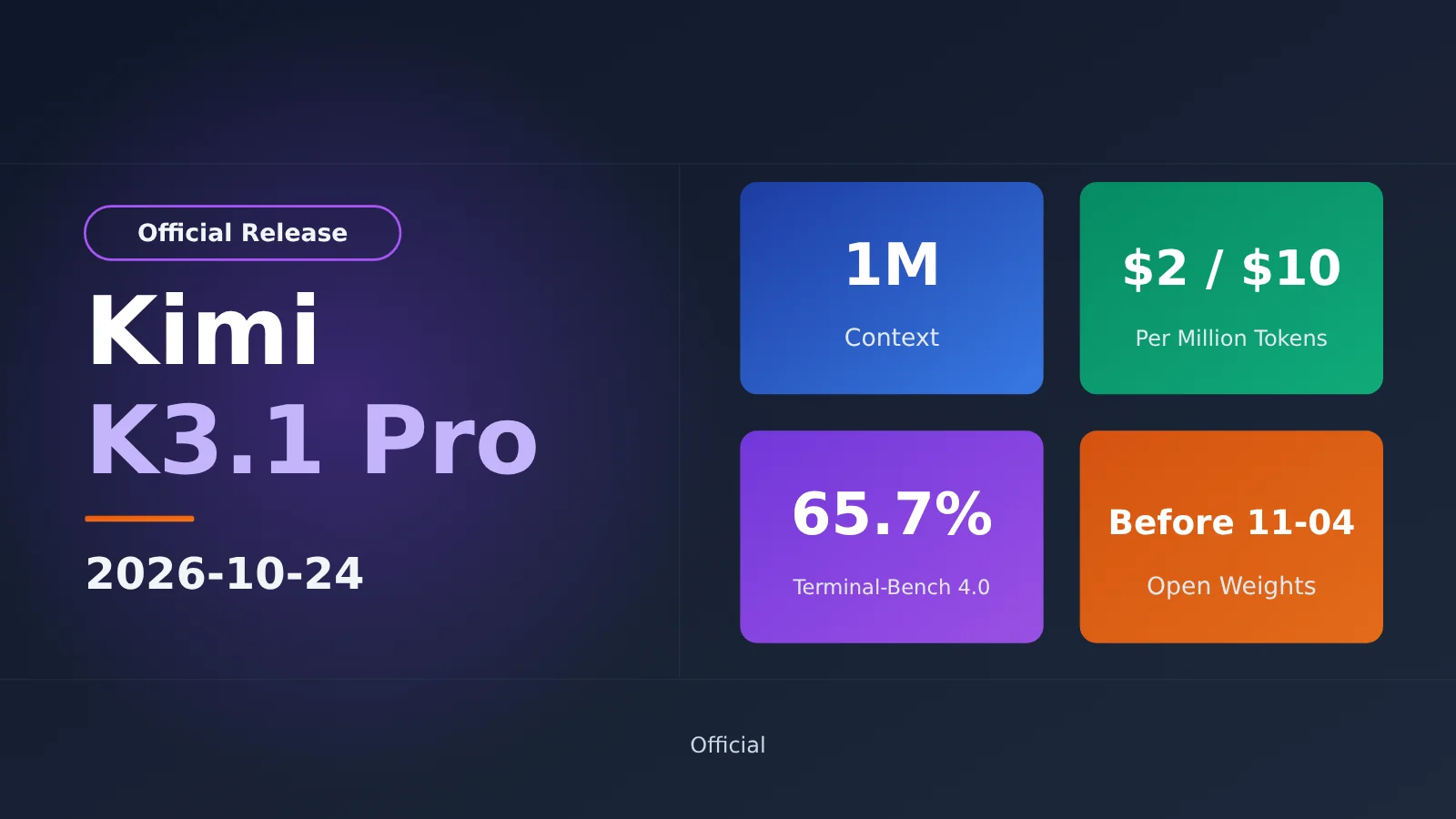
Kimi K3.1 Pro officially launched on 2026-10-24. It was available that same day on the web, in the app, through Kimi Code, and via the Kimi API. Its three main prices are 33% lower than K3’s. Moonshot has committed to releasing the full model weights by 2026-11-04. This information comes from Moonshot’s official blog and documentation. In a third-party evaluation published by Artificial Analysis on 2026-10-23, the model ranked fourth overall.
This isn’t a rumor: the model name, pricing, and availability are all listed in the official documentation. This article covers what launched, how much it costs, and whether you can use it now—in that order. Each fact is labeled by source type: official, third-party, or unverified.
Key facts (captured on 2026-10-24)
| Item | Details | Source type |
|---|---|---|
| Release date | 2026-10-24 (an overseas evaluation firm published its report on 2026-10-23) | Official |
| Model names | kimi-k3.1-pro, kimi-k3.1-pro-highspeed |
Official |
| Context | 1M tokens, with no tiered pricing | Official |
| Pricing | $2.00 input / $10.00 output (USD per million tokens, excluding tax) | Official |
| Available on | kimi.ai website and app, Kimi Work, Kimi Code, Kimi API, and Enterprise (disabled by default) | Official |
| Weight release | Full model weights promised by 2026-11-04 | Official |
1. What Is Kimi K3.1 Pro? In a Nutshell
Kimi K3.1 Pro is the first model in the K3.1 series. It’s a version of K3 that’s been “post-trained”—meaning it received additional, targeted training on top of an already trained base model, rather than being retrained from scratch. The official announcement says this round of post-training used significantly more compute. Kimi describes it as “the strongest open-weight model in the 3T class,” with a 1M-token context window and significant improvements in coding and Agent capabilities (according to Kimi).
Here are three terms worth explaining. The “context window” is the amount of content a model can process at once. A 1M-token context window is roughly equivalent to several long novels. An “Agent” is a model that can break down tasks, use tools, and carry out multiple steps on its own, rather than just answering one question at a time. “Open weights” means the model’s parameter files are publicly available, so anyone can download and deploy the model themselves.
Kimi K3.1 Pro Highspeed launched on the same day. Kimi says it offers the same capabilities as Pro, runs 2–3 times faster, and costs twice as much (according to Kimi). There’s no third-party testing yet to verify the specific speedup, so we won’t cite it below.
2. The Three Biggest Changes in Kimi K3.1 Pro
| Area | Official figure | Compared with | Source |
|---|---|---|---|
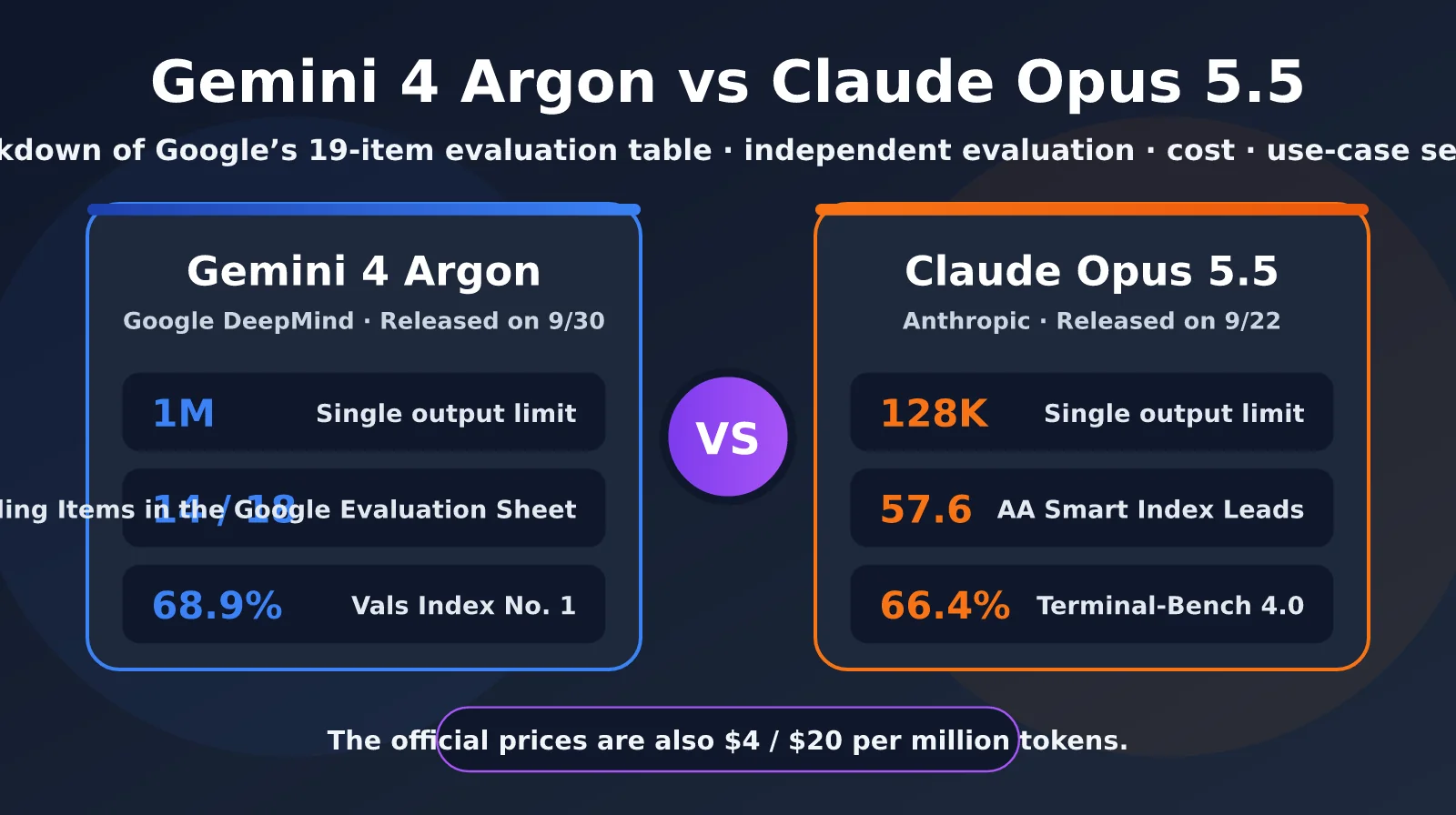
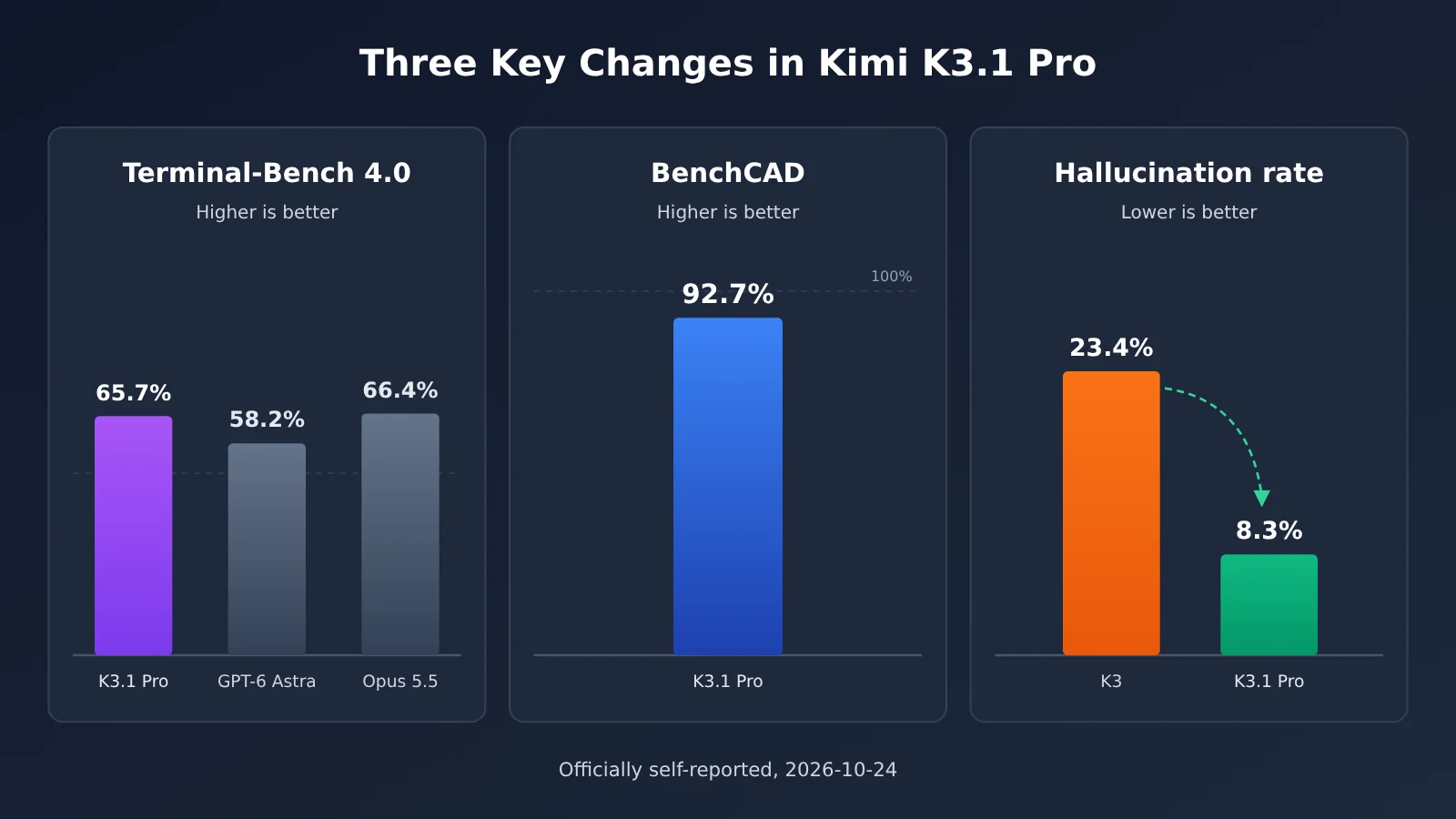
| Coding / terminal tasks | Terminal-Bench 4.0: 65.7% | GPT-6 Astra: 58.2%; Claude Opus 5.5: 66.4% | Official claim |
| 3D modeling and design | BenchCAD: 92.7% (with tools) | 3D Make feature launched at the same time | Official claim |
| Factuality / hallucinations | Kimi Hallu Bench Hard hallucination rate: 23.4% → 8.3% | Compared with K3; internal stress test | Official claim |
2.1 Kimi K3.1 Pro’s Coding Ability: 65.7% on Terminal-Bench 4.0
Terminal-Bench evaluates how well models can independently complete real-world tasks in a command-line environment. A higher score means a model is better at getting the job done on its own. The official report gives K3.1 Pro a score of 65.7%, ahead of GPT-6 Astra at 58.2% and just behind Claude Opus 5.5 at 66.4%. On the official long-horizon coding benchmark, Kimi Code Bench 3.0 Long-horizon, K3.1 Pro scored 61.2%, while K3 scored 55.95%.
Official examples span game engines (Unity, Unreal Engine, and Godot) and web-based 3D with Three.js. They include a UE 5.8 scene, a Godot 4.7.2 game, and a browser-based 3D disassembly animation made up of 2,317 parts that passed 55 browser checks. These are handpicked examples from the official showcase, not a measure of average performance.
2.2 Kimi K3.1 Pro’s 3D Capabilities: 92.7% on BenchCAD and 3D Make
BenchCAD measures how accurately a model can generate CAD (computer-aided design) models. The official report gives K3.1 Pro a score of 92.7% when using tools. K3.1 Pro can write scripts to operate Blender and CAD software directly, without requiring an additional MCP connector. MCP is a general-purpose protocol that lets models connect to external tools.
For everyday users, the new feature is 3D Make, now available on the kimi.ai website and in the Kimi App. Users can preview and edit 3D models online, download files for 3D printing, or export videos and Live Photos.
2.3 Kimi K3.1 Pro Factuality: Hallucination Rate Drops from 23.4% to 8.3%
“Hallucination” refers to a model making up facts that don’t exist. In its internal stress test, Kimi Hallu Bench Hard, the company reported that the hallucination rate dropped from 23.4% for K3 to 8.3%. This is an internal evaluation reported by the company, and no third party has reproduced the results yet. If you cite these figures, be sure to note their source.
The company has also shared official figures for financial tasks. Kimi scored 64.4 on OfficeQA Pro v2, which the company describes as an SOTA (state-of-the-art) result. On internal benchmarks, Financial Modeling improved by 7.2 points, Financial Research by 11.6 points, and Business Operation performance was about 4.2 times that of K3.
2.4 Kimi K3.1 Pro Safety: Deliberately Reducing Cyberattack Capabilities
The company specifically noted that cybersecurity-related data was removed during training because the model’s weights would be made public. On the vulnerability discovery benchmark xdev-bench-hard, the model scored 81.0% on pass@3, compared with 90.5% for an unfiltered version trained using the same pipeline. Pass@3 is the probability that the model succeeds at least once across three attempts. The company said this was intended to let open weights spread gradually and prevent these capabilities from being concentrated in a small number of closed-source systems.
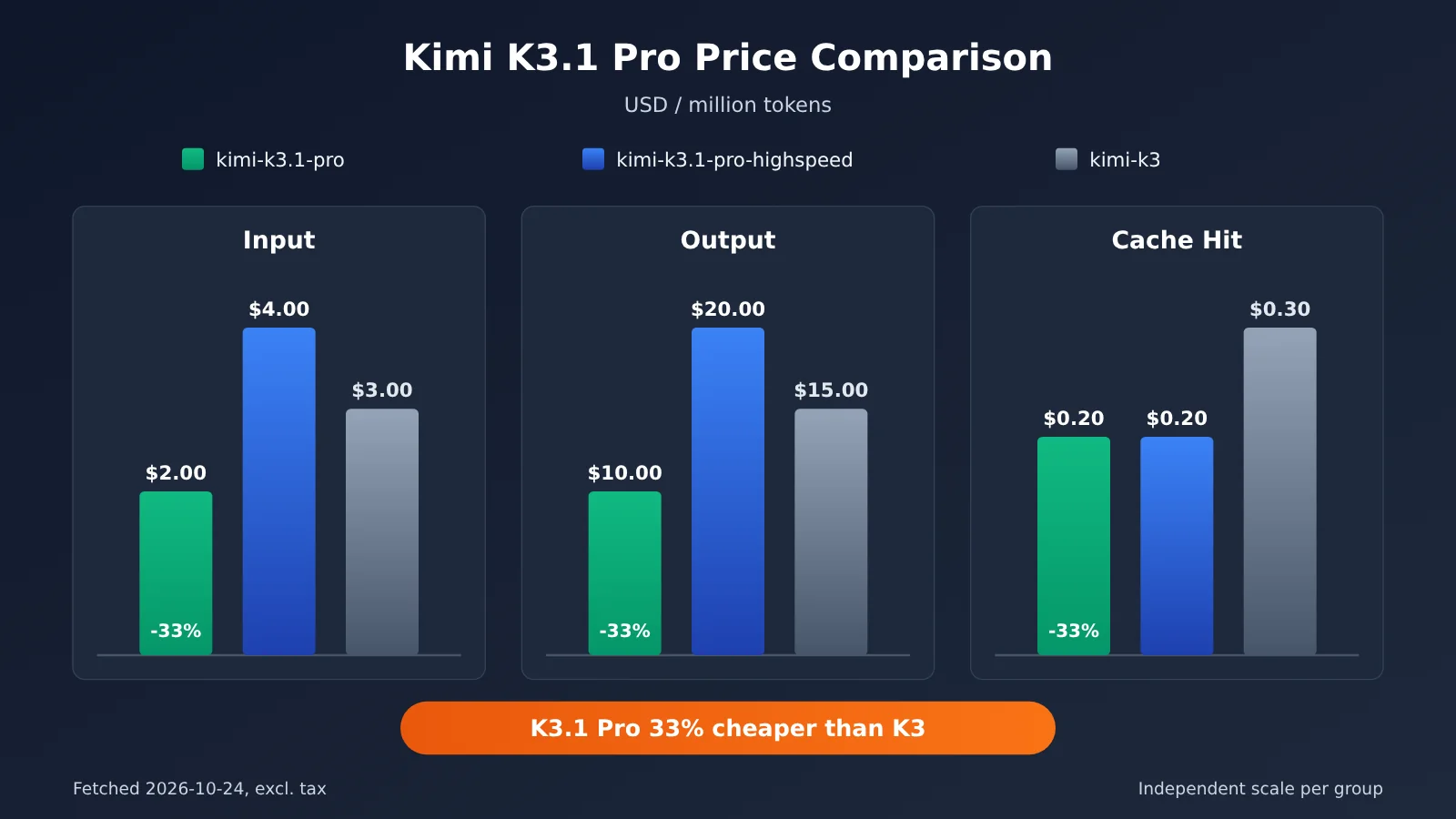
3. Kimi K3.1 Pro Pricing: Comparing Five Rates Across Two Generations
The prices below were retrieved on 2026-10-24, in USD per million tokens, excluding tax (as reported by the official source). Tokens are the text units used for model billing. One Chinese character typically corresponds to about 1–2 tokens.
| Model | Input | Output | Cache hit | 5-minute cache write | 1-hour cache write |
|---|---|---|---|---|---|
kimi-k3.1-pro |
$2.00 | $10.00 | $0.20 | $2.00 | $4.00 |
kimi-k3.1-pro-highspeed |
$4.00 | $20.00 | $0.20 | $4.00 | $8.00 |
kimi-k3 (previous generation) |
$3.00 | $15.00 | $0.30 | $3.00 | $6.00 |
A “cache hit” means that previously sent content, such as a fixed system prompt, is remembered by the server and billed at a lower rate on subsequent calls. A “cache write” is the cost of storing content in the cache for the first time. The 5-minute and 1-hour options indicate how long the cached content is retained.
Compared with the previous generation, K3.1 Pro’s unit prices for input, output, and cache hits are all 33% lower than K3’s. The official source also states that the 1M context window is billed at a flat rate, with no switch to a more expensive tier as the input gets longer. The Highspeed version costs twice as much as Pro for input, output, and cache writes, while the cache hit price is the same. Official data on prices in RMB and discounts from domestic channels wasn’t available at the time of writing, so no estimates are included here (unverified).
4. Where You Can Use Kimi K3.1 Pro Now: A List of 6 Channels
The following information comes from official documentation and is self-reported:
- kimi.ai website and app: Available directly on the website and in the iOS, Android, and HarmonyOS apps.
- Kimi Work desktop app: Requires version 3.1.0 or later. Supports Windows and Macs with Apple chips.
- Kimi Code: Switch to K3.1 Pro with the
/modelcommand. Membership requirements are: k3.1-pro: Plus membership or higher;- 1M context window: Pro membership or higher;
- highspeed version: Pro membership or higher, and uses about twice the quota.
- Kimi API: The model names are
kimi-k3.1-proandkimi-k3.1-pro-highspeed. API customers can opt for ZDR (Zero Data Retention), meaning the server doesn’t store request or response content. - Enterprise version: Disabled by default at launch; an organization admin must enable it manually.
- Full model weights: The company has committed to releasing them by 2026-11-04, so you’ll be able to download and deploy them yourself.
The official documentation also offers three recommendations for switching models. Start a new conversation rather than continuing an old one. Use the native Responses, Chat Completions, or Messages interface whenever possible. When using third-party tools, make sure you enter the exact model name. If you get it wrong, requests will fall back to K2.8 Preview, with thinking mode disabled.
5. Kimi K3.1 Pro Timeline: 4 Key Dates
| Date | Event | Source |
|---|---|---|
| 2026-10-23 | Overseas evaluation organizations such as Artificial Analysis publish their results | Third-party |
| 2026-10-24 | Kimi K3.1 Pro and Highspeed officially launch, and the official blog goes live | Official |
| 2026-10-31 | The K2 series becomes unavailable to newly registered users; existing users are unaffected | Official |
| By 2026-11-04 | Full K3.1 Pro model weights are released | Official |
| By 2026-12-31 | The K2 series is scheduled to be fully retired (the official announcement only says “by the end of the year,” without specifying a date) | Official |
If your project still uses the K2 series, accounts registered after 2026-10-31 can no longer access K2. The official recommendation is to complete the migration by the end of the year. You can migrate directly to K3.1 Pro, which costs less per unit than K3.
6. Third-Party Review of Kimi K3.1 Pro: Artificial Analysis Scores It 55
The following results are from Artificial Analysis’s evaluation, published on 2026-10-23 (third-party):
| Metric | Result |
|---|---|
| Intelligence Index score | 55, ranked 4th—11 points higher than K3 |
| Models ranked higher | Claude Opus 5.5 (58), Claude Sonnet 5.5 (56), Muse Wonder Full (56) |
| Terminal-Bench 4.0 result | 67%, the highest among all models tested by the organization |
| Gap between open-weight and closed-source models | The score gap narrows from 12 points to 3, assuming the weights are released |
| Output speed | 80.7 tokens/second |
| Cost per task | Approximately $1.98–2.11 (USD) |
Two points are worth noting. The third-party Terminal-Bench 4.0 result is 67%, slightly higher than the officially reported 65.7%. This is because the test environments and settings differ, so the two figures can’t be directly compared by subtraction. Also, the claim that it’s the “highest-scoring open-weight model” will only hold once the weights are actually released by 2026-11-04. There are currently too few publicly shared developer experiences from hands-on testing, so this article doesn’t summarize them (unverified).
7. How Developers in China Can Use Kimi K3.1 Pro
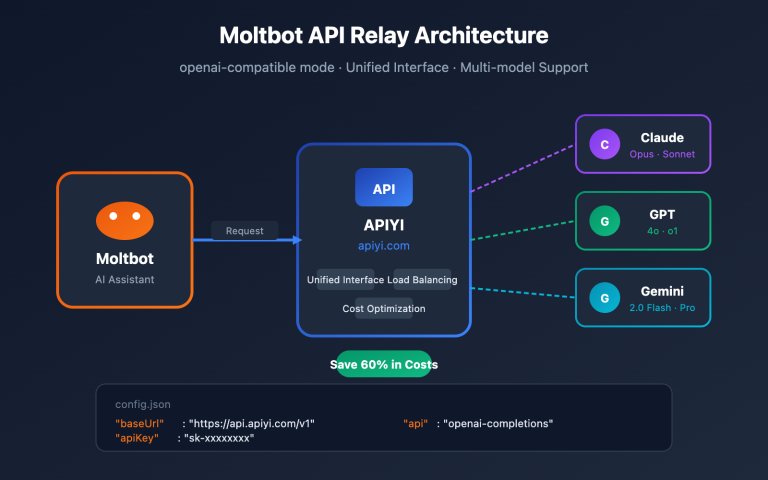
Developers in China who want to use a single API key to access models like Kimi, OpenAI, Claude, and Gemini can consider an OpenAI-compatible aggregator such as APIYI (apiyi.com). To get started, change the base_url in your existing code to https://api.apiyi.com/v1, then set the model parameter to the corresponding model name. You usually won’t need to change anything else. As of 2026-10-24, APIYI’s model list includes the Kimi models kimi-k2.5, kimi-k2.6, kimi-k2.7-code, and kimi-k3. K3.1 Pro hasn’t appeared in the list yet. We’ll add it as soon as possible; once it’s available, check the APIYI model list for its model name and pricing.
Here’s how to get started:
- Register at APIYI (apiyi.com) and get an API key. New users receive free credits for testing.
- For the OpenAI-compatible API, set
base_url = https://api.apiyi.com/v1. - For tools that use the Anthropic Messages format, enter
https://api.apiyi.com. - For now, you can use
kimi-k3to test your integration. Once K3.1 Pro appears in the list at docs.apiyi.com/models, update themodelparameter. Use the model name shown in the list—don’t guess it manually.
Frequently Asked Questions
Q1: How is Kimi K3.1 Pro related to K3?
K3.1 Pro is a post-trained version based on K3, not a new model trained from scratch (according to the company). It retains a 1M context window and improves Agent capabilities in areas such as coding, 3D, and finance. Its prices for input, output, and cache hits are each 33% lower than K3’s.
Q2: Should I choose Kimi K3.1 Pro or the Highspeed version?
The company says the two versions offer the same capabilities, while Highspeed is 2–3 times faster. However, its input, output, and cache write prices are twice those of Pro. Pro is a good choice for batch tasks where latency isn’t critical; consider Highspeed for interactive use. Using Highspeed in Kimi Code requires a Pro or higher membership and consumes about twice the quota.
Q3: When will Kimi K3.1 Pro weights be available to download?
The company has committed to releasing the full model weights by 2026-11-04. Until then, you can only use the model through the official website, app, Kimi Code, and Kimi API.
Q4: Can developers in China access Kimi K3.1 Pro through APIYI?
As of 2026-10-24, K3.1 Pro isn’t yet in the APIYI model list at apiyi.com. We’ll add it as soon as possible. Once it’s available, check the platform’s model list for its name and pricing. In the meantime, you can use the listed `kimi-k3` model to test your integration.
Q5: Do projects still using K2 need to migrate right away?
Existing users can continue using K2 after 2026-10-31, but the company plans to retire all K2 models by the end of 2026, so it’s best to migrate early. When migrating, start a new session and enter the exact model name to avoid falling back to K2.8 Preview.
Q6: What are the known limitations of Kimi K3.1 Pro?
Its cybersecurity capabilities have been deliberately reduced, and its vulnerability discovery score is lower than that of the unfiltered version (81.0% versus 90.5%). Several figures, including the hallucination rate and finance evaluation results, come from internal company tests and haven’t yet been independently reproduced. The enterprise version is disabled by default and must be enabled by an administrator.
Kimi K3.1 Pro Key Takeaways
- Release date: Officially released on 2026-10-24, with the Highspeed version launching the same day.
- Model positioning: A post-training version of K3 with a 1M context window, focused on coding and agents.
- Three official metrics: 65.7% on Terminal-Bench 4.0, 92.7% on BenchCAD, and an 8.3% hallucination rate.
- Pricing: $2 per million input tokens / $10 per million output tokens—33% cheaper than K3.
- Third-party rating: Scored 55 from Artificial Analysis, ranking 4th.
- Key dates: K2 will be closed to new users on 2026-10-31, and its weights will be released by 2026-11-04.
- Access in China: You can access the Kimi series through APIYI at apiyi.com using an OpenAI-compatible API. We’ll make K3.1 Pro available as soon as possible; check the platform’s model list for the model name and pricing.
Summary
Kimi K3.1 Pro stands out in three areas:
- Capabilities: Official metrics support its performance in coding, 3D, and factuality. It scored 55 in third-party evaluations, ranking 4th.
- Pricing: Prices are lower across all five tiers, with uniform pricing for the 1M context window. The Highspeed version costs twice as much.
- Availability: It’s available on the web, in the app, through Kimi Code, and via the Kimi API. Enterprise users need to enable it manually, and the weights will be released by 2026-11-04.
Individual users can try the 3D Make and coding features now on kimi.ai or in the app. Developers can start planning their migration from K2 and follow the weight release on 2026-11-04. Teams that need a unified way to access multiple models can use kimi-k3 on APIYI at apiyi.com to test their workflows. We’ll make K3.1 Pro available as soon as possible; once it launches, check the platform’s model list for its name and pricing.
References
- Official Kimi K3.1 Pro Blog: Kimi K3.1 Pro Tech Blog: Advancing Open Intelligence
- Link:
kimi.ai -
Notes: Official source for release information, capability metrics, pricing, and safety details
-
Artificial Analysis Evaluation: Third-party assessments of the Intelligence Index and Terminal-Bench 4.0
- Link:
artificialanalysis.ai -
Notes: Third-party scores, speed, and cost data published on 2026-10-23
-
APIYI Model List: Models currently available on the platform and their pricing
- Link:
docs.apiyi.com/models - Notes: Refer to this list for Kimi model names and pricing
Author: APIYI Technical Team
Technical Support: For more integration details, see the documentation center at docs.apiyi.com. We plan to make Kimi K3.1 Pro available as soon as possible. The exact model names and pricing will be listed in the platform’s model list.