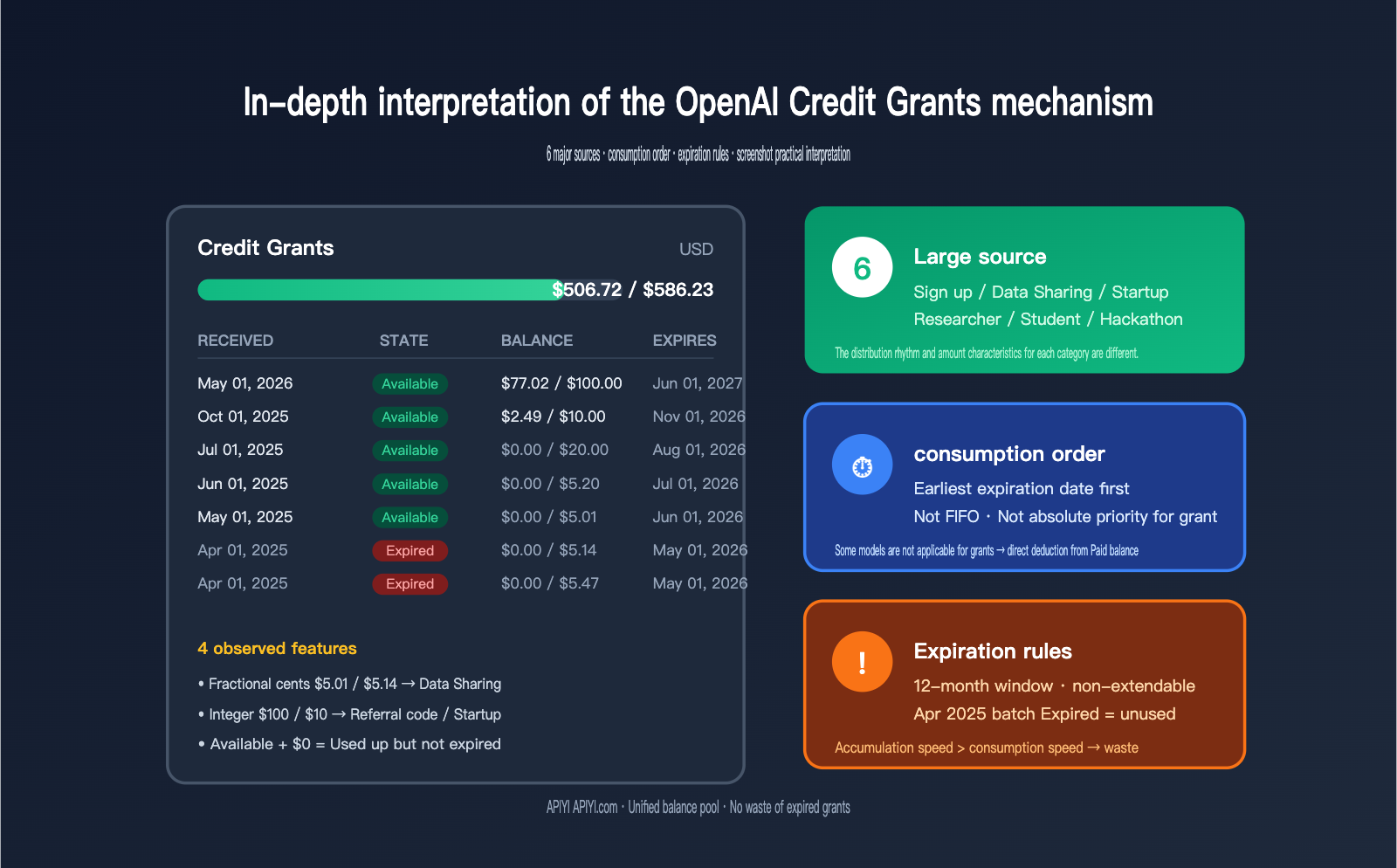
Recently, a client sent us a screenshot asking about their OpenAI dashboard. They noticed dozens of small credit grants piling up—one to three entries almost every month from May 2025 to May 2026. The amounts were odd, like $5.01, $5.14, and $5.32, mixed in with a $100 and a $10 credit. In total, they had $586.23 in grants, with $506.72 already spent. What really confused them was that a $5.01 grant from May 2025 was still marked as "Available," yet their balance was $0.00, while several grants from April 2025 were marked as "Expired," also with a $0.00 balance.
This highlights a fact that many teams misunderstand: OpenAI Credit Grants are not as simple as "use the free credits first, then charge the credit card." The mechanism is far more complex than it appears—it’s not a single concept, a single source, or a simple "first-in, first-out" consumption model. In this article, we’ll use official documentation to break down the six sources of Credit Grants, the consumption order, expiration rules, and how they interact with your Paid Balance, using our client’s screenshot as a case study.
What Exactly Are OpenAI Credit Grants?
Many teams see "Credit Grants" and instinctively assume they're just "free credits." That's only half the story. In the OpenAI dashboard, Credit Grants is a blanket term covering all credits that aren't purchased by the user but are instead issued by OpenAI. This includes sign-up bonuses, data sharing rebates, startup program grants, promo codes, researcher programs, and more—all of which have very different origins.
These are entirely separate from your "Paid Balance" (prepaid credits you've purchased). They have their own ledgers, expiration dates, and display locations in the dashboard. Understanding the boundary between these two pools is essential to grasping how OpenAI’s billing logic works.
| Dimension | Credit Grants | Paid Balance |
|---|---|---|
| Funding Source | Platform gifts, program rebates, promo codes | Credit card / Top-up / Auto-Recharge |
| Ledger Method | ✅ Each batch tracked with its own expiry | ❌ One single total balance |
| Expiration | ✅ Usually 12 months | ✅ 12 months after purchase |
| Refundable | ❌ Non-cash, cannot be refunded | ❌ Non-refundable (OpenAI policy) |
| Dashboard Location | Settings → Billing → Credit Grants | Settings → Billing → Overview |
| API Key Usage | Applied automatically, no switching needed | Applied automatically, no switching needed |
🎯 Pro-tip for simplicity: If your business requires high billing transparency and you don't want to manually track multiple expiring grants every month, consider routing your production traffic through a unified gateway like APIYI (apiyi.com). This consolidates your account into a single balance pool, eliminating the headache of "multiple expiring pools" and making cost estimation and reconciliation much easier.
6 Common Sources of OpenAI Credit Grants
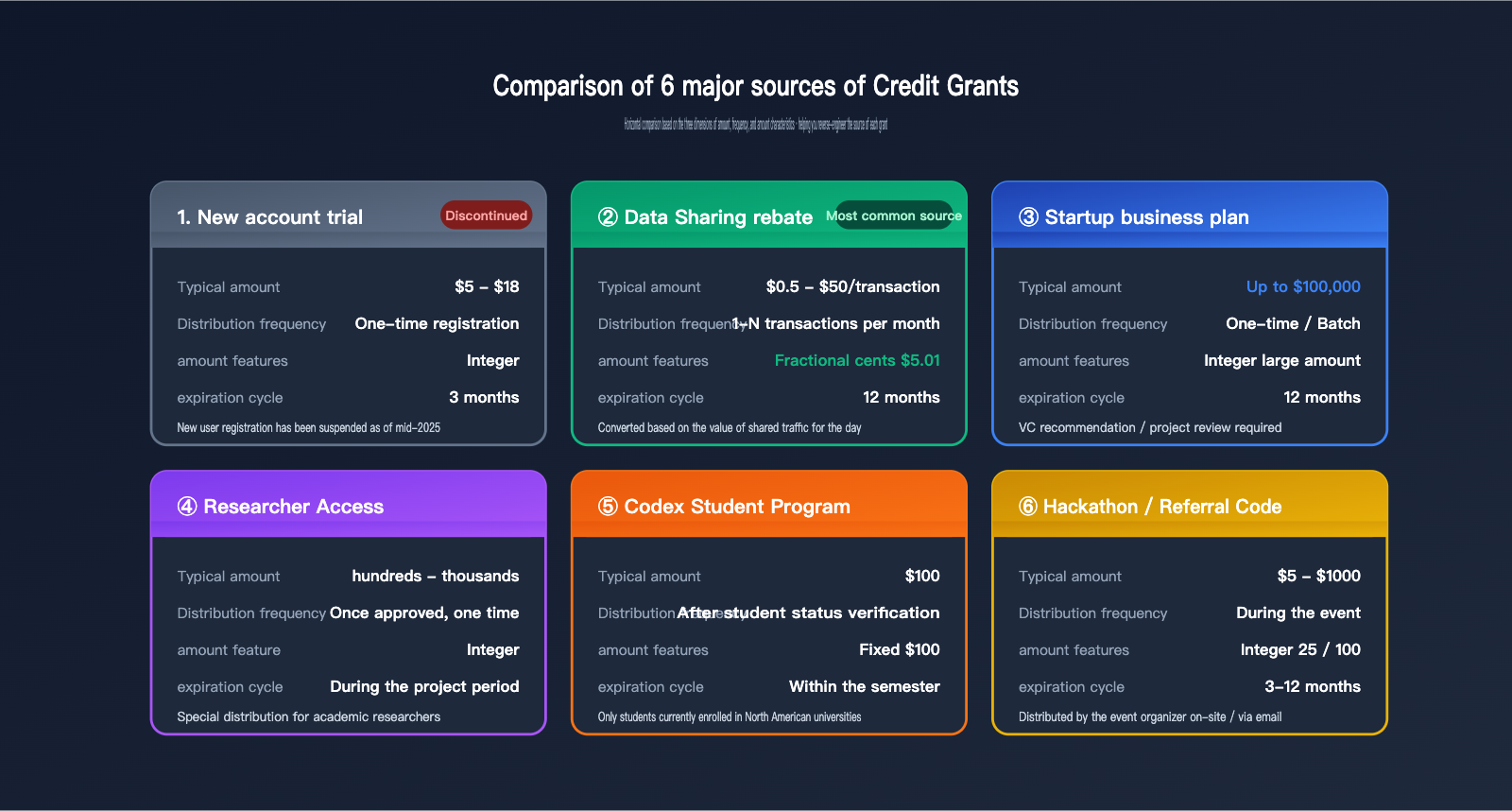
Based on OpenAI's issuance patterns for 2025-2026, there are six main sources for Credit Grants. Understanding the characteristics and frequency of these grants can help you quickly identify where a specific credit in your account came from.
The first category is New Account Sign-up Bonuses. In the past, OpenAI provided $5–$18 in trial credits for new accounts, but this was discontinued in mid-2025, so new users won't see this anymore. The second is the Data Sharing Program rebate, launched in December 2024. If you enable data sharing, your shared traffic is converted into credits daily. A tell-tale sign of these is the odd, fractional cent amounts.
The third is the OpenAI for Startups program, which provides qualified early-stage teams with up to $100,000 in development credits, usually issued as a large lump sum or in stages. The fourth is the Researcher Access Program, which provides bulk credits to academic researchers. The fifth is the Codex Student Program, which provides small amounts to North American university students. Finally, the sixth category includes Hackathons / Promo Codes. OpenAI sponsors many hackathons annually, and developers often collect hundreds or even thousands of dollars in credits this way.
| Source | Typical Amount | Frequency | Amount Characteristics |
|---|---|---|---|
| New Account Trial | $5–$18 | One-time (Discontinued) | Whole numbers ($5 / $10 / $18) |
| Data Sharing Rebate | $0.5–$50/entry | 1–N times per month | Fractional cents ($5.01 / $5.14) |
| Startup Program | Up to $100,000 | One-time or phased | Large whole numbers |
| Researcher Access | Hundreds to thousands | One-time after approval | Whole numbers |
| Codex Student | $100 ChatGPT credit | After enrollment verification | Whole numbers |
| Hackathon / Promo | $5–$1000 | During events | Whole numbers ($25 / $100 / $500) |
🎯 Identification Tip: If you see recurring, small-amount entries with "fractional cents" and "start-of-month" timestamps in your Credit Grants list, it's almost certainly the Data Sharing Program. To turn this into stable, predictable capacity, we recommend routing your production traffic through an API proxy service like APIYI (apiyi.com). This ensures you're working with a stable balance settled in real-time based on tokens, rather than relying on "potentially expiring" vouchers.
The Truth About OpenAI Credit Grants Consumption Order
This is arguably the most misunderstood aspect of OpenAI billing. The official policy is: When your account holds multiple Credit Grants and a Paid Balance, they are consumed based on their "earliest expiration date" first. It is neither FIFO (First-In, First-Out), nor LIFO (Last-In, First-Out), and it certainly doesn't mean grants are always prioritized over paid funds.
The reason most users feel like "grants are always used first" is simply that grants tend to expire sooner than paid credits. Grants usually expire 12 months after they are issued, and paid credits also have a 12-month window, but the clock for paid credits starts the moment you top up your account. Consequently, in most scenarios, your grants hit their expiration threshold before your paid balance, leading them to be consumed first.
However, there are exceptions. Certain OpenAI models or billing items (such as specific fine-tuning training costs or image generation via particular channels) are marked as "grant ineligible." These calls bypass the grant pool and deduct directly from your paid balance. This is the root cause of the "my grant is still valid, but my paid balance was deducted" phenomenon frequently reported in the OpenAI community—it’s not a bug, and it’s not OpenAI "stealing" your money.
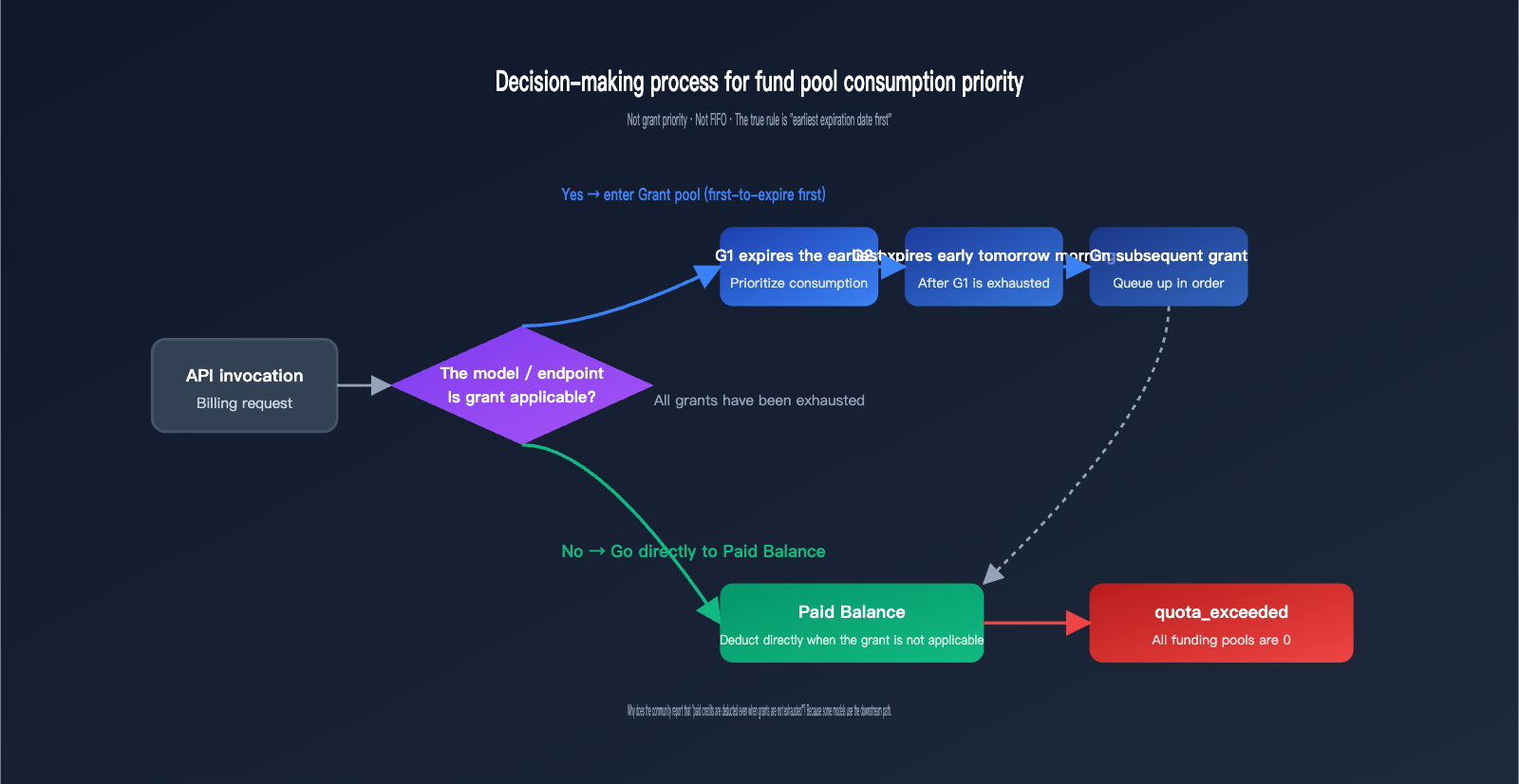
| Priority | Fund Type | Trigger Condition |
|---|---|---|
| 1 | Earliest Expiring Grant | The grant is applicable to the current model/endpoint |
| 2 | Next Earliest Expiring Grant | The previous one is exhausted |
| 3 | Paid Balance | All applicable grants are exhausted, or the call is grant-ineligible |
| 4 | Call Failure | All available funds are 0, returns quota_exceeded |
🎯 Production Stability Tip: If your business relies on a stable monthly budget and you want to avoid the chaos of "multiple expiring pools + applicability switching," the simplest approach is to route your OpenAI calls through the APIYI (apiyi.com) gateway. Your entire account will have a single balance, billed transparently by token, ensuring you don't face unexpected "sudden paid balance deductions" due to shifting grant eligibility.
Deep Dive into OpenAI Credit Grants Account Screenshots
Let's take a closer look at the user's screenshot. The progress bar showing $506.72 / $586.23 indicates that this account has received a total of $586.23 in grants and has already consumed $506.72, leaving a remaining balance of $79.51. If you carefully cross-reference the rules we discussed earlier, every line item in the status list has a logical explanation.
The first pattern is monthly batch issuance + fractional cents. You'll see 1–3 grants of around $5 appearing on the 1st of every month, with amounts like $5.01, $5.14, $5.20, or $5.32. This is the Data Sharing Program batch-processing the previous month's shared traffic, converted into USD based on official pricing. Those fractional cents are just the remainders from the Token-to-Dollar conversion.
The second pattern is occasional large amounts mixed with small ones. In the screenshot, there's a $100 grant in May 2026 and a $10 grant in October 2025. These clearly break the "small monthly amount" pattern and are almost certainly from hackathon promo codes or Startup program batches. The expiration dates for these are also longer than the standard small grants, which confirms that "different sources have different expiration dates."
The third pattern is $0.00 balance while still in "Available" status. For example, the $5.01 grant from May 2025 is still marked as "Available" (expiring in June 2026), but the balance is already $0.00. This is a direct result of the "first-to-expire, first-consumed" rule: because its expiration date was relatively close, it was prioritized for consumption, even though the status hasn't flipped to "Expired" yet because the date hasn't actually passed.
The fourth pattern is the entire batch of April 2025 grants marked as "Expired". The four grants at the bottom of the screenshot, issued in April 2025, are all marked "Expired" with an expiration date of May 1, 2026. This means this batch wasn't fully consumed before the deadline, and the remainder was forfeited. In other words, the user's grant accumulation rate was faster than their consumption rate, so some of the gifted credit was genuinely wasted.
| Screenshot Feature | Phenomenon | Underlying Mechanism | Note |
|---|---|---|---|
| Fractional cents ($5.01 / $5.14) | Appears monthly | Daily Data Sharing traffic conversion | Ongoing |
| Integers ($100 / $10) | Occasional | Promo codes / Startup program | One-time issuance |
| Available + $0.00 | Used up, not expired | First-to-expire, first-consumed | Not a bug |
| Expired + $0.00 | Expired and forfeited | Accumulation > Consumption | Wasted |
| Progress bar $506.72/$586.23 | 86% consumed overall | Includes consumed + forfeited | Real net usage is lower |
🎯 Optimization Tip: If you notice the "Expired" ratio in your account is increasing, it means your grant accumulation is outpacing your consumption. Relying solely on stretching out your direct OpenAI usage isn't the most cost-effective strategy. We recommend routing your production traffic through the APIYI (apiyi.com) gateway, keeping your direct OpenAI account specifically for "burning through" those must-use grants, while managing your new budget through APIYI for better, more centralized control. Overall, this approach offers much better value.
FAQ: Common Misconceptions About OpenAI Credit Grants and Paid Balance
Q1: Are Credit Grants always consumed before Paid Balance?
Not necessarily. OpenAI’s rule is "earliest expiration date first," not "grants always take priority over paid." In most cases, grants are used up before paid balance simply because they tend to expire sooner. If you just added paid credit a few days ago, but you have a grant in your pool that expires next month, OpenAI will still deduct from that grant first.
Q2: I haven't enabled data sharing, so why do I still get $5 in monthly grants?
There are three possibilities: you enabled it previously and forgot to turn it off in Data Controls, another project in your organization enabled data sharing, or you participated in a hackathon/used a promo code in the past and forgot. You can check your current status in Settings → Data Controls and cross-reference it with your grants timeline to trace the source.
Q3: Is it a bug if my Grants show $0.00?
It’s not a bug. "Available" status + $0.00 balance means the grant has been fully consumed, but its expiration date hasn't passed yet, so the status hasn't flipped to "Expired." "Expired" status + $0.00 means the grant has reached its expiration date, and any remaining unused portion is now void.
Q4: Is there any way to recover expired Grants?
No. OpenAI explicitly states in their Help Center that they "cannot extend any expired credit grants or purchased credits." To avoid this waste, you can route your production traffic to a unified gateway like APIYI (apiyi.com), which settles costs in real-time based on token usage, eliminating the "use it or lose it" failure mode at the architectural level.
Q5: How can I tell where a specific Grant in my account came from?
The OpenAI dashboard doesn't label sources directly, but you can infer them based on amount patterns and frequency: monthly recurring amounts + odd cents = Data Sharing; round numbers like $100 / $200 = Promo codes or Startup credits; one-time $25k / $100k = Researcher Access or large Startup grants; occasional $5-$10 round numbers = Hackathons. If you really can't figure it out, email OpenAI support with the issuance date, and they can look it up for you.
3 Key Takeaways on OpenAI Credit Grants
First, Credit Grants is a collective term for promotional or program-based credits, not a single concept, and certainly not a simple "rebate." It encompasses six major funding sources, ranging from registration trials to enterprise Startup programs, each with different issuance cadences and amount characteristics. Those "odd cents" you see in your screenshots are almost certainly the result of the Data Sharing Program.
Second, consumption follows the "earliest expiration first" rule, not FIFO, and definitely not "grants always beat paid." This rule explains why grants often appear to be "used first" and why your paid balance might be deducted during certain model invocations. Understanding this rule will resolve 90% of your billing disputes.
Third, "Available" does not mean "still usable"—$0.00 is the reality. Entries showing "Available" + $0.00 are simply grants that have been exhausted before their expiration date, while "Expired" + $0.00 means they have been forfeited. If you want to avoid the complexity of managing multiple pools and expiration schedules, the most stable approach is to route your production traffic through the APIYI (apiyi.com) gateway. With a single balance and transparent, token-based billing, you can eliminate the risk of grant expiration waste at the root.
{Interpretation of customer account health}
{$506.72 / $586.23 surface figures · the truth after breaking it down is more than "86% used"}
{Accumulation vs. consumption rate}
{$50}
{$30}
{$15}
{$0}
{Apr 25}
{Jul 25}
{Oct 25}
{Jan 26}
{May 26}
{accumulated grants}
{consumption speed}
{Accumulation > Consumption → Inevitably Expired}
{$586.23 total composition}
{$586.23}
{Total cumulative}
{Effective consumption 73%}
{Expired, 14% wasted}
{13% available for the current period}
{Expectations after switching to the unified gateway}
{expiration waste ratio}
{14% → 0%}
{number of funding pools}
{multi-pool → single-pool}
{Priority rules}
{Complex → Simple}
{reconciliation complexity}
{N transactions → one transaction}
{grant applicability}
{No need to worry}
{Suggest a dual-track system}
{Direct connection accounts are exclusively for consuming grants}
{Add the new budget to the unified gateway}
{The truth: the progress bar says "86% used", but 14% was actually wasted by Expired.}
If you're confused about the status of Credit Grants in your account, the quickest step is to check your dashboard against the "earliest expiration first" rule to calculate exactly how much you've lost to expired credits. Then, decide whether you want to direct more traffic to OpenAI to burn through those grants or switch to a unified gateway like APIYI (apiyi.com) to simplify your costs and eliminate expiration risks entirely.
📌 Author: APIYI Technical Team — We track OpenAI billing strategies, Credit Grant policy changes, and best practices for multi-model API gateways. We provide developers with a unified billing and transparent reconciliation experience for multi-model access. To learn more, visit APIYI at apiyi.com.