Many Hong Kong companies face the same awkward situation when building AI applications: they want to use GPT-5.5 and run OpenAI APIs, but a quick check of the official website reveals that Hong Kong isn't on the supported regions list. When they try to handle payments, their Hong Kong-issued credit cards get blocked by Stripe. This double barrier has stalled the AI deployment plans for many Hong Kong startups, cross-border e-commerce teams, and financial firms.
This article cuts to the chase, providing the three most practical paths for accessing OpenAI APIs in Hong Kong as of May 2026, along with an integration checklist for the full GPT-5.5 series. We'll focus on the API proxy service, which is the most suitable solution for commercial use in Hong Kong, and walk you through a 5-step guide complete with details on top-up rebates.
The 3 Core Obstacles to Using OpenAI API in Hong Kong
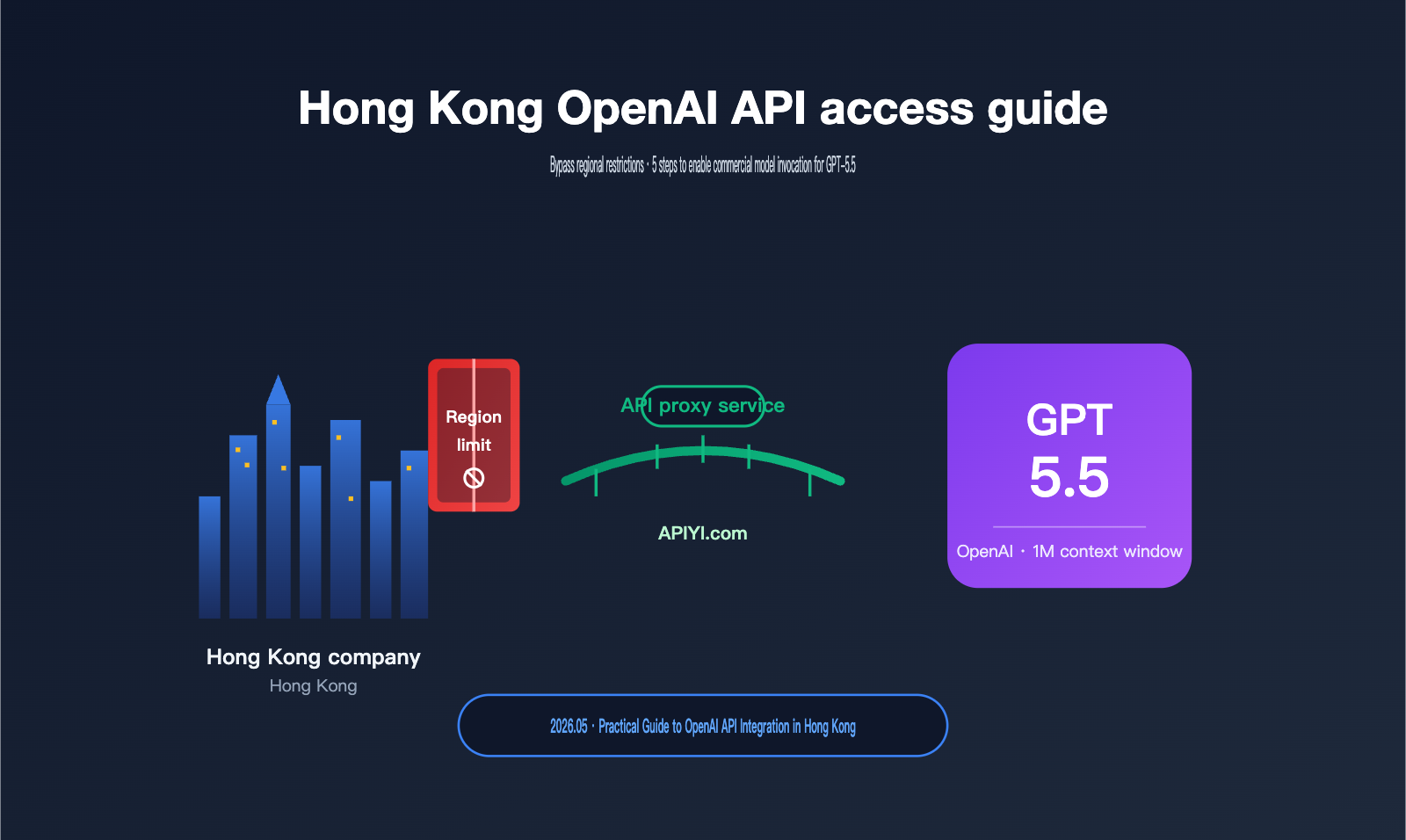
Many people assume that because Hong Kong is an international financial hub, accessing OpenAI shouldn't be an issue. The reality is much more complex. These three obstacles are unavoidable.
Obstacle 1: Hong Kong is not in the official OpenAI supported regions
If you open the official list of OpenAI supported countries (developers.openai.com/api/docs/supported-countries), you'll see Taiwan, Japan, and India on the list, but Hong Kong, Macau, and mainland China are not. OpenAI explicitly warns in its documentation: if you access or provide services from an unsupported region, your account may be frozen or banned.
This policy isn't just a simple technical restriction; it's a hard constraint at the compliance level. If a Hong Kong company provides services based on OpenAI directly to the public, they are already on the wrong side of the contract terms.
Obstacle 2: Hong Kong-issued credit cards are rejected by Stripe
OpenAI's payment channel is handled by Stripe. The three most common Hong Kong card issuers—HSBC, Hang Seng, and Bank of China (Hong Kong)—are frequently rejected during the payment process. Even international cards, like the HSBC Premier or Citibank Priority, have unstable success rates that fluctuate based on risk control policies.
This means that even if you bypass the IP restriction, you might not be able to link a card or top up your account. Many Hong Kong teams waste more time than their entire budget just trying different cards and dealing with 3D verification.
Obstacle 3: Commercial compliance and audit traceability
A deeper issue is compliance and auditing. It's hard for a Hong Kong company to justify using a "gray path" (VPN + US-issued card) for internal audits, client due diligence, or external service terms. Once a client asks, "How is your AI backend procured?", this path will immediately fall apart.
🎯 Core Conclusion: The real bottleneck for OpenAI API in Hong Kong isn't technical; it's "compliance explainability." Regardless of which path you choose, you need one that can be written into a contract and pass an audit. This is the fundamental reason why more and more Hong Kong companies are choosing compliant API proxy services like APIYI (apiyi.com)—it turns "OpenAI model invocation" into "procuring services from a compliant domestic company," making the contractual relationship clear and transparent.
Comparison of the 3 Main Access Methods for OpenAI API in Hong Kong
In theory, there are three primary paths for Hong Kong companies to access OpenAI: Microsoft Azure OpenAI, connecting directly to the official website via VPN + an overseas credit card, or using a third-party API proxy service. Each path has vastly different technical barriers, cost structures, and compliance profiles.
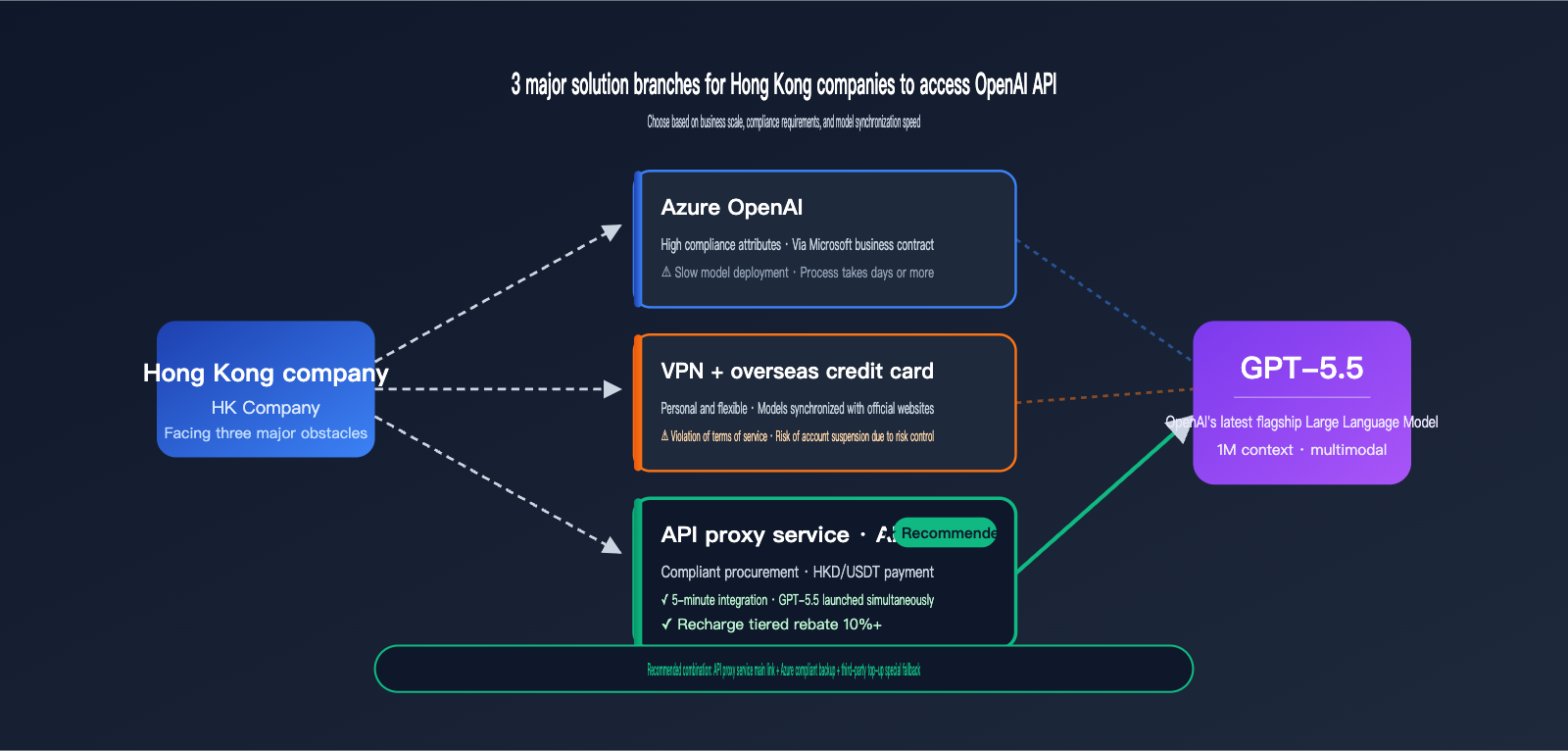
The table below compares the key dimensions of these three solutions, which you can use as a quick reference for internal technical selection.
| Dimension | Azure OpenAI | VPN + Overseas Credit Card | API Proxy Service (APIYI) |
|---|---|---|---|
| Access Barrier | High (requires corporate credentials, Microsoft partnership) | Low (individuals can do it), but prone to risk control | Extremely low (ready to use upon registration) |
| Compliance | High (governed by Microsoft business contracts) | Low (risk of violating OpenAI Terms of Service) | High (procurement of services for domestic compliant companies) |
| Model Coverage | Some models have a time lag; waiting for Azure deployment for models like GPT-5.5 | Synchronized with the official website | Synchronized with the official website |
| HK Credit Card Payment | Supported (via Microsoft channels) | Frequently declined | Supported (RMB, HKD, USDT, etc.) |
| Cost | Comparable to or slightly higher than official prices | Official price + VPN costs | Recharge rebates available on top of official prices |
| Target Audience | Large enterprises, those with Microsoft relationships | Individual developers, proof-of-concept projects | SMEs, independent developers, startups |
| Setup Time | Several days to weeks (due to processes) | Several hours (luck-dependent) | Within 5 minutes |
From this table, a clear conclusion emerges: Azure is suitable for large enterprises already using Microsoft, VPN direct connection is only suitable for personal experimentation, while an API proxy service is the optimal, immediately deployable solution for small and medium-sized Hong Kong companies.
💡 Selection Advice: If your Hong Kong company is already using Microsoft 365 Business, you can apply for Azure OpenAI as your foundation while using APIYI (apiyi.com) as a supplement. The former ensures a compliant base, while the latter ensures access to the latest models (as new models like GPT-5.5 often take weeks or months to land on Azure). Walking on two legs provides the highest level of business resilience.
Why an OpenAI API Proxy Service is the Best Choice for Hong Kong Companies
The essence of an API proxy service is simple: a compliant domestic company maintains full OpenAI accounts, compliant payment channels, and enterprise-level quotas overseas. They then provide these resources to you via a proxy interface. When a Hong Kong company connects, all they see is an HTTPS endpoint that is fully compatible with the OpenAI protocol, a single API key, and a billing channel that supports RMB/HKD/USDT invoices.
This model offers four irreplaceable benefits for Hong Kong companies:
First, zero-migration integration. You only need to change one line in the official OpenAI SDK to update the base_url. Model IDs (like gpt-5.5 or gpt-5.5-pro), parameters, function calls, and tool usage remain identical, making migration costs virtually zero.
Second, fully localized payments. Hong Kong companies can settle payments directly in HKD or RMB, receive official invoices, and process them through corporate accounts, completely avoiding the uncertainty and risk control issues associated with overseas credit cards.
Third, rapid model synchronization. When OpenAI releases a new model like GPT-5.5 at the end of April, mature proxy services like APIYI (apiyi.com) typically complete integration within a few hours to a day—far faster than Azure. This is critical for product teams that need to keep pace with rapid model iterations.
Fourth, dedicated technical support. When you run into issues like 429 errors, timeouts, or context window truncation, proxy services usually provide Chinese-language technical support groups and ticketing systems. Their response time is significantly faster than filing a ticket with OpenAI directly.
| Comparison Point | Direct OpenAI Official | API Proxy (APIYI) |
|---|---|---|
| Registration & Payment | Requires overseas phone + international credit card | Email registration + various local payments |
| Integration Time | Days (account, card binding, card rejection risks) | Get API key within 5 minutes |
| GPT-5.5 Availability | Requires account quota qualification | Available immediately upon registration |
| Chinese Support | Primarily English | Full Chinese documentation + group chat support |
| Recharge Granularity | Minimum $5 | Minimum ¥10, tiered rebates for large amounts |
| Invoice Compliance | International invoices, difficult for HK accounting | Compliant domestic invoices or HKD billing |
🚀 Quick Tip: The core value of an API proxy isn't just "being cheap"—it's about "avoiding pitfalls." It takes an average of 3–7 days for a Hong Kong engineer to go from registering an official OpenAI account to running their first successful call, with a high failure rate. Using APIYI (apiyi.com) to do the same takes just 5 minutes, with a high probability of success on the first try. Time costs are far more important than the price difference per token.
APIYI Now Covers the Full GPT-5.5 Series and Synchronized Model List
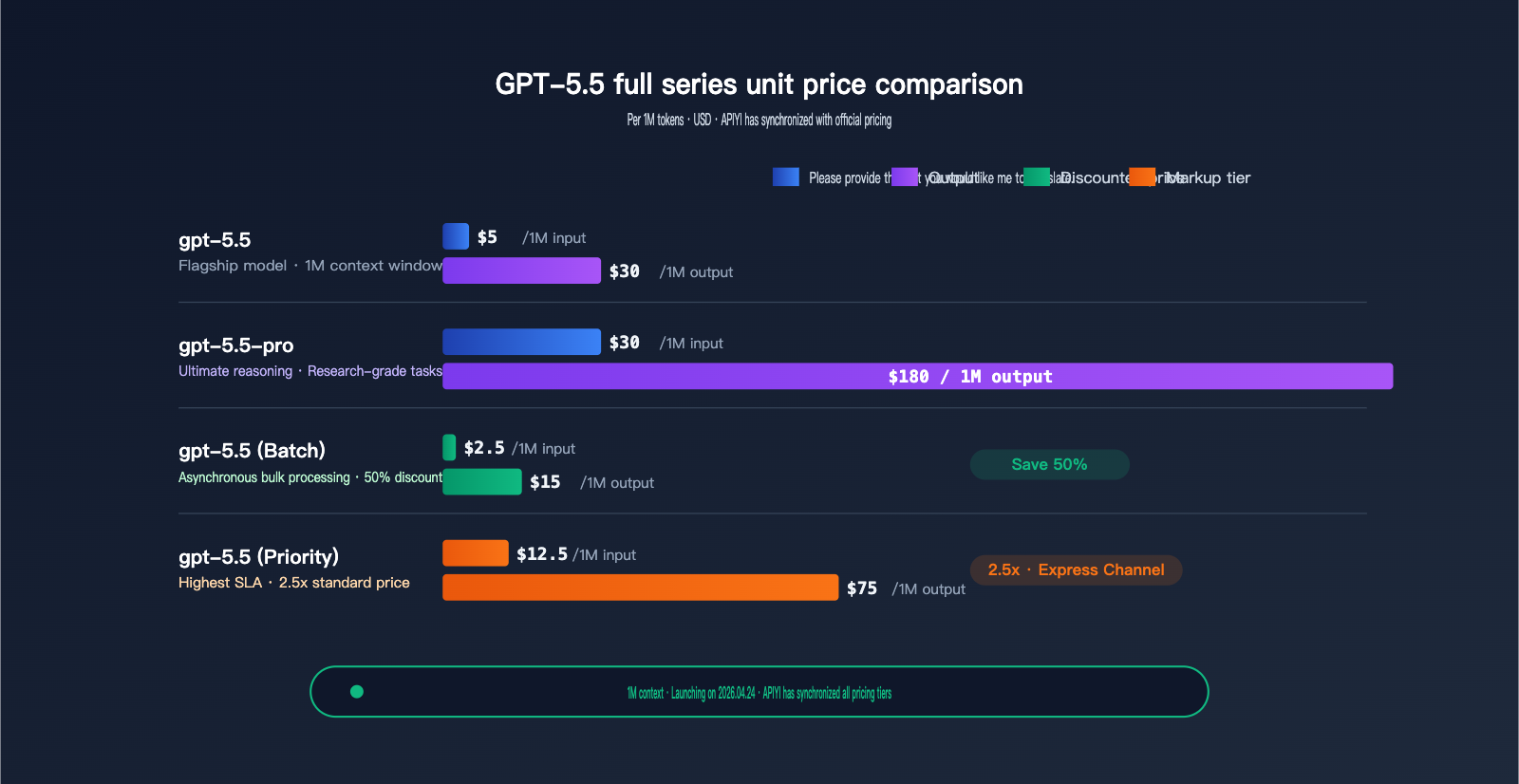
By the end of April 2026, the model list at APIYI (apiyi.com) has fully integrated the latest GPT-5.5 series released by OpenAI, which is exactly what Hong Kong companies are most interested in right now. The table below summarizes the official pricing for the GPT-5.5 series (using the synchronized pricing on APIYI as a reference).
| Model ID | Input Price | Output Price | Context Window | Use Case |
|---|---|---|---|---|
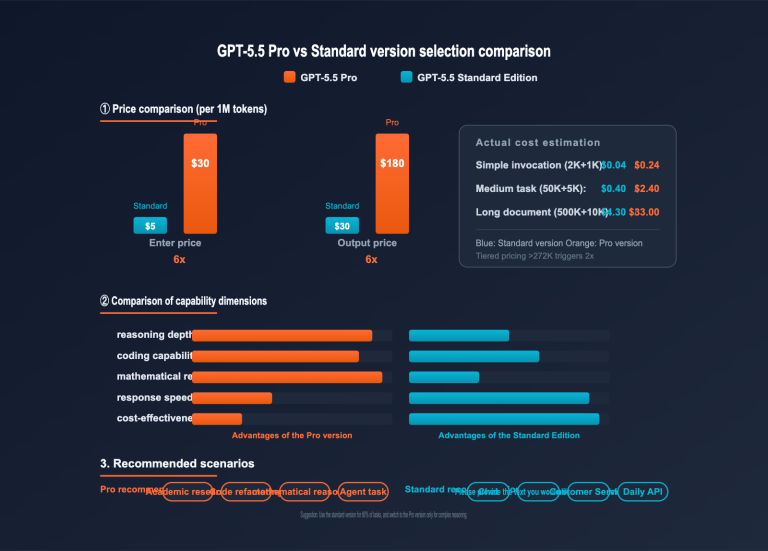
| gpt-5.5 | $5 / 1M tokens | $30 / 1M tokens | 1M | Daily flagship tasks, complex code, long documents |
| gpt-5.5-pro | $30 / 1M tokens | $180 / 1M tokens | 1M | Advanced reasoning, research-level tasks, critical decisions |
| gpt-5.5 (Batch) | $2.5 / 1M tokens | $15 / 1M tokens | 1M | Large-scale asynchronous tasks, 50% discount |
| gpt-5.5 (Priority) | $12.5 / 1M tokens | $75 / 1M tokens | 1M | Highest priority SLA, 2.5x standard price |
Beyond the GPT-5.5 series, APIYI also provides synchronized access to historical core models like GPT-5, GPT-4.1, GPT-4o, o3, and o4-mini, as well as the full suite of DALL·E 3, Whisper, TTS, and Embeddings models. The interface is fully compatible with the official OpenAI SDK. Whatever model your Hong Kong company was using before switching to the proxy, you can continue using the same model ID afterward without changing any code.
5-Step Guide for Hong Kong Companies to Get Started with APIYI
Here is a complete workflow from registration to running your first line of code. Our goal is to help Hong Kong engineers get their first response from GPT-5.5 in under 5 minutes.
Step 1: Register and Verify Your Account
Visit the official APIYI website: apiyi.com and register using your email. No phone verification or ID upload is required; Hong Kong companies can simply use their work email to get started. Once registered, head over to the "Token Management" page to create your first API key. Remember to check the permissions for the models you need.
Step 2: Make Your First Deposit
Go to the "Console – Recharge" page to select your amount. Hong Kong companies can pay via WeChat Pay (HKD), Alipay (supporting HKD cards), USDT, or corporate bank transfer. Your first deposit will automatically receive an extra $1 bonus, and larger deposits qualify for tiered rebates (details in the next section).
Step 3: Switch the SDK base_url
For the official OpenAI Python SDK, you only need to change two parameters. You can set the model ID directly to gpt-5.5:
from openai import OpenAI

client = OpenAI(
    api_key="sk-apiyi-your-key",
    base_url="https://api.apiyi.com/v1",  # The only change needed
)

resp = client.chat.completions.create(
    model="gpt-5.5",
    messages=[{"role": "user", "content": "Explain RAG in one sentence"}],
)
print(resp.choices[0].message.content)
Step 4: Run a Smoke Test for Your Model Stack
If your application uses multiple models like GPT-5.5, Embeddings, or Whisper, we recommend running a smoke test after switching the base_url to ensure every model ID returns a 200 status code. APIYI's model IDs are identical to the official ones, so you'll rarely run into compatibility issues.
Step 5: Configure Monitoring and Rate Limiting
For commercial use by Hong Kong companies, it's essential to configure retry logic, rate limiting, and cost alerts. The APIYI console provides usage statistics by key, model, and day, which you can integrate into your alerting systems.
📌 Integration Tip: Once these 5 steps are complete, your application has successfully migrated from a "direct OpenAI connection" to an "API proxy service," usually requiring fewer than 5 lines of code changes. If you're using frameworks like LangChain or LlamaIndex, most support a custom
base_url—just configure it directly. If you have any questions, check the official APIYI Help Center: help.apiyi.com or join our technical community group for support.
APIYI Recharge Benefits: Tiered Bonuses and First-Deposit Rewards
APIYI’s pricing strategy is very friendly for Hong Kong companies—base unit prices are aligned with official OpenAI rates, but the recharge process includes automatic tiered bonuses, making your actual costs lower than the official site. This mechanism is automatically triggered by the platform; no manual application is required.
Tiered Recharge Bonus Rules
| Single Deposit Amount | Automatic Bonus Rate | Actual Credit (Example) | Best For |
|---|---|---|---|
| $100 – $499 | Starting at 10% | Deposit $100, get $110+ | Small projects, individual developers |
| $500 – $999 | Tiered Increase | Rate increases with amount | Mid-sized teams |
| $1000+ | Large Tier | Significantly higher rate | Enterprise commercial use, long-term contracts |
| First-time users | Extra $1 | Bonus added to first deposit | All new users |
🎁 Key Rule: Bonuses are automatically identified and issued by the system; no manual application is needed. They typically arrive within 2 hours of a successful deposit. For the full tiered rates and the latest promotions, please refer to the official website: docs.apiyi.com/faq/recharge-promotions
This mechanism is particularly valuable for Hong Kong companies. A typical SaaS team using $500–$2000 worth of GPT-5.5 per month can effectively drive their per-token cost below the official OpenAI price by utilizing one-time deposits and tiered bonuses, all while avoiding IP restrictions and payment headaches.
Advanced Option: Proxy Recharge for OpenAI Official API Direct Access
If your Hong Kong company is required by specific partnership agreements to use native OpenAI accounts (for example, if a client contract explicitly mandates direct OpenAI supply), there is another solution: proxy recharge for OpenAI official API direct access. Essentially, you hire a professional service provider to handle account registration, card binding, and top-ups, and you receive a functional account that connects directly to OpenAI.
The value of the proxy recharge solution lies in "maintaining an official account identity." However, the downsides include higher costs compared to an API proxy service, risks of account suspension, and it doesn't eliminate the compliance issue of "violating OpenAI's Terms of Service." It's better suited as a transitional solution for those who "must use a direct OpenAI account but don't want the hassle of setting it up themselves in the short term."
Here are two established service providers in the market that you can evaluate based on your specific needs:
- AI Upgrade Service: ai.daishengji.com — Supports both ChatGPT Plus/Pro membership upgrades and OpenAI API credit recharges; the process is quite beginner-friendly.
- Established GPT Recharge Site: www.gpt516.com — One of the earlier players in the proxy recharge market, supporting OpenAI API balance top-ups and enterprise account setup.
⚠️ Selection Tip: Proxy recharge solutions and API proxy services are complementary rather than mutually exclusive. The best combination for most Hong Kong companies is: use APIYI (apiyi.com) as your primary channel for stability, compliance, and cost-effectiveness, and only use proxy recharge for special requirements (e.g., when a client specifies a native account). Relying on proxy recharge as your main channel is too expensive, and if an account gets flagged, it could disrupt your business continuity.
FAQ: OpenAI API for Hong Kong Companies
Is it compliant for a Hong Kong company to use an API proxy service?
Yes, it is. The legal relationship with an API proxy service is that the Hong Kong company is purchasing "AI inference services" from the provider, which is a standard international/cross-border technical service procurement. The relationship between the proxy provider and OpenAI is handled by the provider itself and is independent of your contract chain. This is why many Hong Kong startups prefer using an API proxy gateway like APIYI (apiyi.com)—the contract structure is clear, and it fits into standard vendor management processes.
Does an API proxy service introduce higher latency?
In actual testing, the additional latency when accessing GPT-5.5 through a proxy is usually in the range of a few dozen milliseconds, which is negligible for the vast majority of use cases (chat, long-form content generation, Agent pipelines). For scenarios that are extremely sensitive to latency, you can choose the Priority channel on APIYI, which offers the highest SLA level.
Can I top up APIYI directly with a Hong Kong credit card?
Yes. APIYI supports various localized payment methods, including HKD WeChat Pay, HKD Alipay, USDT cryptocurrency, and corporate RMB transfers. Hong Kong companies can easily obtain formal invoices and process reimbursements through corporate accounts, which is a key reason why it's more business-friendly for Hong Kong SMEs than connecting directly to OpenAI.
Is the price of GPT-5.5 on APIYI the same as the official OpenAI website?
The base unit price is aligned with OpenAI's official public pricing (input $5/output $30 per 1M tokens). When you factor in APIYI's tiered recharge bonuses, the actual cost per token is lower than the official site. The specific ratio varies based on the recharge amount; please refer to the pricing page on apiyi.com for details.
Can I still use function calling and JSON mode after switching the base_url in my application?
Absolutely. APIYI fully proxies all features of the OpenAI protocol, including function calling, tools, JSON mode, structured outputs, vision, and streaming. Your SDK won't perceive any difference.
How can I avoid rate limits in high-traffic scenarios?
We recommend applying for a higher quota in the APIYI dashboard in advance and using multi-key polling. For batch tasks, switch to the Batch model (50% discount) + asynchronous queues. For commercial deployments by Hong Kong companies, you can contact your account manager at apiyi.com to access the enterprise quota channel, where SLA and rate-limiting policies are significantly relaxed.
Summary: Best Practices for OpenAI API in Hong Kong
Returning to the three main hurdles we started with—regional restrictions, payment rejections, and compliance audits—the most reliable best practice for Hong Kong companies as of May 2026 is: Prioritize an API proxy service as your primary pipeline, use Azure as a compliant backup, and leverage third-party top-up services as a fallback for specific scenarios. This combination allows you to access the latest models like GPT-5.5 immediately, ensures your contracts remain compliant and auditable, and helps you keep your per-token costs under control.
If you're currently selecting an OpenAI API integration method for a Hong Kong project, I recommend starting by registering an account at APIYI (apiyi.com), completing a minimum initial top-up, and running through the 5-step process mentioned above. The whole thing takes less than 10 minutes, and it's the fastest way to determine if it's the right fit for your team. With a model list that covers the entire GPT-5.5 series and an automatic tiered rebate system, it’s already the best out-of-the-box solution for the vast majority of small and medium-sized enterprises in Hong Kong.
📚 Further Reading: Official OpenAI supported regions list: developers.openai.com/api/docs/supported-countries; APIYI official documentation and pricing: apiyi.com; Details on tiered recharge promotions: docs.apiyi.com/faq/recharge-promotions; If you need native OpenAI accounts or ChatGPT Plus upgrades, you can refer to third-party services like ai.daishengji.com and www.gpt516.com.
Author: APIYI Team — Focused on AI Large Language Model API engineering practices and cross-border compliant access. We provide unified API proxy services for GPT, Claude, and Gemini models. Learn more at apiyi.com.