Author's Note: A deep dive into how to access the Claude Mythos API, including the Project Glasswing targeted invitation, restricted AWS Bedrock access, and Vertex AI channels, complete with benchmark data and recommended alternatives.
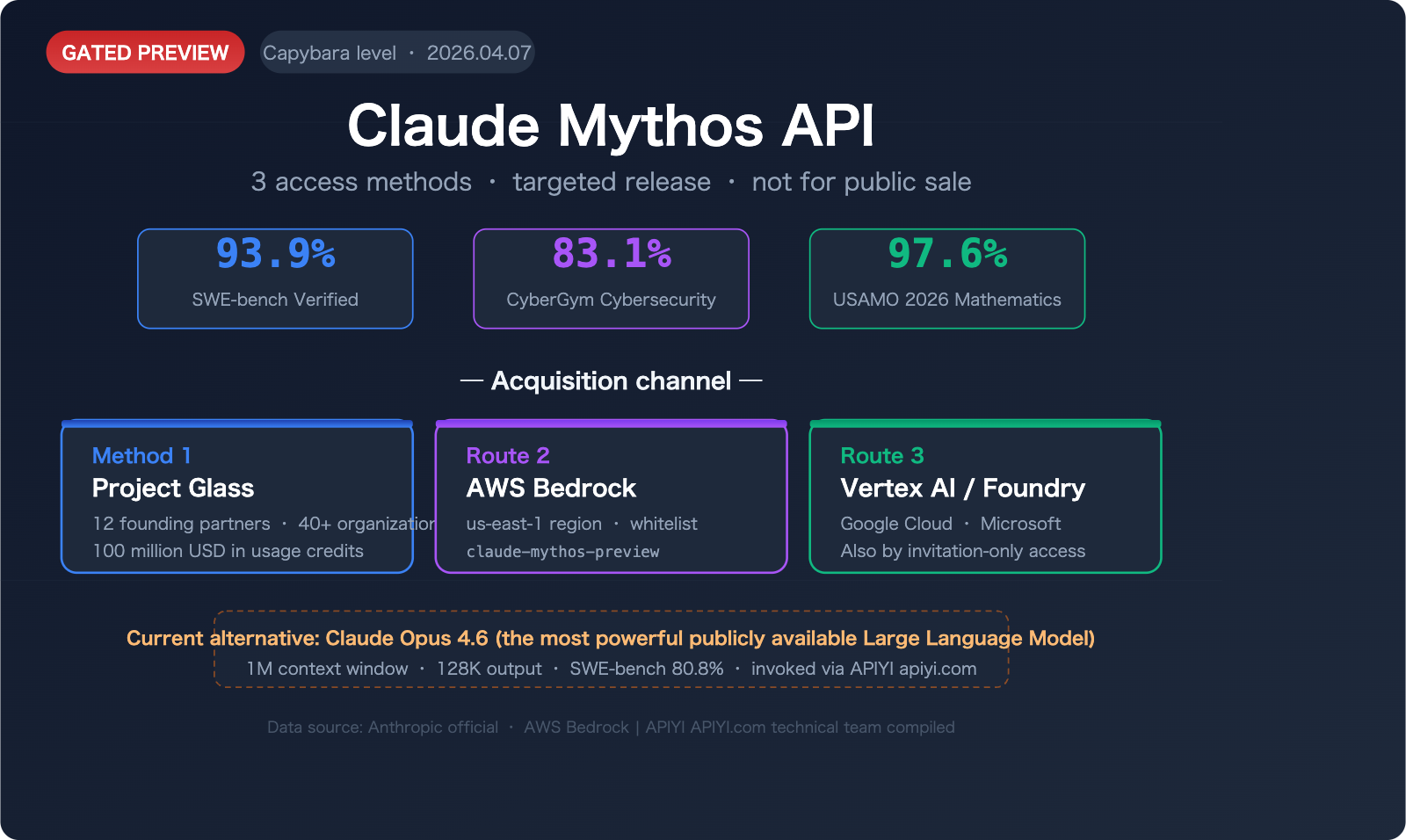
Claude Mythos is the most powerful AI model in history, released by Anthropic on April 7, 2026. It achieved a record-breaking 93.9% score on SWE-bench Verified, but it isn't available for public purchase. Anthropic describes it as a model "too powerful to be released publicly," and it is currently only available to specific organizations through the Project Glasswing initiative.
Core Value: By the end of this article, you'll understand the three ways to access the Claude Mythos API, the current restrictions, and how to use existing Claude models to meet your needs while you wait for wider access.
Quick Overview of Claude Mythos API
| Parameter | Details | Notes |
|---|---|---|
| Model ID | anthropic.claude-mythos-preview |
Bedrock side |
| Context Window | 1M tokens | Same as Opus 4.6 |
| Max Output | 128K tokens | Same as Opus 4.6 |
| Pricing | $25/million input · $125/million output | Partner pricing |
| Available Regions | us-east-1 (N. Virginia) only | No cross-region support yet |
| Access Status | Gated Research Preview | No self-service registration |
| Knowledge Cutoff | December 2025 | — |
| Model Tier | Capybara | Higher than Opus tier |
Why isn't Claude Mythos released publicly?
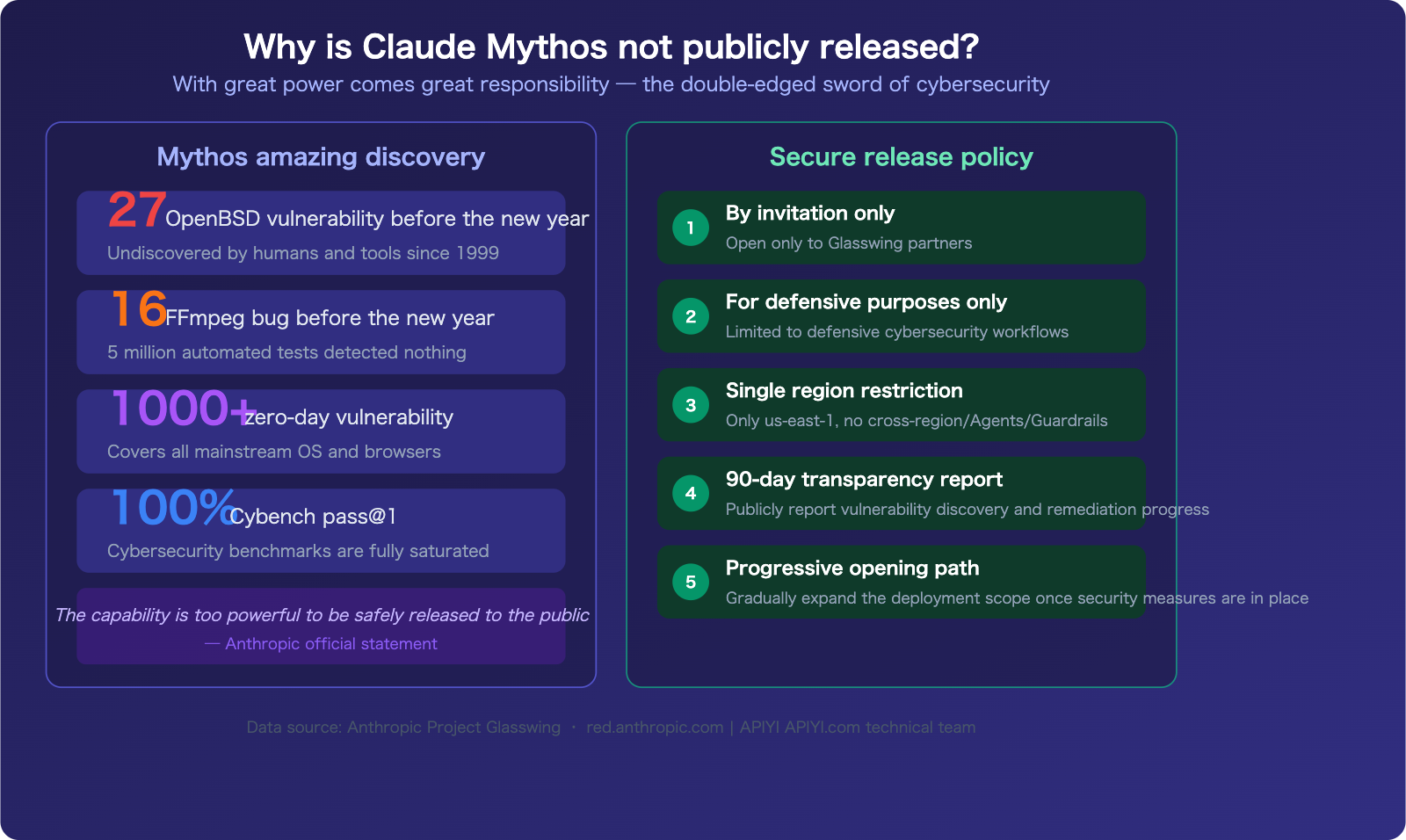
Anthropic's positioning for Claude Mythos is very clear—it is a specialized model for defensive cybersecurity. The official statement is:
"AI models have reached a level of coding capability where they can surpass all but the most elite humans in discovering and exploiting software vulnerabilities."
Mythos has autonomously discovered thousands of zero-day vulnerabilities across all major operating systems and browsers, including:
- A 27-year-old vulnerability in OpenBSD.
- A 16-year-old flaw in FFmpeg (which had previously eluded millions of automated security tests).
Because of this "double-edged sword" nature of its capabilities, Anthropic has chosen an extremely cautious release strategy.
A Detailed Guide to Accessing the Claude Mythos API
Method 1: Project Glasswing Targeted Invitation
This is currently the primary channel for obtaining the Claude Mythos API. Project Glasswing is a cross-industry cybersecurity initiative launched by Anthropic, bringing together 12 founding partners:
| Category | Partners |
|---|---|
| Cloud Computing | Amazon Web Services, Google, Microsoft |
| Tech Giants | Apple, NVIDIA, Broadcom |
| Security Vendors | CrowdStrike, Cisco, Palo Alto Networks |
| Financial Institutions | JPMorganChase |
| Open Source Foundations | Linux Foundation |
| AI Companies | Anthropic (Initiator) |
Additionally, over 40 organizations that develop or maintain critical software infrastructure have been granted access.
How to Apply:
- If your organization maintains software that impacts hundreds of millions of users, you can contact your AWS account team.
- Security researchers can apply for Anthropic's Cyber Verification Program.
- Anthropic has committed to investing $100 million in Mythos usage credits.
Method 2: AWS Bedrock Restricted Access
Amazon Bedrock has already listed the model card for Claude Mythos Preview, but access is currently restricted to organizations on the whitelist.
Technical Parameters:
Model ID: anthropic.claude-mythos-preview
Endpoint: https://bedrock-mantle.us-east-1.api.aws/v1
Region: us-east-1 (N. Virginia)
Service Tier: Standard only (Pay-as-you-go)
Current Limitations:
- Does not support Priority, Flex, Reserved, or other service tiers.
- Does not support advanced features like Guardrails, Knowledge Bases, or Agents.
- Does not support cross-region access.
- Does not support Token Counting API.
If you are already an AWS enterprise customer and your business involves critical infrastructure security, you can apply for whitelist eligibility through your AWS account manager.
Method 3: Google Vertex AI and Microsoft Foundry
In addition to Bedrock, Claude Mythos Preview is also available via restricted access on the following platforms:
- Google Cloud Vertex AI: Also invitation-only.
- Microsoft Foundry: A newly supported platform.
- Direct Claude API: Some Glasswing partners can access it via the official Anthropic API.
The access conditions and usage restrictions for all three platforms are largely the same, requiring targeted approval from either Anthropic or the respective cloud provider.
Claude Mythos API Benchmark Data
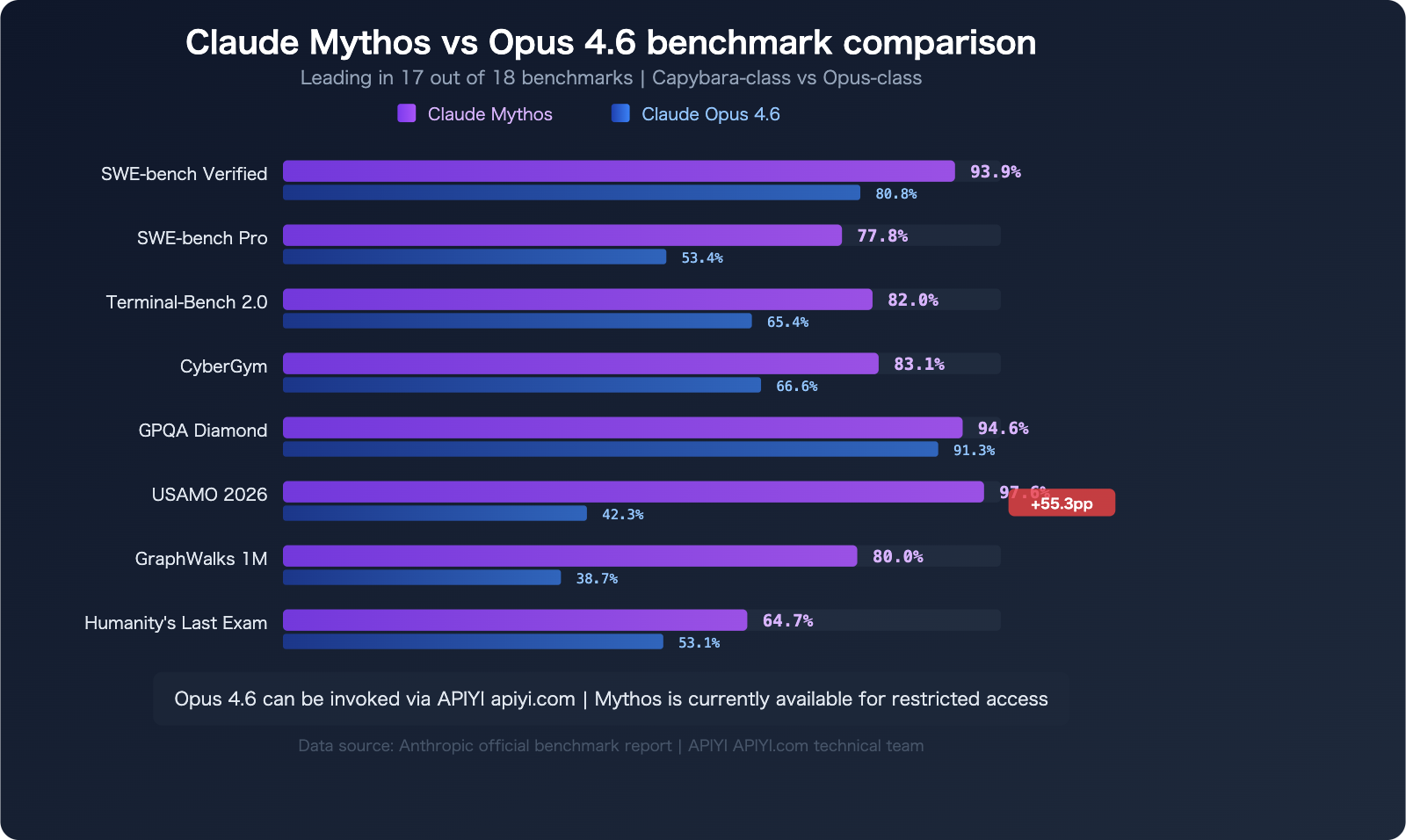
Claude Mythos leads in 17 out of 18 benchmarks measured by Anthropic. Below is a detailed comparison with Opus 4.6:
| Benchmark | Claude Mythos | Claude Opus 4.6 | Improvement |
|---|---|---|---|
| SWE-bench Verified | 93.9% | 80.8% | +13.1pp |
| SWE-bench Pro | 77.8% | 53.4% | +24.4pp |
| Terminal-Bench 2.0 | 82.0% | 65.4% | +16.6pp |
| CyberGym | 83.1% | 66.6% | +16.5pp |
| GPQA Diamond | 94.6% | 91.3% | +3.3pp |
| USAMO 2026 | 97.6% | 42.3% | +55.3pp |
| GraphWalks 256K-1M | 80.0% | 38.7% | +41.3pp |
| Humanity's Last Exam | 64.7% | 53.1% | +11.6% |
The most striking leaps are in the USAMO 2026 mathematical proof test (+55.3pp) and the GraphWalks long context test (+41.3pp), indicating that Mythos has achieved a qualitative leap in mathematical reasoning and long context understanding.
Alternatives While Waiting for the Claude Mythos API
Although Claude Mythos isn't publicly available just yet, Anthropic's existing model family is already incredibly powerful. For the vast majority of development scenarios, Claude Opus 4.6 and Sonnet 4.6 are more than capable of handling the job.
| Model | Best For | API Pricing | Available via APIYI |
|---|---|---|---|
| Claude Opus 4.6 | Complex reasoning, large codebases, long context analysis | $5/$25 per million tokens | Yes |
| Claude Sonnet 4.6 | Daily coding, fast responses, cost-effective scenarios | $3/$15 per million tokens | Yes |
| Claude Haiku 4.5 | Lightweight tasks, high concurrency, cost-sensitive needs | $1/$5 per million tokens | Yes |
Minimalist Code Example
Calling Claude Opus 4.6 (the most powerful Claude model currently available) via the APIYI platform:
import openai

client = openai.OpenAI(
    api_key="YOUR_API_KEY",
    base_url="https://vip.apiyi.com/v1"
)

response = client.chat.completions.create(
    model="claude-opus-4-6",
    messages=[{"role": "user", "content": "Analyze this code for security vulnerabilities"}]
)
print(response.choices[0].message.content)
View AWS Bedrock Native Invocation Example
import boto3
import json

# Calling Claude Opus 4.6 (publicly available)
bedrock = boto3.client(
    service_name="bedrock-runtime",
    region_name="us-east-1"
)

response = bedrock.invoke_model(
    modelId="anthropic.claude-opus-4-6-v1",
    contentType="application/json",
    body=json.dumps({
        "anthropic_version": "bedrock-2023-05-31",
        "max_tokens": 4096,
        "messages": [
            {"role": "user", "content": "Analyze this code for security vulnerabilities"}
        ]
    })
)
print(json.loads(response["body"].read()))
🎯 Recommendation: Opus 4.6 has achieved an impressive 80.8% score on SWE-bench Verified, and its 1M context window is more than enough to cover large-scale project analysis. You can quickly integrate the full official Claude API and AWS Claude API via APIYI (apiyi.com) and get free testing credits.
Future Outlook for the Claude Mythos API
Anthropic has provided clear signals regarding the future path of Mythos:
"We do not currently plan to release Claude Mythos Preview publicly, but our ultimate goal is to enable users to safely deploy Mythos-level models at scale."
Key Timeline:
- Within 90 days (by approximately July 2026): Anthropic will publicly report on discovered vulnerabilities, patches, and improvements.
- Future Plans: Deployment will be considered only after implementing safety protections through the upcoming new version of the Claude Opus model.
- Policy Recommendations: Anthropic is calling for government involvement in AI leadership and national security impact assessments.
For developers, the most pragmatic strategy is:
- Make the most of the existing Claude Opus 4.6—it remains one of the most powerful programming models publicly available.
- Keep an eye on the progress of Anthropic's Glasswing project.
- If your organization deals with critical infrastructure security, proactively reach out to your AWS account team or the Anthropic sales team.
We recommend accessing the Claude API through APIYI (apiyi.com). The platform provides both direct official Claude connections and AWS Bedrock dual channels, supporting unified model invocation for the entire Opus 4.6, Sonnet 4.6, and Haiku 4.5 series.
FAQ
Q1: Can regular developers apply for the Claude Mythos API?
It's currently very difficult. The Claude Mythos Preview is only available to Project Glasswing partners and organizations that maintain critical software infrastructure. Regular developers cannot obtain access through self-service at this time. Security researchers can try applying for the Cyber Verification Program.
Q2: How much of an improvement is Claude Mythos over Claude Opus 4.6?
The improvement is quite significant. SWE-bench Verified scores jumped from 80.8% to 93.9%, CyberGym from 66.6% to 83.1%, and USAMO mathematical proofs soared from 42.3% to 97.6%. However, for most non-security-related development tasks, Opus 4.6 is already powerful enough. You can access the full-featured Opus 4.6 via APIYI at apiyi.com.
Q3: How can I use existing Claude models for security-related tasks?
Claude Opus 4.6 itself possesses excellent code security analysis capabilities:
- Visit APIYI at apiyi.com to register an account and obtain an API key.
- Use the Opus 4.6 model for code auditing and vulnerability analysis.
- Leverage the 1M context window to analyze the security status of large projects in one go.
Summary
Key takeaways regarding Claude Mythos API access:
- Targeted Access Only: The Claude Mythos Preview is provided exclusively to 12 founding partners and 40+ critical infrastructure organizations via Project Glasswing; there is no self-service registration.
- Three Main Channels: AWS Bedrock (us-east-1), Google Vertex AI, and Microsoft Foundry are all by invitation only.
- Impressive Performance: With scores of 93.9% on SWE-bench, 83.1% on CyberGym, and 97.6% on USAMO, it leads in 17 out of 18 benchmarks.
- Current Alternative: Claude Opus 4.6 is the most powerful publicly available model, featuring a 1M context window and 128K output, accessible via APIYI at apiyi.com.
- Future Outlook: Anthropic plans to gradually expand the deployment of Mythos-level models once security measures are fully in place.
We recommend using APIYI at apiyi.com to quickly integrate the full range of Claude models (official direct connection + AWS dual-channel). The platform offers free credits and a unified interface, allowing you to experience the latest Claude capabilities as soon as they are released.
📚 References
-
Amazon Bedrock Claude Mythos Announcement: Official announcement from AWS regarding the launch of Mythos.
- Link:
aws.amazon.com/about-aws/whats-new/2026/04/amazon-bedrock-claude-mythos/ - Description: Official release details for the Claude Mythos Preview on AWS Bedrock.
- Link:
-
Project Glasswing Official Page: A cross-industry cybersecurity initiative launched by Anthropic.
- Link:
anthropic.com/glasswing - Description: Learn about the participants, goals, and capability demonstrations of the Mythos model within the Glasswing project.
- Link:
-
Amazon Bedrock Claude Mythos Model Card: AWS technical documentation.
- Link:
docs.aws.amazon.com/bedrock/latest/userguide/model-card-anthropic-claude-mythos-preview.html - Description: Technical parameters including model IDs, endpoints, and regional availability.
- Link:
-
Claude Models Overview: Official model comparison documentation from Anthropic.
- Link:
platform.claude.com/docs/en/about-claude/models/overview - Description: Pricing, specifications, and tier comparisons for all Claude models.
- Link:
-
Anthropic Red Team Mythos Preview: Security assessment report.
- Link:
red.anthropic.com/2026/mythos-preview/ - Description: Security evaluation and capability boundary analysis for Mythos.
- Link:
Author: APIYI Technical Team
Technical Discussion: Feel free to join the discussion in the comments section. For more resources, visit the APIYI documentation center at docs.apiyi.com.