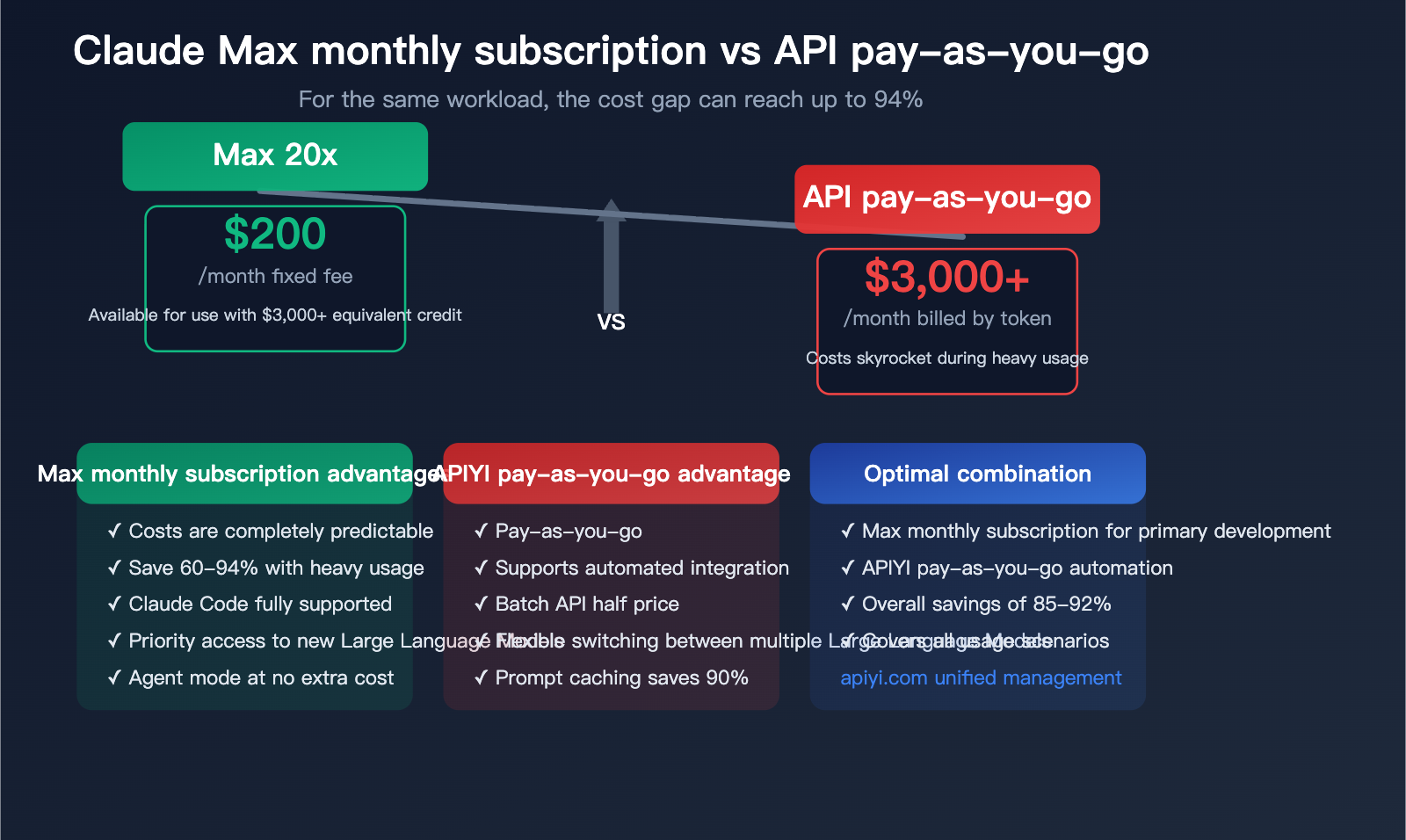
Spending $3,000 a month on Claude API usage while a colleague gets the same amount of work done for just $200 with a Claude Max subscription? This isn't a joke—it's the reality for many heavy Claude Code users. In this article, we’ll break down the real cost differences between a Claude Max monthly subscription and API pay-as-you-go usage across three dimensions: price, consumption, and use cases, helping you choose the most cost-effective path.
Core Value: After reading this, you’ll know exactly whether to choose a Claude Max subscription or API pay-as-you-go, and how to flexibly switch between the two to optimize your costs.
Claude Subscription Plans and API Pay-As-You-Go Pricing Overview
Before we dive into the comparison, we need to understand the various paid plans currently offered by Anthropic.
Claude Subscription Plans (Monthly)
| Plan | Monthly Fee | Usage Multiplier | Claude Code | Reset Cycle | Target Audience |
|---|---|---|---|---|---|
| Free | $0 | Base Limit | Not supported | 5-hour rolling | Casual users |
| Pro | $20 | 1x (Baseline) | Limited support | 5-hour rolling | Daily chat users |
| Max 5x | $100 | 5x Pro | Full support | Weekly reset | Mid-level developers |
| Max 20x | $200 | 20x Pro | Full support | Weekly reset | Power users |
| Team Standard | $20/user | Pro level | Not supported | — | Basic team collaboration |
| Team Premium | $100/user | Max level | Full support | — | Team development |
Claude API Pay-As-You-Go Pricing (Per Million Tokens)
| Model | Input Price | Output Price | Batch Input | Batch Output |
|---|---|---|---|---|
| Claude Opus 4 | $15 | $75 | $7.50 | $37.50 |
| Claude Sonnet 4 | $3 | $15 | $1.50 | $7.50 |
| Claude Haiku 4.5 | $1 | $5 | $0.50 | $2.50 |
🎯 Technical Tip: If your project requires pay-as-you-go model invocation for Claude, we recommend using the APIYI (apiyi.com) platform. It provides an OpenAI-compatible interface consistent with the official one, supports the full range of Claude models, offers transparent billing, and supports RMB top-ups.
Key Differences: The Essence of Monthly Subscriptions
It's crucial to understand the core difference between these two models:
- API Pay-As-You-Go: Billed precisely per token; you pay for what you use. Costs are predictable but can scale very high.
- Max Monthly Subscription: A fixed monthly fee in exchange for computing resources far exceeding the face value, though subject to weekly usage caps.
Simply put—the Max subscription is an "all-you-can-eat buffet" from Anthropic for power users, while API pay-as-you-go is "a la carte."
Claude Max Subscription vs. API Pay-As-You-Go: Core Cost Differences
Real User Data: What is the Max Subscription Actually Worth?
According to analysis from multiple independent sources:
| User Type | Daily API Equivalent Usage | Monthly API Equivalent Cost | Max 20x Fee | Savings Ratio |
|---|---|---|---|---|
| Casual User | ~$2-3 | ~$60-90 | $200 | Not worth it ❌ |
| Average Developer | ~$6 | ~$180 | $200 | Roughly break-even |
| Mid-level Developer | ~$12-20 | ~$360-600 | $200 | 44-67% ✅ |
| Power Developer | ~$20-60 | ~$600-1,800 | $200 | 67-89% ✅ |
| Extreme User | ~$120+ | ~$3,650+ | $200 | 94%+ ✅ |
Real-world case: One developer consumed over 10 billion tokens via a Max subscription over 8 months. Based on API pricing, this would have cost over $15,000, while the actual subscription cost was only $800 ($100/month × 8 months), saving them 94%.
Another case: An operations team used Claude Max to process 600+ podcasts and publish 50+ articles daily. Their daily API equivalent cost was $35-53, while the daily amortized cost of the Max 20x plan was only $6.50.
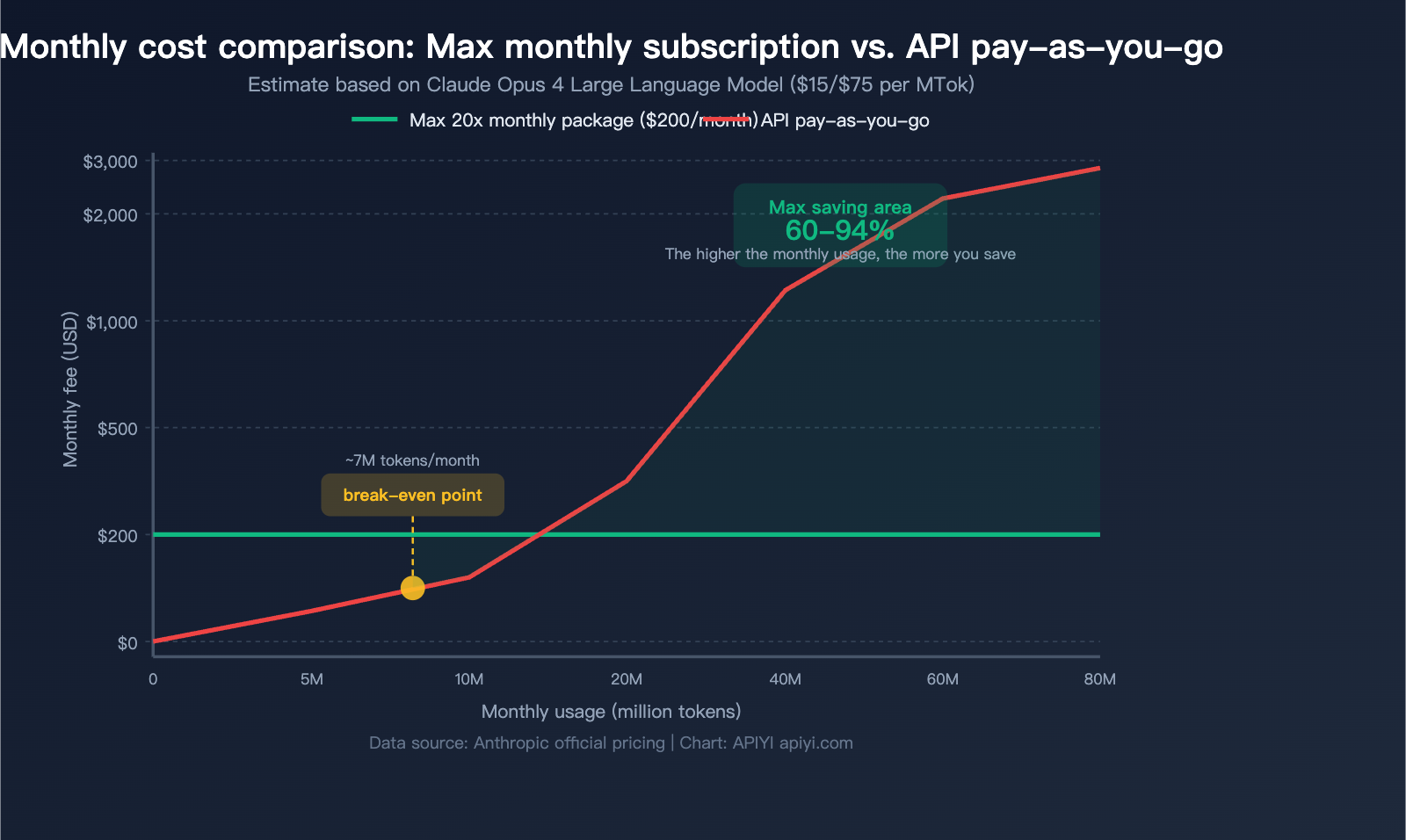
Break-Even Point Analysis
Using the Claude Sonnet 4 model as a benchmark ($3/$15 per million tokens):
| Daily Interactions | Monthly Estimated API Cost | Recommended Plan | Note |
|---|---|---|---|
| 5-10 times | ~$21-42 | Pro $20 | Just covers it |
| 15-25 times | ~$63-105 | Max 5x $100 | Starting to save |
| 45-50 times | ~$189-210 | Max 20x $200 | Break-even line |
| 75 times | ~$315 | Max 20x $200 | Save $115 |
| 100+ times | ~$420+ | Max 20x $200 | Save $220+ |
If you use the Claude Opus 4 model ($15/$75 per million tokens), the break-even point drops significantly—just 10-15 Opus interactions per day could exceed the $200/month API cost.
💰 Cost Optimization: For scenarios requiring API pay-as-you-go (such as automated pipelines or backend integration), consider calling the Claude API via the APIYI (apiyi.com) platform. It offers flexible billing and more competitive pricing, making it ideal for small-to-medium teams and individual developers looking to control costs.
Claude Code Scenarios: Maximizing the Value of the Max Subscription
Claude Code is the core scenario where the Max subscription plan truly shines. Why? Because coding tasks are inherently token-intensive.
Claude Code Token Consumption Characteristics
| Operation Type | Token Consumption (Single) | Description |
|---|---|---|
| Simple Q&A | 1,000-3,000 | Similar to standard chat |
| Code Review | 5,000-20,000 | Reading code context |
| Feature Development | 10,000-50,000 | Includes multi-turn interaction |
| Large-scale Refactoring | 50,000-200,000+ | Full codebase scanning |
| Agent Mode | 100,000-500,000+ | Autonomous multi-step execution |
A typical Claude Code development day might include:
- 3-5 feature development sessions (150k-250k tokens)
- 10+ code reviews/minor edits (50k-200k tokens)
- 1-2 large-scale refactors or Agent tasks (100k-500k tokens)
Average Daily Token Consumption: 300k-1M tokens. At Sonnet 4 pricing, this equates to $5-$20/day; at Opus 4 pricing, it's $25-$100/day.
Max Subscription vs. API Pay-as-you-go: Monthly Costs for Claude Code
Scenario: Full-time developer, using Claude Code 8 hours/day

Sonnet 4 Model Estimate:
├── Avg Daily Tokens: ~500k (400k input + 100k output)
├── Avg Daily API Cost: 400k/1M×$3 + 100k/1M×$15 = $1.2 + $1.5 = $2.7
├── Avg Monthly API Cost: $2.7 × 22 workdays = $59.4
└── Conclusion: Pro $20 plan covers light usage

Opus 4 Model Estimate:
├── Avg Daily Tokens: ~500k (400k input + 100k output)
├── Avg Daily API Cost: 400k/1M×$15 + 100k/1M×$75 = $6 + $7.5 = $13.5
├── Avg Monthly API Cost: $13.5 × 22 workdays = $297
└── Conclusion: Max 20x ($200) starts saving money

Heavy Opus 4 Usage Estimate:
├── Avg Daily Tokens: ~2M (1.5M input + 500k output)
├── Avg Daily API Cost: 1.5M/1M×$15 + 500k/1M×$75 = $22.5 + $37.5 = $60
├── Avg Monthly API Cost: $60 × 22 workdays = $1,320
└── Conclusion: Max 20x ($200) saves $1,120 (85%)
Agent Mode: The Token Consumption Multiplier
Claude Code's Agent mode autonomously executes multi-step tasks, with token consumption 5-7 times higher than standard mode. If you use Agent mode frequently:
- Standard mode daily average of 500k tokens → Agent mode daily average of 2.5M-3.5M tokens
- Monthly API costs for Agent mode using Opus 4 can easily exceed $3,000-$5,000
- The savings ratio of the Max 20x ($200) subscription can reach 93-96%
🚀 Recommendation: If you are a heavy Claude Code user, we strongly suggest subscribing to the Max 20x plan.
For automated tasks requiring API integration, we recommend using the APIYI (apiyi.com) pay-as-you-go service as a supplement,
achieving the optimal cost combination of "Subscription for main tasks + API for supplements."
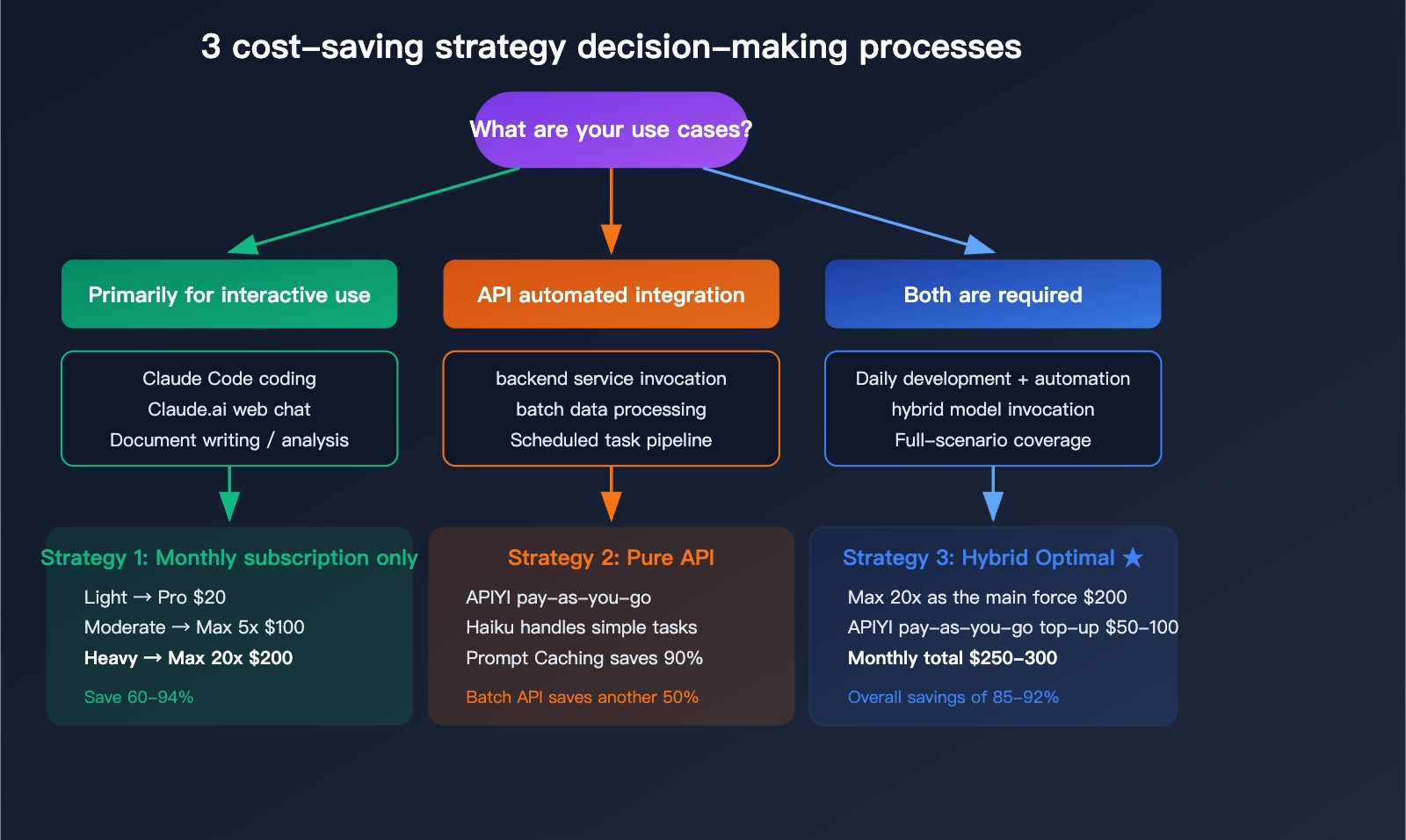
3 Cost-Saving Strategies: Choose Flexibly Based on Your Scenario
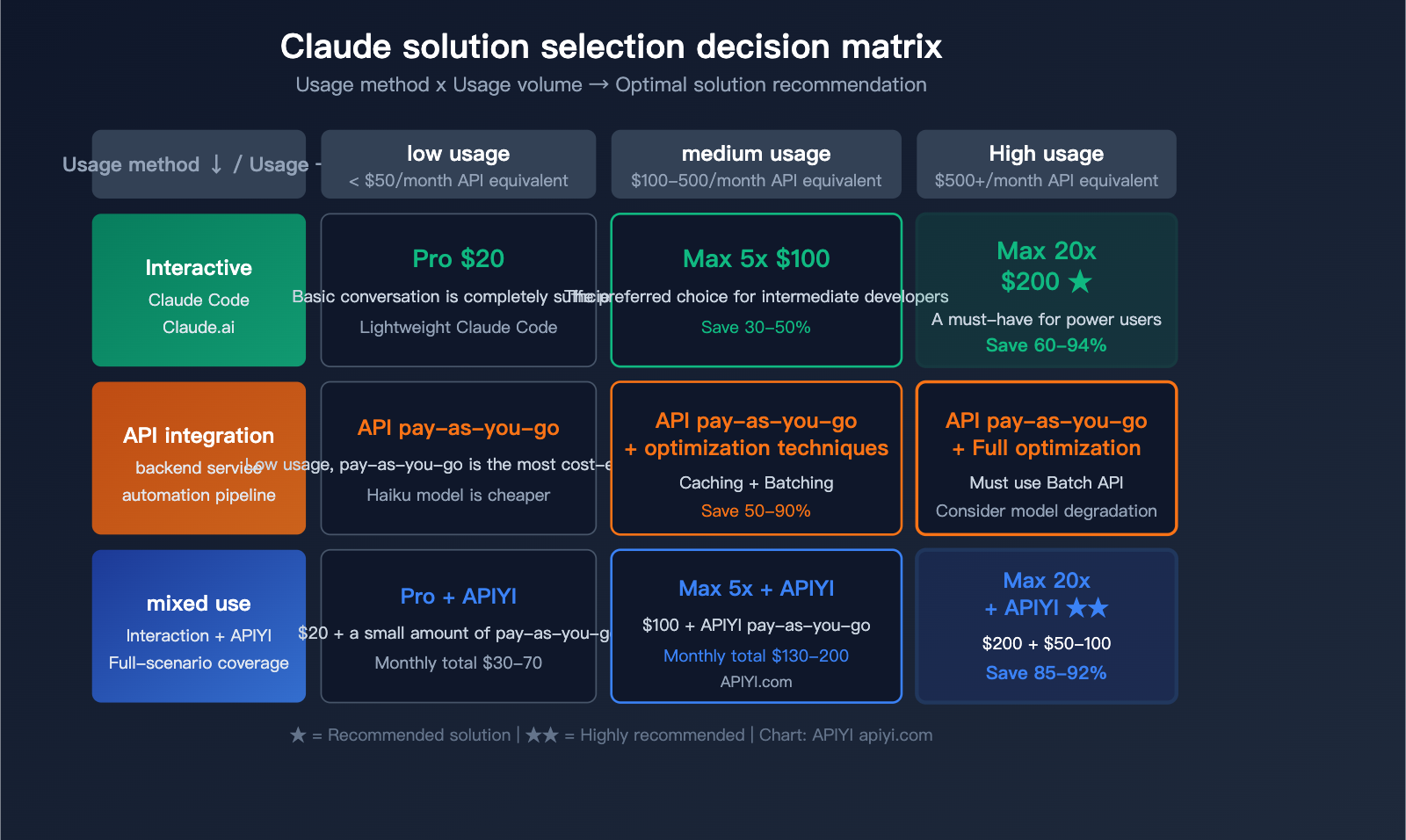
Strategy 1: Pure Subscription Plan (For Heavy Interactive Users)
Best for: Users primarily working via the Claude.ai web interface or Claude Code.
| Daily Usage | Recommended Plan | Monthly Fee | Estimated Savings |
|---|---|---|---|
| 1-2 hours | Pro $20 | $20 | Break-even |
| 3-5 hours | Max 5x $100 | $100 | 30-50% |
| 6-10 hours | Max 20x $200 | $200 | 60-94% |
Pros: Costs are fully predictable; no risk of "accidental" overspending.
Cons: Weekly usage limits apply; cannot be used for automated pipelines.
Strategy 2: Pure API Pay-as-you-go (For Automation and Integration)
Best for: Backend service integration, automated workflows, and batch processing.
# Standard way to call Claude API via APIYI
import openai

client = openai.OpenAI(
    api_key="YOUR_APIYI_KEY",
    base_url="https://api.apiyi.com/v1"  # APIYI unified interface
)

# Use the most cost-effective model
response = client.chat.completions.create(
    model="claude-sonnet-4-20250514",
    messages=[{"role": "user", "content": "Analyze the performance bottlenecks in this code"}]
)
Pros: Precise cost control, supports automated integration, options to choose different models to optimize pricing.
Cons: Costs can far exceed subscription plans during heavy usage.
API Cost Optimization Tips:
| Tip | Savings Ratio | Description |
|---|---|---|
| Use Haiku for simple tasks | 80-95% | Replace Sonnet with Haiku for simple classification/extraction |
| Enable Prompt Caching | Up to 90% | Cached requests with repeated prefixes cost only 0.1x |
| Use Batch API | 50% | Execute non-real-time tasks at half price |
| Optimize prompt length | 20-40% | Streamline system prompts to reduce input tokens |
View Prompt Caching code example
import openai

client = openai.OpenAI(
    api_key="YOUR_APIYI_KEY",
    base_url="https://api.apiyi.com/v1"
)

# System prompt with caching - input costs drop by 90% on repeat calls
response = client.chat.completions.create(
    model="claude-sonnet-4-20250514",
    messages=[
        {
            "role": "system",
            "content": "You are a code review expert...(long system prompt)...",
            # Cache control is set via API headers
        },
        {"role": "user", "content": "Review this code"}
    ]
)
Strategy 3: Subscription + API Hybrid Plan (Optimal Cost Combination)
Best for: Users who need both interactive usage and API automated integration.
Optimal Combination:

Daily Development → Claude Max 20x ($200/month, fixed cost)
├── Claude Code coding
├── Claude.ai chat
└── Document writing/analysis

Automated Tasks → APIYI Pay-as-you-go (flexible cost)
├── Backend service integration
├── Batch data processing
└── Scheduled task pipelines
Real-world Case:
- Max 20x Subscription: $200 (covers 90% of interactive usage)
- APIYI Pay-as-you-go: $50-$100 (covers automated tasks)
- Total Monthly Cost: $250-$300
- If done entirely via API: Could cost $2,000-$4,000
- Total Savings: 85-92%
🎯 Recommendation: For most developers, Strategy 3 ("Max Subscription + APIYI Pay-as-you-go") is the best solution.
By managing API calls through the APIYI (apiyi.com) platform, you can unify the usage and costs of 300+ models, including Claude, GPT, and Gemini, with a single key for all model switching.
Considerations and Limitations of the Claude Max Subscription
The Max Monthly Plan is Not "Unlimited"
While the Max monthly plan offers incredible value, it comes with a few important limitations:
| Limitation | Description | Impact |
|---|---|---|
| Weekly Usage Cap | Max 20x has a weekly limit; speed is throttled once reached | Heavy users might hit limits before the weekend |
| 5-Hour Rolling Window | Still has a message limit over short periods | Intensive use should be spread throughout the day |
| Interactive Use Only | Does not support API invocation or automation | Backend integration must use the API |
| Anthropic's Right to Adjust | Limits may be adjusted at any time | Consider potential changes for long-term planning |
| No Annual Discount | Max plans are monthly only | Annualized cost is $2,400 |
When is Pay-As-You-Go API More Suitable?
| Scenario | Reason | Recommended Plan |
|---|---|---|
| Backend Service Integration | Max does not support API invocation | API Pay-As-You-Go |
| Monthly Usage < $50 | The $200 Max plan isn't cost-effective | Pro $20 or API |
| Need Precise Cost Control | Pay-as-you-go is more transparent | API Pay-As-You-Go |
| Batch/Async Processing | Batch API offers a 50% discount | API Batch Mode |
| Multi-Model Switching | Need to mix GPT/Gemini/Claude | APIYI Unified Interface |
💡 Technical Tip: If you need to use multiple models like Claude, GPT-4o, and Gemini simultaneously, APIYI (apiyi.com) provides a unified OpenAI-compatible interface. You can switch between 300+ models with a single integration, eliminating the need to configure separate API keys and base URLs for each model.
FAQ
Q1: Is the $200 Claude Max 20x subscription really worth thousands of dollars in API equivalent credit?
Yes, multiple independent analyses and user reports confirm this. Heavy Claude Code users (especially those using the Opus model and Agent mode) can indeed consume $1,000–$5,000 worth of API-equivalent compute resources per month. In one extreme case, a user consumed 10 billion tokens over 8 months—which would cost over $15,000 at standard API rates—while only paying $800 in subscription fees. Of course, Anthropic may adjust its limit policies in the future, but for now, it's an exceptionally cost-effective plan.
Q2: I mainly use the API for automation; can I replace it with the Max subscription?
It cannot be used as a direct replacement. The Max subscription is limited to interactive use (Claude.ai web version and Claude Code) and does not provide an API interface. Automation tasks must be handled via the pay-as-you-go API. The recommended strategy is "Max subscription for daily development + APIYI (apiyi.com) pay-as-you-go for automation" to achieve the best overall cost efficiency.
Q3: How do I change my code when switching from API to the Max subscription?
The Max subscription is for interactive scenarios (Claude Code coding, Claude.ai chats), so your code doesn't need to change. Your backend services will continue to use API calls. What changes is your workflow—you can move exploratory coding and code reviews, which were previously done via API scripts, into Claude Code, significantly reducing your API usage and costs.
Q4: Should I choose the Max 5x ($100) or Max 20x ($200) plan?
If you use Claude Code for more than 4 hours a day, go straight for the Max 20x. That extra $100 buys you 4x the usage capacity, which is a fantastic deal. The Max 5x is better suited for users who "occasionally use Claude Code and primarily use Claude.ai for chat." For full-time developers, the Max 20x is almost the only logical choice.
Summary: If you can, go for the Claude Max monthly subscription
Returning to the question at the beginning of this article—what’s the real difference between a Claude Max subscription and pay-as-you-go API usage?
Core Conclusions:
- Light Users (Monthly API spend < $50): A $20 Pro plan or pay-as-you-go API is perfectly fine.
- Moderate Users (Monthly API spend $100–$300): The Max 5x ($100) plan starts to show a clear advantage.
- Heavy Users (Monthly API spend $500+): The Max 20x ($200) plan can save you between 60% and 94% on costs.
- Power Users (Monthly API spend $3,000+): The Max 20x plan can save you over $2,800 per month.
Our Recommendations:
- Go for Max 20x if you can—For full-time developers, $200/month offers an incredibly high return on investment.
- Use API for automated scenarios—Manage costs transparently with pay-as-you-go services like APIYI (apiyi.com).
- Make the most of Prompt Caching and Batch API—You can save an additional 50–90% in API scenarios.
- Adjust dynamically based on actual usage—Try using the API for a month to check your bills before deciding whether to upgrade to Max.
We recommend using APIYI (apiyi.com) to manage your pay-as-you-go API needs, combining it with a Claude Max subscription to achieve the most cost-effective setup.
📝 Author: APIYI Technical Team | APIYI apiyi.com – A unified access platform for 300+ AI Large Language Model APIs.
References
-
Anthropic Official Pricing Page: Claude subscription plans and API pricing.
- Link:
anthropic.com/pricing - Note: Includes the latest Max plans and API token pricing.
- Link:
-
Claude API Documentation: Model pricing and Prompt Caching details.
- Link:
docs.anthropic.com/en/docs/about-claude/models - Note: Detailed parameters and billing rules for each model.
- Link:
-
Claude Max Help Center: Max plan usage guidelines.
- Link:
support.anthropic.com - Note: Specific limits and reset rules for Max plans.
- Link: