Author's Note: A deep dive into the world knowledge of Seedance 2.0 and Kling 3.0 across 7 dimensions—including physical simulation, scene consistency, and object permanence—to help you choose the best AI video generation model.
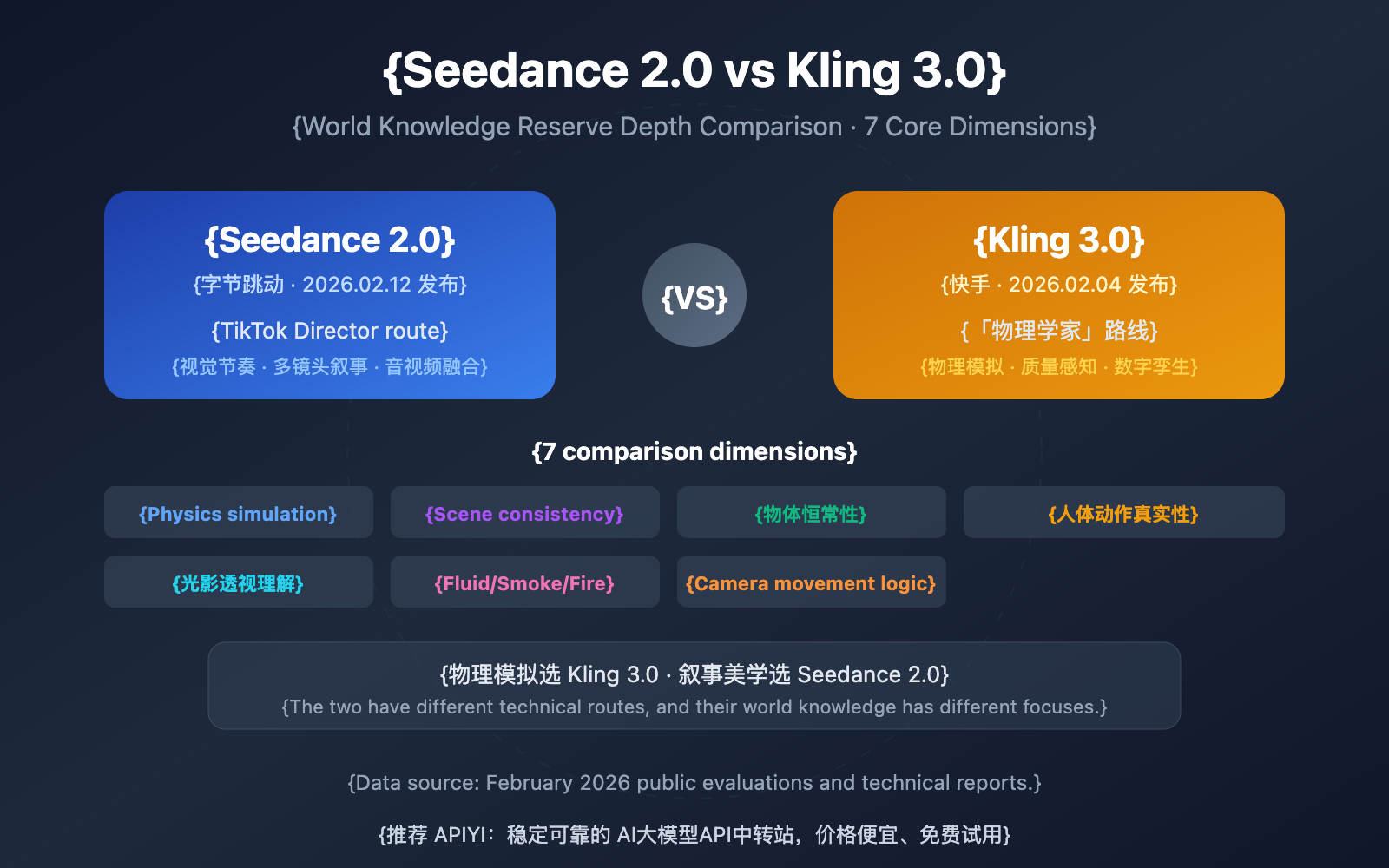
Who has the stronger world knowledge: Seedance 2.0 or Kling 3.0? This is the hottest topic in the AI video generation space in February 2026. ByteDance's Seedance 2.0 and Kuaishou's Kling 3.0 were released almost simultaneously, but they've taken completely different technical paths—one acts like a "TikTok Director," while the other acts like a "Physicist." In this article, we'll dive deep into their world knowledge across 7 dimensions to help you make a clear choice.
Core Value: By the end of this post, you'll understand the real differences between Seedance 2.0 and Kling 3.0 in terms of physical simulation, scene understanding, and motion performance, and you'll know exactly which one to pick for different scenarios.
Seedance 2.0 vs Kling 3.0: Core Differences Overview
Before we dive into world knowledge, let's take a quick look at the basic specs of both models:
| Comparison Dimension | Seedance 2.0 (ByteDance) | Kling 3.0 (Kuaishou) |
|---|---|---|
| Release Date | February 12, 2026 | February 4, 2026 |
| Technical Architecture | Dual-branch Diffusion Transformer | Quality-aware Diffusion Transformer |
| Design Philosophy | "TikTok Director" — Visual Rhythm First | "Physicist" — Realistic Simulation First |
| Max Resolution | 2K (1080p) | 4K (3840×2160) / 60fps |
| Video Duration | 4-15 seconds | Up to 15 seconds (supports 6 segments multi-shot) |
| Native Audio | ✅ Joint Audio-Video Generation | ✅ Multi-lingual Voice + Sound Effects |
| Multi-modal Input | Text/Image/Audio/Video (12 files) | Text/Image/Video |
| API Status | Expected Feb 24th | Already Open |
🎯 Key Finding: These two models have taken entirely different paths regarding world knowledge. Kling 3.0 aims to be "as precise as a physics engine," while Seedance 2.0 aims to be "as visually stunning as a professional director." This difference in philosophy directly determines their performance across various dimensions. You'll soon be able to conveniently call both models for side-by-side testing via APIYI (apiyi.com).
Seedance 2.0 vs Kling 3.0: A 7-Dimension Deep Dive into World Knowledge
Dimension 1: Physics Simulation
Physics simulation is the core metric for measuring a model's "world knowledge" reservoir. The differences between these two models are most striking in this dimension.
Kling 3.0 — Mass-Aware Diffusion Transformer
Kling 3.0 utilizes a self-developed Mass-Aware Diffusion Transformer architecture, combining 3D Spacetime Joint Attention with a Chain-of-Thought mechanism. When a character in a video kicks a ball, Kling 3.0 accurately simulates the ball's deformation at the moment of impact, the bending response of the grass, and the character's momentum transfer. This level of physical understanding is industry-leading.
Seedance 2.0 — Visual Rhythm Driven
While physics simulation isn't a weakness for Seedance 2.0, it's not its primary strength. It has a solid grasp of 3D spatial consistency—background objects produce correct parallax when the camera pans left, and shadow lengths change reasonably when the light source moves. However, in complex physical interaction scenes involving collisions, deformation, or inertia, its precision doesn't quite match Kling 3.0.
| Physics Simulation Sub-items | Seedance 2.0 | Kling 3.0 | Notes |
|---|---|---|---|
| Gravity Simulation | ★★★★☆ | ★★★★★ | Kling's mass awareness is more precise |
| Collision Detection | ★★★☆☆ | ★★★★★ | Kling simulates object deformation and momentum |
| Inertia/Momentum | ★★★★☆ | ★★★★★ | Kling's character movements have a real sense of weight |
| Material Reflection | ★★★★☆ | ★★★★★ | Kling is more sensitive to reflection differences across materials |
Physics Simulation Conclusion: Kling 3.0 wins.
Dimension 2: Scene Consistency
Scene consistency tests whether a model can maintain environmental stability throughout a video without "breathing" artifacts or flickering.
Seedance 2.0 — Environment Lock
Seedance 2.0 has a unique edge in scene consistency. Its "Environment Lock" mechanism ensures that in a 15-second clip, background objects like books on a shelf or trees in a forest don't shift or "breathe." In multi-shot narrative scenes, character appearance, clothing textures, and scene styles remain highly consistent across different angles.
Kling 3.0 — Director Memory
Kling 3.0 has achieved top scores for both background and subject consistency in independent tests. Its "Director Memory" mechanism maintains a global state throughout the video generation process, ensuring perfect environmental stability and coherent character performance.
Scene Consistency Conclusion: Both perform excellently. Kling 3.0 has a slight edge in single-shot scenes, while Seedance 2.0 stands out in multi-shot, cross-scene consistency.
Dimension 3: Object Permanence
Object permanence refers to whether a model understands the basic physical concept that "an object still exists even when it's hidden."
Kling 3.0 is the clear leader here. Its "Director Memory" allows it to remember occluded objects—for instance, when a car drives behind a tree, the model knows the car still exists and can correctly restore it once it emerges. Handling object permanence like this is a key capability for building a "Digital Twin" worldview.
Seedance 2.0 performs well in simple occlusion scenarios but occasionally slips up in complex interactions involving multiple overlapping objects.
Object Permanence Conclusion: Kling 3.0 wins.
Dimension 4: Human Motion Realism
Human motion is one of the toughest challenges in AI video generation, involving skeletal kinematics, muscle deformation, cloth physics, and more.
Kling 3.0 is currently rated as having the most natural human movement among AI video models—complex actions like martial arts, dancing, or running don't result in "noodle limbs" or body warping. Its facial expression details and lip-syncing are also best-in-class.
Seedance 2.0 is also excellent with human movement, especially its ability to replicate choreography. By using the "@" reference feature with a source video, Seedance 2.0 can generate choreographed content perfectly synced to the beat—a capability no competitor can currently match. Additionally, Seedance 2.0 scores a perfect 1.000 in dynamic intensity, meaning its generated movements carry the highest sense of energy.
| Human Motion Sub-items | Seedance 2.0 | Kling 3.0 |
|---|---|---|
| Martial Arts/Fighting | ★★★★☆ | ★★★★★ |
| Dance Choreography | ★★★★★ | ★★★★☆ |
| Facial Expressions | ★★★★☆ | ★★★★★ |
| Lip-Syncing | ★★★★★ | ★★★★★ |
| Dynamic Energy | ★★★★★ | ★★★★☆ |
Human Motion Conclusion: Each has its strengths; overall, it's a tie. Kling 3.0 is more realistic, while Seedance 2.0 is more expressive.
Dimension 5: Lighting and Perspective
Lighting and perspective reflect how well a model understands 3D space and optical physics.
Seedance 2.0 shows great "director's intuition" here—it understands the relationship between light and shadow, perspective laws, and cinematic language, allowing it to generate lighting effects with a professional film quality. However, its focus is on "looking good" rather than being "physically perfect."
Kling 3.0 leans more toward physical realism. Its material reflection system correctly distinguishes between metal, glass, fabric, and other materials, and its global illumination calculations are more precise.
Lighting & Perspective Conclusion: Kling 3.0 wins on physical accuracy, while Seedance 2.0 wins on artistic expression.
Dimension 6: Fluid, Smoke, and Fire Simulation
Fluid dynamics is one of the best ways to test the depth of a model's world knowledge.
Kling 3.0 is the definitive leader in this dimension. Independent evaluations show that Kling 3.0 generates the most realistic water, fire, and smoke effects in the industry. Water surface reflections, ripple propagation, and smoke diffusion all follow the laws of fluid mechanics.
Seedance 2.0 has significantly improved its fluid performance over previous generations—water movement and hair flow are much more stable and smooth—but it still trails Kling 3.0 in complex fluid interaction scenarios.
Fluid Simulation Conclusion: Kling 3.0 wins.
Dimension 7: Camera Movement Logic
Camera movement logic tests whether a model understands the rules of professional cinematography.
Seedance 2.0 is the clear winner here. Trained on ByteDance's massive short-video dataset, Seedance 2.0 has mastered "visual rhythm"—the ability to manage multi-shot assembly, transition timing, and overall aesthetic control. Its "@" reference system allows users to upload a camera-work reference video, which the model can then replicate with precision.
Kling 3.0's camera movements are also professional, supporting 6-segment multi-shot assembly, but it leans toward a more natural, documentary style. It doesn't quite match Seedance 2.0 in terms of creative camera work and visual rhythm.
Camera Movement Conclusion: Seedance 2.0 wins.
Seedance 2.0 vs Kling 3.0 World Knowledge Comparison Summary
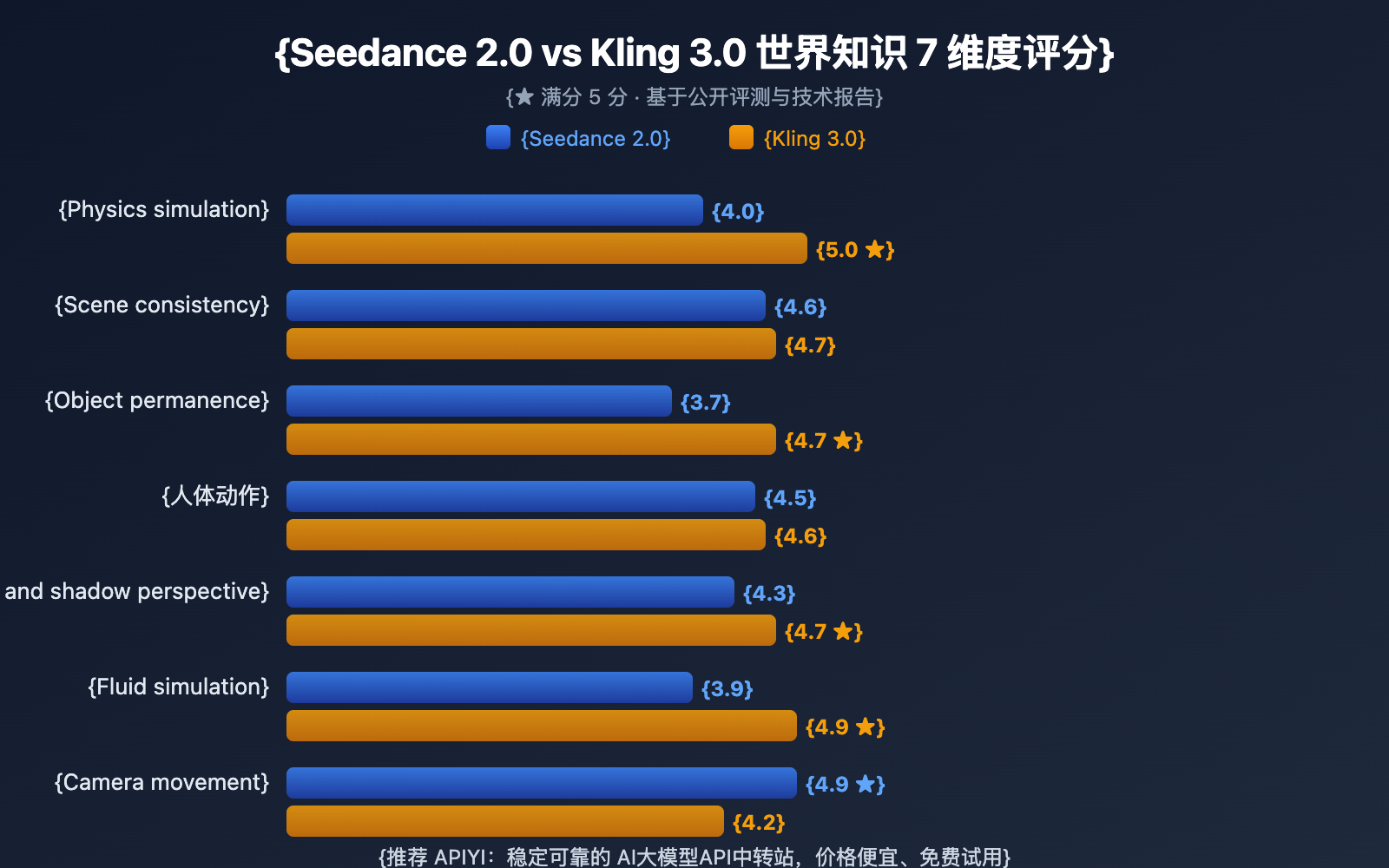
Here's a summary of the scores across all 7 dimensions:
| Comparison Dimension | Seedance 2.0 | Kling 3.0 | Winner |
|---|---|---|---|
| Physics Simulation | ★★★★☆ (4.0) | ★★★★★ (5.0) | Kling 3.0 |
| Scene Consistency | ★★★★★ (4.6) | ★★★★★ (4.7) | Tie |
| Object Permanence | ★★★★☆ (3.7) | ★★★★★ (4.7) | Kling 3.0 |
| Human Motion | ★★★★★ (4.5) | ★★★★★ (4.6) | Tie |
| Lighting & Perspective | ★★★★☆ (4.3) | ★★★★★ (4.7) | Kling 3.0 |
| Fluid Simulation | ★★★★☆ (3.9) | ★★★★★ (4.9) | Kling 3.0 |
| Camera Movement | ★★★★★ (4.9) | ★★★★☆ (4.2) | Seedance 2.0 |
Comparison Note: Across the 7 core dimensions of world knowledge, Kling 3.0 wins in 4, Seedance 2.0 wins in 1, and 2 are essentially ties. If you're looking for "physically correct" results, Kling 3.0 is your best bet. If you're after "visually stunning" aesthetics and rhythm, Seedance 2.0 takes the crown. We recommend doing your own head-to-head testing via APIYI (apiyi.com); the platform will integrate both models as soon as their APIs are available.
The gap in "world knowledge" between these two models really comes down to their different technical approaches:
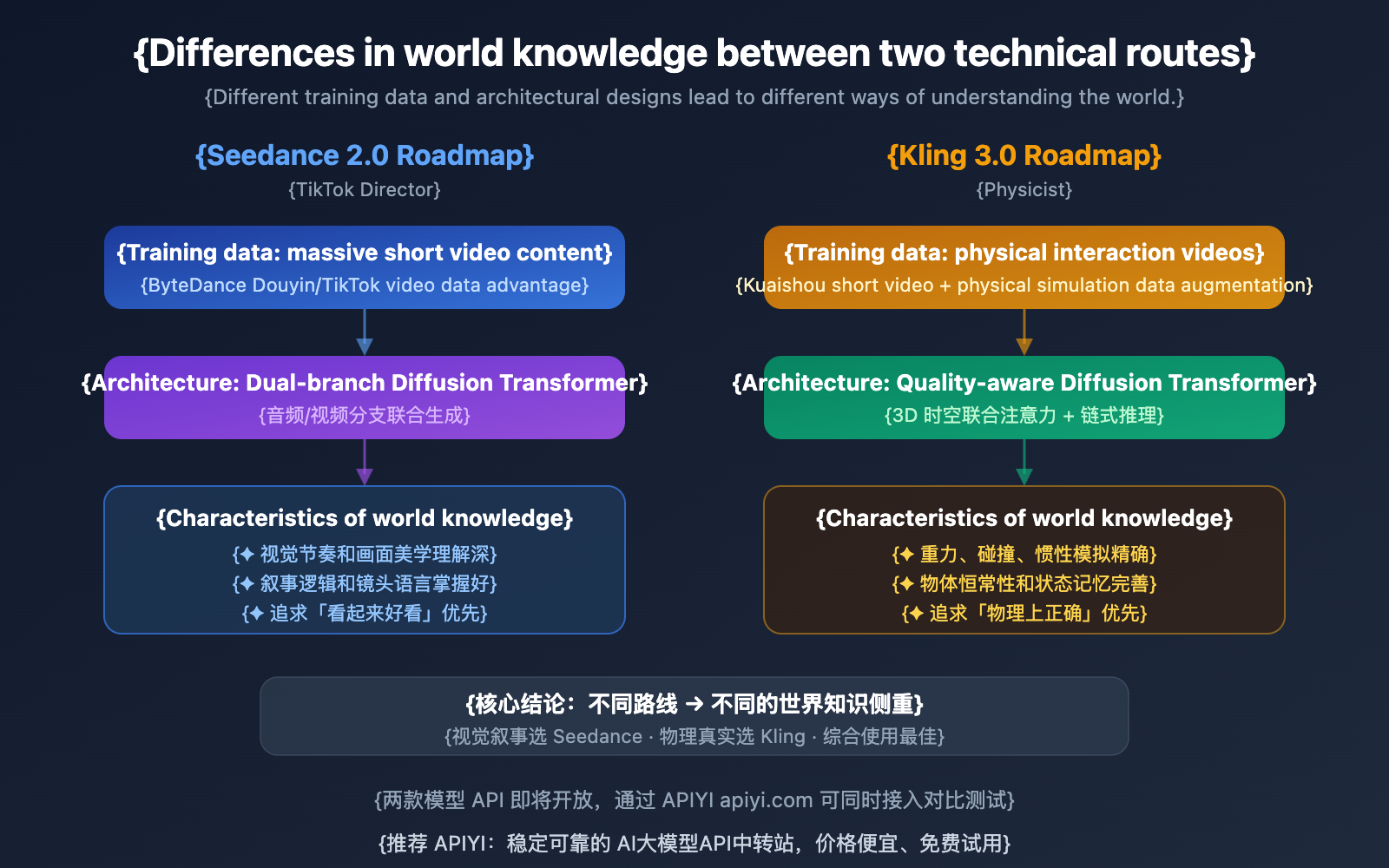
Where Seedance 2.0 gets its world knowledge: ByteDance has access to a massive ocean of short video data from Douyin/TikTok. Seedance 2.0 has essentially learned "visual rhythm" from this—the pacing of multi-shot sequences, the perfect timing for transitions, and high-end compositional aesthetics. Its world knowledge is more like "a seasoned director's understanding of the visual world."
Where Kling 3.0 gets its world knowledge: Kuaishou also has a huge repository of short video data, but Kling 3.0 injects stronger physical priors at the architectural level. Its quality-aware Diffusion Transformer and 3D spatiotemporal joint attention mechanism allow the model to reason through the physical state of every frame like a "physics engine." Its world knowledge is more like "a physicist's understanding of the real world."
Seedance 2.0 vs Kling 3.0: Which one should you choose?
| Application Scenario | Recommended Model | Why? |
|---|---|---|
| E-commerce Product Showcases | Kling 3.0 | Needs realistic textures and precise lighting |
| Short Videos / Vlog Creation | Seedance 2.0 | Great visual rhythm and multi-shot storytelling |
| Music Video (MV) Production | Seedance 2.0 | Native AV sync and choreography replication |
| Industrial / Architectural Visualization | Kling 3.0 | Precise physics simulation and 4K resolution |
| Film & Commercials | Use Both | Seedance for creative direction, Kling for VFX |
| Educational / Science Animation | Kling 3.0 | High precision needed for physical laws |
| Social Media Content | Seedance 2.0 | Looks great and generates fast |
🎯 Pro Tip: For most production teams, the best strategy is to use both models in tandem—Seedance 2.0 handles the creative direction and audio-video fusion, while Kling 3.0 takes care of physical effects and high-precision assets. We recommend testing them out via APIYI (apiyi.com). The platform provides a unified interface for various video generation models, making it easy to compare and switch between them quickly.
FAQ
Q1: Which one has better world knowledge, Seedance 2.0 or Kling 3.0?
If we're looking at the traditional definition of "world knowledge" (physical simulation, object permanence, fluid dynamics, etc.), Kling 3.0 is overall stronger. However, Seedance 2.0 takes the lead in "director's knowledge," such as camera language and visual rhythm. Both models have different strengths in world knowledge, depending on how you define the term.
Q2: When will the APIs for these two models be available?
Kling 3.0's API is already live and can be accessed via Kuaishou's official platform. The Seedance 2.0 API is expected to launch on February 24, 2026, through Volcengine. APIYI (apiyi.com) will sync both models as soon as they're available, providing a unified interface and pricing at roughly 90% of the official rates.
Q3: I’m on a tight budget—which one should I choose?
From a value-for-money perspective, Kling 3.0 has a lower entry-level subscription price ($6.99/month vs. Seedance's $19.90/month). If you're primarily creating short-form video content, Kling 3.0's cost for high-frequency generation is better. However, if you need audio-visual integration and multi-shot storytelling, Seedance 2.0's unique capabilities might be worth the extra cost. We recommend checking out APIYI (apiyi.com) for more competitive API pricing.
Summary
Here are the key takeaways from the Seedance 2.0 vs. Kling 3.0 world knowledge comparison:
- Kling 3.0 is stronger in physical simulation: Thanks to its Quality-aware Diffusion Transformer + 3D Spatio-temporal Joint Attention, it leads in the precision of collisions, gravity, and fluid simulations.
- Seedance 2.0 is stronger in visual storytelling: Trained on massive short-video datasets, its sense of visual rhythm, multi-shot narrative, and joint audio-video generation are currently unmatched.
- The best strategy is to use both: Use Seedance for creative storytelling and Kling for physical effects. Combining the two is the most effective approach right now.
We recommend following APIYI (apiyi.com) for API access to both models. The platform offers a unified OpenAI-compatible interface at about 90% of the official price, making it easy for developers to call both models for side-by-side testing.
📚 References
-
Seedance 2.0 Official Introduction: Model details released by ByteDance's Seed team
- Link:
seed.bytedance.com/en/seedance2_0 - Description: Includes the full technical architecture and feature overview.
- Link:
-
Kling 3.0 Official Launch Announcement: Official news from Kuaishou Kling AI
- Link:
ir.kuaishou.com/news-releases - Description: Covers core technologies like 4K/60fps support and physics engines.
- Link:
-
WaveSpeedAI Comparison Review: A comprehensive comparison of the top four models
- Link:
wavespeed.ai/blog - Description: Includes detailed benchmark data and recommended use cases.
- Link:
Author: Technical Team
Tech Talk: Feel free to share your hands-on experience with Seedance 2.0 and Kling 3.0 in the comments. For more news on AI video generation models, visit the APIYI (apiyi.com) tech community.