
Worth upgrading — but judge it workflow by workflow. For Astra workflows centered on professional documents, spreadsheets, and long-horizon agent tasks, GPT-6.2 Astra sends two signals at once in the public benchmarks: better quality and lower cost. Add an across-the-board price cut on the Standard Short tier, and the case for upgrading is fairly solid. For coding workflows where the core metric is mergeable code changes, the two generations score nearly level on the same toolchain — better to let your own project’s acceptance criteria decide whether to switch. And if your scheduled jobs depend on the Flex processing tier, there’s one extra migration gap to close: the new model isn’t wired into Flex.
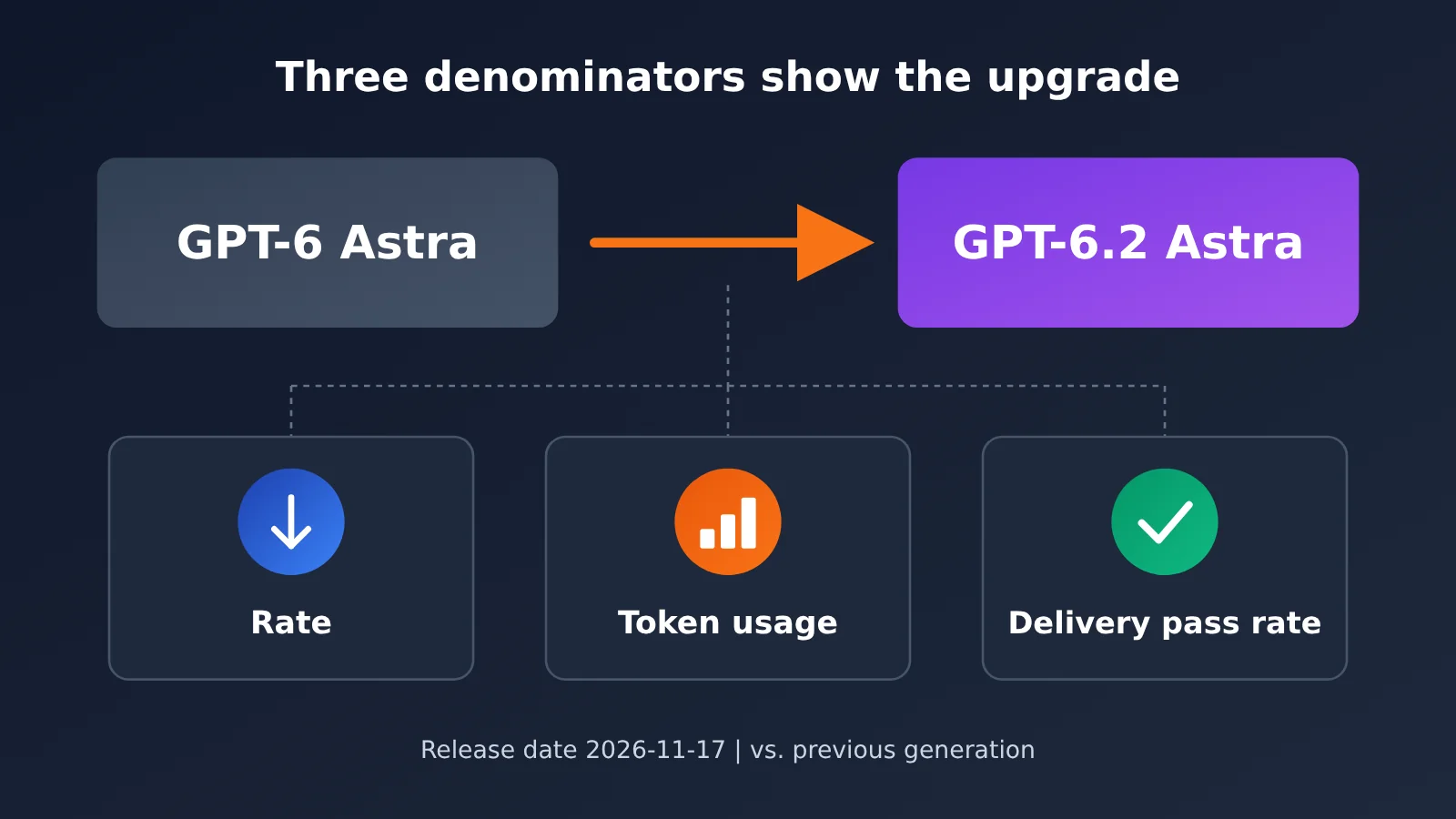
What you’ll learn from this article
- GPT-6.2 Astra’s specs versus GPT-6 Astra, the public benchmark numbers, and how each one is measured.
- The change in per-million-token rates on the Standard Short tier, plus a fixed-usage worked example you can plug your own usage into.
- The parameters, instruction placement, cache prefixes, and processing-tier differences you have to check when migrating from the old Astra.
- A runnable migration snippet and an acceptance checklist organized by request type.
Index: The “To Know” table first explains the benchmark and billing terms used in this article, then “Impact at a Glance” covers how different teams are affected. The “Objective Facts” section walks through the release and specs, three same-tier benchmarks, rates and the worked example, and the API/processing-tier differences — all with sources and measurement definitions. The “Analysis and Judgment” section discusses how to judge upgrade value using three denominators, gives recommendations for each kind of workflow, and provides migration code and an acceptance process. The article ends with an FAQ and references.
GPT-6.2 Astra Upgrade: Concepts to Know
| Concept | Brief explanation |
|---|---|
| Same-tier predecessor | This article only compares gpt-6.2-astra with gpt-6-astra and doesn’t cover models in other tiers |
| GDPval v2 | An internal OpenAI evaluation that draws long-horizon knowledge-work tasks—such as consulting, finance, and design—from real projects |
| FrontierCode 2.0 | A benchmark from Cognition, the task author, measuring whether changes to real codebases meet maintainers’ merge standards; triggering a blocker results in a score of zero |
| Agents’ Last Exam | An agent benchmark for long-horizon professional work |
| Percentage points | The difference from directly subtracting two scores, not a relative increase |
| Standard short tier / long tier | Requests with up to 272K tokens of input are billed at the short tier; once above that, the entire request switches to the long tier |
| Cache read / cache write | Input that hits an existing prompt cache is billed as cache read; input newly written to cache is billed separately as cache write |
| reasoning effort | The reasoning intensity level; set it as reasoning.effort in Responses and reasoning_effort in Chat Completions |
| Flex / Batch | Two low-priority processing tiers that trade longer completion times for lower rates |
| Background completion window | A public beta feature in Responses that lets requests complete within a 2-hour or 8-hour window and receive a discount |
| Zero Data Retention (ZDR) | For approved organizations on applicable endpoints, the server doesn’t retain responses; in multi-turn conversations, the client must pass output items back itself |
GPT-6.2 Astra Upgrade Impact at a Glance
- Professional document and spreadsheet teams: Public benchmarks show better quality, fewer output tokens, and lower unit prices at the same time—this group has the strongest set of benefit signals.
- Coding agent teams: Under the same toolchain, their combined score differs by only 0.2 percentage points, but average cost per run is down and output volume is actually up. They’ll need to re-test with their own repositories.
- Heavy cache users: The cache-read unit price drops by 60%, higher than the 20% drop for regular input. Bills in multi-turn, high-hit-rate scenarios may fall even more.
- Scheduled jobs that rely on Flex: The new model isn’t in the Flex public beta, so you’ll need to switch to Batch or background completion windows and revalidate completion deadlines.
- Developers maintaining multi-turn toolchains: The placement and billing behavior of top-level instructions have changed. You’ll need to adjust the prompt structure to preserve cache hits.
The Objective Facts About GPT-6.2 Astra and GPT-6 Astra
GPT-6.2 Astra Release Info and Spec Comparison
OpenAI API released GPT-6.2 Astra on November 17, 2026. The model ID is gpt-6.2-astra, and its predecessor at the same tier is gpt-6-astra. The specs below come from two official model cards. Items not listed on the older card are marked “not disclosed” — that doesn’t mean they’re unsupported.
| Spec | GPT-6 Astra | GPT-6.2 Astra |
|---|---|---|
| Model ID | gpt-6-astra | gpt-6.2-astra |
| Context window | 1,050,000 tokens | 1,050,000 tokens |
| Max output | 128,000 tokens | 128,000 tokens |
| Max input | Not listed separately on the model card | 922,000 tokens |
| Input / output modalities | Text, images / text | Text, images / text |
| Streaming responses, structured outputs | Supported | Supported |
| Long-context tier threshold | Single input over 272K tokens | Single input over 272K tokens |
| Flex processing tier | Available, priced at 50% of Standard in the same tier | Not yet connected to the Flex public beta that’s wrapping up |
| Batch processing tier | Not covered by the materials in this article | Available, priced at 50% of Standard |
The max context listed on the model card describes request capacity, while billing tiers are based on whether a single request’s input exceeds 272K tokens. These are two different limits. When migrating long-document tasks, it’s worth keeping both input-limit validation and billing-tier logic in place.
GPT-6.2 Astra Peer Benchmark Data
The three public evaluations differ in who authored them, the task types, and how the metrics are defined. The table below lists each one separately — no merging across evaluations, and no composite scoring.
| Benchmark (publisher) | Metric | GPT-6 Astra | GPT-6.2 Astra | Change and definition |
|---|---|---|---|---|
| GDPval v2 (OpenAI internal) | Score | Not disclosed separately | Not disclosed separately | New model is 6.2 percentage points higher |
| GDPval v2 (OpenAI internal) | Output tokens | Baseline | 22% fewer | Older model’s output volume used as the denominator |
| FrontierCode 2.0 (Cognition) | Weighted score | 44.0% | 44.2% | +0.2 percentage points, Codex toolchain, max reasoning tier |
| FrontierCode 2.0 (Cognition) | Pass rate | 47.6% | 48.2% | +0.6 percentage points |
| FrontierCode 2.0 (Cognition) | Average cost per run | $6.68 | $5.97 | About -10.6%, converted using public pricing and public discounts |
| FrontierCode 2.0 (Cognition) | Average output volume | 36.4k tokens | 46.0k tokens | About +26.4% |
| Agents’ Last Exam (cited in OpenAI’s announcement) | Score | Not disclosed separately | Not disclosed separately | New model is 5.2 points higher |
| Agents’ Last Exam (cited in OpenAI’s announcement) | Cost | Baseline | Less than one-third of the previous generation | Based on that leaderboard’s tasks and estimation methodology |
The two GDPval v2 numbers describe quality and usage changes within the same evaluation, so both can be true at once. The FrontierCode 2.0 results show that coding tasks can produce more output tokens while still costing less on average per run — the opposite direction from the output reduction in GDPval v2. OpenAI’s release announcement also shows both Astra generations completing the same valuation workbook, which helps illustrate the dimensions of professional deliverables that can be spot-checked — model assumptions, formula references, and presentation hierarchy, for example. That sample was picked by the publisher, though, so it shouldn’t be treated as a statistical conclusion.
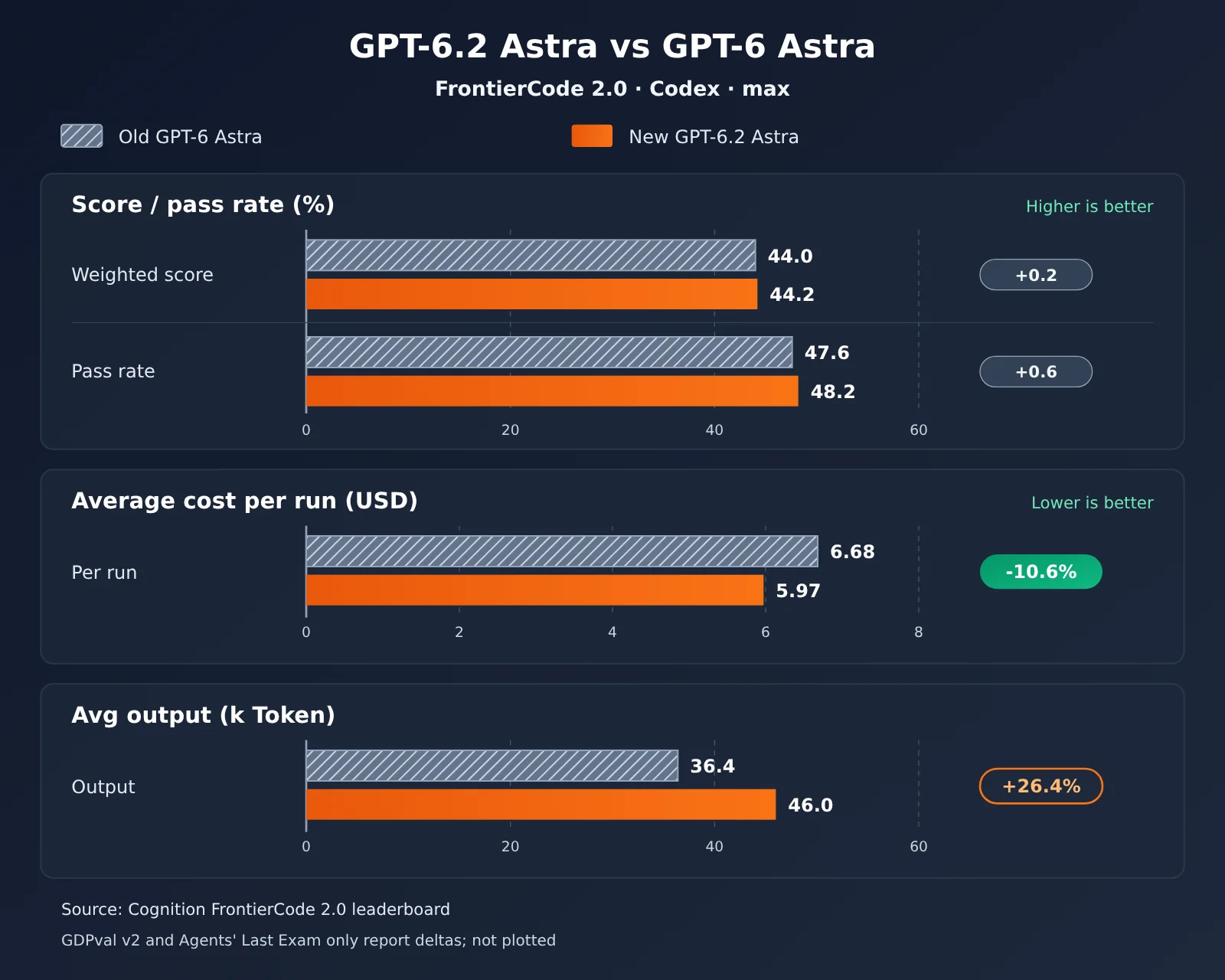
Chart note: the aggregated score for coding tasks is essentially flat, while cost per run drops and output volume climbs — so you can’t judge by token count alone, and you can’t judge by unit price alone either.
GPT-6.2 Astra Standard Short-Context Rates and Fixed-Usage Example
Here are OpenAI’s public standard short-context prices checked on November 27, 2026, in USD per million tokens. Percentage decreases use the old price as the denominator.
| Billing item (standard short-context) | GPT-6 Astra | GPT-6.2 Astra | Change |
|---|---|---|---|
| Regular input | 10 | 8 | -20% |
| Cached read | 1 | 0.40 | -60% |
| Output | 50 | 40 | -20% |
| 30-minute cache write | 12.50 | 10 | -20% |
| 12-hour cache write | 25 | 20 | -20% |
| Long-context multiplier (whole request when input exceeds 272K) | Input and cached read ×2, output ×1.5 | Input and cached read ×2, output ×1.5 | Same |
The fixed-usage example uses a request below the long-context threshold: 80,000 regular input tokens, 30,000 cached read tokens, and 10,000 output tokens. It counts model tokens only and excludes new cache writes, tool fees, and regional surcharges. Old Astra comes to 0.80 + 0.03 + 0.50 = $1.33, while new Astra comes to 0.64 + 0.012 + 0.40 = $1.052, about 20.9% lower.
If we further assume the new model’s output drops from 10,000 to 7,800 tokens while both input components stay the same, the new total is 0.64 + 0.012 + 0.312 = $0.964, about 27.5% lower than the old total. This scenario is only meant to show the combined effect of changing unit prices and usage; it’s not measured data. For a real comparison, plug in the usage field returned by your own requests.
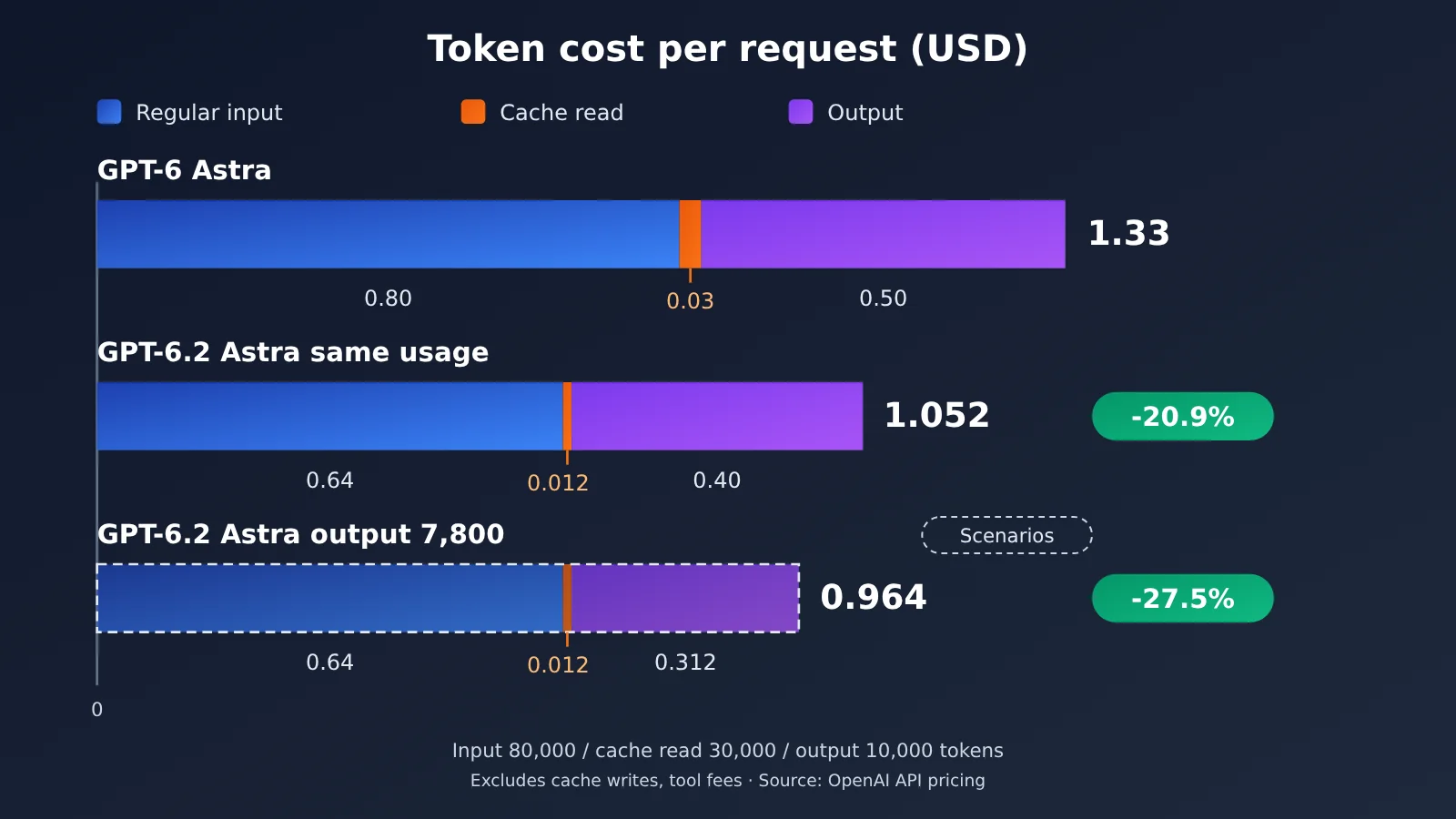
Figure note: You can do this kind of recalculation by running the same fixed task set once on each generation of the model, then switching model IDs through APIYI apiyi.com’s unified OpenAI-compatible interface for comparison. The models actually available are subject to the platform’s model list.
GPT-6.2 Astra Migration: API and Service Tier Differences
GPT-6.2 Astra supports both Responses and Chat Completions; use Responses when you need to call tools. The table below summarizes the changes relevant to legacy Astra projects from the migration guide and release notes.
| Migration item | Requirement or change | Notes |
|---|---|---|
| Reasoning effort syntax | Responses uses reasoning.effort; Chat Completions uses reasoning_effort |
New integrations can start with medium, while existing integrations should first use their original level as a baseline. |
| none / minimal | The model card explicitly disallows none, and the guide recommends switching none or minimal to low | Existing configurations need to be replaced one by one. |
| Parameters removed from Chat Completions | temperature, top_p, logprobs, top_logprobs | Be aware of default values in general-purpose clients. |
| Parameters removed from Responses | temperature, top_p, top_logprobs; message.output_text.logprobs is removed from include |
Legacy Astra already had sampling parameter restrictions; this step is mainly about checking project configuration. |
| Top-level instructions | Come after input; if sent repeatedly, they’re billed as regular input and do not carry over with previous_response_id | Stable cross-turn guidance should go in a developer message at the beginning of input. |
| Cached prefix | Shortening old tool results or rewriting early rules may cause the content after the change to lose cache eligibility | The new version may also discard reasoning items after the change. |
| Zero data retention organizations | Responses treats store as false | For multi-turn, previous output items must be sent back in order, including encrypted reasoning items. |
| Low-priority service tier | The new model has no Flex; Batch is available (50% of Standard); background completion windows are 30% lower for 2 hours and 40% lower for 8 hours | The background completion window is a public beta feature. |
Assessing the GPT-6.2 Astra Upgrade
Using three denominators to judge the value of the GPT-6.2 Astra upgrade
The upgrade payoff can be broken down into three observable quantities: the change in rates at the same usage, the change in token consumption for completing comparable tasks, and the change in delivery pass rates and rework. These have different denominators, and mixing them together easily leads to misleading conclusions. For example, FrontierCode 2.0’s output volume rose 26.4% — judged purely on usage, that looks like it got more expensive, yet on a cost-per-run basis it actually dropped by about 10.6%.
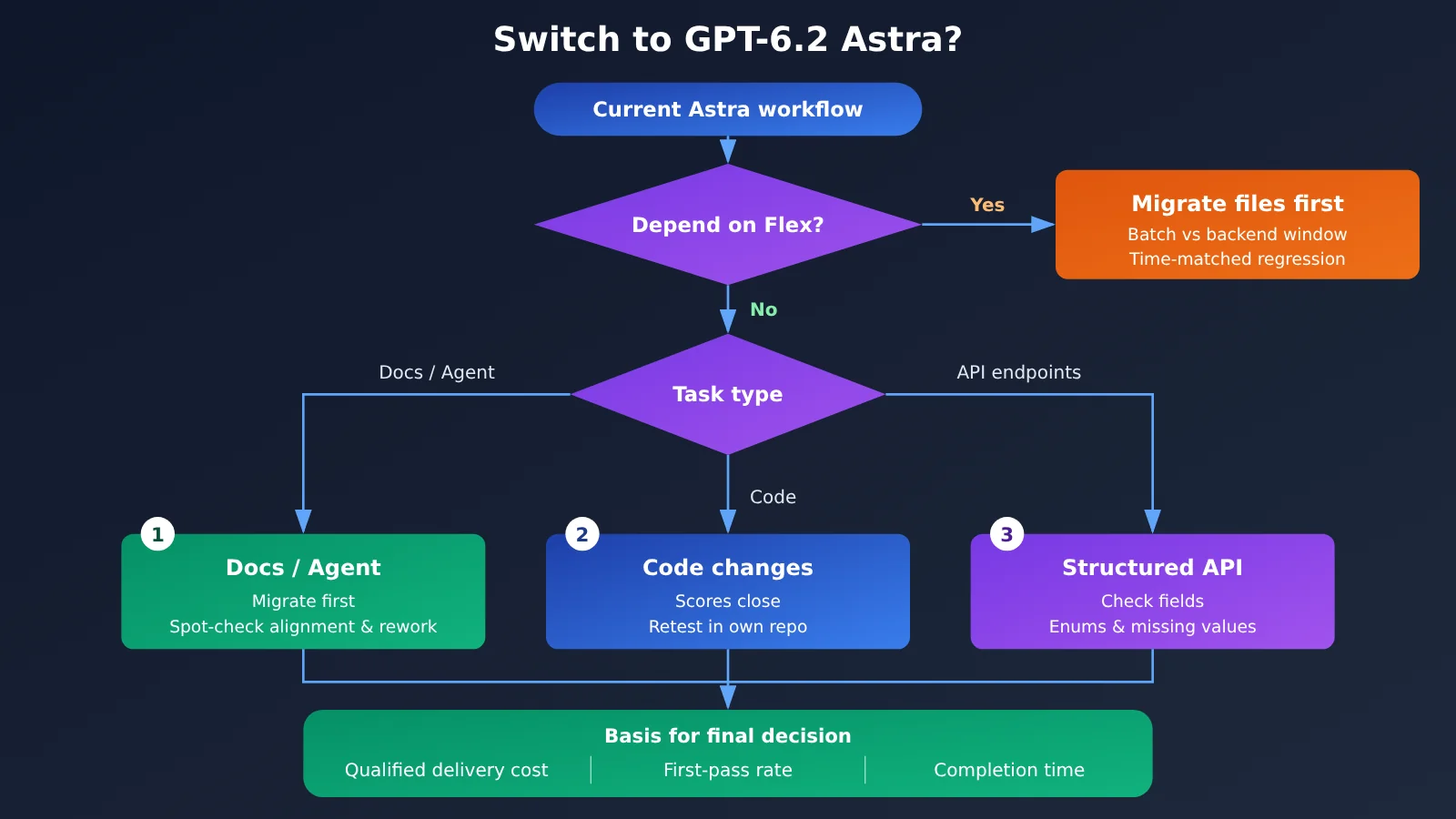
A more reliable approach is to fix a set of tasks you run frequently, multiply each generation’s rates by the corresponding usage, then fold in the cost of failed retries and rework. Finally, divide the total cost by the number of deliverables that pass the same acceptance criteria, giving you “cost per qualified deliverable.” Cost, completion time, and first-pass acceptance rate are best shown side by side — that way you can separate the cost of a single model invocation from the cost of a complete delivery.
There are a few conditions to watch that will widen or narrow the reduction. When the cache-read share is high and multiple turns hit the cache consecutively, the overall reduction gets closer to the 60% cache-read figure. When new prefixes are frequently written to cache, when some requests cross the 272K threshold, or when tool-call retries increase, all of those costs need to be included — otherwise you’ll overstate the savings.
Upgrade guidance for GPT-6.2 Astra across different workflows
The judgments below are based on the public data discussed earlier. They’re analytical conclusions, and you’ll still want to validate the actual results on your own tasks.
- Professional documents, financial modeling, consulting reports: GDPval v2 and Agents’ Last Exam both show quality gains alongside lower usage or cost, and combined with the lower unit price, this is the first place to migrate. When you sign off, focus on cross-file data alignment, long-task completeness, template adherence, and how much rework is needed after delivery.
- Coding agents and code edits: A 0.2 percentage point score difference isn’t enough on its own to justify switching; the main benefit comes from lower average run cost. Re-test under the same repo state, toolchain, reasoning tier, and test suite, and track the mergeable ratio, output volume per run, and retry cost.
- Structured interfaces: Both generations support structured output. The main risks are parameter cleanup and differences in field behavior. Just verify field constraints, enums, and missing values against your existing examples.
- Scheduled jobs that depend on Flex: This is the highest-migration-cost category. If you simply divide the old Flex rate by the new Standard rate, the result mixes two factors at once: the processing tier change and the model upgrade. Compare Batch and the background completion window at the same delivery deadline instead.
How to Migrate to GPT-6.2 Astra: Minimal-Change Example
As a first step, I recommend confirming the target ID, output parsing, and structured fields in a tool-free request. The following uses Chat Completions for a minimal validation—note that you don’t pass sampling parameters like temperature or top_p anymore:
import openai

client = openai.OpenAI(
    api_key="YOUR_API_KEY",
    base_url="https://api.apiyi.com/v1"  # APIYI OpenAI-compatible endpoint
)

response = client.chat.completions.create(
    model="gpt-6.2-astra",          # old value was gpt-6-astra
    reasoning_effort="medium",      # if the old project already has a working tier, use the original tier for comparison first
    messages=[{"role": "user", "content": "用三点概括这份季度报表的风险。"}],
)
print(response.choices[0].message.content)
print(response.usage)
When tool calls and multi-turn conversations are involved, switch to Responses and put the rules reused across turns into a developer message at the beginning of input. The complete example below also includes a function that estimates the per-request cost at standard rates, making it easy to recalculate the cost of both generations using real usage. For whether the Responses endpoint is supported through the proxy, refer to the platform documentation.
View the complete migration and cost-recalculation code
import openai

client = openai.OpenAI(
    api_key="YOUR_API_KEY",
    base_url="https://api.apiyi.com/v1"
)

# Standard short-tier public price, in USD per million tokens (verified 2026-11-27)
PRICES = {
    "gpt-6-astra":   {"input": 10.0, "cached": 1.00, "output": 50.0},
    "gpt-6.2-astra": {"input": 8.0,  "cached": 0.40, "output": 40.0},
}
LONG_THRESHOLD = 272_000  # if a single input exceeds this value, the entire request is billed at the long tier


def estimate_cost(model: str, input_tokens: int, cached_tokens: int, output_tokens: int) -> float:
    """Counts model tokens only: excludes cache writes, tool fees, and regional surcharges.
    input_tokens is total input (including the cached-read portion), and cached_tokens is the portion that hit cache."""
    p = PRICES[model]
    long_tier = input_tokens > LONG_THRESHOLD
    in_mul, out_mul = (2.0, 1.5) if long_tier else (1.0, 1.0)
    uncached = input_tokens - cached_tokens
    cost = (
        uncached * p["input"] * in_mul
        + cached_tokens * p["cached"] * in_mul
        + output_tokens * p["output"] * out_mul
    ) / 1_000_000
    return round(cost, 4)


DEVELOPER_RULES = "你是财务分析助手。输出必须引用源表单元格,数字保留两位小数。"


def run_turn(user_text: str, model: str = "gpt-6.2-astra", effort: str = "medium"):
    # none / minimal should be changed to low on the new model
    if effort in ("none", "minimal"):
        effort = "low"
    resp = client.responses.create(
        model=model,
        input=[
            {"role": "developer", "content": DEVELOPER_RULES},  # stable prefix; helps caching
            {"role": "user", "content": user_text},
        ],
        reasoning={"effort": effort},
        # no longer pass temperature / top_p / top_logprobs
    )
    u = resp.usage
    cached = getattr(u.input_tokens_details, "cached_tokens", 0) or 0
    return resp.output_text, u.input_tokens, cached, u.output_tokens


if __name__ == "__main__":
    # recompute the fixed-usage example in the article: total input 110,000, with 30,000 cached reads and 10,000 output
    for m in PRICES:
        print(m, estimate_cost(m, 110_000, 30_000, 10_000))
    # expected: gpt-6-astra 1.33, gpt-6.2-astra 1.052

    text, inp, cached, out = run_turn("根据附表核对三张报表的营收是否一致。")
    print(text)
    print("本次估算费用:", estimate_cost("gpt-6.2-astra", inp, cached, out))
🚀 Quick start: The easiest way to compare during migration is to use the same codebase and switch only the model ID. You can get free testing credits through APIYI apiyi.com, call the old and new models under the same API key, record usage, then plug it back into the function above to recalculate.
GPT-6.2 Astra Migration Acceptance Checklist
For acceptance testing, it’s best to group by request type. For each group, use fixed inputs and scoring rules, and run one round on each of the two model generations:
- Documents and tables: Use the same reference file and scoring rules to check number verification, citation accuracy, and format compliance.
- Coding tasks: Lock the repository state, toolchain, reasoning tier, and test suite. Record the share of mergeable changes, output volume per run, and retry cost.
- Structured interfaces: Use existing examples to verify field constraints, enum values, and missing-value behavior.
- Multi-turn tool chains: Place checkpoints at the second turn and later. Observe whether citations, formatting, call order, retries, and the ratio of regular input to cache reads match expectations.
- Processing tiers: After moving original Flex jobs to Batch or background completion windows, verify the completion rate and retry behavior against the original delivery deadlines.
Overall, GPT-6.2 Astra’s lower unit price applies to all Astra users. What really needs item-by-item validation are the two denominators: usage and rework. First, establish the “cost per qualified delivery” on one or two high-frequency task types, then decide the pace of full migration. That’s more reliable than just looking at leaderboards. When you need to compare multiple models in parallel, you can also use APIYI apiyi.com’s unified interface to reduce integration effort.
GPT-6.2 Astra Upgrade FAQ
Q1: What is GPT-6.2 Astra, and how does it relate to GPT-6 Astra?
GPT-6.2 Astra is a model released by the OpenAI API on November 17, 2026, with the ID `gpt-6.2-astra`. Its predecessor in the same tier is `gpt-6-astra`. Both have a 1,050,000-token context window and a 128,000-token maximum output; the new model card also lists a 922,000-token maximum input.
Q2: How much better is GPT-6.2 Astra than GPT-6 Astra?
It depends on the task. It scores 6.2 percentage points higher on GDPval v2 and produces 22% fewer output tokens. On Agents’ Last Exam, it scores 5.2 points higher at less than a third of the previous generation’s cost. On FrontierCode 2.0, the weighted scores are only 0.2 percentage points apart, but the average per-run cost is about 10.6% lower. These three benchmarks use different methodologies, so it’s not appropriate to merge them into one overall conclusion.
Q3: How much did GPT-6.2 Astra’s standard short-tier pricing drop?
Per million tokens, regular input fell from $10 to $8, and output fell from $50 to $40—both 20% decreases. Cache reads fell from $1 to $0.40, a 60% decrease. The 30-minute and 12-hour cache-write tiers also dropped 20%. These are OpenAI’s public prices checked on November 27, 2026.
Q4: Which scenarios are best suited for upgrading to GPT-6.2 Astra first?
– **Financial modeling and valuation workbooks**: public benchmarks show the strongest signal for professional deliverables.
– **Long-horizon agent tasks**: Agents’ Last Exam shows improvements in both quality and cost.
– **Multi-turn conversations with high cache hit rates**: cache-read unit prices saw the biggest drop.
For coding-agent tasks, we recommend re-testing in your own repository before deciding.
Q5: How can I quickly compare GPT-6 Astra and GPT-6.2 Astra via the API?
1. Visit APIYI apiyi.com to sign up and get an API key and free trial credits.
2. Set the `base_url` in this article’s example to `https://api.apiyi.com/v1`.
3. Run the same batch of tasks against both model IDs, record usage, and plug it into your cost function to recalculate.
Refer to the platform’s model list for available model IDs.
Q6: What are the known limitations when migrating to GPT-6.2 Astra?
– **Processing tiers**: The new model isn’t available on Flex, so you’ll need to use Batch or background completion windows instead.
– **Parameters**: The reasoning tier doesn’t accept `none`, and sampling- and logprobs-related parameters must be removed.
– **Prompt structure**: Repeatedly sending top-level instructions is billed as regular input and doesn’t carry over with `previous_response_id`.
– **Long-context tier**: If a single input exceeds 272K tokens, the entire request is billed at the long-context tier; this is the same for both generations.
If you’re unsure how a parameter will behave, you can first validate it on a small sample using APIYI apiyi.com’s trial credits.
References
- OpenAI API changelog: release notes for both Astra generations and their processing tiers
- Link:
developers.openai.com/api/docs/changelog
- Link:
- OpenAI announcement: GDPval v2, Agents’ Last Exam results, and workbook showcase
- Link:
openai.com/index/introducing-gpt-6-2-astra-sol
- Link:
- GPT-6 Astra / GPT-6.2 Astra model cards: specs, long-context threshold, and processing tier
- Link:
developers.openai.com/api/docs/models/gpt-6-astra - Link:
developers.openai.com/api/docs/models/gpt-6.2-astra
- Link:
- OpenAI API pricing: standard short-context, long-context, and processing-tier rates
- Link:
developers.openai.com/api/docs/pricing
- Link:
- GPT-6.2 migration guide and prompt caching guide: parameter cleanup, instruction placement, and prefix preservation
- Link:
developers.openai.com/api/docs/guides/latest-model - Link:
developers.openai.com/api/docs/guides/prompt-caching
- Link:
- Cognition FrontierCode 2.0: leaderboard and scoring methodology
- Link:
cognition.com/frontiercode
- Link:
- Agents’ Last Exam: original leaderboard
- Link:
agents-last-exam.org/leaderboard
- Link:
Author: APIYI Technical Team
Technical support: Feel free to contact us through the APIYI homepage. For more integration resources, visit the documentation center at docs.apiyi.com.