Author’s note: This review evaluates GLM-5.4 from four angles—loop architecture, official demos, KingBench 4 third-party single-sample data, and time/cost—to make clear where its “generalized Coding” strengths lie, where it’s slow, and when you shouldn’t switch yet.
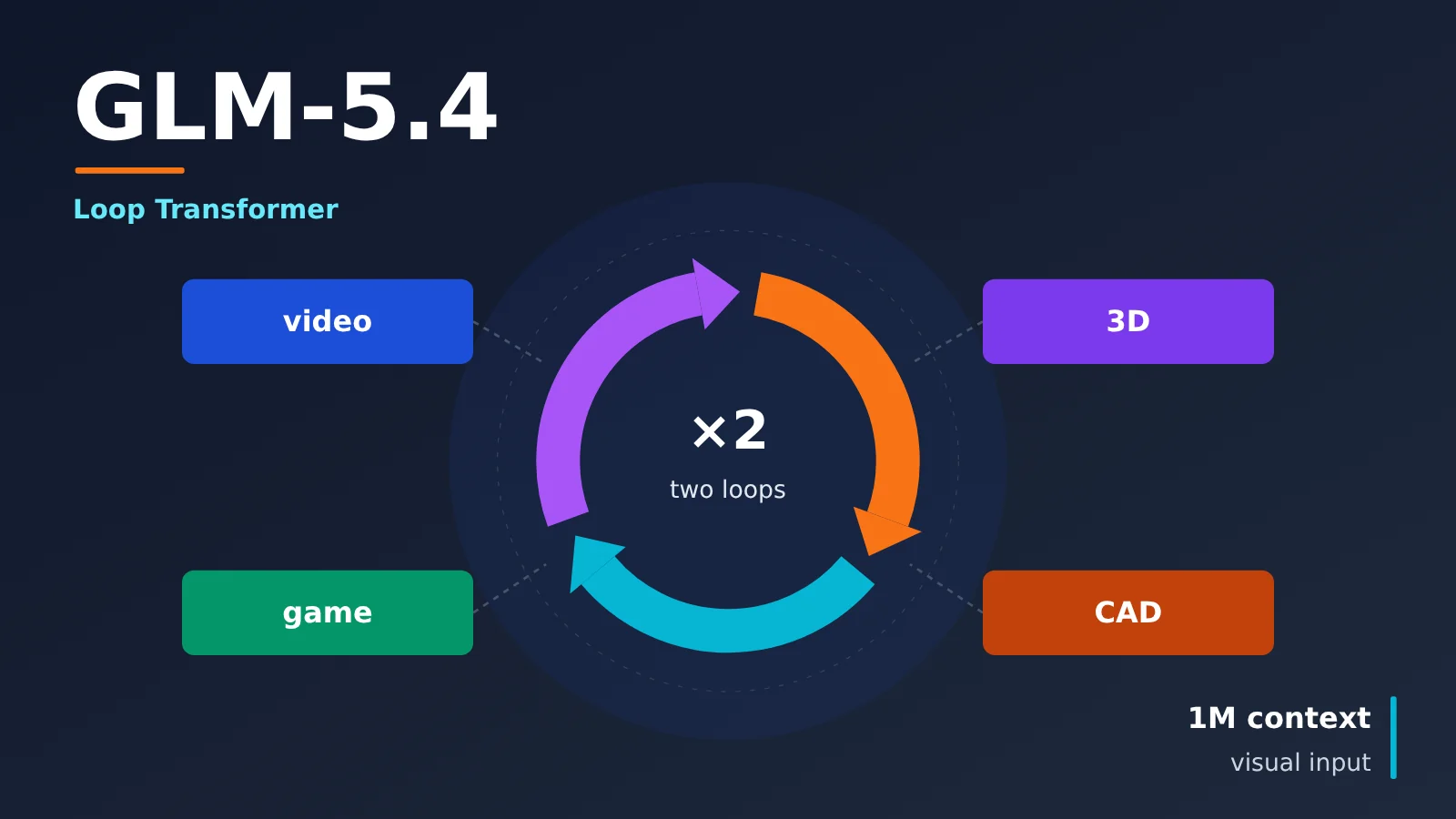
Here’s the conclusion up front: GLM-5.4 pushes long-horizon programming and visual Coding a step further, but it is not a fast model. Z.ai released this first flagship model built on Loop Transformer on 2026-11-23, emphasizing a 1M context window, visual input, and “generalized Coding” capabilities that extend from writing code to video, games, 3D shaders, and CAD modeling.
This isn’t a rehash of the launch press release. This article breaks the information into three layers: what the company claims, what third-party independent single-sample tests show, and what can’t currently be verified—each discussed separately. The company did not publish aggregate benchmark scores like SWE-bench. The only independent data point that can be checked right now is KingBench 4: 33.2 points, 7th out of 19 models, 5.7 points higher than GLM-5.3 and 1.5 points lower than Claude Opus 5.5. The cost also comes from this data: 1,128 reasoning steps and 431 minutes.
Core value: After reading this article, you’ll be able to judge whether GLM-5.4 is worth switching to from GLM-5.3 or other models, and which scenarios should wait.
GLM-5.4 Key Takeaways
| Point | Details | What it means for developers |
|---|---|---|
| Looped architecture | 28 of the 78 layers in the GLM-5 base share weights and run in a loop for two passes | The parameter count stays the same, but the network is effectively deeper |
| Specs | 1M context, 128K max output; input supports video / image / text / files | You can feed in a full repo and design mockups together |
| Broad coding | Official demos cover MV, complete games, GLSL 3D scenes, and FreeCAD robotic arms | It opens up “code-generated content” tasks that models previously couldn’t handle |
| Independent data | KingBench 4 score of 33.2, 7th place, 5.7 points higher than GLM-5.3 | The improvement is real and visible, but a single test isn’t the final leaderboard |
| Trade-off | Same test: 1,128 steps and 431 minutes; the vendor admits it can get stuck in marathon thinking | Not suitable for interactive scenarios that need instant responses |
GLM-5.4 information tiers: what you can trust and what you’ll need to wait for
When you’re reading up on GLM-5.4, the easiest mistake to make is treating vendor claims as conclusions. We’ve sorted the information available so far into three credibility tiers:
- Vendor self-reported: looped architecture details, the 30B control experiment, the claim that output length drops 10%–14%, specs such as 1M context, throughput figures, the four broad-coding demo videos, and self-reported win rates against GLM-5.3 / Kimi K3.1 Pro / DeepSeek-V4.1-Flash. Z.ai provided all of this itself. It’s useful as a reference, but there’s no external reproduction.
- Third-party independent single run: AICodeKing’s KingBench 4 evaluation. It’s a private test set with only one evaluator and one test run. Its value is that “someone independently ran it,” but it isn’t a vendor’s final leaderboard, and it doesn’t represent every coding scenario.
- Currently unverifiable: the official claim that its “intelligence level reaches that of 2T–3T-parameter models”; the Chinese docs’ claim that it “ranks among the top domestic models in an internal evaluation of 200 real coding scenarios” (no score given); and the fact that GLM-5.4 has no public score in the Artificial Analysis index yet. None of these can be used as a basis for model selection.
GLM-5.4’s Core Feature: How the Loop Transformer Makes the Model “Deeper”
The 28-Layer, Two-Pass Loop in GLM-5.4
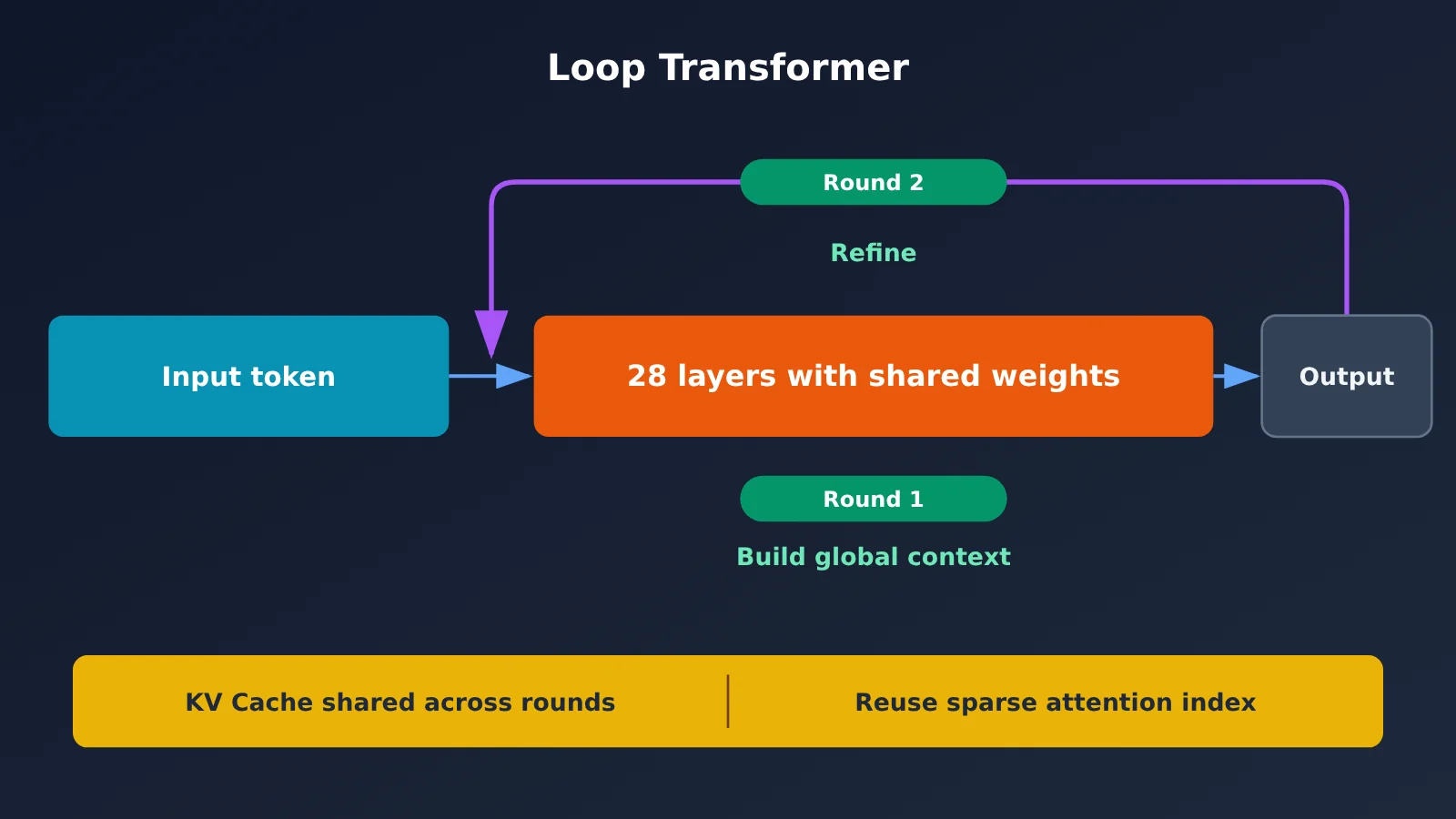
The usual way to make a model smarter is to stack on more parameters. GLM-5.4 takes a different route: it pulls out the 28 layers from the GLM-5 base model, shares their weights, and runs the input through that stretch of the network twice. The parameter count doesn’t change, but every token now goes through more computation. The official design intent is that the first pass builds a global context, and the second pass refines on top of it.
To make this design work at the 750B scale, the team made three engineering changes. First, token-wise gated progressive write-back, which governs how the results of the second pass get merged back in. Second, KV Cache sharing across passes plus an independent sliding window, so an extra pass only costs the KV overhead of one more sliding window. Third, the second pass directly reuses the sparse attention indices from the first pass, adding no extra indexing cost. These three points decide whether a loop architecture can actually run at long context — and they’re the precondition for GLM-5.4 supporting a 1M context.
Official Comparison Data for GLM-5.4’s Loop Architecture
Does looping actually help? The official team ran a set of controlled experiments at the same 30B parameter count: same architecture as the 750B base model, 200K long-context SFT, thinking enabled, and only about 10% more training compute. All data in the table below is self-reported by the official team.
| Benchmark | No Loop | Two Loop Rounds | Improvement |
|---|---|---|---|
| AIME25 | 19.17 | 30.42 | +11.25 |
| GPQA-Diamond | 47.58 | 56.26 | +8.68 |
| MMLU-Pro | 71.65 | 75.05 | +3.40 |
| AA-LCR (long-context reasoning) | 40.33 | 47.67 | +7.34 |
| IFBench (instruction following) | 50.20 | 53.47 | +3.27 |
Looking at this data, looping helps most with mathematical reasoning and long-context reasoning, while the gains on knowledge-based tasks and instruction following are relatively modest. The official team also noted that average output length dropped by 10%–14% on benchmarks like GPQA-Diamond and MMLU-Pro, explaining that part of the reasoning shifted from explicit tokens into the implicit depth of the loop. Worth noting: this is a comparison on the 30B small model, and the equivalent comparison for the 750B flagship has not been released.
GLM-5.4’s General Coding: Video, Games, 3D, and CAD
What GLM-5.4 calls “general coding” means using code to produce things beyond code itself. The official blog released four demo videos. All of the following are official demos, not test results you can reproduce yourself:
- Self-narrated music video “Hello World”: renders visuals in real time with code and calls a third-party music model for the soundtrack.
- FreeCAD engineering modeling: builds an engineering-grade CAD model of a 6-axis robotic arm.
- Complete game: generates a game from scratch, including character movement, physics, maps, a combat system, and art assets.
- 3D birdwatching scene: creates an interactive scene using pure mathematical geometry plus custom GLSL shaders.
These tasks share a few things: long pipelines, a need for visual feedback, and high demands on spatial and geometric understanding. That lines up exactly with a loop architecture combined with visual input. The Chinese documentation also lists vision coding, visual replication, and long-horizon tasks as standout areas, but it doesn’t provide specific scores.
GLM-5.4 Specifications
| Item | GLM-5.4 official specs |
|---|---|
| Input modalities | Video / image / text / files |
| Output modalities | Text |
| Context length | 1M |
| Max output | 128K |
| Supported capabilities | Thinking mode, streaming, function calling, structured output, context caching |
| Throughput (official) | Up to 200 token/s off-peak, 70-80 token/s at peak |
Peak throughput is less than half of off-peak throughput, so factor that in when estimating how long long tasks will take.
GLM-5.4 Benchmark Data: 33.2 Points and 431 Minutes on KingBench 4
First, the data source: the following numbers come from KingBench 4, published by AICodeKing on 2026-11-23. This is a third-party independent single run, not an APIYI test and not a vendor’s final leaderboard. The test consists of six “one-sentence apps,” such as a room designer, a QMK keyboard, and a Fitbit watch face. A total of 19 models were evaluated, with a maximum score of 60, using max thinking effort.
GLM-5.4 Score and Runtime Comparison
| Model | KingBench 4 Score | Gap vs GLM-5.4 | Notes |
|---|---|---|---|
| Claude Fable 5.2 | 42.0 | +8.8 | Top this round |
| Gemini 4 Neon | 37.9 | +4.7 | 244 steps, 109 minutes |
| Claude Opus 5.5 | 34.7 | +1.5 | — |
| GLM-5.4 | 33.2 | — | 7th, 1,128 steps, 431 minutes |
| Kimi K3.1 Pro | 32.2 | -1.0 | — |
| GLM-5.3 | 27.5 | -5.7 | Previous generation |
According to the evaluator, GLM-5.4 is the highest-scoring open-weight model in this round. The 5.7-point improvement over GLM-5.3 is the most solid signal from this generational upgrade; being only 1.5 points behind Claude Opus 5.5 shows it has reached the edge of the top tier on these one-sentence app tasks.
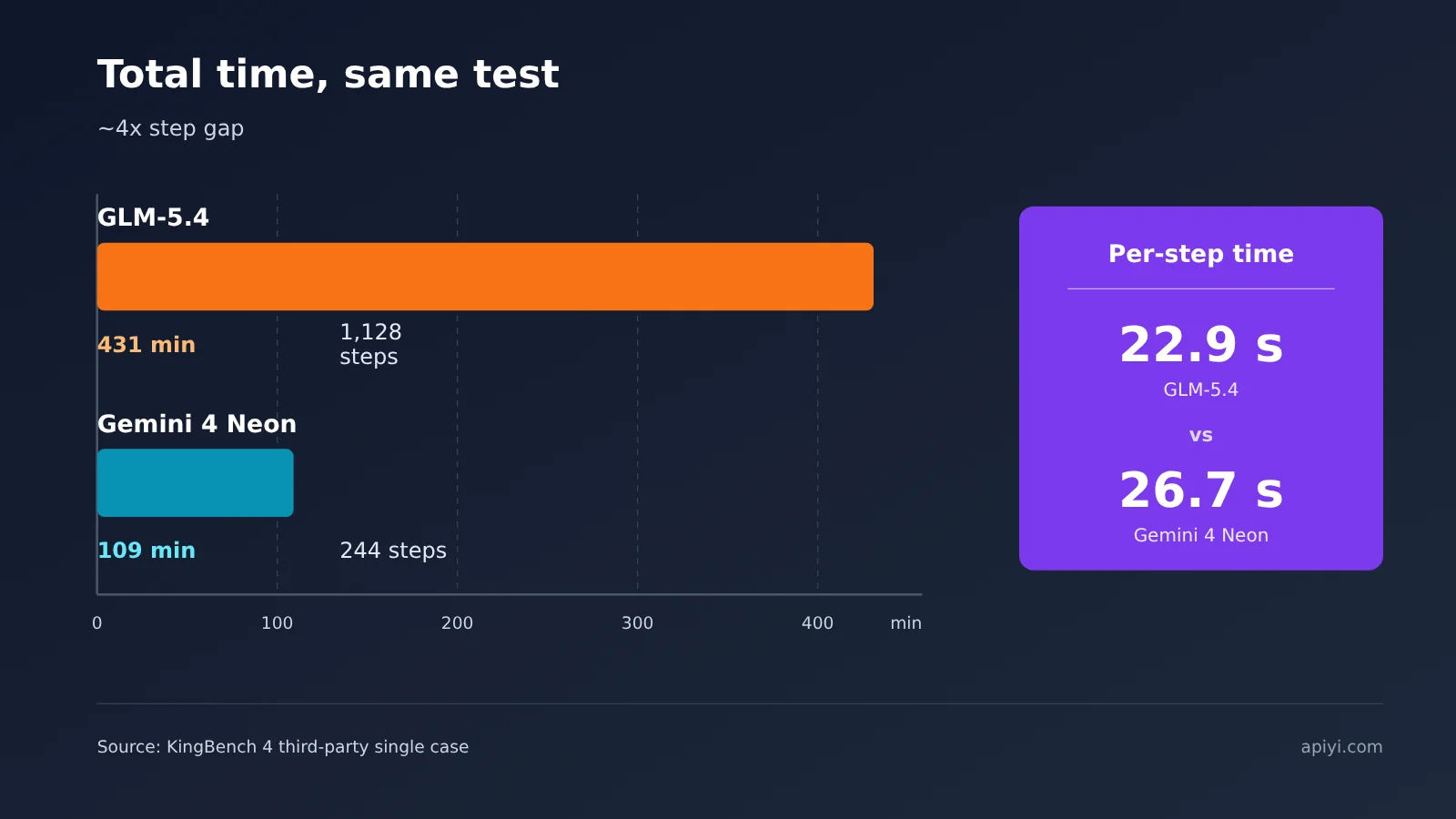
But the runtime numbers are just as striking. To complete the same test suite, GLM-5.4 used 1,128 reasoning steps and 431 minutes; Gemini 4 Neon used only 244 steps and 109 minutes. Interestingly, GLM-5.4’s per-step time was 22.9 seconds, actually shorter than Gemini 4 Neon’s 26.7 seconds. It’s slow not because each step is slow, but because it took nearly four times as many steps — which lines up perfectly with the official description of “marathon thinking.”
How to Choose the GLM-5.4 Thinking Level
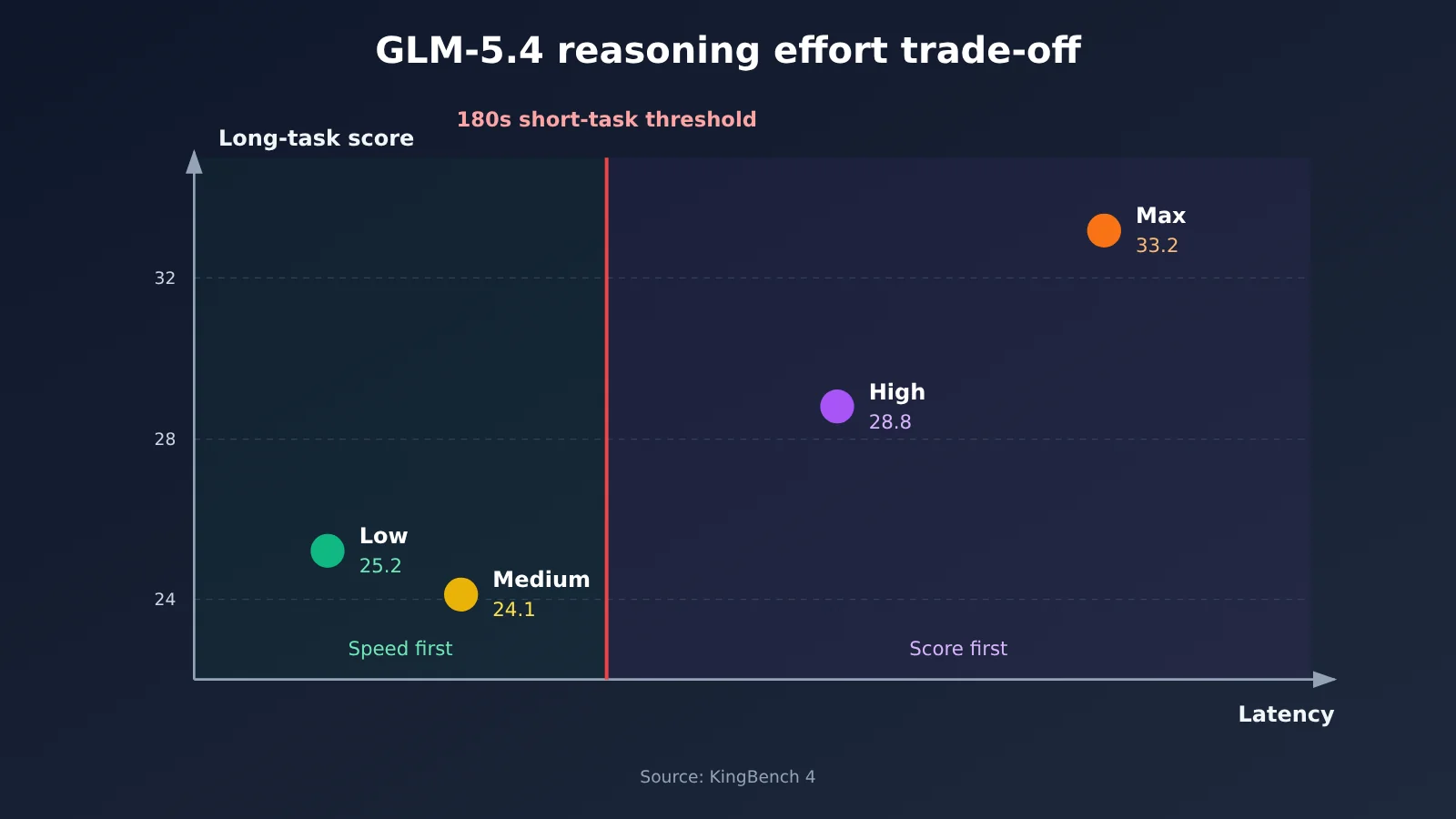
The evaluator also ran a 180-second short-task probe: Low and Medium finished within 180 seconds, while High and Max timed out outright. Switching to the long-task KingBench 4, the results flipped: Max scored 33.2 and High 28.8, clearly above Low at 25.2 and Medium at 24.1.
This gives a very practical conclusion: GLM-5.4’s high score is “ground out” through high thinking levels. If you dial it down to Low or Medium for speed, long-task scores fall to around GLM-5.3, and the value of the generational upgrade becomes much smaller. The evaluator also recorded a 98.4% cache hit rate and a 31/31 pass rate on parallel tool schema checks, showing it’s stable in agent tool invocation compliance.
GLM-5.4 Pros and Cons Analysis
GLM-5.4 Strengths
- Long-horizon coding gains are visible: It scores 5.7 points higher than GLM-5.3 on KingBench 4, and the official internal evaluation also lists long-horizon tasks as a standout.
- Visual coding is a new capability: It supports video and image input, making it suitable for recreating pages from design mockups and fixing UI based on screenshots.
- General coding opens up new scenarios: Official demos cover 3D shaders, CAD, and games—areas where most models have historically been weak.
- Tool calling is well-specified: A third-party record shows 31/31 parallel tool schema checks passed, with a 98.4% cache hit rate, which is friendly to agent workflows.
- The architectural efficiency approach is clear: The parameter count stays the same while the model is deepened through recurrence; a 30B comparison shows only about 10% more training compute.
GLM-5.4 Limitations
- Slowness is the real weakness: It took 431 minutes on the same test, roughly four times that of Gemini 4 Neon. The way around this is to use it only for long tasks that can run offline without someone watching.
- The official team acknowledges marathon thinking: Repeated reflection often pushes accuracy higher, but runtime is unpredictable. It’s recommended to set step or time limits in agents.
- It lacks public comprehensive benchmark scores: There are no SWE-bench or Terminal-Bench scores, and Artificial Analysis has no data yet. Procurement decisions can only rely on one independent single-instance evaluation.
- The API isn’t open yet: It’s waiting for the safety evaluation to be completed, and there’s no timeline for open-sourcing the weights either. For now, it can only be used through subscriptions and coding tools.
When You Shouldn’t Use GLM-5.4
The most important question an evaluation article should answer isn’t “How capable is it?” but “When should you avoid using it?” In the following three scenarios, you should probably hold off on switching from your current model:
- Interactive scenarios that require instant responses: online customer support, IDE inline completion, real-time chat. The High / Max tiers time out even on 180-second short tasks. Low / Medium are fast, but their long-task scores fall back to the GLM-5.3 level.
- Production pipelines that require a stable API: GLM-5.4’s official API isn’t available yet, and there’s no timeline. Live services that have already integrated an API can currently only keep using GLM-5.3 or other models.
- Public, reproducible benchmark scores needed as a procurement basis: if you’re writing a model selection report for your team, a single data point from a private test set won’t support your conclusion. Wait until official or third-party public benchmarks are available before deciding.
Conversely, if your task is long-horizon refactoring that you can hand to an Agent to run overnight and accept in the morning, rebuilding a frontend from a design mockup, writing shaders, or doing parametric modeling, GLM-5.4 is worth trying first in a Coding Plan.
GLM-5.4 Quick Start: Subscription, Coding Tools, and API Preparation
Using GLM-5.4 Through the Coding Plan and Coding Tools
Right now, the official way to use GLM-5.4 is the GLM Coding Plan, which is available to all users. For weekly quota users, the GLM-5.4 quota has been raised to 1.5× that of GLM-5.3. As of the subscription page on 2026-11-24, Lite is $12.6/month (10,000 credits per week), Pro is $56/month (6× Lite), and Max is $117.6/month (14× Lite). Check the subscription page for the latest details.
After activation, you can select it directly in ZCode and Z.ai Chat. Third-party reports also list supported tools such as Trae, WorkBuddy, Qoder, CatPaw, and OpenCode. When using it in Claude Code-style tools, we recommend setting the thinking level to High or Max and giving each task a time budget.
Build Your API Pipeline Now, Then Switch with One Click When GLM-5.4 Is Listed
If your project uses API calls, you can build the pipeline now with its sibling model, GLM-5.3. GLM-5.4 isn’t listed on the APIYI platform yet, but we’ll get it listed as soon as possible. Model IDs and pricing are subject to the platform’s model list. Here’s how to connect:
- Sign up at APIYI (apiyi.com) and get your API key. New users get free trial credits.
- Use an OpenAI-compatible SDK, set
base_urltohttps://api.apiyi.com/v1, and put your key inapi_key. - Set
modeltoglm-5.3for now, or switch toglm-5.3-flashwhen you need speed and low cost. - When streaming is enabled, set
stream=True. For long tasks, increasemax_tokensand configure timeout retries. - Once GLM-5.4 is listed, just change
modelto the new ID from the platform’s model list. The rest of your code stays the same.
🚀 Quick start: With APIYI’s unified interface, one key lets you switch among
glm-5.3,claude-opus-5-5, andgemini-4-neon. It’s a good way to get your agent workflow running with existing models first, then compare results side by side.
How Pricing Works for GLM-5.4’s Sibling and Comparison Models
The table below shows prices from the APIYI price list as of 2026-11-23 10:23 (UTC+8), in USD per 1M tokens:
| Platform Model ID | Input | Output | Cache Read | Best For |
|---|---|---|---|---|
glm-5.3 |
$1.4 | $4.396 | $0.259 | GLM flagship coding, ClaudeCode group 0.95× |
glm-5.3-flash |
$0.15 | $0.5 | $0.03 | Lightweight, fast tasks |
claude-opus-5-5 |
$4 | $20 | $0.2 | Demanding coding and reasoning |
gemini-4-neon |
$3 | $15 | $0.15 | Faster on long tasks |
kimi-k3.1-pro |
$2 | $10 | $0.2 | Open-weight camp comparison |
deepseek-v4.1-flash |
$0.3 | $1.2 | $0.006 | Low-cost batch calls |
GLM-5.4 takes more steps, which means the same task will likely consume more tokens than the previous generation. Cache hit rate becomes the key to controlling costs. When switching models, we recommend running the same batch of tasks separately with glm-5.3 and the comparison models on apiyi.com, recording token consumption and latency, and then deciding whether GLM-5.4 is worth switching to once it’s listed.
FAQ
Q1: What kind of model is GLM-5.4?
GLM-5.4 is Z.ai (Zhipu)’s flagship model, released on 2026-11-23 — and their first Loop Transformer. It runs the 28 layers in the GLM-5 base through two loops, supports a 1M context window along with video and image inputs, and is built around long-horizon coding and visual coding.
Q2: How much better is GLM-5.4 than GLM-5.3?
The only independently verifiable number is KingBench 4: GLM-5.4 scores 33.2, GLM-5.3 scores 27.5 — a 5.7-point gap. The official self-run win rate is 51.1% wins, 25.7% ties, and 23.1% losses, but that’s the vendor grading its own work.
Q3: How does GLM-5.4 compare with Claude Opus 5.5?
On KingBench 4, GLM-5.4 comes in 1.5 points below Claude Opus 5.5 — not a huge gap, but it takes noticeably longer. The official team hasn’t published a head-to-head comparison against Claude Opus 5.5, so the safer move is to test both on your own tasks.
Q4: What is GLM-5.4 best suited for?
– **Long-horizon refactoring**: multi-file overhaul work that can run offline for hours.
– **Visual replication**: turning design mockups or screenshots into front-end pages.
– **Graphics and modeling code**: GLSL shaders, FreeCAD parametric modeling, small game prototypes.
Q5: Can I call GLM-5.4 through an API?
The official API won’t open up until the safety evaluation is finished, and there’s no timeline yet. On APIYI (apiyi.com), GLM-5.4 isn’t listed yet — we’ll get it up as soon as we can; model names and pricing are subject to the platform’s model list. For now, you can build your pipeline on `glm-5.3` and switch over by changing a single `model` parameter once it goes live.
Q6: Is the official 2T-3T parameter-scale claim credible?
That’s the vendor’s own statement. The blog doesn’t provide composite benchmark scores like SWE-bench or Terminal-Bench, and Artificial Analysis has no public GLM-5.4 data yet. For now it can’t be treated as a conclusion — only as the official positioning.
Q7: Why is GLM-5.4 so slow, and can that be eased?
The slowness comes from the number of reasoning steps, not from any single step being slow. You can drop the thinking level to Low or Medium to buy speed, but scores on long tasks will fall noticeably. The more practical approach is to use the higher setting only for long tasks you can run offline, and to cap the number of steps.
Q8: Will GLM-5.4 be open-sourced?
The plan is to open-source the weights responsibly after safety hardening, but no timeline has been given.
GLM-5.4 Key Takeaways
- Recurrent architecture: 28 layers with shared weights, run for two passes — same parameter count, deeper network.
- Real gains: 33.2 on KingBench 4, 5.7 points higher than GLM-5.3.
- Narrow gap: just 1.5 points behind Claude Opus 5.5 — close to the top tier.
- A clear cost: 1,128 steps and 431 minutes on the same test, roughly four times Gemini 4 Neon.
- The tier decides the score: high scores depend on High / Max; Low / Medium suits short tasks.
- Where not to switch yet: when you need instant responses, a stable API, or public benchmark numbers for procurement.
- How to get started: use the Coding Plan now, and build out the API pipeline with
glm-5.3on APIYI apiyi.com first.
Summary
The core takeaways for GLM-5.4:
- Where it’s strong: long-horizon coding, visual coding, and tasks like 3D / CAD that it previously couldn’t handle — backed by both independent data and official demos.
- Where it’s weak: it’s slow, and the slowness has a structural cause; public aggregate benchmark scores are missing, and the API isn’t open yet.
- How to choose: long tasks that can run offline are worth a try; for interactive and production pipelines, wait and see.
If you’re using a coding agent for large refactors or front-end replication, you can try GLM-5.4’s high thinking tier through the Coding Plan first. For teams going through the API, we’d suggest first getting the comparison workflow working on APIYI apiyi.com with glm-5.3 and models like claude-opus-5-5; once GLM-5.4 is listed, run the same batch of tasks to directly verify the gains from the upgrade.
📚 References
-
Z.ai Official Technical Blog: GLM-5.4 recurrent architecture and the 30B controlled experiment
- Link:
z.ai/blog/glm-5.4 - Notes: Architecture details, demo videos, and the limitations officially described by the team
- Link:
-
Z.ai Official Documentation: GLM-5.4 specifications
- Link:
docs.z.ai/guides/llm/glm-5.4 - Notes: Context, output length, modalities, and supported features
- Link:
-
Zhipu Chinese Documentation: GLM-5.4 model introduction
- Link:
docs.bigmodel.cn/cn/guide/models/glm-5.4 - Notes: Qualitative description of internal coding-scenario evaluations
- Link:
-
GLM Coding Plan Subscription Page: Plans and quotas
- Link:
z.ai/subscribe - Notes: Current subscription pricing and weekly quotas
- Link:
-
Artificial Analysis: Third-party composite intelligence index
- Link:
artificialanalysis.ai - Notes: Worth watching to see whether GLM-5.4 later adds public scores
- Link:
Author: APIYI Technical Team
Technical Contact: Feel free to reach us through the APIYI website homepage. Model names and pricing are available in the docs.apiyi.com documentation center.