A detailed comparison of Claude Opus 4.5 and Sonnet 4.5 performance, pricing, and use cases, mastering the efficient pairing strategy of using Opus for reasoning and thinking, Sonnet for execution and implementation.
After the release of the Claude 4.5 series, many developers face a practical question: How to choose between claude-opus-4-5-20251101 and claude-sonnet-4-5-20250929? The answer is actually quite simple—Use Opus for reasoning and thinking, use Sonnet for execution and implementation.
Core Value: Master the differences and pairing strategies of these two models to achieve the best cost-effectiveness in Claude Code and API scenarios.
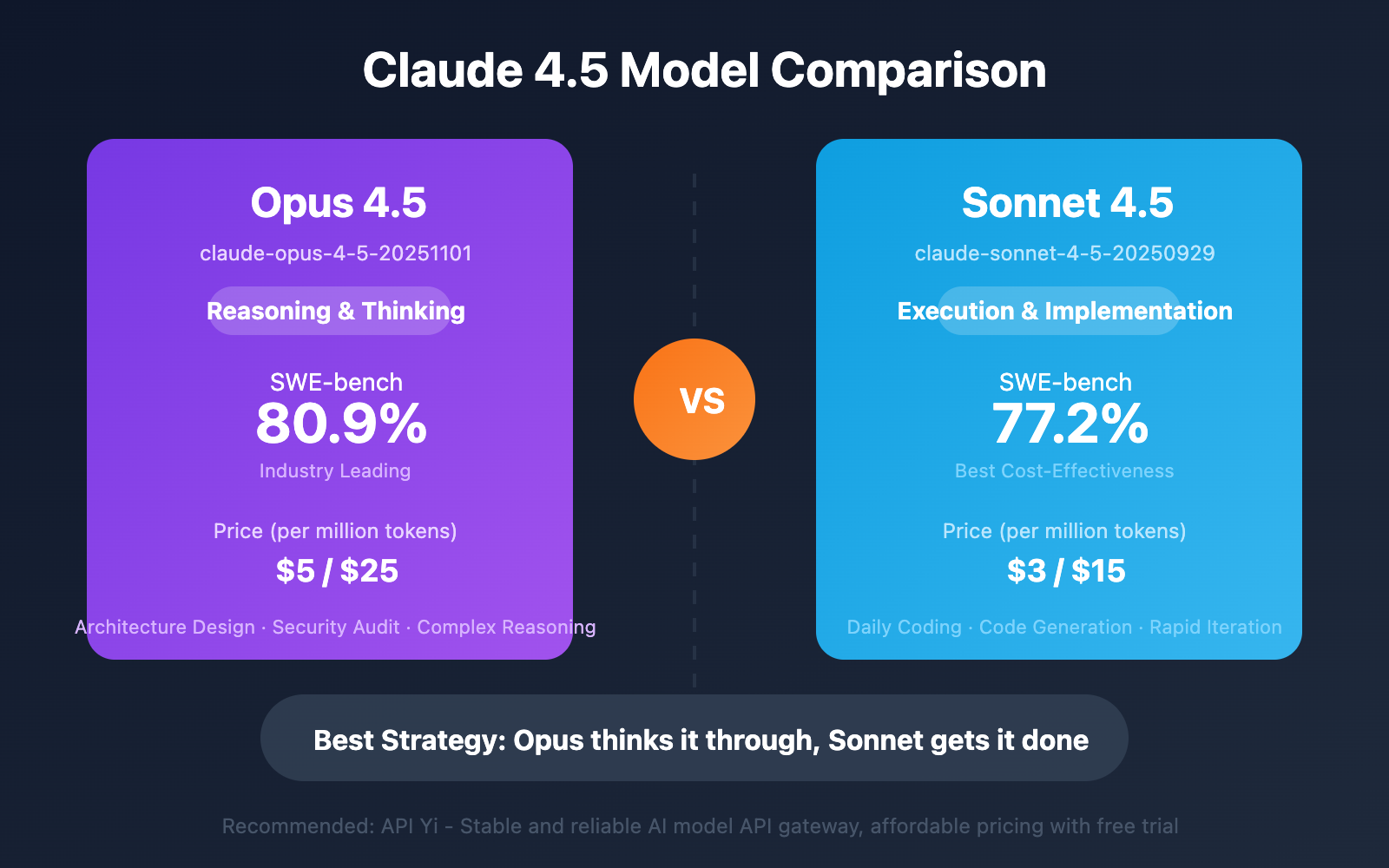
Core Differences: Claude Opus 4.5 vs Sonnet 4.5
Let's look at the most critical comparison data first:
| Dimension | Claude Opus 4.5 | Claude Sonnet 4.5 | Conclusion |
|---|---|---|---|
| Model ID | claude-opus-4-5-20251101 | claude-sonnet-4-5-20250929 | – |
| SWE-bench | 80.9% (Industry leading) | 77.2% | Opus leads by 3.7% |
| ARC-AGI-2 | 37.6% | 13.6% | Opus nearly 3x better |
| Pricing (Input/Output) | $5 / $25 | $3 / $15 | Sonnet 40% cheaper |
| Context Window | 200K | 200K / 1M (beta) | Sonnet supports longer context |
| Knowledge Cutoff | March 2025 | January 2025 | Opus more recent |
One-Sentence Summary of Differences
- Opus 4.5: Most intelligent, strongest reasoning capability, suitable for complex thinking
- Sonnet 4.5: Best cost-effectiveness, faster speed, suitable for daily execution
This is why the best practice is "Use Opus for reasoning, Sonnet for execution."
Claude Opus 4.5 In-Depth Analysis
Opus 4.5 is currently the most powerful model in the Claude series, leading across multiple benchmarks.
Claude Opus 4.5 Core Advantages
1. Top-Tier Reasoning Capability
On the ARC-AGI-2 test (measuring a model's ability to solve novel problems), Opus scores 37.6%, nearly 3 times higher than Sonnet's 13.6%. This means Opus can make better reasoning and judgments when facing problems it has never encountered before.
2. Industry-Leading on SWE-bench
Opus 4.5 achieves 80.9% on SWE-bench Verified, the highest score among all AI models currently. This benchmark measures the ability to solve real-world software engineering problems.
3. More Efficient Token Usage
An interesting finding: although Opus is more expensive, it uses fewer tokens to complete the same tasks. Tests show that Opus uses 19.3% fewer total tokens than Sonnet when completing the same application development tasks.
4. Exclusive effort Parameter
Opus 4.5 is the only model that supports the effort parameter, allowing you to control how many tokens Claude uses when responding, flexibly balancing quality and cost.
Claude Opus 4.5 Use Cases
| Scenario | Description | Why Use Opus |
|---|---|---|
| Architecture Design | System design, technology selection | Requires global perspective and deep thinking |
| Security Audit | Code security review | Needs to discover hidden security vulnerabilities |
| Algorithm Design | Complex algorithm implementation | Requires creative solutions |
| Difficult Bugs | Troubleshooting tricky issues | Needs cross-file, cross-system reasoning |
| Code Review | In-depth code evaluation | Requires understanding design intent and potential issues |
Usage Recommendation: Opus is suitable for the "thinking it through" phase. When you face complex problems and need to make important decisions, let Opus do the thinking. But don't use it for simple code modifications—that's overkill.
Claude Sonnet 4.5 In-Depth Analysis
Sonnet 4.5 is the "workhorse" of the Claude series, achieving the best balance between performance and cost.
Claude Sonnet 4.5 Core Advantages
1. Cost-Performance Champion
Sonnet's price is 60% of Opus ($3/$15 vs $5/$25), but the performance gap isn't that large. For most tasks, Sonnet is completely sufficient.
2. Faster Response Speed
Due to its lighter model, Sonnet's response speed is noticeably faster than Opus, which is very important in development scenarios requiring frequent interaction.
3. Supports 1M Context (beta)
Sonnet is currently the only Claude model supporting a 1M token context window, offering clear advantages when processing extremely large codebases.
4. Excellent Agent Capabilities
Sonnet 4.5 is specifically optimized for agent tasks, supporting browser operations, spreadsheet processing, cross-file debugging, and other complex workflows.
Claude Sonnet 4.5 Use Cases
| Scenario | Description | Why Use Sonnet |
|---|---|---|
| Daily Coding | Feature development, bug fixes | Fast speed, low cost |
| Code Generation | Bulk code generation | High cost-performance ratio |
| Documentation | Code comments, API documentation | Fully capable |
| Debugging | Routine problem debugging | Quick response |
| Refactoring Execution | Refactoring according to established plans | Strong execution |
Usage Recommendation: Sonnet is suitable for the "getting it done" phase. When you already know what to do and need to implement it quickly and efficiently, let Sonnet execute. 80-90% of daily development tasks should use Sonnet.
Opus vs Sonnet Combination Strategy in Claude Code
In Claude Code, flexibly switching between Opus and Sonnet is key to improving efficiency.
Claude Code Model Switching Commands
# Switch to Opus (reasoning mode)
/model opus
# Or full model name
/model claude-opus-4-5-20251101

# Switch to Sonnet (execution mode)
/model sonnet
# Or full model name
/model claude-sonnet-4-5-20250929

# View current model
/model
Claude Code Best Combination Workflow
Recommended workflow:
1. Start session (default Sonnet)
   $ claude --model sonnet

2. Switch to Opus when encountering complex problems
   > /model opus
   > Help me analyze the architecture issues of this system and design a refactoring plan

3. Switch back to Sonnet for execution after plan confirmation
   > /model sonnet
   > Following the above plan, start refactoring the src/api/ directory

4. Use Opus again for code review
   > /model opus
   > Review the recent changes and check for any security issues
Claude Code opusplan Hybrid Mode
Claude Code provides an intelligent hybrid mode—opusplan:
# Use opusplan mode
/model opusplan
How this mode works:
- Planning phase: Automatically uses Opus for architecture design and decision-making
- Execution phase: Automatically switches to Sonnet for code implementation
This is the officially recommended hassle-free solution, suitable for users who don't want to switch manually.
Claude Code Cost Optimization Results
| Strategy | Cost Savings | Use Cases |
|---|---|---|
| Full Opus | 0% (baseline) | Not recommended |
| Full Sonnet | ~40% | Simple projects |
| Smart switching | 60-80% | Recommended |
| opusplan | 50-70% | Hassle-free option |
Practical experience: As one developer aptly summarized—"Haiku for preparation, Sonnet for development, Opus for review." This combination works best in actual projects.
Opus vs Sonnet Combination in API Calls
In API scenarios, you can also flexibly combine the two models.
API Call Example
import openai

client = openai.OpenAI(
    api_key="YOUR_API_KEY",
    base_url="https://vip.apiyi.com/v1"
)

def ask_opus(prompt: str) -> str:
    """Use Opus for complex reasoning"""
    response = client.chat.completions.create(
        model="claude-opus-4-5-20251101",
        messages=[{"role": "user", "content": prompt}],
        max_tokens=4000
    )
    return response.choices[0].message.content

def ask_sonnet(prompt: str) -> str:
    """Use Sonnet for fast execution"""
    response = client.chat.completions.create(
        model="claude-sonnet-4-5-20250929",
        messages=[{"role": "user", "content": prompt}],
        max_tokens=4000
    )
    return response.choices[0].message.content

# Practical application: Plan with Opus first, then execute with Sonnet
plan = ask_opus("Analyze this requirement and design a technical solution: {requirement description}")
code = ask_sonnet(f"Generate code according to the following plan:\n{plan}\n\nRequirement: Generate complete runnable code")
View Complete Dual-Model Call Wrapper
import openai
from enum import Enum
from typing import Optional, List, Dict

class ModelType(Enum):
    OPUS = "claude-opus-4-5-20251101"    # Reasoning and thinking
    SONNET = "claude-sonnet-4-5-20250929" # Execution and implementation

class ClaudeClient:
    def __init__(self, api_key: str):
        self.client = openai.OpenAI(
            api_key=api_key,
            base_url="https://vip.apiyi.com/v1"
        )

    def chat(
        self,
        messages: List[Dict],
        model_type: ModelType = ModelType.SONNET,
        max_tokens: int = 4000,
        temperature: float = 0.7
    ) -> str:
        """
        Unified chat interface

        Args:
            messages: List of conversation messages
            model_type: Model type, default Sonnet
            max_tokens: Maximum output tokens
            temperature: Temperature parameter
        """
        response = self.client.chat.completions.create(
            model=model_type.value,
            messages=messages,
            max_tokens=max_tokens,
            temperature=temperature
        )
        return response.choices[0].message.content

    def think(self, prompt: str) -> str:
        """Use Opus for deep thinking"""
        return self.chat(
            messages=[{"role": "user", "content": prompt}],
            model_type=ModelType.OPUS,
            temperature=0.5  # Lower temperature for reasoning tasks
        )

    def execute(self, prompt: str) -> str:
        """Use Sonnet for fast execution"""
        return self.chat(
            messages=[{"role": "user", "content": prompt}],
            model_type=ModelType.SONNET,
            temperature=0.7
        )

    def plan_and_execute(self, task: str) -> Dict[str, str]:
        """Plan-Execute pipeline"""
        # Step 1: Opus planning
        plan = self.think(f"As a technical expert, analyze the following task and develop a detailed execution plan:\n{task}")

        # Step 2: Sonnet execution
        result = self.execute(f"Execute the task according to the following plan and generate specific code:\n{plan}")

        return {"plan": plan, "result": result}

# Usage example
client = ClaudeClient("YOUR_API_KEY")

# Individual use
analysis = client.think("Analyze the architectural differences between React and Vue")
code = client.execute("Write a quicksort algorithm in Python")

# Plan-Execute pipeline
output = client.plan_and_execute("Develop a user authentication system")
print(output["plan"])   # View plan
print(output["result"]) # View code
Platform recommendation: Through APIYI apiyi.com, you can uniformly call Claude Opus 4.5 and Sonnet 4.5, with free test credits and pay-as-you-go pricing, suitable for development scenarios that require flexible model switching.
FAQ
Q1: Opus is more expensive than Sonnet, but uses fewer tokens. Which actually costs more?
It depends on task complexity. For simple tasks, Sonnet is more cost-effective; for complex tasks, although Opus has a higher unit price, it uses 20-50% fewer tokens, potentially resulting in lower total costs. It's recommended to use Opus for complex tasks and Sonnet for routine tasks.
Q2: How do I know when to switch models in Claude Code?
When you find Sonnet's responses aren't deep enough, requiring repeated follow-up questions, or when architectural decisions are involved, switch to Opus. When Opus provides a solution that requires substantial code implementation, switch back to Sonnet. Simply put: use Opus when you can't think it through, use Sonnet for execution.
Q3: What advantages does the APIYi platform offer for calling Claude?
APIYi (apiyi.com) provides a unified interface supporting both Opus and Sonnet, with switching requiring only a model parameter change. It also supports other models like GPT and Gemini for easy comparison testing, and offers free credits.
Summary
Core selection strategy for Claude Opus 4.5 vs Sonnet 4.5:
- Use Opus for reasoning: Architecture design, security audits, complex reasoning, important decisions
- Use Sonnet for execution: Daily coding, code generation, documentation writing, routine debugging
- Smart combination saves costs: Flexible switching can save 60-80% in costs
- Quick switching in Claude Code:
/model opusand/model sonnetfor instant switching
Remember this principle: Opus is responsible for thinking it through, Sonnet is responsible for getting it done.
Through APIYi (apiyi.com), you can call both models through a unified interface, with support for free testing and flexible pay-as-you-go pricing.
Author: Technical Team
Technical Discussion: Feel free to share your Opus/Sonnet combination experiences in the comments. For more AI development resources, visit APIYi apiyi.com
References:
- Anthropic – Introducing Claude Opus 4.5: anthropic.com
- ClaudeLog – Claude Sonnet 4.5 vs Opus for Claude Code: claudelog.com
- LLM Stats – Claude Opus 4.5 vs Sonnet 4.5: llm-stats.com
- Claude Code Docs – Model Configuration: code.claude.com