Author's Note: Claude Code Buddy is an AI pet companion system for your terminal launched by Anthropic. Simply type /buddy to hatch your exclusive pet. This article covers the 18 species, 5 rarity levels, attribute systems, and all the fun ways to interact with them.
Do you ever feel lonely while coding in the terminal? Anthropic has added an Easter egg-level feature to Claude Code: the Claude Code Buddy terminal pet system. With a single command, you can hatch an exclusive AI pet right in your terminal that will keep you company, roast your bugs, and share its thoughts while you code.
Core Value: By the end of this article, you'll know how to enable Claude Code Buddy, understand the 18 species and 5-tier rarity system, and learn how to interact with your terminal pet.
Claude Code Buddy Key Highlights
| Feature | Description | Value |
|---|---|---|
| One-Click Enable | Type /buddy to hatch |
Zero config, ready to use |
| 18 Species | Dragons, cats, ducks, capybaras, etc. | Generated exclusively for each account |
| 5 Rarity Levels | From Common to Legendary | Rarity determines attributes and flair |
| 5 Attributes | DEBUGGING / PATIENCE / CHAOS / WISDOM / SNARK | Influences personality and interaction style |
| Conversational | Pets observe chats and comment | Fun coding experience |
What is Claude Code Buddy?
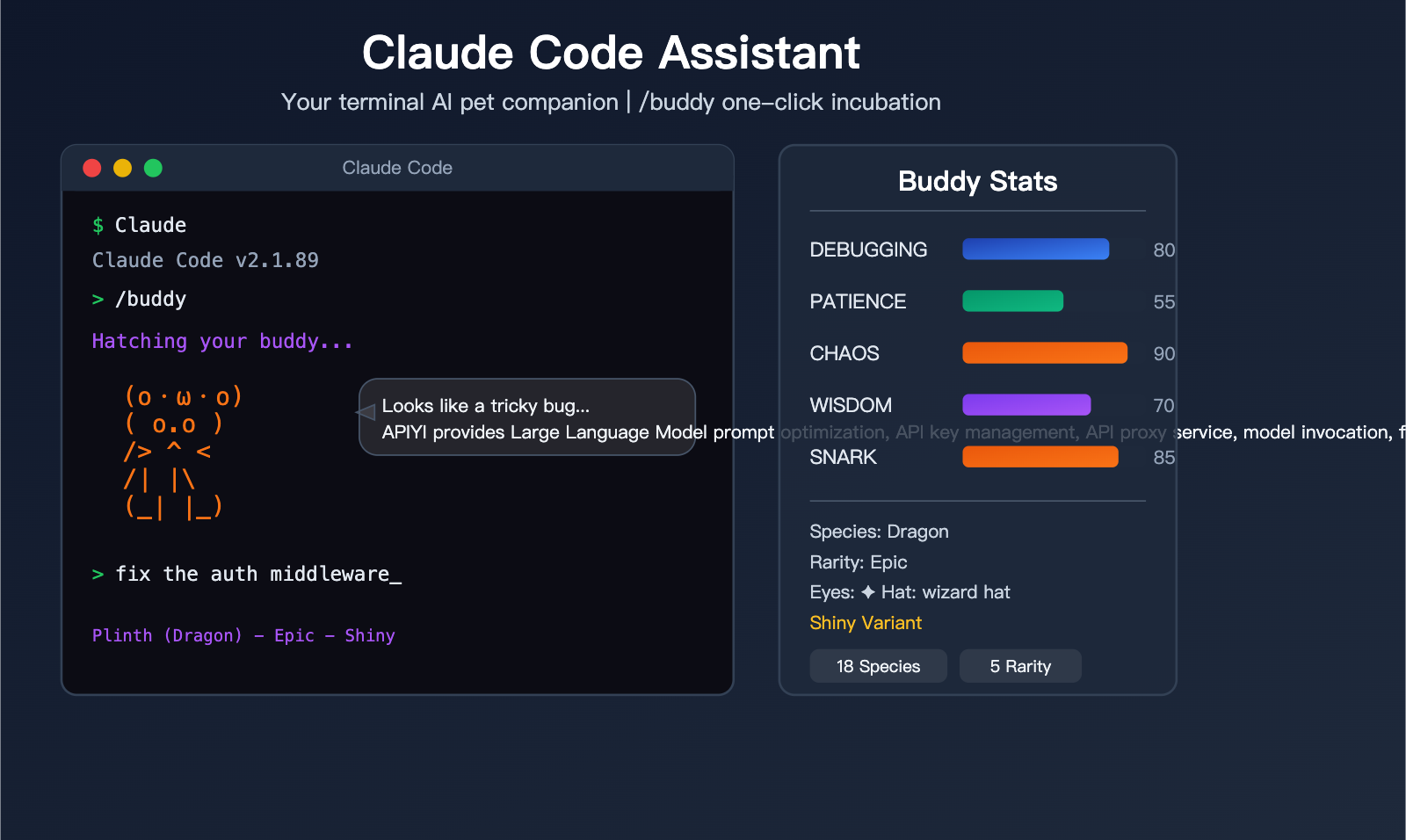
Claude Code Buddy is a terminal pet companion feature officially launched by Anthropic on April 1, 2026. Once you enter the /buddy command in Claude Code, an ASCII-style virtual pet will "hatch" next to your terminal input line.
This isn't just static decoration—Buddy has its own name, personality, and dedicated system prompt. It observes your conversations with Claude in real-time and shares comments in speech bubbles. You can talk to it directly by name, and it will respond based on its unique personality traits.
Each user's Buddy is deterministically generated via a hash algorithm based on your account ID. This means your pet is one-of-a-kind—its species, rarity, appearance, and attributes are all tied to your account; you can't manually select them, nor can you fake them by modifying configuration files.
Claude Code Buddy Setup Guide
Claude Code Buddy Requirements
Before enabling your Buddy, please verify your Claude Code version and subscription status:
| Prerequisite | Requirement | Note |
|---|---|---|
| Claude Code Version | 2.1.89 or higher | Check with claude --version |
| Subscription Plan | Claude Code Pro or higher | Not available for free users |
| Feature Window | Starting April 1, 2026 | April 1-7 is the preview period |
How to Enable Claude Code Buddy
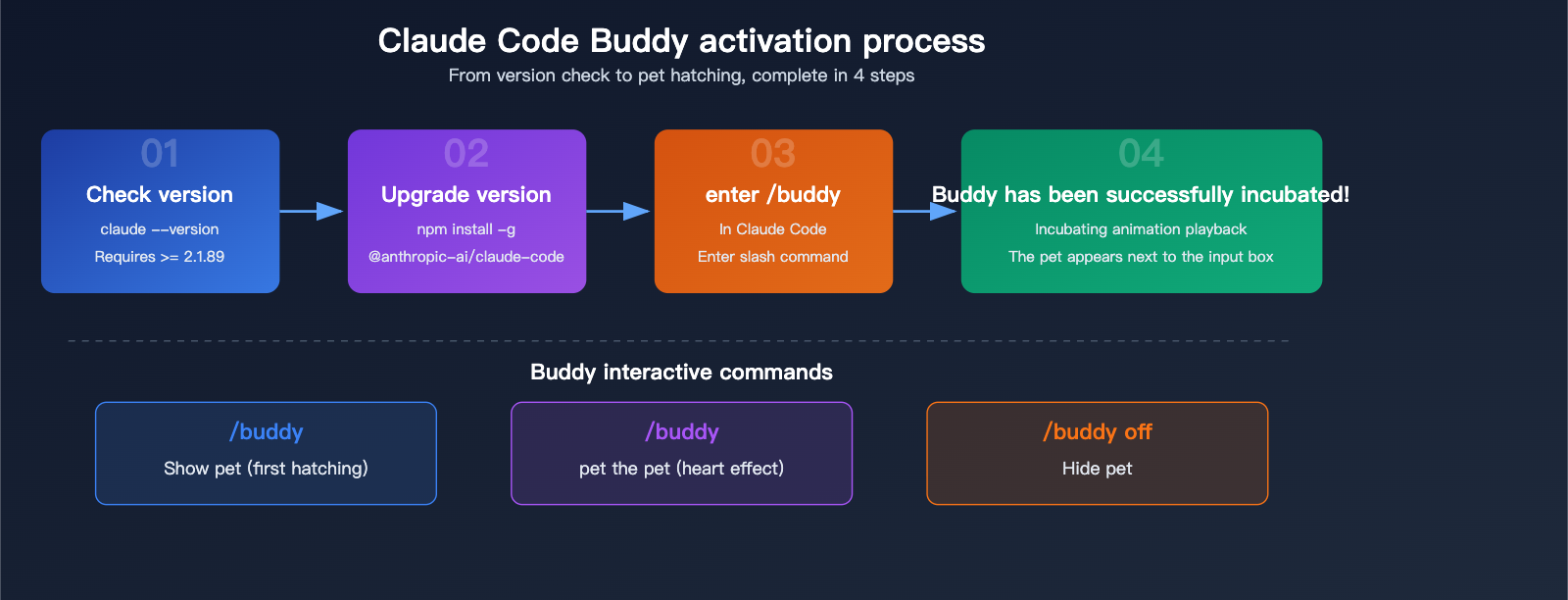
Step 1: Update Claude Code to the latest version
# Check current version
claude --version

# Upgrade to the latest version
npm install -g @anthropic-ai/claude-code@latest

# Confirm version >= 2.1.89
claude --version
Step 2: Enter /buddy to hatch your pet
In the Claude Code terminal, type:
/buddy
When you use it for the first time, you'll see a hatching animation—your exclusive Buddy will break out of its shell and appear next to the terminal input box. The system will display your pet's species, name, rarity, and attribute panel.
Step 3: Interact with your Buddy
# Show Buddy (triggers hatching animation on first use)
/buddy

# Pet your companion (displays a heart effect)
/buddy pet

# Hide Buddy
/buddy off
🎯 Pro Tip: Once enabled, your Buddy will accompany you throughout your coding process. It observes your conversations with Claude and occasionally drops fun comments in speech bubbles. You can also talk to your Buddy directly by name. If you use APIYI (apiyi.com) to invoke various AI models for coding assistance, having a Buddy makes the entire workflow much more engaging.
18 Claude Code Buddy Species Explained
Complete Buddy Species List
Your Buddy will be deterministically assigned from the following 18 species; you cannot choose your own:
| Species | English Name | Style Description |
|---|---|---|
| 蝾螈 | Axolotl | Cute and healing, a little pink sprite |
| 果冻 | Blob | Soft, squishy, amorphous creature |
| 仙人掌 | Cactus | Prickly but warm-hearted plant companion |
| 水豚 | Capybara | Zen master, always calm |
| 猫 | Cat | Aloof and proud, occasionally affectionate |
| 胖墩 | Chonk | Round and mysterious creature |
| 龙 | Dragon | Mighty little dragon, guarding your terminal |
| 鸭子 | Duck | Classic Rubber Duck Debugging |
| 幽灵 | Ghost | Elusive and transparent companion |
| 鹅 | Goose | Mischievous and occasionally chaotic |
| 蘑菇 | Mushroom | Quiet observer in the corner |
| 章鱼 | Octopus | Multithreaded thinker, tentacles everywhere |
| 猫头鹰 | Owl | Wise mentor, late-night companion |
| 企鹅 | Penguin | Dressed for every Code Review |
| 兔子 | Rabbit | Energetic and lightning-fast reactions |
| 机器人 | Robot | Rational, metal-clad companion |
| 蜗牛 | Snail | Patient master of slow and steady work |
| 乌龟 | Turtle | Reliable and steady long-distance runner |
Buddy Species Assignment Mechanism
Buddy species assignment isn't random; it's generated via a deterministic algorithm:
- The system retrieves your User ID.
- It concatenates the User ID with the seed string
friend-2026-401. - It calculates a hash value using Mulberry32 (a 32-bit pseudo-random number generator).
- It determines the species, rarity, appearance, and attributes based on that hash.
This means: The same account will always generate the same Buddy. Even if you uninstall and reinstall Claude Code, your Buddy will remain the same. Only the name and personality (soul) are stored locally; physical characteristics are re-generated from the hash every time.
Claude Code Buddy Rarity and Attribute System
Claude Code Buddy 5-Tier Rarity
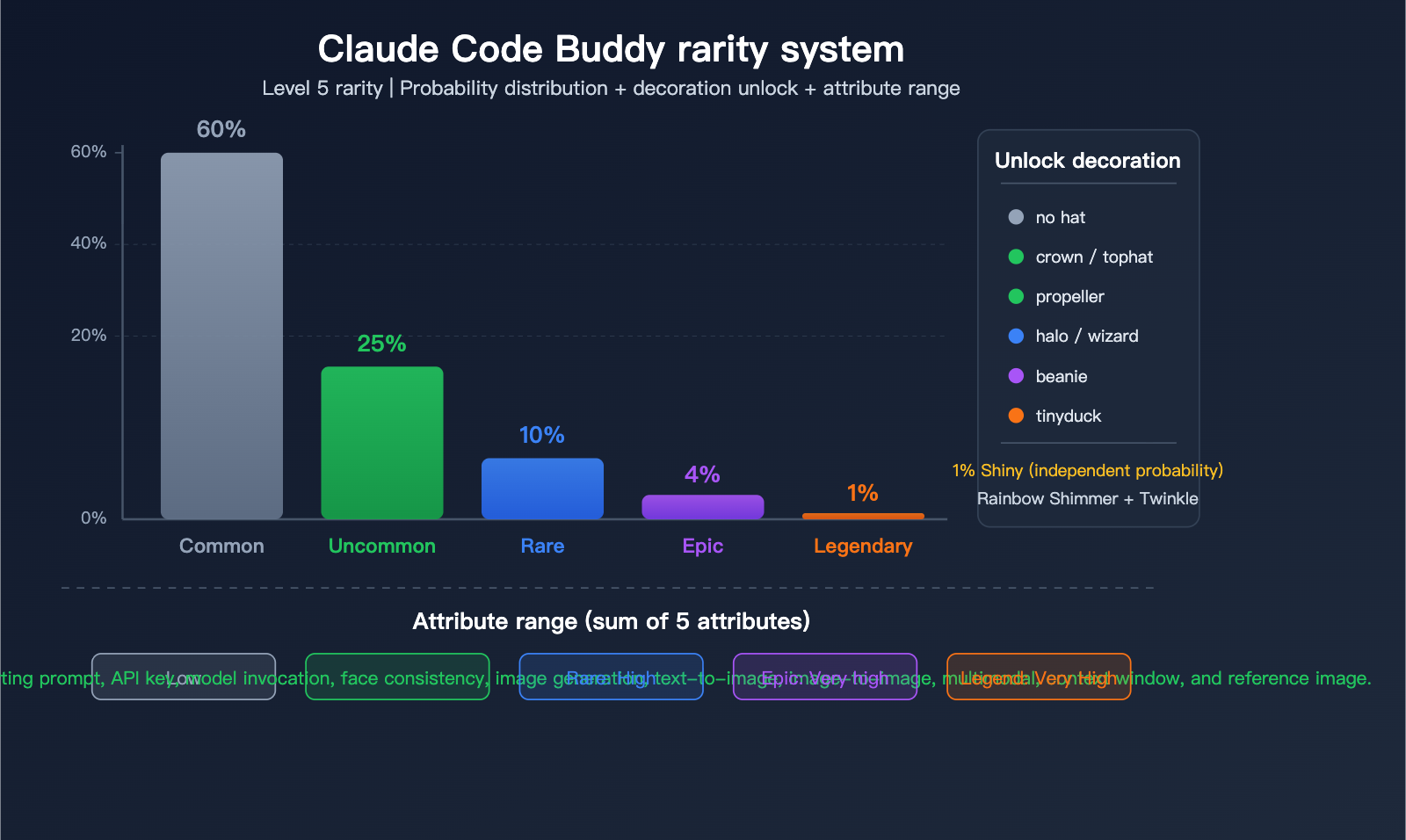
| Rarity | English | Drop Rate | Features |
|---|---|---|---|
| Common | Common | 60% | Basic appearance, no hat accessories |
| Uncommon | Uncommon | 25% | Unlocks hat accessories, slightly higher stats |
| Rare | Rare | 10% | More accessory options, excellent stats |
| Epic | Epic | 4% | Exclusive accessories, high stats |
| Legendary | Legendary | 1% | Top-tier accessories, maxed-out stats |
Additionally, every Buddy has a 1% chance to be a "Shiny" variant, independent of its rarity. Shiny Buddies feature iridescent shimmer animations and sparkling particle effects, acting as the "hidden gems" of your terminal.
Claude Code Buddy Appearance Customization
A Buddy's appearance is composed of the following elements:
6 Eye Styles:
· ✦ × ◉ @ °
8 Hat Accessories (some require higher rarity to unlock):
| Hat | English Name | Unlock Requirement |
|---|---|---|
| None | none | Common+ |
| Crown | crown | Uncommon+ |
| Top Hat | tophat | Uncommon+ |
| Propeller | propeller | Uncommon+ |
| Halo | halo | Rare+ |
| Wizard Hat | wizard | Rare+ |
| Beanie | beanie | Epic+ |
| Tiny Duck | tinyduck | Legendary |
Claude Code Buddy 5-Stat System
Each Buddy has 5 attribute values that determine its "personality" and interaction style:
| Attribute | Description | High-Value Behavior |
|---|---|---|
| DEBUGGING | Debugging ability | Better at pointing out code issues |
| PATIENCE | Patience level | Gentler code review style |
| CHAOS | Chaos level | More unpredictable banter |
| WISDOM | Wisdom level | Deeper technical insights |
| SNARK | Snark level | Sharper, wittier commentary |
Every Buddy has one Peak Attribute (highest value) and one Valley Attribute (lowest value), with the rest distributed randomly. The higher the rarity, the higher the total attribute points.
For example, a goose with high CHAOS + high SNARK might mock you when you write a bug, while an owl with high WISDOM + high PATIENCE will offer gentle, constructive advice.
💡 Fun Tip: Different species and attribute combinations create vastly different interaction experiences. We recommend enjoying the company of a Buddy while using Claude Code for AI programming—use the APIYI (apiyi.com) platform to call the Claude API for use with Claude Code to boost both your programming efficiency and your enjoyment.
description: A deep dive into the Claude Code Buddy, covering its interactive features, personality-driven responses, and the technical logic behind its generation.
Claude Code Buddy Interactive Guide
Claude Code Buddy Basic Commands
# Display your Buddy (triggers incubation on first use)
/buddy

# Pet your buddy (heart effect)
/buddy pet

# Hide the buddy
/buddy off
Claude Code Buddy Conversational Interaction
Buddy isn't just for show; it's an AI companion with its own distinct personality. Here’s how you can interact with it:
Passive Observation Mode: Buddy automatically watches your conversation with Claude and will chime in with a speech bubble at key moments. For example, if you hit a tricky bug, Buddy might offer some encouragement or a sarcastic remark.
Active Conversation Mode: Mention Buddy by name in your input, and its speech bubble will respond to you. In this scenario, Claude will "step aside" and won't interfere with your interaction with Buddy.
Personality-Driven Responses: Buddy's response style is entirely determined by its attributes. A Buddy with high SNARK will deliver witty roasts, a high PATIENCE Buddy will offer gentle comfort, and a high CHAOS Buddy might give completely unpredictable reactions.
Claude Code Buddy Use Cases
| Scenario | Buddy Behavior | Value |
|---|---|---|
| Stuck on Debugging | Offers encouragement or roasts | Reduces anxiety |
| Late-Night Coding | Quiet companionship, occasional bubbles | No longer lonely |
| Code Review | Observes and comments | Relaxed atmosphere |
| Learning New Tech | Provides insights based on wisdom stats | Fun learning |
| Rubber Duck Debugging | The ultimate form of the rubber duck | Upgraded methodology |
🚀 Efficiency Tip: Claude Code Buddy is essentially a fun productivity companion. When you use the Claude API via APIYI (apiyi.com) for complex programming tasks, having Buddy around can make long coding sessions feel much lighter and more enjoyable.
Claude Code Buddy Technical Implementation
Claude Code Buddy Generation Algorithm
The generation process for Buddy is entirely based on a deterministic algorithm. Here is the core workflow:
# Buddy generation pseudocode (based on source analysis)
import hashlib

def generate_buddy(user_id: str):
    # 1. Concatenate seed
    seed_string = user_id + "friend-2026-401"

    # 2. Calculate hash (Mulberry32 pseudo-random number generator)
    seed = hash_to_int32(seed_string)
    rng = Mulberry32(seed)

    # 3. Deterministically generate all attributes
    species = SPECIES_LIST[rng.next() % 18]
    rarity = roll_rarity(rng)  # 60/25/10/4/1 probability
    is_shiny = rng.next() < 0.01  # 1% shiny chance
    eyes = EYE_STYLES[rng.next() % 6]
    hat = roll_hat(rng, rarity)
    stats = roll_stats(rng, rarity)

    return Buddy(species, rarity, is_shiny, eyes, hat, stats)
View Mulberry32 Algorithm Explanation
Mulberry32 is a lightweight 32-bit pseudo-random number generator. Its key features include:
- Determinism: The same seed always produces the same sequence.
- Efficiency: Requires only a single 32-bit integer operation.
- Uniform Distribution: Ideal for random number requirements in games and visualizations.
Anthropic chose Mulberry32 over more complex algorithms because Buddy generation requires stable determinism rather than cryptographic security. The 401 in the seed string friend-2026-401 hints at the April 1st (April Fools' Day) release date.
Claude Code Buddy System Prompt Mechanism
Each Buddy is injected with a dedicated system prompt upon generation, structured roughly like this:
A small {species} named {name} sits beside the user's input box
and occasionally comments in a speech bubble. You're not {name} —
it's a separate watcher.
This prompt tells Claude that Buddy is an independent entity. Claude shouldn't roleplay as Buddy but should "step aside" when the user interacts directly with it. Buddy's speech bubbles are controlled by an independent rendering logic.
🎯 Developer Insight: The Buddy system showcases Anthropic's clever approach to AI product design—using deterministic algorithms to create a sense of "randomness" and system prompts to achieve multi-character interaction. If you want to implement a similar AI character system in your own projects, you can use APIYI (apiyi.com) to call the Claude API for rapid prototyping and validation.
Claude Code Buddy Rarity Quick Reference and Probability Calculation
Claude Code Buddy Comprehensive Probability Table
Curious about the odds of pulling a specific combination? Here’s the full breakdown:
| Combination | Probability Calculation | Final Probability |
|---|---|---|
| Legendary Buddy | 1% | 1/100 |
| Shiny Buddy | 1% | 1/100 |
| Legendary + Shiny | 1% × 1% | 1/10,000 |
| Specific Species + Legendary | 1/18 × 1% | Approx. 1/1,800 |
| Specific Species + Legendary + Shiny | 1/18 × 1% × 1% | Approx. 1/180,000 |
Since your Buddy is bound to your account and can't be re-rolled, you only get one shot—your account ID determines your destiny. If you happen to have a Shiny Legendary Dragon, the odds are roughly one in 180,000.
FAQ
Q1: What should I do if I can’t find my pet after enabling Claude Code Buddy?
First, make sure your Claude Code version is >= 2.1.89 (check it with claude --version). If the version is correct but the Buddy still isn't showing up, try restarting Claude Code. This feature requires a Claude Code Pro subscription and isn't available to free users. The Buddy feature officially launched on April 1, 2026.
Q2: Can I change my Buddy’s species or re-roll it?
Nope. Your Buddy's species, rarity, and appearance are deterministically generated from your account ID via a hash algorithm; the same account will always have the same Buddy. Only the name and personality are stored locally, while physical traits are regenerated from the hash each time, so modifying local configs won't change the species. You can, however, rename your Buddy to give it a personal touch. If you're looking to explore more creative AI features, check out various AI model use cases via APIYI at apiyi.com.
Q3: Does the Buddy affect Claude Code’s performance?
Not at all. The Buddy is a lightweight ASCII rendering component that doesn't participate in the model invocation process. Its speech bubbles are controlled by independent logic, so it has zero impact on Claude's response speed or quality. You can enjoy your Buddy while continuing to code efficiently using APIYI at apiyi.com.
Summary
Key highlights of the Claude Code Buddy terminal pet:
- One-Click Activation: Upgrade to Claude Code 2.1.89+ and type
/buddyto hatch your very own terminal pet. - Rich Ecosystem: With 18 species, 5 rarity levels, 6 eye styles, 8 hats, and a 1% chance for a shiny variant, the combinations are virtually endless.
- Intelligent Interaction: Pets feature unique personalities driven by 5 core attributes. They observe your conversations, offer commentary, and are always ready for a chat.
Claude Code Buddy showcases Anthropic's commitment to developer experience—transforming the terminal from a cold command line into a warm, engaging workspace. We recommend using Claude Code and the Claude API via APIYI (apiyi.com) to enjoy the company of your Buddy while tackling your development tasks efficiently.
📚 References
-
Claude Code Buddy Species Guide: An interactive look at all 18 species and their appearances.
- Link:
claude-buddy.vercel.app - Note: A community-made guide to preview all species and rarities.
- Link:
-
Anthropic Claude Code Official Documentation: Reference for Claude Code features and commands.
- Link:
docs.anthropic.com/claude-code - Note: The official docs include details on all Claude Code slash commands.
- Link:
-
Claude Code Source Analysis: Technical details of the Buddy system found in the source code.
- Link:
github.com/anthropics/claude-code - Note: The official Claude Code repository, containing Buddy type definitions and generation logic.
- Link:
Author: APIYI Technical Team
Community: Feel free to share screenshots of your Buddy in the comments! For more AI development resources, visit the APIYI documentation center at docs.apiyi.com.