On May 14, 2026, Anthropic published "The Founder's Playbook: Building an AI-native startup" on the official Claude blog. For the first time, they systematically remapped the four startup stages—Idea, MVP, Launch, and Scale—according to the AI capabilities of 2026, defining the goals, exit criteria, and failure modes for each. This article breaks down the manual section by section and explains what it means for AI founders in China.
Core Value: Understand Anthropic's AI-native startup roadmap in 3 minutes, learn how to utilize the Claude product ecosystem at different stages, and identify the remaining open windows across 9 major consumer AI sectors.
Quick Overview of the Anthropic Founder's Playbook
What makes this manual special isn't that it's just another "AI trend report." Instead, Anthropic stands on the 2026 AI capability curve and rewrites the parts of traditional startup methodology that have already been disrupted. The manual is written for two types of people: founders who treat AI as the default architecture from day one, and the early operators helping them execute.
| Information Item | Details |
|---|---|
| Release Date | 2026-05-14 |
| Publisher | Anthropic / Claude Official Blog |
| Title | The founder's playbook: Building an AI-native startup |
| Reading Time | 5 minutes (main text + appendix exercises) |
| Core Framework | Idea / MVP / Launch / Scale 4-stage map |
| Products Involved | Claude apps (Chat), Claude Cowork, Claude Code, Claude Platform |
| Case Studies | Ambral, Anything, Carta Healthcare, HumanLayer, Vulcan Technologies |
| Source | claude.com/blog/the-founders-playbook |
The Fundamental Difference Between AI-Native and Traditional Startups
The manual opens with a key observation: the founder's role is shifting from an individual contributor to an orchestrator. In the past, founders either wrote code themselves or hired engineers; in 2026, founders are directing a team of AI agents, reserving their most scarce attention for "things only a founder can do," such as customer conversations, positioning decisions, and culture building.
The real change behind this is the collapse of release cycles—Anthropic revealed that internally, "the time from idea to ship has compressed from 6 months to a single day," adopting "Just do things" as an internal mantra. When the cost of trial and error drops from "months of wasted time" to "an afternoon's prototype," the optimal strategy naturally shifts from "think it through before doing" to "build it first." We suggest that Chinese founders reading this manual focus on this insight and combine it with API proxy services like APIYI (apiyi.com) to quickly validate the feasibility of multi-model combinations using Claude, GPT, and Gemini.
Anthropic Startup Handbook: A Detailed 4-Stage Framework
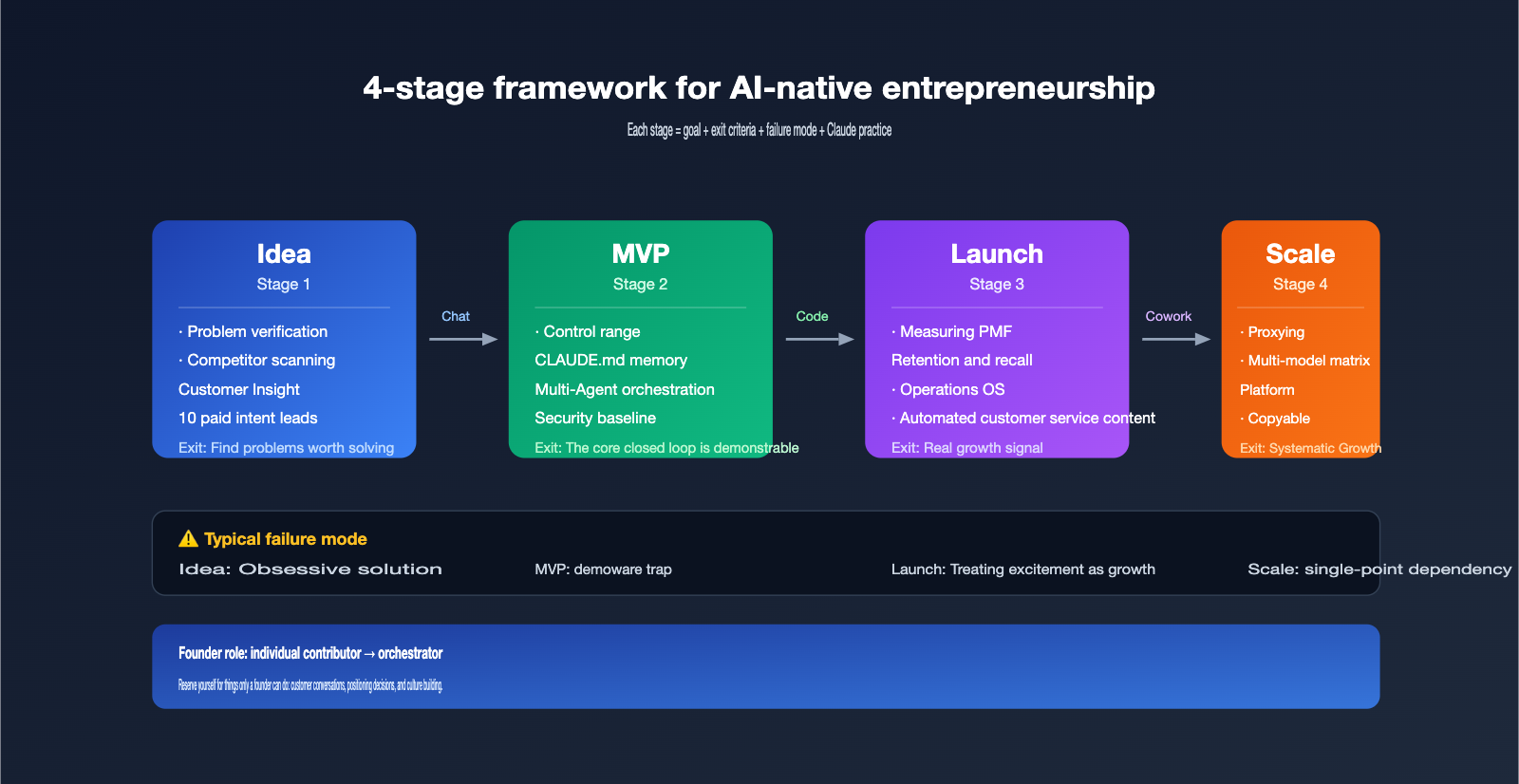
These four stages form the backbone of this handbook. Each stage maps to a set of "goals to achieve / exit criteria for the next stage / common failure modes / Claude-driven exercises." For Chinese entrepreneurs, this is a plug-and-play guide that turns the abstract concept of "polishing your product" into a concrete, actionable checklist.
Core Essentials of the Idea Stage for AI-Native Startups
The goal of the Idea stage isn't just to "come up with an idea," but to validate a problem worth solving. The handbook emphasizes using AI for three things: problem validation, competitive landscape mapping, and customer discovery. Specific exercises include having Claude read hundreds of user interview transcripts, automatically summarizing competitive positioning differences, and generating a "target customer interview list" based on public signals.
| Key Action | Exit Criteria | Typical Failure Mode |
|---|---|---|
| Problem Validation | Find 10 target users willing to pay | Obsessing over the solution, ignoring the problem |
| Competitive Scan | Clearly articulate 3 key differences from existing solutions | Treating "no competition" as a selling point |
| Customer Insight | Document at least 20 raw, first-hand user conversation transcripts | Using surveys instead of deep interviews |
Engineering Discipline for AI-Native Startups in the MVP Stage
The core of the MVP stage is "maintaining engineering discipline under AI acceleration." The handbook warns that while AI writes code quickly, technical debt can accumulate at an unprecedented rate if you don't constrain the scope. Claude Code is the primary tool here, used alongside a CLAUDE.md project memory file to maintain context consistency, and a Multi-Agent Team pattern to split UI, backend, and QA tasks among different agents to advance in parallel.
The exit criteria is a "demonstrable core loop" that passes a minimal security checklist (authentication, API key management, dependency audits). The most common failure mode is the "demoware trap"—the demo looks stunning, but the underlying data model can't handle the real-world data impact of a second customer. We recommend integrating an API proxy service like APIYI (apiyi.com) during the MVP stage to avoid locking your SDK into a single model provider from the start, which significantly lowers future switching costs.
Measuring PMF for AI-Native Startups in the Launch Stage
The Launch stage is where founders most easily fall into the "false prosperity" trap. The handbook suggests distinguishing between genuine traction and early enthusiasm, providing three objective metrics: whether the retention curve is flattening, user proactive recall rate, and the marginal cost of paid conversion. In this stage, you should start using Claude Cowork to automate internal operations, freeing up founders to focus on sales and fundraising.
The handbook highlights a "launch operating system"—extracting founders from customer support, content creation, and community management by using multi-agent collaboration to complete 80% of repetitive tasks. This is highly valuable for domestic entrepreneurs: many teams burn through their bandwidth on operational trivialities before ever reaching PMF.
Product Matrix for AI-Native Startups in the Scale Stage
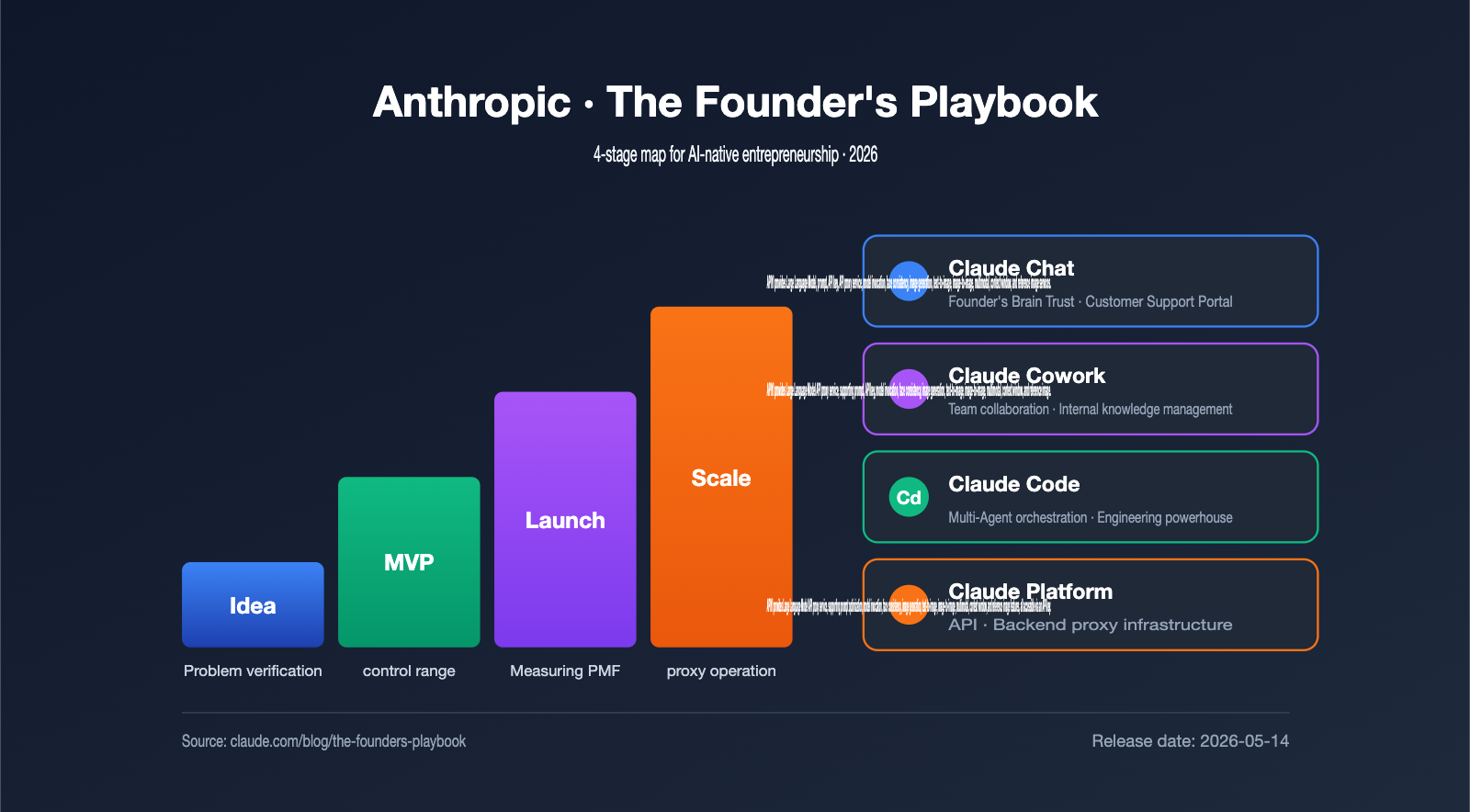
The key to the Scale stage isn't fundraising; it's building a replicable "agentic operating system." The handbook provides deployment suggestions for a Claude product matrix: Claude apps (Chat) as the customer support entry point, Claude Cowork for internal knowledge management, Claude Code for continuous product code iteration, and Claude Platform for backend model invocation and multi-agent orchestration. Each product corresponds to a category of high-frequency tasks that "cannot be outsourced to humans."
🎯 Implementation Tip: Stability is the lifeblood of the Scale stage. We recommend using an API proxy service like APIYI (apiyi.com) to aggregate Claude, GPT, and Gemini models under a unified interface, selecting the most appropriate model for each business module to prevent a single provider's failure from paralyzing your core processes.
Anthropic's Startup Handbook: 9 Consumer AI Opportunities
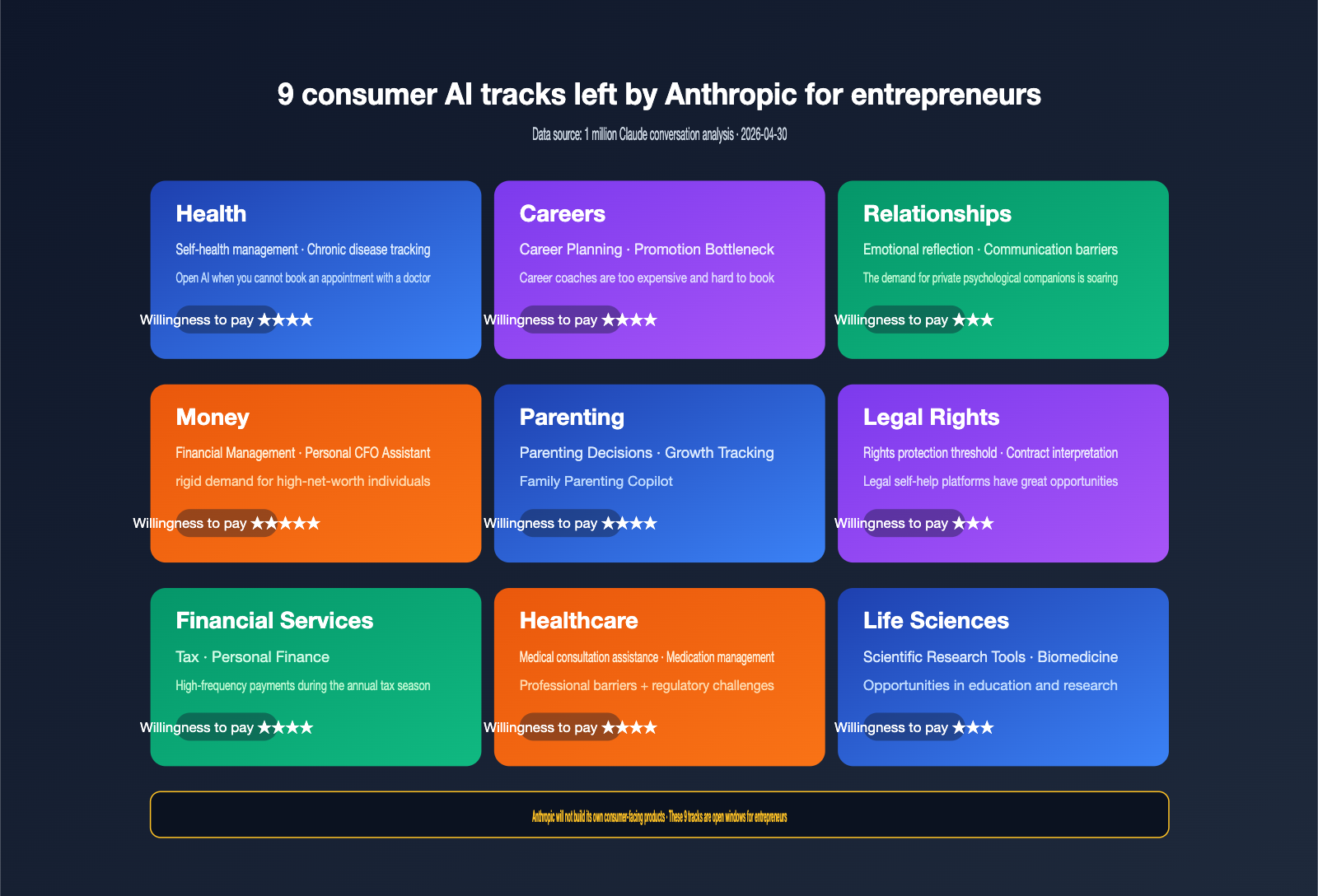
The reason this handbook has sparked such widespread discussion is that it acts as a "one-two punch" alongside the "1 Million Conversation Analysis Report" released by Anthropic on April 30, 2026. That report revealed that approximately 6% of Claude user conversations fall under the category of personal advice, spanning 9 high-demand consumer AI sectors. Anthropic explicitly stated in the handbook: they won't be entering these consumer-facing markets themselves, leaving them open for entrepreneurs to tackle.
9 Major Tracks and Opportunity Windows
The table below organizes the typical user pain points and commercialization directions for these 9 consumer AI fields. The subtext of the handbook is clear: users are turning to AI because they "can't afford, can't find, or can't get an appointment" with professionals—this is essentially a market opportunity created by supply-side failure.
| Field | Typical User Pain Points | Commercialization Direction |
|---|---|---|
| Health / Healthcare | Long consultation cycles, health self-management | AI health steward, chronic disease data assistant |
| Careers | Promotion bottlenecks, career transition planning | Career coach, interview simulation |
| Relationships | Communication barriers, emotional reflection | Private psychological companion |
| Money / Financial services | Personal finance, tax filing | Personal CFO assistant |
| Parenting | Parenting decisions, growth tracking | Family parenting co-pilot |
| Legal rights | High barriers to rights protection, contract interpretation | Legal self-service platform |
| Life sciences | Learning biomedical knowledge | Research tools and education |
The most classic success story is Cal AI—by cutting into a single vertical of "calorie counting + body composition," they achieved $40M in revenue, $50M ARR, with only 7 employees and $0 in venture capital. This is the "ultra-lean startup" model frequently cited in the AI-native era, and it directly validates the judgment in Anthropic's handbook: small teams deeply focused on a single field can indeed build independent valuations.
We suggest that domestic entrepreneurs score these 9 tracks based on "policy risk / data acquisition difficulty / willingness to pay," and combine this with the multi-model A/B testing capabilities of APIYI (apiyi.com) to quickly build 3 prototypes within 4 weeks before deciding on their primary focus.
Anthropic Startup Handbook: Claude Product Matrix Deployment Strategy
One of the most underrated highlights of this handbook is how it precisely positions the four Claude products based on their usage stage. This means founders don't need to pay for the "entire suite" right out of the gate; instead, they can introduce tools progressively as their business evolves. The table below outlines Anthropic's product-stage recommendations, supplemented with our localized insights for the Chinese startup ecosystem.
| Claude Product | Primary Stage | Role Positioning | Localization Advice |
|---|---|---|---|
| Claude apps (Chat) | Idea / Launch | Founder's advisor, customer support | Use via APIYI (apiyi.com) to avoid account compliance risks |
| Claude Code | MVP / Scale | Engineering powerhouse, Multi-Agent orchestration | Use CLAUDE.md to document team knowledge |
| Claude Cowork | Launch / Scale | Team collaboration, knowledge base | Integrate information flows with Feishu or DingTalk |
| Claude Platform | Scale | Backend API, custom agents | Decouple multiple models with a unified interface layer |
Below is a minimum viable example of multi-agent invocation that you can copy directly into your MVP project as a starting point for further expansion.
import openai

client = openai.OpenAI(
    api_key="YOUR_APIYI_KEY",
    base_url="https://api.apiyi.com/v1"
)

response = client.chat.completions.create(
    model="claude-sonnet-4-6",
    messages=[
        {"role": "system", "content": "You are a product orchestrator responsible for breaking down tasks for sub-agents."},
        {"role": "user", "content": "Draft a customer interview outline for an AI health product at the Idea stage."}
    ]
)
print(response.choices[0].message.content)
View Multi-Agent Orchestration Expansion Example
agents = {
    "researcher": "Scan public forums and summarize high-frequency user pain points.",
    "interviewer": "Draft 10 open-ended interview questions.",
    "summarizer": "Compress the interview notes into a 1-page conclusion."
}

for role, mission in agents.items():
    resp = client.chat.completions.create(
        model="claude-sonnet-4-6",
        messages=[
            {"role": "system", "content": f"You are the {role}."},
            {"role": "user", "content": mission}
        ]
    )
    print(f"=== {role} ===\n{resp.choices[0].message.content}\n")
🚀 Engineering Tip: The stability of multi-agent orchestration depends on the capacity and rate limits of the underlying API. We recommend running a peak stress test via APIYI (apiyi.com) before launching your Multi-Agent mode to ensure latency remains under control at 100 QPS.
Anthropic Startup Handbook: Impact Analysis
Impact on Independent Developers
The handbook's biggest beneficiaries are independent developers who "haven't written much code before." Claude Code, combined with the Multi-Agent Team mode, means one person can simultaneously run three pipelines: "UI Agent + Backend Agent + QA Agent." The story of Cal AI achieving $40M in revenue with just 7 people has raised the bar for this model to a level everyone can see.
For domestic developers, the barrier lies primarily in two areas: English prompt engineering skills and precise control over model costs. We suggest using the multi-model comparison dashboard on APIYI (apiyi.com) to verify the "cost difference of the same prompt across Claude / GPT / DeepSeek," aiming to reduce token consumption by over 30% before committing to formal development.
Impact on Early-Stage Investors
The handbook doesn't talk about valuations directly, but by setting the "7 people, $40M revenue" case as a new benchmark, it effectively changes the coordinate system for early-stage investors. The question VCs must now answer isn't "Can this team build it?" but "Does this track have an AI-native lean approach?" This will make the traditional "team size → valuation multiple" formula increasingly obsolete.
Impact on the Domestic Startup Ecosystem
The domestic startup ecosystem faces two levels of impact from this handbook: First, a rhythm shock—Anthropic's release cycle is "daily"; if domestic teams continue to iterate on a quarterly basis, they will lose their window of opportunity. Second, a toolchain shock—the Claude product matrix is centered on "agentic operations," requiring domestic counterparts (agent platforms, collaboration tools) to reposition themselves.
We recommend that domestic teams use this handbook as a benchmark to self-check whether their exit criteria for each stage are clear and whether they have fully utilized AI at every step. For implementation tools, you can use APIYI (apiyi.com) to aggregate multiple models into a unified billing view, avoiding redundant purchases and implementation efforts.
FAQ
Q1: Is this handbook suitable for founders without a technical background?
Absolutely. The entire handbook emphasizes "outcome engineering"—describing goals in natural language and having AI agents execute them. The text explicitly targets "founders who treat AI as the default architecture from Day 1," so technical depth isn't a barrier.
Q2: I don’t have a Claude account. Can I still complete the exercises in the handbook?
Yes, you can. All Claude model invocation examples in the handbook can be completed through a unified interface layer. Users in China can directly call models like Claude-3.5-Sonnet via APIYI (apiyi.com). You just need to change the base_url to api.apiyi.com/v1, and the code is fully compatible with the OpenAI SDK.
Q3: Among the 9 consumer AI tracks, which one is best suited for the domestic market?
Our assessment is that the careers, money, and parenting tracks are the easiest to validate domestically. First, users have a strong willingness to pay; second, policy compliance boundaries are relatively clear; and third, the barrier to data acquisition is low. You can start by validating PMF with a 4-week prototype.
Q4: Is the “ship almost broken” culture mentioned in the handbook feasible in China?
Partially. In To-C scenarios, domestic users have a lower tolerance for poor experiences, so we recommend starting with a closed beta. In To-B scenarios, "rapid demo + co-creation with customers" is definitely viable. The key is to decouple the demo pipeline from the production pipeline at the API layer, allowing for rapid iteration without affecting paying customers.
Summary
The true value of Anthropic's "The Founder's Playbook" isn't in introducing new buzzwords, but in solidifying the fuzzy AI startup experience of the last 18 months into a 4-stage roadmap and clarifying the roles within the Claude product matrix. For domestic founders, there are three things you can do right now: self-assess your current stage (Idea / MVP / Launch / Scale), build out your multi-agent orchestration capabilities, and find the most suitable niche within the 9 consumer AI tracks.
Regarding implementation tools, we recommend using an API proxy service like APIYI (apiyi.com) as your infrastructure. Use it to complete three prototype comparisons over 4 weeks before deciding on your main direction. The deciding factor in AI-native startups has shifted from "can you build it" to "can you iterate and orchestrate faster"—which is exactly the skill this Anthropic handbook wants every founder to start practicing today.
Author: APIYI Team — APIYI (apiyi.com), an enterprise-grade Large Language Model API proxy service, supporting unified access to mainstream models such as Claude, GPT, Gemini, and DeepSeek.