Author’s note: this article answers one specific question — is deepseek-v4-1-flash-economy-261017 a worse model? The answer: no. It uses the same weights as deepseek-v4.1-flash; it’s just slower and cheaper.
Once DeepSeek V4.1 Flash was split into two pricing tiers, which model field to put in your request became an unavoidable decision for developers using this model. This article compares deepseek-v4-1-flash-economy-261017 with deepseek-v4.1-flash and gives a clear recommendation across four dimensions: price, endpoint, group, and speed.
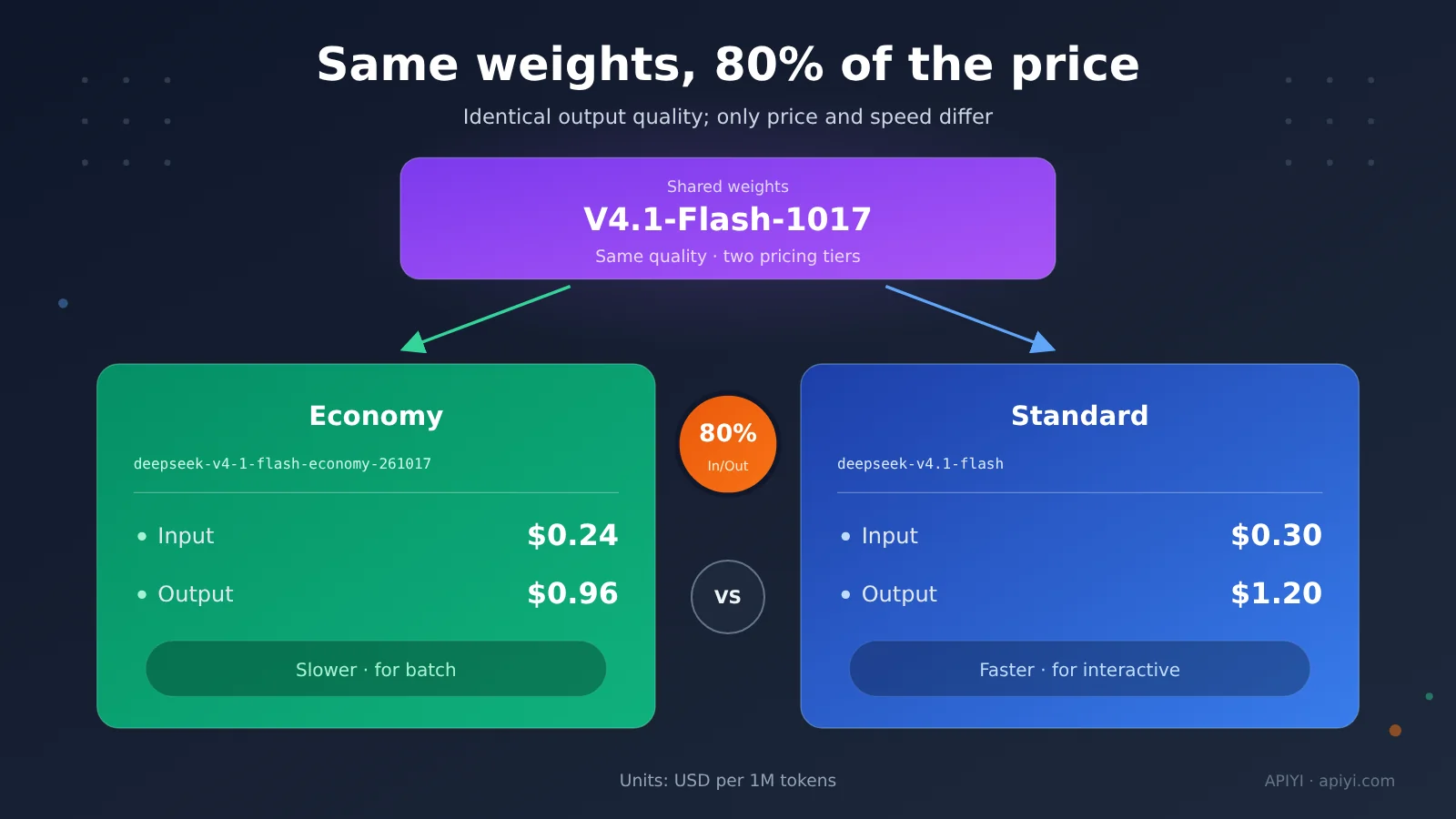
Bottom line up front: the economy version is not a worse model. Both IDs load the same V4.1-Flash-1017 weights, and the official spec lists identical output quality. There are only two differences — generation is slower, and the input and output prices are 80% of the standard version’s. This isn’t a benchmark of some new model, and it isn’t a watered-down version — it’s the same weights sitting in two pricing tiers.
What you’ll get from this: after reading, you’ll know exactly which ID to use for batch offline workloads, interactive products, Anthropic-format workflows, and similar scenarios. Both models are already listed on APIYI (apiyi.com), and switching is just a one-string change.
What is deepseek-v4-1-flash-economy-261017?
The economy edition went live on 2026-11-11 12:22 (UTC+8), and by the time I checked for this article (2026-11-13) it was barely two days old. Its positioning takes one sentence to explain: the same V4.1-Flash-1017 weights, a lower input/output unit price, and slower generation. It’s neither a distilled nor a quantized version — APIYI serves the full 552B weights through the official BytePlus channel, with no quantization and no distillation, and billing settles at a single peak-price tier.
Right now the economy edition doesn’t have its own model detail page or documentation page, so the key parameters come from the launch docs; pricing was cross-checked against both the official model list and the apiyi.com price API, and the two match. To save you from digging through docs, here are the essentials in one table:
| Key point | Description | What it means for you |
|---|---|---|
| Same weights | Shares V4.1-Flash-1017 with deepseek-v4.1-flash |
Output quality is officially stated to be identical, so no need to retune your prompts |
| Input/output at 80% of price | Input $0.24, output $0.96 (per 1M tokens) | Batch job costs drop by a fifth |
| Slower generation | Docs estimate roughly 2 seconds to first token, about 15 ms per token | Good for offline batch processing, not for heavy interaction |
| Fewer endpoints | Chat endpoint only, groups Default and SVIP | Works through an OpenAI-compatible interface |
Why deepseek-v4-1-flash-economy-261017 deserves its own model ID
Because what you save is direct cost, and you don’t have to hedge on quality. For batch jobs, the bulk of the bill is input and output token fees, and 20% off means the same budget runs about a quarter more volume. Since neither the weights nor the output quality change, the only cost is waiting — so the question shifts from “should I switch?” to “can my task afford to wait?” That’s exactly the difference the next section breaks down.
Key differences between deepseek-v4-1-flash-economy-261017 and deepseek-v4.1-flash
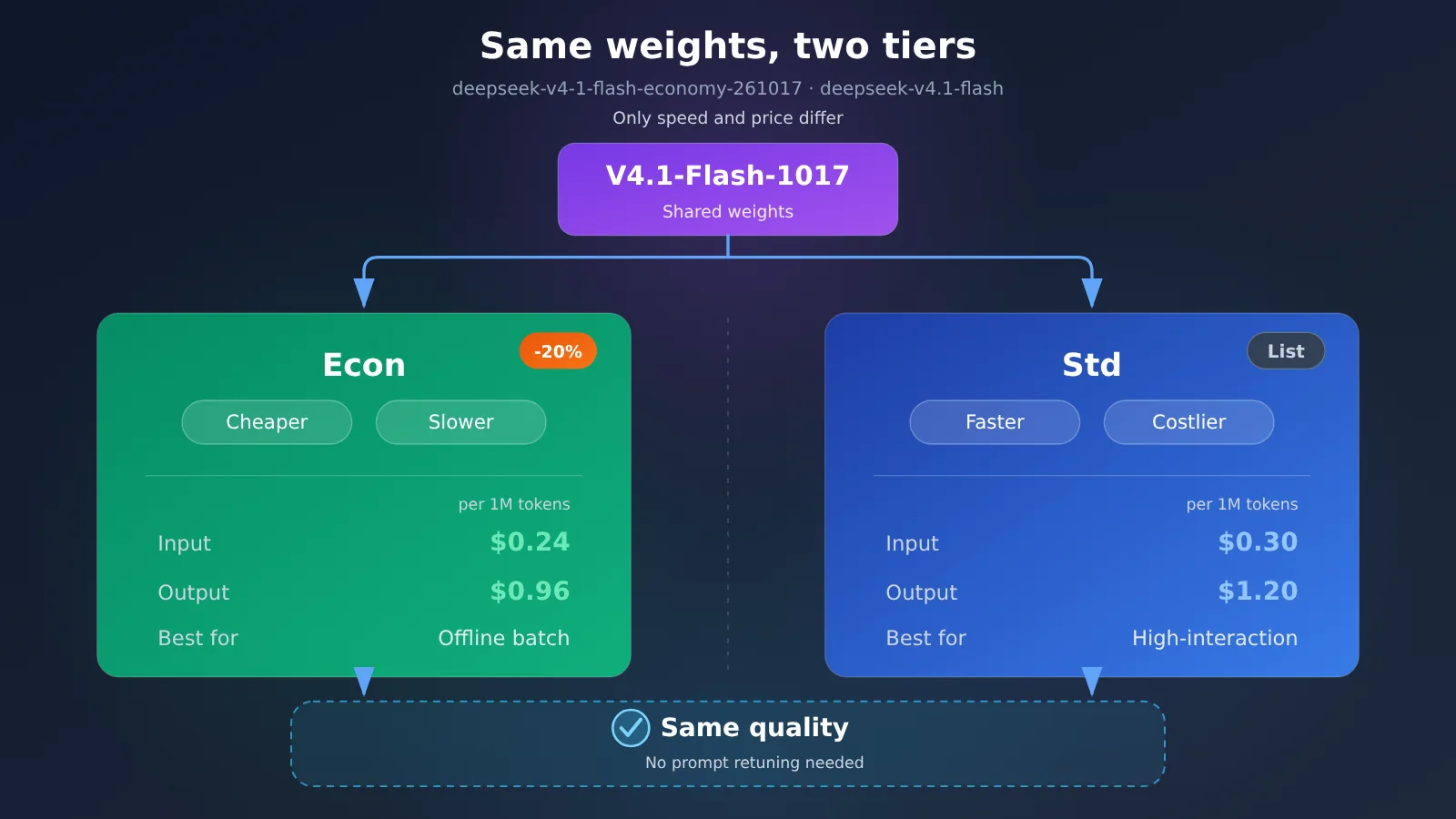
The differences between the two versions come down to three things: price, endpoints and groups, and speed. Weights and quality aren’t on this list — both versions load the same V4.1-Flash-1017 anyway.
Price difference: 20% off input and output, same price for cache reads
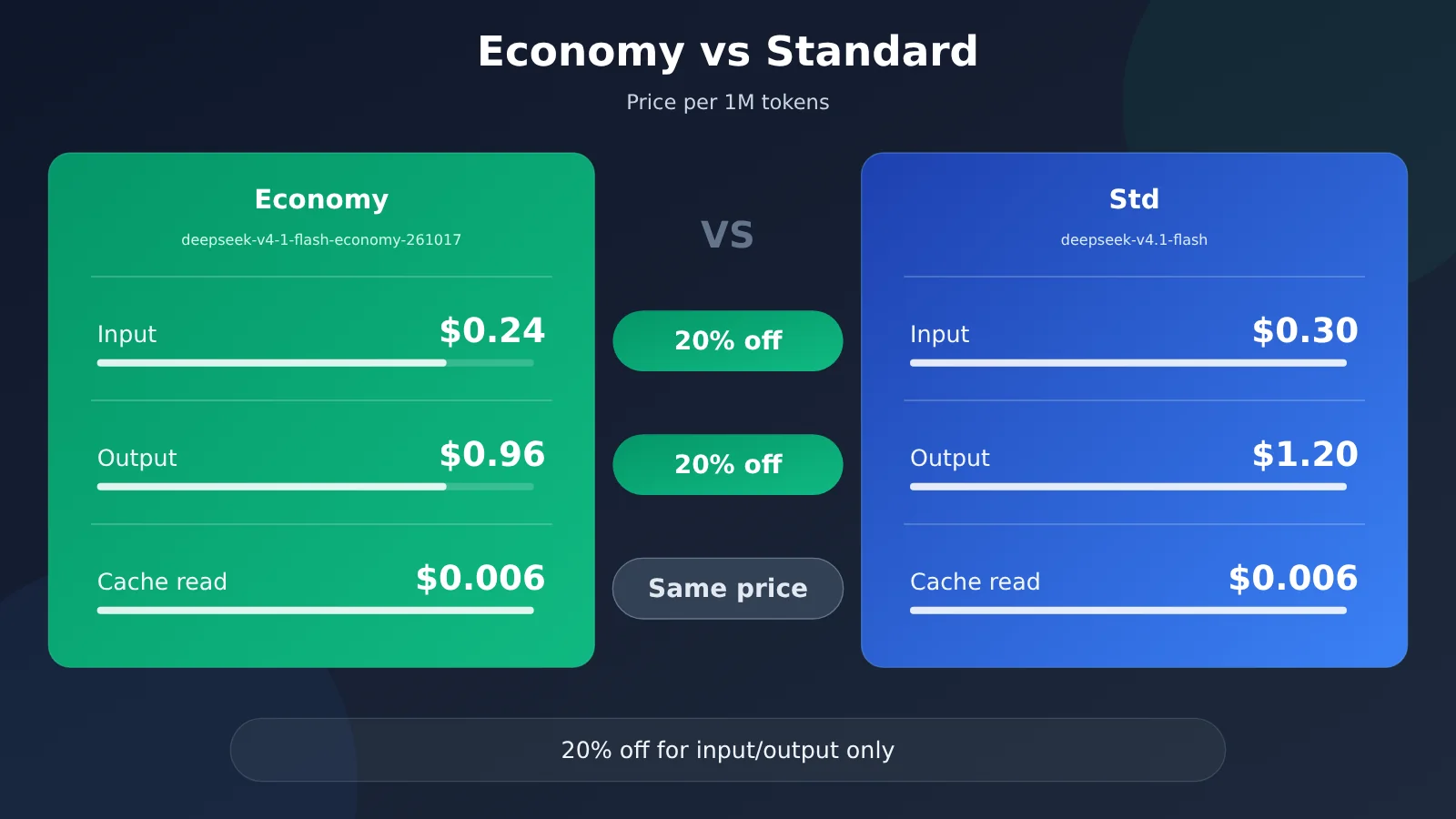
| Billing item (per 1 million tokens) | deepseek-v4-1-flash-economy-261017 | deepseek-v4.1-flash | Discount |
|---|---|---|---|
| Input | $0.24 | $0.30 | 20% off |
| Output | $0.96 | $1.20 | 20% off |
| Cache read | $0.006 | $0.006 | Same price |
0.24 divided by 0.30 is 0.8, and 0.96 divided by 1.20 is also 0.8 — so the 20% discount applies only to the economy version’s input and output billing items relative to the standard version. Cache reads are $0.006 in both versions, with no discount. If your workload has a high cache hit rate, there’s no price difference on that portion between the two versions, which dilutes your overall savings. When you run cost estimates, break out cache reads separately.
One more thing that’s easy to confuse: this 20% is a fixed difference between the two models’ list unit prices, not a limited-time promotion. APIYI’s account discounts come through top-up bonuses, and the bonus credits don’t change the unit prices in the table above; billing settles at the peak price tier and won’t fluctuate with promotions.
💰 Cost tip: For batch jobs, you can set reasoning_effort to none to turn off thinking, then stack the economy version’s 20% off input and output on top — save on both at once. If you want to run the numbers before you start, you can compare both models’ unit prices and do a cost simulation on APIYI at apiyi.com.
Endpoint difference: deepseek-v4-1-flash-economy-261017 is Chat only
This is the only hard difference between the two versions in terms of “whether you can use it.” The economy version only exposes the Chat endpoint, with groups limited to Default and SVIP; the standard version supports Anthropic format in addition to Chat, and its groups also include ClaudeCode and CodexResponses.
| Dimension | deepseek-v4-1-flash-economy-261017 | deepseek-v4.1-flash |
|---|---|---|
| Endpoints | Chat | Chat, Anthropic format |
| Groups | Default, SVIP | Default, SVIP, ClaudeCode, CodexResponses |
In practice, that means: if your client builds requests using the Anthropic message format, or your orchestration runs under the ClaudeCode or CodexResponses groups, you can only use deepseek-v4.1-flash. Regular applications going through the OpenAI-compatible interface can pick either version. For calls, the base_url is always https://api.apiyi.com/v1, and switching tiers only means changing the model field.
Speed difference: deepseek-v4-1-flash-economy-261017 is slower — but only slower
The launch documentation estimates speed at about 2 seconds to first token and about 15 milliseconds per token. To be clear, that’s the documentation’s estimate, not a measured benchmark — real-world feel varies with task length and time of day, so leave headroom if you’re doing capacity planning. Don’t worry about the quality dimension: the official docs state that output quality is identical between the two versions, because they load the same V4.1-Flash-1017.
In other words, don’t treat the two IDs as two models and run quality evals against them. The only thing you actually need to evaluate is one question: can your task tolerate slower generation?
deepseek-v4-1-flash-economy-261017 Scenario Recommendations
The one-line rule for choosing: if latency isn’t a concern and you’re hitting the Chat endpoint, go with the economy version; otherwise, use the standard version. Let’s break it down by scenario.
When to choose deepseek-v4-1-flash-economy-261017
Best for cases where unit price comes first and no one’s sitting in front of a screen waiting for results:
- Batch offline processing: log summarization, document tagging, corpus cleaning, bulk translation — high volume, queueable, rerunnable
- Overnight scheduled jobs: tasks accumulated during the day run at night, and a 2-second time-to-first-token is completely unnoticeable
- Cost-sensitive intermediate steps: pipeline nodes like classification, extraction, and structured conversion that don’t need human interaction
- Long-prefix reruns: the same batch of context called repeatedly — cached portions cost the same on both versions, while uncached input is 20% off on the economy version
There’s one more small switch worth remembering for batch processing: setting reasoning_effort to none turns off thinking and saves output tokens. It’s a separate thing from the 20% discount, but the two can stack.
When to still use deepseek-v4.1-flash
- Interactive products: chat and Copilot-style interfaces, where time-to-first-token directly affects the experience
- Workflows locked into Anthropic format: clients that assemble requests per the Anthropic protocol — the economy version can’t handle them
- ClaudeCode and CodexResponses groups: orchestration depends on these two groups, which only the standard version provides
- Online throughput first: willing to pay more for a faster generation pace
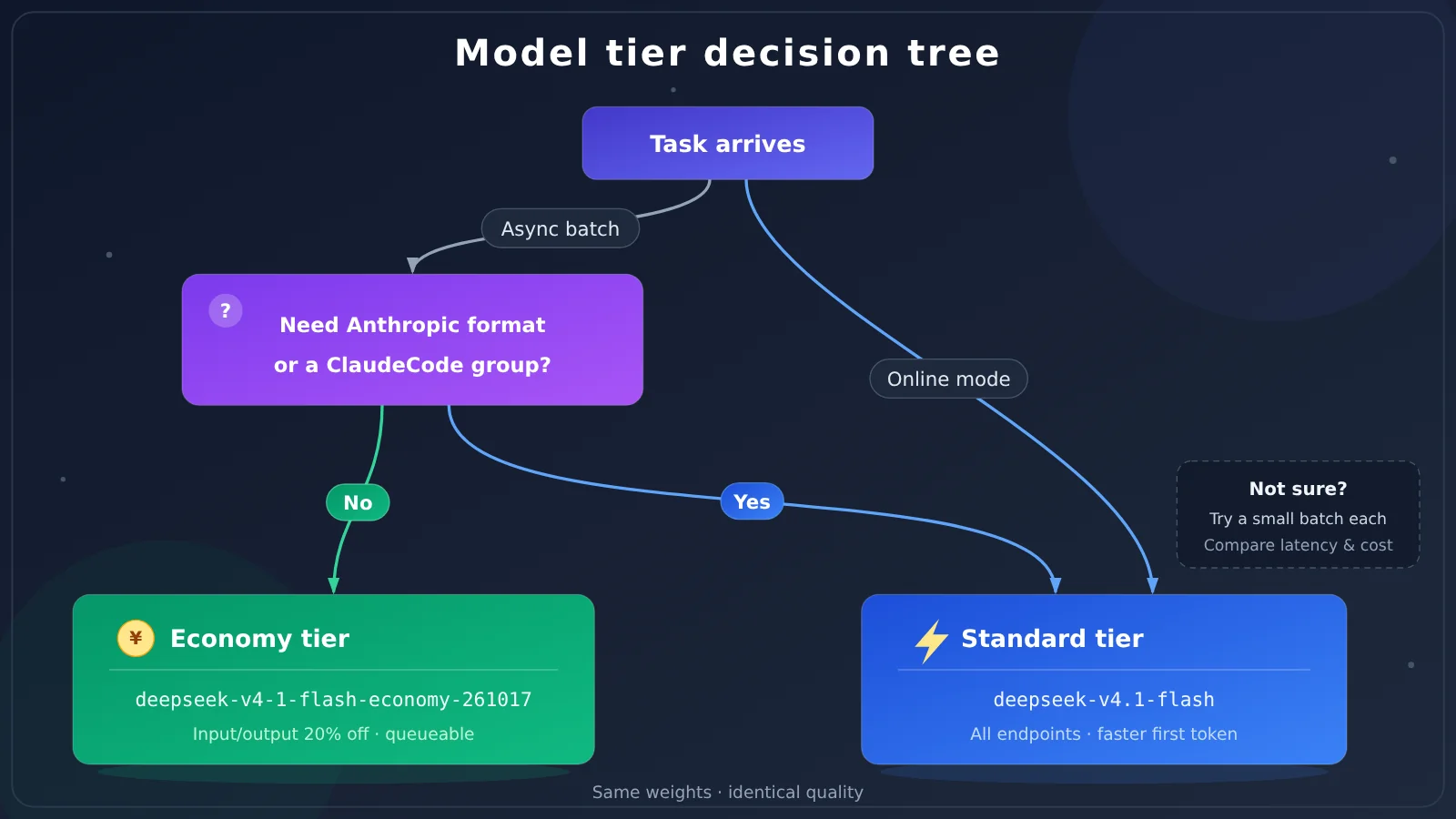
| Your scenario | Recommendation | Reason |
|---|---|---|
| Batch offline, scheduled jobs | deepseek-v4-1-flash-economy-261017 |
20% off input and output, latency unnoticeable |
| Chat, Copilot interfaces | deepseek-v4.1-flash |
First-response speed takes priority |
| Anthropic format or ClaudeCode, CodexResponses groups | deepseek-v4.1-flash |
Economy version only has the Chat endpoint |
| Queueable, cost-sensitive | deepseek-v4-1-flash-economy-261017 |
Same weights, consistent quality |
🎯 Scenario tip: If you’re unsure, run a small batch of the same tasks on both tiers and compare latency and billing before deciding. APIYI apiyi.com lets you switch the model field directly with a single API key — no other configuration changes needed.
deepseek-v4-1-flash-economy-261017: When to Use It and How to Switch
Switching costs you nothing. The request structure doesn’t change, base_url is still https://api.apiyi.com/v1 — just swap the model field from deepseek-v4.1-flash to deepseek-v4-1-flash-economy-261017 and you’re on the economy tier. Billing is handled automatically per model ID, so there’s no need for a new key, and both the Default and SVIP groups can use the economy version.
| Field | Economy | Standard |
|---|---|---|
| model | deepseek-v4-1-flash-economy-261017 |
deepseek-v4.1-flash |
| base_url | https://api.apiyi.com/v1 |
https://api.apiyi.com/v1 |
| Endpoint | Chat | Chat, Anthropic format |
| Input / output unit price | $0.24, $0.96 | $0.30, $1.20 |
One easy trap to fall into: the standard ID uses a period — deepseek-v4.1-flash, not a hyphen. Misspell either ID and you’ll get a “model not found” error. Worth saving this cheat sheet in your team’s model config notes so nobody fat-fingers it.
💡 Recommendation: Use the economy version for offline batch processing and the standard version for online interactive workloads. The Anthropic format, ClaudeCode, and CodexResponses groups are standard-only. For a new task, run a small batch on each tier first using the free trial credit at APIYI apiyi.com, then lock in your choice.
deepseek-v4-1-flash-economy-261017 FAQ
Q1: What is deepseek-v4-1-flash-economy-261017?
It’s the economy tier of DeepSeek V4.1 Flash, launched 2026-11-11 12:22 (UTC+8). It loads the same V4.1-Flash-1017 weights as the standard `deepseek-v4.1-flash`, but its input and output prices are 80% of the standard tier’s, and generation is slower.
Q2: What’s the difference between deepseek-v4-1-flash-economy-261017 and deepseek-v4.1-flash?
Three things: price (80% of standard on input and output, same price for cache reads), speed (the economy tier is slower), and endpoints/groups (the economy tier only has Chat plus Default and SVIP; the standard tier also offers the Anthropic format along with ClaudeCode and CodexResponses). The weights and output quality are identical.
Q3: When did the economy tier launch? Can I use it now?
It launched 2026-11-11 12:22 (UTC+8) and is already available on APIYI apiyi.com, usable in the Default and SVIP groups. It doesn’t have a separate model detail page yet, so refer to the launch documentation and the official model list for its parameters.
Q4: What applications is deepseek-v4-1-flash-economy-261017 best suited for?
Tasks that aren’t latency-sensitive and go through the Chat endpoint: batch log summarization, document tagging, corpus cleaning, batch translation, overnight scheduled jobs, and cost-sensitive classification/extraction pipelines. For batch offline work, you can also set `reasoning_effort` to `none` to turn off thinking and save even more tokens.
Q5: How do I call deepseek-v4-1-flash-economy-261017 through the API?
Sign up for an account on APIYI apiyi.com to get an API key, set `base_url` to `https://api.apiyi.com/v1`, put `deepseek-v4-1-flash-economy-261017` in the `model` field, and make a Chat request through the OpenAI-compatible interface. New users get free trial credit, so you can directly compare latency and billing between the two tiers.
Q6: What are the known limitations of deepseek-v4-1-flash-economy-261017?
Three things to keep in mind: generation is slower (the docs estimate about 2 seconds to first token and about 15 ms per token); it only has the Chat endpoint, so use the standard tier if you need the Anthropic format; cache reads get no discount — same $0.006 as the standard tier. It’s “slower but cheaper,” not “worse.”
Q7: Is the 80% a promotion? Will it go back to full price later?
No, it’s not a promotion. The 80% is the fixed difference between the two models’ list prices — $0.24 vs $0.30 for input, $0.96 vs $1.20 for output. On APIYI apiyi.com, account discounts come in the form of top-up bonuses, which don’t change these two unit prices; billing settles at a single peak-price tier.
deepseek-v4-1-flash-economy-261017 Key Takeaways
- Same weights: Shares V4.1-Flash-1017 with
deepseek-v4.1-flash; output quality is officially stated to be identical - Where the 20% off applies: Input $0.24, output $0.96 (per million tokens) — that’s 80% of the standard version’s price; cache reads at $0.006 cost the same on both
- The cost of speed: Docs estimate about 2 seconds to first token and about 15 ms per token — good for offline work, not for interactivity
- Endpoint differences: The economy version only offers Chat (Default, SVIP); the standard version also has the Anthropic format plus ClaudeCode and CodexResponses groups
- Switching cost: The request structure doesn’t change — just swap the model field to move between tiers
- Rule of thumb: If you can wait, save; if you can’t, go fast
Summary
Here’s the relationship between the two models in one sentence: deepseek-v4-1-flash-economy-261017 and deepseek-v4.1-flash are two tiers built on the same V4.1-Flash-1017 weights — same quality, different speed, with input/output prices at 80% of the standard rate.
- Cost: Batch jobs benefit directly — 80% pricing on input and output, same price for cache reads
- Capability: Full 552B weights served through the official BytePlus channel — no quantization, no distillation
- Boundaries: The economy version only has the Chat endpoint and the Default/SVIP groups; the Anthropic format plus ClaudeCode and CodexResponses are standard-version only
Keep your choice simple: if latency doesn’t matter, go with the economy version; if you need online interactivity or a fixed Anthropic format, go with the standard version. I recommend running a small batch on each tier through APIYI at apiyi.com using free test credits, and letting the bill make the final call.
📚 References
- DeepSeek V4.1 Flash Economy Edition Launch Documentation
- Link:
docs.apiyi.com/live/2026-11/deepseek-v4-1-flash-economy-launch.md -
Note: The primary source for weights, pricing, endpoints, groups, and speed estimates
-
APIYI Model List
- Link:
docs.apiyi.com/models -
Note: Where to verify the listed unit prices for both models
-
APIYI Pricing API
- Link:
api.apiyi.com/api/pricing - Note: Machine-readable pricing data, handy for scripted reconciliation
Author: APIYI Technical Team
Technical discussion: Feel free to reach us through the APIYI website homepage — for more resources, head over to the docs.apiyi.com documentation center