Author’s note: Based on the 10-item summary from the official model cards and the official pricing, this compares Gemini 4 Hydrogen and Claude Sonnet 5.5 on capability differences and cost, then offers selection advice broken out by task type.
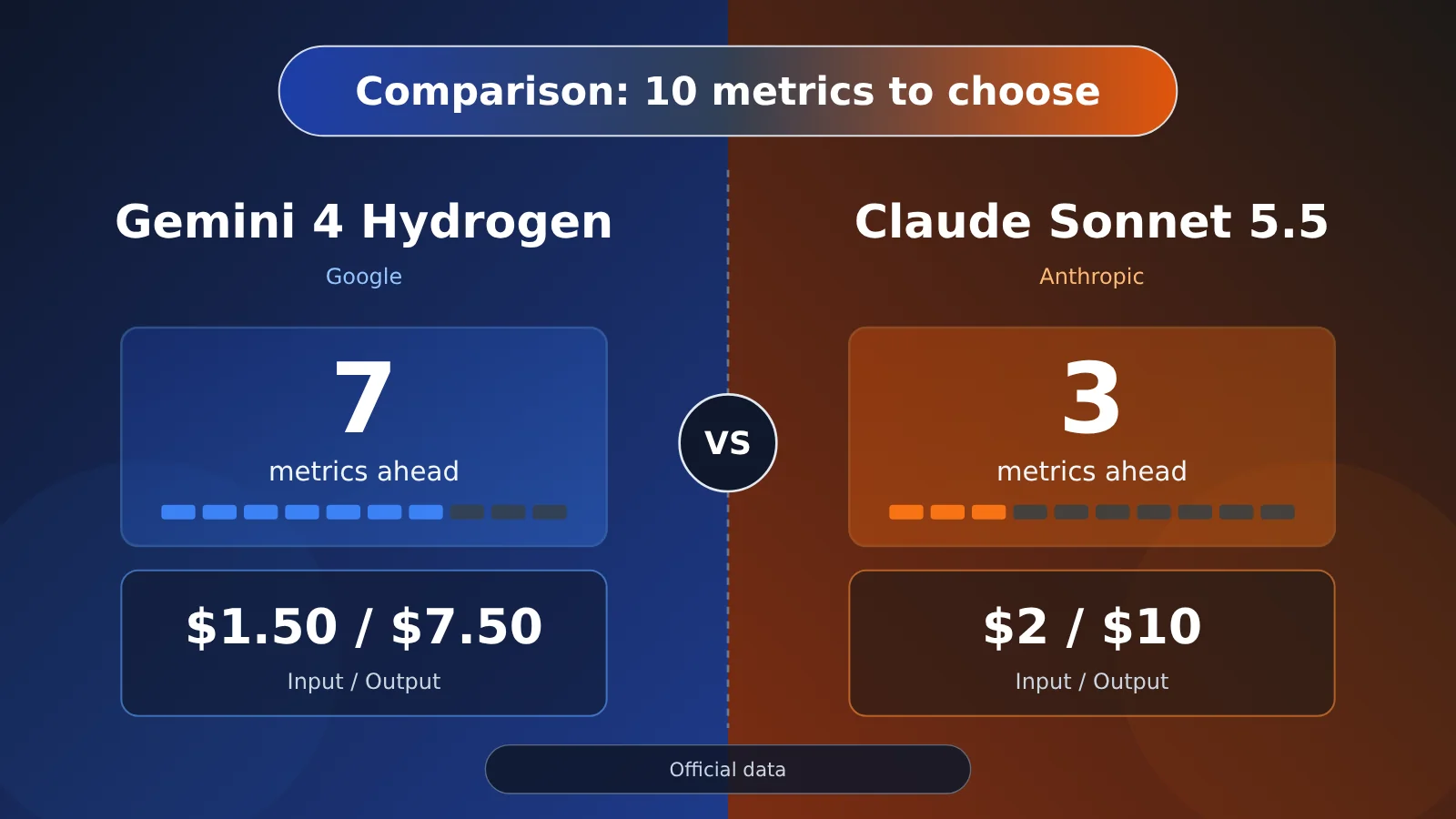
Google released Gemini 4 Hydrogen on 2026-11-12, positioned for day-to-day coding and agent execution. In the global standard tier it charges a flat rate across the entire context window: $1.50 input, $7.50 output (per 1M tokens, with output covering both the reply and the reasoning). The comparison target is Claude Sonnet 5.5, whose official standard pricing is $2 input, $10 output.
Here’s the bottom line up front: for terminal operations, computer use (GUI automation), and scientific terminal tasks, keep handing the work to Claude Sonnet 5.5; for codebase-level fixes, general agent benchmarks, chart understanding, hard Q&A, and the remaining tasks, try Gemini 4 Hydrogen first. Of the 10 items in the official model card summary, Hydrogen comes out on top in 7 and Sonnet in 3.
This isn’t an article about “which one is stronger overall.” All 10 scores come from the official model card summary, not from APIYI re-testing; Hydrogen is cheaper on short prompts, but its default thinking tier is high, so output tokens get stretched on long tasks and the bill isn’t necessarily lower every time. Right now APIYI (apiyi.com) lets you call claude-sonnet-5-5 directly; gemini-4-hydrogen isn’t listed yet, and we’ll get it up as soon as we can — the model name and pricing are subject to the platform’s model list.
Core value: after reading this, you’ll know exactly which way each of the 10 metrics tips when Gemini 4 Hydrogen goes up against Claude Sonnet 5.5, which work should stay on which side, and the cost gap between the two on short prompts.
Gemini 4 Hydrogen vs. Claude Sonnet 5.5: Basic Specs
Before we get into the scores, let’s lay out the specs we can confirm for both models. Gemini 4 Hydrogen is derived from Gemini 4 Carbon. Its model ID is gemini-4-hydrogen, its knowledge cutoff is 2026-03, and it supports four thinking levels: low / medium / high / xhigh, with high as the default. Its input modalities cover text, images, audio, and video.
The context window needs a careful description. The model card says input and output combined can be up to 1 million tokens; synchronous requests default to up to 64,000 output tokens, while background long outputs can go up to 1 million. Google’s blog post says native 1 million input, with output up to 1 million. These two statements use different scopes, so this article won’t simplify it to “1 million input and 1 million output each.” We didn’t verify the official context length for Claude Sonnet 5.5 this time, so the table leaves it blank rather than guessing.
| Spec | Gemini 4 Hydrogen | Claude Sonnet 5.5 |
|---|---|---|
| Model ID | gemini-4-hydrogen |
claude-sonnet-5-5 (APIYI model name) |
| Release | 2026-11-12 (Google) | Not covered in this article |
| Positioning | Everyday coding and agent execution | — |
| Thinking levels | low / medium / high (default) / xhigh | Highest publicly available thinking level used in evaluation |
| Context | Model card: input + output combined up to 1M; synchronous output defaults to up to 64,000 | Official figure not verified this time |
| Input modalities | Text, image, audio, video | — |
| Standard input price | $1.50 / 1M (global standard tier) | $2 / 1M |
| Standard output price | $7.50 / 1M (including reasoning) | $10 / 1M |
| Cache read | $0.075 / 1M | $0.10 / 1M |
Two pricing details about Hydrogen are also worth flagging. Prices are higher in non-global regions: $1.65 input and $8.25 output. Cache writes are listed at $1.875, but a footnote says that price doesn’t take effect until 2027-01-12, so you shouldn’t factor write fees into your budget yet. Sonnet 5.5’s cache writes come in two tiers: $2.50 for a 5-minute write and $4 for a 1-hour write.
Gemini 4 Hydrogen vs Claude Sonnet 5.5: Item-by-Item Conclusions from 10 Official Scores
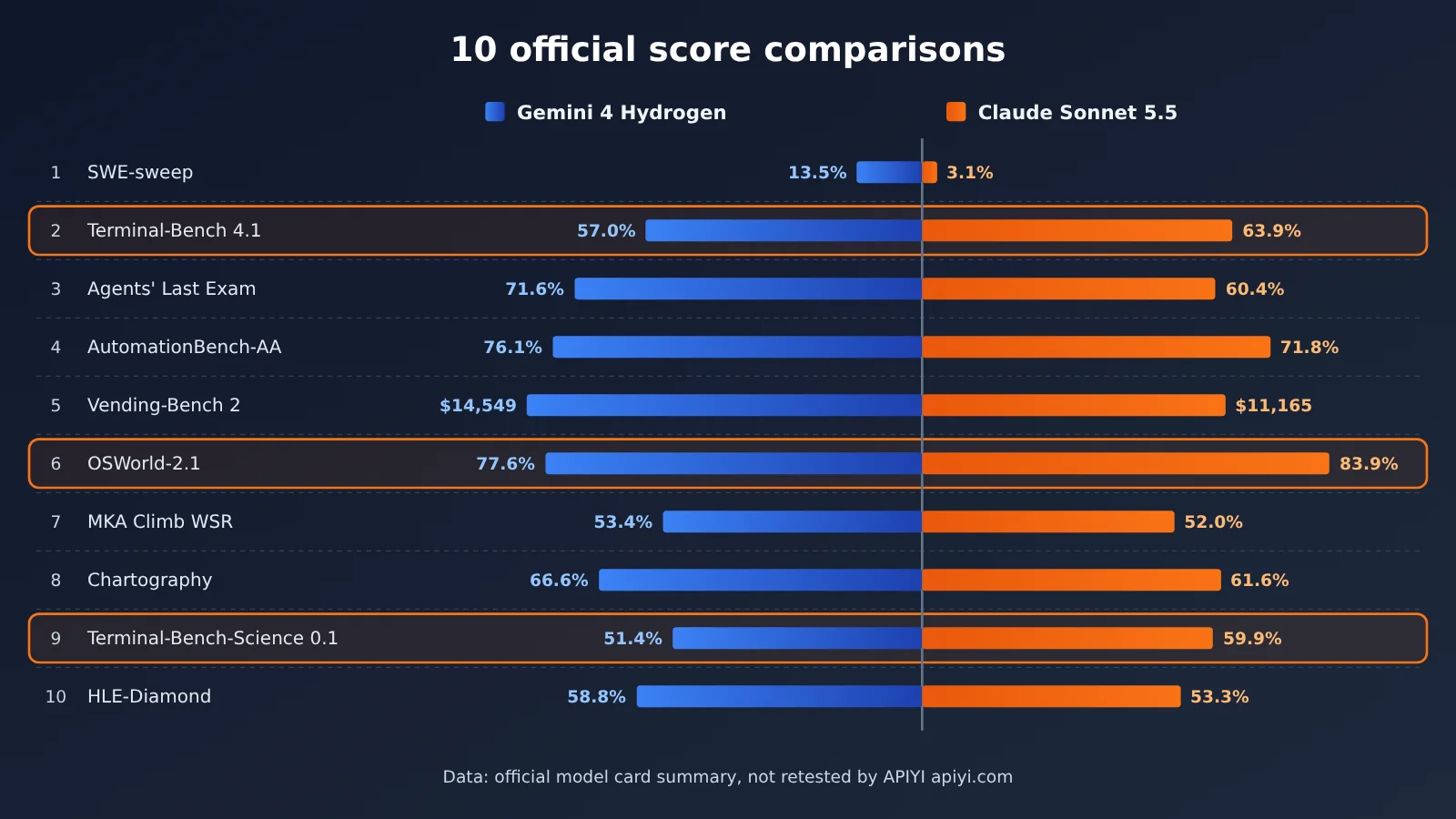
The table below is the heart of this article. The data comes from a roundup of official Google model cards (November 2026). Hydrogen uses the highest reasoning setting and pass@1; Sonnet 5.5 uses the largest publicly available reasoning setting, or the best result available where none is offered. Sonnet’s SWE-sweep score comes from a public leaderboard. Because the measurement conditions aren’t perfectly aligned, treat this as a directional reference rather than an exact ranking.
| # | Benchmark | Gemini 4 Hydrogen | Claude Sonnet 5.5 | Best | One-line takeaway |
|---|---|---|---|---|---|
| 1 | SWE-sweep | 13.5% | 3.1% | Hydrogen | The widest gap; codebase-level sweeping repair favors Hydrogen |
| 2 | Terminal-Bench 4.1 (cheating-adjusted) | 57.0% | 63.9% | Sonnet | Sonnet is more reliable at multi-step command-line operations |
| 3 | Agents’ Last Exam v1.1 | 71.6% | 60.4% | Hydrogen | Hydrogen is clearly higher on general agent composite tasks |
| 4 | AutomationBench-AA | 76.1% | 71.8% | Hydrogen | Hydrogen is slightly higher on automation workflow orchestration |
| 5 | Vending-Bench 2 (balance) | $14,549 | $11,165 | Hydrogen | Hydrogen performs better on long-horizon business-operation agent tasks |
| 6 | OSWorld-2.1 offline | 77.6% | 83.9% | Sonnet | Sonnet is stronger at computer use / GUI automation |
| 7 | MKA Climb WSR | 53.4% | 52.0% | Hydrogen | Essentially tied; Hydrogen is slightly ahead |
| 8 | Chartography | 66.6% | 61.6% | Hydrogen | Hydrogen is higher on chart understanding |
| 9 | Terminal-Bench-Science 0.1 | 51.4% | 59.9% | Sonnet | Sonnet leads on scientific-computing terminal tasks |
| 10 | HLE-Diamond | 58.8% | 53.3% | Hydrogen | Hydrogen is higher on hard question-answering reasoning |
What Hydrogen’s 7 Leading Benchmarks Actually Tell Us
Hydrogen’s wins cluster around “understanding + planning” tasks: codebase-level repair (SWE-sweep), comprehensive agent exams (Agents’ Last Exam), automated orchestration (AutomationBench), long-horizon decision-making (Vending-Bench 2), and charting plus hard reasoning (Chartography, HLE-Diamond). Among these, SWE-sweep and Agents’ Last Exam show gaps of more than 10 percentage points — that’s the most convincing part of this release.
That said, MKA Climb differs by only 1.4 percentage points, and AutomationBench by roughly 4. Since the evaluation conditions on both sides aren’t perfectly identical, small gaps like these are better read as “same tier.” I wouldn’t migrate production workloads based on them alone.
Why Sonnet’s 3 Leading Benchmarks Matter
Sonnet 5.5’s three wins all map directly to “real execution environments”: Terminal-Bench 4.1 at 63.9% vs 57.0%, OSWorld-2.1 at 83.9% vs 77.6%, and Terminal-Bench-Science 0.1 at 59.9% vs 51.4% — gaps of 6 to 9 percentage points. That means when the model actually has to type commands, click through a UI, and run scientific computing pipelines, Sonnet is less likely to fail and need a retry.
For agent products, one failure at the execution layer usually costs more than a few extra cents of tokens. So “Hydrogen leads in 7 benchmarks” doesn’t automatically mean “migrate everything to Hydrogen.”
How to Calculate Cost: Gemini 4 Hydrogen vs Claude Sonnet 5.5
The short-prompt math: Hydrogen comes in at about 75% of Sonnet
Take a typical short-prompt request: no caching, 100K input tokens plus 10K output tokens, all calculated at official list prices. One thing worth stressing: Hydrogen’s output price includes thinking tokens, and its default thinking level is high.
| Billing item | Gemini 4 Hydrogen | Claude Sonnet 5.5 |
|---|---|---|
| 100K input tokens | 0.1 × $1.50 = $0.150 | 0.1 × $2 = $0.200 |
| 10K output tokens | 0.01 × $7.50 = $0.075 | 0.01 × $10 = $0.100 |
| Total per request | $0.225 | $0.300 |
| Difference | $0.075 cheaper, roughly 75% of Sonnet | — |
Why you can’t say “every task is 25% cheaper”
The example above assumes both sides produce 10K output tokens, but Hydrogen’s output includes the reasoning process. At the high or xhigh level, the same question might produce noticeably more than 10K output tokens. Working backward from the input volume above: if Hydrogen’s actual output (including thinking) reaches 20K tokens while Sonnet stays at 10K, then 0.15 + 0.02 × 7.50 = $0.30 — the two sides break even.
So a more sensible approach looks like this:
- Light tasks: drop Hydrogen’s thinking level to low or medium. You keep the price advantage and keep output length in check.
- Heavy tasks: measure average output tokens from real requests, then compare total cost per task instead of just looking at unit price.
- Long-context reuse: Hydrogen’s cache-read price is $0.075 versus Sonnet’s $0.10, so Hydrogen still has the edge when you’re re-reading large chunks of context.
💰 Cost tip: Run your cost comparison with your own business prompts. On the Sonnet side, you can start right now through APIYI apiyi.com using
claude-sonnet-5-5to record real input and output tokens as a baseline for comparison once Hydrogen becomes available.
How to Access Claude Sonnet 5.5 on APIYI
Over in APIYI’s master model list at docs.apiyi.com/models, you can already find claude-sonnet-5-5, priced the same as Anthropic’s official standard rates: $2 input, $10 output, and $0.1 cache read (per 1M tokens). The platform’s pricing endpoint returns those same dollar figures, and it also lists a cache write multiplier of 1.25, which works out to roughly $2.50 / 1M based on the $2 input price — the same as the official 5-minute write rate. Worth noting: the master list itself doesn’t break out the write price separately.
gemini-4-hydrogen doesn’t appear yet in the master list, its model detail page, or the pricing endpoint — it’s simply not listed for now. We’ll get that model onto the platform as soon as we can; until then, the model detail page and pricing should be taken from the platform’s model list.
| Item | Value |
|---|---|
| Model ID | claude-sonnet-5-5 |
| base_url | https://api.apiyi.com/v1 |
| Supported endpoints | chat (OpenAI-compatible), messages (Anthropic format) |
| Pricing (per 1M tokens) | $2 input / $10 output / $0.1 cache read |
| Gemini 4 Hydrogen | Not yet listed — refer to the platform’s model list |
If you’re already using the OpenAI SDK, you only need to change two parameters: set base_url to https://api.apiyi.com/v1 when you initialize the client, and put the key generated on the platform into api_key. Then when you call chat.completions.create, set model to claude-sonnet-5-5 and leave messages in its existing structure. If your toolchain already speaks Anthropic’s messages format, you can use the messages endpoint directly — no need to rewrite your message structure.
The nice thing about this setup is that once Hydrogen goes live, you only change the model field, and you can run an A/B comparison with the same key and the same code — no maintaining two SDKs and two sets of invoices.
🚀 Quick start: Register at APIYI apiyi.com first and claim the free trial credit for new users. Get terminal-style and GUI-style tasks working with
claude-sonnet-5-5, then set aside a solid evaluation set for the comparison once Hydrogen launches.
Gemini 4 Hydrogen vs Claude Sonnet 5.5: Scenario Recommendations
Mapping the 10 findings onto concrete business scenarios gives us the division of labor below. These “recommendations” are a starting point based on the direction of the official scores — ultimately, what matters is how each model performs on your own business data.
| Business scenario | Preferred choice | Rationale |
|---|---|---|
| CLI agents, ops script execution, server troubleshooting | Claude Sonnet 5.5 | Terminal-Bench 4.1: 63.9% vs 57.0% |
| Browser / desktop GUI automation, RPA-style operations | Claude Sonnet 5.5 | OSWorld-2.1: 83.9% vs 77.6% |
| Scientific computing pipelines, data analysis terminal tasks | Claude Sonnet 5.5 | Terminal-Bench-Science 0.1: 59.9% vs 51.4% |
| Repo-wide batch fixes, cross-file changes | Gemini 4 Hydrogen | SWE-sweep: 13.5% vs 3.1% |
| Multi-tool planning agents, automation orchestration | Gemini 4 Hydrogen | Leads on Agents” Last Exam and AutomationBench |
| Chart comprehension, report interpretation | Gemini 4 Hydrogen | Chartography: 66.6% vs 61.6% |
| Hard knowledge Q&A, complex reasoning | Gemini 4 Hydrogen | HLE-Diamond: 58.8% vs 53.3% |
| Audio, video, and other multimodal inputs | Gemini 4 Hydrogen | Officially listed as supporting audio and video input |
When to choose Gemini 4 Hydrogen
- Heavy on planning, light on execution: the hard part of the task is understanding the codebase, breaking down steps, and making decisions, while the actual execution is handed off to deterministic tools.
- Cost-sensitive high-frequency calls: batch requests with short prompts that can run at a lower thinking tier make the per-unit price advantage more obvious.
- Large-context reuse: cached reads cost $0.075, and the global standard tier charges a flat price for the entire window, so there’s no need to worry about long-context tiered surcharges.
When to choose Claude Sonnet 5.5
- The model directly operates the environment: every step in the terminal, on the desktop, or in the browser is issued by the model, so execution accuracy comes first.
- Scientific workflows: terminal tasks involving numerical computation, experiment scripts, and data processing.
- You need to ship today: Sonnet 5.5 is already callable on APIYI, while Hydrogen isn’t listed yet.
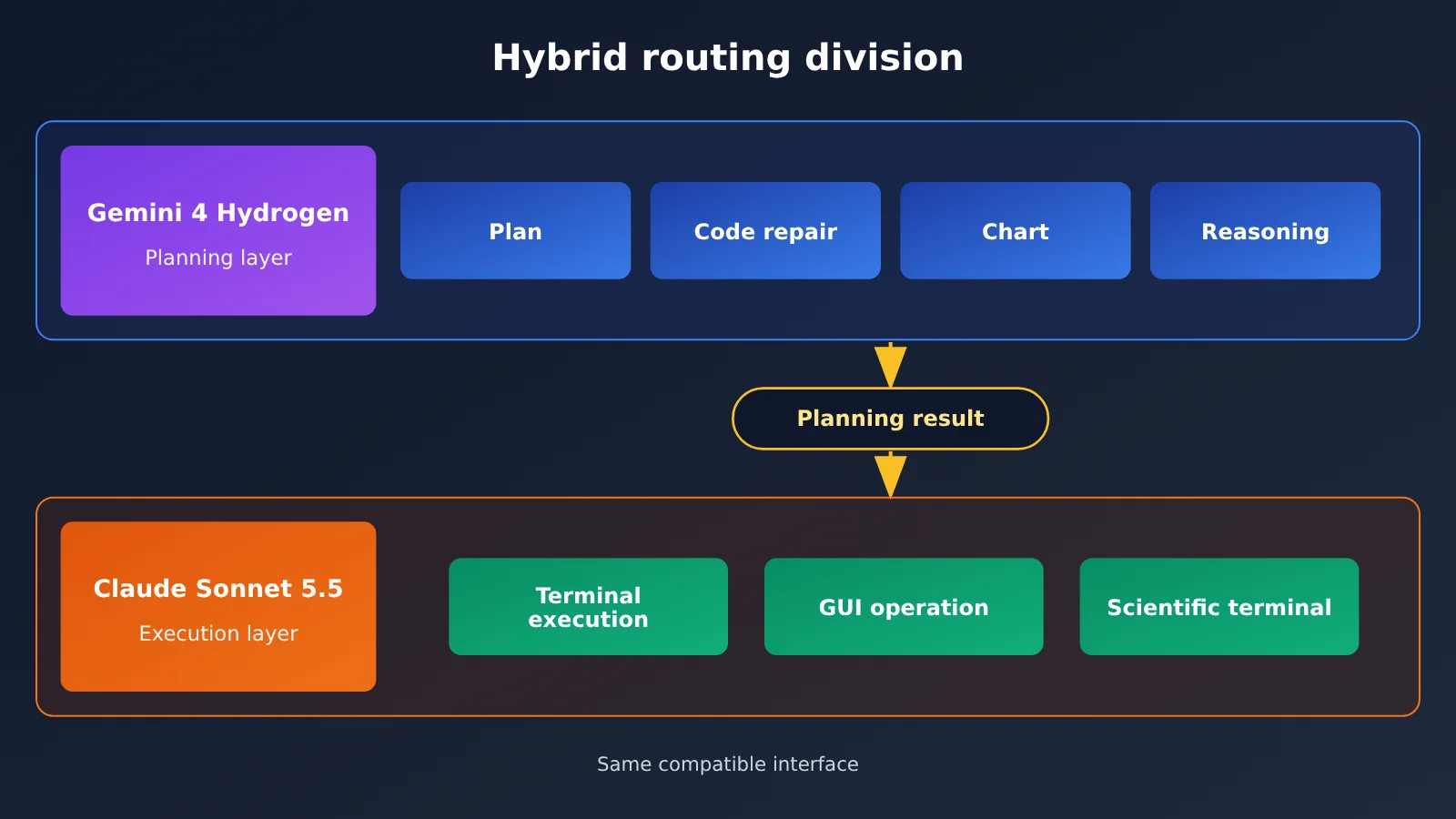
Gemini 4 Hydrogen vs Claude Sonnet 5.5: Decision Guide
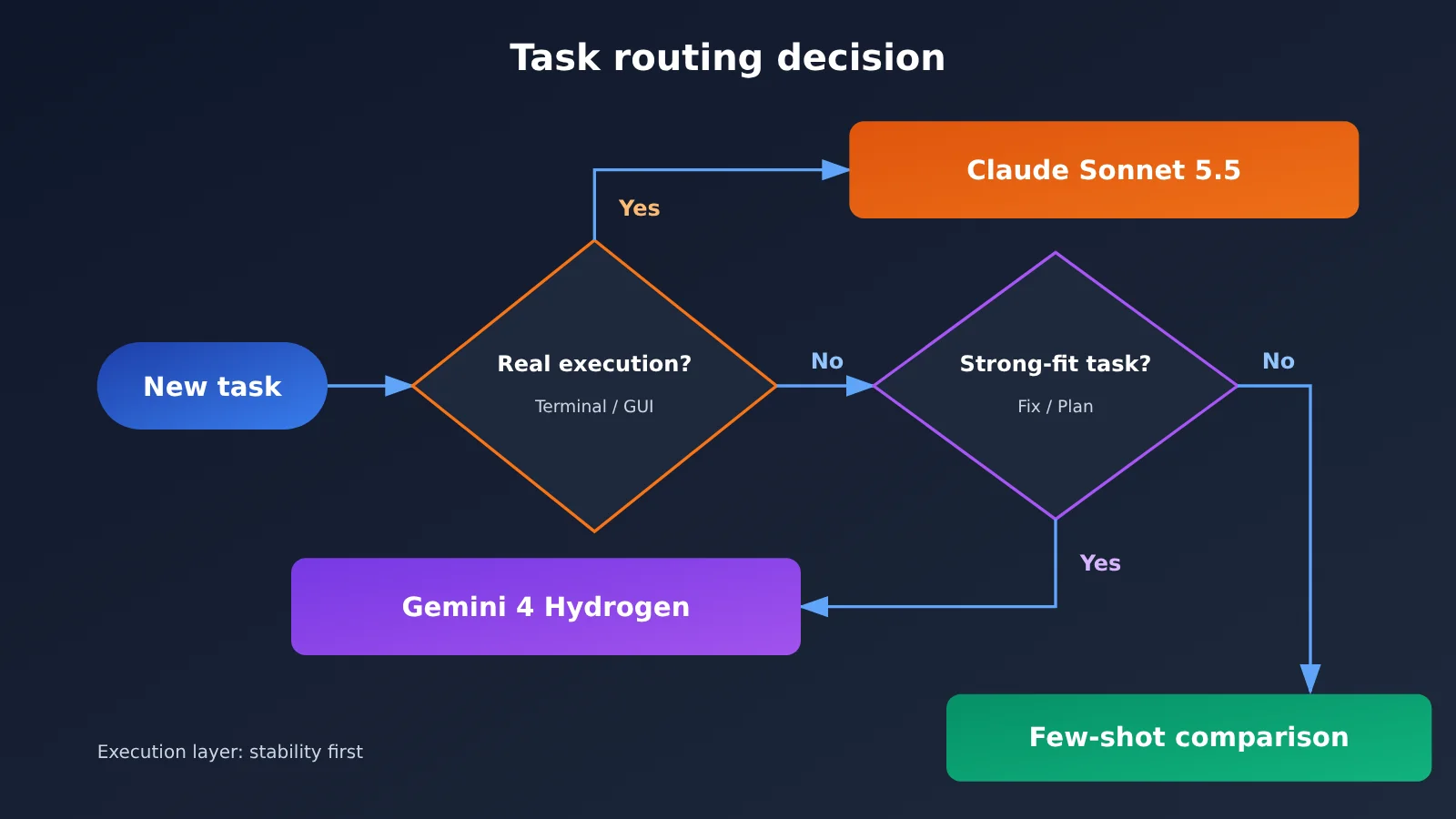
If you can only pick one, start by looking at how much of your workload involves “direct model execution.” If execution makes up a large share, go with Sonnet 5.5—trading roughly a one-third price difference for a lower failure rate. If planning and understanding dominate, Hydrogen’s seven areas of advantage and lower unit price are more appealing.
A better approach is hybrid routing: let Hydrogen handle planning, code change proposals, and chart interpretation, while Sonnet 5.5 handles actual execution in the terminal and GUI. That way, you get Hydrogen’s pricing and planning strengths without giving up stability at the execution layer. The prerequisite for routing is that both models use the same compatible interface—otherwise, maintenance costs will eat into the benefits.
💡 Selection advice: Which model to choose depends on the structure of your specific tasks. We recommend first connecting the Sonnet side to APIYI apiyi.com to establish a baseline. After Hydrogen launches, compare success rates and per-task costs by task type under the same interface, then decide the routing ratio.
Frequently Asked Questions
Q1: What is the Gemini 4 Hydrogen model?
Gemini 4 Hydrogen is a model Google released on 2026-11-12, derived from Gemini 4 Carbon and positioned for everyday coding and agent execution. It supports four thinking levels (high by default), has a knowledge cutoff of 2026-03, accepts text, images, audio, and video as input, and at the global standard tier it costs $1.50 for input and $7.50 for output.
Q2: Between Gemini 4 Hydrogen and Claude Sonnet 5.5, which one is stronger?
Neither is stronger across the board. Of the 10 items in the official model card, Hydrogen leads on 7, mostly codebase bug fixing, agent planning, charts, and hard reasoning; Sonnet 5.5 leads on 3, namely Terminal-Bench 4.1, OSWorld-2.1, and Terminal-Bench-Science 0.1, all of which are real-world execution tasks.
Q3: Are these 10 scores trustworthy?
They come from the summary in Google’s official model card, not from independent re-testing by APIYI. Hydrogen’s numbers use the highest thinking level and pass@1, while Sonnet’s use the largest publicly available thinking level or the best result obtainable, and Sonnet’s SWE-sweep score comes from a public leaderboard. The conditions aren’t fully aligned, so these figures are good for gauging direction but gaps of a few percentage points shouldn’t be read too much into.
Q4: Is Hydrogen really 25% cheaper than Sonnet?
Only under certain conditions. With 100K input + 10K output and no caching, Hydrogen comes to $0.225 and Sonnet to $0.30. But Hydrogen’s output includes thinking tokens, and the default high level stretches output longer; at that input volume, the two break even once Hydrogen’s output reaches roughly 20K tokens.
Q5: Can I call both models on APIYI right now?
`claude-sonnet-5-5` is already callable, at $2 input, $10 output, and $0.1 cache read, supporting the chat and messages endpoints with a base_url of `https://api.apiyi.com/v1`. `gemini-4-hydrogen` isn’t listed yet; we’ll get it up as soon as we can. For model names and pricing, refer to the model list on the APIYI apiyi.com platform.
Q6: What is Gemini 4 Hydrogen’s context window?
The model card states a maximum of 1M tokens for input and output combined, with synchronous output capped at 64K by default and background long output up to 1M; Google’s blog post says natively 1M input with output up to 1M. These are two different ways of stating it, so when planning very long outputs, go by the model card and the actual API limits.
Q7: Do I need to factor in Hydrogen’s cache write fee now?
Not at the moment. The Google Cloud price list shows a cache write price of $1.875 / 1M, but a footnote states it only takes effect on 2027-01-12. For now, Hydrogen’s caching cost only needs to be estimated at $0.075 for cache reads, whereas Sonnet 5.5 requires accounting for $2.50 for 5-minute writes or $4 for 1-hour writes.
Gemini 4 Hydrogen vs Claude Sonnet 5.5 Key Takeaways
- Score breakdown: Out of the 10 official benchmarks, Hydrogen leads on up to 7, while Sonnet 5.5 leads on up to 3 — so it’s not a clean sweep.
- Sonnet holds the execution layer: It leads on Terminal 4.1, OSWorld, and scientific terminal by 6-9 percentage points.
- Hydrogen shines in planning: It leads on SWE-sweep and Agents’ Last Exam by more than 10 percentage points.
- Short prompts are cheaper: For 100K input + 10K output, $0.225 vs $0.30 — roughly 75%.
- Thinking tokens are the wildcard: The default high tier produces longer output, so total cost needs to be calculated based on real tasks.
- Availability: APIYI already supports
claude-sonnet-5-5; Hydrogen isn’t listed yet.
Summary
The core conclusions from the Gemini 4 Hydrogen vs Claude Sonnet 5.5 comparison:
- Split tasks by role, not by leaderboard loyalty: Leave terminal work, computer operation, and scientific terminal to Sonnet 5.5; try Hydrogen first for planning, code repair, charts, and reasoning.
- The price advantage has caveats: With short prompts, Hydrogen costs about 75% of what Sonnet does, but the higher the thinking tier, the longer the output — and the smaller that advantage becomes.
- Build a baseline before migrating: Use real tasks to record success rates and token usage on the Sonnet side, then compare on the same basis once Hydrogen is available.
Today you can use the same key to call claude-sonnet-5-5 on APIYI apiyi.com and get the Sonnet side up and running. Once Hydrogen is listed, all you need to do is switch the model field to complete the comparison.
📚 References
- Google Blog – Introducing Gemini 4 Hydrogen: Release notes and official pricing
- Link:
blog.google/innovation-and-ai/models-and-research/gemini-models/introducing-gemini-4-hydrogen -
Details: Release date, positioning, context window, and pricing details
-
Google DeepMind – Gemini 4 Hydrogen Model Card: Specifications and summary of 10 benchmarks
- Link:
deepmind.google/models/model-cards/gemini-4-hydrogen -
Details: Thinking tiers, context window definitions, knowledge cutoff date
-
Google DeepMind – Evaluation Methodology Page: Description of evaluation conditions
- Link:
deepmind.google/models/evals-methodology/gemini-4-hydrogen -
Details: How pass@1, thinking tiers, and competitor scores are derived
-
Google Cloud Vertex AI Pricing: Hydrogen regional pricing and caching billing
- Link:
cloud.google.com/vertex-ai/generative-ai/pricing -
Details: Global / non-global pricing and cache write effective dates
-
Claude Official Pricing Documentation: Sonnet 5.5 standard and cache pricing
- Link:
platform.claude.com/docs/en/about-claude/pricing - Details: Input/output, cache write, and cache hit pricing
Author: APIYI Technical Team
Technical Discussion: Feel free to reach out to us via the homepage of the APIYI website. Model listings and pricing can be found at docs.apiyi.com/models