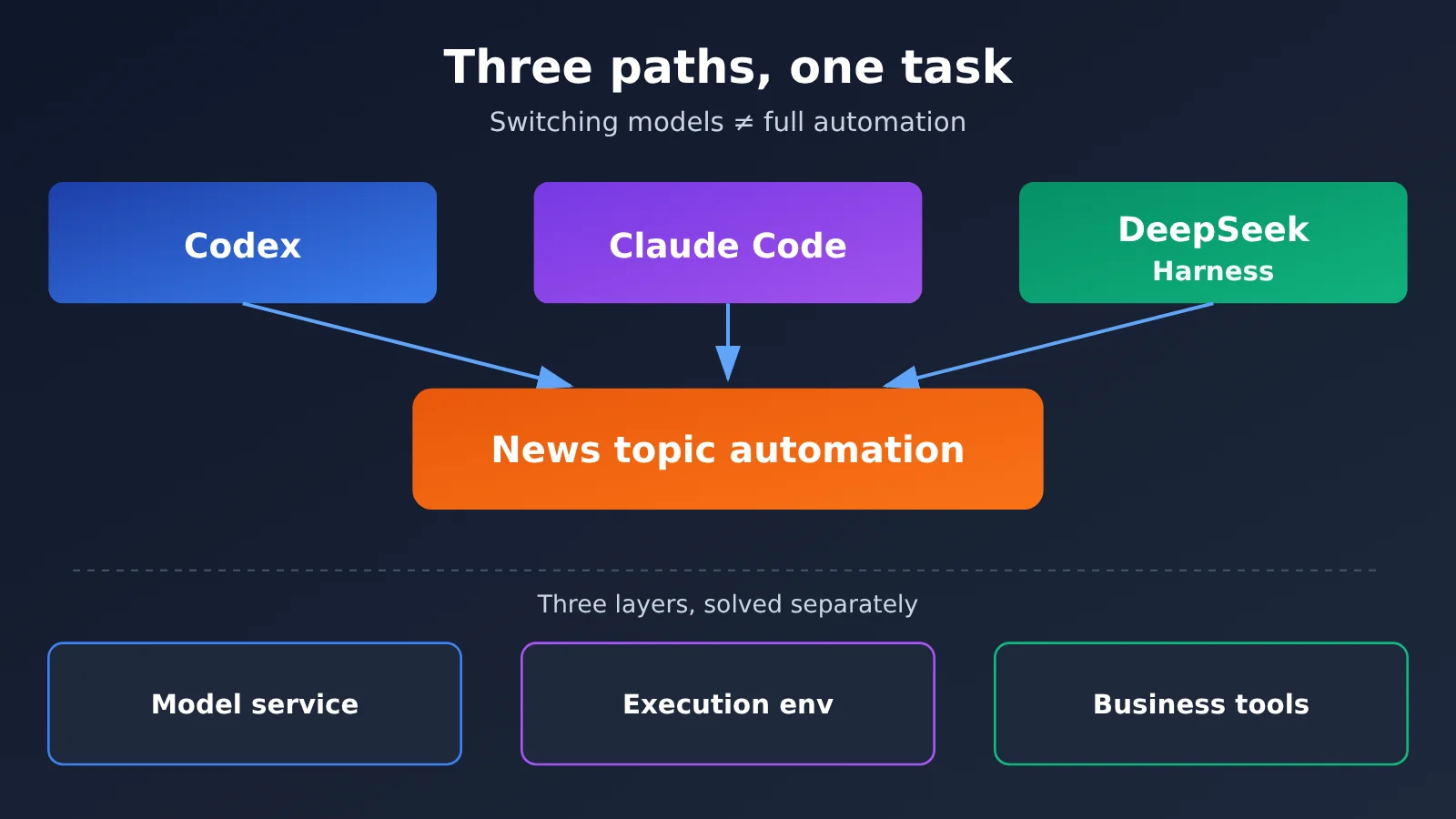
One-sentence summary: If you want to build a project directly, start by evaluating Codex or Claude Code; if you want to replace the model adapter, tools, and execution loop, focus on DeepSeek Harness; if you want it to run automatically every day, you’ll also need to solve deployment, permissions, and scheduling separately.
Changing the API endpoint doesn’t mean the whole Agent can switch models, operate a browser, and then automatically work for you every day. This isn’t a leaderboard ranked by feature count; it’s an integration guide built around the same task.
This article uses the same hypothetical task throughout: every morning, collect AI news, generate topic ideas and a research packet, then submit them to the company’s content backend. The capability comparison is based on the official materials provided, with information verified as of November 12, 2026; we did not run the same-task test across all three products, and product entry points and account entitlements still need to be confirmed against the actual version.
Understanding Codex, Claude Code, and DeepSeek Harness: Start by Getting These Terms Straight
The same “search for news and save topic ideas” task involves the model, the program, and business permissions at the same time. Put the terms back into the actual actions first, and the product differences will be easier to understand.
| Term | What it means in this task |
|---|---|
| API, API key | The API defines how a program calls the model or backend; the API key identifies and authorizes requests and should be kept secret |
| Base URL, model adapter | The former determines where requests are sent; the latter handles the request, response, and tool-calling formats of the model service |
| Tool calling, MCP | Tool calling lets the model request a search or draft submission; MCP is a protocol for connecting external tools and data services |
| SDK, Webhook | An SDK helps you manage the Agent inside your program; a Webhook lets external events send notifications or requests to your application |
| Agent Loop | The model proposes an action, the program executes the tool, then hands the result back to the model, repeating until the task ends |
| Cloud tasks, continuous scheduling | Cloud tasks run in a remote environment; continuous scheduling is responsible for starting them again at the scheduled time — these are not the same thing |
For example, the model can decide which piece of news is worth writing about, but the search tool is responsible for getting the source material, and the backend API is responsible for saving the draft. Without tool authorization, even if the model knows what to click, it can’t magically get into your company’s systems.
According to the platform’s public description, APIYI (apiyi.com) offers a unified API key, an OpenAI-compatible interface, and access to models such as OpenAI, Claude, and Gemini. It uses pay-as-you-go billing and has free trial credits for new users along with discounted pricing information. These are service descriptions at the model invocation layer — they are not Codex or Claude Code subscriptions, and they do not automatically provide browser access, file permissions, or a cloud execution environment.
Why Aren’t Codex, Claude Code, and DeepSeek Harness Simply the Same Kind of Product?
All three can take part in software development, but the most useful comparison isn’t whether they can write code. It’s which layer of the system you can modify. Codex and Claude Code make it easier to plug directly into a development workflow, while DeepSeek Harness emphasizes the replaceability of the runtime system itself.
| Comparison dimension | Codex | Claude Code | DeepSeek Harness |
|---|---|---|---|
| Openness | CLI is Apache-2.0; the Harness has been released, with hosted services counted separately | Commercial product; core engine source code is not open | Open source under MIT, Developer Preview |
| Model access | ChatGPT account or API key; billing paths need to be distinguished | Subscription, official API, and specified Provider | Replaceable model adapters |
| Tools and integrations | MCP, Plugins, SDK, App Server, etc. | MCP, Plugins, Hooks, Subagents, Agent SDK | Plugin system; tools and the agent loop can be modified |
| Execution environment | Local CLI and hosted Cloud are separate | Depends on the client, tools, and deployment method | You take on more of the assembly and deployment yourself |
| Model service validation | You can use APIYI apiyi.com separately to test model requests, but that doesn’t mean all three agents are directly compatible | Likewise, you need to verify the access protocol | You need to verify adapters and tool calls |
So you can’t reduce Codex to a closed-source finished product, and you shouldn’t interpret Claude Code’s extension interfaces as opening up its internal engine. DeepSeek Harness’s source code is more modifiable, but that doesn’t directly prove it’s safer or easier to maintain.
For news tasks, Codex or Claude Code can help build programs for search, organization, and submission. Beyond carrying out those steps, DeepSeek Harness also lets developers further adjust model invocation, session storage, tool execution, and the task loop—at the cost of more engineering responsibility.
Codex, Claude Code, DeepSeek Harness: What Should You Check Before Switching Models?
A Codex API key isn’t a universal entry point for any model
Codex supports account login and also API key access through configuration. Account login draws on the Codex usage included in the relevant plan, while the API key path is billed as API usage. The two shouldn’t be conflated.
But “supports API key” only means there’s an authentication path to a model service. Whether a given third-party endpoint can handle the corresponding message format, tool calls, and execution characteristics still needs to be checked against the specific configuration. You can’t draw conclusions from an API key or Base URL alone.
A third-party provider in Claude Code doesn’t mean you can swap in any model
The official Claude Code documentation lists access methods such as Anthropic Console, Amazon Bedrock, and Microsoft Foundry, and notes that some CLI and IDE clients support third-party provider configuration. Support can vary across different entry points.
The key distinction here is: choosing how a model service is provided isn’t the same as getting a universal adapter for any model. Even if text chat works, you still need to verify tool calls, context handling, and the capabilities the client depends on.
DeepSeek Harness model adapters can be replaced, but the URL is only one piece of it
The DeepSeek Harness architecture allows model adapters to be swapped. The DEEPSEEK_API_KEY and DEEPSEEK_BASE_URL in the developer docs are examples of DeepSeek adapter configuration; when no custom URL is set, the default service is used.
When connecting to another service, you also need to confirm the authentication method, message roles, tool parameters, and how tool results are passed. If these conventions don’t match, you need to adjust the adapter rather than keep trying different URLs.
Integration tip: First use APIYI at apiyi.com to verify ordinary requests and tool calls for the target model, then verify the specific Agent. Free trial credits, the model catalog, and pricing are subject to the platform’s current pages. Don’t treat platform descriptions as a guarantee of full Agent compatibility.
How Do Codex, Claude Code, and DeepSeek Harness Validate the Model API First?
The two snippets below are for independently validating the model service, not for installing or configuring these three products. The examples assume the environment already provides the OpenAI Python SDK, an API key, and a model identifier that the platform can currently invoke.
Minimal Request Before Connecting Codex, Claude Code, or DeepSeek Harness
import os
from openai import OpenAI

client = OpenAI(
    api_key=os.environ["MODEL_API_KEY"],
    base_url="https://api.apiyi.com/v1",
)
response = client.chat.completions.create(
    model=os.environ["MODEL_ID"],
    messages=[{"role": "user", "content": "给出一个 AI 新闻选题,注明待核实事项。"}],
)
print(response.choices[0].message.content)
This step only verifies authentication, the model identifier, and a basic message round-trip. It does not perform web search, so the output cannot be treated as verified breaking news, and it does not prove that the agent already has permissions for business tools.
Tool-Call Probe Before Connecting Codex, Claude Code, or DeepSeek Harness
import os
from openai import OpenAI

client = OpenAI(
    api_key=os.environ["MODEL_API_KEY"],
    base_url="https://api.apiyi.com/v1",
)
response = client.chat.completions.create(
    model=os.environ["MODEL_ID"],
    messages=[{
        "role": "user",
        "content": "请调用 save_draft,把标题“待核实的 AI 新闻”保存为草稿。"
    }],
    tools=[{
        "type": "function",
        "function": {
            "name": "save_draft",
            "description": "保存选题草稿",
            "parameters": {
                "type": "object",
                "properties": {"title": {"type": "string"}},
                "required": ["title"],
                "additionalProperties": False
            }
        }
    }],
)
message = response.choices[0].message
for call in message.tool_calls or []:
    print(call.function.name, call.function.arguments)
if not message.tool_calls:
    print("未返回工具调用,需要继续检查模型能力或请求配置。")
The code only prints the tool-call request; it does not actually save the draft. The absence of a returned tool call does not necessarily mean the model doesn’t support tools. You need to investigate using the response, platform documentation, and request configuration.
A real agent loop still needs to validate arguments, call business APIs, send tool results back, and set a maximum number of turns, timeouts, and approvals. Even after both probes pass, you should continue checking the streaming responses, multi-turn tool messages, and error handling that the actual agent requires.
Codex, Claude Code, and DeepSeek Harness: which one connects to business tools more flexibly?
For a news workflow, the most important extensions usually aren’t about “can it get online” — they’re about whether it can obtain trustworthy sources, save data field by field, and avoid duplicate submissions. Search, browser clicking, and desktop control are different capabilities, and none of them can substitute for another.
| Extension need | Codex | Claude Code | DeepSeek Harness |
|---|---|---|---|
| Connecting to business tools | MCP, Plugins, and more | MCP; can connect to databases and business services | Tool registry and plugins |
| Pre/post-execution checks | Hooks, SDK, and other approaches | Hooks; can inspect tool calls and task results | Customizable approval and execution components |
| Task division and session management | SDK and App Server manage tasks and sessions | Subagents can have independent context and tool permissions | Session and Agent Loop are replaceable |
| Embedding into your own software | SDK, App Server | Claude Agent SDK | SDK, lean runtime configurations, etc. |
| Browser operation | Depends on actual browser capabilities and authorization | Depends on Chrome and other environments plus authorization | Requires assembling and enabling an experimental browser provider |
Codex’s SDK and App Server are well suited to the question of “getting an Agent into your own application”: it’s not just submitting a prompt, you also need to handle sessions, events, and approvals. Claude Code’s Hooks and Subagents, on the other hand, are good for separating verification, research, and execution responsibilities — but extending those capabilities isn’t the same as modifying its core source code.
DeepSeek Harness can be modified more deeply, including session records, command execution backends, and the Agent Loop. Its browser service requires assembling dsh-browser-use and the matching provider, and those providers are experimental capabilities. Login state isn’t automatically restored from session logs, and browser actions that have already run can’t be undone by cancelling the task.
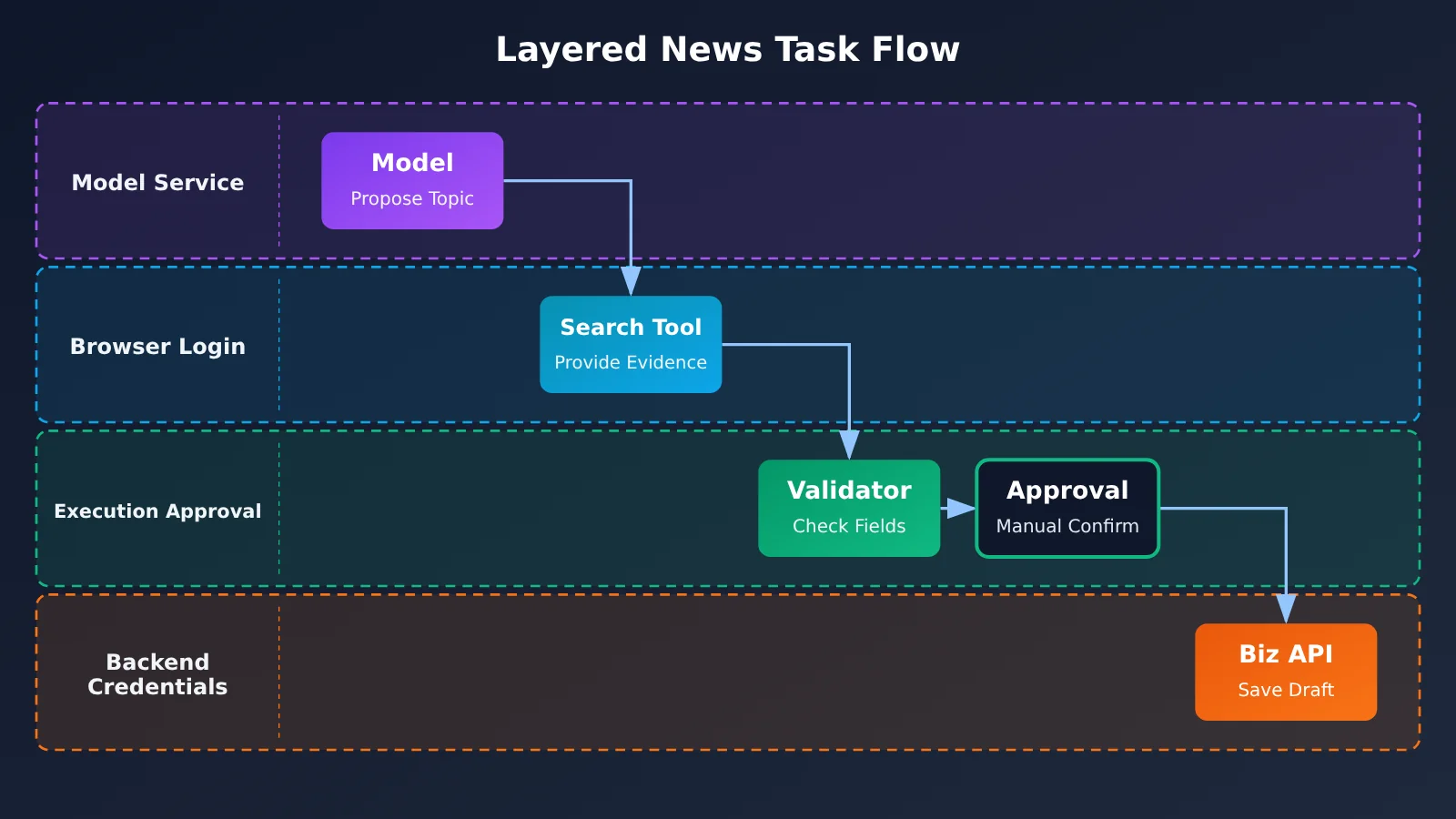
The model service in the diagram can be tested separately through APIYI apiyi.com first; the business backend, though, has to supply its own interface, credentials, and authorization. From an engineering standpoint, you’ll generally want to prefer a stable business API, and only evaluate browser automation when there really is no API available.
Codex, Claude Code, and DeepSeek Harness for automation — which one keeps running after you shut down?
“Running in the background” only means the task doesn’t occupy your current interactive interface — it doesn’t mean it’s been deployed to the cloud. And “the cloud completed a task once” doesn’t mean it’ll automatically start again every day.
| Execution mode | Codex | Claude Code | DeepSeek Harness |
|---|---|---|---|
| Local execution | CLI depends on the local environment | Local client depends on this machine and its tools | Local run depends on the process |
| Remote execution | Cloud provides a hosted remote environment | Specific entry point and remote deployment requirements still need confirmation | Can self-deploy a continuously running environment |
| Background tasks | Cloud, SDK, and other paths | Background Agent and other capabilities | Background Jobs; local backend depends on a running process |
| Daily trigger | Scheduling and environment must be put in place | Scheduled capability still requires verifying the entry point and runtime conditions | Scheduler component needs configuration; scheduled features should be verified carefully |
| External events | Handled through app integrations | Receives external events via MCP and similar | Webhook component can connect to automation systems |
Codex Cloud can keep executing a submitted remote task after your personal computer goes to sleep, but a remote workspace isn’t the same as your local machine. Code, dependencies, network, and credentials still have to be configured in the cloud environment.
Claude Code’s background Agent shouldn’t be broadly understood as continuing to run after shutdown. DeepSeek Harness’s local background jobs likewise depend on a running process; it does have Webhook and background components, but continuous scheduling still requires deployment, recovery, and monitoring.
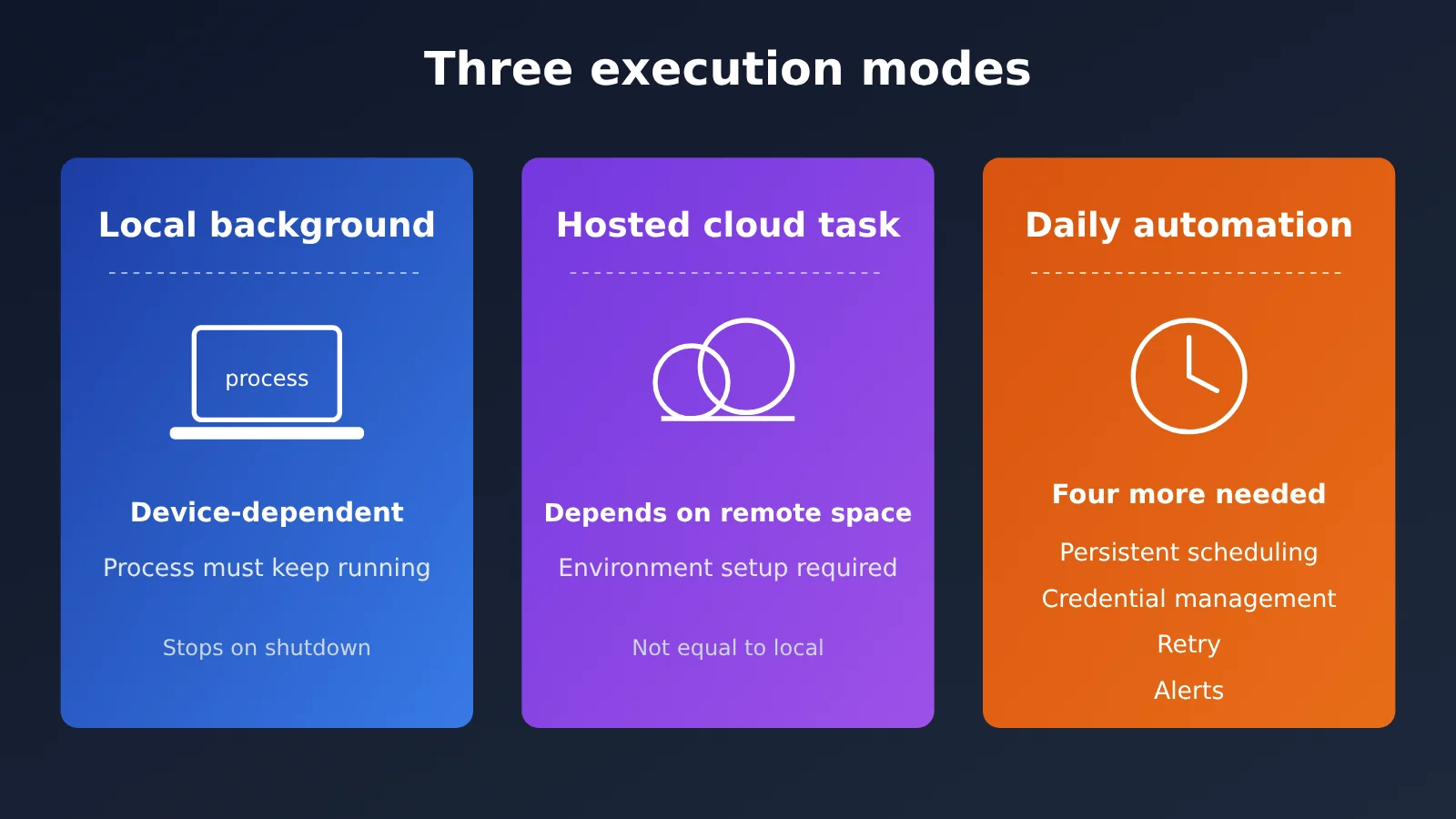
For news tasks, whether you can submit content after shutting down depends on whether the remote environment can access the company’s backend. Public websites, internal systems, and login states that exist only on your local machine should each be verified separately — you can’t promise it’ll connect on the first try.
How Do You Ultimately Choose Between Codex, Claude Code, and DeepSeek Harness?
| Your Primary Goal | What to Prioritize | What You Must Verify |
|---|---|---|
| Building a news pipeline quickly | Codex or Claude Code | Whether repositories, tests, and backend APIs work |
| Integrating into your own business software | Codex SDK / App Server, Claude Agent SDK, DeepSeek Harness SDK | Sessions, approvals, events, and error handling |
| Freely modifying the model and execution mechanism | DeepSeek Harness | Adapter compatibility and maintenance cost |
| Running after your personal computer shuts down | Codex Cloud or a self-hosted remote environment | Network, credentials, and scheduling conditions |
| Connecting to a production backend | First validate in an isolated test environment | Least privilege, duplicate submissions, and human review |
If your primary goal is shipping software rather than studying how an Agent works internally, starting with Codex or Claude Code better fits where the task is headed. You shouldn’t pick a winner between the two based on a feature list; instead, have them work on the same repository, the same backend API, and the same acceptance criteria.
If you have to replace the model adapter, the tool execution backend, and the Agent Loop, DeepSeek Harness is worth a closer look. But the official team labels it a Developer Preview and explicitly states that the security audit isn’t finished yet, so you shouldn’t treat it as production-safe software.
I’d suggest testing first in a disposable VM, container, or dedicated environment, restricting file, network, and credential permissions. Sandboxing and approvals can’t be your only line of defense when running untrusted tasks, and backend writes should start out limited to drafts.
Common Questions About Codex, Claude Code, and DeepSeek Harness
Do Codex and Claude Code get a product subscription just by connecting to an aggregated API?
No. Calling models through APIYI (apiyi.com) belongs to the model service layer, and you can’t infer subscription access for Codex or Claude Code from that. Whether the client supports this integration path also needs to be checked separately.
Can DeepSeek Harness fully switch models just by changing the Base URL?
Not guaranteed. You can first use APIYI (apiyi.com) as a request probe, then verify the adapter’s message protocol and tool calling. A successful plain-text request doesn’t mean full Agent feature compatibility.
Can Codex, Claude Code, and DeepSeek Harness automatically fill in a company admin panel?
If you have business APIs, or browser tools plus login and operation authorization, you can attempt it. The company admin panel in this article is a hypothetical scenario; actual access, filling, or saving results haven’t been verified.
DeepSeek Harness is open source, so why does it still need security validation?
Being able to inspect the source code doesn’t mean it has been audited for security. It can execute model-generated code and commands and may access authorized files, networks, and credentials, so you must restrict its permissions and run it in isolation.
How do you validate daily automation for Codex, Claude Code, and DeepSeek Harness?
At minimum, test the first run, repeated triggers, expired credentials, mid-run failures, and recovery after a process restart. For write operations, use unique task IDs to avoid duplicate drafts from retries, and keep a manual review entry point.
Which practical metrics should be compared for Codex, Claude Code, and DeepSeek Harness?
Record whether the task is completed, the number of manual interventions, error recovery, execution time, and actual usage. Keep model costs, tool costs, and runtime environment costs separate; you can’t derive the cost of the entire workflow from a single model call’s price.
Codex, Claude Code, and DeepSeek Harness: Key Points
- Product selection: First decide whether you’re building directly or modifying an existing runtime system.
- Model access: API keys and endpoints may be configurable, but that doesn’t mean the protocols are compatible.
- Tool permissions: Model reasoning can’t replace backend login and business authorization.
- Execution environment: Validate the local backend, cloud tasks, and continuous scheduling separately.
- Openness boundaries: Codex has publicly released its Harness; Claude Code’s core is not open source.
- Security responsibility: DeepSeek Harness allows deep customization, but also requires more maintenance.
Codex, Claude Code, and DeepSeek Harness Summary: Choose the Goal First, Then the Tool
If you’re building a news topic-selection pipeline directly, start by evaluating Codex or Claude Code. If you need to modify model adapters and execution mechanisms, focus on DeepSeek Harness. If it needs to run automatically every day, separately handle the remote environment, persistent scheduling, and failure recovery.
You can first validate the model invocation layer through APIYI apiyi.com, then validate business tools in an isolated environment, and finally connect to the real backend. The model determines reasoning capability; the Agent environment determines what can be invoked, how execution happens, and how results are delivered.
Codex, Claude Code, and DeepSeek Harness Reference Materials
Below is the index of official materials referenced in this article. The verification date doesn’t necessarily reflect the original publication date.
- Codex open source and platform integration:
developers.openai.com/blog/codex-as-a-platform. Helps distinguish between the Harness, SDK, App Server, and hosted service. - Codex Cloud:
help.openai.com/en/articles/20001545-using-codex-cloud. Covers the remote work environment and the boundaries of cloud tasks. - Claude Code integration methods:
code.claude.com/docs/en/getting-started. Covers the entry points for official and third-party providers. - Claude Code extension documentation:
code.claude.com/docs/en/mcp,code.claude.com/docs/en/hooks,code.claude.com/docs/en/sub-agents. Covers tool integration, checks, and division of labor. - DeepSeek Harness official repository:
github.com/deepseek-ai/deepseek-harness. Includes architecture, development, browser, and security documentation.
Author: APIYI technical team. For questions about model API integration, you can reach us at APIYI apiyi.com. Specific Agent compatibility is subject to the results of configuration verification.