
Author’s note: A footnote from Google says that once the introductory period ends on 2026-11-30, the public-facing Gemini 4 Carbon moves to $4 input and $20 output. Argon doesn’t appear anywhere in the terms. This article breaks down the original wording and checks it against current pricing.
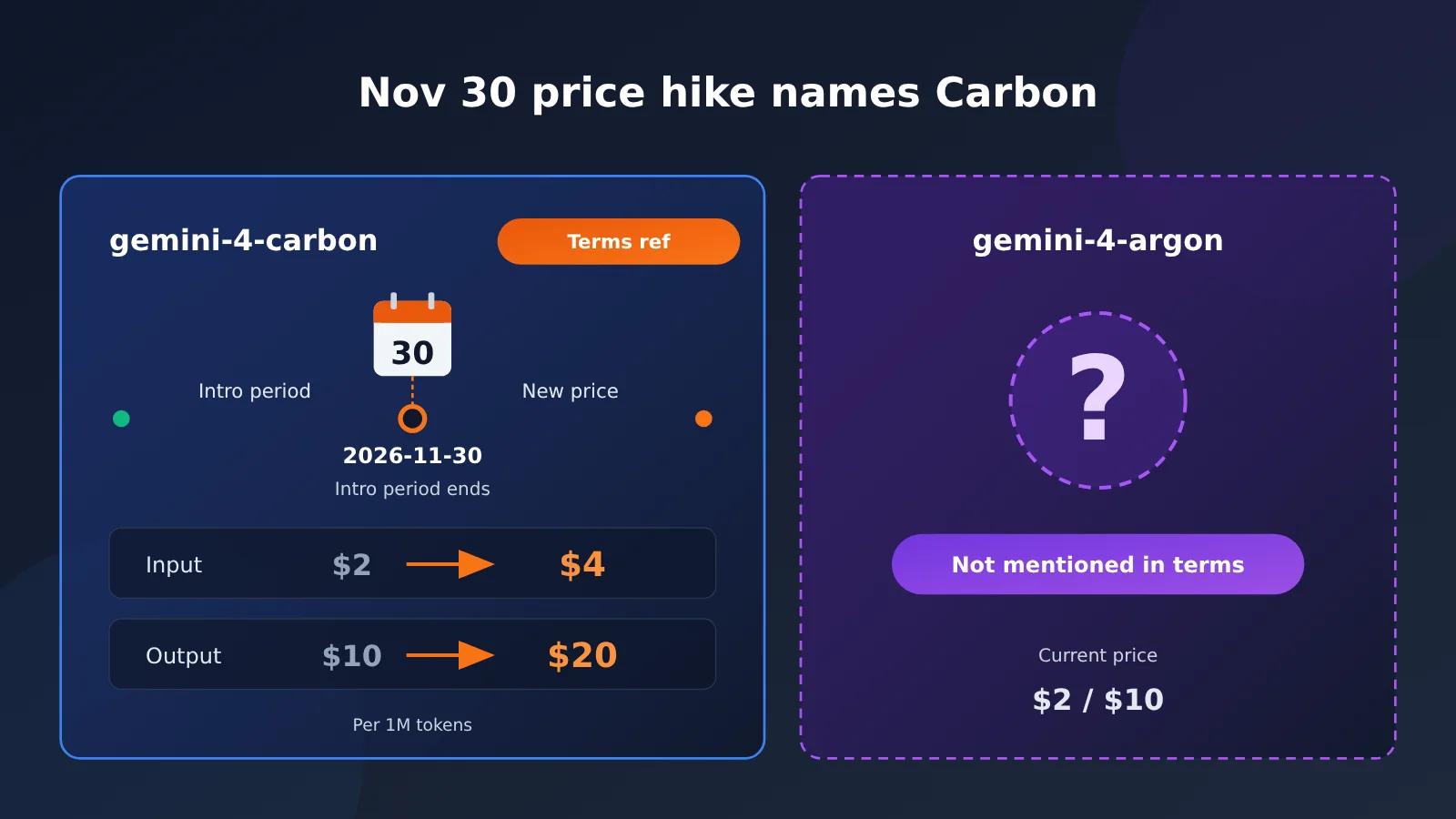
If your project uses both gemini-4-carbon and gemini-4-argon, you’ve probably run into the same question lately: which model does the November 30 price increase actually apply to? Short answer: the footnote in Google’s blog post, published on 2026-11-10, names the public-facing Carbon. After the introductory period ends, its price becomes $4 input and $20 output (per 1M tokens). The terms don’t mention Argon.
This isn’t a rumor. The information comes from the body and footnote of Google’s official blog post. We also won’t stretch it in the other direction: the terms not mentioning Argon only means it’s “not in the terms.” It doesn’t prove Argon “definitely won’t go up.” As of 2026-11-11, both models are still listed at $2 input and $10 output on the APIYI (apiyi.com) model price table, and the price table is the source of truth going forward.
Key takeaway: In 3 minutes, you’ll know which model the Carbon price increase covers, where Argon currently stands, and how to verify prices and plan your budget from here.
Key Details of the Carbon Price Increase
The table below pulls together everything in the official blog post that relates to pricing, so you can check it at a glance.
| Item | Details | Source |
|---|---|---|
| Publication date | 2026-11-10 | Google blog |
| What was announced | Gemini 4 Carbon opens to paid developers | Google blog body |
| Introductory price | Same as Gemini 4 Argon: $2 input, $10 output per 1M tokens | Google blog body |
| Introductory period ends | 2026-11-30 | Google blog footnote |
| Price after it ends | $4 input, $20 output per 1M tokens | Google blog footnote |
| Applies to | Public-facing Carbon models | Google blog footnote |
| Mentions an Argon price increase? | No | Not stated anywhere in the original terms |
How to Read the Original Carbon Pricing Terms
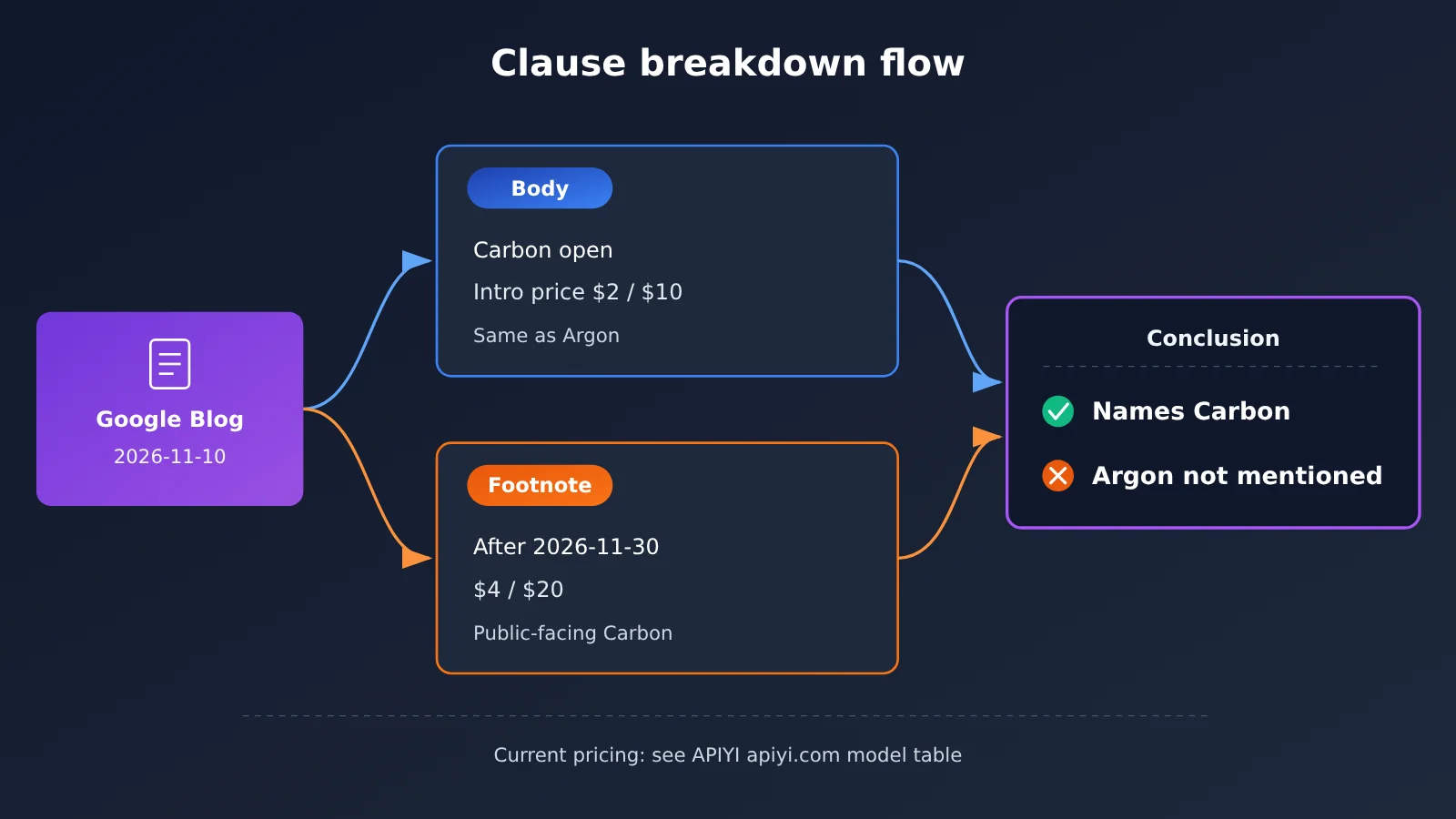
The key details in this announcement are split across two places. The body only states Carbon’s introductory price, and mentions in passing that this price is “the same as Gemini 4 Argon.” Argon shows up in the body as a price reference. The post never says Argon has an introductory period.
The price increase itself is in the footnote. The footnote gives the date (the introductory period ends on 2026-11-30), the new price ($4 input, $20 output), and the scope (public-facing Carbon models). All three items refer only to Carbon. In other words, across the body and the footnote combined, Argon appears exactly once, as a “price benchmark.”
| Where in the terms | Key point from the original | Model it refers to | What you can conclude |
|---|---|---|---|
| First sentence of the body | Carbon opens to paid developers | Carbon | Carbon is now available for paid use |
| Price sentence in the body | Introductory price matches Argon, $2 / $10 | Carbon (Argon is only a reference) | The two currently cost the same |
| Footnote date | Introductory period ends 2026-11-30 | Carbon | The increase has a clear date |
| Footnote price | $4 input, $20 output | Public-facing Carbon | Carbon’s price doubles after the period ends |
| Whole post | No Argon price change mentioned | — | You can’t tell where Argon pricing is headed from this |
What It Means That Argon Isn’t in the Carbon Price Increase Terms
“Not mentioned in the terms” and “confirmed not increasing” are two different things. The terms don’t mention Argon, so the safest reading is this: as of 2026-11-10, based on public information, Google hasn’t announced any price change for Argon. Whether Argon gets adjusted later, this announcement doesn’t say.
There’s one qualifier in the footnote worth noticing: “public-facing” Carbon models. That wording tells you the terms have a limited scope, but the announcement doesn’t explain what falls outside that scope, and this article won’t speculate about it. For budget planning, it’s enough to read it as “publicly available Carbon will be billed at $4 / $20 after the introductory period.”
There’s another detail people often ask about: the footnote lists only input and output prices, not cache reads. So you can’t infer Carbon’s cache read price after the introductory period from this footnote. When you need it, go by the official price list and the platform’s price list at that time.
Current Carbon vs. Argon Pricing (Data as of 2026-11-11)
The table below comes from the APIYI model overview at docs.apiyi.com/models, with data as of 2026-11-11. For now, the two models are identical in pricing, endpoints, and groups.
| Model ID | Input (per 1M tokens) | Output (per 1M tokens) | Cache Read (per 1M tokens) | Endpoints | Groups | Available Platforms |
|---|---|---|---|---|---|---|
gemini-4-argon |
$2 | $10 | $0.1 | chat, gemini | Default, SVIP | APIYI apiyi.com, Google official |
gemini-4-carbon |
$2 | $10 | $0.1 | chat, gemini | Default, SVIP | APIYI apiyi.com, Google official |
One thing to be clear about: the Google footnote describes Google’s own pricing. APIYI’s current price list still shows the numbers in the table above, and the platform hasn’t announced a price increase. For how the platform adjusts after December, go by the numbers in the apiyi.com model overview at that time, and don’t apply the footnote’s prices ahead of schedule.
🎯 Technical tip: If you’re running both models in a project, check the APIYI apiyi.com model overview once a week and verify the input, output, and cache read prices on the
gemini-4-carbonandgemini-4-argonrows. A single key lets you switch between the two models, so adjusting is cheap when prices change.
How the Carbon Price Increase Affects Developers
Impact on Developers
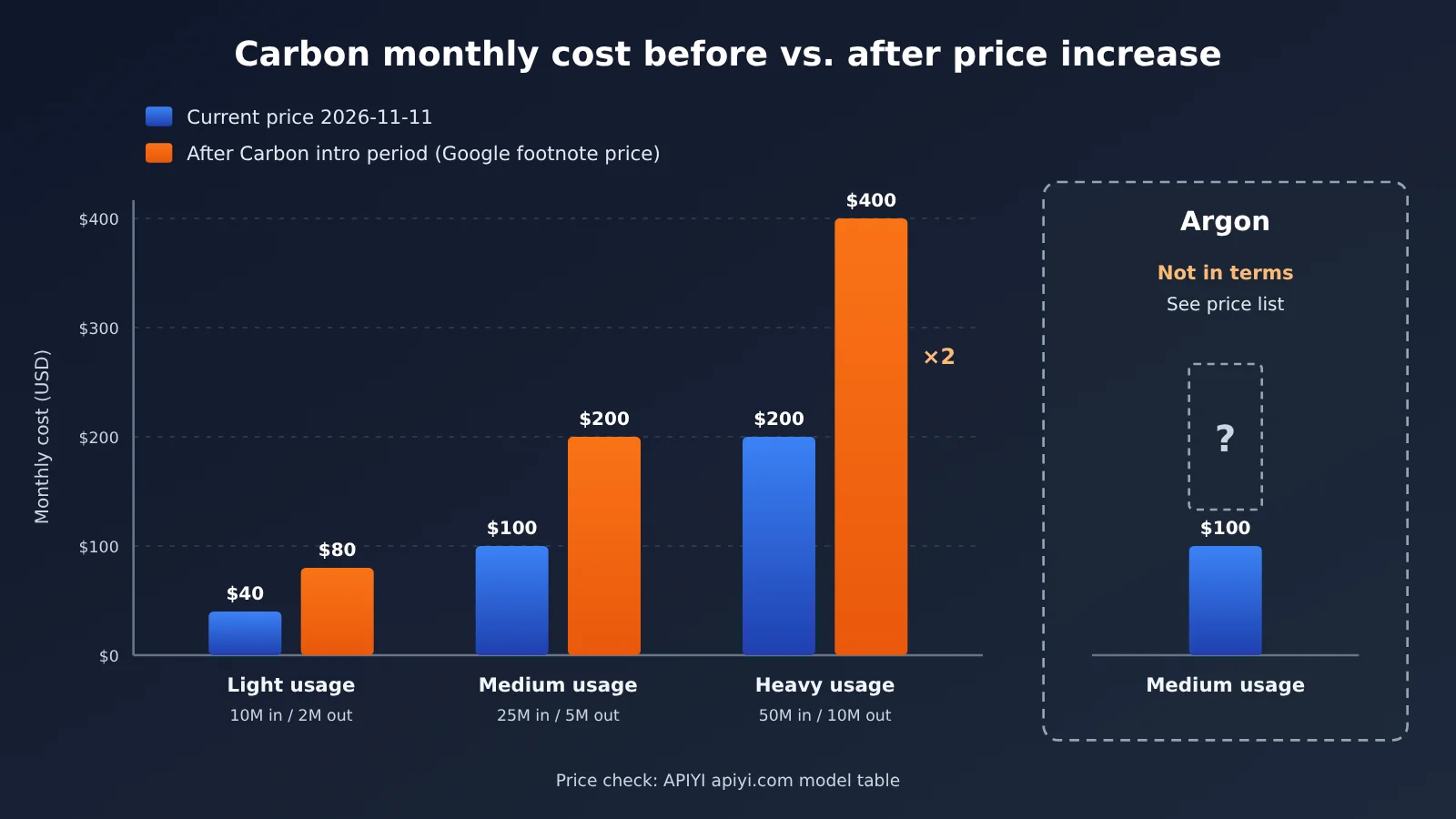
The most immediate change is cost. Going by the footnote pricing, both input and output prices for Carbon will double once the introductory period ends. The table below is a quick estimate, based on simple usage profiles, that you can check against the docs. It counts only input and output tokens, not cache reads:
| Scenario (monthly usage) | Current price (2026-11-11) | Carbon after intro period (Google footnote price) | Argon after intro period |
|---|---|---|---|
| 1M input + 1M output tokens | $2 + $10 = $12 | $4 + $20 = $24 | Not specified in the terms; check the price list |
| 10M input + 2M output tokens | $20 + $20 = $40 | $40 + $40 = $80 | Not specified in the terms; check the price list |
| 50M input + 10M output tokens | $100 + $100 = $200 | $200 + $200 = $400 | Not specified in the terms; check the price list |
A few practical takeaways from the table:
- Budget for the doubling now: After November 30, Carbon calls billed at Google’s pricing will cost twice as much, so you’ll need to update your monthly billing projections and your per-request cost models.
- Weigh both quality and price when picking a model: Right now the two models cost the same, so the choice mostly comes down to output quality. Once Carbon’s price goes up, you’ll want to re-compare cost-effectiveness if Argon’s price stays put. That only holds if Argon’s pricing really doesn’t change by then.
- Make your routing logic configurable: Treat the model ID as a config value instead of hardcoding it. That way, switching between
gemini-4-carbonandgemini-4-argonis a one-line config change.
Connecting and Switching Models
Both models support the chat and gemini endpoints on APIYI. If you’re calling them through the OpenAI-compatible interface, you only need three settings:
- Endpoint base_url:
https://api.apiyi.com/v1(APIYI’s OpenAI-compatible endpoint) - Model ID:
gemini-4-carbonorgemini-4-argon - Authentication: an API key created in the apiyi.com console
To use the native Gemini format, pick the gemini endpoint. The model ID stays the same. As for groups, both models are available under the Default and SVIP groups. Which one you use depends on how your account is set up.
🚀 Quick Start: Set base_url to
https://api.apiyi.com/v1and the model ID togemini-4-carbon, and your existing OpenAI SDK will work as is. To compare against Argon, just change the model ID togemini-4-argon. New users can claim free test credits at APIYI (apiyi.com) and run both models before the price increase.
Model ID Lookup and Troubleshooting Cheat Sheet
When you switch models, most problems come from a wrong model ID or the wrong endpoint. This table lists what to check, organized by symptom:
| Symptom | Likely Cause | How to Check |
|---|---|---|
| Error says the model doesn’t exist or isn’t available | Typo in the model ID, such as a missing gemini-4- prefix |
Copy the model ID exactly as listed at docs.apiyi.com/models |
| Request format rejected | An OpenAI-compatible request was sent to the native endpoint, or vice versa | Confirm whether you’re using the chat endpoint or the gemini endpoint |
| Group has no permission | Your current group isn’t Default or SVIP | Check which group your key belongs to in the apiyi.com console |
| Billed unit price doesn’t match expectations | Google’s footnote price was applied to the platform’s price list | Go by the current day’s prices in the APIYI model price table |
Impact on the Industry
- Introductory pricing is getting more common: A new model launches at the same price as the older one, then moves to its official price on a fixed date. This puts more pressure on developers to read the footnotes and check the dates.
- Same price doesn’t mean same fate: Carbon and Argon cost the same today, but the announcement only gives a price-increase date for Carbon. Cost planning needs to be checked model by model. Don’t assume the whole “series” behaves the same way.
Carbon Price Increase FAQ
Q1: Which model is getting the November 30 price increase, Carbon or Argon?
The footnote on Google’s blog names the public-facing Carbon. After the introductory period ends on 2026-11-30, pricing becomes $4 for input and $20 for output (per 1M tokens). The terms don’t mention Argon.
Q2: The terms don’t mention Argon. Does that mean Argon won’t go up?
You can’t conclude that. The terms only show that no Argon price change has been announced so far. They don’t promise Argon won’t increase. We recommend checking the official price list regularly, along with the price of `gemini-4-argon` in the APIYI apiyi.com model table.
Q3: How much does each model cost right now through APIYI?
As of 2026-11-11, the APIYI model table shows `gemini-4-carbon` and `gemini-4-argon` both at $2 for input, $10 for output, and $0.1 for cache reads (per 1M tokens). The platform hasn’t announced a price increase yet, so go by the price list going forward.
Q4: What will Carbon’s cache read price be after the introductory period ends?
Google’s footnote only gives $4 for input and $20 for output. It doesn’t mention cache reads. You can’t work out the cache read price from this term, so check the official price list and the platform price list when the time comes.
Q5: How can I quickly compare Carbon and Argon before the price increase?
Here are the steps:
1. Sign up at APIYI apiyi.com and claim your free test credit
2. Set base_url to `https://api.apiyi.com/v1`
3. Call `gemini-4-carbon` and `gemini-4-argon` with the same set of prompts, then compare output quality and token usage
Both models sit under the same key, so switching only requires changing the model ID.
Q6: What’s still uncertain about this information?
There are three main points: Argon’s future pricing hasn’t been published; Carbon’s cache read price after the introductory period isn’t specified; and the announcement doesn’t explain exactly where the boundary of the qualifier “public-facing” lies. Treat all of these as subject to later official announcements and price lists.
Carbon Price Increase Clause: Key Takeaways
- Who’s named: Google’s footnote only names the public-facing Carbon. Argon isn’t mentioned in the terms.
- Timeline: The introductory period ends on 2026-11-30, after which Carbon is billed at the new price.
- New pricing: Carbon will cost $4 per 1M input tokens and $20 per 1M output tokens, twice the introductory price.
- Argon’s status: Not being in the terms doesn’t mean it won’t go up. Keep an eye on the price list.
- Current pricing: As of 2026-11-11, both models on APIYI are priced at $2 / $10 / $0.1 for cache reads.
- How to get started: Use a single key on APIYI (apiyi.com) to switch between the two model IDs and compare results ahead of time.
Summary
Here are the main points on the Carbon price increase clause:
- The clause names Carbon: Once the introductory period ends on 2026-11-30, the public-facing Carbon goes up to $4 for input and $20 for output.
- Argon isn’t mentioned: That only means no price increase has been announced. Don’t treat it as a promise that the price won’t change.
- Both models cost the same today: As of 2026-11-11, the platform lists both at $2 input, $10 output, and $0.1 for cache reads. Go by the price list from here on.
Before November 30, we’d suggest making the model ID a configurable setting, updating your cost estimates, and setting aside some time to run both models on your own business data. We recommend using APIYI (apiyi.com) to test gemini-4-carbon and gemini-4-argon with a single key, then adjusting your routing based on the model comparison table when prices change.
📚 References
- Google Blog – Gemini 4 Carbon now available: The Carbon launch announcement and the introductory pricing footnote (2026-11-10)
- Link:
blog.google/innovation-and-ai/models-and-research/gemini-models/gemini-4-carbon-now-available -
Notes: The original source for the price increase date, the new pricing, and its scope
-
APIYI Model Directory: Pricing, endpoints, and groups for
gemini-4-carbonandgemini-4-argon(2026-11-11) - Link:
docs.apiyi.com/models - Notes: Where to check the platform’s current pricing and model IDs
Author: APIYI Technical Team
Technical discussion: Feel free to reach out to us on the APIYI apiyi.com homepage. For more model and pricing information, visit the docs.apiyi.com documentation center.