
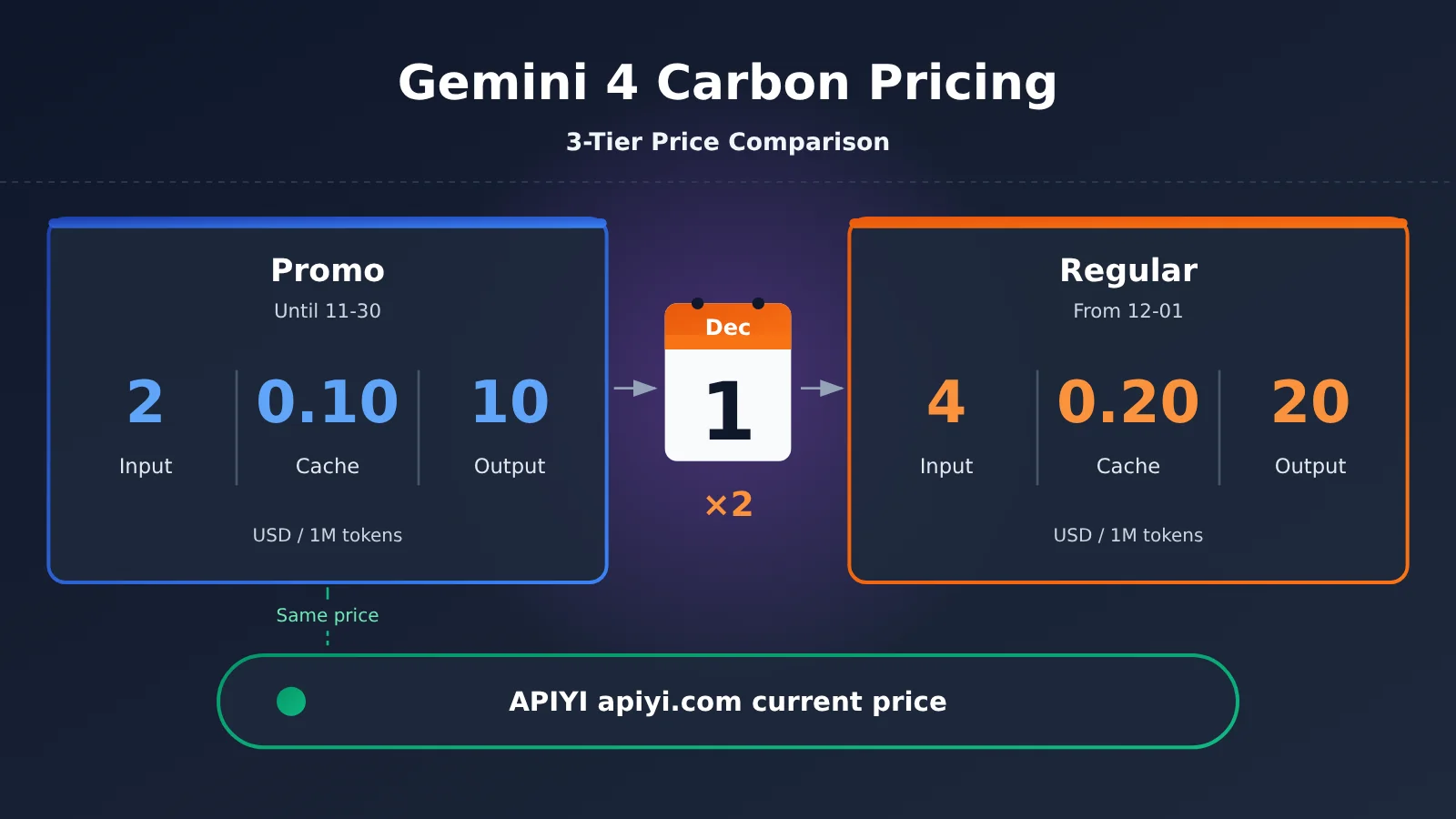
Through 2026-11-30, Gemini 4 Carbon’s official global price is $2 input, $0.10 cached read, and $10 output per 1M tokens. APIYI’s gemini-4-carbon listing on 2026-11-11 matches that. On 2026-12-01, the official global price doubles to $4 input, $0.20 cached, $20 output, so a budget you built in November can’t simply carry over to December.
This isn’t a rumor. Google announced Carbon’s availability to paid developers on its official blog on 2026-11-10. The Gemini API changelog recorded gemini-4-carbon as generally available (GA) the same day, and both the Google Cloud and AI Studio pricing pages already list the two price tiers. This article is only about money: the current price, the price from December 1, how caching is billed, whether it’s expensive compared with similar models, and which tier APIYI (apiyi.com) is listing today.
What you’ll get: a three-column price table (official global promotional price, official price from December 1, and APIYI’s 2026-11-11 listed price), plus an explanation of why the same unit price doesn’t always add up to the same bill.
Gemini 4 Carbon Pricing: The Key Facts at a Glance
Gemini 4 Carbon (model ID gemini-4-carbon) is built on Gemini 4 Argon. Google officially calls it its most capable model to date, aimed at the hardest tasks, like complex multi-step coding and debugging and open-ended scientific research. The October 28 announcement only covered a select group of cybersecurity defenders. It wasn’t until November 10 that it opened up fully to paid developers, enterprises, and consumers.
| Item | Details |
|---|---|
| Release date | 2026-10-28 initial launch (limited scope), 2026-11-10 full availability and GA |
| Publisher | Google / Google DeepMind |
| Input / output modalities | Input: text, images, audio, video; output: text only |
| Context | Input, thinking, and output share a 1M token window; default synchronous output cap is 65,536 |
| Official pricing (global, through 11-30) | Input $2 / cached $0.10 / output $10 per 1M tokens |
| Official pricing (global, from 12-01) | Input $4 / cached $0.20 / output $20 per 1M tokens |
| APIYI listed price (2026-11-11) | Input $2 / cache read $0.10 / output $10, now available |
There’s one easy-to-miss detail beyond the headline prices. The official pricing page states that output pricing includes both the answer and reasoning tokens, and Google also notes that Carbon spends more thinking tokens than Argon. So while the per-token price is the same for both models, a single task on Carbon will usually cost more. We’ll work through that math separately later in the article.
Gemini 4 Carbon Official Pricing: Through November 30 vs. From December 1
The three-column table below is the main takeaway of this article. The first two columns come from the Google Cloud and AI Studio pricing pages (checked 2026-11-11). The third column comes from APIYI’s live pricing endpoint as of 2026-11-11.
| Billing item (USD / 1M tokens) | Official global promo price (through 11-30) | Official global price (from 12-01) | APIYI list price (2026-11-11) |
|---|---|---|---|
| Input (text, image, video, audio) | 2.00 | 4.00 | 2.00 |
| Cached input / cache read | 0.10 | 0.20 | 0.10 |
| Output (including reasoning tokens) | 10.00 | 20.00 | 10.00 |
| Cache write | Not billed separately (implicit caching) | Not billed separately (implicit caching) | No separate cache write field |
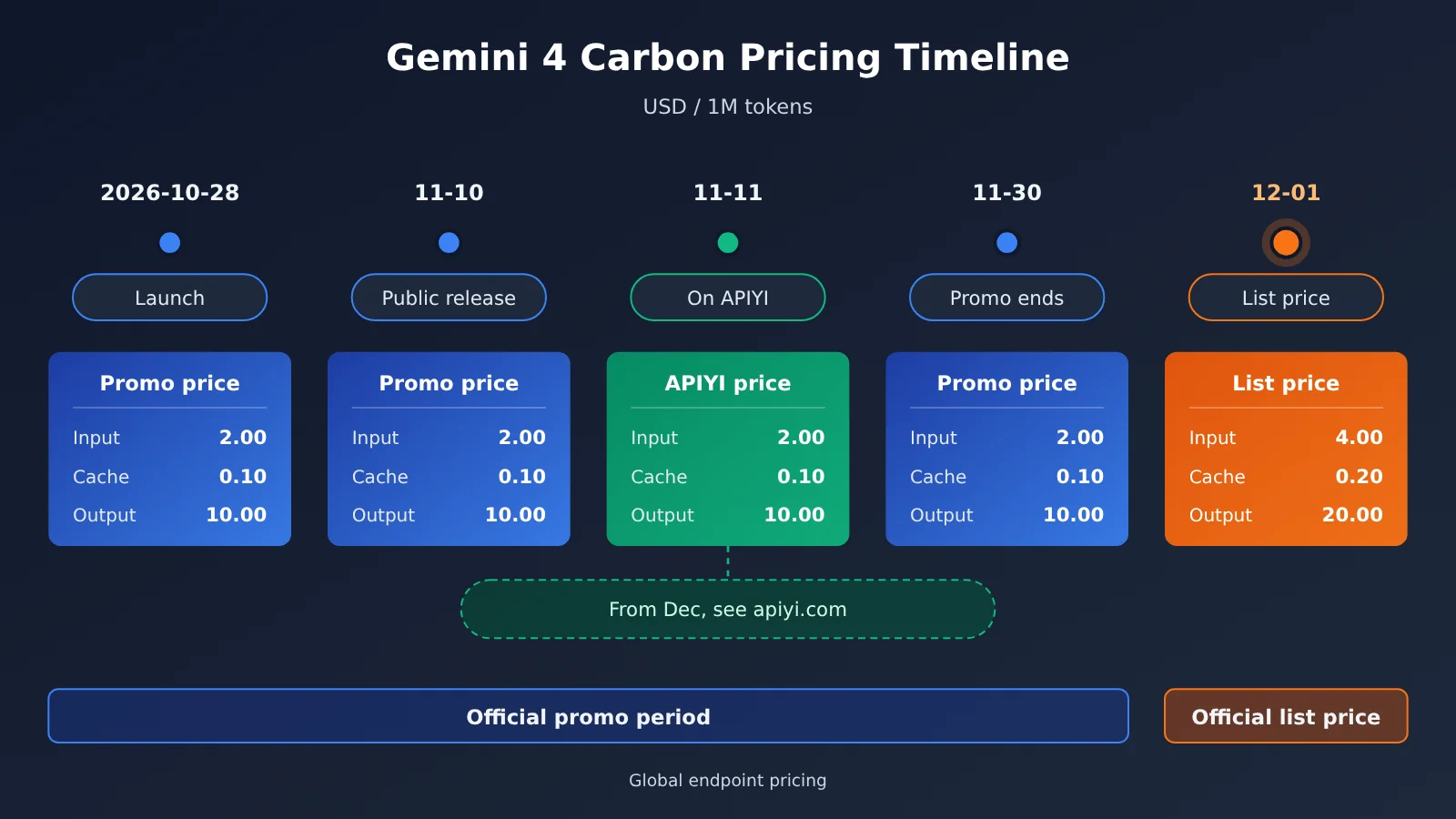
The key date in the diagram is December 1. That’s when the official pricing switches to 4 / 0.20 / 20. Whether APIYI adjusts its prices at that point depends on the platform’s listing that day, and this article doesn’t try to predict it.
Gemini 4 Carbon: Global vs. Non-Global Pricing
Google Cloud splits pricing into “global” and “non-global” endpoints, and non-global runs about 10% higher. Through November 30, non-global pricing is $2.20 for input, $0.11 for cached input, and $11 for output. From December 1, it’s $4.40 for input, $0.22 for cached input, and $22 for output. If your Vertex project is pinned to a specific region because of data residency requirements, base your budget on the non-global column.
Gemini 4 Carbon Cyber Permissive Isn’t Part of the Promo
The pricing page also lists a separate variant, Gemini 4 Carbon Cyber Permissive. It doesn’t get the promo price, and it’s billed at the December 1 rate starting now: 4 / 0.20 / 20 for global, and 4.40 / 0.22 / 22 for non-global. This variant is tied to the Fairwind Program (for verified cybersecurity defenders). You can’t get it just by swapping the model name to gemini-4-carbon, so the $2 promo price doesn’t apply to it either.
How Gemini 4 Carbon Caching Is Billed
Carbon uses implicit caching, which is on automatically. Cache hits are billed at 5% of the input price, a 95% discount. That makes cache reads $0.10 during the promotional period and $0.20 starting December 1. Google’s developer guide is explicit: don’t create or pass an explicit cached_content anymore. When you migrate old code, remove that logic.
Moving from Argon to Carbon should only require changing the model name, since thinking_level and the 1M window are the same. But a few things affect cost and stability, so keep these in mind:
thinking_budgetis deprecated and you’ll get a warning if you pass it. Usethinking_level(low / medium / high, default medium) to control thinking depth.- Custom
temperature,top_p, andtop_kvalues are ignored with a warning. - Hard problems can run for several minutes, so set your client timeout to at least 15 to 20 minutes, or use
background=Trueon the Interactions API. - The
highlevel produces more thinking tokens, so output costs go up noticeably. For classification and routing tasks,lowis cheaper.
💡 Integration tip: When calling Carbon through APIYI (apiyi.com) with the OpenAI-compatible approach, set base_url to
https://api.apiyi.com/v1, usegemini-4-carbonas the model name, and send requests to/v1/chat/completions. You can also use the native Gemini/v1betaendpoint. Caching hits automatically either way, so no extra parameters are needed.
Gemini 4 Carbon Pricing on APIYI
The pricing endpoint APIYI pulled on 2026-11-11 already includes a gemini-4-carbon row, so the model is now listed. The snapshot in the docs summary table was taken at 2026-11-10 15:40 (UTC+8), which was before Google’s public release, so the row wasn’t there yet. If the summary table still hasn’t refreshed when you open it, go by the console and the pricing endpoint. Model names and prices follow the platform’s model list.
APIYI uses the same conversion rules as the Argon, Opus, and Astra models already priced in the docs: input price in USD = model_ratio × 2; output = input × completion_ratio; cache read = input × cache_ratio; group multipliers are applied separately.
| Item | gemini-4-carbon value on APIYI |
|---|---|
| model_ratio | 1 → $2 input / 1M |
| completion_ratio | 5 → $10 output / 1M |
| cache_ratio | 0.05 → $0.10 cache read / 1M |
| Cache write | No separate field |
| Groups and multipliers | default (1), svip (1) |
| Endpoints | gemini (/v1beta native), openai (/v1/chat/completions) |
APIYI top-ups use a fixed 1:7 exchange rate, and you can stack them with top-up bonuses and group discounts. The actual charge is whatever the console shows. All prices in this article are default list prices, not discounted prices.
Is Gemini 4 Carbon Expensive Compared to Argon, Opus 5.5, and Astra?
Going by list price alone, Carbon and Argon cost exactly the same, Carbon is half the price of Claude Opus 5.5, and it’s far cheaper than GPT-6 Astra. The table below shows each model’s default-group list price on APIYI. The Opus 5.5 and Astra numbers also match their official prices.
| Model (APIYI list price, USD / 1M) | Input | Output | Cache Read | Cache Write | Endpoints |
|---|---|---|---|---|---|
| gemini-4-carbon | 2 | 10 | 0.10 | No separate field | gemini, openai |
| gemini-4-argon | 2 | 10 | 0.10 | No separate field | gemini, openai |
| claude-opus-5-5 | 4 | 20 | 0.20 | 5 | anthropic, openai |
| gpt-6-astra (≤272K) | 10 | 50 | 1 | 12.5 | openai |
| gpt-6-astra (272K–1.05M) | 20 | 75 | 2 | 25 | openai |
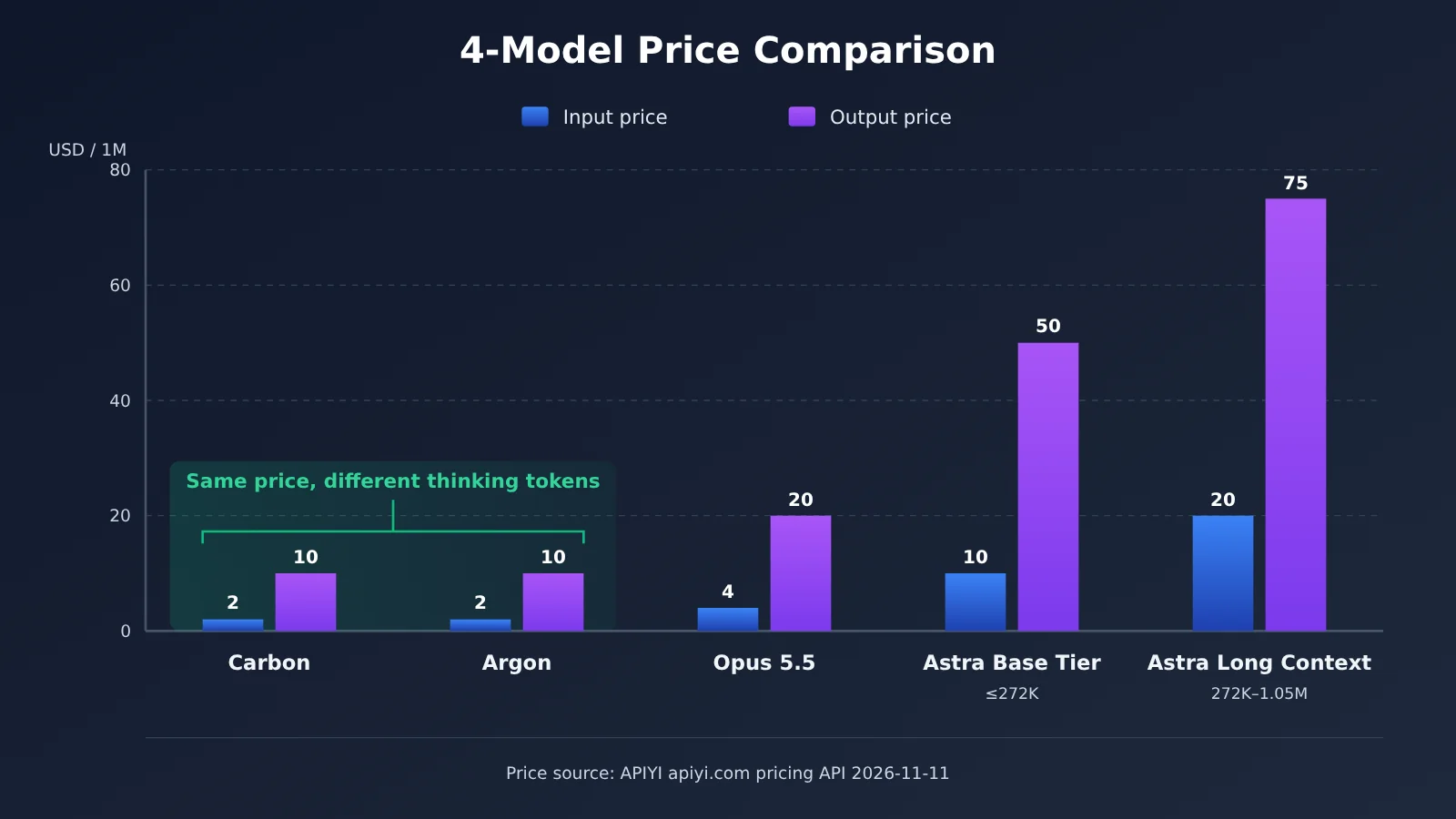
A few notes on how they compare:
- Argon: The unit prices are identical, but Google says plainly that Argon’s tokens are tighter and its interactions are faster. Keep using Argon for most software engineering and knowledge work, and save Carbon for the hardest tasks, like multi-step engineering, architecture audits, and scientific reasoning.
- Opus 5.5: The official price is 4 / 20, with cache reads at 0.20 and 5-minute cache writes at $5. After December 1, Carbon’s official website price matches Opus’s input and output unit prices, but Opus adds a cache write fee. Opus also has other groups on APIYI, such as ClaudeCode, each with a different multiplier. This article only counts the default group.
- Astra: The base tier is 10 / 50, roughly 5x Carbon’s promotional price. When a single request’s input exceeds 272K, the whole request moves into the long-context tier, where output is 75 rather than 100.
🎯 Pick the right model: Unit price is only a starting point. What actually drives your bill is how many thinking tokens a task burns. We’d suggest using a single key on APIYI (apiyi.com) to run the same batch of real tasks through Carbon, Argon, and Opus 5.5, then comparing the actual charges in the console before you decide.
How to Calculate the Bill for Gemini 4 Carbon (Estimated from List Prices)
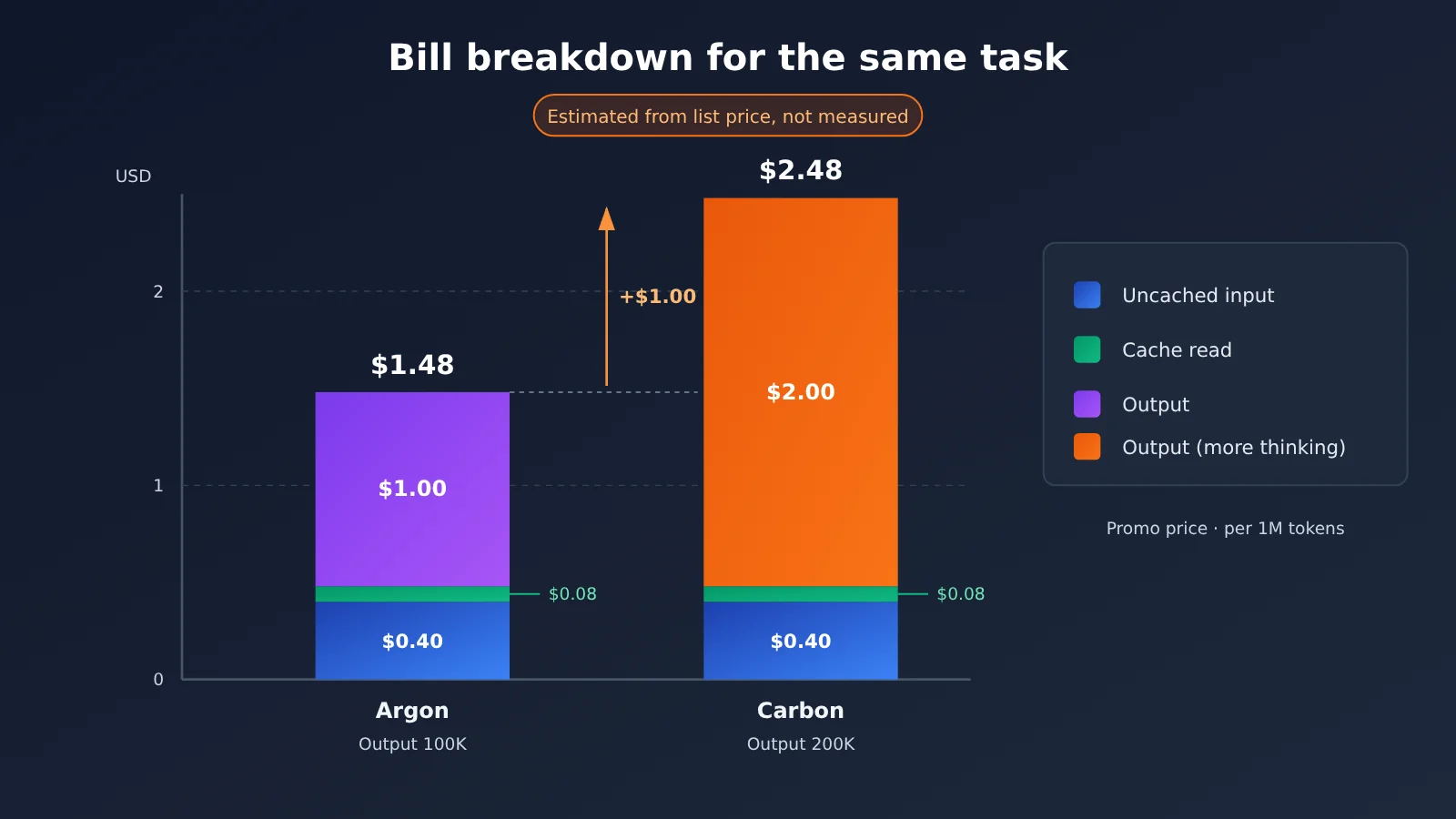
The examples below are estimated from list prices, not measured bills. Assume 1 million cumulative input tokens, 800K of which hit the cache, plus 100K output tokens, spread across multiple requests with each one staying under 272K.
Gemini 4 Carbon promotional pricing (current list price on the official global site and APIYI):
- Uncached input:
200,000 × 2 / 1,000,000 = 0.40USD - Cache hits:
800,000 × 0.10 / 1,000,000 = 0.08USD - Output (including reasoning):
100,000 × 10 / 1,000,000 = 1.00USD - Total:
0.40 + 0.08 + 1.00 = 1.48USD
Here’s how the same usage looks on other pricing tiers:
| Model / Pricing Tier | Uncached Input | Cache Read | Output | Total (USD) |
|---|---|---|---|---|
| Carbon / Argon promotional price | 0.40 | 0.08 | 1.00 | 1.48 |
| Carbon global price from 12-01 on the official site | 0.80 | 0.16 | 2.00 | 2.96 |
| Opus 5.5 (excluding cache writes) | 0.80 | 0.16 | 2.00 | 2.96 |
| Astra base tier (excluding cache writes) | 2.00 | 0.80 | 5.00 | 7.80 |
Opus and Astra also charge a separate fee the first time you write to the cache, so the actual amounts will be higher than the numbers in the table. If the 1 million input tokens were sent in a single request, Astra would move into its long-context tier, and the same usage would cost about 0.2×20 + 0.8×2 + 0.1×75 = 13.10 USD.
Don’t treat this example as an actual bill. The output price includes reasoning tokens, and Carbon burns more thinking tokens than Argon does. If Carbon’s output side grows to 200K tokens on the same task, the promotional total climbs to about 2.48 USD, noticeably higher than Argon’s 1.48 USD. So “same unit price” doesn’t mean “same bill,” and your thinking_level choice has a big impact on cost.
Impact of the Gemini 4 Carbon Price Change
Impact on Developer Budgets
- November is a low-cost validation window: Through November 30, both the official site and APIYI are at 2 / 0.10 / 10. That’s a good time to run real tasks, measure Carbon’s average thinking tokens, and set a baseline for your December budget.
- Official costs double starting in December: The same usage goes from $1.48 to $2.96. Whether APIYI adjusts its pricing depends on the listing on December 1, so check apiyi.com then before updating your budget sheet.
- Cache hit rate matters a lot: Uncached input costs 20x as much as a cache read. Put fixed prefixes like the system prompt and long documents at the start of the request, and you’re more likely to get implicit cache hits.
Impact on Model Selection
- Argon is still the default choice: It has the same unit price, uses fewer tokens, and runs faster.
- Carbon suits a small number of high-difficulty tasks: Think multi-file root cause analysis, architecture audits, and long-context retrieval. The official model card (as of October 2026) shows Carbon leading on long-context benchmarks like GraphWalks. But Opus 5.5 tops OSWorld-2.1 and Astra tops FrontierSWE 2, so Carbon isn’t first on every benchmark.
- The protocol affects your choice too: Carbon uses the native Gemini or OpenAI-compatible interface, not Anthropic messages. If your project is already in the Claude Code ecosystem, you’ll want to evaluate the switching cost separately.
Frequently Asked Questions (FAQ)
Q1: How much does Gemini 4 Carbon cost per million tokens right now?
Through 2026-11-30, the official global pricing is $2 for input, $0.10 for cached reads, and $10 for output. Non-global pricing is 2.20 / 0.11 / 11. Starting 2026-12-01, global pricing becomes 4 / 0.20 / 20, and non-global becomes 4.40 / 0.22 / 22.
Q2: Gemini 4 Carbon and Argon cost the same, so why are the bills different?
Output pricing includes reasoning tokens, and Google says Carbon spends more thinking tokens than Argon to explore hypotheses and run longer verification loops. The unit price is the same, but the consumption isn’t. For everyday tasks, staying on Argon is usually cheaper.
Q3: What’s the price of gemini-4-carbon on APIYI? Will it go up in December?
As of 2026-11-11, APIYI lists it at $2 input, $10 output, and $0.10 cached read per 1M tokens. The multiplier is 1 for both the default and svip groups, and the model is already available. Whether APIYI adjusts its pricing after the official increase on December 1 depends on what the model list on apiyi.com shows that day. No adjustment has been confirmed so far.
Q4: How do I call Gemini 4 Carbon quickly through APIYI?
1. Sign up at APIYI (apiyi.com) and get your API key. New users get free test credits.
2. For the OpenAI-compatible approach, set base_url to `https://api.apiyi.com/v1` and use `gemini-4-carbon` as the model.
3. You can also use the native Gemini `/v1beta` endpoint. Don’t pass `cached_content`, since caching hits automatically.
Q5: Can Cyber Permissive use the promotional pricing?
No. The official site states that promotional pricing doesn’t apply to Gemini 4 Carbon Cyber Permissive, which is billed directly at 4 / 0.20 / 20 (global). Cybersecurity-specific capabilities go through the Fairwind Program and aren’t part of the default capabilities of the paid API.
Q6: What cost-related limitations does Gemini 4 Carbon have?
The model card mentions occasional slowdowns or timeouts, and higher thinking levels use more tokens. Hard problems can run for several minutes, so you’ll need to relax client timeouts. The default cap on synchronous output is 65,536 tokens, and longer outputs require background mode.
Gemini 4 Carbon Pricing Key Takeaways
- Promo pricing: Through November 30, global pricing is $2 / $0.10 / $10 per 1M tokens (input / cached input / output).
- Starting December 1: Global pricing goes to $4 / $0.20 / $20, and non-global pricing is $4.40 / $0.22 / $22.
- Caching: Implicit caching gets a 95% discount, so you no longer need to pass an explicit
cached_content. - Cyber Permissive: Not part of the promo. It’s billed at the $4 / $20 tier right away.
- APIYI list price: $2 / $10 / $0.10 for cache reads. It’s already live, and you can verify it at apiyi.com.
- Same price, different bill: Carbon uses more thinking tokens, so the cost per task is usually higher than Argon’s.
Summary
Here’s what to remember about Gemini 4 Carbon pricing:
- Right now: The official global promo price and the APIYI list price as of 2026-11-11 are the same: $2 / $0.10 / $10.
- December 1: The official site switches to $4 / $0.20 / $20. Whether APIYI adjusts its prices is something to confirm on that day’s price list.
- Doing the math: Your cache hit rate and thinking-token usage are the main variables that drive your bill, so estimates based on list prices should only be treated as a lower bound.
We’d suggest running your real workloads through both Carbon and Argon during the promo period, then recording thinking-token consumption before you set a budget. With APIYI (apiyi.com), you can use a single key to compare actual charges across Carbon, Argon, Opus 5.5, and Astra.
📚 References
- Google Official Blog – Gemini 4 Carbon is now available: November 10 availability announcement
- Link:
blog.google/innovation-and-ai/models-and-research/gemini-models/gemini-4-carbon-now-available -
Notes: Availability channels and official positioning
-
Google Cloud Model Pricing Page: Carbon promotional pricing, standard pricing, and Cyber Permissive pricing
- Link:
cloud.google.com/model-garden/pricing -
Notes: Source for the global and non-global pricing tiers
-
Gemini 4 Carbon Developer Guide: thinking_level, implicit caching, and migration notes
- Link:
aistudio.google.com/learn/gemini-4-carbon-developer-guide -
Notes: Official documentation on caching and timeout settings
-
Gemini 4 Carbon Model Card: Self-reported official benchmarks (as of October 2026)
- Link:
deepmind.google/models/model-cards/gemini-4-carbon/ -
Notes: Comparison data against Argon, Opus 5.5, and Astra
-
APIYI Model Directory and Pricing API: Platform list prices and group multipliers
- Link:
docs.apiyi.com/models - Notes: The directory may refresh with a delay, so check the console for real-time pricing
Author: APIYI Technical Team
Get in touch: Reach out to us on the APIYI homepage at apiyi.com. For more integration resources, visit the docs.apiyi.com documentation center.