
On October 31, several tech news outlets noticed that OpenAI had added a Legal model configurations section to its official API pricing page. It listed gpt-6-astra-law at $10 per million input tokens, $50 per million output tokens, and $1 per million cached input tokens. Many developers’ first question was: Does this mean the legal version of Astra is already available through the API?
This isn’t a signal of general availability. As of November 2, 2026, OpenAI’s Help Center still says Astra for Law is initially available through Trusted Access only to eligible U.S. law firms, with API access still listed as coming soon. Using only verifiable public sources, this article separates three distinct events: the product launch, the pricing announcement, and API availability.
What you’ll learn: In 3–5 minutes, you’ll know who can access OpenAI’s legal version of Astra, roughly what API calls will cost, and what your team can do now.
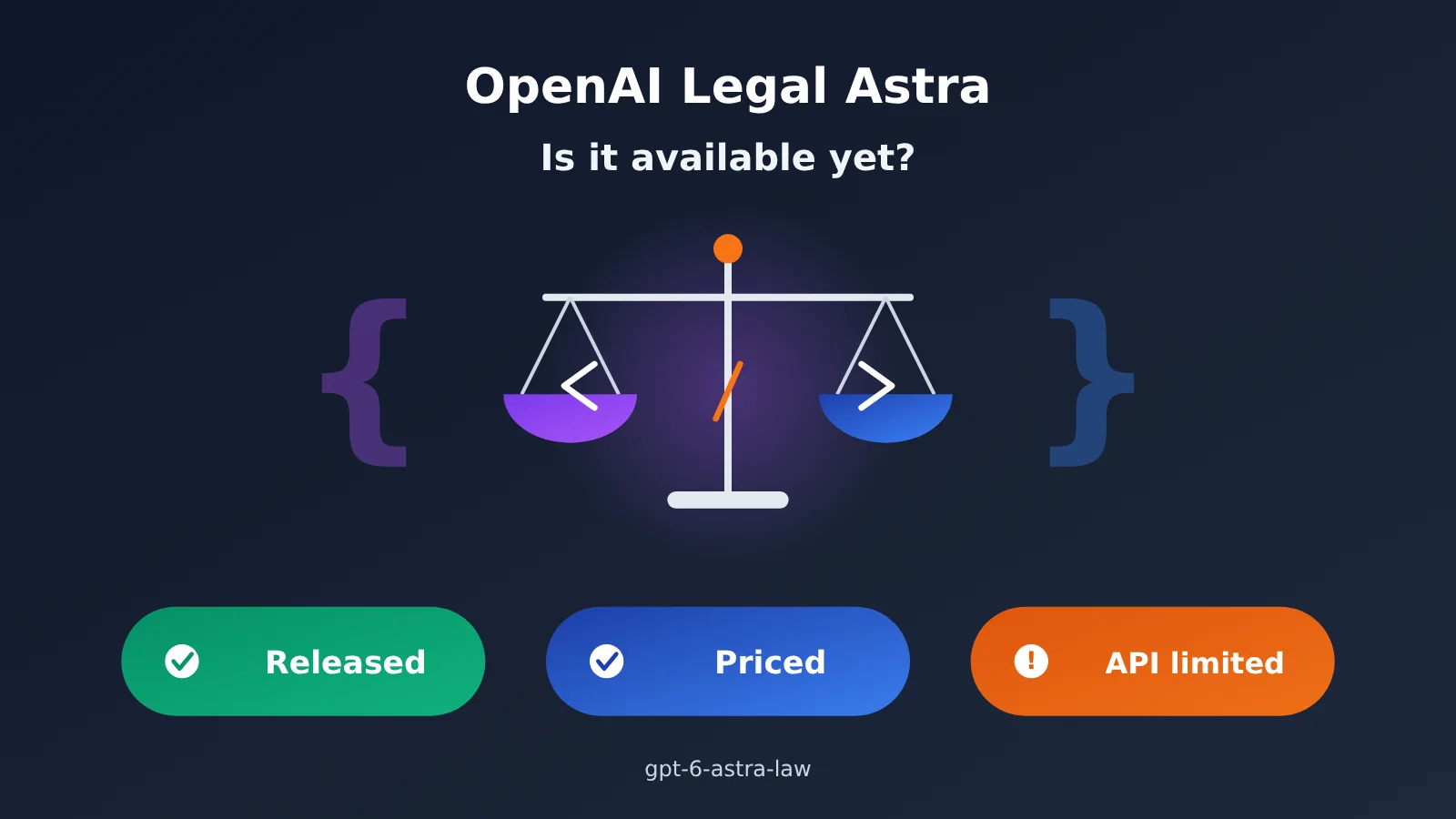
OpenAI’s Legal Version of Astra at a Glance
Let’s start with the bottom line. The table below summarizes the key facts confirmed as of November 2, including the points most likely to be misunderstood.
| Item | Details |
|---|---|
| Product name | Astra for Law (displayed as GPT-6 Astra Law in the interface) |
| API model ID | gpt-6-astra-law |
| Product launch date | Officially launched by OpenAI on September 17, 2026 |
| Pricing disclosure date | Noticed and reported by media on October 31, 2026 (the pricing page doesn’t specify exactly when the entry went live) |
| Official pricing | $10 input / $50 output / $1 cached input (per million tokens) |
| Current access | Trusted Access for selected U.S. law firms, available in ChatGPT and Codex |
| API status | Still described as coming soon by the official Help Center |
| Self-service access for general developers | Not officially confirmed |
There are two dates worth keeping separate. September 17 was the product launch, when OpenAI said it would make the product available to API customers in the future. October 31 was when the pricing entry was publicly noticed. The entry shows that OpenAI has prepared API pricing, but the company didn’t simultaneously announce who could access it.
Confusing these two dates is behind many of the mistaken interpretations circulating online. The key point is: Pricing is public, but that doesn’t mean the API is officially available to all developers.
What Is Astra for Law?
How Astra for Law Relates to General-Purpose GPT-6 Astra
Astra for Law isn’t a separate foundation model trained from scratch to replace GPT-6 Astra. According to OpenAI’s public product documentation, it’s a legal-specific configuration built on GPT-6 Astra. It’s positioned as an AI foundation for law firms and legal technology companies, not just a chatbot.
It has three components:
- Foundation model: GPT-6 Astra, which handles reasoning, language understanding, and text generation.
- Legal Search Index: A dedicated legal search index for finding trusted primary sources of US law and relevant passages.
- Specialized instructions, tools, and workflows: Custom configurations for legal research, argument analysis, legal drafting, contract transactions, and risk identification.
OpenAI’s public materials focus mainly on configurations for retrieval, tools, and instructions. There’s therefore no basis for claiming that the legal version received new legal-specific parameter training. Developers evaluating it should think of it as a combination of a general-purpose model and a specialized configuration.
How Big Is Astra for Law’s Legal Index?
OpenAI says the dedicated index covers more than 230 million URLs, including US case law, statutes, administrative regulations, court rules, and administrative decisions, with new sources added daily. Its primary data partner is the nonprofit Free Law Project, which operates CourtListener, a major open-source US legal database. According to official figures, it covers more than 99.9% of published precedential US cases.
There are two important caveats. “230 million URLs” doesn’t mean 230 million distinct court opinions, and “99.9%” applies only to published precedential US cases. There’s currently no reliable official information indicating that the dedicated index offers comparable coverage of Chinese laws, regulations, court decisions, or other jurisdictions. Teams in China should pay particular attention to this when evaluating it.
How to Interpret Astra for Law’s Evaluation Results
In its launch announcement, OpenAI compared the two systems using a private validation set from the Vals AI Legal Research Bench, consisting of 200 US legal research questions. Both used the highest reasoning setting:
| Metric | Astra for Law | General-Purpose Astra + Web Search |
|---|---|---|
| Overall correctness check pass rate | 54.0% | 38.7% |
| Difference | An absolute increase of 15.3 percentage points, or a relative increase of about 40% | Baseline |
| Case law retrieval | Found 24% more reference cases | Baseline |
| Target passage retrieval | Found up to 54% more relevant passages in the correct court opinions | Baseline |
These figures need careful interpretation. The 40% is a relative increase, not a 40-percentage-point gain in correctness. The 54.0% is a pass rate on a specific legal research benchmark; it doesn’t represent accuracy in legal advice, contract review, or litigation prediction. Also, Vals AI’s strict scoring requires answers to satisfy all necessary elements. Scoring is performed by an LLM-based evaluation system, which has methodological limitations of its own.
OpenAI reported these results, so they shouldn’t be described as “independently reproduced by Vals AI.” The public Vals AI leaderboard updated on October 29 used a different configuration from this private validation-set test, so the rankings shouldn’t be combined directly.
OpenAI Astra Legal Pricing Explained
Official Pricing Compared With General-Purpose Models
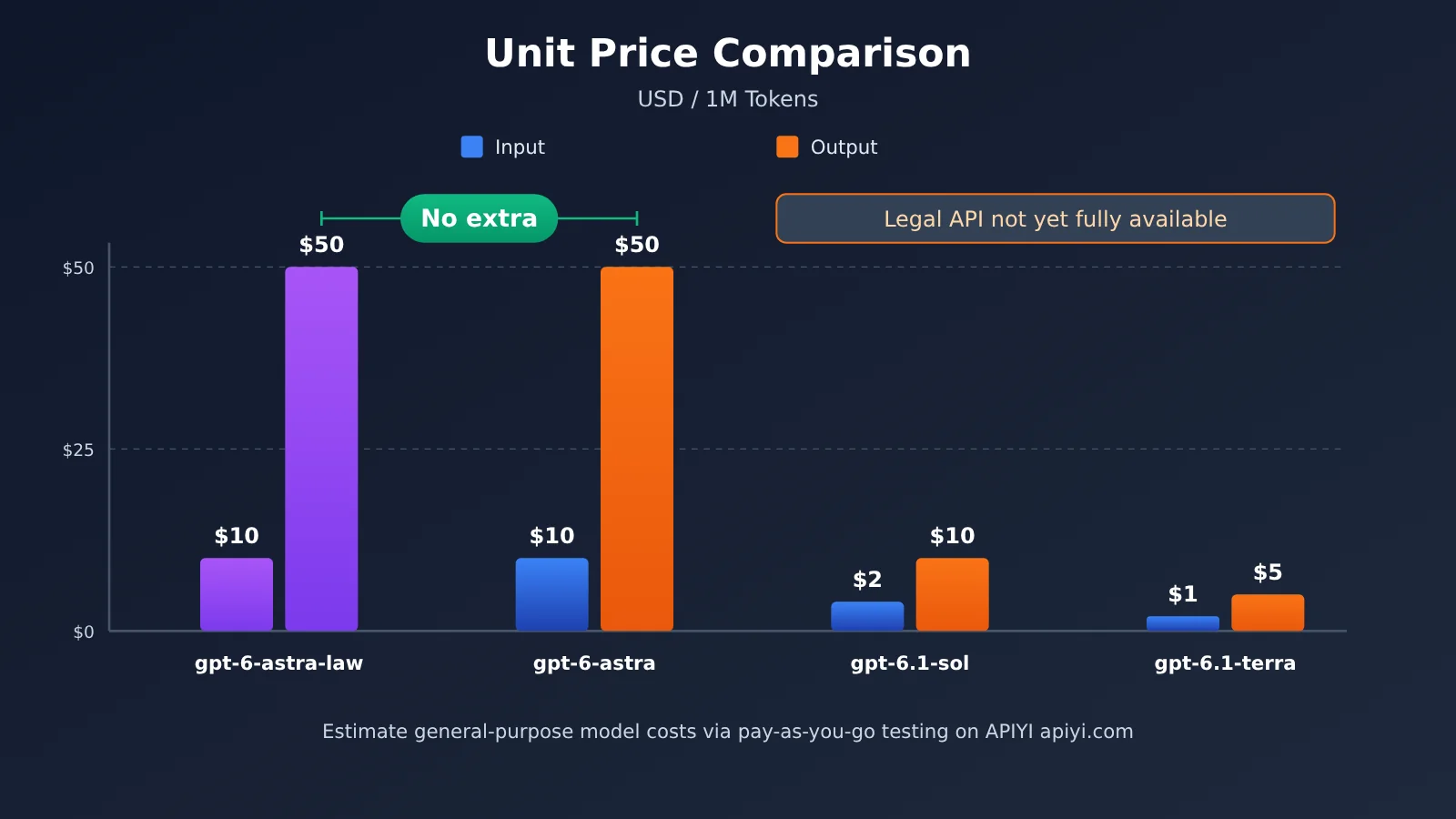
The following standard-mode rates are listed on OpenAI’s official API pricing page, in US dollars per million tokens, as checked on November 2, 2026:
| Model | Input | Output | Cached input | Current availability |
|---|---|---|---|---|
| gpt-6-astra-law | $10 | $50 | $1 | Trusted Access only; API not yet generally available |
| gpt-6-astra | $10 | $50 | $1 | General-purpose model; subject to account permissions |
| gpt-6.1-sol | $2 | $10 | $0.10 | General-purpose model; subject to account permissions |
| gpt-6.1-terra | $1 | $5 | $0.05 | General-purpose model; subject to account permissions |
The key takeaway is that Astra Legal has exactly the same base token rates as general-purpose Astra, with no additional premium. Its input and output rates are both five times those of GPT-6.1 Sol. But that doesn’t necessarily mean the same task will cost five times as much: output length, reasoning token usage, tool calls, and task success rates can all vary.
Example Astra Legal API Costs
The sample bills below are calculated using the published rates. They’re intended to illustrate the scale of costs, not represent actual user bills:
| Scenario | Input tokens | Output tokens | Input cost | Output cost | Total |
|---|---|---|---|---|---|
| Short Q&A research | 10,000 (standard) | 3,000 | $0.10 | $0.15 | $0.25 |
| Long-document analysis | 100,000 (standard) | 10,000 | $1.00 | $0.50 | $1.50 |
| Long document + cache hit | 100,000 (cached) | 10,000 | $0.10 | $0.50 | $0.60 |
The third example assumes all input tokens qualify for cached-input pricing. For tasks like contract review and due diligence, where you ask repeated questions about the same set of documents, the $1 cached-input rate can bring input costs down to one-tenth of the standard rate. How you structure your prompts can make a big difference to cost.
All examples exclude any potential charges for tools, retrieval, special processing, or regional processing. There’s currently no public documentation on how the full legal search index is billed through the API, so you shouldn’t assume retrieval is included for free in the token price.
Promotional Pricing Period
The pricing page states that current promotional rates will remain in effect through at least December 31, 2026. “At least” means the rates will last through that date; it doesn’t mean a price increase has been announced for January 1, 2027. There’s also no public standard price list for the period afterward. For budgeting purposes, consider the end of 2026 a good time to check prices again.
💰 Cost tip: Astra Legal isn’t currently available for self-service use. But if you’d like to estimate the token usage and cost of processing legal text with general-purpose models, you can run small-scale, pay-as-you-go tests through APIYI apiyi.com to help inform your budget.
OpenAI Astra Law Eligibility and Access
Who can use Astra Law?
According to the OpenAI Help Center, initial access is limited to:
- Select, vetted, eligible law firms in the United States;
- Access provided through Trusted Access;
- Eligible attorneys and people working under their supervision;
- ChatGPT and Codex, where the model appears as GPT-6 Astra Law in the model selector.
This means that buying ChatGPT Plus or Pro doesn’t automatically grant access, and lawyers worldwide aren’t automatically eligible. The interface name GPT-6 Astra Law and the API identifier gpt-6-astra-law are also different: the former appears in ChatGPT and Codex, while the latter is used for API billing and calls.
How to apply for early access to Astra Law
OpenAI has published two ways to apply:
- Existing OpenAI enterprise customers: Contact your OpenAI account team to discuss eligibility for legal product access.
- New customers: Contact OpenAI Sales through OpenAI’s official legal industry page.
OpenAI hasn’t published a standard self-service application process, approval timeline, minimum employee count, minimum spend, or approval rate. So be skeptical of anyone claiming you can “fill out a form and get approved instantly.”
Eligibility, technical access, and compliance are separate considerations
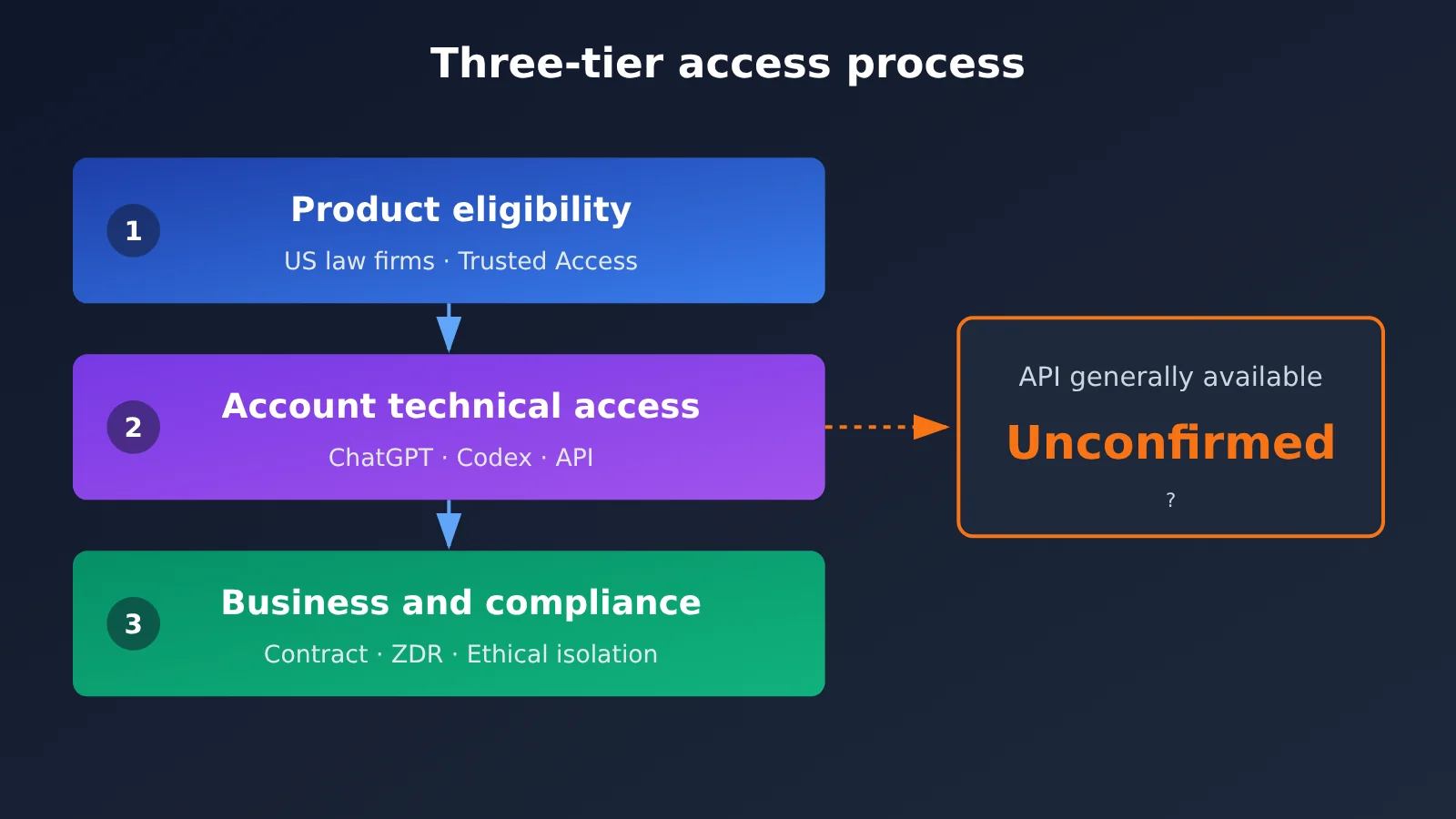
In practice, there are at least three layers to evaluate: product eligibility (whether the organization meets Trusted Access requirements), account-level technical access (whether the account can actually select the legal configuration in ChatGPT, Codex, or the API), and commercial and compliance conditions (whether the necessary contracts, authorization scope, and data protection arrangements are in place). A publicly available model name only tells you that OpenAI offers the product—it doesn’t prove that all three requirements have been met for you.
On privacy, OpenAI says eligible law firms can receive a Zero Data Retention (ZDR) arrangement for API usage, but not all standard API accounts automatically have the same configuration. Relevant ChatGPT Enterprise usage is excluded from human review by default. OpenAI also worked with Latham & Watkins to design ethical walls, access permissions, and law-firm-level oversight mechanisms. Privacy settings, however, don’t eliminate model hallucinations or incorrect citations, and lawyers remain responsible for their professional obligations.
API Availability and Limits for OpenAI’s Legal Version of Astra
What’s Been Announced and What Hasn’t
As of November 2, here’s a summary of the verifiable information:
| Question | Current status |
|---|---|
| Has the legal product launched? | Yes, on September 17 |
| API pricing and model identifier | Announced |
| Early access for selected US law firms | Announced |
| Self-service API access for all developers | Not confirmed |
| Date of general API availability / supported regions | Not announced |
| Dedicated model specification page | Not found (the corresponding documentation URL returns a 404) |
| API documentation and pricing for legal search tools | Not found |
| Rate limits by account tier | Not announced |
| Availability for users in China | Not announced |
Other details also lack official documentation, including context window size, maximum output tokens, supported API endpoints, the reasoning effort parameter, whether the Legal Search Index is enabled by default, structured outputs, and batch and asynchronous calls. The general-purpose GPT-6 Astra has its own specification page, but without confirmation, its parameters can’t be assumed to apply to the legal version.
How to Check Model Availability Before Integration
The safest approach for developers is to check with code rather than guess. The example below uses an OpenAI-compatible API to list the models available to your account and check whether gpt-6-astra-law is included. If it isn’t, use a general-purpose model for testing.
import openai

client = openai.OpenAI(
    api_key="YOUR_API_KEY",
    base_url="https://api.apiyi.com/v1"  # APIYI OpenAI 兼容接口
)

TARGET = "gpt-6-astra-law"
available = {m.id for m in client.models.list().data}

if TARGET in available:
    print(f"{TARGET} 在当前账户模型列表中")
else:
    print(f"{TARGET} 不在当前账户模型列表中,请改用通用模型测试")
A model appearing in the list only means you can send requests to it—it doesn’t guarantee that the full legal configuration is available. You’ll also need to confirm whether the dedicated legal index is active and whether billing is listed separately.
View the full code: availability check + general-purpose model fallback
import openai
from typing import Optional

client = openai.OpenAI(
    api_key="YOUR_API_KEY",
    base_url="https://api.apiyi.com/v1"
)

TARGET_MODEL = "gpt-6-astra-law"
# 替换为你账户模型列表中实际可用的通用模型
FALLBACK_MODEL = "gpt-6.1-sol"


def pick_model() -> str:
    """优先使用法律配置,不可用时回退到通用模型"""
    try:
        ids = {m.id for m in client.models.list().data}
    except Exception as e:
        print(f"获取模型列表失败: {e}")
        return FALLBACK_MODEL
    if TARGET_MODEL in ids:
        return TARGET_MODEL
    print(f"{TARGET_MODEL} 当前不可用,回退到 {FALLBACK_MODEL}")
    return FALLBACK_MODEL


def analyze_clause(clause: str, system_prompt: Optional[str] = None) -> str:
    """对合同条款做初步风险梳理,结果须由律师复核"""
    model = pick_model()
    messages = []
    if system_prompt:
        messages.append({"role": "system", "content": system_prompt})
    messages.append({"role": "user", "content": clause})
    try:
        resp = client.chat.completions.create(
            model=model,
            messages=messages,
            max_tokens=1000
        )
        usage = resp.usage
        print(f"模型: {model} | 输入 {usage.prompt_tokens} | 输出 {usage.completion_tokens}")
        return resp.choices[0].message.content
    except Exception as e:
        return f"Error: {e}"


if __name__ == "__main__":
    result = analyze_clause(
        "卖方应在交割前取得全部第三方同意,但重大合同除外。",
        system_prompt="你是法律文本分析助手,只做风险提示,不提供正式法律意见。"
    )
    print(result)
🎯 Technical tip: Before the legal API is officially available, you can use a single key through APIYI at apiyi.com to call general-purpose models from multiple providers and build your retrieval-augmented generation, citation verification, and human review workflows. Note that APIYI doesn’t currently offer the Astra for Law legal configuration. Once it’s available from the upstream provider, you can switch models without major changes to your application code.
What to Check With Third-Party Providers
If a third-party platform claims to offer Astra for Law, verify whether it actually calls gpt-6-astra-law; whether it has official upstream access; whether it provides the full legal configuration or just standard Astra with a custom prompt; whether it includes the dedicated legal index; whether tool fees are published separately; whether its data retention policy matches the official legal business terms; and whether it can provide technical evidence of a successful call. Simply allowing you to enter the model name in a request doesn’t prove the call will succeed.
Impact of OpenAI’s Astra for Law
Impact on Developers
- Predictable pricing: The legal version costs the same as general-purpose Astra, so developers can model costs using standard Astra and switch models when access becomes available.
- Configuration, not unit price, makes the difference: The legal version’s value comes mainly from its dedicated index and workflows. If your business doesn’t rely on US legal research, a general-purpose model plus your own knowledge base may be enough.
- Alternatives already exist: OpenAI’s general-purpose File Search can help you build a retrieval-augmented system using legal documents you’re authorized to process. But that isn’t the same as accessing the official legal index of 230 million URLs.
Impact on the Legal Tech Industry
In a September 17 report, Reuters noted that OpenAI’s entry into the legal AI market has intensified competition, with Anthropic, Google, Thomson Reuters, Harvey, and Legora all active in the space. Notably, OpenAI also named Harvey and Legora as future API customers for Astra for Law. Different companies are taking on different roles, providing foundation models, legal data, workflow software, and law firm expertise.
The release also includes 26 partner plugins, 9 community plugins, and 47 custom Skills, involving providers such as iManage, Intapp, DeepJudge, and Thomson Reuters HighQ. ChatGPT for Word is also generally available. But these are features of the broader legal ecosystem and shouldn’t be understood as built-in capabilities of the gpt-6-astra-law API alone. Likewise, the partnership examples involving law firms such as Sullivan & Cromwell, Ropes & Gray, and Cooley shouldn’t all be treated as production tests using the final API.
What Different Groups Should Do Now
- Eligible US law firms: Apply for Trusted Access through your account team or OpenAI Sales, while preparing compliance arrangements for contracts, ZDR, and ethical walls.
- General API developers: Keep an eye on updates to the OpenAI Help Center and model specifications page. In the meantime, validate workflows with a general-purpose model and don’t hard-code a dependency on
gpt-6-astra-lawin production. - Legal AI product teams: Refine retrieval, citation verification, and human review using a general-purpose model and your own data. Make the model name configurable, then evaluate migration once OpenAI publishes the API specifications, rate limits, and retrieval pricing.
Frequently Asked Questions
Q1: Is OpenAI’s Astra for Legal a separate new model?
No. It’s a legal-specific configuration based on GPT-6 Astra, with a dedicated U.S. legal search index, specialized instructions, and tools. Public information doesn’t indicate that a separate legal foundation model was trained.
Q2: Can Astra for Legal be called directly through the API now?
As of November 2, 2026, this hasn’t been officially confirmed. The model identifier and pricing have been published, but the official Help Center still describes the API as coming soon. The availability date, supported regions, and rate limits for general developers haven’t been announced.
Q3: Is Astra for Legal more expensive than general-purpose Astra?
The base token prices are the same: $10 for input, $50 for output, and $1 for cached input per million tokens. Promotional pricing will last through at least December 31, 2026. It hasn’t been announced whether tools such as legal search will incur additional charges.
Q4: Does the 54.0% score represent its accuracy for legal advice?
No. This is the overall correctness pass rate reported by OpenAI on the Vals AI private legal research validation set, which contains 200 U.S. legal research questions. The baseline was 38.7%. It can’t be generalized to accuracy for legal advice, contract review, or predictions of case outcomes.
Q5: How can developers who aren’t eligible prepare now?
You can start by building a retrieval-augmented prototype using a general-purpose model and your own legal documents, with the model name set as a configuration option. Through APIYI at apiyi.com, you can use one API key to compare models from multiple providers. New users get free test credits, but APIYI doesn’t currently offer the legal-specific configuration.
Q6: Can teams in China use Astra for Legal to handle Chinese legal questions?
The dedicated index currently focuses on U.S. legal materials, and no official information confirms comparable coverage of Chinese laws and regulations. Availability for users in China hasn’t been announced either. For Chinese legal materials, a more practical option for now is to combine a general-purpose model with your own database. You can compare multiple models on APIYI at apiyi.com.
OpenAI Legal Astra: Key Takeaways
- Product positioning: A legal-specific configuration based on GPT-6 Astra, not a separate foundation model.
- Two key dates: The product launched on September 17, and its API pricing was publicly observed on October 31.
- Pricing: The same price as general-purpose Astra, with promotional pricing through at least the end of 2026.
- Eligibility: Initially limited to selected US law firms, with access through Trusted Access in ChatGPT and Codex.
- API status: The model identifier is public, but general developer access has yet to be confirmed. Specifications and retrieval pricing haven’t been published.
- Benchmark caveat: The 54.0% result comes from a specific legal research benchmark, not the accuracy rate of legal advice.
- Getting started: You can build a workflow with general-purpose models through APIYI at apiyi.com, then switch once official access opens.
Conclusion
Back to the question: Is OpenAI Legal Astra available to use yet? The answer depends on who you are.
- For selected US law firms: It’s already available through Trusted Access in ChatGPT and Codex. To apply, contact your OpenAI account team or sales.
- For general API developers: Pricing and the model identifier are public, but self-service access hasn’t been confirmed. Don’t assume that published pricing means the model is generally available.
- For legal AI teams: You can estimate costs based on general-purpose Astra. The main unknowns are API specifications, rate limits, and legal retrieval pricing.
The most practical approach is to build and test your retrieval, citation verification, and human review workflow with general-purpose models now, while keeping an eye on updates to OpenAI’s Help Center and model specification pages. If you need to quickly compare the performance and costs of general-purpose models from multiple providers, you can test them through a unified integration with APIYI at apiyi.com, then evaluate a migration once the legal version officially opens.
📚 References
- OpenAI Official Announcement: Astra for Law (2026-09-17)
- Link:
openai.com/index/astra-for-law -
Details: Product positioning, index size, evaluation results, and collaboration examples
-
OpenAI API Pricing Page (checked 2026-11-02)
- Link:
developers.openai.com/api/docs/pricing -
Details:
gpt-6-astra-lawpricing and promotional period -
OpenAI Help Center: Astra for Law
- Link:
help.openai.com/en/articles/20001528-astra-for-law -
Details: Eligibility, application process, and API availability
-
Vals AI Legal Research Bench (updated 2026-10-29)
- Link:
www.vals.ai/benchmarks/legal_research -
Details: Legal research benchmark question types and strict scoring methodology
-
LawSites: Launch Event and Demo Coverage (2026-09-17)
- Link:
www.lawnext.com/2026/09/openai-releases-astra-for-law-a-gpt-6-model-configured-for-legal-work.html -
Details: Product demonstrations and early user feedback
-
ByteForward: API Pricing and Availability Check (2026-10-31)
- Link:
bytefwd.com/astra-for-law-api-pricing-access - Details: Appearance of pricing entries and access restrictions
Author: APIYI Technical Team
Technical Note: The facts in this article are current as of November 2, 2026. For future API availability, refer to OpenAI’s official announcements. For more information on accessing general-purpose models, visit the documentation center at docs.apiyi.com.