Author’s note: A look at Astra for Law’s legal search index of 230 million URLs, test results, and API pricing, based on official disclosures, to clarify where its specialized capabilities come from.
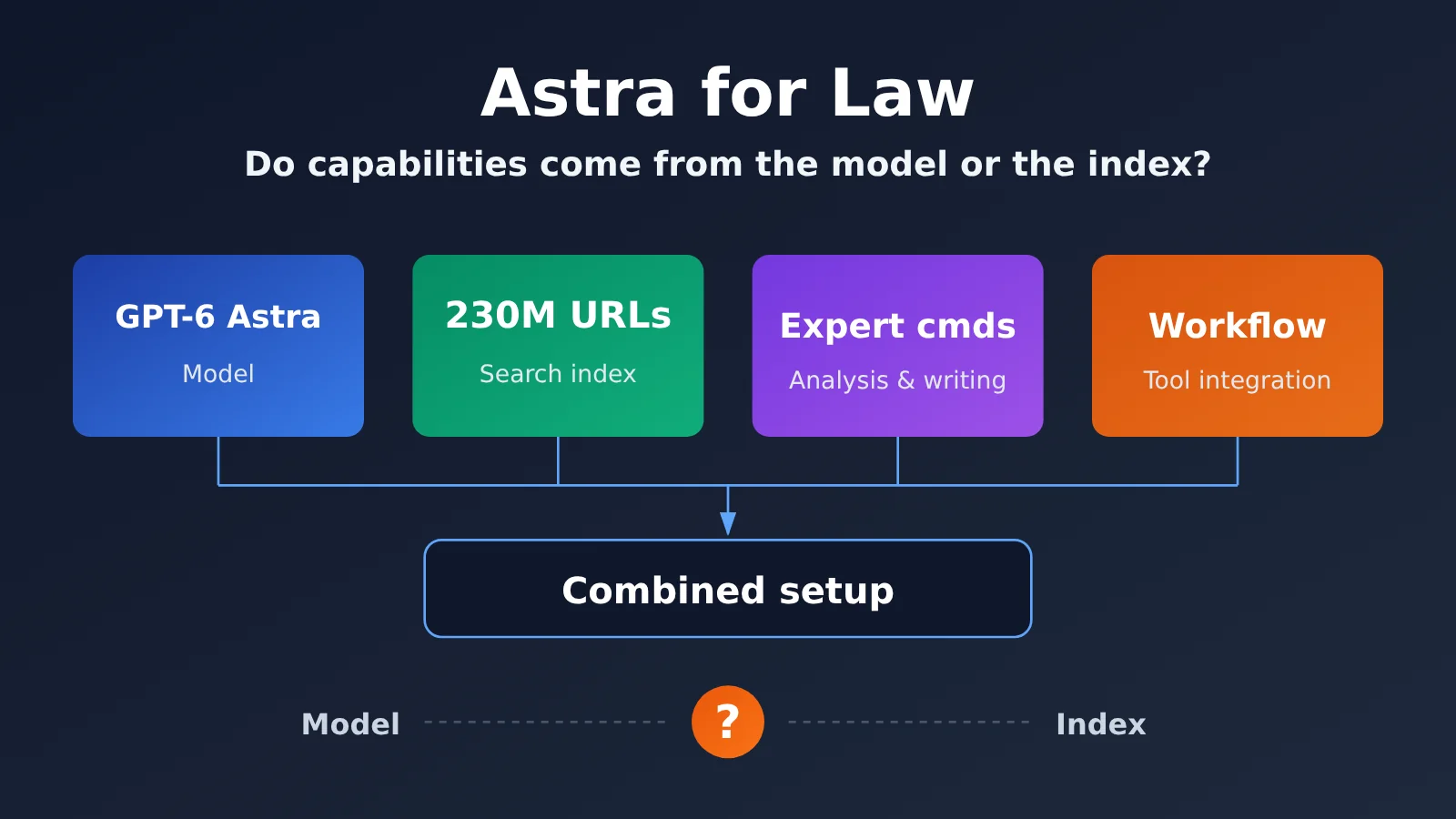
OpenAI has added the legal configuration gpt-6-astra-law to its official API pricing page, an entry several tech outlets picked up on October 31, 2026. Also drawing attention is Astra for Law’s legal search index of more than 230 million URLs. That raises a key question: Do its specialized capabilities come from the model or the index?
This isn’t a rumor: The product description, index size, and pricing can all be verified on OpenAI’s official pages. But the data released so far only shows that the full configuration outperforms a general-purpose configuration. It doesn’t tell us how much of the improvement comes from the model, the index, or the instructions.
The takeaway: In three minutes, you’ll understand what Astra for Law is made of, what its key numbers mean, and what developers can do with it today.
Astra for Law’s 230 Million URLs: Key Facts at a Glance
As of November 2, 2026, here’s what public information tells us. The easiest detail to misread is the API status: pricing has been published, but that doesn’t mean all developers can access it.
| Item | Details |
|---|---|
| Release date | September 17, 2026 |
| Released by | OpenAI |
| Product positioning | A specialized AI foundation platform for law firms and legal technology companies |
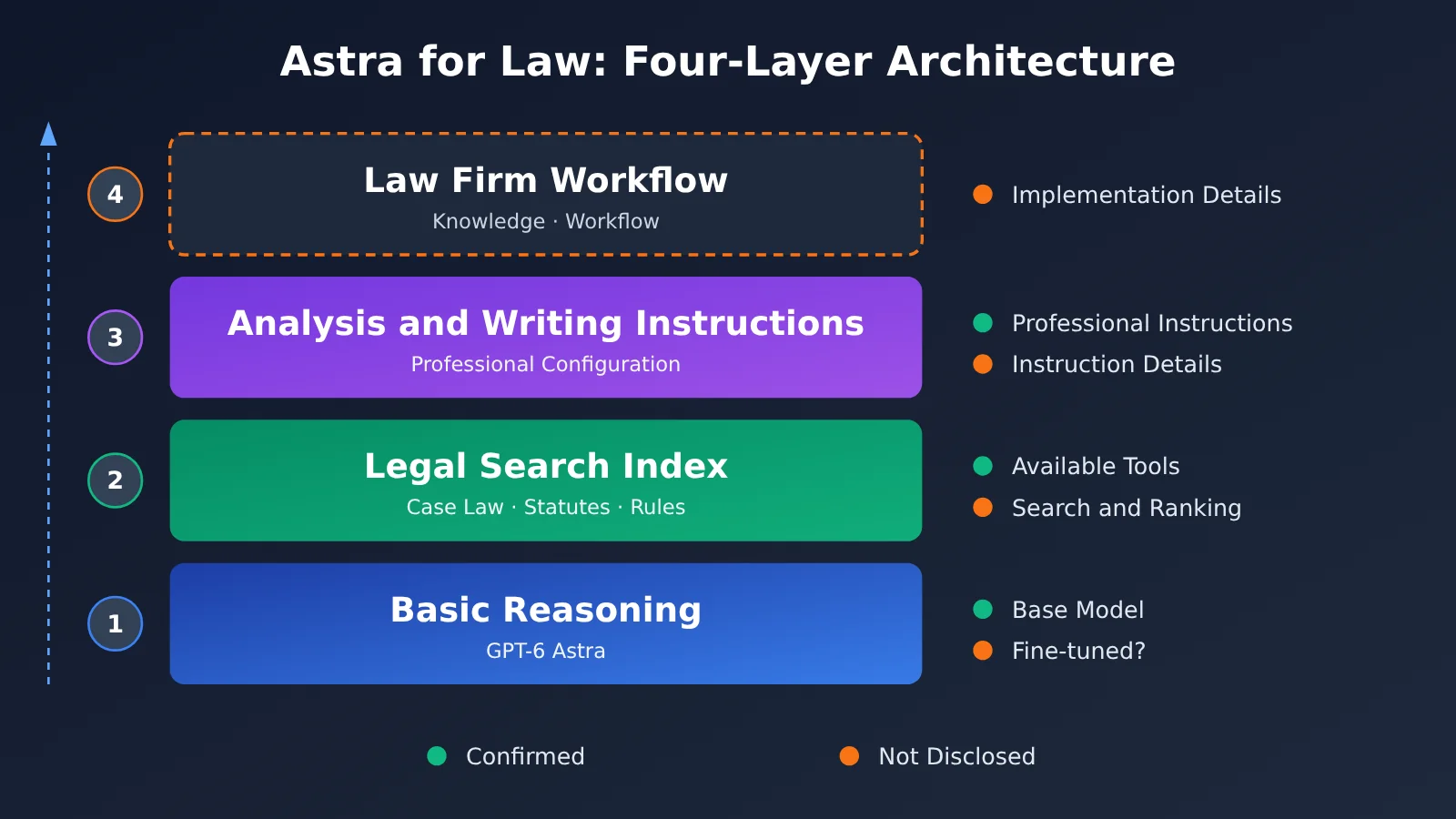
| Technical components | GPT-6 Astra, a legal search index, legal analysis and writing instructions, and tool and workflow integrations |
| Index size | More than 230 million URLs, with new sources added daily |
| Availability | Initially available to eligible US law firms through Trusted Access |
| API status | OpenAI still describes API access as a future offering; no official launch date has been announced |
What’s in Astra for Law’s 230 Million-URL Legal Search Index?
The index covers US case law, statutes, administrative regulations, court rules, and administrative decisions. OpenAI has also partnered with the nonprofit Free Law Project to bring CourtListener’s US case law data into the research environment.
A URL may point to a page, document, record, or other legal material, so “230 million URLs” doesn’t mean “230 million court decisions.” The figures below also measure different things. You can’t subtract one from another or use them to estimate the number of other materials.
| Figure | Disclosed by | What it means | What it doesn’t mean |
|---|---|---|---|
| More than 230 million URLs | OpenAI | The size of the full legal search index | 230 million individual court decisions |
| More than 9 million records | Free Law Project | CourtListener’s legal decision records | The full contents of OpenAI’s index |
| More than 2,000 courts | Free Law Project | The range of CourtListener’s data sources | Coverage of courts worldwide |
| More than 99.9% | Free Law Project | Coverage of published US precedential case law | Completeness across all legal materials |
There are also clear limits to the index’s coverage. It currently focuses on US legal materials. There’s no credible official documentation showing that it offers the same level of specialized coverage for China’s current laws and regulations, court decisions, or judicial interpretations.
Does Astra for Law’s Legal Expertise Come From the Model or the Legal Search Index?
The most accurate answer right now is that it comes from a combination of both, and the available data doesn’t tell us exactly how much each contributes. OpenAI describes Astra for Law as a legal-specialized configuration built on GPT-6 Astra and identifies the legal search index as one of the tools it can use. Its public explanation focuses on the configuration, retrieval, tools, and instructions, but doesn’t confirm whether the model underwent legal-domain fine-tuning, distillation, or separate parameter training.
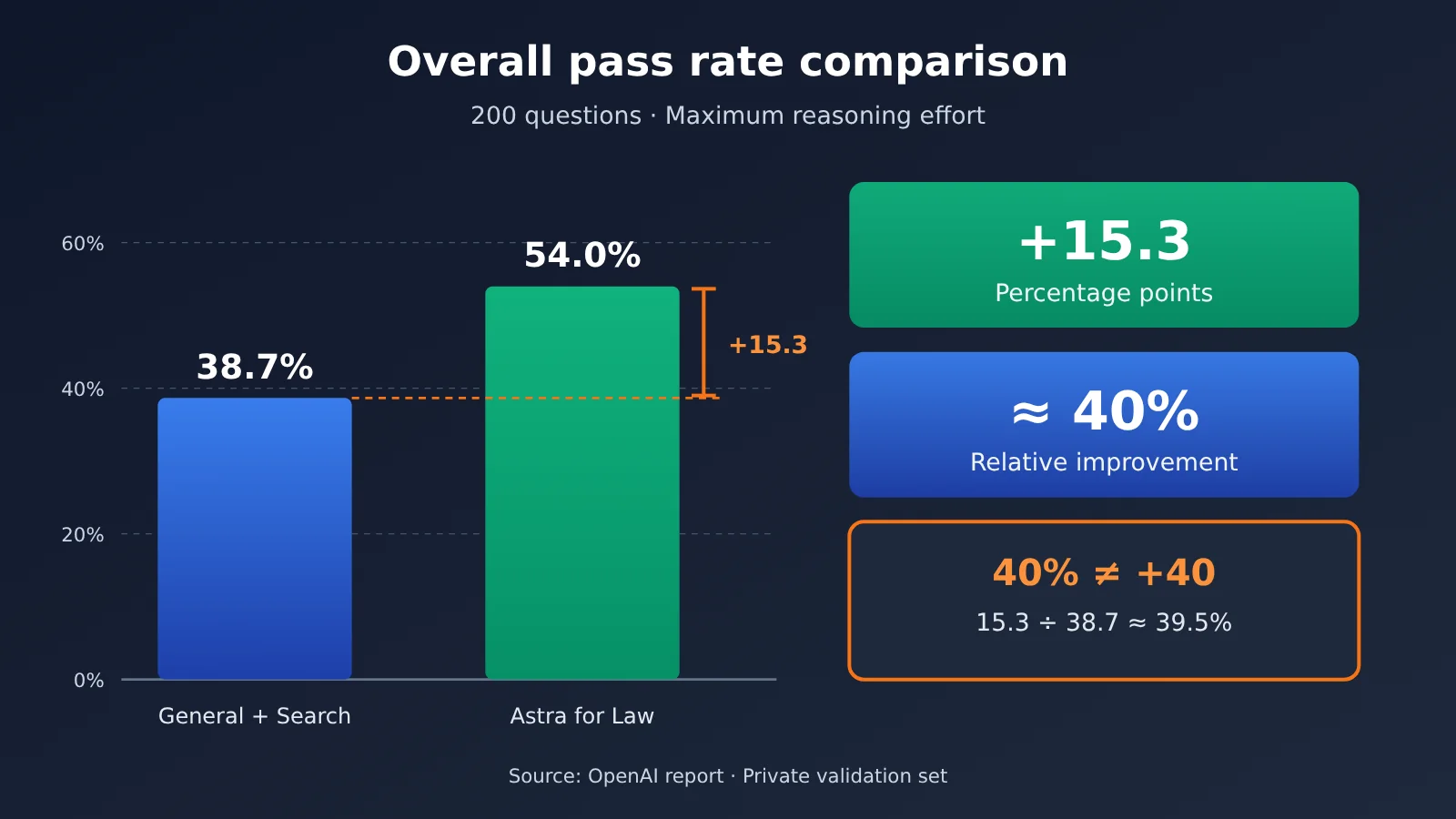
The strongest evidence comes from a test reported by OpenAI. It compared two configurations at the highest reasoning effort level, using 200 US legal research questions from the private validation set of the Vals AI Legal Research Bench.
| Metric | Astra for Law | General-purpose Astra + web search | Difference |
|---|---|---|---|
| Overall correctness check pass rate | 54.0% | 38.7% | Up 15.3 percentage points, or approximately 40% relative |
| Number of cases referenced for case law questions | More | Baseline | 24% more |
| Relevant passages in correct court opinions (at equal reasoning effort) | More | Baseline | Up to 54% more |
The results support three conclusions:
- The base model is still the foundation: Understanding, reasoning, and generation after retrieval all depend on GPT-6 Astra, but this test didn’t measure the model’s contribution on its own.
- Retrieval metrics improved significantly: Both the number of cases and the relevant-passage metric point to stronger specialized retrieval. But finding more cases doesn’t necessarily make a legal opinion more accurate.
- The improvement can’t be attributed to a single component: The test compared complete configurations. The index, instructions, and other settings changed together, so it would be inaccurate to say that “the legal index alone improved performance by 40%.”
There are also clear limits to how these results should be used. OpenAI reported the score using a private validation set; that doesn’t mean Vals AI independently reproduced it. Nor does the 54% figure represent the accuracy of legal advice, predictions of litigation outcomes, or contract review. Results for general-purpose models on public leaderboards also use different test configurations and can’t be directly combined into the same ranking.
Why Web Search Alone Can’t Replace a Legal Search Index
Legal research involves more than finding semantically relevant text. Court hierarchy, jurisdiction, whether a precedent is binding, and whether it has been overturned or limited all affect how useful an authority is. The same contract dispute could lead to different conclusions under the laws of different states.
General-purpose search can find relevant content, but it can’t guarantee that a cited legal authority actually applies. That’s the problem a specialized legal index and professional instructions are meant to address together. Even so, their presence doesn’t mean every citation has automatically been checked for validity.
🎯 Technical tip: If you’re building a domain-specific knowledge base, start by comparing three configurations on the same set of questions: “model only,” “model + general-purpose search,” and “model + specialized knowledge base.” Switching models through APIYI’s unified interface at apiyi.com can reduce the work of building separate integrations.
How Does Astra for Law Relate to Traditional RAG Architecture?
A traditional RAG workflow takes a user’s question, searches a knowledge base, retrieves relevant passages, and then has the model generate an answer using that context. Astra for Law follows a similar idea: neither relies solely on knowledge stored in the model’s parameters. But the similarity is conceptual—you can’t assume that a typical RAG implementation reflects how Astra for Law works internally.
| Technical question | Public status | What you can say |
|---|---|---|
| Does it use a legal search index? | Confirmed | It’s a tool Astra for Law can call |
| What does the index contain? | Confirmed | Case law, statutes, regulations, court rules, and administrative decisions |
| Does it use vector or hybrid retrieval? | Not disclosed | Don’t assert a specific approach |
| What embedding and reranking methods does it use? | Not disclosed | Don’t speculate about specific models or algorithms |
| What chunking strategy and retrieval count does it use? | Not disclosed | Don’t apply generic settings |
| How is authority ranking implemented? | Not disclosed | Describe the goal, not the implementation |
OpenAI’s general-purpose File Search does use vector stores and combines semantic search with keyword search. But no public information confirms that it shares the same underlying implementation as the legal index, so its settings can’t be applied directly to Astra for Law.
Reproducing the Basic Legal Research Pattern with RAG
The example below doesn’t call gpt-6-astra-law and can’t reproduce the Legal Search Index. It only demonstrates a general pattern: retrieve supporting material, restrict the sources, and require citations. Check the list of available models for the correct model name.
import openai

client = openai.OpenAI(
    api_key="YOUR_API_KEY",
    base_url="https://api.apiyi.com/v1"
)

context = "[DOC-1] 示例资料:此处放入检索到的法律片段"
response = client.chat.completions.create(
    model="gpt-6.1-sol",
    messages=[
        {"role": "system", "content": "仅依据给定资料回答,并标注来源编号。资料不足时明确说明。"},
        {"role": "user", "content": f"资料:{context}\n问题:该条款有哪些风险?"}
    ]
)
print(response.choices[0].message.content)
View the complete example with metadata filtering
import openai

client = openai.OpenAI(
    api_key="YOUR_API_KEY",
    base_url="https://api.apiyi.com/v1"
)

# 以下均为虚构演示数据,不是真实法律资料
DOCS = [
    {
        "id": "DOC-1",
        "title": "示例判决 A",
        "jurisdiction": "示例州",
        "year": 2024,
        "text": "示例内容:合同终止条款需要事先书面通知。"
    },
    {
        "id": "DOC-2",
        "title": "示例判决 B",
        "jurisdiction": "其他州",
        "year": 2023,
        "text": "示例内容:合同终止通知可以采用电子方式。"
    }
]


def retrieve(keywords, jurisdiction, top_k=3):
    """按司法辖区过滤,再按关键词命中数和年份排序"""
    candidates = [d for d in DOCS if d["jurisdiction"] == jurisdiction]
    scored = []
    for doc in candidates:
        score = sum(keyword in doc["text"] for keyword in keywords)
        if score > 0:
            scored.append((score, doc["year"], doc))
    scored.sort(key=lambda item: (item[0], item[1]), reverse=True)
    return [item[2] for item in scored[:top_k]]


def answer(question, keywords, jurisdiction):
    docs = retrieve(keywords, jurisdiction)
    if not docs:
        return "未检索到符合司法辖区要求的资料,请人工复核。"

    context = "\n".join(
        f"[{d['id']}] {d['title']}({d['jurisdiction']},{d['year']}):{d['text']}"
        for d in docs
    )
    response = client.chat.completions.create(
        model="gpt-6.1-sol",  # 以平台实际可用模型为准
        messages=[
            {
                "role": "system",
                "content": (
                    "你是法律研究助手。仅依据给定资料回答,并标注来源编号。"
                    "指出不确定性和缺失信息。输出仅供专业人员复核,不构成法律意见。"
                )
            },
            {
                "role": "user",
                "content": f"资料:\n{context}\n\n问题:{question}"
            }
        ]
    )
    return response.choices[0].message.content


print(answer("终止合同是否需要书面通知?", ["合同", "通知"], "示例州"))
Tip: You can get free testing credits through APIYI at apiyi.com and use your own question set to compare model performance. When evaluating results, check whether citations are accurate and the cited material applies—not just whether the answer reads smoothly.
What Astra for Law API Pricing Means for Developers
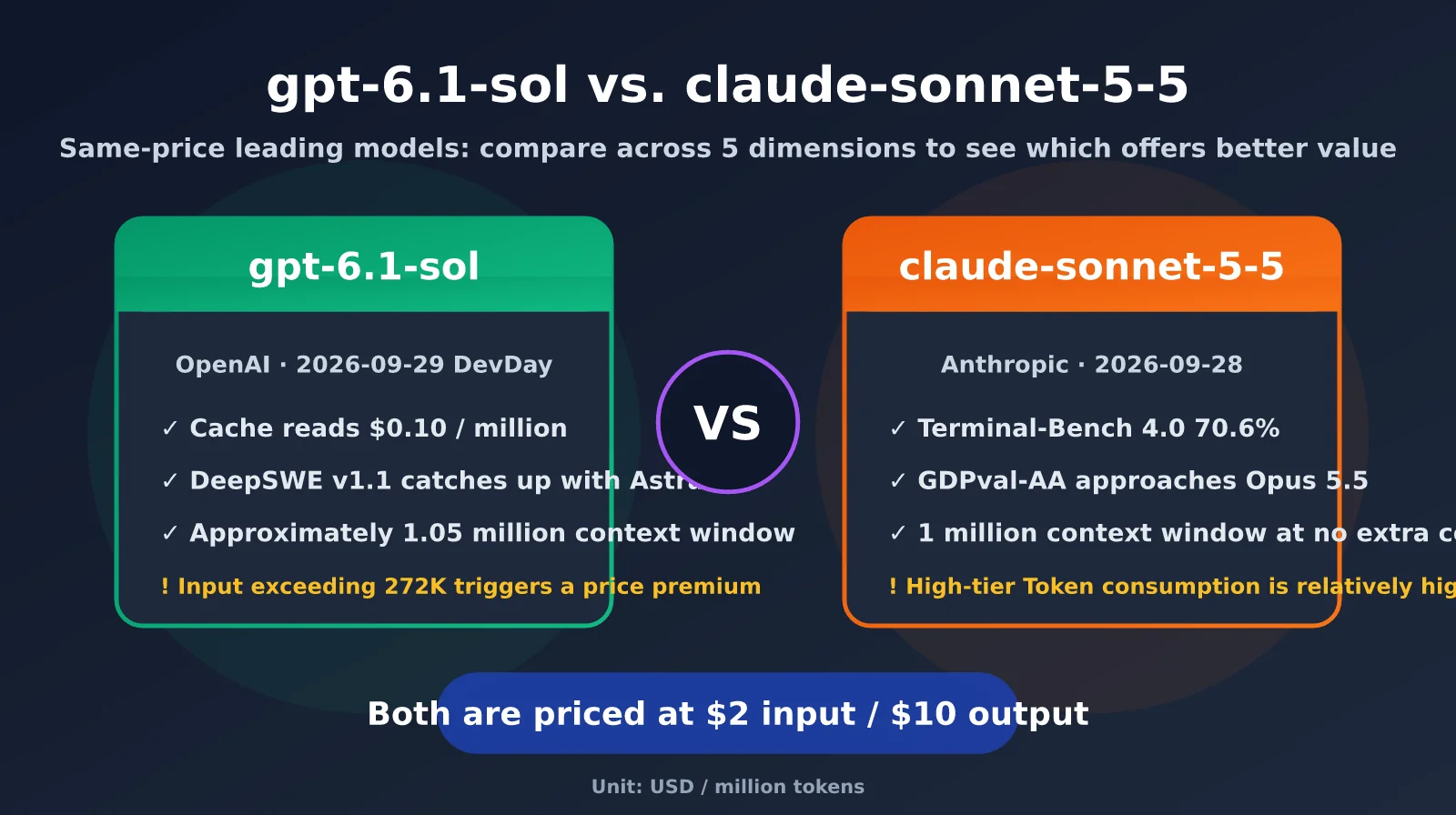
The pricing reveals an important detail: gpt-6-astra-law has the same base token rates as the general-purpose gpt-6-astra, with no additional premium for now. The following standard-mode rates are listed on the official pricing page, and the promotional pricing will last through at least December 31, 2026.
| Model | Input / million tokens | Cached input / million tokens | Output / million tokens |
|---|---|---|---|
gpt-6-astra-law |
$10 | $1 | $50 |
gpt-6-astra |
$10 | $1 | $50 |
gpt-6.1-sol |
$2 | $0.10 | $10 |
gpt-6.1-terra |
$1 | $0.05 | $5 |
At these rates, 100,000 regular input tokens and 10,000 output tokens would cost about $1.50. If all the input qualifies for cached pricing, the cost would be about $0.60. This is just an illustrative bill and doesn’t include any potential charges for tools, retrieval, or special processing. How the legal index is billed through the API hasn’t been fully confirmed, so don’t assume retrieval is free.
💰 Cost note: The legal model’s token rates are five times those of Sol, but actual task costs also depend on output length, tool calls, and task success rates. Budget-conscious projects can first use existing models through APIYI at apiyi.com to build and test their retrieval workflows, then assess whether an upgrade is worthwhile based on the full cost per task.
Implications for Developers
- Capability development is shifting: Competition in vertical AI isn’t just about model selection. It also involves data quality, source traceability, and the design of domain-specific rules.
- Evaluation methods need to evolve: Compare complete configurations on the same set of test questions, and include citation accuracy and jurisdictional applicability in your metrics.
- Leave room in launch plans: The availability date, rate limits, and tool parameters haven’t been confirmed, so it isn’t wise to make this the sole dependency for a product launch yet.
Implications for the Legal AI Industry
- Competition is heating up: Anthropic, Google, Thomson Reuters, Harvey, and Legora are all advancing legal AI products or capabilities.
- Competition and cooperation coexist: Harvey and Legora may be competitors, but OpenAI has also named them as future API customers.
- Law firm knowledge still matters: Sullivan & Cromwell’s contract analyzer incorporates internal negotiation playbooks and historical contract precedents, showing that a public legal index can’t replace organizational knowledge. Partnerships with Ropes & Gray, Cooley, and others have similar characteristics, but they shouldn’t all be treated as production tests of the final API.
Frequently Asked Questions
Q1: Is Astra for Law a separately trained legal model?
There’s currently no evidence to support that claim. Officially, it’s described as a legal-specific configuration built on GPT-6 Astra, with a legal index, specialized instructions, and tools. There’s no public confirmation of any additional legal-domain fine-tuning or parameter training.
Q2: Does 54.0% represent its accuracy in providing legal advice?
No. The 54.0% figure is the pass rate for overall correctness checks in a specific legal research test. It doesn’t apply to every legal scenario, and it doesn’t represent a win rate or contract review accuracy. A lawyer still needs to review the product’s output.
Q3: Can I use gpt-6-astra-law now?
There’s no basis to assume it’s already available to all developers. The official help center still says the product is initially available to eligible US law firms, with API access coming later. A public model identifier and pricing don’t mean every API key has access.
Q4: Are the 230 million URLs suitable for Chinese legal use cases?
That can’t be confirmed at this point. The index explicitly focuses on US legal materials, and there’s no credible official evidence that it provides equivalent coverage of Chinese law. Chinese use cases require compliant local data sources and separate testing.
Q5: How can I test a similar legal RAG solution at this stage?
You can follow three steps:
1. Register at APIYI apiyi.com to get an API key and free testing credits.
2. Use the example in this article to connect your own compliant legal materials.
3. Build a test set with reference answers, then compare different models and retrieval approaches.
Q6: What are Astra for Law’s current limitations?
The main limitations are restricted access, unpublished API details, and a lack of large-scale independent third-party testing. There’s also insufficient data on latency, throughput, real-world error rates, and cost per case. Privacy controls can’t eliminate hallucinations or incorrect citations, so final conclusions still need human review. If you’d like to compare general-purpose models first, you can run small-scale tests through APIYI apiyi.com.
Astra for Law: Key Takeaways
- What it is: Astra for Law is a legal-focused configuration built on GPT-6 Astra, not a confirmed standalone model.
- Index size: The 230 million figure refers to URLs, not court decisions. The index focuses on US legal materials.
- Where its capabilities come from: Its professional performance comes from a combination of the model, index, instructions, and workflows. Available data doesn’t show exactly how much each contributes.
- Test results: The reported scores of 54.0% versus 38.7% come from official testing, representing a relative improvement of about 40%.
- Pricing: The legal version has the same base unit price as general-purpose Astra, but search tool fees haven’t been fully confirmed.
- API status: Pricing is public, but availability dates and access permissions for general developers haven’t been confirmed.
- Getting started: You can test general-purpose models through APIYI at apiyi.com to validate your own knowledge base and retrieval workflow.
Conclusion: What Astra for Law’s 230 Million URLs Tell Us
Coming back to the original question, Astra for Law’s professional capabilities can’t be attributed to the model or the index alone. The model handles understanding, reasoning, and generation; the legal search index provides traceable sources; specialized instructions guide analysis and writing; and a law firm’s own knowledge brings those capabilities into real-world workflows.
Official testing shows that the complete configuration has an advantage on certain legal research tasks, but it doesn’t reveal how much each component contributes. For developers, the more practical approach is to build your own data, retrieval, and evaluation systems first, while keeping an eye on official API availability announcements.
If you’re planning a specialized knowledge base application, consider using APIYI at apiyi.com to compare multiple models through a unified interface and test your approach at a lower initial cost.
📚 References
- OpenAI: Astra for Law product announcement: Product positioning, index size, test results, and partnership examples
- Link:
openai.com/index/astra-for-law -
Notes: The primary source for this article’s core technical information and official test data
-
OpenAI API pricing page: Model identifiers and token prices for the legal configuration
- Link:
developers.openai.com/api/docs/pricing -
Notes: Use it to verify pricing and promotion dates. Check again before making an API call.
-
OpenAI Help Center: Astra for Law: Access eligibility and API availability
- Link:
help.openai.com/en/articles/20001528-astra-for-law -
Notes: Check this first to determine whether you can currently use the product.
-
Free Law Project: CourtListener data coverage: Sources and coverage of U.S. case law data
- Link:
wiki.free.law/c/courtlistener/help/data-coverage/case-law -
Notes: Helps clarify exactly what the 99.9% coverage figure refers to.
-
Vals AI Legal Research Bench: Legal research testing methodology and public leaderboard
- Link:
www.vals.ai/benchmarks/legal_research -
Notes: Useful for designing evaluation criteria for legal AI.
-
OpenAI File Search documentation: How the general-purpose file search tool works
- Link:
developers.openai.com/api/docs/guides/tools-file-search -
Notes: Useful as a RAG reference, but it doesn’t describe the legal index’s internal implementation.
-
Reuters: OpenAI legal product launch coverage: Competitive background for the legal AI market
- Link:
www.reuters.com/legal/litigation/openai-launches-legal-focused-ai-platform-escalating-race-law-firm-users-2026-09-17 - Notes: Provides context on competition across the industry.
Author: APIYI Technical Team
Technical discussions: Contact us through the APIYI homepage. For more resources, visit the documentation center at docs.apiyi.com.