Author’s note: this post answers exactly one question. Who said “Grok 4.8 is gonna surprise a lot of people”—and does that count as an xAI release?
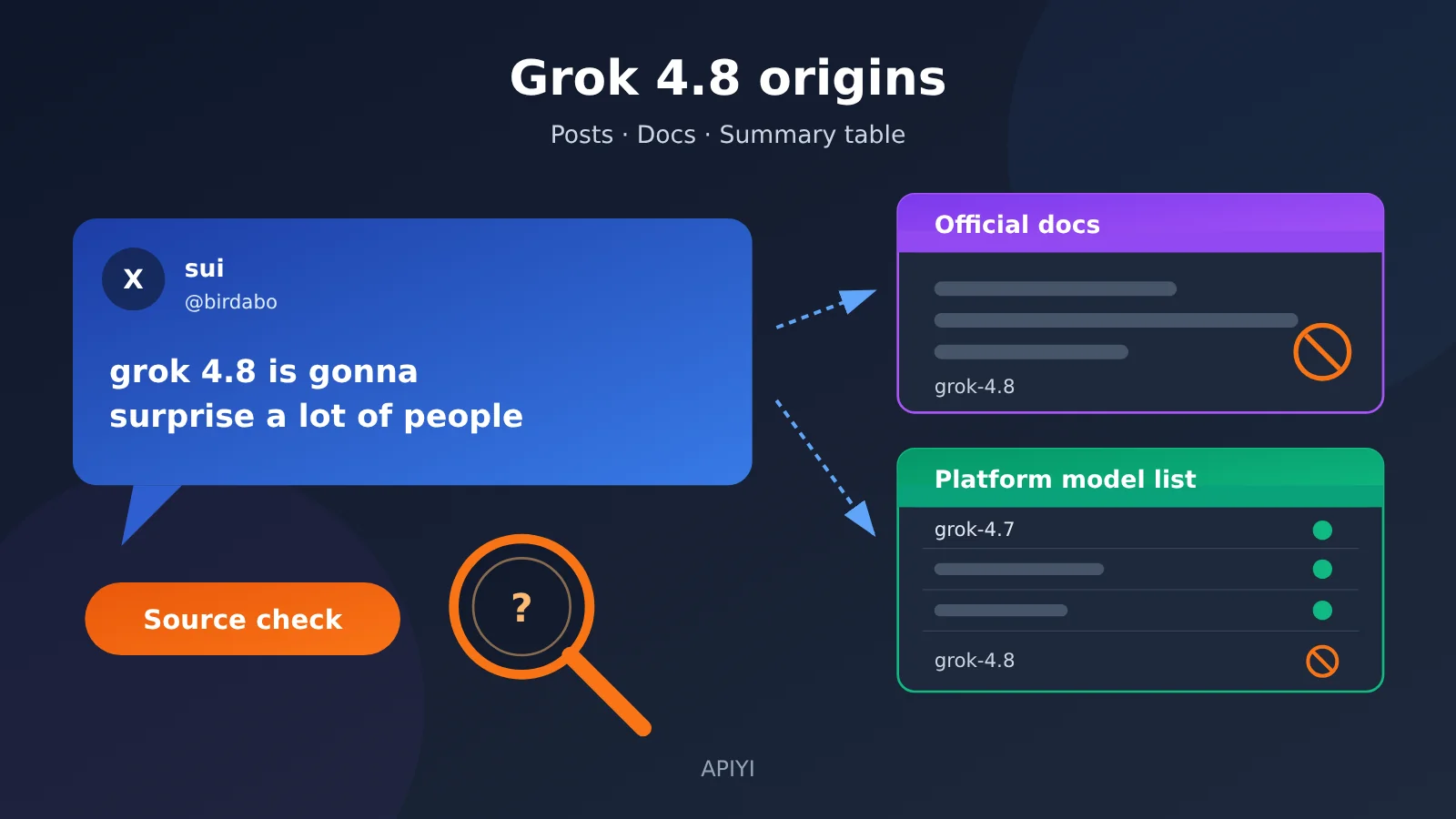
If you’ve been calling Large Language Model APIs lately, you’ve probably run into a short English post in the past couple of days: grok 4.8 is gonna surprise a lot of people. Reposts and screenshots made it look like a teaser, and plenty of people started asking when the new model will be callable and whether pricing is about to change.
This isn’t an article that endorses the rumor. The person who wrote it is a long-standing account in the xAI community that keeps a close eye on every update—not a company employee. The original post has no date, no callable model name, and no price. This article cross-checks the original post, the official documentation, and APIYI’s platform model table separately, so you know how to wire things up today and what to change later.
Core takeaway: three minutes to pin down where the Grok 4.8 line came from and how much weight it actually carries—plus which model to use for text APIs today and what price to budget with.
The Grok 4.8 Claim: Core Information at a Glance
Let’s start by putting the confirmable information into one table. Everything here comes from the original post, public reports, and two documents—no speculation.
| Item | Details | Source type |
|---|---|---|
| Original quote | grok 4.8 is gonna surprise a lot of people | Post text |
| Post time | 2026-11-26 07:59 GMT | Post text |
| Posting account | X account @birdabo, display name sui | Post text |
| Account identity | Called an anonymous X user and xAI watcher by TechCrunch | Media report |
| Release elements in the quote | None—no date, no model name, no price | Post text |
| Official model list | Checked on 2026-11-27; no grok-4.8 | Official docs |
| APIYI platform master list | Among the 278 models updated on 2026-11-27, there is no grok-4.8 | APIYI master list |
Who Said the Grok 4.8 Line?
The poster is X account @birdabo, display name sui. His bio reads chief shitposting officer @SpaceXSI. That line is a joke title he wrote himself, not a company appointment at xAI (now named SpaceXSI). You shouldn’t treat him as a company insider just because @SpaceXSI appears in his bio.
Outside media is more direct about what he is. In an article dated 2026-09-29, TechCrunch called him an “anonymous X user and xAI watcher”—that is, an anonymous X user and a long-time xAI observer. He has no public Grok Build code commit history. He wrote himself that last June he was 22, had no money, and had only 8 followers.
So this article calls him an “xAI community veteran.” He’s been watching xAI long enough, is tuned in to community sentiment, and gets a fair number of reposts. But his role is observer, not the one making the announcement.
Why the Grok 4.8 Line Doesn’t Equal a Release
For a model release, developers need to know at least when it will be usable, what model name to write in calls, and what price they’ll be billed at. Line those items up against the original post, and the gaps are immediately clear.
| Must-have for a release | What an official release usually provides | Does this line have it? |
|---|---|---|
| Timing | Launch date or availability time | No |
| Model name | An ID you can put in the model field |
No—only the colloquial grok 4.8 |
| Price | Unit prices for input, output, and cache | No |
| Context and parameters | Context length, reasoning tiers | No |
| Release channel | Official docs or official account | Personal account |
“It will surprise people” is an emotional judgment. It doesn’t point to anything verifiable. It can be a reference for community sentiment, but it can’t be the basis for API planning. On the same day, Pavel Svitek quoted this post at 2026-11-26 13:47 GMT and added his own conditional judgment. Those conditions are his additions, not part of the original line. Other discussions that grew out of this line aren’t in the original post either, so I won’t go into them here.
How to Verify the Grok 4.8 News: Separate the Three Source Types
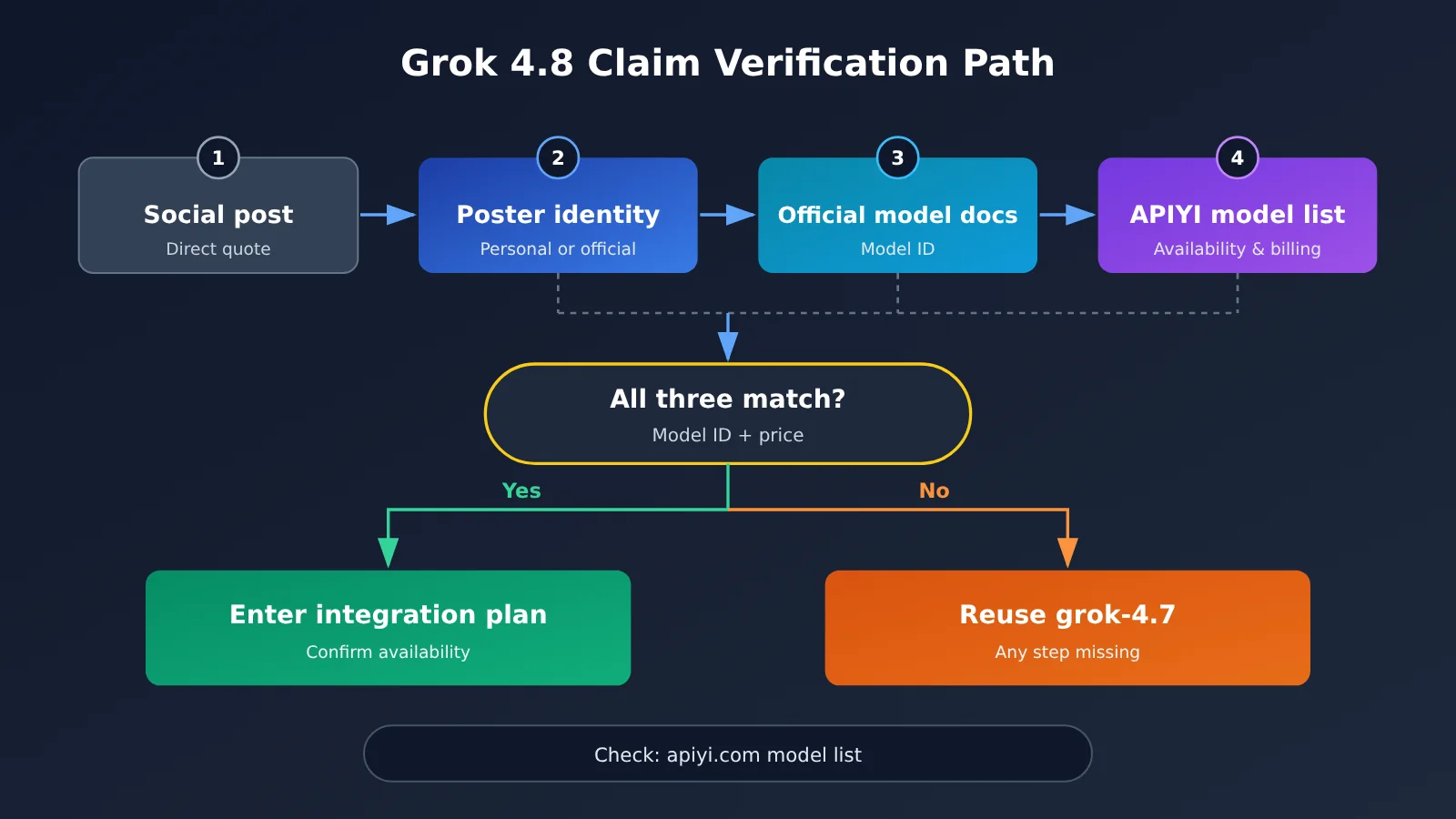
When you run into a short post like this, the safest approach is to separate sources into layers. The original post only shows that “someone said so”; the official docs show “what the vendor offers”; and the platform list shows “what you can call right now and how much it costs.” Mix all three together, and it’s easy to read a casual remark as an official announcement.
| Source type | What I found this time | What it can prove | What it can’t prove |
|---|---|---|---|
| Original post | A single line from @birdabo | Someone in the community expects this | Model existence, launch date, pricing |
| Official docs | The model page doesn’t list grok-4.8, and recommends grok-4.7 for text tasks | The models and prices the vendor currently offers | Future release plans |
| APIYI model list | 278 models, no grok-4.8, includes grok-4.7 | Currently callable models, groups, and billing method | The vendor’s internal roadmap |
I checked the official docs on 2026-11-27. The page is the model list in xAI’s developer docs, and the docs site is credited to SpaceXSI. The page explicitly says to use grok-4.7 for code and other text tasks. APIYI’s model list is on docs.apiyi.com, with data updated at 2026-11-27 11:59 (UTC+8). It has 278 models, and grok-4.8 isn’t there either.
🎯 Verification tip: When you see a rumor about a new model, first search the official model page for the model ID, then check the APIYI model list at apiyi.com to see whether it’s callable. Only when both sides show a clear model ID and price is it worth adding to your development plan.
Before Grok 4.8: The grok-4.7 Model and Pricing You Can Call Today
Since Grok 4.8 is still just a post in a thread, if you want to hook into xAI’s text capabilities today, grok-4.7 is the model the official docs tell you to use. Here are the specs from the official documentation:
- Context length: 500K tokens
- Reasoning tiers: four levels — low, medium, high, xhigh — defaulting to high
- Knowledge cutoff: May 2026
- Positioning: officially recommended for coding and other text tasks
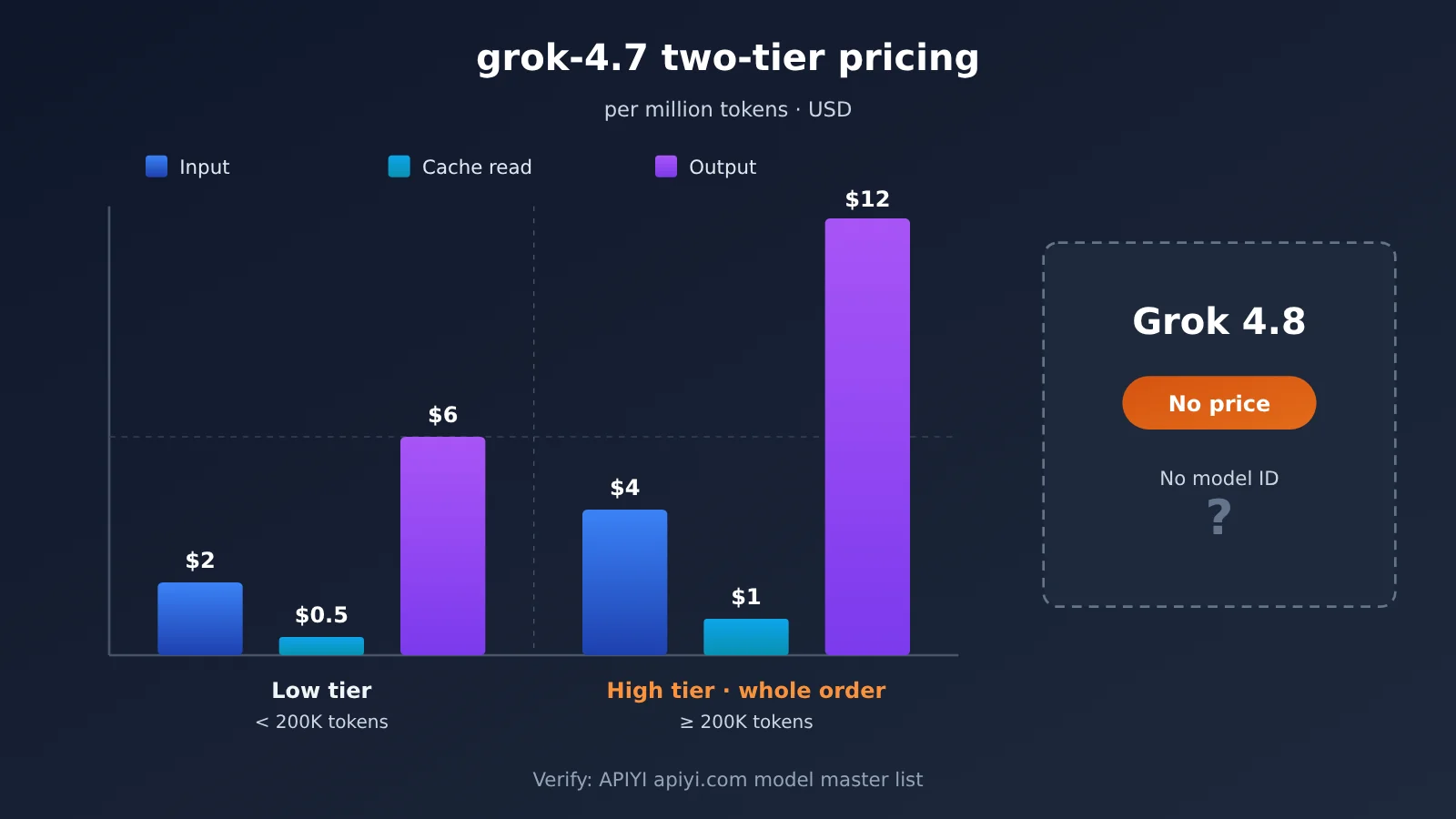
Pricing splits into two tiers based on prompt length, all denominated in USD per million tokens. You can compare the official docs and the APIYI master table side by side:
| Billing item | Official docs: prompt < 200K tokens | Official docs: prompt ≥ 200K tokens | APIYI master table and pricing endpoint |
|---|---|---|---|
| Input | $2 | $4 | $2 at the low tier, $4 at the high tier |
| Cache read | $0.50 | $1 | $0.5 low tier, $1 high tier |
| Output | $6 | $12 | $6 low tier, $12 high tier |
| Available platform | xAI official API | xAI official API | APIYI apiyi.com, chat endpoint |
In the APIYI master table, grok-4.7 occupies just one row, and that row shows the low-tier prices: $2 input, $6 output, $0.5 cache read. The high-tier prices live in the tier notes and the pricing endpoint. The tier notes split it like this: 0 to 200K tokens input bills at $2, and 200,001 to 500K tokens input bills at $4. In the pricing endpoint, the high-tier expression is $4 input, $12 output, and $1 cache read for the whole request.
Two details are worth flagging here. First, the high tier is billed on the entire request — if a single request’s prompt crosses the threshold, the whole request is charged at the high tier, not just the portion above the line. Second, the official docs phrase it as “at or above 200K,” while APIYI’s tier ladder starts at 200,001. A request sitting exactly on the 200K boundary is subject to whatever the platform’s billing says. For tasks involving long documents or big codebases, it’s best to estimate your token count before firing off the request so the whole thing doesn’t slip into the high tier.
💰 Cost tip: If your task’s prompt length tends to hover right around 200K tokens, try a small run first on APIYI apiyi.com’s usage-based billing, then look at the ratio of low-tier to high-tier charges on your bill before deciding whether you need to trim your prompts.
Integrating with grok-4.7: Switching to Grok 4.8 Later Means Changing Just One Field
The grok-4.7 endpoint on APIYI is chat only, and the available groups are CodexResponses, Default, and SVIP. There’s no dedicated model detail page yet, so the model and its pricing are whatever the platform’s model list says. Integration works the same way as the OpenAI-compatible API, so there are only three things to configure:
- base_url: set it to
https://api.apiyi.com/v1 - api_key: set it to the key you generated in the APIYI console
- model: set it to
grok-4.7; if you don’t set a reasoning tier, it runs at the defaulthigh
The upside here is that your business code isn’t coupled to whether Grok 4.8 ships. Once the official docs and the platform model list both show a clear new model ID, you just swap the value of the model field and leave the rest of your code untouched. I’d put the model name in a config file or environment variable — that way, switching doesn’t even cost you a redeploy.
🚀 Quick start: Sign up at APIYI (apiyi.com) to claim free test credits, then get one text request working end to end with
https://api.apiyi.com/v1plusgrok-4.7. Write the model name as a configurable value so you’ve got a hook ready for the eventual switch.
Impact Analysis of the Grok 4.8 Rumors
Impact on developers
- Your integration plan doesn’t need to change: Grok 4.8 has no model ID or pricing yet, so keep using
grok-4.7for today’s text tasks per the official docs - Budget against the two existing tiers: your cost model should be based on the 2/0.5/6 and 4/1/12 tiers — don’t bake unreleased-model pricing into your budget
- Your code needs to be switchable: making
modela config item pays off far more than chasing rumors and editing code - Keep the verification order fixed: original post → official model page → platform model master list, and look at all three separately
Impact on the community and the industry
- Community sentiment leading the way is normal: one sentence from a long-time observer can rapidly amplify expectations, but expectations aren’t a roadmap
- Information layering matters more and more: the same sentence gets requoted with extra conditions attached, so readers need to go back to the original post to confirm what was actually said
- Documentation is the real basis for implementation: for API developers, a model ID showing up in vendor docs and the platform master list is the signal that something is actually actionable
Grok 4.8 FAQ
Q1: Did xAI officially say “Grok 4.8 will surprise people”?
No. That line comes from the X account @birdabo (display name sui), posted on 2026-11-26 at 07:59 GMT. TechCrunch describes him as an anonymous X user and xAI observer — the @SpaceXSI title in his bio is something he wrote himself, not a company appointment.
Q2: Can I call Grok 4.8 through the API right now?
No. The official model page, checked on 2026-11-27, doesn’t list grok-4.8, and it’s not among the 278 models updated on APIYI apiyi.com that same day. We’ll follow up on this model as soon as we can — model names and pricing are whatever the platform’s model list says.
Q3: When will Grok 4.8 be released, and what will it cost?
There’s nothing verifiable right now. The original post gives no date, model ID, or price, and the conditions later commenters tacked on aren’t part of the original statement. Until official documentation shows up, any specific timing or pricing is just guesswork.
Q4: If I want to hook up xAI’s text capabilities today, which model should I use?
Go with `grok-4.7` per the official docs. It has a 500K-token context window, reasoning levels of low, medium, high, and xhigh (default is high), a knowledge cutoff of May 2026, and it’s officially recommended for coding and other text tasks.
Q5: How do I quickly call grok-4.7 through APIYI?
Sign up at APIYI apiyi.com and grab an API key, set base_url to `https://api.apiyi.com/v1`, set `model` to `grok-4.7`, and use the chat endpoint. New users get a free trial quota, so you can get a working call first and then estimate your usage.
Q6: What limitations should I watch out for with grok-4.7?
Mainly the pricing tiers. Once the prompt reaches around 200K tokens, the whole request jumps to $4 for input, $1 for cached reads, and $12 for output per million tokens. Also, on APIYI it currently only exposes the chat endpoint and has no dedicated model detail page — check the platform’s model list for the specifics.
Grok 4.8 Key Takeaways
- Source: The quote comes from @birdabo, a longtime community watcher of xAI — not a company employee
- Weight: The original post has no date, model ID, or pricing attached — it’s just one expectation
- Official status: As of 2026-11-27, the official model page has no grok-4.8, and text tasks recommend
grok-4.7 - Today’s pricing:
grok-4.7runs 2/0.5/6 USD on the low tier and 4/1/12 USD on the high tier, per million tokens - Platform check: APIYI apiyi.com’s master list of 278 models includes no grok-4.8, but
grok-4.7is available - Switch strategy: Make the model name a config item — when a new model ships, you only change the
modelfield
Summary
The core points behind that “Grok 4.8” line:
- The speaker is an observer: @birdabo is a longtime follower of the xAI community. The title in their bio is self-applied, and there are no public Grok Build code commits
- The quote isn’t a release: No date, no model ID, no pricing — and grok-4.8 shows up neither in the official docs nor in the platform’s master list
- Integrate as usual today: For text tasks, use
grok-4.7per the official docs, and estimate costs from the two price tiers
Community anticipation is worth watching, but API planning should follow the docs. Our suggestion: get your pipeline working with grok-4.7 now, keep the model name as a configurable item, and when a new model actually appears in the official docs and platform model list, switch by changing that one field.
We recommend grabbing free credits through APIYI apiyi.com to validate grok-4.7‘s performance first — and for future model listings, keep the platform’s model list as your source of truth.
📚 References
-
Original post – @birdabo: “grok 4.8 is gonna surprise a lot of people” — the original post
- Link:
x.com/birdabo/status/2125861881630142875 - Note: Posted on 2026-11-26 07:59 GMT; this is the source of the quote discussed in this article.
- Link:
-
Original post – Pavel Svitek’s quote post: a secondary quote of the above original post
- Link:
x.com/pavelsvitek/status/2125949509440049436 - Note: Posted on 2026-11-26 13:47 GMT. The conditional wording was added by the person quoting it and is not part of the original quote.
- Link:
-
Media report – TechCrunch: describes @birdabo as an anonymous X user and xAI watcher
- Link:
techcrunch.com/2026/09/29/the-internet-is-convinced-elon-musks-xai-trolled-openais-dots-launch - Note: Used to confirm the poster’s external identity description.
- Link:
-
Official documentation – xAI (SpaceXSI) model list: grok-4.7 specs and two-tier pricing
- Link:
docs.x.ai/developers/models - Note: Checked on 2026-11-27; there is no grok-4.8.
- Link:
-
APIYI master list – platform model list: available models, groups, and billing methods
- Link:
docs.apiyi.com/models - Note: Data updated on 2026-11-27 11:59 (UTC+8); 278 models in total.
- Link:
Author: APIYI Technical Team
Technical inquiries: Feel free to contact us through the APIYI apiyi.com homepage. For more models and integration materials, visit the docs.apiyi.com documentation center.