Author’s note: The promotional pricing for Gemini 4 Carbon ends on December 1. Input, output, and cache reads all double. This article uses the same usage volume to calculate the per-task and monthly costs across four tiers, then lays out three cost-saving levers that don’t require switching models and a tier-switching checklist.
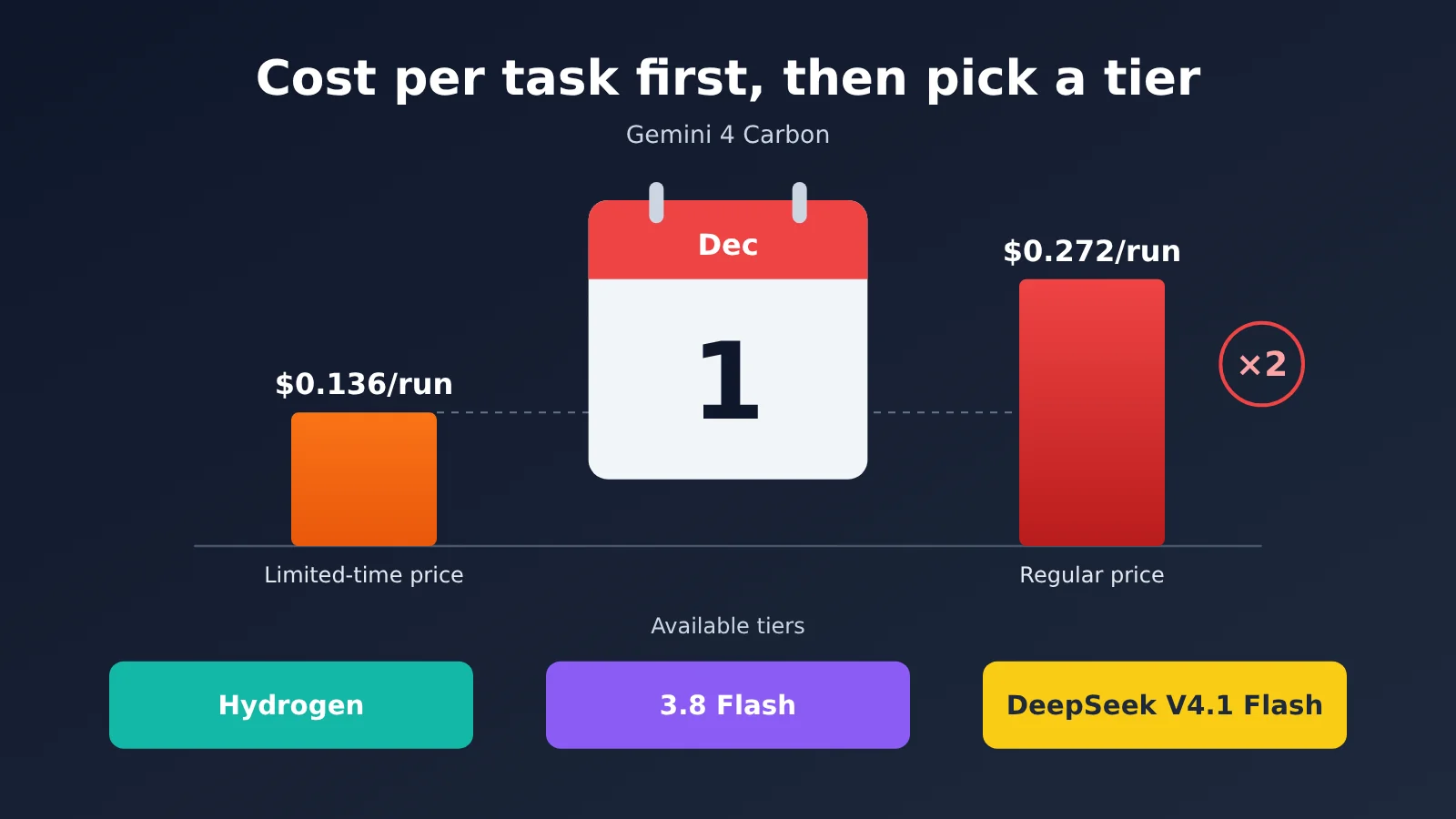
There are only a few days left until December 1. On that day, the promotional pricing for gemini-4-carbon ends, and input goes from $2 back to $4, output from $10 back to $20, and cache reads from $0.1 back to $0.2 (per 1M tokens). All three prices double at the same time, so your bill for the same usage will double exactly.
This isn’t a rumor. The Google Gemini Developer API pricing page, the Google Cloud pricing page, the LiteLLM blog, and APIYI’s launch announcement all say the same thing: promotional pricing runs through November 30, 2026, and regular pricing returns on December 1.
This also isn’t a “Carbon is finished” article. Carbon is still Google’s strongest reasoning tier right now. The question this article answers is more specific: how much more your bill will be next month, which tasks can move to other tiers, and which tasks should stay on Carbon. By the time you finish reading, you’ll have a comparison table calculated on a per-task cost basis, three cost-saving levers that don’t require switching models, and a tier-switching checklist you can put into action right away.
Gemini 4 Carbon Doubles on December 1: How the Pricing Actually Changes
Let’s start with the official numbers. The table below pulls together Carbon pricing from Google’s pricing page and the LiteLLM blog, in USD per 1M tokens. Thinking tokens are billed at the output rate.
| Billing item | Before November 30 (limited-time price) | From December 1 | Notes |
|---|---|---|---|
| Standard input | $2.00 | $4.00 | Global endpoint |
| Standard output (including thinking) | $10.00 | $20.00 | Thinking tokens billed at the output rate |
| Cache read | $0.10 | $0.20 | Implicit caching only |
| Batch / Flex input/output | $1.00 / $5.00 | $2.00 / $10.00 | Half the standard price |
| Priority input/output | $3.60 / $18.00 | $7.20 / $36.00 | 1.8× the standard price |
| Non-global input/cache/output | $2.20 / $0.11 / $11.00 | $4.40 / $0.22 / $22.00 | Regional endpoints cost 10% more |
One thing to keep in mind: the official announcement only covers the price changes for Carbon and Argon. Whether Hydrogen and the other tiers change price after December 1 hasn’t been stated officially, and we won’t speculate on them here.
Current pricing for Gemini 4 Carbon on APIYI
APIYI’s master model price list (data as of 2026-11-25 12:49 UTC+8) lists the default prices for Carbon and a few neighboring tiers. The prices below are default list prices; top-up promotions (starting at roughly 9% off) and group discounts can stack, and the console is the final word on what you actually get charged. For actual quotes after December 1, refer to the model list on the APIYI apiyi.com platform.
| Model | Input $/1M | Output $/1M | Cache read $/1M | Endpoints | Available on |
|---|---|---|---|---|---|
gemini-4-carbon |
2 | 10 | 0.1 | chat, gemini | APIYI apiyi.com |
gemini-4-hydrogen |
1.5 | 7.5 | 0.075 | chat, gemini | APIYI apiyi.com |
gemini-3.8-flash |
0.75 | 3.75 | 0.075 | chat, gemini | APIYI apiyi.com |
gemini-3.1-flash-lite |
0.25 | 1.5 | 0.025 | chat, gemini | APIYI apiyi.com |
deepseek-v4.1-flash |
0.3 | 1.2 | 0.006 | chat, messages | APIYI apiyi.com |
Carbon’s specs: a 1,048,576-token context window and a maximum output of 65,536 tokens. Input accepts text, images, video, and audio; output is text; the knowledge cutoff is 2026-03. The vendor released it on 2026-11-10, APIYI brought it online on 2026-11-11, and both the Default and SVIP groups sit at a 1× rate multiplier.
Gemini 4 Carbon per-task cost formula: four tiers with the same usage
Comparing unit prices alone is easy to get wrong; per-task cost is a more accurate comparison. Here’s the cost-per-run formula—swap in your own usage for any of the variables:
Cost per run = uncached input tokens ÷ 1e6 × input price + cached tokens ÷ 1e6 × cache price + output tokens ÷ 1e6 × output price
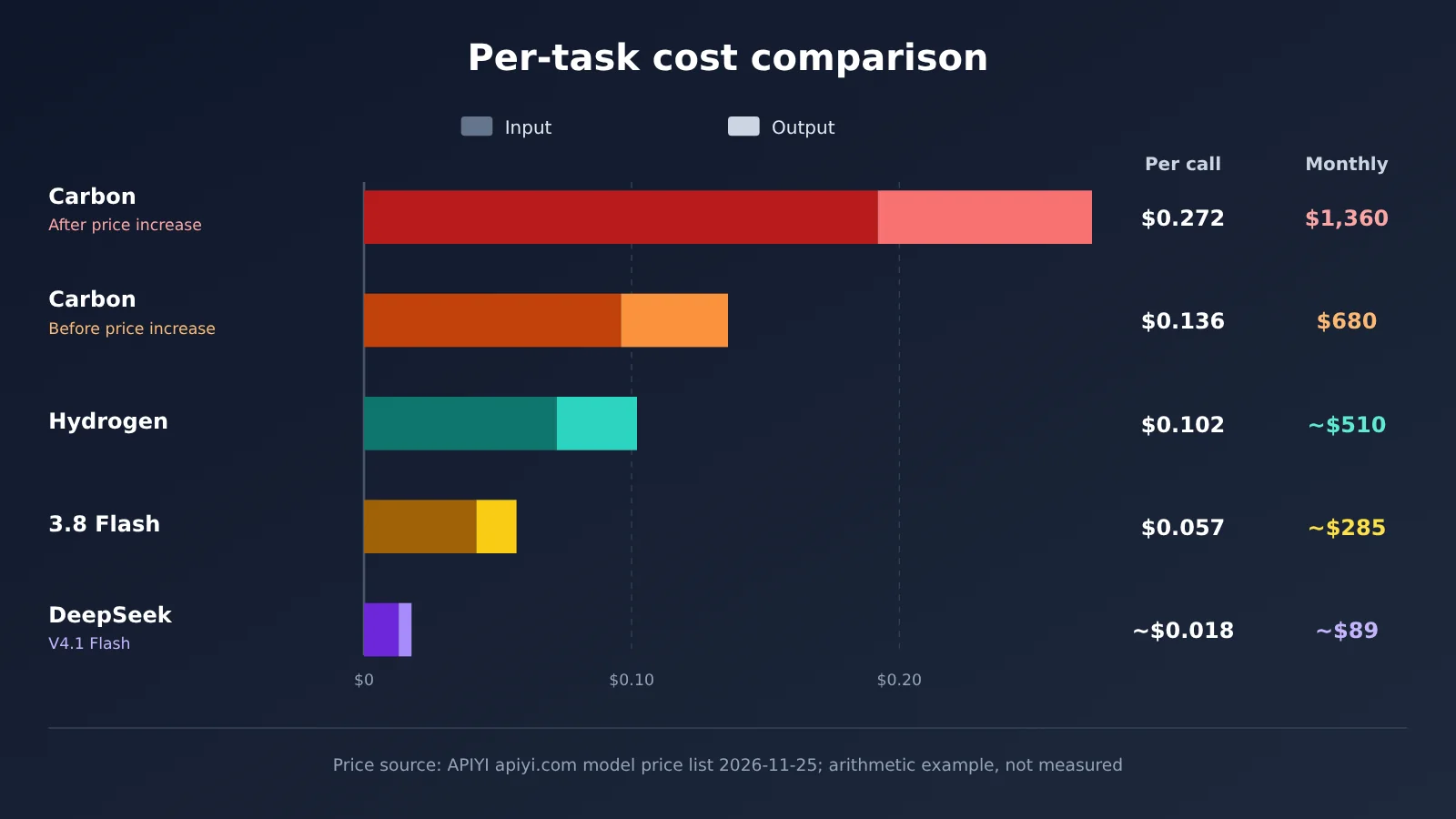
The sample usage is a typical long-context task: 200,000 input tokens, of which 160,000 hit the cache and 40,000 miss; 4,000 output tokens (Carbon’s thinking tokens count toward output). Unit prices for each tier come from the 2026-11-25 price table in the previous section; for Carbon’s post-increase numbers, we use the official December 1 prices.
| Model | Uncached input | Cache read | Output | Cost per run | Monthly cost (5,000 runs) |
|---|---|---|---|---|---|
gemini-4-carbon before price increase |
$0.080 | $0.016 | $0.040 | $0.136 | $680 |
gemini-4-carbon after price increase |
$0.160 | $0.032 | $0.080 | $0.272 | $1,360 |
gemini-4-hydrogen (11-25 list price) |
$0.060 | $0.012 | $0.030 | $0.102 | ~$510 |
gemini-3.8-flash |
$0.030 | $0.012 | $0.015 | $0.057 | ~$285 |
deepseek-v4.1-flash |
$0.012 | $0.00096 | $0.0048 | ~$0.018 | ~$89 |
All of the above are arithmetic examples, not actual bills. After the price increase, Carbon costs about $680 more per month. At current list prices, Hydrogen comes in at about 37% of post-increase Carbon per run. 3.8 Flash is about 21%, and DeepSeek V4.1 Flash is under 7%.
Same unit price doesn’t always mean the same bill
The calculation above assumes all four models produce the same number of output tokens, but that’s not how it works in practice. Google itself reports that Carbon consumes more tokens than Argon because it thinks longer. Single-case data from third-party Artificial Analysis shows Carbon consuming roughly 200 million output tokens to complete the full index.
So when you switch tiers, output token counts can change too. What you should compare is the total bill for the same batch of requests, not the unit price on the rate card. The same third-party data also measured Carbon’s AA-Omniscience hallucination rate at about 11%, versus about 4% for Argon. That’s a third-party measurement, not an APIYI comparison review. The point is to remind you: the most capable tier isn’t necessarily the most reliable on every task.
Gemini 4 Carbon: Three Cost-Saving Levers Without Switching Models
If your workload really needs Carbon, you can hold off on switching models and cut costs through billing instead. Each of the three levers has its own conditions and trade-offs:
| Lever | When it works | How much you save | What it costs you |
|---|---|---|---|
| Implicit caching | Prefix is byte-for-byte identical and ≥ 4,096 tokens | Cached portion billed at just 5% of the input price | You have to restructure your prompt, and you can’t guarantee a hit rate |
| Batch / Flex | The task can be queued offline | Half the standard price | High latency, so it’s a poor fit for interactive use |
| Thinking level high → low | The task isn’t sensitive to reasoning depth | Directly reduces thinking output tokens | The official quality curve isn’t published, so you’ll have to evaluate it yourself |
Lever one: implicit caching. Carbon only supports implicit caching, not explicit caching. The prefix must be at least 4,096 tokens to trigger it, and the cached portion costs 95% less than standard input. To raise your hit rate, put the system prompt, long documents, and codebase index at the very front of the request, and make sure that part is identical across requests, character for character. Anything that changes, like timestamps or user IDs, should go later. How big is the cost impact? Using the new, higher prices, if nothing hits the cache, a single request costs 200,000 × $4 + 4,000 × $20, about $0.88 — more than three times the cost at an 80% hit rate.
Lever two: Batch and Flex. The official Batch/Flex pricing starting December 1 is $2 for input and $10 for output, with a secondary source quoting a cached price of $0.10. For the sample usage, that comes to about $0.136 per request — exactly the pre-increase standard price. The trade-off is latency, which makes it a good fit for overnight batch summarization, offline evaluation, and data labeling — anything that doesn’t need a real-time response. Conversely, Priority output is $36 after the increase, so it’s only worth it when you absolutely must guarantee low latency.
Lever three: thinking level. Carbon defaults to the medium level, and you can set it to low, medium, or high — minimal isn’t supported. Thinking tokens are billed as output, so at the new prices, every 1,000 fewer output tokens saves $0.02. For exploratory and draft-style tasks, dropping to low is the most direct way to save money. But the official quality curve for the different levels isn’t published, so you’ll need to verify the results on your own evaluation set.
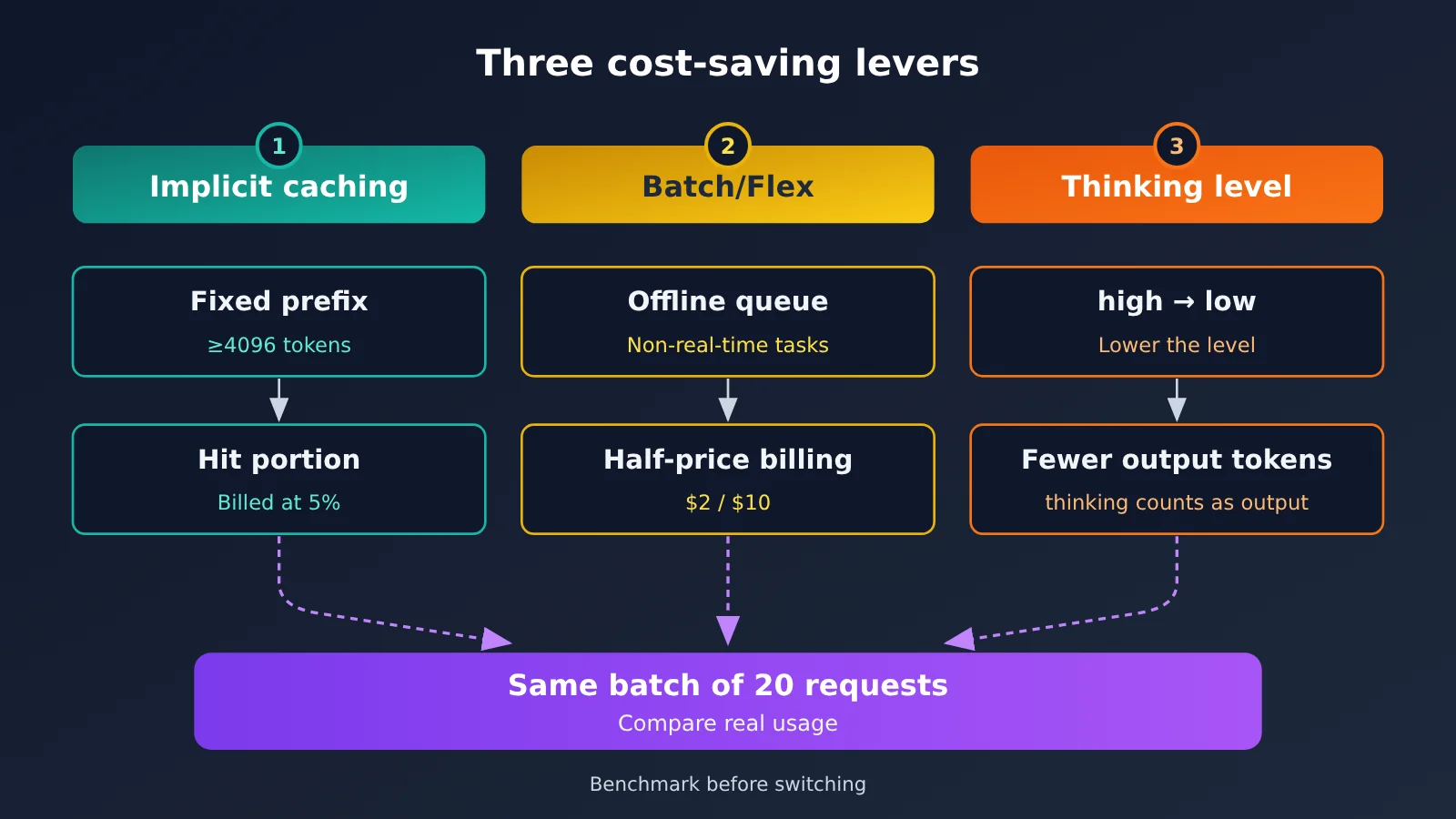
🎯 Technical tip: The three levers can be stacked. Start by running the same batch of real requests on APIYI apiyi.com with two settings — “caching on” and “lower thinking level” — and record how
cached_tokensandcompletion_tokenschange before deciding whether you actually need to switch models.
Gemini 4 Carbon Scenario Recommendations: What to Keep, What to Switch
The answer depends on the task—there’s no one-size-fits-all rule. Below are recommendations based on task characteristics, but every decision should be validated on your own evaluation set.
Tasks That Are Better Left on Gemini 4 Carbon
- Multi-step reasoning and complex decisions: for example, cross-file architecture refactoring or long-chain data analysis. For these tasks, the cost of rework after downgrading is often higher than the tokens you save.
- Very long multimodal inputs: when you need to process video, audio, and documents together within a 1M context window, Carbon’s context and modality coverage are its main strengths.
- Tasks where a single mistake is very costly: generating legal or financial conclusions. Even if you keep these on Carbon, add a validation layer—third-party measurements show its hallucination rate isn’t low.
Tasks You Can Consider Downgrading
gemini-4-hydrogen: Also part of the Gemini 4 family. It’s a good fit for medium-complexity long-document Q&A and code review, at roughly $0.102 per call at current list pricing.gemini-3.8-flash: Good for structured tasks like information extraction, classification, and format conversion, at about $0.057 per call.deepseek-v4.1-flash: Cache reads cost only $0.006, making it a good fit for high-frequency batch jobs with repeated prefixes, at about $0.018 per call. It uses the chat and messages endpoints and doesn’t support Gemini’s native endpoints.
| Task characteristic | Recommended tier | Why | First lever to try |
|---|---|---|---|
| Deep reasoning, high cost of errors | gemini-4-carbon |
Strongest reasoning capability | Caching + keep medium |
| Medium reasoning, long context | gemini-4-hydrogen |
Same family, lower cost | Caching |
| Structured extraction, classification | gemini-3.8-flash |
Per-call cost is about one-fifth of what Carbon costs after the price increase | Batch |
| High-frequency batch, repeated prefixes | deepseek-v4.1-flash |
Cache-read price is extremely low | Fixed prefix |
| Offline batch processing that must use Carbon | gemini-4-carbon Batch |
Half price, close to pre-increase levels | Batch + low |
💡 Selection tip: Different tasks within the same product can be assigned to different tiers. With APIYI apiyi.com, you can call every model in the table above using a single API key—so when you split routing by task, you don’t need to maintain multiple accounts.
Gemini 4 Carbon Tier Switch Checklist: Only Change the model Name
The actual switch is a small change, but you still need to do the comparison work. Follow these steps in order:
- Keep
base_urlunchanged: OpenAI-compatible calls still usebase_url="https://api.apiyi.com/v1". Initialization looks likeclient = OpenAI(api_key="YOUR_API_KEY", base_url="https://api.apiyi.com/v1"). The native Gemini endpoint uses the/v1betapath. - Change only the model name: swap
model="gemini-4-carbon"formodel="gemini-4-hydrogen"or another tier. Themessagesstructure doesn’t need to change. When switching todeepseek-v4.1-flash, make sure you’re using the chat endpoint. - Remove Carbon-specific parameters: Carbon’s sampling parameters are fixed (
temperature1.0,topP0.95,topK64), and any custom values you pass in are ignored. It doesn’t supportthinkingBudget; passing it should return400. If you switch back to Carbon from another model, remember to remove these parameters. - Save a usage snapshot before switching: run Carbon with 20 real requests and record
prompt_tokens,cached_tokens, andcompletion_tokens. - Save another usage snapshot after switching: run the same batch of 20 requests on the new tier, record the same three fields, and manually check output quality.
- Plug the numbers into the formula to compare per-task cost: use the two usage snapshots to calculate cost per request, then multiply by your monthly call volume. You’re comparing per-task cost, not unit price.
🚀 Quick start: Register at APIYI apiyi.com to get free trial credits, enough to complete the two-part comparison for the 20 requests above. It’s pay-as-you-go, so after you run them you’ll see the real usage for each model.
Gemini 4 Carbon Decision Recommendations
💡 Decision recommendation: Before December 1st, use the current limited-time pricing to run all 20 comparison requests and get your data in the cheapest time window. Once you have the data, make the call in three steps: first, if the cache hit rate is lower than expected, adjust the prompt structure; second, move tasks that don’t need real-time responses to Batch first; third, if the per-task cost still exceeds budget after the first two steps, move tasks that aren’t sensitive to reasoning depth to the Hydrogen or Flash tier. If you’re calling multiple models at the same time, you can run all comparisons through a single interface via APIYI apiyi.com.
FAQ
Q1: How much exactly will Gemini 4 Carbon increase after December 1st?
According to the official statement, the Global endpoint input goes from $2 to $4, output from $10 to $20, and cache reads from $0.1 to $0.2 (per 1M tokens)—all three double. Non-global regional endpoints are another 10% more expensive on top of that.
Q2: How much does the per-task cost differ between Gemini 4 Carbon and Hydrogen?
Based on the example usage in this article, after the price increase Carbon costs $0.272 per call, while Hydrogen costs $0.102 per call at the 2026-11-25 list price. Whether Hydrogen will have a price adjustment after December 1st hasn’t been announced officially—refer to the platform’s model list.
Q3: What’s the actual price for calling through APIYI after December 1st?
The pricing table data in this article is as of 2026-11-25. For actual quotes after December 1st, please check the model list on the APIYI apiyi.com platform. The actual charges after stacking top-up promotions and group discounts are subject to the console.
Q4: Why does implicit caching often miss?
There are two most common reasons: the prefix is under 4,096 tokens, or the prefix contains content that changes every time, such as timestamps or session IDs. Putting fixed content at the very front and keeping it word-for-word identical usually improves the hit rate.
Q5: How do I fastest complete a tier-switching comparison for Gemini 4 Carbon?
Keep `https://api.apiyi.com/v1` unchanged, change only the model name, and run the same batch of 20 real requests against both models while recording usage. APIYI apiyi.com’s free credits for new users can cover this small-scale comparison.
Q6: What are the risks of lowering the thinking tier?
Thinking tokens are billed as output, so dropping to low can directly cut costs. But the official quality curves for different tiers haven’t been published, so complex reasoning tasks may fail as a result—you must validate on your own evaluation set first. Also, Carbon doesn’t support the minimal tier or the `thinkingBudget` parameter.
Gemini 4 Carbon Tier-Switch Key Takeaways
- All three rates doubled at once: input, output, and cache reads all doubled, so the per-call cost at the same usage goes from $0.136 to $0.272.
- Compare per-task cost, not unit price: plug your usage into the formula and factor in the differences in output token counts across models.
- Caching is the biggest lever: with a fixed prefix of ≥ 4,096 tokens, the cached portion costs 95% less than standard input.
- Batch can offset the increase: move offline jobs to Batch and the per-call cost lands roughly where the pre-increase standard price was.
- Split tiers by task: keep deep reasoning on Carbon, move structured tasks to Flash, and consider DeepSeek for high-frequency batch jobs.
- Switching tiers is cheap: base_url stays the same — you only change the model name. On APIYI apiyi.com, one API key is enough to run the whole comparison.
Summary
Gemini 4 Carbon doubles on December 1, and there are three things worth remembering:
- The doubled bill is a certainty: at the example usage, 5,000 calls a month goes from $680 to $1,360.
- Pull the levers first, then think about switching models: implicit caching, Batch/Flex, and thinking levels — none of these require changing the model.
- Let data decide the switch: 20 real requests, two usage reports, and one formula are enough to work out the per-task cost.
It’s best to have your comparison data in hand before November 30, so you can capture comparable usage during the last few days of the limited-time pricing. Running a single comparison across Carbon, Hydrogen, Flash, and other tiers through APIYI apiyi.com is the recommended approach.
📚 References
- APIYI Gemini 4 Carbon Launch Announcement: when the limited-time price applies and when it returns to the original price
- Link:
docs.apiyi.com/news/gemini-4-carbon-launch - Description: the APIYI integration date and the limited-time pricing deadline
- Link:
- APIYI Model Price Master List: default listed prices for adjacent tiers
- Link:
docs.apiyi.com/models - Description: data as of 2026-11-25; after December 1, refer to the platform’s model list
- Link:
- Google Gemini Developer API Pricing Page: the official word on the price increase
- Link:
aistudio.google.com/docs/pricing - Description: before-and-after prices for input, output, and caching, plus a note on implicit-only caching
- Link:
- Google Cloud Pricing Page: Global vs. non-global endpoint pricing
- Link:
cloud.google.com/model-garden/pricing - Description: price differences for regional endpoints
- Link:
- LiteLLM Blog: Batch, Flex, and Priority pricing
- Link:
docs.litellm.ai/blog/gemini-4-carbon - Description: complete pricing across multiple billing modes
- Link:
Author: APIYI Technical Team
Technical Discussion: Feel free to reach us via the APIYI homepage; for more integration resources, check the docs.apiyi.com documentation center