
Author’s note: How teams already running Gemini 4 Carbon should think about Gemini 4 Neon. This article aligns intelligence scores by thinking tier, checks three separate per-task cost ledgers, and lists the models and prices you can call on APIYI.
Google released Gemini 4 Neon on 2026-11-18. Sundar Pichai posted about it that day, noting that it targets complex software engineering, knowledge work, and scientific workflows, and that it shipped simultaneously across the Gemini API in Google AI Studio, Gemini for business, Google Antigravity, and the Gemini App. The same day, the DeepMind model card, the Google Cloud developer guide, and Artificial Analysis’s review all went live, so you can cross-reference them against each other.
If you already have Gemini 4 Carbon running in production, the question you actually need answered is very concrete: is Gemini 4 Neon meant to replace Carbon, or does it sit beside it and take over part of the workload? This article splits that question into two halves: how much depth actually differs, and how many cost ledgers a single task really has.
Core value: By the end of this article, you’ll have intelligence scores aligned by thinking tier, three cost ledgers built on different accounting bases, and the models and prices you can call directly on APIYI. Whether to switch ultimately comes down to your own task data.
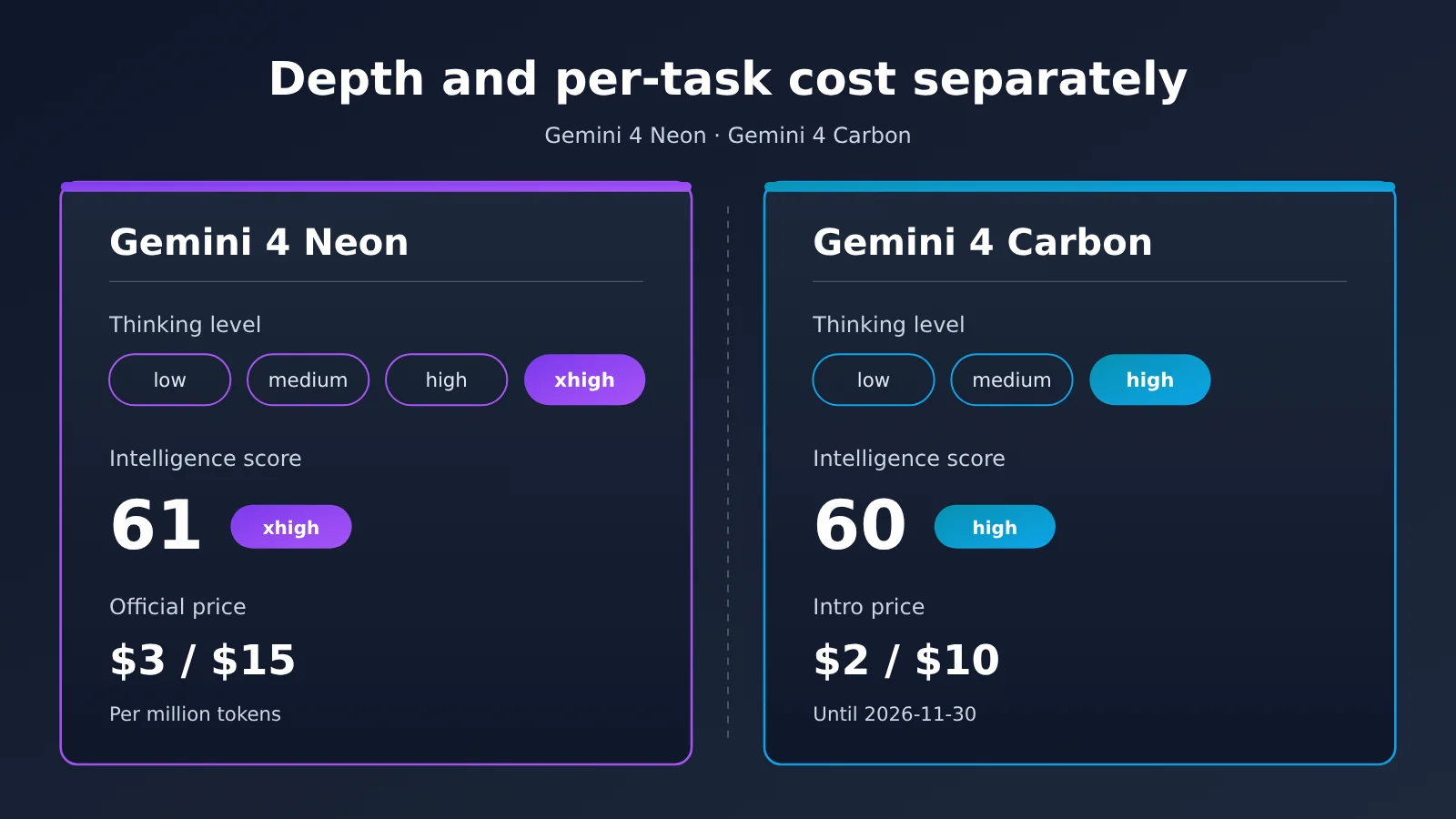
Gemini 4 Neon vs. Gemini 4 Carbon: Key Takeaways
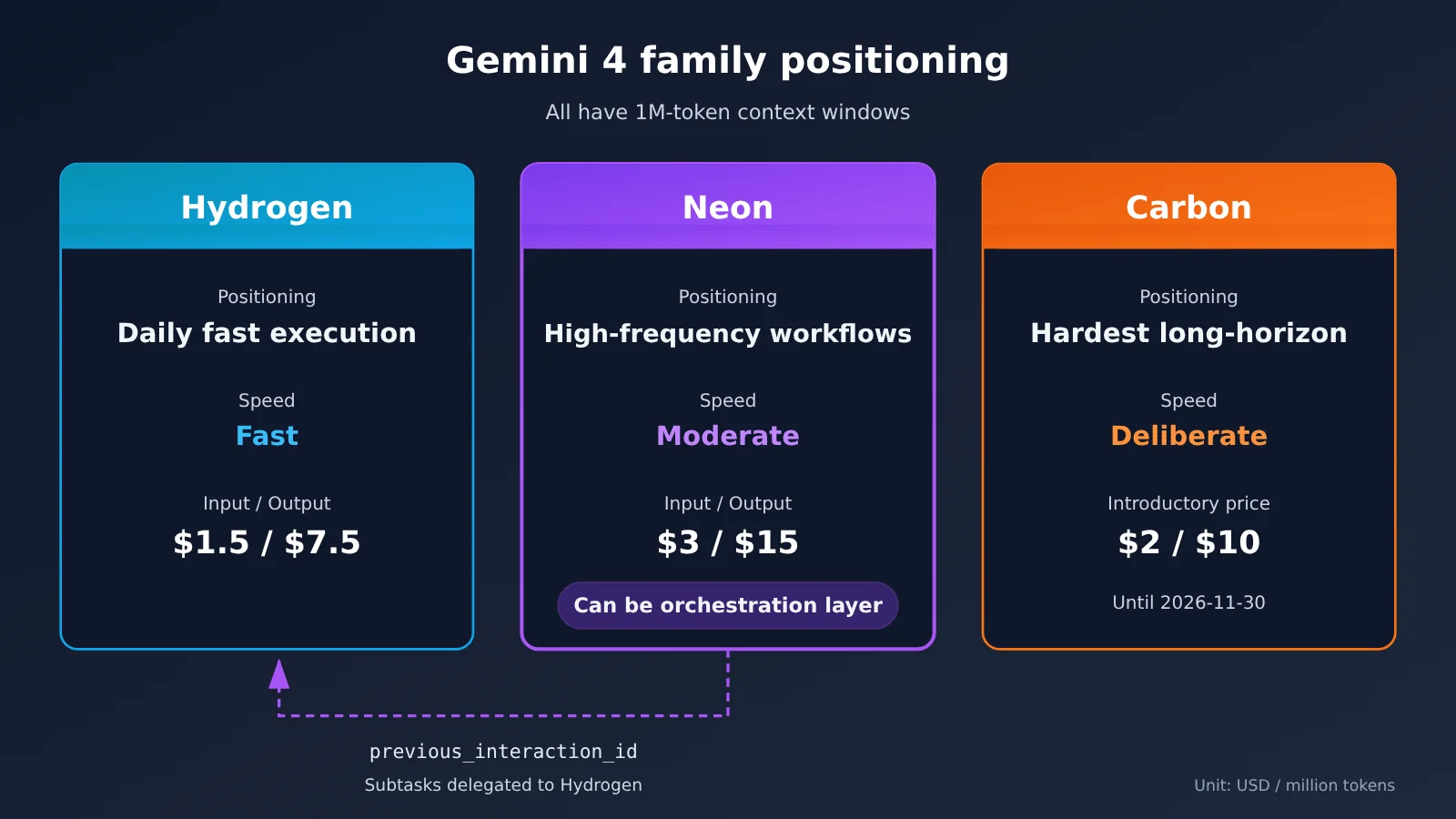
The Gemini 4 family currently has three models: Carbon, Neon, and Hydrogen. Google’s blog and the Google Cloud developer guide are consistent on positioning — Neon sits between Hydrogen and Carbon.
| Model | Official positioning (Google blog, developer guide) | Speed characterization (AI Studio latest models page) | Thinking levels | Default |
|---|---|---|---|---|
| Gemini 4 Carbon | Hardest long-horizon tasks | Deliberate | low / medium / high, no xhigh | medium |
| Gemini 4 Neon | Middle ground, aimed at high-frequency complex workflows | Moderate | low / medium / high / xhigh | high |
| Gemini 4 Hydrogen | Everyday fast execution | Fast | Not listed in reference materials | Not listed in reference materials |
How Gemini 4 Neon relates to Carbon in the family
According to the model card, Gemini 4 Neon is adapted from Gemini 4 Carbon, has a knowledge cutoff of March 2026, and accepts text, images, audio, and video as input. The unified window is up to 1M tokens, default synchronous output is up to 64K tokens, and background long decoding goes up to 1M. The AI Studio latest models page shows all three models share the same 1M unified-token context and 64K default synchronous output.
The context specs are identical, so the differences come down mainly to thinking depth, speed characterization, and unit price. The Google Cloud developer guide suggests one combined approach: use gemini-4-neon for orchestration and hand previous_interaction_id to gemini-4-hydrogen to run faster subtasks. In that framing, Neon doesn’t have to replace anything — it can serve as the middle layer of the family.
One thing to note: the model card’s comparison table has only three columns — Gemini 4 Neon, Claude Opus 5.5, and GPT-6.2 Sol — there’s no Gemini 4 Carbon column. The evaluation notes PDF also states that non-Gemini results come from each vendor’s self-reported figures by default. So when comparing Neon and Carbon, the main sources are the scattered official self-reported numbers in Google’s blog plus third-party measurements from Artificial Analysis.
Gemini 4 Neon vs Carbon: How Big Is the Depth Gap?
Before comparing depth, let’s line up the tiers. According to the latest model page in AI Studio, Carbon’s thinking levels are low, medium (default), and high — there’s no xhigh. Artificial Analysis’s Carbon model page doesn’t list xhigh either. So when Artificial Analysis compares against Neon xhigh, it’s actually comparing against Carbon high.
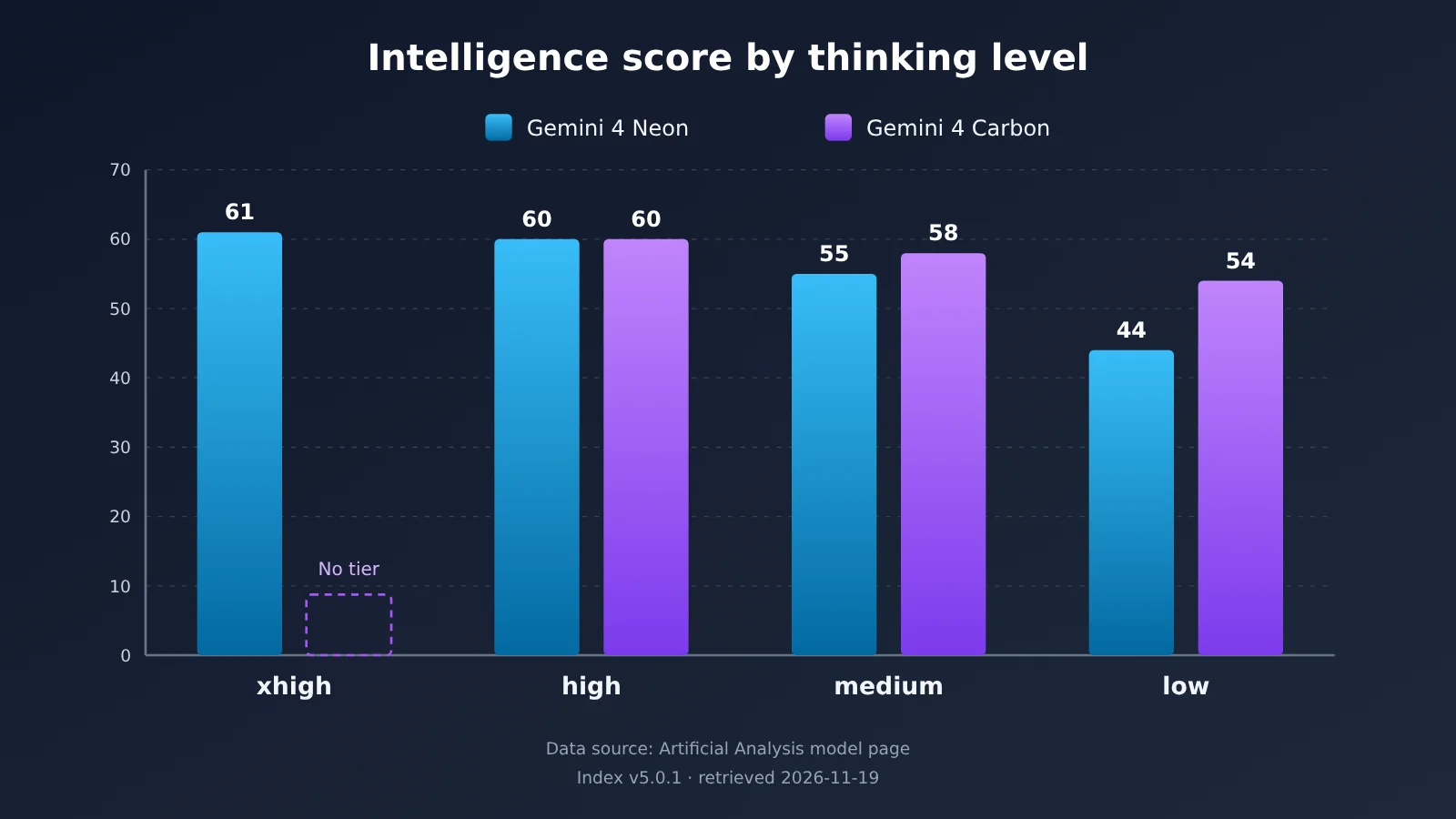
| Thinking level | Gemini 4 Neon intelligence score | Gemini 4 Carbon intelligence score | Notes |
|---|---|---|---|
| xhigh | 61 | Not a tier on that page | Neon-only tier |
| high | 60 | 60 | Same score; Neon’s default tier |
| medium | 55 | 58 | Carbon’s default tier |
| low | 44 | 54 | Carbon scores higher at the low tier |
The table above comes from the Artificial Analysis model page, index version v5.0.1, read on 2026-11-19. According to the Artificial Analysis article, Neon xhigh’s 61 is 1 point higher than Carbon high, putting it 3rd overall — ahead of it are GPT-6.2 Astra (max) and Claude Fable 5.2 (max). Google’s official blog post also reports 61 at xhigh and 3rd overall, and the AA Index v5.0.1 row on the model card says 61 too. The intelligence score number is consistent across all three sources.
The table also makes clear something that often gets overlooked: at the high tier, the two are tied. At medium and low, the Artificial Analysis model page shows Carbon scoring higher. So the claim “Neon is deeper” only holds for xhigh versus Carbon high — and the gap is 1 point.
Sub-metrics for Gemini 4 Neon and Carbon
Looking only at the total score makes it easy to miss details. The following items have numbers for both Neon and Carbon, but they come from different sources, so the methodologies need to be tracked separately:
- GDP.pdf (Artificial Analysis article): Neon high 33.4%, Carbon high 28.4%, Neon xhigh 28.0%. On this benchmark, xhigh scores lower than high, which shows that a higher thinking level doesn’t necessarily mean a higher score.
- Coding Agent Index: The Artificial Analysis article reports Neon xhigh 59 and Carbon high 55 on Antigravity CLI; Google’s blog reports 58.6 and calls it 1st overall. These two numbers don’t match, so both are kept here rather than merged.
- MKA: The Artificial Analysis article reports Neon 56%, 2 points above Carbon; the model card reports MKA Climb WSR 56.5%. Again, the two numbers are recorded separately.
- CWE-bench v2 (official self-reported): Neon 70.7%, 3.4 percentage points above Carbon. This is a cybersecurity-oriented result; the cyber version will be provided only to trusted defenders in the Fairwind Program for a few days, with no public model ID.
- Safety behavior (official self-reported): 43% to 56% less underservice than Carbon, and 15% to 35% less overreach than Carbon.
One quick note on speed: according to the Artificial Analysis model page, Carbon high outputs 55 tokens/sec with 37.2 minutes per task, while Neon xhigh outputs 110 tokens/sec with 21.5 minutes per task. More details go in the speed section.
Gemini 4 Neon vs. Carbon: Three Separate Cost Calculations
Let’s start with the unit prices. According to the AI Studio pricing page, gemini-4-neon has no free tier. Its paid pricing is $3.00 per million input tokens and $15.00 per million output tokens (including thinking tokens), with caching at $0.15 — implicit caching only. Carbon is a bit more complicated: the intro price on AI Studio’s latest models page is valid through 2026-11-30 at 2.00 for input and 10.00 for output, while the standard price cited in the Artificial Analysis article is 4/20.
Which Carbon price you use directly changes the conclusion. The three calculations below each stand on their own — you can’t add or subtract between them.
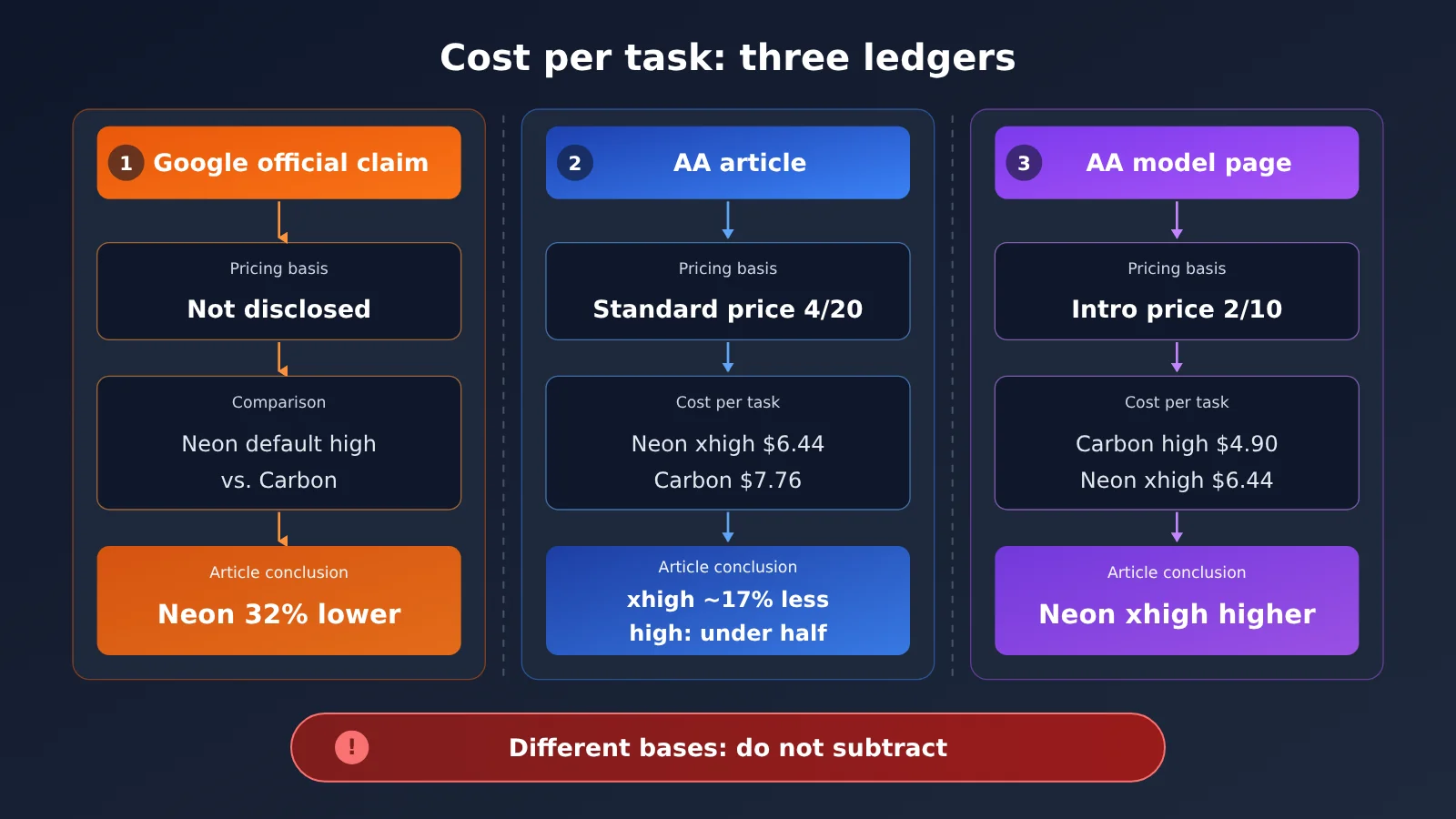
Ledger One: Google’s Own Numbers Say Neon Is 32% Cheaper per Task
Google’s blog states that under the default high tier, Neon’s per-task cost is 32% lower than Carbon’s. That’s Google’s own cost methodology — the blog doesn’t say whether Carbon’s figure uses the introductory price or the standard price, so there’s no way for outsiders to reproduce it.
The blog also mentions that on Vals and Agent Arena, Neon high’s per-task cost is roughly 50% to 80% lower than leading competitors, and xhigh is still more than 36% below competitors’ top tiers. These are likewise official self-reported figures. Our take: treat them as directional signals, not as numbers you’d put straight into a budget.
Ledger Two: The Artificial Analysis Article, Priced at Carbon’s Standard Rate
The Artificial Analysis article reports: Neon xhigh costs $6.44 per task, while Carbon at its non-discounted price is $7.76 — so Neon comes out roughly 17% cheaper. The article also breaks down why: Neon’s output tokens per task run about 15% higher, and the cost still comes down because its unit price of 3/15 is 25% lower than Carbon’s standard price of 4/20.
That same article also lays out the reverse case: if you use Carbon’s current discounted price of 2/10 (valid through November 30), Neon’s unit price is actually 50% higher. In the high tier, Neon and Carbon high score the same, and at Carbon’s standard price, Neon’s per-task cost is less than half.
The Third Ledger: Artificial Analysis Model Pages, Priced at the Introductory Rate
The Carbon costs shown on Artificial Analysis model pages are calculated from the page’s current list prices — that is, the introductory price of 2.00/10.00, with a 90% cache discount. On that basis, Carbon high comes out to $4.90 per task, 1.54 blended, and runs the index at 205 million output tokens. The Neon model page puts xhigh at $6.44 per task, 2.21 blended, with 283 million output tokens and a 95% cache discount.
By this ledger, Neon xhigh’s $6.44 is higher than Carbon high’s $4.90. The Neon model page summary doesn’t list a per-task cost for the high tier, so this ledger can’t directly compare what the two cost at high.
| Ledger | Source label | Carbon pricing basis | Comparison | Original conclusion |
|---|---|---|---|---|
| First | Self-reported by the vendor (Google blog) | Not disclosed | Neon default high vs. Carbon | Neon is 32% lower per task |
| Second | Artificial Analysis article | Standard price 4/20 | Neon xhigh vs. Carbon high; Neon high vs. Carbon high | xhigh is about 17% less; high is less than half |
| Third | Artificial Analysis model pages | Introductory price 2/10 | Neon xhigh vs. Carbon high | Carbon high $4.90, Neon xhigh $6.44 |
The 32%, 17%, and $4.90 in these three ledgers each rest on a different basis, so you can’t drop them into the same subtraction. Our view: which ledger matters to you depends on the Carbon unit price you actually pay. The introductory price expires on 2026-11-30, and once it does, the premise behind the third ledger will change.
How to Call Gemini 4 Carbon and Comparison Models on APIYI
In the APIYI master table (docs.apiyi.com/models.md, page marked as updated at 2026-11-16 09:39, UTC+8) and the pricing API (queried 2026-11-19, version shell-api-modelmak-v1, 285 models total), the Gemini 4 family currently has the following models available:
| Model ID | Google official price (USD/million tokens) | APIYI listed price: input / cache read / output | Endpoint | Status |
|---|---|---|---|---|
gemini-4-carbon |
Introductory price 2 / 10 (through 2026-11-30); standard price 4 / 20 (Artificial Analysis article) | 2 / 0.1 / 10 | chat, gemini | Available |
gemini-4-hydrogen |
1.5 / 7.5 (AI Studio) | 1.5 / 0.075 / 7.5 | chat, gemini | Available |
gemini-4-neon |
3 / 15, cache 0.15 (AI Studio) | Not listed in either the master table or the pricing API | — | Not yet available |
gemini-4-neon isn’t available yet; we’ll make it available as soon as we can. Model IDs and prices are subject to the platform’s model list.
On APIYI, gemini-4-carbon is listed at input 2, cache read 0.1, and output 10. That corresponds to Google’s introductory price through 2026-11-30, not the later standard price of 4/20. In the pricing API, model_ratio is 1, which maps to $2 per million input tokens; completion_ratio is 5, meaning the output price is 5 times the input price, consistent with the master table. Groups are written as Default and SVIP in the docs, and as default and svip in the pricing API. The Carbon model page also lists: context 1048576, max output 65536, knowledge cutoff 2026-03, released 2026-11-10, launched 2026-11-11. gemini-4-hydrogen shares a page with Carbon and can serve as a reference for the everyday-task tier.
Minimal invocation steps
- Sign up at apiyi.com and create an API key, store it in the environment variable
APIYI_API_KEY, and don’t put the plaintext key in your code. - OpenAI-compatible approach:
client = OpenAI(api_key=os.environ["APIYI_API_KEY"], base_url="https://api.apiyi.com/v1"). - Send a request:
client.chat.completions.create(model="gemini-4-carbon", messages=[{"role": "user", "content": "..."}]); the response content is inresponse.choices[0].message.content. - Gemini native approach: base URL
https://api.apiyi.com, API versionv1beta— a good fit for projects already using the Google GenAI SDK. - Everyday subtasks: with the same key, just change
modeltogemini-4-hydrogen.
What You Can Prepare Before Gemini 4 Neon Is Available
According to the Google Cloud developer guide, integrating Neon differs from Carbon in a few ways, so you can get your code ready in advance:
- Thinking levels: only
low,medium,high, andxhighare available; the default ishigh. Passingthinking_budgetorMINIMALreturns HTTP400. - Caching: explicit context caching isn’t supported; shared prefixes over 4096 tokens automatically use implicit caching, and persistent caching is enabled by default.
- Output limit: the unified limit is 1048576 tokens, covering both input and output; output includes thinking, function calls, and the final response. A single segment defaults to at most 65536 tokens, and long decoding can go up to 1048576 minus the input length.
- Files: Office and OpenDocument formats can be read directly.
🎯 Technical recommendation: You can already run your own task set on APIYI at apiyi.com with
gemini-4-carbonandgemini-4-hydrogennow. Record the output token count and cost for each task. Once Neon is available, run the same batch of tasks again — only then will the numbers you calculate reflect the real cost for your own business.
The table below puts official positioning and third-party data side by side, with the source noted for each claim. “Which tier to check first” is our own call — for reference only, not the final word.
| Scenario | Which tier to check first | Basis (source) | APIYI status |
|---|---|---|---|
| The hardest long-horizon tasks | Carbon high | Official positioning; Carbon has no xhigh tier (AI Studio) | Available — callable at apiyi.com |
| High-frequency complex workflows | Neon high | Official positioning; tied with Carbon high at 60 points (Artificial Analysis model page) | Not yet available |
| When you need that extra point of depth | Neon xhigh | 61 points (Artificial Analysis model page, article) | Not yet available |
| Budgeting at introductory pricing | Carbon high | $4.90 per task (Artificial Analysis model page) | Available |
| Everyday fast loops, orchestrating subtasks | Hydrogen | Official positioning; the orchestration use case in the developer guide | Available |
Scenarios where Carbon stays the main choice
- Your long-horizon tasks are already tuned: Your prompts and toolchain were tuned around Carbon high, and Neon high only ties it on the Artificial Analysis model page.
- Billing settled at introductory pricing: Under the third accounting basis, Carbon high’s per-task cost is lower than Neon xhigh.
- You mostly use the medium or low tier: Carbon scores higher on both of these tiers on the Artificial Analysis model page.
Scenarios where Neon sits next to Carbon
- Many invocations, moderately hard per call: This lines up with the official “high-frequency complex workflows” positioning for Neon.
- You want an orchestration layer: Following the developer guide’s approach, Neon orchestrates and Hydrogen executes the subtasks.
- Your focus is knowledge work like GDP.pdf: In the Artificial Analysis article, Neon high scores 33.4%, above Carbon high’s 28.4%.
Gemini 4 Neon vs. Carbon: Decision Recommendations
Our take: Neon and Carbon are better suited to task-based routing than to an all-or-nothing choice. On depth, xhigh vs. high is just a 1-point gap, and high vs. high is a tie. On cost, the three calculations point in different directions because Carbon’s pricing basis differs across them. Public data alone can’t produce a single answer for your business.
A safer approach: pick a representative batch of real tasks, record each task’s output token count and completion quality, then plug in the unit price you actually pay. The Artificial Analysis article already notes that Neon uses roughly 15% more output tokens per task — that alone directly affects pay-as-you-go results.
💡 Recommendation: Whether to keep Carbon or add Neon depends mainly on your task mix and actual unit price. You can start by running a baseline for Carbon and Hydrogen through a unified interface on APIYI apiyi.com; once Neon is listed, just swap the model ID for a side-by-side comparison — no need to change your calling code.
FAQ
Q1: What is Gemini 4 Neon?
Gemini 4 Neon is a model Google released on 2026-11-18, adapted from Gemini 4 Carbon according to its model card. Officially positioned between Hydrogen and Carbon, it targets high-frequency complex workflows and offers four thinking tiers — low, medium, high, and xhigh — with high as the default.
Q2: How big is the depth difference between Gemini 4 Neon and Carbon?
According to the Artificial Analysis model page, Neon xhigh scores 61, Carbon high scores 60, and Neon high is also 60. Carbon has no xhigh tier, so the 1-point gap comes from comparing Neon xhigh against Carbon high. At the medium and low tiers, Carbon scores higher.
Q3: Why do the three cost calculations disagree?
Because Carbon’s pricing basis differs in each one. Google’s self-reported “32% lower” doesn’t specify which Carbon price basis it uses; the Artificial Analysis article’s “about 17% less” and “less than half” use the standard price of 4/20; and the $4.90 on the Artificial Analysis model page uses the introductory price of 2/10. The three figures can only be compared within their own basis — you can’t subtract one from another.
Q4: When does Gemini 4 Carbon’s introductory price end?
The AI Studio latest models page says the introductory price runs through 2026-11-30, at 2.00 input / 10.00 output. APIYI’s current `gemini-4-carbon` shelf price matches the introductory price; if it changes later, refer to the platform’s model list.
Q5: How do I quickly call Gemini 4 Carbon via API?
After registering at APIYI apiyi.com and getting an API key plus free trial quota, you can call `gemini-4-carbon` in OpenAI-compatible mode; the native Gemini endpoint uses `v1beta`. `gemini-4-neon` isn’t listed yet — once it is, you can switch over with the same key.
Q6: What are the known limitations of Gemini 4 Neon?
– Per the AI Studio pricing page, there’s no free tier, and the output price includes thinking tokens.
– Per the developer guide, explicit context caching isn’t supported; passing `thinking_budget` or `MINIMAL` returns `400`.
– The web version is only provided to trusted defenders in the Fairwind Program and has no public model ID.
Q7: Can the 12.8% and 39.0% of SWE-sweep be compared directly?
No. The two numbers come from different harnesses: 12.8% under the mini-SWE harness and 39.0% in Google Antigravity. The Google blog attributes this gap to the harness, so it reflects a difference in the test environment rather than in the model.
Gemini 4 Neon vs Carbon: Key Takeaways
- Family positioning: Carbon handles the hardest long-horizon tasks, Neon handles high-frequency complex workflows, and Hydrogen handles everyday quick execution.
- Tier alignment: Carbon has no xhigh; Neon’s xhigh is compared against Carbon’s high.
- Depth gap: Neon xhigh scores 61, Carbon high scores 60, and Neon high is also 60.
- Three separate ledgers: The official self-reported 32%, the Artificial Analysis article’s 17%, and the model page’s $4.90 all use different bases.
- Introductory pricing deadline: Carbon’s intro price of 2/10 runs until 2026-11-30 — after that, the premise behind the third ledger changes.
- How to get started: APIYI has already listed
gemini-4-carbonandgemini-4-hydrogen;gemini-4-neonisn’t listed yet.
Summary
Key comparison points between Gemini 4 Neon and Gemini 4 Carbon:
- Depth: Once you align the tiers, the gap comes down to just 1 point — Neon xhigh vs Carbon high — and at the high tier the two score the same.
- Cost: All three ledgers hold up on their own because Carbon’s pricing bases differ, so the conclusions can’t be merged.
- Positioning: Officially, Neon sits right next to Carbon and takes on high-frequency complex workflows.
This article doesn’t draw a conclusion about which one you should switch to. Our suggestion: recalculate using your own task data and actual unit price first, then decide how to split the traffic. We recommend running baselines for Carbon and Hydrogen through APIYI at apiyi.com first, then adding the third comparison group once Neon is listed.
📚 References
-
Sundar Pichai’s launch post: Gemini 4 Neon launch and availability channels
- Link:
x.com/sundarpichai/status/2123167780988125621 - Note: the official wording from launch day
- Link:
-
Google blog, Introducing Gemini 4 Neon: Google’s self-reported benchmarks and costs
- Link:
blog.google/innovation-and-ai/models-and-research/gemini-models/introducing-gemini-4-neon - Note: source for the 32% lower per-task cost and the family positioning
- Link:
-
DeepMind model card: specs and comparison table
- Link:
deepmind.google/models/model-cards/gemini-4-neon/ - Note: the comparison table has no Carbon column, and non-Gemini results are self-reported by each vendor
- Link:
-
Google Cloud developer guide: model IDs, thinking levels, and caching rules
- Link:
docs.cloud.google.com/gemini-enterprise-agent-platform/models/guides/gemini-4-neon - Note: the parameters you need to change before integrating Neon
- Link:
-
Google AI Studio pricing and latest models pages: unit prices, introductory pricing, and tiers
- Link:
aistudio.google.com/docs/pricing,aistudio.google.com/docs/latest-model - Note: source for the Carbon introductory price ending 2026-11-30
- Link:
-
Artificial Analysis article: third-party measurements and standard-price methodology
- Link:
artificialanalysis.ai/articles/gemini-4-neon-intelligence-gain - Note: source for the roughly 17% lower and less-than-half figures
- Link:
-
Artificial Analysis model pages: intelligence scores by tier and costs under introductory pricing
- Link:
artificialanalysis.ai/models/gemini-4-neon,artificialanalysis.ai/models/gemini-4-carbon - Note: source for the $4.90 Carbon high figure
- Link:
Author: APIYI technical team
Technical discussion: feel free to reach us through the APIYI website homepage. For more models and pricing, check the docs.apiyi.com documentation center.