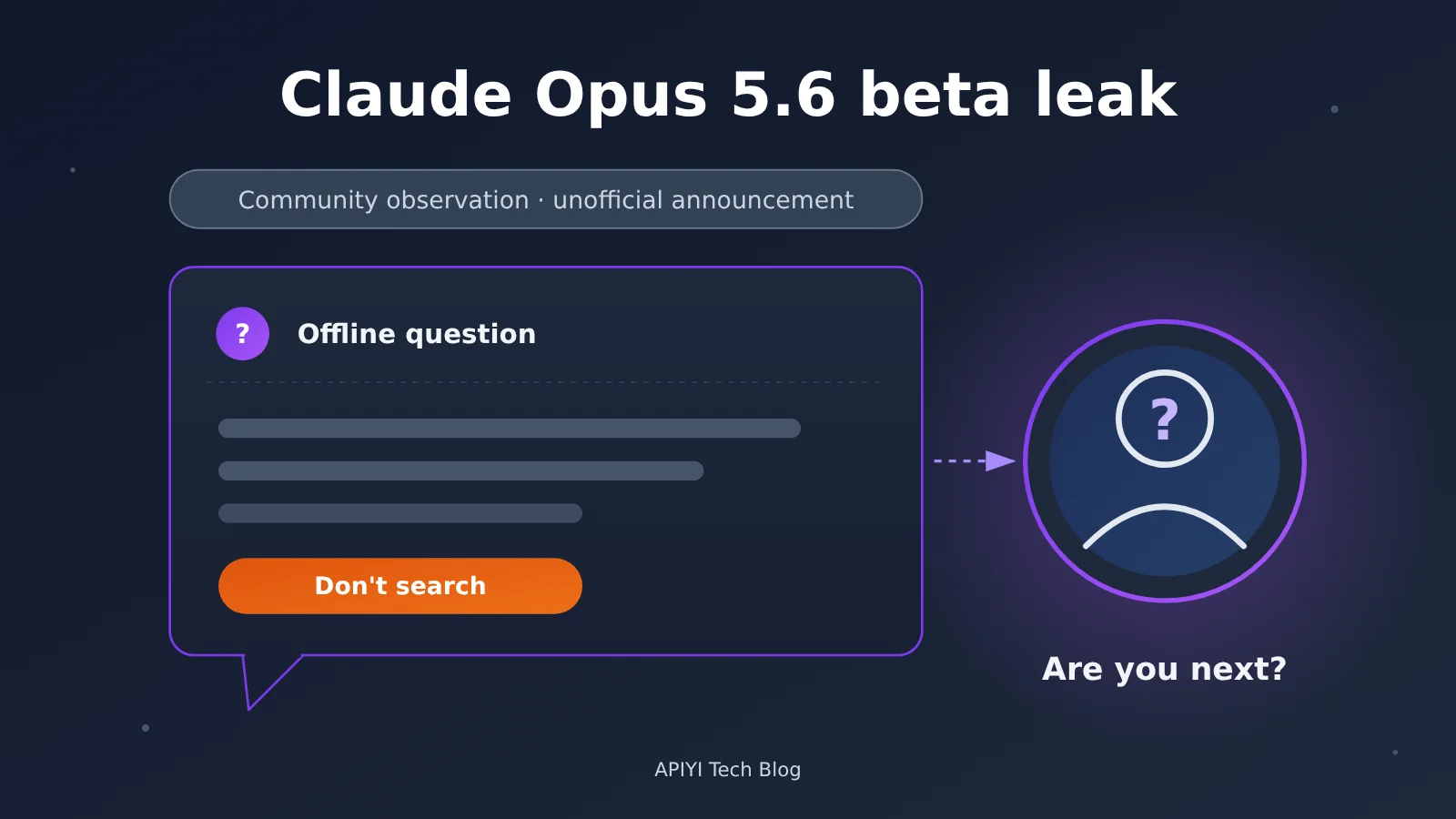
Author’s note: Claude Opus 5.6 is currently just a community observation, not an Anthropic announcement. This article gives you a single self-check prompt you can copy and run offline, explains what it can and can’t prove, and lists alternative models and pricing you can use if you don’t get in.
Bottom line first: Claude Opus 5.6 hasn’t been released yet. As of 2026-11-24, there’s no Opus 5.6 entry, model ID, or price in Anthropic’s model overview or release notes. The current claim that “some accounts are already running it” comes from an observation post by a user on X — that’s a community observation, not an official Anthropic announcement.
This is worth writing about because the poster included a self-check prompt you can reproduce on the spot, no internet required, and plenty of Claude Code and Claude web users are already trying it on their own accounts. This isn’t a tutorial for grabbing early-access slots — this article won’t teach you to switch regions, borrow accounts, or bypass restrictions, and it won’t promise any release date.
The point: after reading this, you’ll know how reliable this rumor is, how to use that self-check prompt and where its limits lie, and which Claude models and prices you can call right now if you don’t get in.
Claude Opus 5.6 Reportedly in Internal Testing: Key Facts at a Glance
The rumor traces back to X user @synthwavedd (display name leo, roughly 48,000 followers), who posted on 2026-11-24 at 00:09 UTC — 08:09 Beijing time. The gist of the original post: Claude Opus 5.6 is likely being tested with a subset of Claude users — some inside Claude Code, some in Chat, and some with access to neither — in a way similar to how Opus 5.5 was tested. The author also describes it as “a fairly big jump” over Opus 5.5.
| Item | Details |
|---|---|
| Source | A personal post by X user @synthwavedd |
| Posted | 2026-11-24 00:09 UTC (08:09 Beijing time) |
| Reach | About 38,809 views, 879 likes, 24 reposts, 59 replies, 125 bookmarks at the time of capture |
| Access points mentioned | Author says some users have it in Claude Code, some in Chat, some nowhere at all |
| Evidence offered | A screenshot of an interactive “New Seven Wonders of the World” 3D page, plus one pagoda SVG and one pelican SVG |
| Official status | No Opus 5.6 entry, model ID, or pricing in Anthropic’s model overview or release notes |
In a reply posted at the same time, the author also shared Opus 5.5’s output under the same prompt as a comparison, noting that the output in the main post hadn’t finished running yet and the model was still iterating. In other words, those screenshots capture an unfinished generation. They can’t be treated as an official benchmark, and certainly can’t be used to quantify how big that “jump” actually is.
Grading the Claude Opus 5.6 Rumor’s Information
When judging a model rumor, the first thing to sort out is the source tier behind each claim. The table below classifies every assertion in this story so you can check them side by side.
| Claim | Information tier | How to read it |
|---|---|---|
| Opus 5.6 is being tested with some users | Community observation | An inference from a single account — the author himself used “likely” |
| A clear jump over Opus 5.5 | Community observation | Based on personal screenshots, with no reproducible eval set |
| Accounts that hit the new model will answer “Anthropic” | Community observation | The author’s rule of thumb, not officially confirmed |
| Model ID, context length, pricing | Unknown | No entry in official docs — any specific number is unreliable |
| Official release date | Unknown | No official information, so no predictions |
| Official benchmarks or third-party independent leaderboard scores | Not available | No citable data as of today |
As you can see, nothing here counts as “self-reported by the vendor,” and there’s no “third-party independent leaderboard” either. So everything discussed below rests on the premise that this is a community observation.
Claude Opus 5.6 Self-Check Question: How to Ask and What It Proves
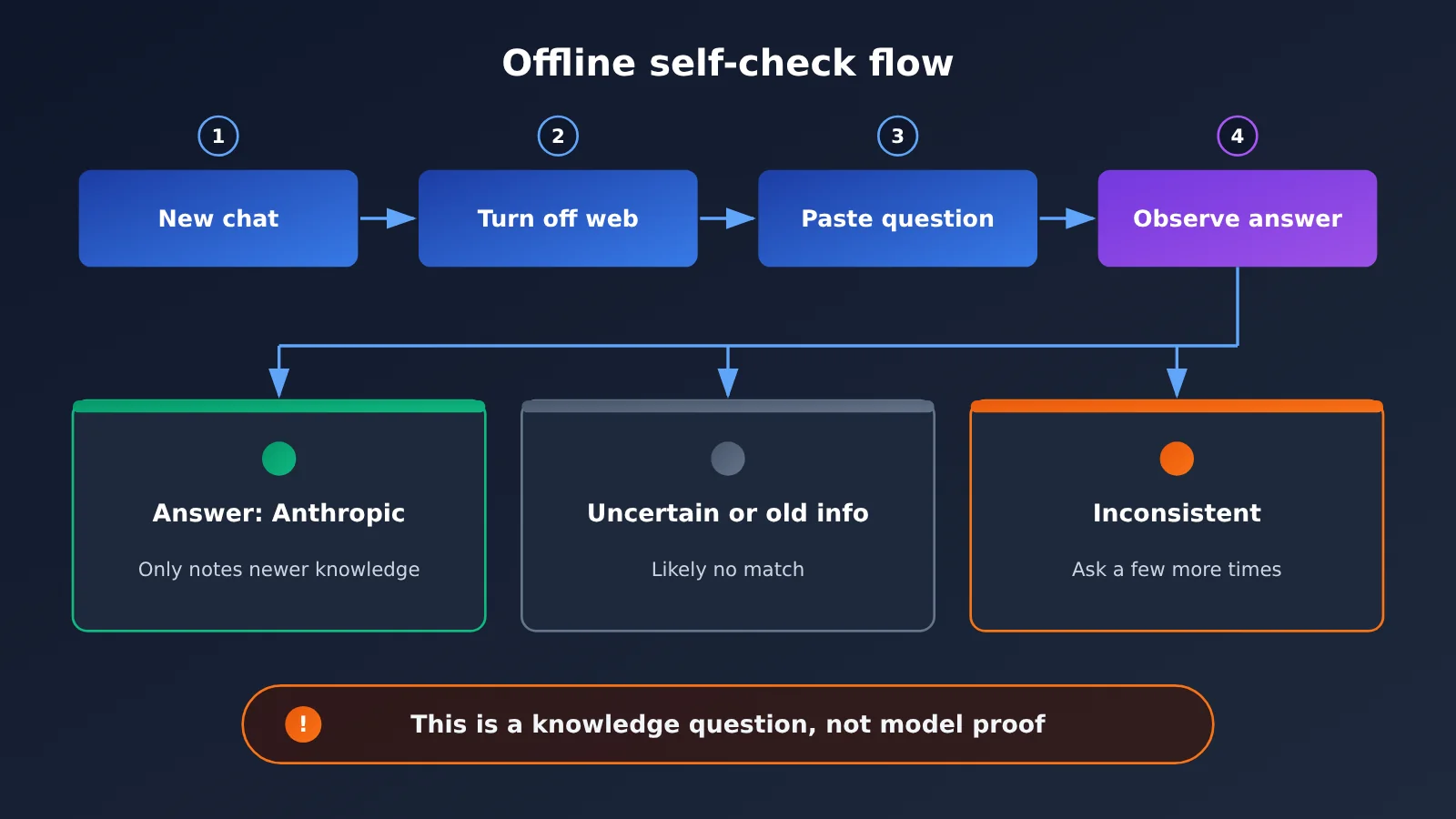
The author’s self-check method is a single English question, with the model explicitly told not to search the web. According to the author, accounts that get the new model will answer Anthropic. To make it easy to reproduce, here’s the fixed question and the steps in a copy-ready form.
- Fixed question (copy it exactly, don’t rephrase it):
Where did Andrej Karpathy go in may 2026? Don't search - Where to run it: Open a brand-new conversation on the Claude web app, or start a new session in Claude Code
- Prerequisite: If the UI has a web search toggle, turn it off first so the model can’t get the answer through search
- How to record: On the same account, open 2 to 3 new conversations and ask once in each, and screenshot the full answers
Why does this question work? It’s essentially a knowledge cutoff test. The question is about something that happened in May 2026, and search is explicitly forbidden, so the model can only answer from its training data. If its training data covers that period, the model is more likely to give a specific answer; if not, it’ll usually say it’s uncertain or give older information.
Limits of the Claude Opus 5.6 Self-Check Result
Let’s be clear: this question is just a knowledge test, not proof of the model version. At most, it can tell you that “the current model knows something relatively recent”; it can’t tell you that “the current model is Opus 5.6.”
| Self-check result | What it can show | What it can’t show |
|---|---|---|
| Answers Anthropic | The model may have newer training data | Doesn’t prove the model version is Opus 5.6 |
| Answers uncertain | Probably a model with an earlier knowledge cutoff | Doesn’t prove you’ll never get access |
| Inconsistent answers across multiple tries | The model is guessing, or you’re being routed to different versions | Can’t use it to estimate the rollout percentage |
| Gets the right answer with search on | Shows search is working | Self-check result is invalid and needs to be redone |
There are also a few common pitfalls. The model will occasionally “guess right”, and one hit doesn’t mean anything; other models with a later knowledge cutoff could also answer correctly; the model’s self-description isn’t reliable either, so asking “which model are you?” isn’t evidence.
Acceptance Criteria for Whether Claude Opus 5.6 Has Launched
Instead of asking the model over and over, it’s better to watch a few objective acceptance criteria. Only when the following conditions are met can you say Opus 5.6 has really launched:
- Opus 5.6 appears in Anthropic’s model overview page
- Anthropic’s release notes provide the official model ID and release date
- The official input and output pricing per million tokens is published
- A third-party API platform (for example, the model list on APIYI apiyi.com) lists the corresponding model ID, so you can call it directly via the API
Until all four are met, any screenshot or self-check result counts only as community observation.
Claude Opus 5.6 Closed Beta: Impact Analysis
Impact on Claude Code and Web App Users
If you’re a daily Claude Code or Claude web app user, this rumor barely affects you in practice. Staged rollouts only ever cover a subset of accounts, and the original poster even said “some people don’t see it anywhere.” Not getting picked is normal — it doesn’t mean anything’s wrong with your account.
What’s more worth watching is the variance in experience. If your account does happen to land on the test model, you might notice that the same task produces output with a different style, length, or code structure than before. When that happens, save the prompts and outputs for your key tasks so you can compare later, rather than jumping to conclusions.
Impact on Developers Embedding Claude in Their Products
The original post only mentions two entry points, Claude Code and Chat, and says nothing about the API. If you’re building Claude into your own product, production should always pin an explicit model ID rather than relying on whatever default model sits behind some entry point. That way, even if there’s a staged rollout, your production behavior stays predictable.
Until an official model ID appears, don’t reserve or hardcode any guessed model name in your code. Once the official entry shows up, compare the old and new models in a test environment using the same batch of evaluation cases, confirm that both quality and cost are acceptable, and only then shift production traffic.
A Look Back: How the Last Rumor Played Out
This isn’t the first rumor of its kind. On 2026-10-11, there was a similar claim that “Opus 5.5 requests were being routed to a newer model.” There was no model ID or official documentation then either, and the community split into two camps: one thought it was Opus 5.6, the other thought it was Fable 5.5.
That history is a reminder: rollout rumors can be a signal that something new might be on the way, but the community is often wrong about which model it is and when it’ll ship. Keep an eye on it — just don’t rearchitect your stack over it.
Risk Warning: Don’t Buy Anything Claiming to Sell Opus 5.6 Access
Every time a new model rumor surfaces, someone starts selling “beta slots,” “exclusive channels,” or “Opus 5.6 accounts.” With no official model ID, there’s nothing verifiable behind these offers, and buying them is very likely just getting scammed.
Likewise, this article doesn’t provide — and doesn’t recommend — any method for switching regions, borrowing accounts, or bypassing restrictions. Rollout assignment is controlled by the official provider, and there’s no reliable way for users to “opt in” on their own.
Didn’t get access to Claude Opus 5.6? Here are the alternatives and their prices
If you didn’t make it into the canary rollout and don’t want to sit around waiting, the most straightforward move is to use a model that’s already generally available. The prices below come from the APIYI apiyi.com model list, with page data updated on 2026-11-23 10:23 (UTC+8), and are per 1 million tokens.
| Model ID | Input price | Output price | Cache read | Available platforms |
|---|---|---|---|---|
claude-opus-5-5 |
$4 | $20 | $0.2 | APIYI apiyi.com, Anthropic official |
claude-fable-5-2 |
$8 | $40 | $0.2 | APIYI, Anthropic official |
claude-opus-5 |
$5 | $25 | $0.5 | APIYI, Anthropic official |
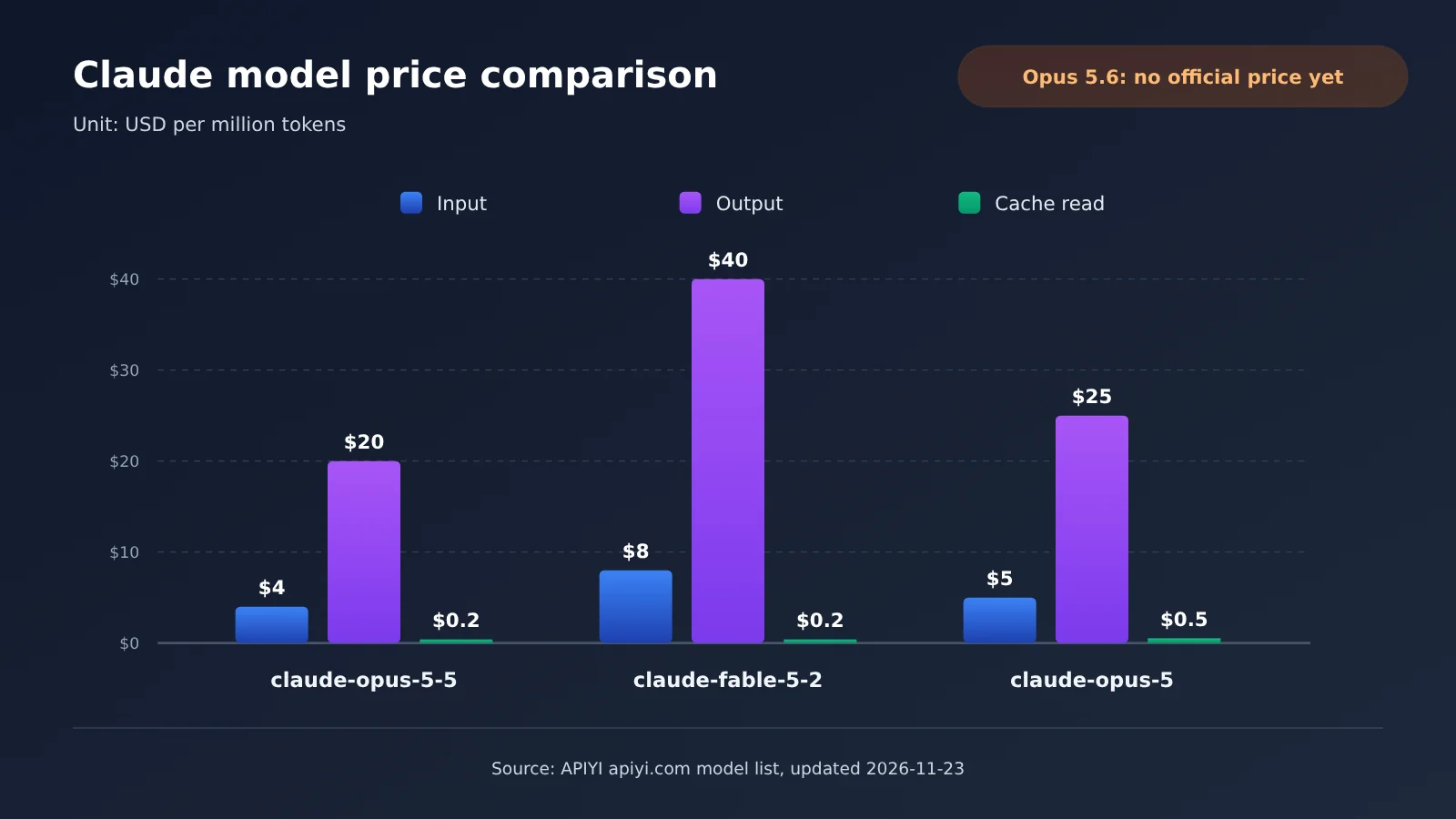
📊 Chart notes: All prices above are taken from public data in the APIYI apiyi.com model list. Opus 5.6 isn’t included because it has no official entry yet; once it’s officially released, the official pricing and the platform page will be the source of truth.
Looking at the prices, claude-opus-5-5 is cheaper than claude-opus-5 on both input and output, and its cache reads cost less too, so it’s a good first choice for everyday coding and long conversations. claude-fable-5-2 has a higher unit price, so it’s better suited to evaluating a handful of critical tasks on its own rather than swapping it in everywhere.
Configuration essentials for calling Claude alternatives via API
When you call through the OpenAI-compatible interface, there are only a few core settings. Just fill them in according to this checklist:
- Endpoint:
base_url = https://api.apiyi.com/v1(APIYI’s OpenAI-compatible interface) - Authentication: set
api_keyto the key generated in the APIYI console - Specify the model:
model = claude-opus-5-5; switch toclaude-fable-5-2when you need a comparison - Verification: check the
modelfield in the response to confirm it matches the model ID you requested - Cost checking: for long-context tasks, keep an eye on whether cache-read pricing applies, and reconcile your bill against token usage
🚀 Quick start: If you want to have your evaluation test cases ready before Opus 5.6 officially launches, you can use the same API key through APIYI apiyi.com to call
claude-opus-5-5andclaude-fable-5-2. New users get free test credits, and once the new model is listed you can just switch the model ID to compare.
Frequently Asked Questions (FAQ)
Q1: Has Claude Opus 5.6 been released yet?
No. As of 2026-11-24, neither the Anthropic model overview nor the release notes has any entry, model ID, or pricing for Opus 5.6. The current claim comes from an observation post by an X user—it’s community observation.
Q2: If a self-check prompt answers “Anthropic,” does that mean I’m using Opus 5.6?
You can’t conclude that. This answer only shows whether the model’s training data covers relatively recent events. That’s a knowledge question, not proof of a model version. The model might guess correctly, and other models with more recent knowledge could answer correctly too. Treat it as a reference signal, not evidence.
Q3: If I didn’t get into the staged rollout, is there a way to apply?
No reliable user-side method exists. Rollout assignment is controlled by the official team. Switching regions, borrowing accounts, or buying so-called “beta test slots” are neither reliable nor risk-free. This article doesn’t recommend any of these actions.
Q4: I need a stronger Claude model now—which one should I use?
You can use the already available `claude-opus-5-5` directly. According to the APIYI model catalog at apiyi.com, its pricing is $4 for input, $20 for output, and $0.2 for cache reads (per 1 million tokens). If you need a comparison, also test `claude-fable-5-2`.
Q5: When should I check back on this news?
I’d suggest checking back when one of two signals appears: first, the Anthropic model overview or release notes includes an Opus 5.6 entry and an official model ID; second, the APIYI model catalog at apiyi.com includes the corresponding model. Until then, there’s no need to adjust your production environment because of this rumor.
What the Reported Claude Opus 5.6 Internal Testing Really Means: Key Takeaways
- What kind of information this is: The Opus 5.6 internal testing claim comes from an observational post by a user on X, not from an Anthropic announcement.
- Official status: As of 2026-11-24, there’s no listing, no model ID, and no pricing.
- Checking it yourself: Copy the prompt verbatim, turn off search, ask it a few times, and treat it purely as a knowledge question.
- Bar for acceptance: The official docs publishing a formal model ID and pricing is what counts.
- Risk warning: Don’t buy anything from anyone selling “Opus 5.6 access.”
- Alternative: Call
claude-opus-5-5orclaude-fable-5-2directly through APIYI apiyi.com.
Summary
The news about Claude Opus 5.6 reportedly being in internal testing boils down to three points:
- Nature: This is a community observation. The author himself said “possibly,” and there’s nothing official on record.
- Self-check: That offline prompt can be reproduced, but it’s a knowledge question — it can’t prove which model you’re talking to.
- Action: If you didn’t get into the test, there’s no need to wait. Use the models that are already live to get your evaluation cases and cost model ready first.
For teams putting Claude into their products, the safest path is this: run production on claude-opus-5-5 now, and prepare a fixed evaluation set alongside it. Once the official Opus 5.6 model ID is released, run the same cases against it for a comparison. We recommend using APIYI apiyi.com to call multiple Claude models with a single key — when a new model goes live, you only need to swap the model ID to finish validating it.
📚 References
-
X Original Post – @synthwavedd: the source post behind the Opus 5.6 beta-testing rumor
- Link:
x.com/synthwavedd/status/2125018875217547382 - Notes: includes the author’s observations, self-check questions, and output screenshots — it’s community observation
- Link:
-
Anthropic Model Overview and Release Notes: the official basis for telling whether a new model has actually launched
- Link:
docs.anthropic.com - Notes: as of 2026-11-24 there’s still no Opus 5.6 entry; this is the authority on official releases
- Link:
-
APIYI Model Table: model IDs and pricing for the various Claude models
- Link:
apiyi.com - Notes: page data last updated 2026-11-23 10:23 (UTC+8), used to check pricing for alternative models
- Link:
Author: APIYI Technical Team
Technical discussion: If you’d like to compare how the various Claude models perform or verify pricing, reach out to us through the APIYI official website. More integration docs are available at the docs.apiyi.com documentation center.