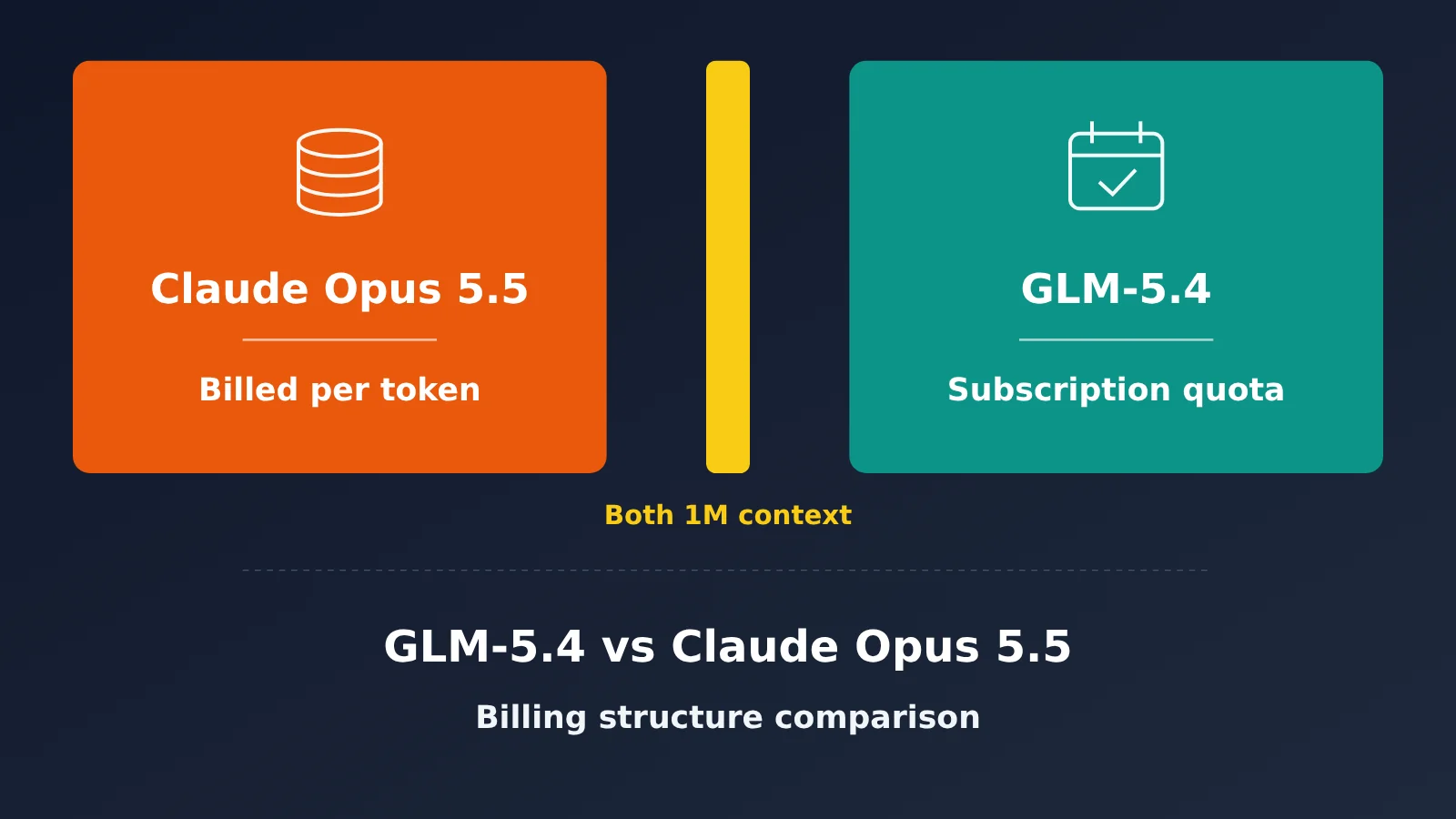
Author’s note: These are both 1M-context coding models, but Claude Opus 5.5 can be called via API on a per-token basis right now, while GLM-5.4 is currently only available through subscription channels like the GLM Coding Plan. This article starts from billing structure to help you figure out which side your coding agent budget should go to.
If your team is already running coding agents with Claude Code, you’ve probably seen GLM-5.4 all over your feed lately. Zhipu Z.ai released GLM-5.4 on 2026-11-23 — their first flagship built on Loop Transformer, also supporting a 1M context window and 128K max output, and all GLM Coding Plan users could access it that same day. On the other side, Claude Opus 5.5 launched on 2026-09-22, already has a batch of public benchmarks and independent leaderboard results, and its API is billed per token.
This isn’t a fence-sitting “each has its strengths” analysis, and it won’t declare an overall winner either. The most direct difference between GLM-5.4 and Claude Opus 5.5 isn’t really about benchmark scores — it’s about how the money works: one is token-priced, pay for what you use; the other requires a subscription first, then usage within your quota. This article sorts the verifiable facts into three layers: vendor-reported, independent third-party single cases, and currently unverifiable — then gives recommendations by task.
Key takeaway: After reading this, you’ll be able to judge whether your coding agent workload belongs on Claude Opus 5.5’s token bill or should first test the waters with GLM-5.4’s subscription quota — and you’ll know when not to switch.
Core Differences Between GLM-5.4 and Claude Opus 5.5: A Four-Row Comparison Table
Let’s start with the summary table. It only includes information you can find on official pages or independent leaderboards, with four rows covering public benchmarks, context/output, availability, and pricing.
| Comparison Dimension | Claude Opus 5.5 | GLM-5.4 |
|---|---|---|
| Public Benchmarks | Vendor-reported Terminal-Bench 4.0 at 66.4% (mostly at max effort); Terminal-Bench official independent leaderboard 4.0 at 64.8% ±3.1, using 8.0B tokens (~$4.7k) per single run; Artificial Analysis index 59 | The official blog publishes no comprehensive scores like Terminal-Bench or SWE-bench; third-party KingBench 4 scored 33.2 (Opus 5.5 scored 34.7 on the same test); no Artificial Analysis score yet |
| Context / Output | 1,000,000-token context, 128,000 max output, thinking always on | 1M context, 128K max output, supports video, image, text, and file input |
| Availability | API is live — you can call it directly per token, or hook it into Claude Code | Available to all GLM Coding Plan users, and now in ZCode, Z.ai Chat, and more; the API opens only after security evaluation is complete, with no timeline |
| Pricing | Input $4 / output $20 / cache reads $0.20 (per million tokens) | Subscription-based; monthly fee per the Zhipu official page; per-token pricing not yet announced |
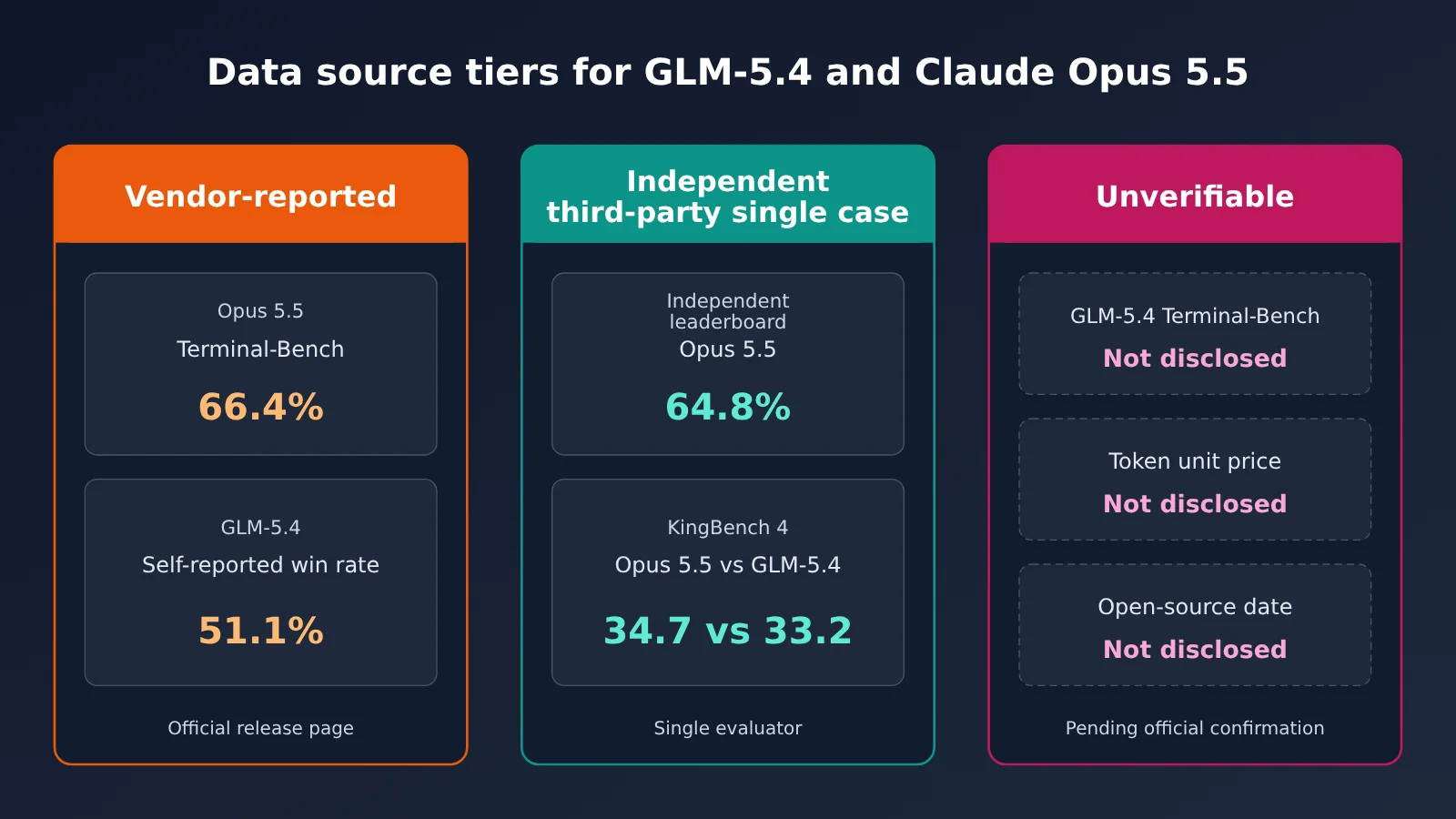
Two things in this table are easy to misread. First, Claude Opus 5.5’s 66.4% is the vendor-reported figure from Anthropic’s announcement page, while the Terminal-Bench official independent leaderboard shows 64.8% ±3.1 — the two numbers use different methodologies, so cite the source when you quote them. Second, GLM-5.4 currently has no Terminal-Bench result at all; the only thing that can be compared head-to-head with Opus 5.5 is KingBench 4. You can’t use KingBench’s 33.2 score to extrapolate GLM-5.4’s Terminal-Bench result — the two benchmarks differ in task types, scoring methods, and maximum scores, so any conversion is meaningless.
Fact stratification for GLM-5.4 and Claude Opus 5.5
To avoid treating vendor marketing as independent conclusions, let’s separate the information from both sides by source:
- Vendor self-reported: Opus 5.5’s Terminal-Bench 66.4%, OSWorld 2.0 81.8%, CursorBench 4.0 57.8%, etc., come from Anthropic’s release page. GLM-5.4 claims to “reach the intelligence level of 2T–3T parameter models,” with AIME25 rising from 19.17 to 30.42 and GPQA-Diamond from 47.58 to 56.26 in the 30B comparison experiment; its self-tested win rate against GLM-5.3 is 51.1%, from the Z.ai blog.
- Third-party independent single instances: Opus 5.5’s 64.8% on the official independent Terminal-Bench leaderboard; GLM-5.4’s 33.2 and Opus 5.5’s 34.7 on AICodeKing’s KingBench 4. KingBench is a single evaluator’s private test set with only six one-sentence apps, so the sample size is limited.
- Currently unverifiable: GLM-5.4’s position on composite indices, its API token unit price, and the release date of its open-source weights. Z.ai’s official comparison also doesn’t include Claude Opus 5.5.
The 1.5-point gap on KingBench only shows that the two are close on those six apps. It’s not grounds to judge that GLM-5.4 lags overall, nor to claim in reverse that it has already caught up.
How the Billing Structures for GLM-5.4 and Claude Opus 5.5 Work
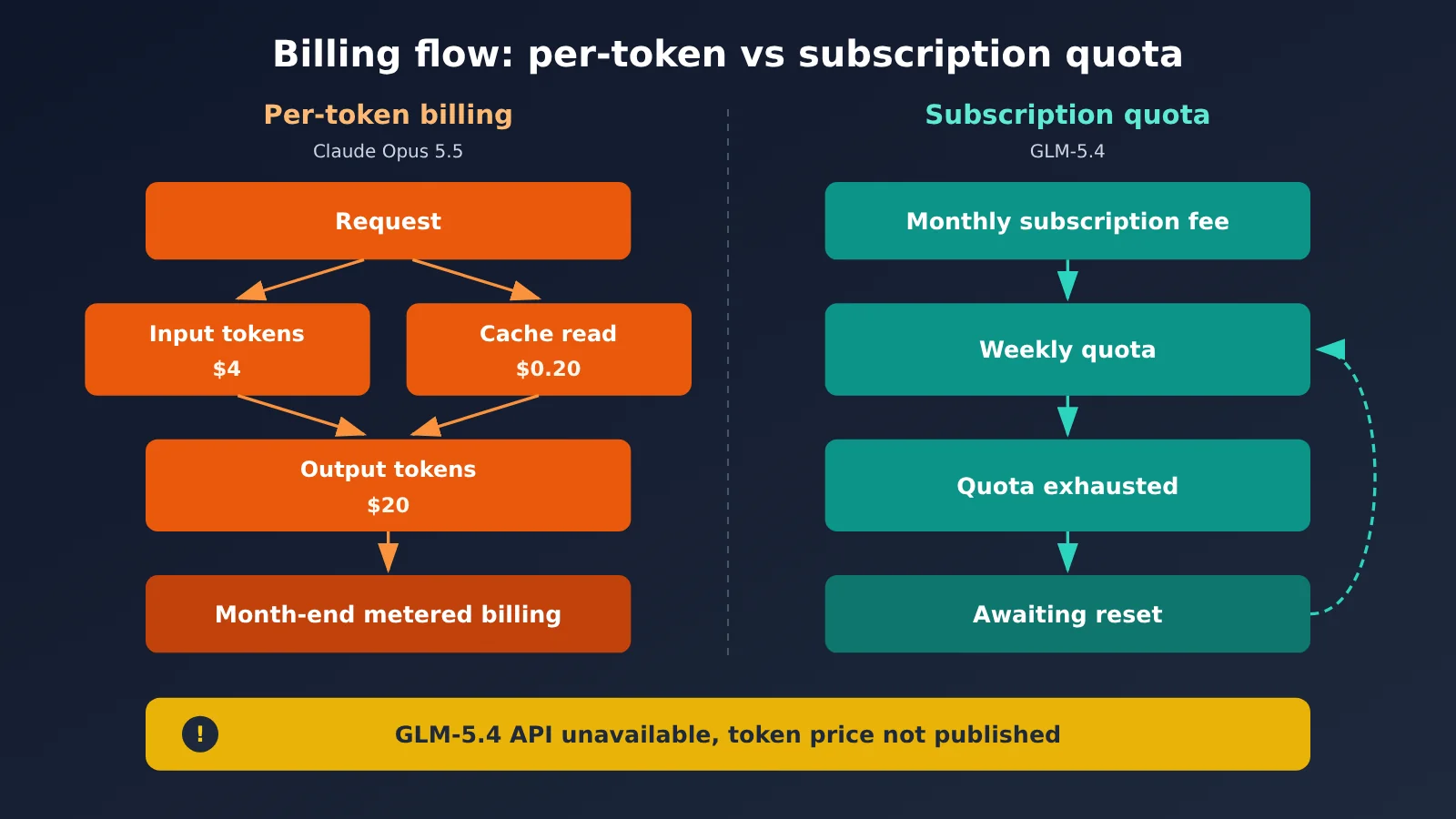
This section is the main focus of this article. Their billing logic is different, so “which one is cheaper” can only be answered in the context of actual usage.
Claude Opus 5.5: Token-Based Billing, and Long-Running Tasks Need to Account for Caching
Claude Opus 5.5 is priced at $4 for input, $20 for output, and $0.20 for cache reads, per million tokens. Coding agents send context back and forth repeatedly, so cache hit rate makes a big difference to the bill. Here’s an illustrative example: suppose one task accumulates 2M input tokens and 200K output tokens. Without caching, that’s about 2×4 + 0.2×20 = $12. If 1.8M of the input hits the cache, the input portion drops to 1.8×0.2 + 0.2×4 = $1.16, for a total of about $5.16.
That benchmark run on the independent Terminal-Bench leaderboard cost about $4.7k and consumed 8.0B tokens. It covered the entire benchmark suite, so it doesn’t represent the cost of a typical single task. Still, it’s a reminder that terminal agents at max effort are very token-hungry. Opus 5.5’s thinking can’t be turned off. Effort has five levels—low, medium, high, xhigh, and max—with medium as the default. Lowering the effort level is the most direct way to control costs.
GLM-5.4: Prepay for the Subscription, Use It by Quota
GLM-5.4 is currently offered through the GLM Coding Plan and is available to all subscription users. For users on weekly limits, the GLM-5.4 quota has been raised to 1.5x that of GLM-5.3. The upside of a subscription is fixed monthly spending, which makes it a good fit for exploratory long-running coding work. The downside is that once you use up your quota, you have to wait for it to reset, and you can’t embed it into your own service and scale up with call volume the way you can with an API.
There’s also a time cost to factor in. KingBench 4 evaluators recorded that GLM-5.4 took 1,128 reasoning steps and 431 minutes to complete the same test, while Gemini 4 Neon took 244 steps and 109 minutes. The official team itself acknowledges that GLM-5.4 tends to get stuck in excessively long “marathon thinking.” Subscription quotas aren’t charged by token, but a slow agent turns waiting time into a real cost.
GLM-5.4 vs. Claude Opus 5.5: Effort and Latency at a Glance
| What we looked at | Claude Opus 5.5 | GLM-5.4 | Source |
|---|---|---|---|
| Thinking mode | Always on, five effort levels, defaults to medium | Supports thinking mode | Official documentation |
| Short tasks (180-second probe) | Not reported in that probe | Low / Medium finish within 180 seconds, High / Max time out | KingBench evaluator |
| Long-task performance | 34.7 on KingBench 4 | Max 33.2, High 28.8, Low 25.2, Medium 24.1 | KingBench evaluator |
| Throughput | Not provided in the reference materials | Up to 200 token/s off-peak, 70-80 token/s at peak | Z.ai official |
| Caching and tool calls | Cache-read billing supported | 98.4% cache hit rate in evaluation, 31/31 parallel tool schema checks passed | KingBench evaluator |
This table shows that GLM-5.4’s scores depend heavily on the effort level. To hit its ceiling you need to push it to High or Max — but that also makes it noticeably slower.
How to call Claude Opus 5.5 and the GLM family through the API
If you need reproducible, integrable API calls, you can start with Claude Opus 5.5 today, and use the already-listed GLM-5.3 as a stand-in for the GLM family. APIYI (apiyi.com) is a Large Language Model API aggregation platform that offers an OpenAI-compatible interface, so you can switch between models with a single API key.
Claude Opus 5.5 quick start
- Create an API key in the APIYI console.
- In the OpenAI SDK or any compatible client, set
base_urltohttps://api.apiyi.com/v1and put the key you just created inapi_key. - Set
modeltoclaude-opus-5-5; if you need explicit thinking output, useclaude-opus-5-5-thinking. - Pass
messagesin OpenAI format, for example[{"role": "user", "content": "refactor this function"}], and read the result fromchoices[0].message.content. - To compare against the GLM family, just change
modeltoglm-5.3orglm-5.3-flash— nothing else in your code needs to change.
There are a few breaking changes in Opus 5.5 to watch for when migrating: thinking can’t be turned off; setting tool_choice to any or tool returns a 400; thinking blocks are bound to the model and session and can’t be reused across models; and computer use only supports the new tool set. If your old agent code forces a specific tool, you’ll need to change that logic first.
🚀 Quick start: We recommend using the free trial quota for new users on APIYI apiyi.com first — run the same coding task with
claude-opus-5-5andglm-5.3, record token consumption and elapsed time, and then decide how to allocate your long-term budget.
APIYI platform listed model prices
The table below comes from the APIYI model price master list, dated 2026-11-23 10:23 (UTC+8), in USD per million tokens:
| Model ID | Input | Output | Cache read | Notes |
|---|---|---|---|---|
claude-opus-5-5 |
$4 | $20 | $0.2 | Same billing as the official site |
glm-5.3 |
$1.4 | $4.396 | $0.259 | ClaudeCode group 0.95× |
glm-5.3-flash |
$0.15 | $0.5 | $0.03 | Lightweight tasks |
kimi-k3.1-pro |
$2 | $10 | $0.2 | Optional comparison |
deepseek-v4.1-flash |
$0.3 | $1.2 | $0.006 | Optional comparison |
GLM-5.4 isn’t listed yet — we’ll get this model up as soon as we can; model names and prices are subject to the platform’s model list. Before GLM-5.4 opens its API, glm-5.3 can be used to validate how the GLM family performs on your codebase. Keep in mind that GLM-5.3 scores only 27.5 on KingBench 4, a clear gap from GLM-5.4’s 33.2, so this step is only suitable for validating your workflow — it can’t represent GLM-5.4’s capabilities.
Scenario Recommendations for GLM-5.4 and Claude Opus 5.5
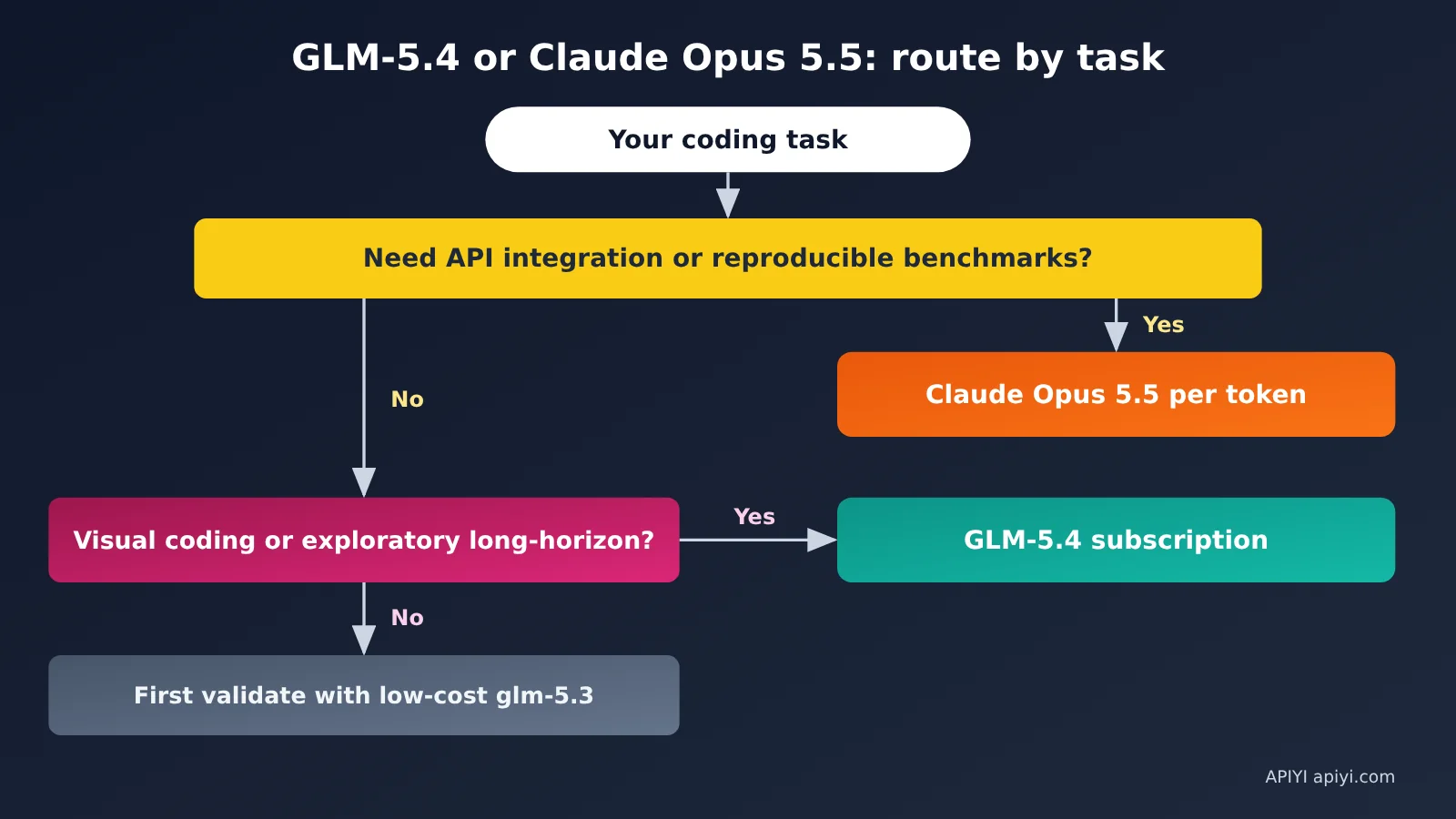
When to choose Claude Opus 5.5
- Reproducible terminal agents: Opus 5.5 has results on an independent Terminal-Bench leaderboard, and its evaluation setup is public. That makes it a good choice when you need to explain your reasoning to a team or client.
- Stable API integration needed: CI pipelines, internal code review services, and batch refactoring scripts all need on-demand scaling and programmatic invocation. Right now, only Opus 5.5 can meet those requirements.
- You already have a Claude Code workflow: If your tool invocation and permission settings are already dialed in, switching costs are high, so sticking with Opus 5.5 is the least hassle.
When to choose the GLM-5.4 subscription
- Trying long-horizon coding on a budget: For exploratory tasks like generating a small game or a CAD modeling script from scratch, you can run on subscription quota without worrying about token bills.
- Visual coding: GLM-5.4 adds visual input. According to the official announcement, it stands out in visual coding, visual replication, and long-horizon tasks (no specific scores have been published), making it a good fit for rebuilding front-end pages from screenshots or design mockups.
- General coding experiments: For tasks beyond traditional coding, like GLSL shaders, FreeCAD modeling, and audio/video scripts, you can try them out under the subscription first.
GLM-5.4 vs Claude Opus 5.5: How to Decide
💡 Recommendation: Let the task decide — you don’t have to pick one over the other. Keep your production pipeline on Claude Opus 5.5’s API, and route exploratory and visual work to a GLM-5.4 subscription. That’s a reasonably safe combination. On the production side, you can manage invocations centrally through the APIYI apiyi.com API proxy service, which makes it easy to onboard new models later.
For budget allocation, there are three rules you can actually put into practice:
- Start by working out what share of your current Opus 5.5 bill goes to exploratory tasks — that’s the slice best moved over to a GLM-5.4 subscription.
- For long-horizon tasks, push the cache hit rate up before you consider dropping the effort tier. That usually pays off faster than switching models.
- Once GLM-5.4 opens its API and publishes token pricing, run a proper head-to-head comparison using the same batch of tasks.
When you shouldn’t switch: If your workflow depends on reproducible terminal agent benchmarks, needs programmatic API calls, or your Claude Code toolchain is already tuned and stable, then hold off migrating your main workload until GLM-5.4 opens its API and independent Terminal-Bench results are available.
Common Questions (FAQ)
Q1: What kind of model is GLM-5.4?
GLM-5.4 is the flagship released by Zhipu Z.ai on 2026-11-23, and it’s also their first Loop Transformer model. It takes 28 of the 78 layers in the GLM-5 base and makes them weight-sharing layers that execute two loops, keeping the parameter count the same while making the network effectively deeper. It supports a 1M context, 128K output, and visual input.
Q2: How big is the benchmark gap between GLM-5.4 and Claude Opus 5.5?
The only direct comparison available is the third-party KingBench 4: Opus 5.5 scores 34.7 and GLM-5.4 scores 33.2, a 1.5-point difference. This is one evaluator’s private test, and GLM-5.4 has no Terminal-Bench score either, so you can’t line it up against Opus 5.5’s 64.8% and convert between the two.
Q3: When will the GLM-5.4 API open up?
The official word is that the API will open after safety evaluation is complete, and the model weights are planned for open-sourcing after safety hardening. Neither has a timeline. For now you can only use it through channels like the GLM Coding Plan, ZCode, and Z.ai Chat.
Q4: What coding tasks is GLM-5.4 best suited for?
– **Visual replication**: generating front-end code from screenshots or design mockups
– **General coding**: GLSL shader scenes, FreeCAD engineering modeling, small games with physics systems
– **Long-horizon exploration**: multi-step tasks where you turn on High or Max effort and aren’t in a hurry
Q5: How can I compare the GLM series with Claude Opus 5.5 via API right now?
You can sign up at APIYI apiyi.com and claim free trial credits, set `base_url` to `https://api.apiyi.com/v1`, and run the same batch of tasks with `claude-opus-5-5` and `glm-5.3` respectively. GLM-5.4 isn’t listed yet; once it is, you just swap the `model` parameter to add it to the comparison.
Q6: What are the known shortcomings of GLM-5.4?
– **Time-consuming**: the official team acknowledges it tends to get stuck in overly long thinking loops, and it took 431 minutes on KingBench 4
– **Tier dependence**: scores on the Low and Medium tiers drop noticeably on long tasks
– **Integration limits**: no API yet, so you can’t embed it in your own services or CI pipelines
Q7: What code changes are needed when migrating to Claude Opus 5.5?
Thinking is always on and can’t be disabled; `tool_choice` set to `any` or `tool` returns a 400; thinking blocks can’t be reused across models or sessions; computer use requires switching to the new tool set. Before upgrading, it’s a good idea to get these working in a test environment first.
GLM-5.4 vs Claude Opus 5.5: Key Takeaways
- Different billing structures: Opus 5.5 is billed per token, while GLM-5.4 is subscription-only for now
- Mind which benchmark numbers you’re citing: 66.4% is the vendor’s own figure; the independent leaderboard shows 64.8%
- Only one apples-to-apples data point: KingBench 4 puts them at 34.7 vs 33.2 — you can’t convert across benchmarks
- What’s new in GLM-5.4: vision input and general coding, a good fit for exploratory tasks
- For long-running tasks, watch the cache: Opus 5.5 cache reads cost just $0.20, so hit rate is what drives the bill
- How to get started: on APIYI apiyi.com, use a single unified interface to compare Opus 5.5 against glm-5.3 first
Summary
The key points on GLM-5.4 and Claude Opus 5.5:
- Claude Opus 5.5: has published independent leaderboard results, and the API can be called per token right now — a good fit for production-grade terminal agents.
- GLM-5.4: available with a subscription, adds vision-based coding, and is great for low-cost experiments with long-running and general coding tasks — but there’s no API yet.
- How to decide: split your budget by task instead of picking just one, and do a formal comparison once GLM-5.4 opens up its API.
If you want to first check which model suits your codebase better, I’d recommend running Opus 5.5 and the GLM family on APIYI apiyi.com with the same key, then deciding on budget allocation once you have real token consumption data.
📚 References
-
Z.ai Official Technical Blog: GLM-5.4 architecture and experimental data
- Link:
z.ai/blog/glm-5.4 - Details: Loop Transformer design, 30B controlled experiments, and officially self-stated limitations
- Link:
-
GLM-5.4 Official Documentation: Model specs and capabilities
- Link:
docs.z.ai/guides/llm/glm-5.4 - Details: Context window, output length, input modalities, and feature support
- Link:
-
Terminal-Bench Official Independent Leaderboard: Terminal Agent benchmark
- Link:
tbench.ai - Details: Opus 5.5’s independent score of 64.8% and benchmarking cost
- Link:
-
Artificial Analysis: Third-party composite intelligence index
- Link:
artificialanalysis.ai - Details: Opus 5.5 index 59; GLM-5.4 has no public score yet
- Link:
Author: APIYI Technical Team
Technical discussion: Feel free to contact us on the APIYI apiyi.com homepage. Model pricing and access instructions are subject to the platform’s documentation center.