Author’s note: From four angles—modality support, long-context pricing, third-party composite scores, and the December 1 price change—this piece breaks down the selection logic between GPT-6.2 Sol and Gemini 4 Carbon, and explains why “the same sticker price” doesn’t mean “the same bill.”
On November 17, 2026, OpenAI released GPT-6.2 Astra and GPT-6.2 Sol. A week earlier, on November 10, Google released Gemini 4 Carbon. Pull up the official price lists on both sides and you’ll see that through 2026-11-30, the two models’ standard short-context prices are exactly the same: $2 input, $10 output, $0.10 cache read (per 1 million tokens).
This isn’t an article declaring “which one is cheaper.” The numbers on the price list match, but the pricing rules, the modalities each model supports, and the third-party composite scores don’t—and Carbon’s official prices will also change starting December 1. Stack these differences onto your actual requests, and the two bills could easily end up quite far apart.
Core takeaway: By the end of this article, you’ll have one deadline locked in (2026-11-30), and you’ll be able to judge—based on the kind of work you’re doing—whether GPT-6.2 Sol or Gemini 4 Carbon is the better fit.
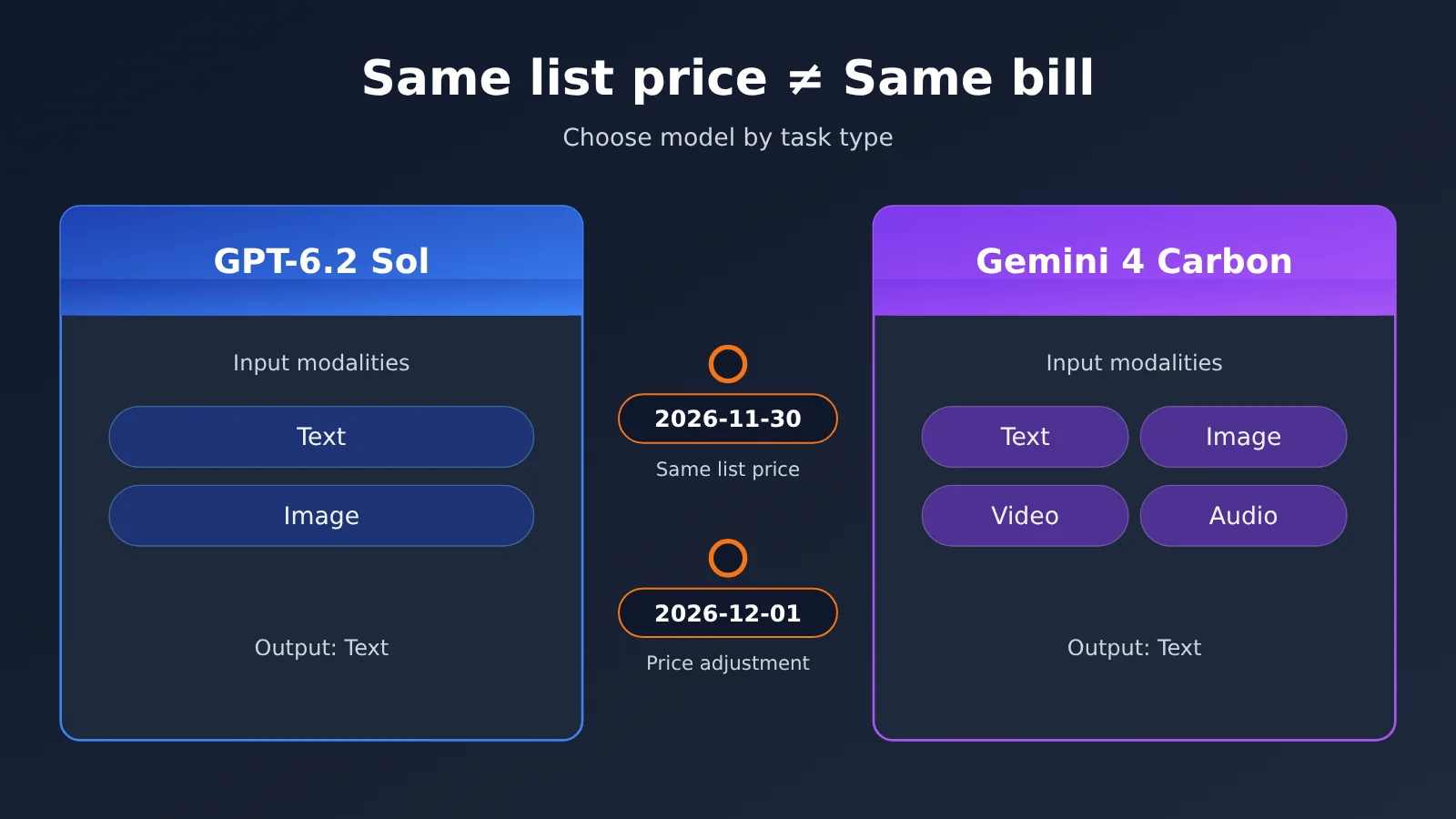
GPT-6.2 Sol and Gemini 4 Carbon Key Takeaways
Let’s start with a table laying out the information that matters most for choosing between them. All prices in the table are official vendor list prices, quoted per 1 million tokens; the composite scores come from third-party Artificial Analysis, with the reasoning tier noted.
| Key Point | GPT-6.2 Sol | Gemini 4 Carbon | What It Means for Your Choice |
|---|---|---|---|
| Short-context official list price (through 11-30) | Input $2 / Output $10 / Cached read $0.10 | Input $2 / Output $10 (includes thinking tokens) / Cached read $0.10 | Same list price, but different pricing rules |
| Official list price from Dec 1 | Model page shows no price change | Input $4 / Output $20 / Cached read $0.20 | Carbon’s introductory price has an end date |
| Input modalities | Text, images | Text, images, video, audio | The difference is obvious when you need audio/video |
| Entire request doubles for inputs over 272K | Applies | Google’s price sheet has no such line | Long-document scenarios need to be calculated separately |
| Third-party composite score (AA Intelligence Index v5.0.1) | Max reasoning tier: 57 | Highest reasoning tier: 60 | Third-party benchmark—doesn’t equal your actual task performance |
GPT-6.2 Sol and Gemini 4 Carbon: Key Details
GPT-6.2 Sol is the “efficient” model in OpenAI’s release. According to the official model page, it only accepts text and images as input, outputs text only, and has a context window of 1,050,000 tokens, with a max input of 922,000, max output of 128,000, and a knowledge cutoff of 2026-06-01. For endpoints, it supports Chat Completions, Responses, and Batch, but not Realtime, Assistants, fine-tuning, image generation, video, or speech. There’s also a detail that’s easy to trip over: the API doesn’t accept setting reasoning effort to none.
Gemini 4 Carbon stands out for its fuller modality support. According to the APIYI documentation page, it accepts text, images, video, and audio as input, outputs text, and has a context window of 1,048,576 tokens, max output of 65,536, and a knowledge cutoff of 2026-03. Google’s pricing page states that Carbon only supports implicit caching and has no free tier. Its introductory price matches Argon’s, and a footnote in the release notes says it changes to $4 / $20 after November 30.
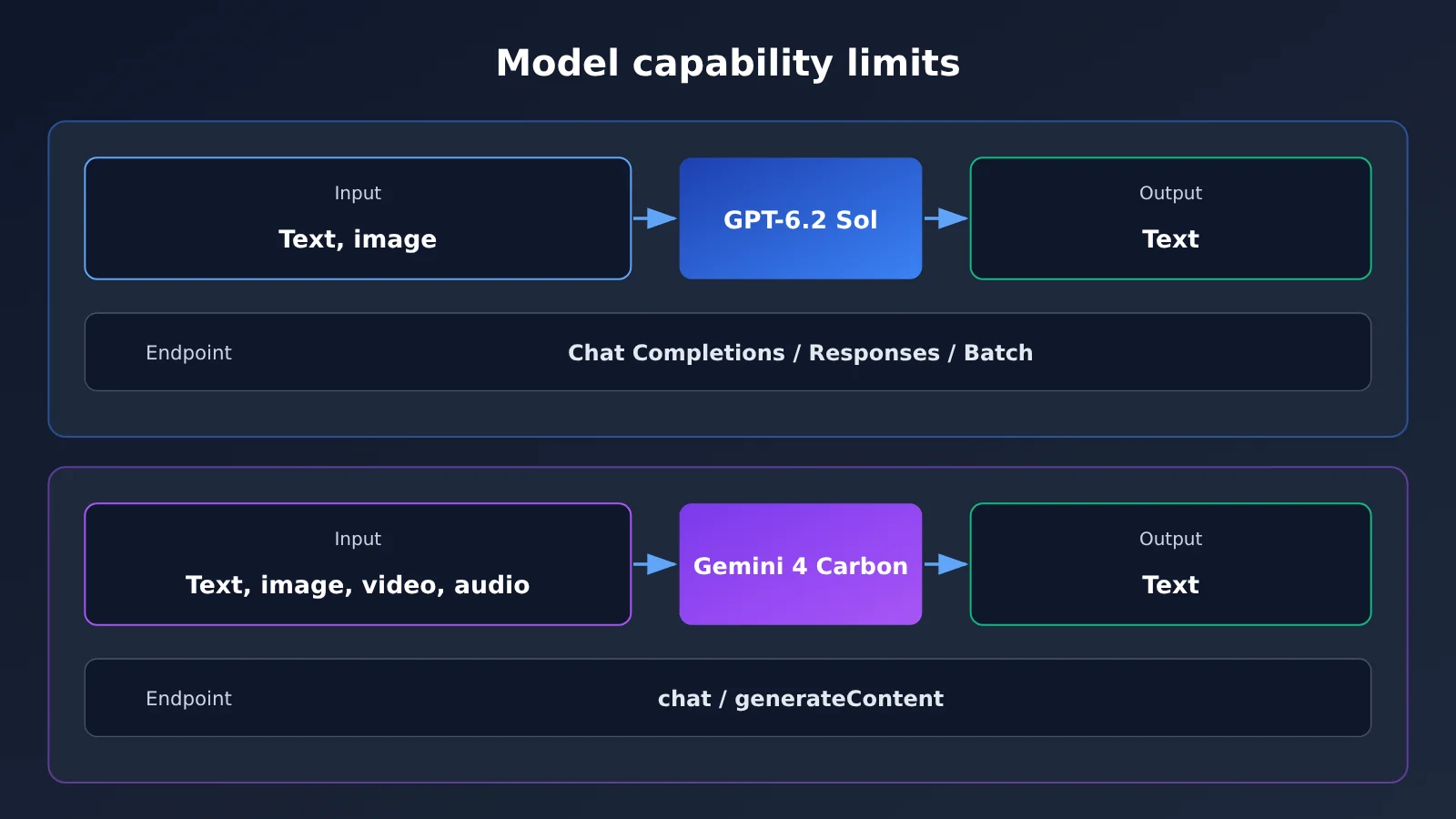
GPT-6.2 Sol vs Gemini 4 Carbon: Key Differences
Put the two models side by side, and it’s the dimensions below that really determine your bill and your experience. There’s no “winner” column here, because whether each item is an advantage or a drawback depends entirely on the shape of your requests.
| Dimension | GPT-6.2 Sol | Gemini 4 Carbon | How to read it |
|---|---|---|---|
| Context / Max output | 1,050,000 / 128,000 | 1,048,576 / 65,536 | Look at Sol’s ceiling when you need extra-long outputs |
| Long-input pricing | Above 272K, input and cache unit prices double and output is billed at 1.5x, applied to the entire request | This rule isn’t listed in the official price sheet | Cost out long-document batch jobs separately for each model |
| Caching | Cache writes are billed separately: $2.50 for 30 minutes, $5 for 12 hours | Only implicit caching is supported | Cache hit rate directly affects your bill |
| Thinking tokens | Supports reasoning; effort can’t be set to none | Output price includes thinking tokens | Reasoning length widens the gap in actual output volume |
| Pricing timeline | No price change noted on the model page | Doubles starting December 1 | Projects spanning the switch have to be budgeted in two segments |
| Regional pricing | Not mentioned | Non-global Cloud regions run about 10% more | Your deployment region affects unit price |
GPT-6.2 Sol vs Gemini 4 Carbon: Same Sticker Price, So Why Might the Bills Differ?
The first reason is timing. As of 2026-11-30, Carbon’s official standard pricing is $2 for input, $10 for output, and $0.10 for cache reads; starting 2026-12-01, it changes to $4 input, $20 output, and $0.20 cache reads. Google Cloud’s global regions match these figures, while non-global regions run about 10% higher — until November 30, that’s $2.20 for input and $11 for output. Sol’s model page shows no such price change, so if your project spans December, you’ll need to budget the Carbon portion across two separate time periods.
The second reason is the long-input rule. Sol’s model page spells it out: when a single request’s input exceeds 272K tokens, input and cache prices double and output is billed at 1.5x the short-context rate — and this applies to the entire request, not just the portion above the threshold. Google’s pricing table has no such row. If your requests regularly land above 272K, the actual per-token costs on the two sides are already different, even when the short-context sticker prices look identical.
The third reason is the tokens themselves. Different models tokenize differently and produce different reasoning lengths, so the same passage of text or the same question will likely generate different input and output token counts on each side. Carbon’s output price includes thinking tokens, and Sol generates reasoning tokens too. Comparing unit prices alone, without looking at actual consumption, won’t get you a reliable conclusion.
Then there’s platform pricing. As of the APIYI master price table’s data timestamp, 2026-11-17 15:54 (UTC+8), plus the public pricing endpoint queried the same day, the platform offers gemini-4-carbon at $2 input, $0.1 cache read, and $10 output, with groups Default and SVIP at a multiplier of 1. Keep in mind that this page lists introductory prices and doesn’t mention Google’s December 1 price change — after December 1, please go by the real-time prices on the APIYI apiyi.com model list.
As for GPT-6.2 Sol, OpenAI’s official short-context standard pricing is $2 input, $0.10 cache read, $2.50 cache write (30 minutes), and $10 output. Batch runs at 50% of standard, Fast at 2x, and Ultrafast at 3x through 2027-02-28 (Pacific time), then 6x from 2027-03-01. It’s not available yet — we’ll list this model as soon as we can; treat the platform’s model list as the source of truth for model names and prices. The gpt-6.1-sol and gpt-6-sol currently on the platform are earlier models, so their prices shouldn’t be taken as 6.2’s.
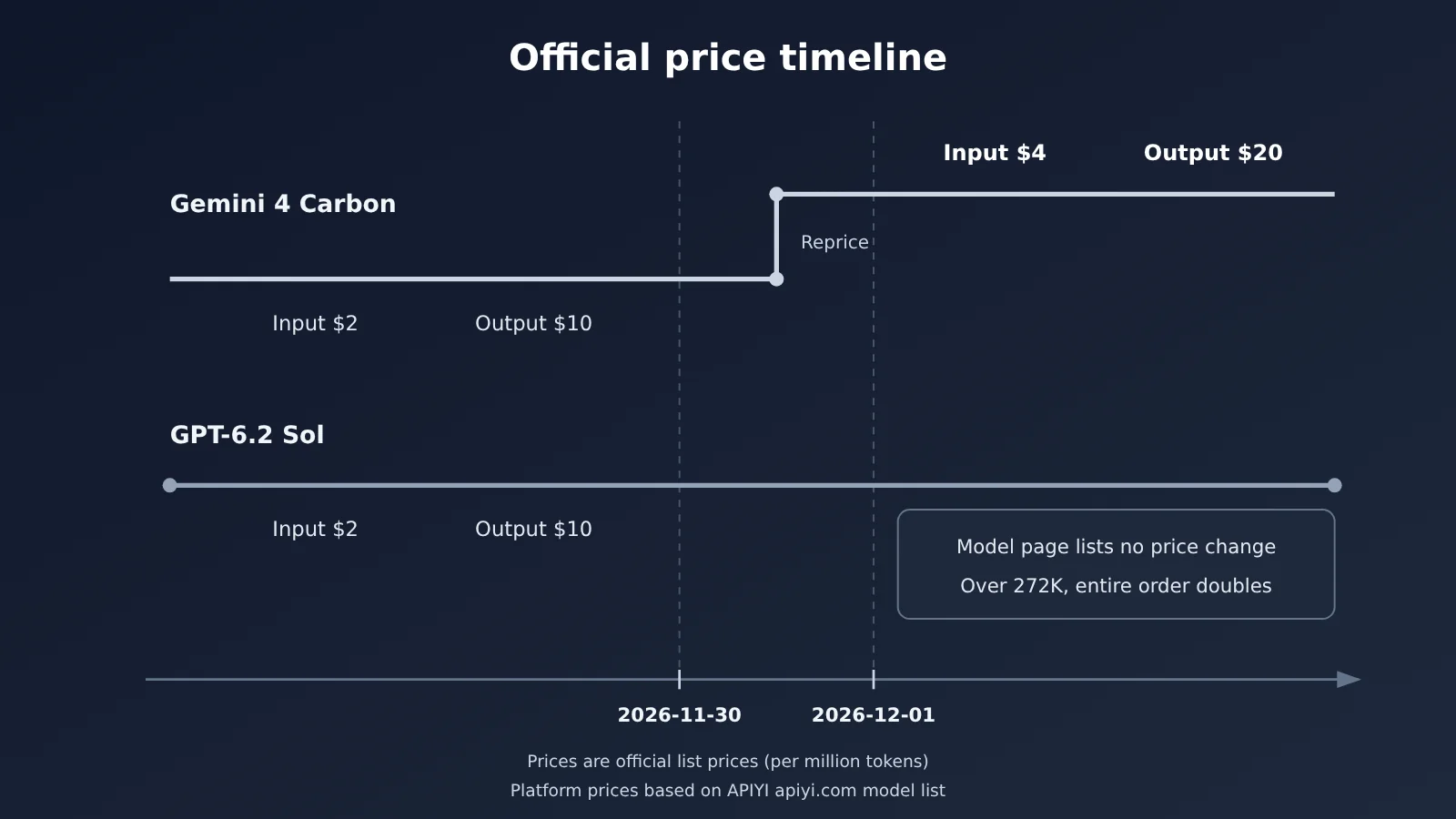
GPT-6.2 Sol vs Gemini 4 Carbon Aggregate Scores: Read Third-Party and Official Self-Reports Separately
In Artificial Analysis’s third-party Intelligence Index v5.0.1, GPT-6.2 Sol scored Max 57, Xhigh 56, High 55, Medium 53, and Low 41 across reasoning tiers, while the article puts Gemini 4 Carbon’s top reasoning tier at 60. The same source also notes that Sol’s per-task cost on the aggregate index at Max is $1.01, and that on the Coding Agent Index (Codex harness, max), it scores 3 points lower than GPT-6.1 Sol — mainly because it drops 14 points on SWE-Atlas-QnA-AA and is more likely to miss key facts. Its AA-Omniscience hallucination rate (Max) is 55%. The third-party data doesn’t include Carbon’s per-task cost, so we won’t estimate it here.
OpenAI’s official self-reported numbers use a completely different yardstick. Officially, on FrontierCode 2.0, GPT-6.2 Sol trails Astra by less than 0.5 points at roughly a fifth of the cost (both at Max); on LifeVal, the company’s in-house benchmark, Sol outscores GPT-6 Astra at about a seventh of the cost; and on GDPval v2, Sol beats GPT-6.1 Sol by 5.3 points. These are all official self-reports — the test sets, reasoning tiers, and comparison baselines all differ from the third-party setup, so the two sets of numbers shouldn’t be rolled into a single “which model is stronger” verdict.
GPT-6.2 Sol vs. Gemini 4 Carbon: Scenario Recommendations
Model selection ultimately comes down to “the kind of work you’re actually doing.” Below are our leanings by task type—on the assumption that you’ll verify everything against your own data.
When to Choose GPT-6.2 Sol
- You need very long single outputs: Sol’s max output is 128,000 tokens, making it a good fit for generating long reports or large code files in one shot.
- Your workflows are already built on the Responses API: Sol supports Responses, while Carbon has no Responses endpoint on APIYI.
- Most requests stay under 272K and you can use explicit caching: Sol prices cache writes separately, while cache reads cost just $0.10—when your hit rate is high, costs are much easier to control.
- Everyday office work and code modification tasks: The officially self-reported LifeVal and FrontierCode 2.0 results both point in this direction, but keep in mind that third parties found it more likely to miss key facts.
When to Choose Gemini 4 Carbon
- Your inputs include video or audio: Meeting recordings, product demo videos, course footage—Sol can’t take these directly.
- Single inputs frequently exceed 272K: Google’s price list has no whole-order doubling rule, so per-unit pricing is easier to estimate for long-document scenarios.
- You care about third-party composite scores: AA’s top reasoning tier comes in at 60, higher than Sol’s Max tier at 57.
- Your project wraps up before November 30: Introductory pricing offers the lowest rates; if you spill into December, you’ll need to recalculate with the new prices.
| Task Type | Worth Trying First | Key Reason | What Else to Verify |
|---|---|---|---|
| Audio/video understanding and transcription analysis | Gemini 4 Carbon | Supports video and audio input | Pricing changes from December |
| Very long text generation | GPT-6.2 Sol | Max output of 128K | Reasoning token consumption |
| Long-document Q&A over 300K | Run the numbers on both | Sol has a whole-order doubling rule | Actual token count |
| Agents and code changes | Test both | Official self-reports and third-party findings diverge | Cases of missing key facts |
| Customer service knowledge bases with high cache hits | Test both | Sol uses explicit caching, Carbon uses implicit caching | Actual hit rate |
GPT-6.2 Sol and Gemini 4 Carbon Quick Start
This post skips code blocks entirely and just covers what you’ll need to change to get connected. Both models speak the OpenAI-compatible Chat Completions protocol, so the migration effort mostly comes down to model names and parameters.
- Verify the model is listed: Search for the model ID in the APIYI model list first.
gemini-4-carbonis currently available;gpt-6.2-solisn’t listed yet — we’ll add it as soon as we can, and the platform’s model list is the source of truth for model names and pricing. - Swap out base_url: In your existing OpenAI SDK config, point base_url to
https://api.apiyi.com/v1, replace the api_key with the platform-generated API key, and leave the rest of your calling code untouched. - Pick the right endpoint: On the platform, Carbon supports chat plus Gemini’s native generateContent — no Responses support. If your code depends on Responses, you’ll need to switch it over to the chat endpoint.
- Handle reasoning parameters: Once Sol goes live and you call
gpt-6.2-sol, don’t set reasoning effort to none — the API will reject those requests. - Log actual consumption: Record the input and output token counts from every response, then multiply your real usage by the unit price for the corresponding date, rather than comparing sticker prices head-to-head.
🚀 Quick start: We’d suggest starting with APIYI’s (apiyi.com) free trial credit for new users — run 20–50 of your own real requests through
gemini-4-carbonand note the token usage and output quality. Once 6.2 Sol is listed, run the same batch of requests again; that’s the only way the comparison will actually tell you something.
GPT-6.2 Sol and Gemini 4 Carbon: Decision Guide
You can work through the selection in order: check modalities first, then length, and timing last. If your input includes audio or video, Carbon is pretty much the only option. If you’re dealing with just text and images, the next question is whether requests regularly exceed 272K, or whether you need single outputs larger than 65,536. Finally, factor in whether your project will still be running after December 1.
| Model | Key Strengths | Things to Watch | Available Platforms |
|---|---|---|---|
| GPT-6.2 Sol | 128K max output, supports Responses and Batch | Whole request billed at double once over 272K; doesn’t accept effort set to none | OpenAI API; not yet listed on APIYI—check the platform’s model list for the latest status |
| Gemini 4 Carbon | Accepts video and audio input, top third-party tier at 60 | Official prices double starting December 1; only supports implicit caching | Google AI Studio, Google Cloud; already listed on APIYI at apiyi.com |
💡 Recommendation: Both models carry the same list price through the end of November, but that’s only the starting point. Run the same batch of real requests through both, tally token consumption on each side, then multiply by the November and December unit prices separately. Break the results down by task type instead of settling for one grand total.
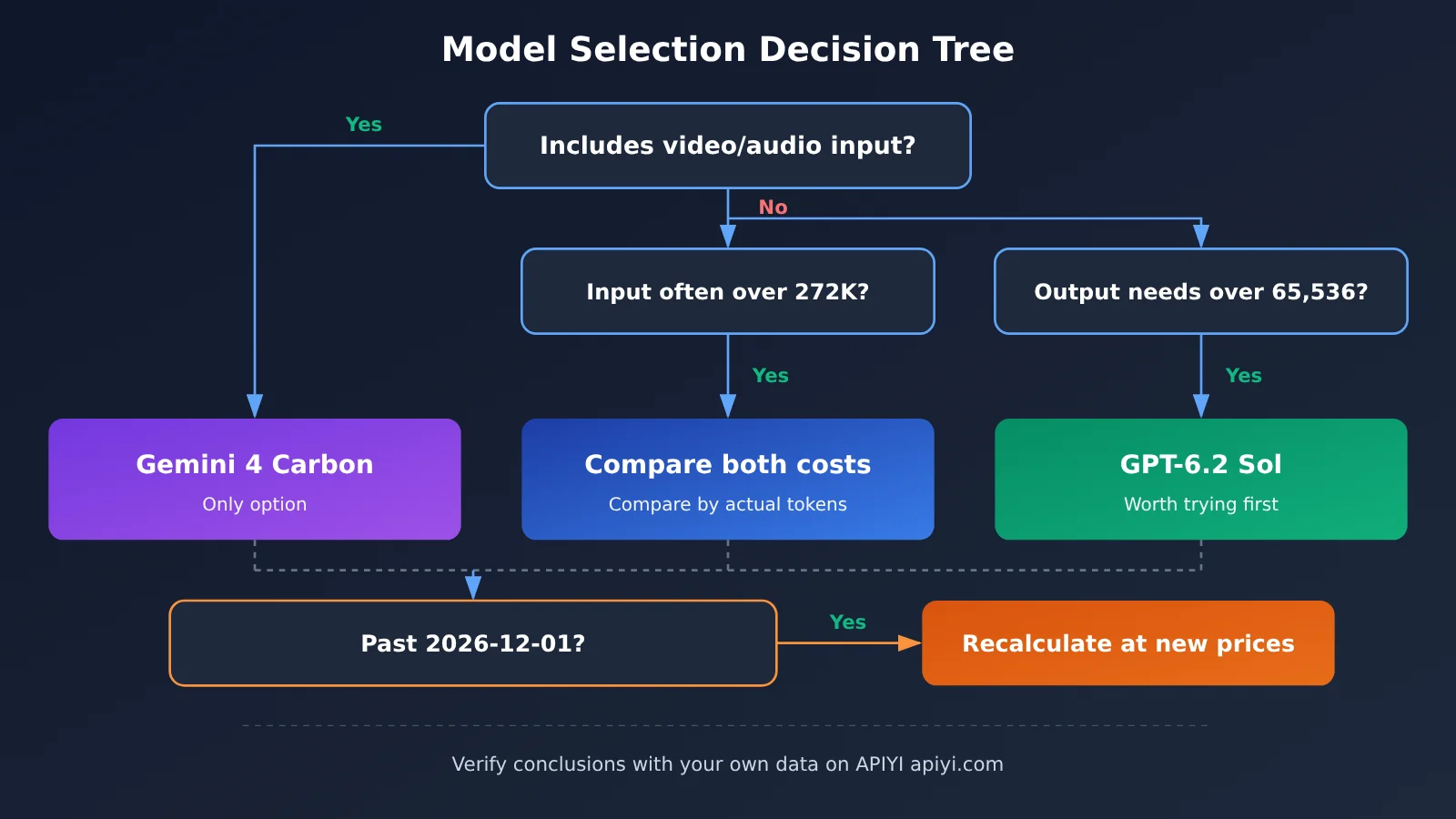
FAQ
Q1: What are GPT-6.2 Sol and Gemini 4 Carbon?
GPT-6.2 Sol is OpenAI’s efficiency-focused model released on 2026-11-17, with the model ID `gpt-6.2-sol`. It accepts text and image input and outputs text. Gemini 4 Carbon is Google’s model released on 2026-11-10, which accepts text, image, video, and audio input and outputs text.
Q2: Both list the same price—does that mean they cost the same to use?
No. The listed price is just the per-million-token rate. Your actual bill also depends on token count, reasoning length, cache hit rate, whether you exceed 272K (which only applies to Sol), and whether your requests fall before or after December 1. This article won’t declare which one is cheaper—we’d suggest calculating it with your own requests.
Q3: When does Gemini 4 Carbon’s introductory pricing end?
According to Google’s release notes and pricing page, the introductory pricing ends on 2026-11-30. Starting 2026-12-01, prices change to $4 for input, $20 for output, and $0.20 for cache reads. The APIYI docs page still shows the introductory pricing, so after December 1, go by the prices on the platform’s model list.
Q4: Do the third-party composite scores of 60 and 57 prove Carbon is stronger?
All they tell you is that on Artificial Analysis’s Intelligence Index v5.0.1, Carbon’s highest reasoning tier scores 60, while Sol’s Max tier scores 57. OpenAI’s self-reported results like FrontierCode 2.0 and LifeVal are a completely different methodology, so you can’t mix the two. How these models handle your business tasks? You’ll need to test that yourself.
Q5: How do I call these two models via API?
Sign up at APIYI (apiyi.com), generate an API key, and use the OpenAI-compatible Chat Completions endpoint—just set the model to `gemini-4-carbon` and you’re calling Carbon. GPT-6.2 Sol isn’t listed yet; we’ll get it on the platform as soon as possible. For models and pricing, always go by the platform’s model list.
Q6: What are GPT-6.2 Sol’s known limitations?
Per the official model page, Sol doesn’t support audio or video input, nor Realtime, Assistants, fine-tuning, or speech endpoints. Inputs over 272K trigger a price increase on the entire request. Third-party Artificial Analysis notes it’s more likely to miss key facts on SWE-Atlas-QnA-AA. OpenAI has also mentioned that both 6.2 models come with stricter cybersecurity safeguards, so some legitimate vulnerability research requests will be rejected.
Q7: What are Gemini 4 Carbon’s known limitations?
The APIYI docs page lists a maximum output of 65,536 tokens, below Sol’s 128,000. Its knowledge cutoff is 2026-03, earlier than Sol’s 2026-06-01. It only supports implicit caching, has no free tier, and doesn’t offer a Responses endpoint on the platform. On top of that, official prices double starting in December, so budget ahead for long-term projects.
GPT-6.2 Sol and Gemini 4 Carbon Key Takeaways
- Deadline: Through 2026-11-30, both models’ official short-context list prices are identical; starting 12-01, Carbon goes up to $4 / $20.
- List price isn’t your bill: Token count, reasoning length, and cache hit rate together determine what you actually pay.
- Long-input rule: The whole-order doubling beyond 272K only applies to Sol—long-document use cases need their own math.
- Modality gap: Carbon accepts video and audio; Sol only takes text and images.
- Keep scores separate: Third-party AA puts Carbon’s top tier at 60 and Sol Max at 57—these can’t be merged with the vendors’ self-reported numbers.
- Getting started: Carbon is already callable on APIYI; Sol isn’t listed yet, so treat the platform’s model list as the source of truth.
Summary
Key points for choosing between GPT-6.2 Sol and Gemini 4 Carbon:
- Modality first: If you have audio or video input, go with Carbon; for pure text and images, both get the job done.
- Length next: If you regularly exceed 272K input, you’ll need to recalculate using Sol’s whole-order doubling rule; if you need extra-long single outputs, check Sol’s 128K cap.
- Timing last: For projects crossing December 1, budget the Carbon portion at the new prices.
Identical numbers on a price sheet are just the starting point for comparison. The answers you can actually rely on come from your own requests, your own token consumption, and the unit price for the relevant date.
We recommend starting on APIYI at apiyi.com: use the free credits to run a batch of real tasks against gemini-4-carbon, then once 6.2 Sol goes live, rerun the same batch for a side-by-side comparison.
📚 References
-
OpenAI launch post: GPT-6.2 Astra and Sol release notes
- Link:
openai.com/index/introducing-gpt-6-2-astra-sol - Notes: Official pricing and OpenAI’s own reported capability numbers
- Link:
-
OpenAI model page: GPT-6.2 Sol specs and pricing rules
- Link:
platform.openai.com/docs/models/gpt-6.2-sol - Notes: Context, endpoints, and the 272K full-order doubling rule
- Link:
-
Artificial Analysis article: Third-party index interpretation following the GPT-6.2 release
- Link:
artificialanalysis.ai/articles/openai-has-the-2-model-in-the-intelligence-index-with-the-release-of-gpt-6-2-astra-and-gpt-6-2-sol - Notes: Independent composite scores and per-reasoning-tier data
- Link:
-
Google release notes: Gemini 4 Carbon availability announcement
- Link:
blog.google/innovation-and-ai/models-and-research/gemini-models/gemini-4-carbon-now-available - Notes: Introductory pricing plus the footnote on prices after November 30
- Link:
Author: APIYI Technical Team
Technical discussion: Feel free to reach out through the APIYI homepage, and you can look up model details and pricing in the docs.apiyi.com documentation center