

Author’s note: Based on OpenAI’s public model catalog and the APIYI master table, here are the 5 GPT-6 model IDs you can put in the model field today — what each one’s for, its price tier, and its request path.
Lately, plenty of developers have seen the claim that “GPT-6.2 is about to drop” and their first instinct is to go edit the model field in their code. But the API only recognizes model IDs that actually exist — put in a name that isn’t in the catalog and the request just errors out. This article answers one question: which GPT-6 models can you actually put in the model field today?
This isn’t a rumor roundup. The model IDs here come from OpenAI’s public model catalog in the developer docs, and the prices come from the APIYI apiyi.com model master table, dated 2026-11-16. On the OpenAI catalog page this article opened, there’s no such model as GPT-6.2. One third-party page also noted on 2026-11-09 that GPT-6.2 Sol isn’t in the public catalog — but that’s not an OpenAI announcement, so it only tells us the rumor hasn’t been confirmed by the catalog.
The point: after reading this, you’ll have a table of GPT-6 model IDs you can call directly, and you’ll know which one handles the heavy lifting, which one handles a flood of short tasks, where the price tiers shift, and which path your requests should take.
GPT-6 Callable Models: Key Information at a Glance
Here’s the bottom line first: there are 5 GPT-6 series models you can actually call through the API today, and all of them appear in both the OpenAI public catalog and the APIYI master table. GPT-6.2 shows up in neither, so this article won’t touch its parameters, pricing, or release date.
| Item | Details |
|---|---|
| Model basis | Public model catalog in the OpenAI developer docs |
| Pricing basis | APIYI model master table, 2026-11-16 09:39 (UTC+8), default list price |
| Callable IDs | gpt-6-astra, gpt-6.1-sol, gpt-6-sol, gpt-6.1-terra, gpt-6-luna |
| Billing unit | USD / per 1M tokens |
| Price tier threshold | 272,000 input tokens |
| Recommended endpoint | /v1/responses under https://api.apiyi.com/v1 |
| Not in this table | gpt-6.2, gpt-6-cyber |
There’s one easily overlooked detail here: whether a model exists depends on the catalog, not on how much buzz it’s getting on social media. The catalog is the public list OpenAI maintains itself, and it’s also the final authority on whether the API can call a model — so “only trust published names” is the simplest rule of thumb.
Official Positioning of the Five GPT-6 Model IDs
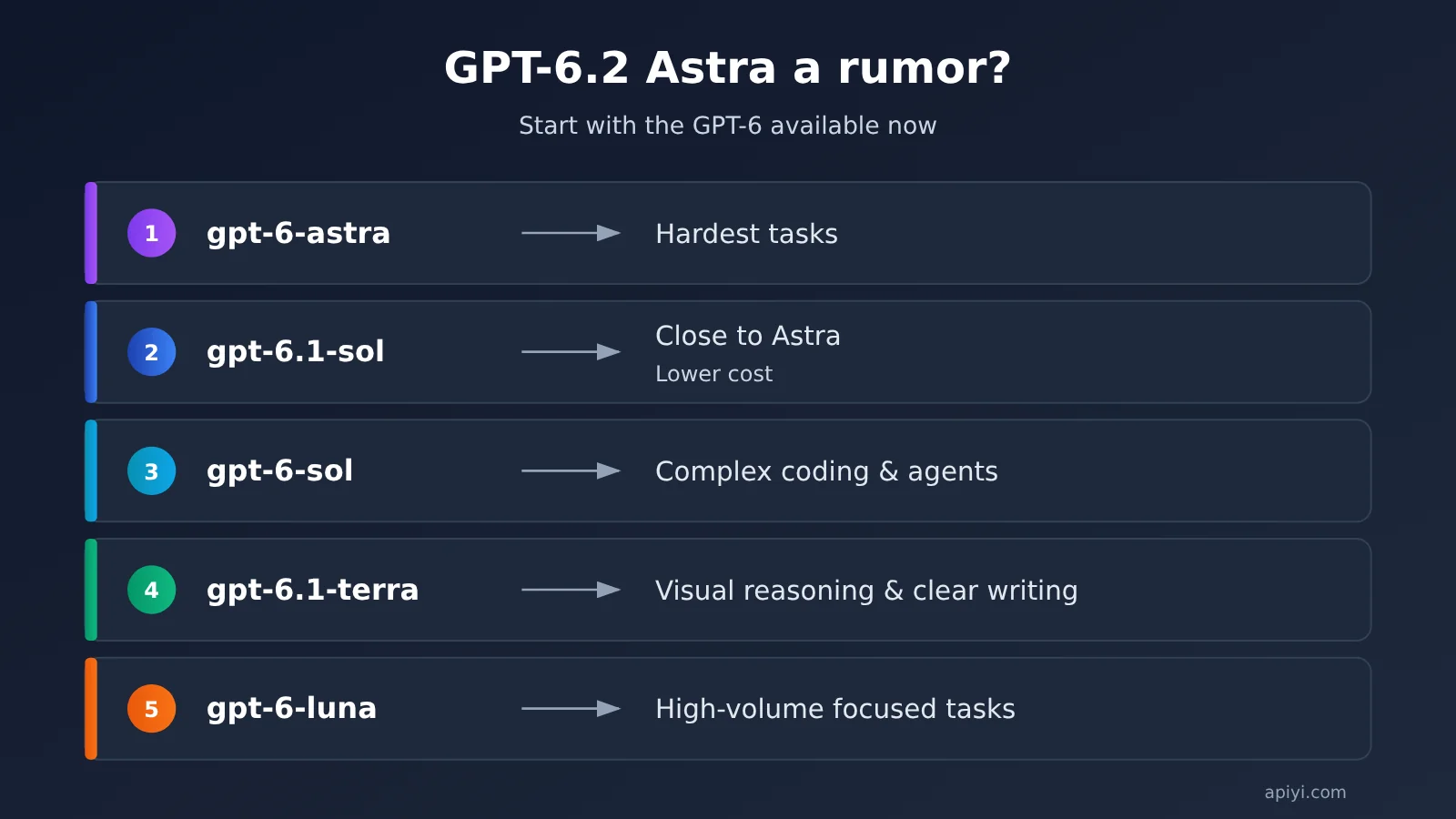
The OpenAI catalog lists 4 of them as flagships, while gpt-6-sol sits in the “More models” column. The one-line positioning in the table below comes straight from the catalog descriptions, with no extra embellishment.
| Model ID | Catalog placement | Official positioning (per OpenAI catalog) |
|---|---|---|
| gpt-6-astra | Flagship | Built for the hardest work |
| gpt-6.1-sol | Flagship | Nearly Astra-level capability at lower cost |
| gpt-6.1-terra | Flagship | Visual reasoning, computer use, clear writing |
| gpt-6-luna | Flagship | High-volume, focused tasks |
| gpt-6-sol | More models | Complex coding and agents |
Among these, gpt-6.1-terra has the most complete information. An update note in the OpenAI Help Center records GPT-6.1 Terra on 2026-10-26 and states that it’s available in Work and Codex, not in Chat. As for the release dates of the other GPT-6 models, this article doesn’t rely on third-party timelines.
GPT-6 Model Pricing and the 272,000 Tier
Price is the most practical dividing line when picking a model. The figures below are the default list prices from the APIYI master table, in USD per 1M tokens, dated 2026-11-16.
| Model ID | Input | Output | Cache read | Input beyond 272,000 |
|---|---|---|---|---|
| gpt-6-astra | $10 | $50 | $1 | $20 |
| gpt-6.1-sol | $2 | $10 | $0.1 | $4 |
| gpt-6-sol | $2 | $10 | $0.2 | $4 |
| gpt-6.1-terra | $1 | $5 | $0.05 | $2 |
| gpt-6-luna | $0.1 | $0.5 | $0.01 | $0.2 |
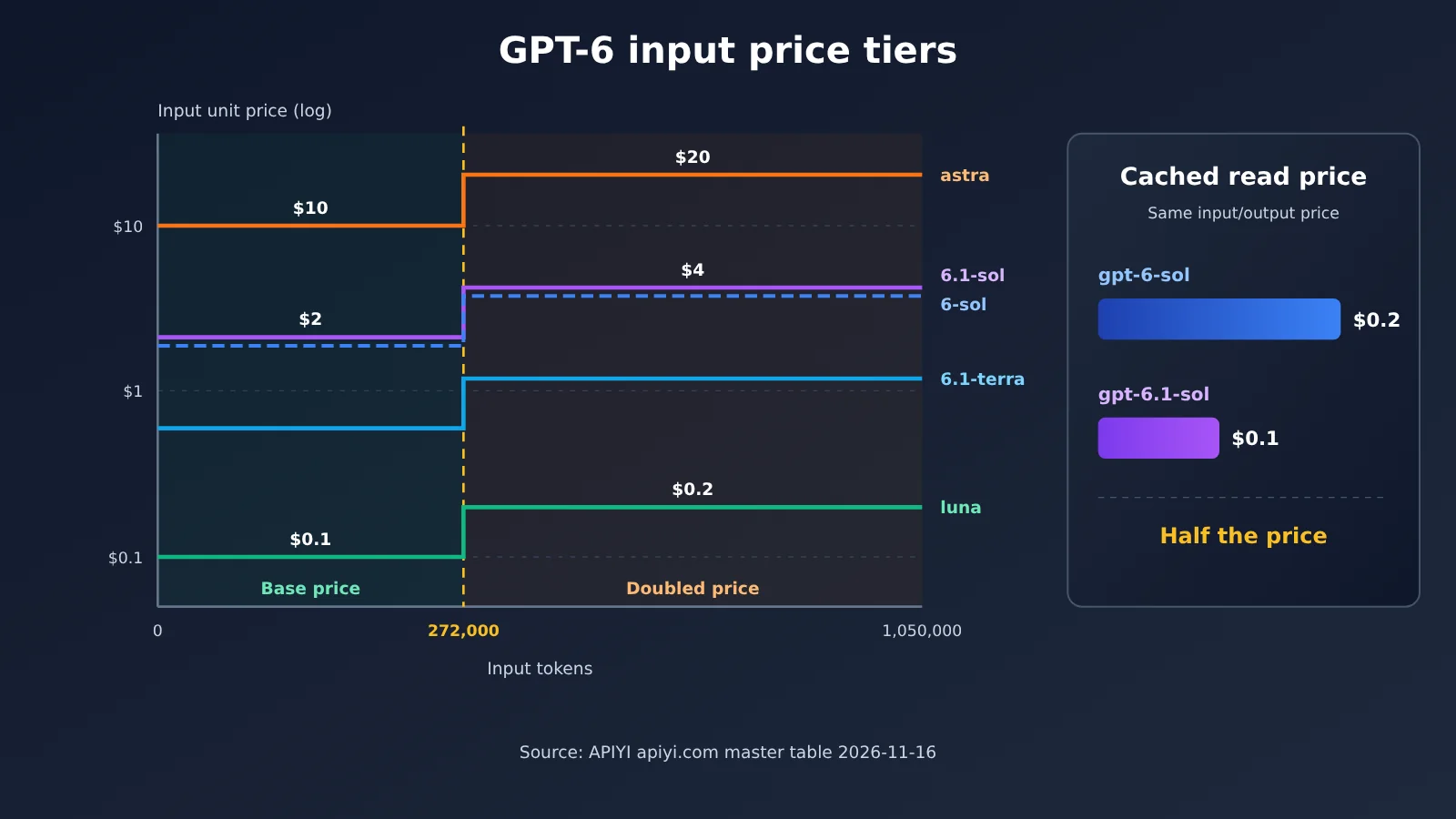
Three things in this table deserve a closer look. First, all five models use 272,000 tokens as the dividing line for input pricing: 0 to 272,000 tokens are billed at the base rate, and anything beyond that doubles the input rate. Take gpt-6-astra as an example — the master table states $10 for input across 0–272,000, and $20 for 272,001–1,050,000.
Second, gpt-6-sol and gpt-6.1-sol share the same input and output rates, but their cache-read rates differ: gpt-6.1-sol is $0.1, gpt-6-sol is $0.2. If your workload reuses the same long system prompt or document context over and over, cache reads make up a large share of the bill, and that gap shows up directly on your invoice.
Third, from the cheapest gpt-6-luna to the priciest gpt-6-astra, the base input rate differs by a factor of 100. That means “just use the strongest model for everything” gets expensive fast in high-volume scenarios — routing tasks to the right tier is the sensible approach.
💰 Pricing note: The table above reflects the default list prices in the APIYI apiyi.com master table as of 2026-11-16. Actual prices may vary by group; the model list in the console is authoritative.
The catalog also includes gpt-6-cyber. It shows up in the OpenAI catalog and targets vulnerability checks in authorized testing environments, so it isn’t part of this master table.
gpt-6.2 and gpt-6-cyber aren’t listed yet — we’ll get this model online as soon as we can. Model names and prices are subject to the platform’s model list.
GPT-6 Models Quick Start: How to Choose Among Five IDs
Picking a model doesn’t have to be complicated—just match the task’s weight and your budget. The recommendations below come from the official positioning in the OpenAI catalog and the prices on the APIYI master list. They’re not benchmark conclusions.
| Task Type | Recommended Model ID | Why |
|---|---|---|
| The hardest, quality-critical heavy lifting | gpt-6-astra | The catalog positions it for “the hardest work” |
| Heavy work while keeping costs in check | gpt-6.1-sol | Close to Astra, with input pricing one-fifth of Astra’s |
| Complex coding, agent workflows | gpt-6-sol or gpt-6.1-sol | gpt-6-sol is positioned for complex coding and agents; 6.1-sol has lower cache reads |
| Clear writing, visual reasoning, computer use | gpt-6.1-terra | Priced below the sol tier, with positioning that includes clear writing |
| High-volume short tasks, classification, extraction | gpt-6-luna | Positioned for “high-volume, focused tasks”—lowest unit price |
A common tiering approach: use gpt-6-luna for the upfront classification, routing, and field extraction, then hand the handful of requests that truly need deep reasoning to gpt-6-astra or gpt-6.1-sol. When you need reader-facing text but don’t want to pay sol-tier prices, look to gpt-6.1-terra first.
GPT-6 invocation path: use /v1/responses
APIYI docs recommend that GPT-5 and later models prioritize the Responses API. In practice, set base_url to https://api.apiyi.com/v1, send requests to /v1/responses, and put any ID from the table in the model field. In the master table, both gpt-6-astra and gpt-6.1-sol are marked with two endpoints—responses (recommended) and chat. Chat Completions still works, but new projects should go straight to Responses.
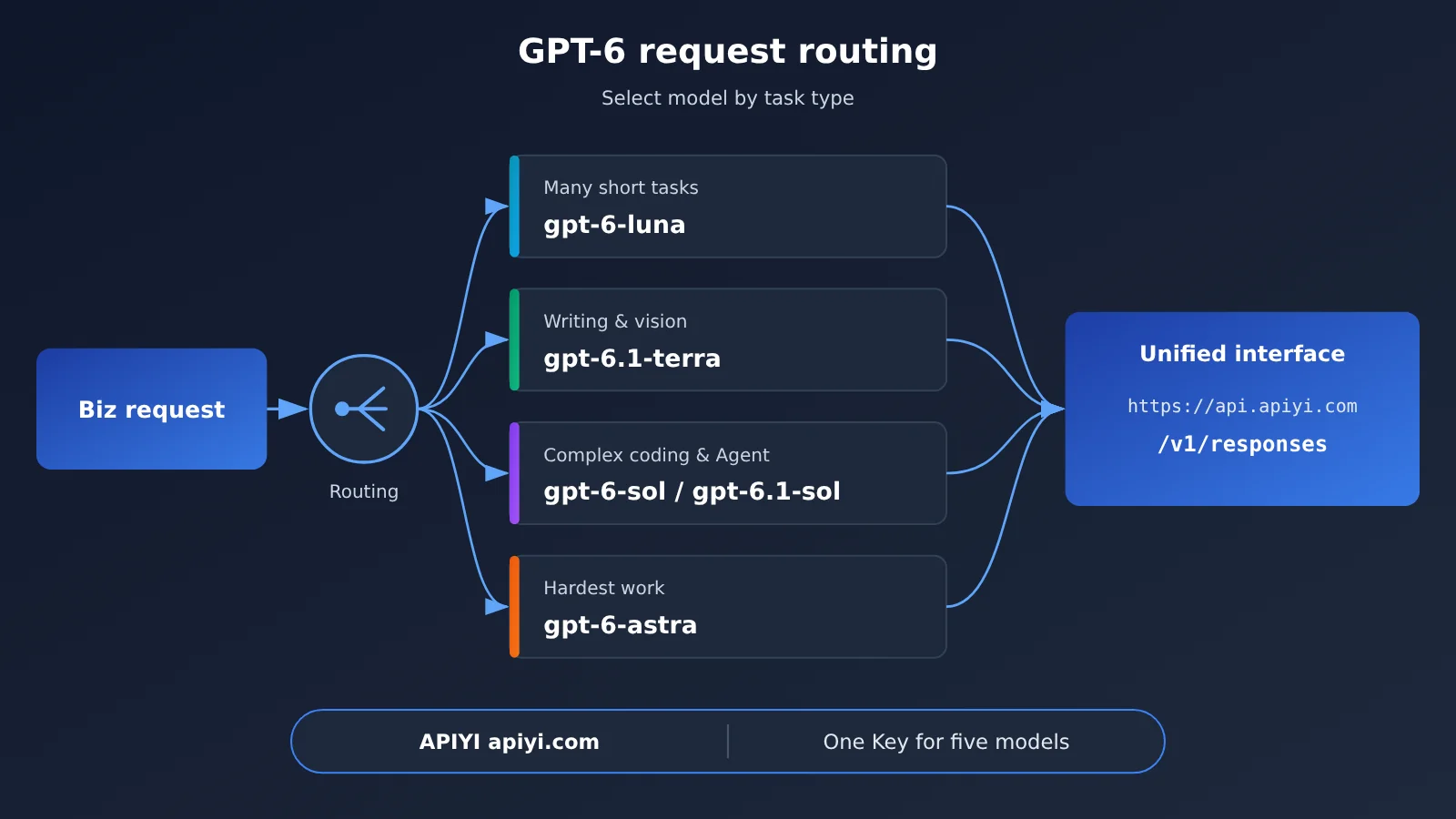
Access is just as straightforward: sign up at APIYI apiyi.com to get an API key, then just change base_url in the official OpenAI SDK. Here’s a minimal example that works in just a few lines:
from openai import OpenAI

client = OpenAI(
    api_key="YOUR_API_KEY",
    base_url="https://api.apiyi.com/v1"  # APIYI unified endpoint
)

resp = client.responses.create(
    model="gpt-6-luna",
    input="把这句话分类为:咨询 / 投诉 / 表扬。句子:发货太慢了。"
)
print(resp.output_text)
View the complete example of task-based model routing
The function below selects a model ID based on task type; all requests go through the same `base_url` and Responses API. You can adjust the model mapping to fit your budget.
from openai import OpenAI
client = OpenAI(
api_key=”YOUR_API_KEY”,
base_url=”https://api.apiyi.com/v1″
)
# Use only published model IDs that are in the master table
MODEL_BY_TASK = {
“hard”: “gpt-6-astra”, # hardest work
“hard_budget”: “gpt-6.1-sol”, # close to Astra, lower cost
“agent”: “gpt-6-sol”, # complex coding and agent workflows
“writing”: “gpt-6.1-terra”, # clear writing, visual reasoning
“bulk”: “gpt-6-luna”, # high-volume, focused tasks
}
def run(task_type: str, prompt: str) -> str:
model = MODEL_BY_TASK.get(task_type, “gpt-6-luna”)
try:
resp = client.responses.create(model=model, input=prompt)
return resp.output_text
except Exception as e:
return f”Error ({model}): {e}”
print(run(“writing”, “用三句话介绍 Responses 接口的用途”))
🚀 Quick start: Start by getting the whole pipeline working with
gpt-6-luna, then move heavier workloads togpt-6-astraorgpt-6.1-solbased on the task. Sign up at APIYI apiyi.com to get free trial credits—one API key lets you switch and compare across all five models.
What the GPT-6 Rumors Mean for Developers
Impact on Developers
- Don’t hard-code unreleased IDs ahead of time: Writing gpt-6.2 into your config will just throw errors at call time. The safer approach is to make
modela configurable option and switch once it shows up in the catalog and on the platform’s model list. - Control costs with tiering, not by waiting for the next release: The five existing models already cover an input price range from $0.1 to $10, and the cost difference you get from assigning models by task is far more certain than waiting for a rumored new version.
- Long context means tiered pricing: Once input exceeds 272,000 tokens, the per-unit price doubles. For long-document scenarios, estimate token volume first, and split the work or use cache reads when necessary.
Impact on the Model Selection Process
The only value of a rumor is that it reminds you “a new model might be coming,” but it can’t replace verification. Build a fixed habit: when you see a new name, check the OpenAI public catalog first, then check the platform’s model list—only start testing when both confirm it. This process prevents production incidents caused by chasing hype.
| Source | What It Can Confirm | Used in This Article |
|---|---|---|
| OpenAI public model catalog | Whether the model exists, official positioning | ✅ Used |
| OpenAI Help Center update notes | Release dates and available products for specific models | ✅ Only the GPT-6.1 Terra entry |
| APIYI model master list | Models callable on the platform and their listed prices | ✅ Used |
| Third-party pages | Supporting evidence only | ⚠️ Only to note the rumor is unconfirmed |
| Social media rumors | Can’t confirm any facts | ❌ Not used |
FAQ
Q1: Which model IDs can I call for GPT-6 right now?
As of 2026-11-16, five are callable: gpt-6-astra, gpt-6.1-sol, gpt-6-sol, gpt-6.1-terra, and gpt-6-luna. All five appear in both the OpenAI public catalog and the APIYI master list.
Q2: What’s the difference between gpt-6-sol and gpt-6.1-sol?
Both are $2 input / $10 output, and input rises to $4 past 272,000 tokens. The difference comes down to positioning and cache reads: gpt-6-sol targets complex coding and agent work, with a $0.2 cache read; gpt-6.1-sol sits closer to Astra at a lower cost, with a $0.1 cache read. If you reuse cached context heavily, 6.1-sol saves more.
Q3: When will GPT-6.2 be available?
GPT-6.2 isn’t in OpenAI’s public catalog right now, and this article won’t speculate about a release date. Just call it once it shows up in the catalog and the platform’s model list.
Q4: Which GPT-6 model should I use for lots of short tasks?
Start with gpt-6-luna. The catalog positions it for “high-volume, focused tasks,” at $0.1 input and $0.5 output — the lowest unit price of the five and a good fit for high-frequency requests like classification, extraction, and routing.
Q5: How do I call GPT-6 models quickly through the API?
1. Sign up at APIYI apiyi.com and get an API key
2. Set base_url to `https://api.apiyi.com/v1`
3. Call `/v1/responses` with model set to one of the five IDs above
The platform is compatible with the OpenAI SDK, so existing code usually just needs a new base_url and model.
Q6: What if the prices here don’t match what I see in the console?
The prices here are the default list prices from the 2026-11-16 master list. Different groups may vary, and prices can change later. Always go by the model list in the APIYI apiyi.com console.
GPT-6 Callable Models: Key Takeaways
- Only trust the names in the catalog: GPT-6.2 isn’t in OpenAI’s public catalog, so don’t put it in the model field
- Five IDs you can call directly: astra, 6.1-sol, 6-sol, 6.1-terra, and luna each have a distinct role
- For heavy lifting, look at astra or 6.1-sol: the latter’s input price is one-fifth of the former’s
- Give short tasks to luna: input at $0.1, ideal for high-frequency batch requests
- 272,000 is the price threshold: beyond it, the input price doubles across the board
- One unified path through Responses: use a single Key on APIYI apiyi.com’s
/v1/responsesto call every model
Summary: Start with the GPT-6 models that have already shipped
Here are the key points for choosing within the GPT-6 family:
- The catalog is the source of truth: the five released IDs are what you can call today, and the rumored 6.2 isn’t among them
- Tier by task: use gpt-6-astra or gpt-6.1-sol for heavy work, gpt-6.1-terra for writing and vision tasks, and gpt-6-luna for lots of short tasks
- Mind the price details: the 272,000 input tier doubles, and gpt-6-sol and gpt-6.1-sol have different cache-read prices
Rather than waiting for a version that hasn’t shown up in the catalog yet, it’s better to divide the work among the five existing models by task and make model a configurable option — when a new model launches, you can switch by changing one line of config. I recommend running all five models through their paces using the free quota on APIYI apiyi.com, then deciding your production allocation ratio.
📚 References
-
OpenAI Model Catalog: GPT-6 series models and their official positioning
- Link:
developers.openai.com/api/docs/models/all - Description: The primary source for determining whether a model has been released
- Link:
-
OpenAI Help Center model release notes: GPT-6.1 Terra release record
- Link:
help.openai.com/en/articles/9624314-model-release-notes - Description: Includes the release date and available products for GPT-6.1 Terra
- Link:
-
APIYI model directory: Models available on the platform and default list prices
- Link:
docs.apiyi.com/models.md - Description: Source of the pricing and 272,000 tier data in this article
- Link:
Author: APIYI Technical Team
Technical inquiries: When models are listed or pricing changes, feel free to contact us through the APIYI homepage for the latest information