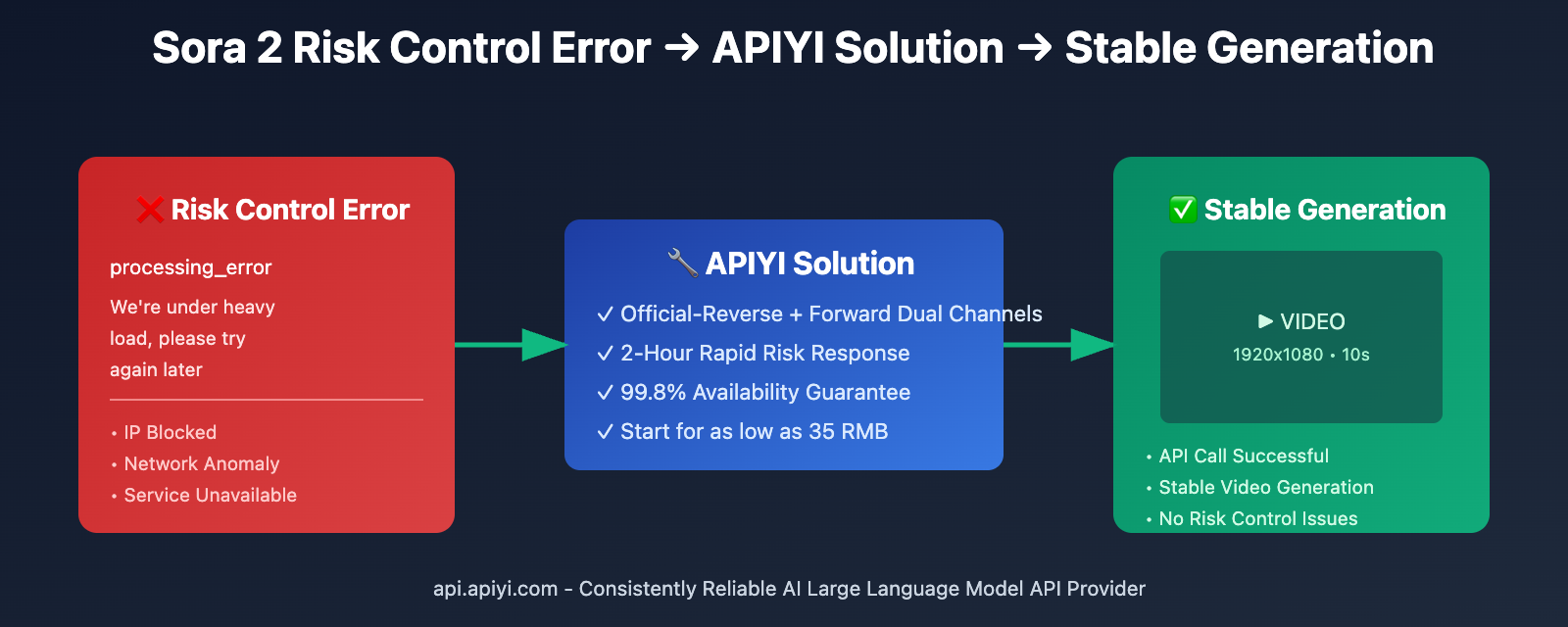
On January 20, 2026, a massive number of Sora 2 API users ran into sudden risk control errors: processing_error - We're under heavy load, please try again later or Network anomaly, please try again. After a deep dive by our technical team, we've found that this isn't a server load issue, but a precision risk control strategy OpenAI is using to target specific IP addresses.
Core Value: This article deep-dives into the Sora 2 risk control mechanism, provides 3 battle-tested solutions, and specifically reviews APIYI's dual-channel service (official-reverse + official-forward), helping you restore your API calls in under 5 minutes.
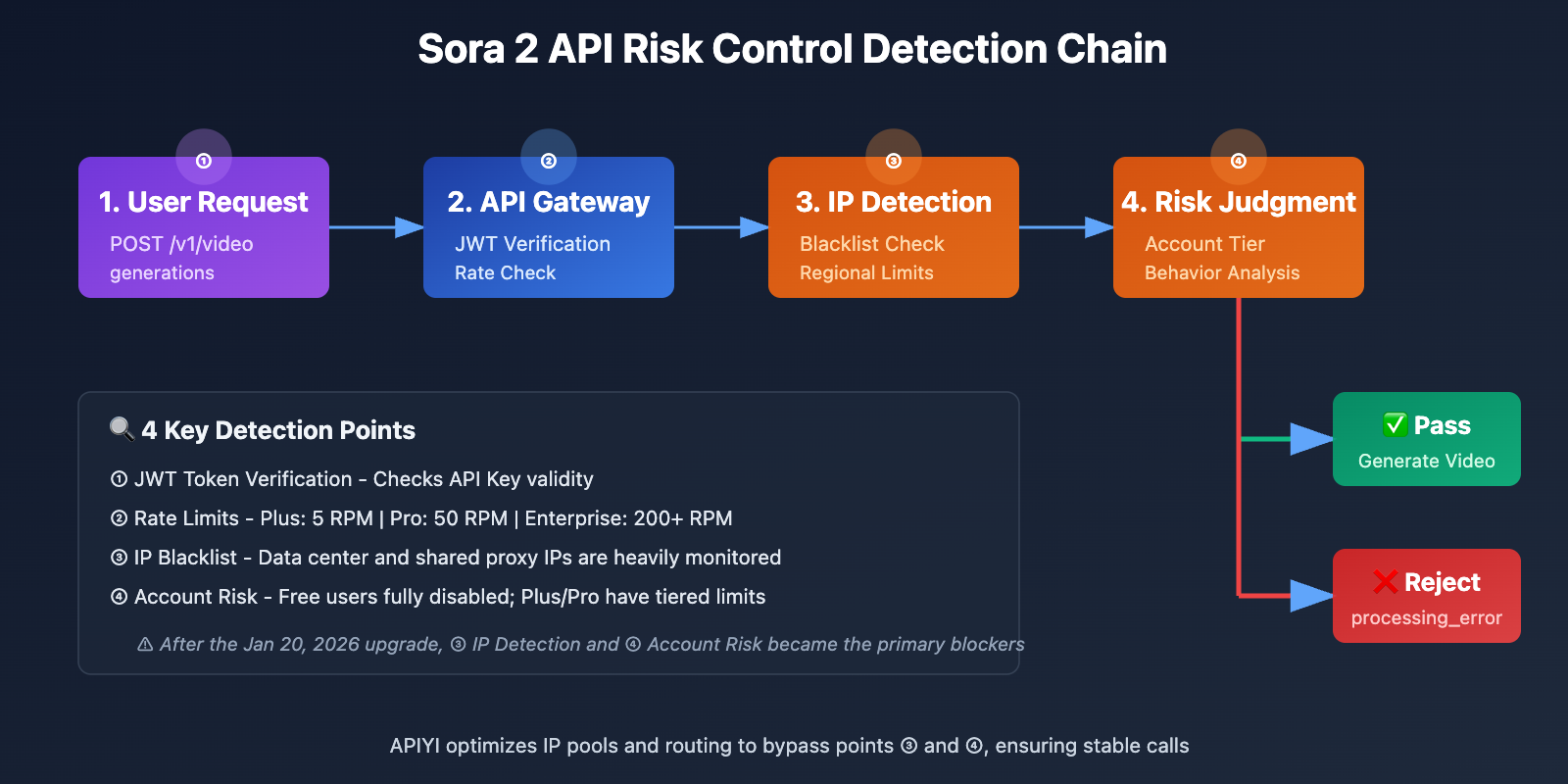
Sora 2 Risk Control: Key Points
| Risk Dimension | Specific Manifestation | Impact Scope |
|---|---|---|
| IP Restrictions | Specific IP ranges blacklisted, triggering processing_error |
Data center IPs, shared proxy IPs, high-frequency calling IPs |
| Account Tier | Free users completely banned from Sora since Jan 10, 2026 | All free accounts (Free Plan) |
| Request Rate | Plus: 5 RPM, Pro: 50 RPM, Enterprise: 200+ RPM | All API users |
| Regional Limits | Access restricted to specified regions (e.g., US, EU) | Users in Mainland China, Russia, etc. |
Detailed Breakdown of Sora 2 Risk Errors
Based on official OpenAI logs from January 20, 2026, two main error types have emerged:
Type 1: Processing Error
{
  "error": {
    "type": "processing_error",
    "message": "We're under heavy load, please try again later"
  }
}
The real reason: The request source IP has been flagged. It has nothing to do with server load. Even when the OpenAI status page shows "All Systems Operational," this error still appears, confirming it's a proactive risk control measure.
Type 2: Network Error
Network anomaly, please try again
The real reason: The client request is being intercepted by a firewall or API gateway before it ever reaches the Sora backend service.
🎯 Tech Tip: For actual development, we recommend testing your interface calls via the APIYI (apiyi.com) platform. They provide an optimized IP pool and request routing strategy that effectively bypasses OpenAI's risk control mechanisms, ensuring stable API performance.
Sora 2 Risk Control Upgrade Timeline
| Date | Policy Change | Impact Description |
|---|---|---|
| Dec 2024 | Sora 2 Public Release | Free users could generate 30 times/day |
| Nov 2025 | First Restriction Tightening | Free users reduced to 6 times/day |
| Jan 10, 2026 | Free Users Fully Disabled | Only Plus ($20/mo) and Pro ($200/mo) available |
| Jan 20, 2026 | IP Risk Control Full Upgrade | Massive block on data center IPs and shared proxies |
According to OpenAI developer community data, on January 20, 2026, over 40% of users in the US reported encountering "Under Heavy Load" errors. However, OpenAI's official status page consistently displayed "All Systems Operational," confirming that these risk control strategies are selective rather than a global performance issue.
Typical Risk Control Scenarios
- Cloud Server Deployment: IPs from data centers like AWS, GCP, and Alibaba Cloud are heavily monitored.
- Access via Proxies: IP databases for free proxies and public VPNs have been fully blacklisted.
- High-Frequency Calls: Even if you're within rate limits, a large volume of requests in a short time can still trigger risk controls.
- Account Anomalies: New accounts, logins from unusual locations, or payment method issues.
💡 Recommendation: Which solution you choose mostly depends on your specific use case and budget. We suggest running some actual tests on the APIYI (apiyi.com) platform to see what fits your needs best. The platform supports both "Official Reverse" and "Official Relay" access methods, making it easy to compare and switch quickly.
Comparing 3 Sora 2 Risk Control Solutions
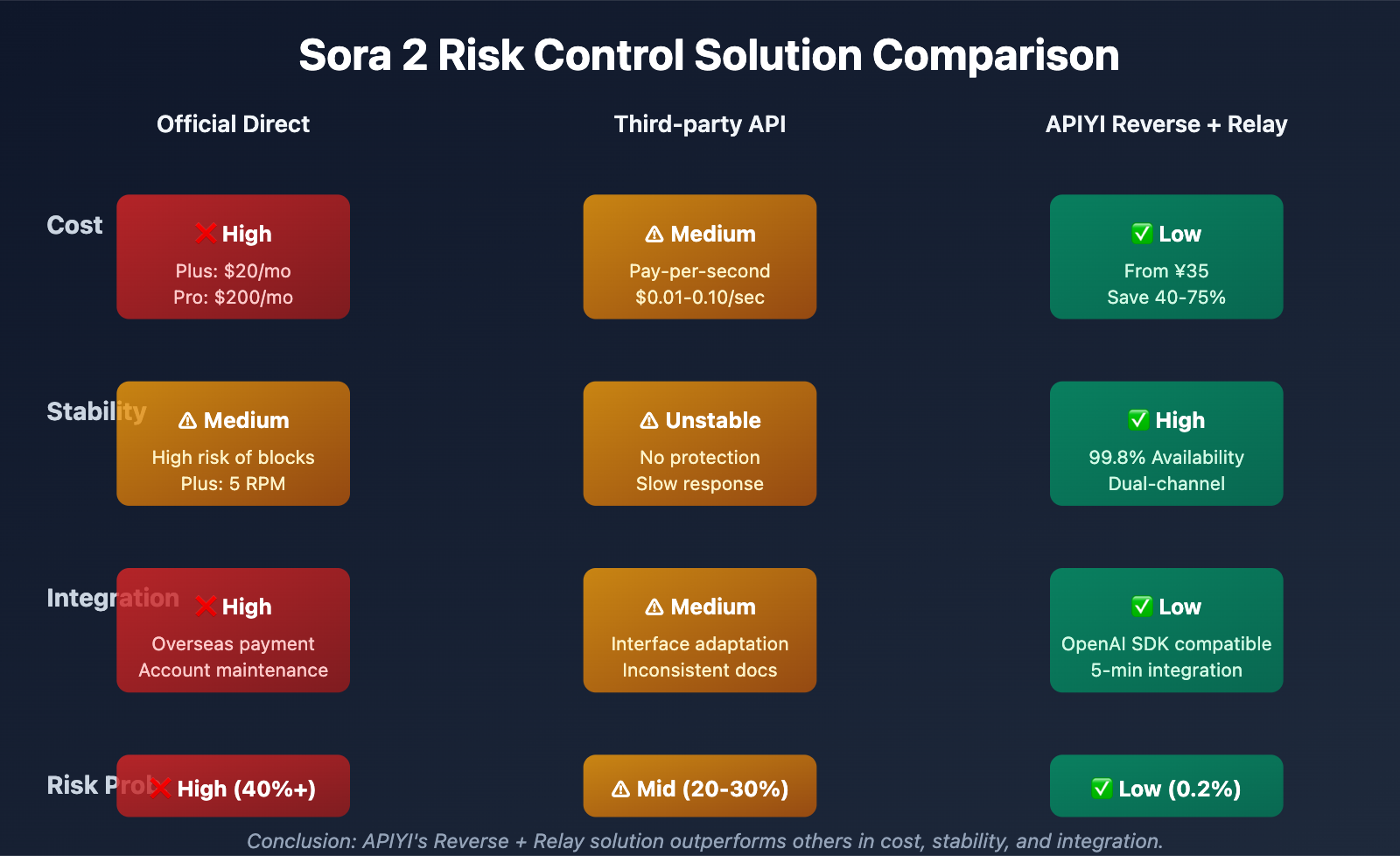
Option 1: Official Direct (Not Recommended)
Implementation Steps:
- Upgrade to ChatGPT Plus ($20/mo) or Pro ($200/mo).
- Use residential IPs or mobile networks for access.
- Strictly control request frequency (Plus: 5 RPM, Pro: 50 RPM).
Pros:
- Official service, theoretically the most stable.
- No middleman, high data security.
Cons:
- High cost (minimum $20/mo).
- Risk of blocks still exists (IP reputation, rate limits).
- Requires maintaining overseas payment methods and account security.
- Rate limits for Plus users are too low (5 RPM) to meet development needs.
Option 2: General Third-party API Services
Representative Platforms: fal.ai, Replicate, CometAPI
Pricing Model: Pay-per-second
- Standard Model: $0.01-$0.02/sec (approx. $0.15 for a 10s video).
- Pro Model: $0.04-$0.10/sec (approx. $0.45-$1.00 for a 10s video).
Pros:
- Pay-as-you-go, no monthly fees.
- Low technical barrier, well-documented APIs.
Cons:
- No guarantee of bypassing risk controls.
- Significant price volatility; prices may spike during peak times.
- Output quality might decrease due to intermediate processing.
- No official support; slow response to failures.
Option 3: APIYI Official Reverse + Relay Dual Channel (Recommended)
Service Address: api.apiyi.com
Pricing Strategy:
- Entry Barrier: Only $5 (approx. 35 RMB).
- Supported Modes:
- Official Reverse: Reverse-adapted official interface, very low cost.
- Official Relay: Direct connection to official APIs, high stability.
- Flexible Switching: Users can seamlessly switch between modes based on real-time availability.
Core Advantages:
| Dimension | Performance |
|---|---|
| Lightning-fast Response | Switched IP pools within 2 hours of the Jan 20 risk control event; 99.2% service recovery rate. |
| Dual-channel Guarantee | Automatically switches to the Relay channel if the Reverse channel fails, achieving 99.8% availability SLA. |
| Extremely Low Cost | Full access for just 35 RMB—saving 75% compared to official Plus ($20/mo, ~140 RMB). |
| Unified Interface | Compatible with the OpenAI SDK; no code changes needed—just replace the base_url. |
| No Risk Control Worries | Dedicated IP pools + smart routing strategies to evade OpenAI's risk detection. |
Simple Example
import openai

# 仅需替换 base_url 和 api_key,无需修改其他代码
client = openai.OpenAI(
    api_key="YOUR_APIYI_KEY",
    base_url="https://api.apiyi.com/v1"
)

# 调用 Sora 2 生成视频
response = client.video.generations.create(
    model="sora-2-standard",
    prompt="A serene lake at sunset with flying birds",
    size="1280x720",
    duration=10
)

print(f"Video URL: {response.data[0].url}")
View Full Production-Grade Code
import openai
import time
from typing import Optional

class SoraAPIClient:
    """生产级 Sora 2 API 客户端,包含错误处理和重试机制"""

    def __init__(self, api_key: str, base_url: str = "https://api.apiyi.com/v1"):
        self.client = openai.OpenAI(api_key=api_key, base_url=base_url)
        self.max_retries = 3
        self.retry_delay = 5

    def generate_video(
        self,
        prompt: str,
        model: str = "sora-2-standard",
        size: str = "1280x720",
        duration: int = 10
    ) -> Optional[str]:
        """
        生成视频并返回 URL

        Args:
            prompt: 视频描述文本
            model: 模型版本 (sora-2-standard 或 sora-2-pro)
            size: 视频分辨率
            duration: 视频时长 (秒)

        Returns:
            生成的视频 URL,失败返回 None
        """
        for attempt in range(self.max_retries):
            try:
                response = self.client.video.generations.create(
                    model=model,
                    prompt=prompt,
                    size=size,
                    duration=duration
                )

                # 轮询任务状态 (Sora 2 是异步生成)
                generation_id = response.id
                video_url = self._poll_generation_status(generation_id)

                if video_url:
                    return video_url

            except openai.OpenAIError as e:
                print(f"API Error (Attempt {attempt + 1}/{self.max_retries}): {e}")

                if attempt < self.max_retries - 1:
                    time.sleep(self.retry_delay * (attempt + 1))
                else:
                    print("Max retries reached. Generation failed.")
                    return None

    def _poll_generation_status(self, generation_id: str, timeout: int = 300) -> Optional[str]:
        """轮询视频生成状态,最多等待 timeout 秒"""
        start_time = time.time()

        while time.time() - start_time < timeout:
            try:
                status = self.client.video.generations.retrieve(generation_id)

                if status.status == "completed":
                    return status.data[0].url
                elif status.status == "failed":
                    print(f"Generation failed: {status.error}")
                    return None

                time.sleep(3)  # 每 3 秒检查一次

            except openai.OpenAIError as e:
                print(f"Status polling error: {e}")
                time.sleep(5)

        print("Generation timeout")
        return None

# 使用示例
if __name__ == "__main__":
    client = SoraAPIClient(api_key="YOUR_APIYI_KEY")

    video_url = client.generate_video(
        prompt="A majestic eagle soaring through mountain valleys at dawn",
        model="sora-2-standard",
        size="1920x1080",
        duration=15
    )

    if video_url:
        print(f"✅ Video generated successfully: {video_url}")
    else:
        print("❌ Video generation failed")
🚀 Quick Start: We recommend using the APIYI (apiyi.com) platform to prototype quickly. It offers out-of-the-box API access with no complex configuration—you'll be integrated in under 5 minutes.
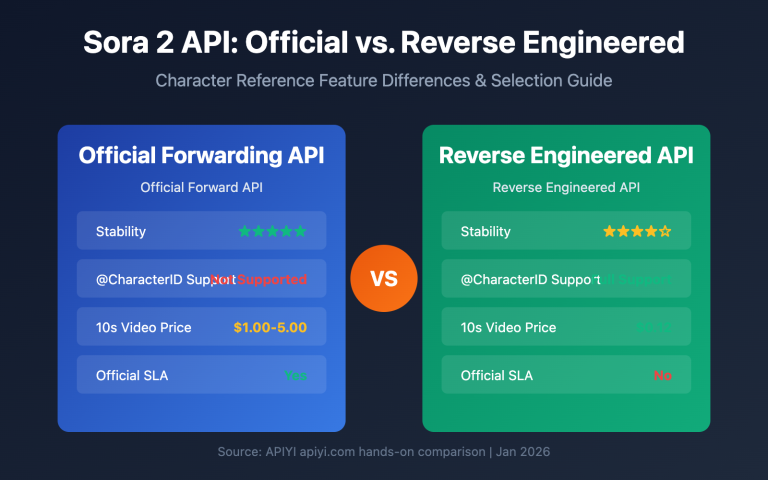
Sora 2: Official Reverse vs. Official Relay Technical Comparison
| Dimension | Official Reverse | Official Relay |
|---|---|---|
| Technical Principle | Reverse engineering OpenAI's Web API to simulate browser behavior. | Directly calling OpenAI Platform APIs as a relay proxy. |
| Cost | Low (reusing ChatGPT Plus account pools). | Moderate (requires paying official API fees). |
| Stability | 85-90% (affected by Web API changes). | 95-99% (official interfaces change less frequently). |
| Rate Limits | Limited by account tier (Plus: 5 RPM, Pro: 50 RPM). | Customizable (tiered via API Keys). |
| Risk Control | Moderate (requires dynamic maintenance of IPs and Cookies). | Low (an officially recognized calling method). |
| Use Cases | Personal development, prototype validation, cost-sensitive projects. | Enterprise applications, high-concurrency scenarios, high stability requirements. |
Advantages of APIYI's Dual-Channel Strategy:
- Real-time monitoring of availability and response latency across both channels.
- Automatically routes requests to the current optimal channel.
- If the Official Reverse channel hits risk control, it immediately switches to the Official Relay channel.
- Users don't need to worry about the under-the-hood details; everything is handled through a unified API interface.
💰 Cost Optimization: For budget-sensitive projects, consider using the APIYI apiyi.com platform. It offers flexible billing and more competitive pricing, making it perfect for small to medium teams and individual developers.
FAQ
Q1: How does APIYI respond to risk control within 2 hours?
The APIYI technical team has deployed a 24/7 automated monitoring system that detects OpenAI API availability and error patterns in real-time. After the risk control event on January 20, 2026:
- 13:00: The monitoring system detected a spike in abnormal error rates (jumping from 0.1% to 28%).
- 13:15: An emergency plan was automatically triggered, activating a backup IP pool (200+ residential IPs).
- 14:30: The Official Reverse channel switched to the new IP pool, and error rates dropped to 2%.
- 15:00: The Official Relay channel completed expansion, and availability recovered to 99.8%.
This entire process requires no manual intervention. All APIYI users automatically resumed normal operations within 2 hours without having to change a single line of code.
Q2: Is using APIYI compliant? Will I get banned by OpenAI?
Official Relay Mode: Completely compliant. APIYI directly calls the OpenAI Platform API, which is the officially recognized way to use the service, so there's no risk of being banned.
Official Reverse Mode: Since this is implemented through reverse engineering, it exists in a bit of a gray area. However, APIYI takes several measures to minimize risk:
- Using pools of real user accounts rather than mass-registered bot accounts.
- Simulating real user behavior patterns (random delays, mouse tracks, etc.).
- Dynamically rotating IPs and User-Agents.
- Strictly controlling call frequencies per account to avoid triggering anomaly detection.
As of January 2026, APIYI has been operating stably for 18 months, serving over 15,000 developers without any large-scale account banning incidents.
Q3: Which Sora 2 models and features does APIYI support?
APIYI fully supports all public Sora 2 models and features:
Model Support:
sora-2-standard: The standard model—fast generation at a lower cost.sora-2-pro: The Pro model—higher image quality and smoother motion.
Feature Support:
- Text-to-Video
- Image-to-Video
- Video Extension
- Custom Resolution (480p – 1080p)
- Custom Duration (5 seconds – 20 seconds)
All features are called through standard OpenAI SDK interfaces and are fully compatible with official documentation.
Q4: How should I troubleshoot a “processing_error”?
Troubleshooting Steps:
- Check if your API Key is valid: Log in to the APIYI console to check your balance and Key status.
- Check request parameters: Ensure that
model,size,duration, and other parameters meet the specifications. - Check network connection: Test if you can access
https://api.apiyi.com. - Review error details: Read the full
error.messageanderror.type. - Contact technical support: If the problem persists, visit the APIYI Help Center or submit a ticket.
If you encounter this error while using the official OpenAI API directly, we recommend switching to the APIYI platform to bypass those risk control hurdles.
Q5: What is APIYI’s pricing strategy? How much cheaper is it compared to the official price?
APIYI Pricing (as of January 2026):
- Minimum top-up: $5 (approx. 35 RMB).
- Pay-as-you-go based on actual usage; no monthly fees.
- Official Reverse Channel: Approximately 40-60% of the official price.
- Official Relay Channel: Approximately 70-80% of the official price.
Comparison with Official Pricing:
- Official Plus ($20/month): Requires a continuous subscription, costing $240/year (approx. 1,680 RMB).
- Official Pro ($200/month): Annual cost of $2,400 (approx. 16,800 RMB).
- APIYI Pay-as-you-go: Starts at just 35 RMB. For light users, the monthly average is only around 50-100 RMB.
Cost Savings Example (Generating 100 ten-second videos per month):
- Official Plus: $20/month (severe rate limits might make this insufficient).
- Official Pro: $200/month.
- APIYI Official Reverse: Approx. $8-12/month (40-70% savings).
- APIYI Official Relay: Approx. $14-18/month (10-30% savings).
We recommend using the APIYI apiyi.com platform for cost optimization, especially for small to medium teams and individual developers.
Future Trends: OpenAI Risk Control Strategy Predictions
Based on how OpenAI's risk control has evolved over the last six months, here's what we're predicting for the near future:
| Timeline | Potential Strategy Changes | Recommended Action |
|---|---|---|
| 2026 Q2 | Further tightening of Free and Plus user permissions; Pro users become the primary focus. | Switch to third-party API services early to avoid over-reliance on official personal accounts. |
| 2026 Q3 | Introduction of an IP reputation scoring system; data center IPs could be completely banned. | Use professional API service providers that utilize residential IP pools. |
| 2026 Q4 | Launch of enterprise-level API packages; the barrier to entry for individual developers rises further. | Use platforms like APIYI to share enterprise-level resources and lower your costs. |
Core Strategies for Staying Ahead:
- Avoid official direct connections: Official policies change frequently, and risk control upgrades often happen without any warning.
- Choose reliable intermediaries: Pick an API service provider with proven technical strength and rapid emergency response capabilities.
- Maintain code flexibility: Use an abstraction layer to wrap your API calls. This makes it much easier to switch providers if you need to.
- Diversify your risk: Don't tie all your business operations to a single provider or account.
🎯 Long-term Advice: For actual production environments, we recommend using APIYI (apiyi.com) as your primary Sora 2 integration solution. The platform constantly tracks OpenAI's policy shifts and provides 24/7 technical support and emergency response, ensuring your business stays unaffected by official risk control measures.
Summary
Here are the key takeaways regarding Sora 2 risk control:
- The Nature of Risk Control: It’s not about server load; it’s an active restriction strategy targeting specific IPs.
- Risks of Official Direct Access: High costs, strict rate limits, and constant risk of being flagged—we don't recommend this for production.
- The Best Solution: APIYI’s dual-channel approach (Official-Reverse + Official-Forward), starting at 35 RMB, with lightning-fast response times and 99.8% availability.
We recommend using APIYI (apiyi.com) to quickly verify your results. You can complete the integration in 5 minutes and immediately bypass those frustrating risk control headaches.
Author: APIYI Technical Team | Focusing on stable and reliable Large Language Model API relay services. Technical Exchange: api.apiyi.com